9 to 5 With the Fox, Bear, Tower, Fishes or Anchor: It’s Enough to Drive You Crazy If You Let It

Last month one of my friends asked me for a reading. Despite several promising interviews, her son had been unable to secure a job. The financial strain of supporting him, since leaving university in 2018, was now causing friction between my friend and her partner.

Interestingly, her question was not whether her son would find a job soon. Instead, her inquiry was why he had thus far been unsuccessful. Even more intriguing was the cards’ response: three so-called work cards and not one meant work!

Over time, employment readings have been a divisive topic for the Anglo-Saxon Lenormand communities. Much vitriol was spat over what card ‘means’ work and thus perpetrating schools’ apocrypha. Sadly, the hostility such discussions provoked were unnecessary.

Contrary to popular opinion, the Lenormand Oracle does not have a card of work (or job, or employment, or career). If one looks through all thirty-six cards, this is perfectly evident. There is no ‘le travail’ card or ‘9 – 5’ card, et cetera.

A Brief Lesson on Master-Cards

The concept of specific cards for work stem from the cartes maîtresses, or thematic/topical significators. However, when a diviner states a card ‘means’ work, she confuses essence (card meaning) and application (master card). There is a secret: THERE IS NO WORK CARD(S).

If we consider some of the so-called ‘work’ cards, we see that these cards connect to one’s career solely on a representation level vis-à-vis their nature:
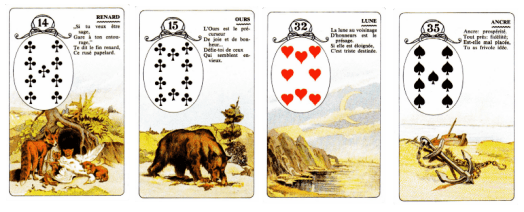
The Fox is an opportunist who will compete, sabotage and steal to survive. The Bear is a habituate who prefers his routine but will assert his dominance if needed. The Moon reflects any role, activity and status we hold to others. The Anchor tethers and keeps one in place until it’s raised.

All one has done, here, is progress the essential nature of each card on a functional level. That is, read the card at the first indexical level of semiotics. We can do that for every card; and in a work reading, you do. If the consultation is about work, then every card dealt is about the profession.

Such an indexical reading is the basis for the conventional distinction between salaried and freelance employment that was common to late-twentieth-century literature. For example, my French mentor used the Fox and the Anchor for temporary and substantive roles, respectively. The issue, here, is that a freelance is often concerned with security, which functionally, is an Anchor-issue.

The master-card for work is a function fulfilled solely in readings that require a pre-selected significator: opening of the key, lost man, no layout, star of destiny, GT. In my experience, it should be the card that shares the most significant relationship with the specific circumstances. For that reason, there cannot just be one card. If you’re concerned about competition it is the Fox; job security the Anchor; an interview, then it is the Moon (as it relies on looking the best to others), et cetera.

Outside of using a significator, no card should be read as simply being ‘work.’ Its house, in the grand tableau, also never means work. The lines of five or nine, 3 x 3, Russian cross, la méthode des treize, astrological wheel, et cetera, never need a master card.

A Line of Five

Let us then return to the query; although my friend posed the question, it about her son’s attempts to find work. The Lord card is the significator. It remains in the pack.

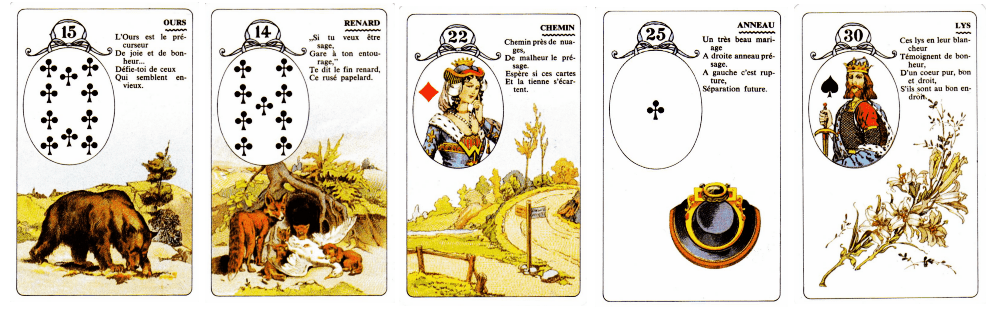
Question, “Why hasn’t the Lord been successful in securing a job?”

The cards as they fell:
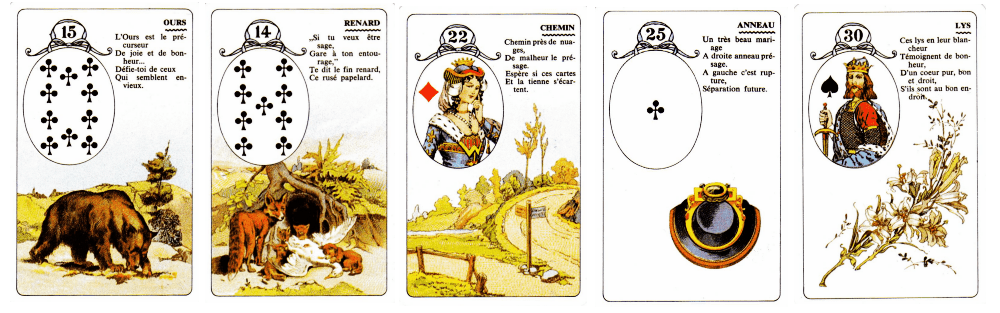
So, which card is work: the Bear, the Fox, or the Lilies? None. Correct! If we impose such signification on any of them, we will lose valuable information.

If we scan the cards, we see three are from the clubs’ suit. These cards emphasise toil, challenges and effort. Now, if we look closely, we can see that person-card (roi de pique, the Lilies) ends the line, too. A person-card at the end often acts as an arbitrator, which makes sense in interviews.

Now, we can see why the Lord has not been successful. The roi de pique doesn’t think the Lord is as good as other candidates in this harsh environment. The Lord pursues highly competitive roles (the Bear and the Fox), overreaching himself (the Fox and the Road) as he lacks the commonality and calibre (the Road and the Ring) the hiring manager desires (the Lilies). Ouch.

Had I read either the Fox, the Bear, or the Lilies card as just being work, I would have been forced into a banal and pedestrian interpretation. A line has a definite starting pointing point and focus, rendering such significators equally redundant. Trust your cards; they will always answer you, you just need to look and read what is there and not what you are told.

Have a good weekend.

§

Cards Jeu Lenormand © Carta Mundi. Title, bastardised from 9 to 5 by Dolly Parton.
The Kinship of Suits

A traditional, 36-card Petit Lenormand contains several different divisions and rankings:

  • A spectrum of positivity and negativity, which relates to facilitation and ease.
  • Classification as either a significator, carte maîtresse, or carte d’ambiance which determines a player, life area, and the atmosphere and circumstances.
  • Thematic fraternity which links cards through leitmotifs, such as the celestial cards and the communicational cards.
  • Whether the cards’ emblem shows an animal (agency), verdure (amelioration), object (whatchamacallit), environment (place).
  • Directional cards, such as the Coffin or the Mice cards, that have an added nuance or emphasis determined from their iconography.

As the reader progresses and gains experience, these different classifications and groupings take on greater importance. However, one of the most visible and most significant rankings is both presently underplayed and ignored. This downplaying contributes to a severe weakness in the cartomante’s utilisation of the Lenormand.

I am referring here to the couleurs/ enseignes françaises, or suits[1].

Our Lenormand Oracle is comprised of thirty-six playing cards. It is important for the reader to recognise this classification. We are not with the Kipperkarten or l’oracle de la Triade classification of oracles. The Lenormand Oracle is of the same family as the le petit cartomancien or l’oracolo della Vera Sibilla.

The dominant Anglo-Saxon literature portrays the playing-cards as an arbitrary association, or distractive motif. However, this is not so. The Boat is the Ten of Spades, and the Ten of Hearts is the Dog. The two are one.

As such, the savvy reader recognises and remembers that there are four realms: clubs, diamonds, hearts, and spades. These are committed to the mind and are exploited.

Each realm contains nine cards: ace, king, queen, knave, ten, nine, eight, seven, and a six.

Cards within a realm share an affinity or kinship with each other.

The four aces each have dominion over their respective families. For example, the Sun card (Ace of Diamonds) is a yellow dwarf star and the gravitational centre of the solar system and provides food energy (photosynthesis), warmth, light and the precipitation needed for life. Thus, it is often held to be the luckiest card.

Similarly, if one considers the clubs, we see a domain of toil, effort, and pressure, that befits a family of the melancholic persuasion. The Ring (the Ace of Clubs) ties one to obligations, and where one is obligated, one expends energy. Plus, as the busy fortune-teller can attest, relationships are often hard work. It heads eight cards that bring riches and losses, answers and choices. In the Lenormand, this is the family of capricious fortune and one that requires a cool head and clear-sightedness.

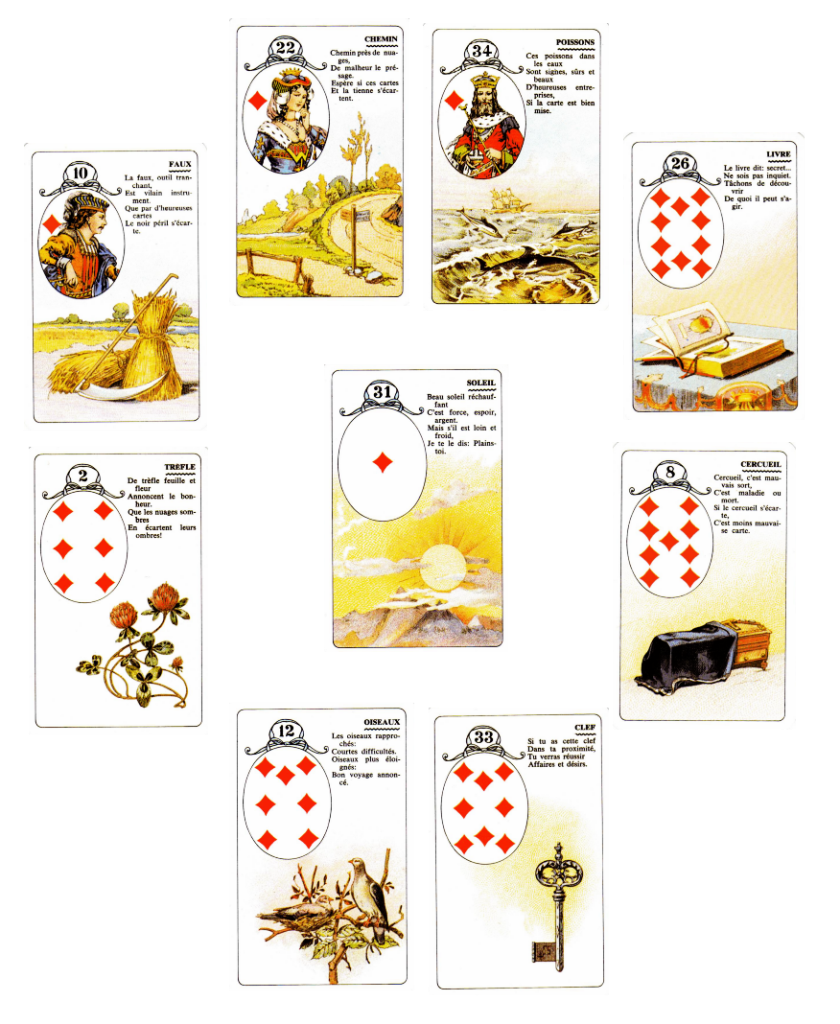
To understand these relationships, the student is invited to put the four aces in front of them and deal the remaining eight cards around their chieftain.

Now we come to the two premier suits: the hearts and the spades. The two aces, here, are the primary significators, the Lord and the Lady. Dependent upon their gender and providing that they are over the age of sixteen – in which case they take the valet of spades, regardless of gender – the client, or person of interest, will take one of the two aces for themselves.

We do not know where the Lenormand’s creator, Johann Kaspar Hechtel[2], took all his inspiration. It is common in Germanic practice to utilise the heart courts for both male and female clients. However, much like Etteilla, Hechtel associated hearts and spades with men and women, respectively.

Thus, in the Lenormand Oracle, a client becomes affiliated with one suit. Within the reading, this association can orient the game in several ways:

The spades and hearts suit are the maternal and paternal line of the client’s heritage. Such a division can determine the origin of a legacy and inheritance, or genetic disorders and inherited diseases. The information is revealed by the encounter of the appropriate suit with the cards in question, e.g. the Lilies (King of Spades) found directly below the Tree (Seven of Hearts) is a maternal inclination.

Dependent upon context our two suits also denote consanguinity (the suit of the significator), or a relative by marriage (the suit of the partner). This can be useful in determining allegiance or hindrance (the clichéd madame Tremaine or Carabosse). It can also tell us about the birth-family, and the adoptive-family.

If the reader utilises cards with the appropriate full playing-cards, the regards of the kings and queens can show goodwill, or enmity.

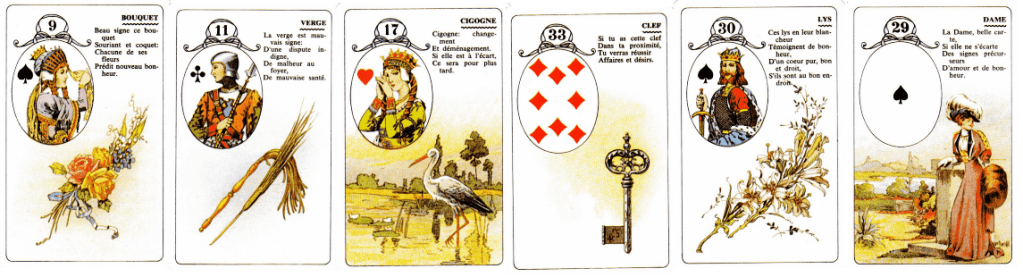
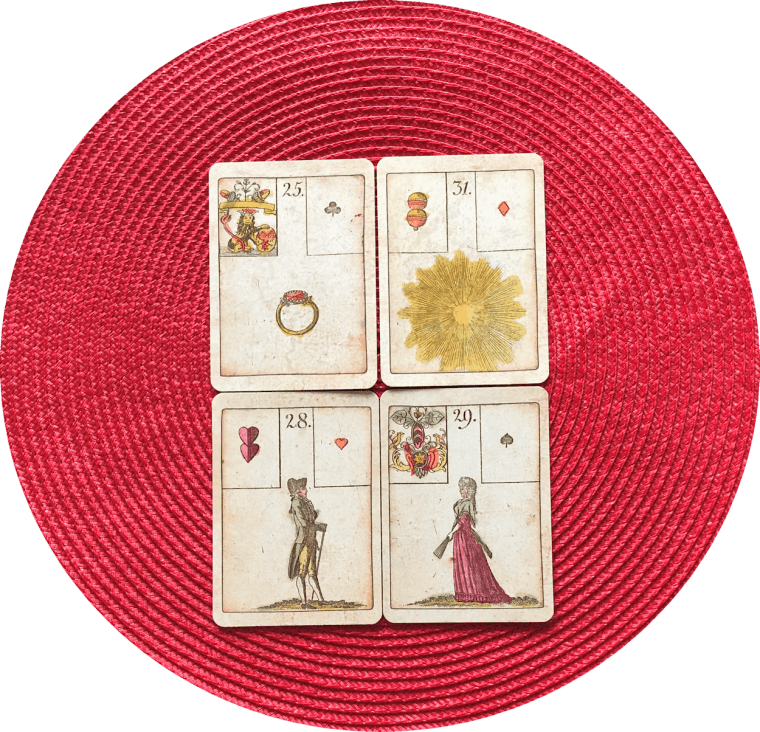
To illustrate this concept, I present an extract of a client’s reading. It is the main past-line for a female querent, represented by the Lady.

We see, here, that the Bouqet (Queen of Spades) and the Stork (Queen of Hearts) chain the Birch Rod (Knave of Clubs). Both Queens regard each other. Two women, one of the client’s own house, are in conflict. The client turns away, putting the battle in her past.

The woman in question had become engaged to a man of different ethnicity and creed. Organising the wedding had resulted in considerable opposition between the mother of the bride and the mother of the groom. A solution had come via the petition of a third party, resulting in appeasement of sorts. Such action is seen quite clearly in the Key securing the Lilies.

The Lenormand has several layers of interpretation that are revealed through practice and explored by the attentive reader in their usage of the cards. Do not let your eyes deceive you, keep them on the pips. They are there for a reason. As any real diviner knows: nothing on the card is irrelevant.

§

References:

Cards: Jeu Lenormand © Cartamundi (1982). Header: User:Duja – Wikimedia Commons

[1] It is not within the scope of this article to discuss the pictorial differences of the Germanic pattern and the French pattern, or the associations. I have therefore used the Anglo-terminology for the suits as a neutral term.

[2] Johann Kaspar Hechtel, creator of the Das Spiel der Hoffnung, motivations and inspirations are unknown. We have no primary sources from Hechtel and assertions that he adapted the so-called Coffee Cards are derived through similarity alone, and not historical fact. It is clear that he was aware of the suit associations; however, as these associations were primarily seasonal (ace of acorns is winter as still evidenced on Hungarian examples), we should exercise caution with attributing motivation.