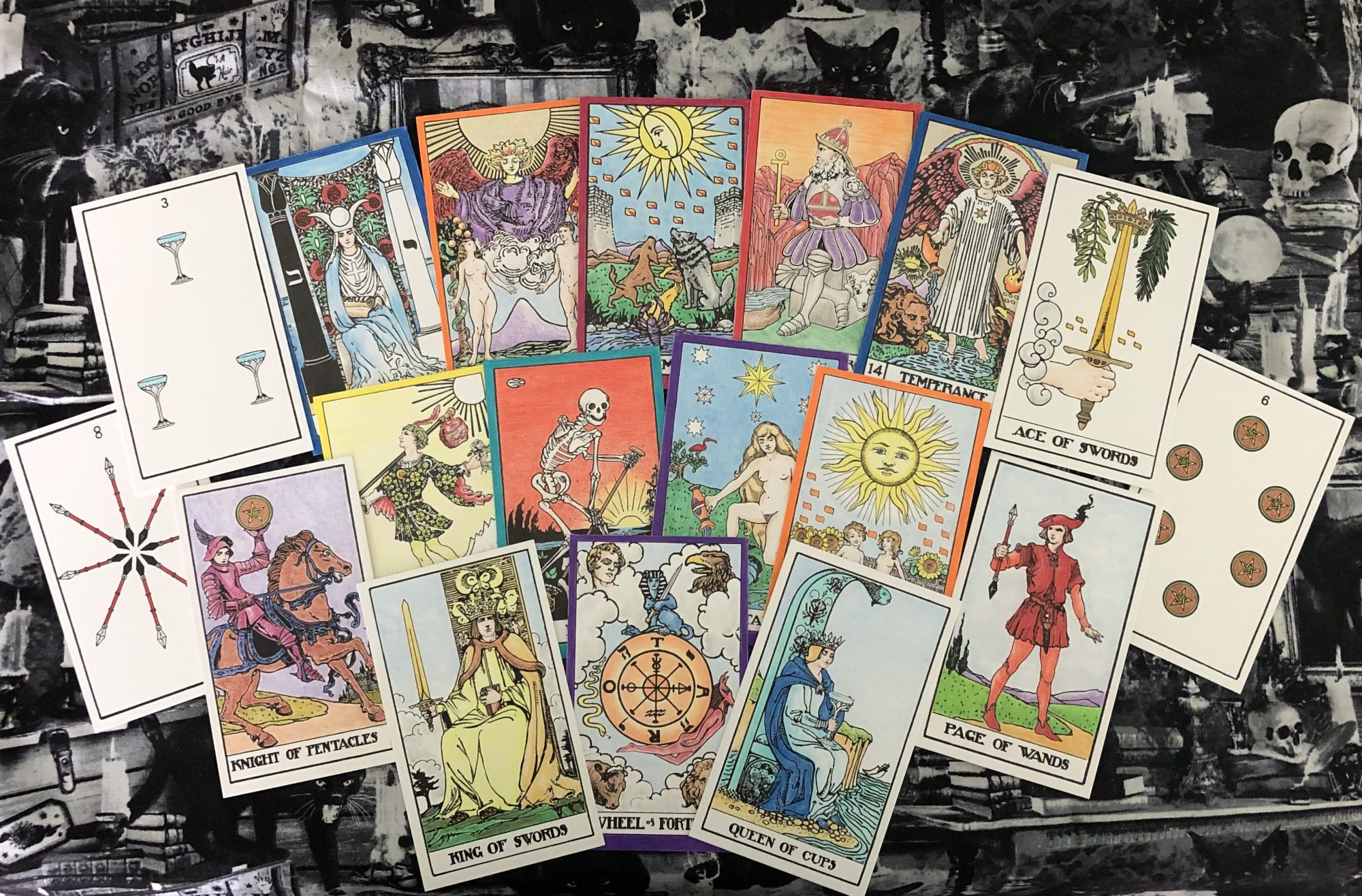
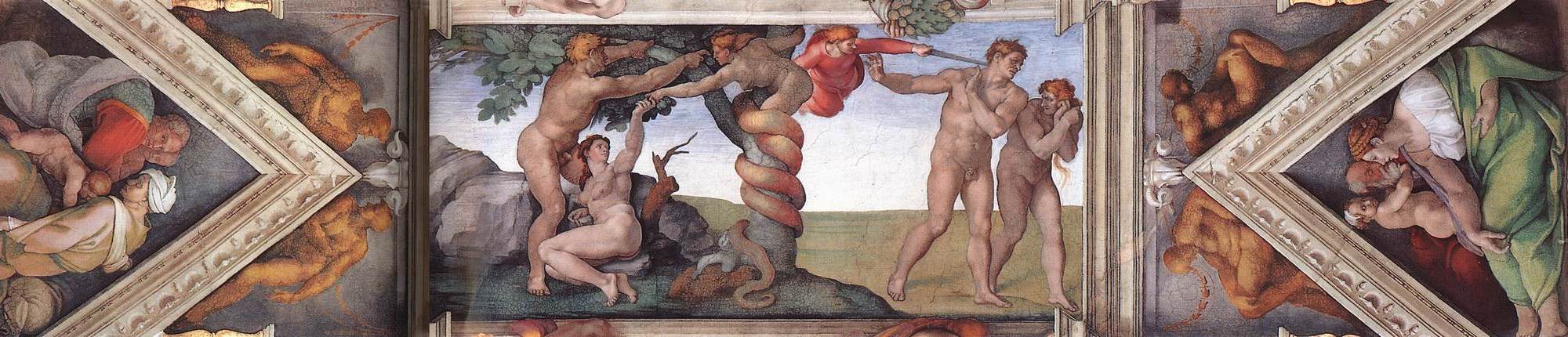
Now the serpent was more subtle than any other wild creature that the Lord God had made.
Genesis 3: 1, Revised Standard Version Catholic Edition
Snake, is a sign of misfortunes, which is gauged by the distance of the card to that of person, but always brings hypocrisy, betrayal and loss.
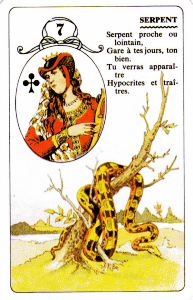
Philippe Lenormand Sheet
Card no. 7, the Queen of Clubs or the SERPENT card, has a notorious reputation. Is this picture the “big bad” of the deck? Perhaps she is a feminine woman, mother or a rival? Or could this card represent tutelary forces and mother wit?
The Essence and Function of the Serpent Card:
The essence and function of the Serpent card is venom and inducement, respectively. The Serpent is a warning card which indicates an area that must be approached with extreme care. Mishandled she will strike and envenomation occurs, giving a devastating blow. Carefully side-stepping this venomous viper will ensure your safety, but can result in delays and detours and also teach a valuable lesson.
A good understanding of the essence and function of the Serpent card is commensurate to a sound comprehension of the creature itself and folklore.
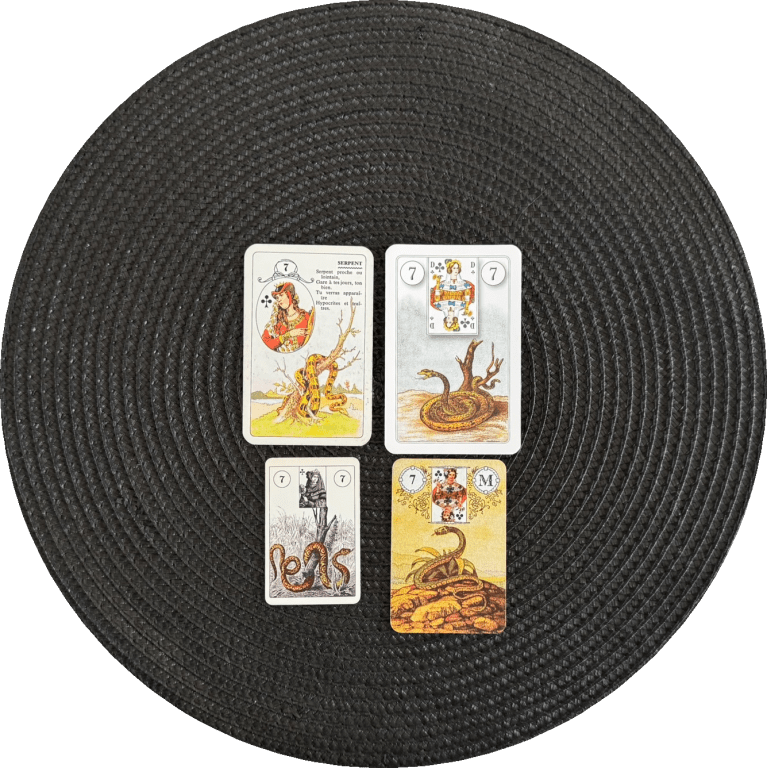
The traditional eikṓn for card no. 7 is that of a snake hiding either in a tree or grass. The former appears in the Das Spiel der Hoffnung, the Dondorf pattern, the Brepols & Dierckx, the C.L. Wüst and the so-called Leipzig Lenormand. The Blaue/Rote Eule favour the latter motif. You can see four examples below.
It is not uncommon to see words such as “constriction,” “strangle,” and “tie-up” used to describe the Queen of Clubs card. In the modern vernacular, the Serpent is perceived as a member of the Boidae family or other non-venomous snake that utilises constriction to kill its prey. But is this consistent with the deck’s origin? No.
Several snake species were to be found in eighteenth and nineteenth-century Europe, but no large boas. Of the snakes common to the region from where the cards emerged, there are non-venomous and venomous candidates. Considering the Serpent card’s nefarious associations, the latter is the likeliest inspiration.
The Vipera aspis or European viper (and its subspecies), is prevalent in various regions of Europe including the Petit Lenormand’s birthplace. It is venomous and its bite is noted to be painful. The venom is used for hunting and defence. Small in size it will bite prey, and wait for the venom to kill before pursuing.
Overtime, misidentification resulted in a myth of their aggressiveness.
Snake folklore is complex and rich — with reverence and fear often appearing side-by-side. As such, one finds much disagreement and contradictions from culture to culture. Consequently, it is best to focus on the folklore of the geographical origin of the cards.
Due to farming, agricultural communities were far likelier to encounter snakes. These communities noted some were venomous, and therefore, dangerous. Seeing the snakes shedding their skin and going underground only to re-emerge brought an association with the underworld. From this, the dark chthonic, tutelary, and primordial serpent emerged.
Unblinking, the snake was thought to be all-seeing and possessing powerful wisdom and discernment, which could be transferred as clairvoyance and clairaudience. That is preserved in the Grimm Brothers’ Die weiße Schlange (The White Snake). However, it must be remembered that the snake keeps her belly to the ground. As such, we can see that will use dirty tricks to get what she wants and never hesitate to stoop low.
Of course, the most significant folkloric influence for the Petit Lenormand would be the snake of the Garden of Eden. Christians specifically linked the snake with demonic powers. This interpretation associates this snake with temptation, incitement and sexuality. All three are to be found in the card (see Marco, &c).
However, I feel there is a better illustration of the Serpent card to be found in old folktales. One many of us will remember from childhood. Let us consider the Farmer and Viper.
In wintertime, a farmer spied a small snake unmoving in his frosty fields. He recognised the snake as one with potent venom. Nevertheless, he was kind-hearted and generous. He carefully picked up the snake and placed it in the breast pocket of his coat. As he went about his business, the snake began to revive and gain its strength. Once sufficiently recovered, the snake bit the farmer, delivering its potent venom. Sensing his demise, the farmer warned those around him to learn from his fate and not pity a scoundrel.
The tale is believed to be the origin of the phrase “nursing a snake at one’s bosom.” However good the farmer’s intentions, his actions were foolish; he nursed his own killer. He failed to keep a safe distance.
If one considers the common negative associations applied to the Serpent card – betrayal, spitefulness and treachery – they all infer a closeness.
To bite, the Serpent has to be close enough. Where she falls, is where you must exercise caution or run the risk of being close enough to be bitten. Her venom will result in some form of adversity, personal loss or complications. But only if she can strike. Remember that.
Coda
The Serpent is a warning card. Where she falls, marks an area that can become toxic. If engaged, she will strike . Her venom brings difficulties, toxic situations and betrayal. These will prove challenging and complicated to resolve.
Person and Description:
Card no. 7 is the Queen of Clubs and can therefore be read as a woman when paired with a social card (the House, the Park, and so on). Ordinarily, the Queen is a woman aged 35 + and is noted to be intelligent, serious-minded, and influencing the querent or their affairs.
If she falls next to the King of Clubs (the Clouds) or the Knave of Clubs (the Birch Rod), it tells the reader that a couple or mother and child have a bearing on the question, respectively. Rarely, all three will fall together. If you see this, it indicates a family unit.
Some cartomantes and authors (such as the French author, Marie Delclos) use the Queen of Clubs as the Significator for married brunettes. Personally, I prefer the Child, the Gentleman the Lady cards for Significators.
It is not uncommon for cartomantes (see Moony, Stella Waldvogel, &c) to use the Queen of Clubs as the Significator for mothers. Depending on the reader, several explanations can be given, such as the umbilical cord being snake-like. However, most cite the Queen herself. Technically, the kreuz-dame was seen as an older woman but not kin without the presence of herzkarten (Kraheck-Liecke, 2008). Even then, it was not necessarily the mother. However, it is a valid association but not one to which I subscribe.
I use the Queen of Clubs as the Significator for the same-sex partner-card for lesbian and bisexual women.
Mary Marco associated card no. 7 with sexuality and lovers, both male and female (Marco and Goffinet, 1989). I concur with Madame Marco. The Serpent card itself can indicate unfaithfulness and lovers of either gender.
If the Serpent pairs with a person card, it can be read as a description. It will describe both the appearance and psychological state or temperament of the person. This can be the Querent’s card or another figure in the game.
Physically, the Serpent describes someone with dark brown or black hair and green or hazel eyes. Often the person (male or female) wears it long. Traditionally, the person is attractive, and can be very feminine.
It is not uncommon for a person described by the Serpent to wear spectacles or corrective lenses. Over time I have also observed that the Serpent can indicate a lisp or breathy voice.
Serpent people are often erudite, well-spoken and multilingual. Often such people can possess knowledge or influence that is needed for the Querent’s cause. However, the Serpent-people are not altruistic and will not help someone if it brings them no benefit. More negatively, the Serpent indicates someone who is a toxic presence and a backstabber, or seditious and passive-aggressive.
It is worth noting where the Serpent falls in relation to the person-card. If it precedes the person-card, such as the Serpent + the Gentleman, then the individual receives the more destructive attributes of the Serpent card. Such a man will be charming, attractive and o-so-kind but should be avoided and treated with extreme caution. If engaged, you will be bitten. As snakes are good at camouflage, you will often be quite surprised that such people are such backstabbers.
If, however, the person-card comes first, such people take the more benign meanings of the Serpent. The individual is intelligent, attractive but probably not the most friendly of people, but they pose no danger providing you do not rile them.
Special Features:
When the Serpent card falls near the Significator card, it is a warning. The Serpent’s poison can be delivered in several forms: betrayal, exploitation and, of course, two-facedness. Camouflaged, snakes are good at hiding. For this reason, when the Serpent strikes, we are often just as devastated by the perpetrator’s identity as much as their actions.
Far away, the Serpent cannot strike at the Querent directly. Like the Fox card, this does not so much neutralise the Serpent’s negative traits as much as creating a safe distance for one to overcome any challenges. It is thus a good indicator of overcoming difficulties.
As with the Fox and the Birch Rod, the Serpent cannot affect every card in the game. Her direct influence is on those cards she is near and encounters.
Of these, her venom is directed to those cards she dominates/overcomes: i.e. when she is card A in an A + B (+ C) formation.
I prefer Petit Lenormands that show a right-facing Serpent (Brepols & Dierckx, Wanderwust, &c). In such patterns, one can use the head of the snake as an aide-memoire.
A card overcome by the Serpent poses some problem or danger to the Querent. Unfortunately, the card often signifies something the Querent desires and will be tempted to pursue. However, if the Serpent is unheeded, the area will prove either damaging or cause a lot of problems that will be challenging to put right later on.
If this is one of the carte maîtresses, that area becomes a key concern and one which the Querent must proceed with caution.
One example I have seen over and over is the Serpent + the Moon near the Significator. All too often, a new job or promotion appears. It looks too good to be true; and it is. Either you are handed a poison chalice or working with toxic people. If you leave too soon, it does not look on your curriculum vitae.
Sadly, the Serpent can be hard to resist. But the topic affected by the Serpent is always best left for a time. Yes, it might delay you. But in the end it is for the best.
When the Serpent falls in a descriptive position (e.g. card B or C), she adds a complexity or roundabout/delayed quality.
For example, the Letter + the Serpent often indicates a telephone call that keeps your waiting, or a letter that is late in the post or delivered to your next-door neighbour by mistake.
Several of the Petit Lenormand cards can be seen as trump cards. That is having the ability to neutralise or overcome another card. The Serpent card is the Mice’s trump card.
The Stork trumps the Serpent card. If the Stork faces the Serpent, she can eat the Serpent. Many older patterns often illustrated the Stork eating either an amphibian or reptile. Storks are known to eat snakes. Remember nature is the oldest oracle!
The Serpent is the card of reptiles and amphibians. If paired with the Hound card, the Querent’s pets are likely to be snakes, tortoises, newts, frogs and so on.
On a mundane level, the Serpent can indicate cables and wires, ropes, piping, or something that can become tangled (laces, &c). Both with the Fishes and on its own, the Serpent can indicate brooks, rivers and streams. With the Road card, it can show winding pathways, country lanes and so on.
Some careers associated with the Serpent card indicate plumbers, cable laying technicians, gas maintenance, sewage workers, environmental science (toxic or dangerous substances), toxicologists, jobs involving the care of exotic animals (especially reptiles), and translators.
Well-Being:
Anatomically, the Serpent refers to organs used in the intestinal stage of digestion: starting with the duodenum and ending with the anus. In addition to the organs, the Serpent can refer to conditions such as Crohn’s disease or ulcerative colitis (with Birch Rod), irritable bowel syndrome (with the Mice), polyps (Flowers) as well as haemorrhoids and constipation (Mountain), and so on.
In addition to the above, the Serpent can also indicate all poisons, toxins and harmful substances. Consequently, we never like to see her near the Tree or the Coffin cards.
The Serpent + the Heart will appear when someone has septicaemia and sepsis occurs. Due to the association with poisons, the Key + the Serpent often appears when someone is undergoing chemotherapy.
Someone with a significant allergic reaction to makeup or beauty products might see the Serpent + the Flowers.
The Serpent in Action:
In August 2020, a female Querent asked about the money she was owed. The finances had been loaned to help someone who was struggling due to furlough. It was a significant amount of money.
The three cards that fell on the table were:
Fishes + Ring + Serpent
The Fishes card is the master card of money. Paired with the Ring card, we have a financial agreement or contract. Consequently, we know that both parties intended this to be a loan. There is every intention of the money being returned to the Querent, and the Ring itself confirms this.
However, the Ring is paired with the Serpent. So, the money will be returned late due to complications.
Consequently, we can say yes but not on time.
The Querent asked for a timescale. Looking through the deck, the Lady faced the Clouds card, which indicates March. That was seven months from the time of the reading, which the Serpent card echoes.
And so it was.
§
Images:
Cards: Jeu Lenormand © Cartamundi, WanderWüst © Jorge/Wandering Oracle, Cartes Lenormand © Dondorf (Author’s Collection) , Nr. 1941 Mlle Lenormand Wahrsagekarten © Piatnik, Petit Lenormand © Daveluy (Author’s Collection).
References:
Delclos, M., 2013. Le Livre du Petit Lenormand. 1st ed. Escalquens: Éd. Trajectoire.
George, R., 2014. Essential Lenormand. 1st ed. Llewellyn Publications, U.S.
Grimm, J., Grimm, W., Zipes, J. and Dezsö, A., n.d (2016). The Original Folk and Fairy Tales of the Brothers Grimm. 1st ed. Princeton University Press.
Johnson, B., 1994. Lady of the Beasts. 1st ed. Rochester, Vt.: Inner Traditions International.
Kraheck-Liecke, B. (2008). Birgitt Kraheck-Liecke [online].
MacNamee, G., 2000. The Serpent’s Tale. 1st ed. Athens: University of Georgia Press.
Marco, M. and Goffinet, J., 1989. Petit Lenormand. Bruxelles: Servranx.
Meuris, B., 2018. Petit Lenormand Encyclopaedia: Volume 1 & 2. Create Space.
Phillips, L., 2021. Lozzy’s Complete Guide To Lenormand: Workbook Edition. 1st ed. Independent.
Silvestre, C., 2003. Le Petit Lenormand. [Montpellier]: Gange éd.
 Journal of a Cartomante