Sailing on the Seven Seas: The Ship Card

Some sailed to the sea in ships to trade on mighty waters. These men have seen the Lord’s deeds, and wonders he does in the deep.

Psalm 106: 23 – 24, Grail Translation

And, just at the moment when someone says, “There, she is gone,”
there are other eyes watching her coming, and other voices
ready to take up the glad shout, “Here she comes!”

Gone from my Sight, Henry Van Dyke

Ship, indicates wealth obtained by commerce or by inheritance; it also means travel when it is located near the person.

Original Instructions

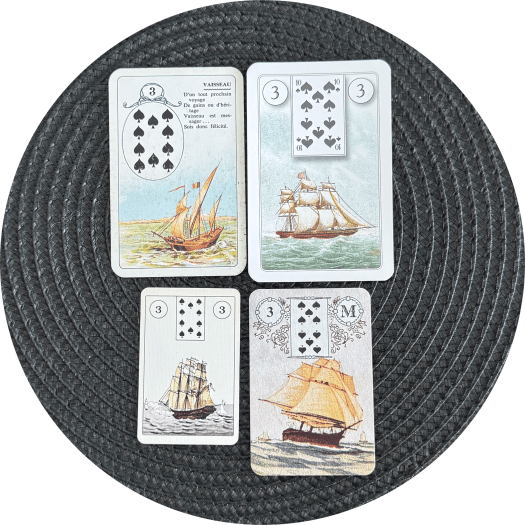
Card No. 3, the Ship or Boat, is represented by the Ten of Spades. At first glance, its meaning appears rather straightforward. Surely it signifies travel and little more? Yet, as with many Lenormand cards, a closer examination of the eikōn reveals a richer and more nuanced symbolism.

The Essence and Function of the Ship

The traditional eikōn depicts a large sea-going vessel, usually a galleon, carrack, or merchant ship, its sails billowing as it makes its way across the ocean. Some decks show one or two additional vessels upon the horizon, reinforcing the impression of long-distance travel, commerce, and movement between distant places.
The essence of the Ship is movement and its function is transport.

To appreciate the significance of the card, one must remember the world from which the Petit Lenormand emerged. In the late eighteenth and early nineteenth centuries, most people never strayed particularly far from their place of birth. Long-distance travel was neither commonplace nor inexpensive. Journeys by sea were often arduous, time-consuming, and fraught with uncertainty. Nevertheless, ships remained essential. They connected nations, facilitated trade, transported goods, and enabled the exchange of ideas, cultures, and opportunities.

For this reason, the Ship’s most immediate and enduring significance remains travel. Whether by land, sea, or air, the card signifies the act of undertaking a journey and moving from one place to another. If the Ship appears prominently near the significator, one may often predict with confidence that the querent will soon travel or that a journey will play an important role in forthcoming events.

Yet the Ship should not be understood solely in a literal sense. Its symbolism extends beyond physical travel into the broader concept of movement itself. In a reading, the card often invites us to consider the course upon which the seeker presently finds themselves. Is their life progressing towards a destination, or have they drifted off course? Are they making steady progress, or are they becalmed and unable to advance? Such questions naturally arise when the Ship appears.

The card can also indicate expansion and the broadening of horizons. Just as a ship carries people and goods beyond the confines of their familiar surroundings, so too can it suggest the need to venture into new markets, acquire new experiences, or seek opportunities beyond one’s customary sphere. In this respect, the Ship can be particularly valuable in business readings.
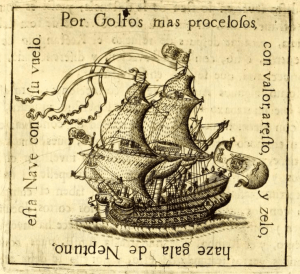
González Cabrera Bueno, José, Public domain, via Wikimedia Commons

For entrepreneurs and those engaged in commerce, the Ship frequently raises questions of distribution, reach, and growth. How might a product be transported to a wider audience? Which new market remains unexplored? What avenue of expansion has yet to be considered? In such instances, particular attention should be paid to the card towards which the Ship is travelling. That card may indicate precisely where one should look for new customers, fresh opportunities, or increased sales.

Ultimately, the Ship is a card of departure and progression. It rarely permits stagnation. Whether manifesting as a literal journey, a commercial venture, a personal development, or a widening of one’s horizons, the Ship encourages movement from the known towards the unknown, carrying the seeker beyond their present shores and towards new possibilities.

As always, the surrounding cards determine whether the movement represented by the Ship is functioning smoothly or encountering obstacles. A vessel sailing freely conveys a very different picture from one struggling against contrary winds and treacherous seas.

Coda:

Whether appearing in questions of travel, business, relationships, or personal growth, the Ship invariably signifies movement from one state to another. It is the card of journeys, horizons, and expansion; of leaving the familiar behind in pursuit of wider opportunities. Above all, the Ship reminds us that progress rarely occurs whilst we remain safely in harbour.

Person and Description

The Ship is not ordinarily employed as a significator. Nevertheless, when it appears alongside a person card, it can provide valuable information regarding both physical appearance and temperament.

Physical Appearance

Traditionally, the Ship introduces an element of foreignness or distinction into a person’s appearance. Such a description should be treated with caution, however, for what is considered foreign or exotic is often relative to the perceptions and experiences of the querent. In practice, it is usually safer to say that the individual possesses a distinctive appearance or stands out in some notable fashion.

The Ship frequently describes a taller individual, often with a lean or elongated frame. The hair tends towards darker shades and, particularly in men, may possess a slightly windswept or untidy quality, as though shaped by the elements. The eyes frequently tend towards blue or green, reflecting the maritime symbolism of the card.

As with all descriptive cards, the surrounding cards may refine or modify these indications.

Temperament

When describing character, the Ship corresponds most closely to the traditional sanguine temperament. Of the four classical temperaments, the sanguine is perhaps the most adventurous, optimistic, and outward-looking. Such individuals possess a natural curiosity about the wider world and are rarely content to confine themselves to a narrow sphere of experience.
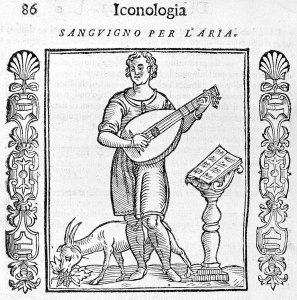
See page for author, CC BY 4.0 https://creativecommons.org/licenses/by/4.0, via Wikimedia Commons

The Ship person enjoys discovering new places, meeting new people, and exchanging ideas. They are often sociable, friendly, and receptive to different perspectives. Just as the merchant vessel carries goods from one port to another, these individuals delight in making connections between people, places, and opportunities.

There is also a strongly enterprising quality to the Ship. The traditional eikōn is not merely a vessel of exploration but one of commerce. Consequently, those represented by the Ship frequently possess a commercial instinct and an eye for opportunity. They are inclined to look beyond familiar boundaries and may prosper through trade, travel, networking, importation, exportation, or other pursuits which broaden their horizons and extend their reach.

At their best, they are adaptable, optimistic, resourceful, and possessed of a genuine enthusiasm for life. Their willingness to embrace change often enables them to succeed where more cautious individuals hesitate.

At their worst, however, they may become restless, dreamy, unsettled, or perpetually in search of the next horizon. There can be a tendency to lose interest once the novelty of a situation has passed, or to pursue new opportunities before fully developing existing ones. Like the vessel depicted upon the card, they are seldom inclined to remain anchored in one harbour for long.

Special Features

Mode of Transport

Some cartomantes associate the Ship with all forms of transport, whether a motor car, bicycle, aeroplane, or boat. I have never found such a broad interpretation particularly convincing. For me, the Ship signifies only certain modes of transport.
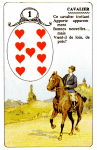
When the Petit Lenormand emerged, the most common means of personal transport were horses, carts, and carriages. In our own time, the motor car, motorcycle, and bicycle fulfil much the same role. The deck already contains a card depicting a rider upon a horse: the Cavalier. If we wish to signify personal transportation—a journey undertaken under one’s own control—the Cavalier frequently serves this purpose admirably.
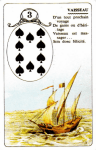
By contrast, the traditional eikōn of the Ship depicts a large sea-going vessel intended for long-distance travel and commerce. A galleon was not used for local errands or daily commuting. It carried people and goods across great distances and often beyond national frontiers.

For this reason, I associate the Ship with trains, coaches, buses, aeroplanes, ferries, cruise liners, and, naturally, ships themselves. The common thread is not merely transportation, but transportation over distance. Unlike the Cavalier, where the traveller directs his own mount, the Ship usually indicates a person being conveyed by a larger system of transport.

This distinction is important. The Ship concerns long-distance travel and those means of transport that carry us beyond our usual sphere. It is less about driving to the shops and more about crossing borders, horizons, and significant distances.

Longing

Beyond physical travel, the Ship can also signify longing. Just as the traveller gazes towards a distant shore, the card captures the feeling of desiring something that lies beyond one’s immediate reach.

This interpretation is most often encountered when the Ship appears with another person card. In such circumstances, the card frequently indicates that the individual is absent, distant, or otherwise unavailable. The separation may be geographical, emotional, or circumstantial, but the defining feature is the same: the absence is keenly felt and seldom forgotten.

The Ship therefore speaks of yearning, homesickness, missing a loved one, or desiring something that remains beyond one’s immediate grasp. In relationship readings, particularly for those seeking a partner, it can indicate a longing for companionship, romance, or a future not yet realised.

Inheritance

Inheritance may seem an unusual signification for the Ship until one reflects upon the card’s essential function. The Ship transports people and goods from one place to another. Inheritance can be understood in much the same way: the transfer of a legacy from one person or generation to the next.

For this reason, the Ship can occasionally signify an inheritance, legacy, bequest, or succession. This is by no means an everyday interpretation and one I have employed only on rare occasions. Nevertheless, in the appropriate context, particularly when supported by other cards, it can prove remarkably apt.

Timing

In matters of timing, the Ship operates at a measured pace. Unlike the rapid activity of the Birds or Moon, the Ship suggests a journey that takes time to complete. Consequently, it tends to operate in terms of months rather than days or weeks.

Over the years, I have also noticed an occasional association between the Ship and Stella Maris—Our Lady, Star of the Sea—whose feast is celebrated on 27 September. This is not a traditional Lenormand correspondence, but one that has appeared with sufficient regularity in my own practice to merit mention.

Health

In health matters, the Ship is associated anatomically with the liver, spleen, and gallbladder. In the appropriate context, combinations can provide further detail. For example, the Ship and Mountain may point towards obstruction within the gallbladder, including the possibility of gallstones.

More commonly, however, the Ship concerns movement and disorders associated with it. It can indicate disturbances of balance, co-ordination, motion, and spatial orientation. Likewise, it frequently appears in connection with travel sickness, seasickness, and anxieties associated with travel itself.

The Ship in Action

In early 2019, Joan consulted me regarding a business and enterprise course she was considering undertaking. Joan operated two businesses: a jewellery-making enterprise and a cleaning business run jointly with her husband. Her question was straightforward: what would she gain from taking the course?
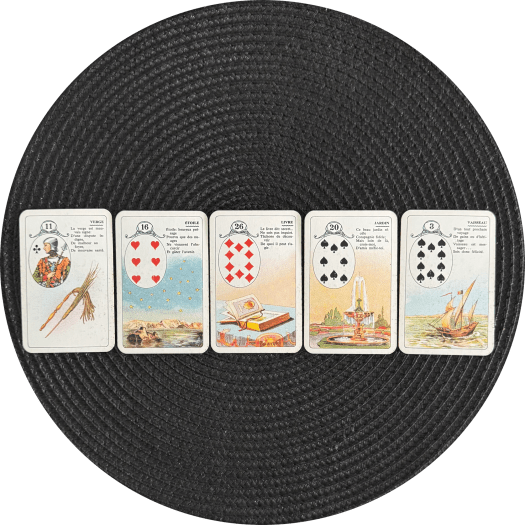
The cards drawn were the Birch Rod, the Stars, the Book, the Park, and the Ship.

The answer was remarkably clear. The greatest benefit would be a better understanding of how to grow her businesses and expand her market.

The Birch Rod occupies the first position. As we have already seen, the essence of the Birch Rod is correction and its function is to discipline. The course would therefore require Joan to scrutinise her existing practices, tighten her business plans, and address weaknesses that might otherwise have gone unnoticed. It was not simply a matter of learning something new; it was a matter of refining what already existed.

This process naturally led to the Stars. Greater discipline and organisation would provide Joan with clarity, direction, and a more focused vision of where her efforts ought to be concentrated.

The Book revealed that there was still much to learn. More importantly, it suggested opportunities, customers, and possibilities that had not yet been discovered. The knowledge required for further growth existed, but it had yet to be accessed.

The combination of BookParkShip was especially striking. The Book pointed towards hidden or unexplored knowledge. The Park expanded this into the public sphere and marketplace. Finally, the Ship showed expansion beyond existing boundaries. Taken together, the cards indicated that the course would help Joan identify and reach a market she was not presently serving.

Here the Ship functions in its broader sense of expansion and extending one’s horizons. Armed with fresh knowledge and a clearer direction, Joan would be able to take her products and services into previously uncharted territory. The course would not merely teach her how to run her businesses more effectively; it would show her where growth could be found and how to reach people beyond her current customer base.

In practical terms, the reading suggested that the greatest value of the course would be neither the qualification nor the certificate itself. Rather, it would provide Joan with the knowledge, clarity, and direction necessary to unlock new opportunities and bring her businesses before a wider audience. The Ship showed that she would be able to expand her horizons and, in doing so, reach more people through markets and opportunities that had previously remained unexplored.

Forthcoming articles will cover the Cross, the Bear, the Key, the Hound, the Fishes, the Stars, the High Tower, and the House cards.

§

Images:

Featured Image:

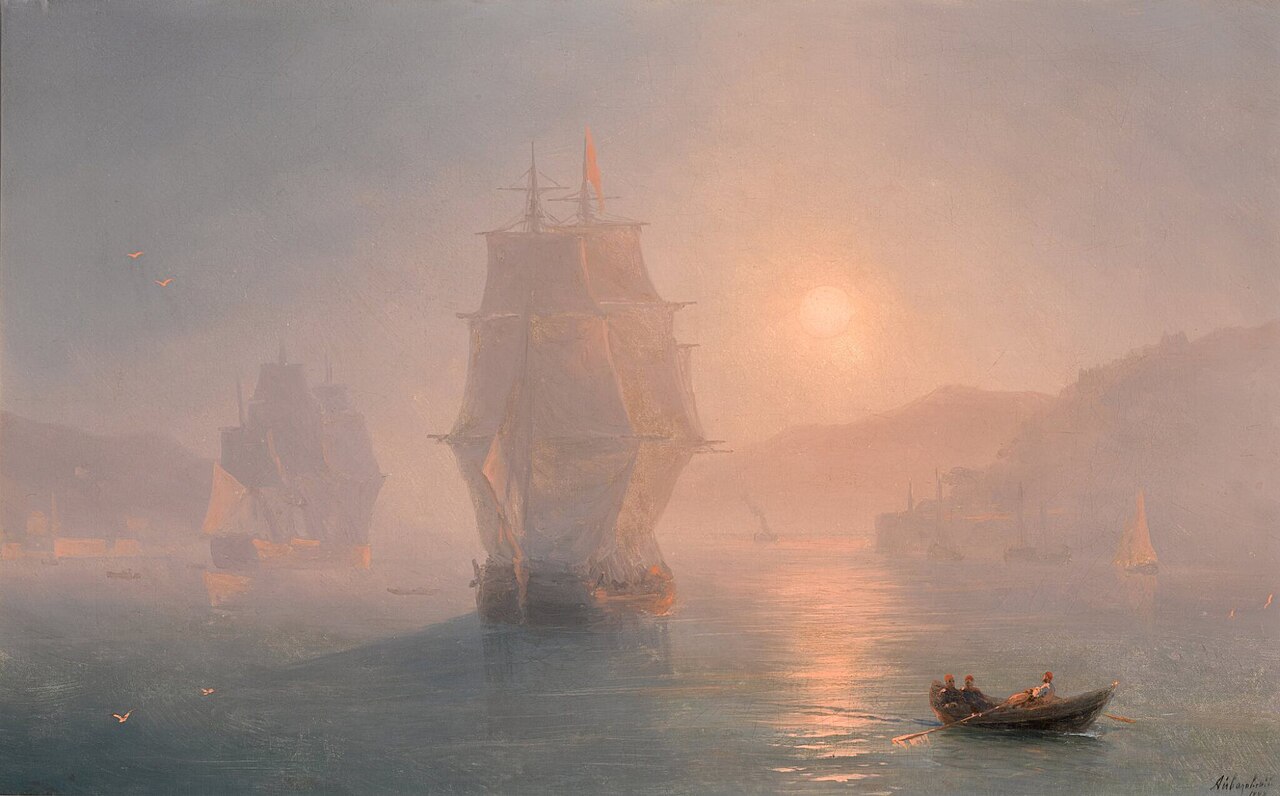
Ships on a Misty Morning. Ivan Aivazovsky. Public Domain via Wikipedia Commons.


Cards:

Lenormand Cards: Jeu Lenormand © Cartamundi, WanderWüst © Jorge/Wandering Oracle, Lenormand Fortune-Telling Cards © Zao-Gelli, The Lenormand Oracle © Verlag für die Frau, Leipzig, Nieuwe Lenormand © Amber Studio/Erna Droesbeke, Lenormand 36 Orakelspielkarten © Königsfurt-Urania

References:

Boroveshengra, A., 2013. Cartomantes’ Cabinet: The Petit Lenormand Course.
Boroveshengra, A., 2015. Lenormand Thirty Six cards. 2nd ed. Create Space.
Delclos, M., 2013. Le Livre du Petit Lenormand. 1st ed. Escalquens: Éd. Trajectoire.
Gelineau, J. (1985) The Grail Psalms: Translated from the Hebrew. London: Collins Liturgical Publications.
Marco, M. and Goffinet, J., 1989. Petit Lenormand. Bruxelles: Servranx.
Matthews, C. (2014) The Complete Lenormand Oracle Handbook: Reading the Language and Symbols of the Cards. Rochester, VT: Destiny Books.
Meuris, B., 2018. Petit Lenormand Encyclopaedia: Volume 1. Create Space.
Silvestre, C., 2003. Le Petit Lenormand. [Montpellier]: Gange éd.

Ruffled Feathers: The Birds Card

The sparrow herself finds a home and the swallow a nest for her brood; she lays her young by your altars, Lord of hosts, my king and my God

Psalm 83:4, The Grail Translation

Two turtle doves will show thee
Where my cold ashes lie
And sadly murmuring tell thee
How in tears I did die

Nikolai Gogol

Birds signifies troubles that we will have to endure, but only for a short time. Far from the person this card is a sign of a happy journey

Original Instructions

Card No. 12 in the Petit Lenormand, the Birds or Seven of Diamonds, is sometimes dismissed as one of the less interesting cards in the deck. After all, does it not simply signify meetings and telephone calls? Yet why do some practitioners associate it with social media, whilst others see pregnancy or a pair of elderly ladies? Such diversity of interpretation raises an important question: what does the Birds card actually represent?

The Essence and Function of the Birds

The essence of the Birds is noise and its function is disturbance.

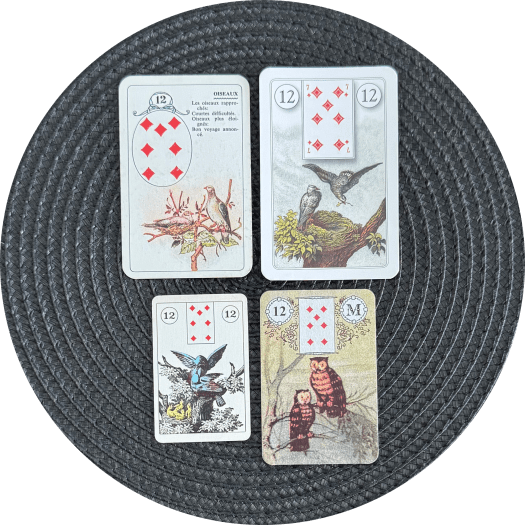
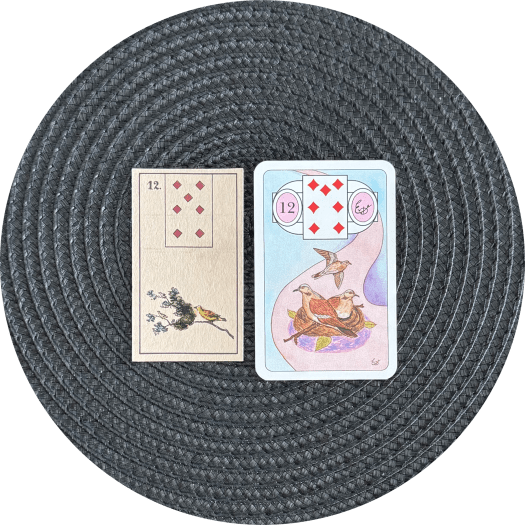
The most common eikōn for the Birds depicts a pair of nesting pigeons. Depending upon the deck, the birds may be shown building a nest, incubating eggs, or tending their young. The Dondorf portrays nest-building, the Brepols shows one bird incubating whilst the other stands guard, and the Wüst includes a nest of fledglings. The celebrated Blaue Eule famously substitutes two owls, whilst other decks, such as the Piatnik, depict birds in flight.

Birds possess a rich place within folklore, mythology, and divination. The concept of the language of birds has appeared throughout mystical and esoteric traditions as a metaphor for hidden knowledge, communication, and revelation.

Unlike the other animal eikōns within the Petit Lenormand, the deck contains two avian cards: the Birds and the Stork. Consequently, it is necessary to distinguish between them by considering the nature and behaviour of the creatures depicted. Such an approach may seem unfashionable to those accustomed to derivative keyword lists, yet much of traditional divination arises from careful observation of the natural world. One need only consider the Serpent to appreciate how many traditional meanings derive directly from the characteristics of the animal itself. The card’s associations with danger and malice become readily apparent once one considers the effects of a viper’s venom.

If we return to the Birds card, what do we actually see? Typically, we are presented with two birds, usually pigeons or members of the passerine family.

The most striking characteristic of such birds is their vocal behaviour. Birds communicate incessantly. They announce their presence, establish territory, identify companions, warn of dangers, and co-operate in responding to threats. The familiar dawn chorus is not merely bird-song; it is a continual proclamation of ownership, identity, and status. Pairs engage in duets, flocks respond collectively to alarm calls, and groups of birds often join together in a cacophony when danger is perceived.

This communication is seldom quiet or static. It is active, restless, and in constant flux. Noise accumulates, calls overlap, and attention is drawn simultaneously in several directions. When alarm spreads through a flock, the volume increases, behaviour becomes agitated, and the birds either scatter or gather together to mob a perceived threat.

Interpreting the Birds

The symbolism of the card thus becomes immediately apparent. The Birds introduces noise into a situation. Opinions multiply. Conversations overlap. People chatter, speculate, discuss, complain, and react to one another. One’s attention is pulled in several directions at once. Feathers become ruffled. What begins as a single voice soon becomes many voices. The result is an atmosphere of bustle, distraction, and nervous activity. The Birds therefore speaks not so much of a meeting itself as of the social commotion that surrounds it.

For this reason, the Birds often signifies chatter, gossip, rumours, discussion, excitement, nervousness, and the hustle and bustle of everyday life. It describes those periods when several demands are made upon our attention simultaneously and the resulting noise becomes difficult to ignore. Whether the disturbance arises from family, friends, colleagues, neighbours, or society at large is determined by the surrounding cards, but the underlying principle remains the same: many voices competing to be heard.

At the same time, the card possesses a fleeting quality. Birds settle only briefly before taking flight once more. Their chatter may dominate the moment, yet it rarely endures. Consequently, the disturbances represented by the Birds are often temporary, passing as quickly as they arise. In matters of proximity, birds heard at a distance are less immediate and less influential than those perched directly beside us. The farther away the Birds lies from the significator, the less directly the querent is affected by the noise and commotion it represents. Eventually, the flock moves on—and perhaps the querent does as well (hence the traditional “far” meaning of a happy trip).

Coda:

In divination, the Birds signifies noise, disturbance, agitation, and social commotion. It describes those periods when life becomes hectic, attention is divided, and numerous voices compete to be heard. Whether manifesting as gossip, worry, excitement, nervousness, or simple hustle and bustle, the card rarely indicates stillness; rather, it reflects a situation characterised by activity, chatter, and restless movement.

Bird Calls and Socials:

Before moving on, it is worth addressing several common interpretations omitted in my practice.

My second Lenormand teacher associated the Birds very strongly with telephone calls and news, to the point that there was relatively little differentiation between the Birds and the Letter. Whilst I made a sincere effort to incorporate this approach into my own practice, I found that telephone calls were consistently foretold by the Letter card rather than the Birds. This distinction seems entirely logical when one considers the nature of the Letter. Its function is to facilitate communication between two people who are not face-to-face. The same can be said of a telephone call. Whether one writes a letter, sends an e-mail, or speaks over the telephone, the underlying principle remains identical: private communication between individuals separated by distance. For this reason, I have always found the Letter a more natural significator for telephone calls than the Birds.

From time to time, readers justify the association through the historical use of pigeons as message carriers. Whilst I can appreciate the rationale, it is important to remember that the pigeon serves merely as a courier. The deck already possesses a card whose function is to deliver messages and announcements: the Cavalier. Consequently, I have never found the image sufficiently persuasive to displace the established symbolism of either the Letter or the Cavalier. For these reasons, I do not associate the Birds specifically with telephone calls. I fully respect those practitioners who do, but the card has simply never manifested in that manner throughout my own thirty-odd years of reading the cards.

Similarly, I associate both social media and meetings with the Park card rather than the Birds. The Park represents the public sphere: places where people gather, interact, exchange ideas, and participate in collective activities. That description applies equally well to modern social media platforms and organised meetings. The Birds may certainly describe the chatter, discussion, gossip, excitement, and occasional uproar that occur within such environments, but it does not signify the environments themselves. Thus, the combination of Park and Birds may aptly describe a platform such as Twitter, characterised by a constant stream of conversation and commentary, just as Park and Book may signify Goodreads, a book club, or some other public literary community. In such combinations, the Birds and the Book function descriptively, refining the nature of the Park, rather than acting as significators in their own right.

Person and Description

Person

The Birds is one of only a handful of Petit Lenormand cards capable of signifying a person despite not being a court card.

When functioning as a person card, the Birds most naturally signifies two people. Depending upon the context, this may indicate a couple, whether married or courting, two siblings, an aunt and uncle, two aunts, two uncles, grandparents, or any other noteworthy pair. The essential idea is not the precise relationship, but the fact that we are dealing with a pair whose affairs are linked. Naturally, this assumes the card depicts two birds, as is the case in the overwhelming majority of Lenormand decks.

One frequently encounters the assertion that the Birds signifies either two elderly women or a young couple. It is further claimed that the former belongs to the so-called German school and the latter to the French. Such distinctions should be treated with caution. Whilst certain conventions may be more prevalent in particular countries or among particular authors, it is a considerable exaggeration to speak of rigid national schools of interpretation. In practice, the historical tradition is far more fluid and diverse than such labels suggest.

For my own part, I have found the Birds to signify a couple or pair of people. Whether that pair manifests as elderly ladies exchanging gossip, young lovers, siblings, friends, or relatives can only be determined by the context of the question and the surrounding cards. The card itself merely establishes that two closely connected individuals are involved.

Physical Description

In matters of physical appearance, the Birds generally describes a person of slight build. The shoulders are often narrow, the bone structure fine, and the musculature relatively light. There is usually something delicate, quick, or bird-like about the individual’s overall appearance.

The eyes are frequently large, prominent, or otherwise distinctive. The voice may be high-pitched, rapid, animated, or even somewhat squeaky, particularly when the card is reinforced by other active or nervous cards.

Hair colour varies according to the species of bird depicted within the deck. In practice, however, I have found the card most commonly associated with shades ranging from chestnut and brown through to ash blonde.

Temperament

When describing character, the Birds often points towards an individual of a nervous and highly sensitive disposition. Such a person is easily startled, readily unsettled, and often acutely aware of their surroundings. Crowds, excessive stimulation, and highly charged situations may prove uncomfortable or draining.

In some cases, this nervousness appears to stem from past experiences. One occasionally encounters individuals represented by the Birds who have endured difficult circumstances, leaving them prone to anxiety or a heightened sense of vigilance.

When supported by more positive cards, however, the Birds can describe a far more sociable expression of the same energy. Here we find the conversationalist, the raconteur, the individual who delights in discussion, gossip, and the exchange of news and opinions. Such people are often lively, animated, easily excited, and rarely lost for words. Beneath both manifestations lies the same essential principle: a mind in constant motion and a life filled with noise, activity, and interaction.

Special Features

Doubling

Most cartomantes are familiar with the concept of doubling cards. Typically, these are identified as card nos. 11 (the Birch Rod), 22 (the Roads), and 33 (the Key). It is often assumed that their doubling quality derives from their numerical associations. In my view, this is mistaken. The doubling principle arises from the card’s iconography, whilst the numbering merely serves as a convenient aide-mémoire.

The Birch Rod generally depicts two scourges or switches bound together. The Roads reaches a point where one path becomes two. The Key possesses a dual function: it may be used to lock as well as to unlock. In each instance, the image itself conveys a notion of duplication, division, or duality. The number merely reinforces what the eye already sees.

Understanding this principle helps us to understand the Birds and its own capacity for doubling.

In reality, doubling is nothing more than a card acting descriptively. When a card falls beside a person card, it describes appearance and temperament. If the Park appears with the High Tower, we may infer a historical site, a distant location, or a place near a border because the High Tower is describing the Park. Age, distance and borders all come from the High Tower’s essence.

The same principle operates throughout the deck. Cards do not merely signify; they also qualify and describe.

The Birds functions according to precisely the same principle. On most Lenormand decks the card depicts two birds. Consequently, it can introduce a sense of twoness or plurality into whatever it touches. Thus, Cloverleaf and Birds may indicate doubled luck, two opportunities, two charms, two coins, two banknotes, or some other paired manifestation of the Cloverleaf’s essence

The important point is that the Birds is not creating an abstract numerical value. Rather, it is describing something as occurring in pairs. The image itself supplies the symbolism.

Not all Lenormand decks, however, depict only two birds. Some examples show three or even more. In such cases, the descriptive principle remains unchanged, but the quantity suggested by the image should be adjusted accordingly. As ever in the Petit Lenormand, careful attention to the eikōn often reveals nuances that would otherwise be overlooked.

Pregnancy

One of the questions I have been asked most frequently over the last fifteen years is why I associate conception and pregnancy with the Birds rather than the Stork. Surely, one might argue, pregnancy ought to belong to the Stork.

The reasoning is understandable, but it does not arise naturally from the Petit Lenormand itself. The traditional eikōn of the Stork depicts a bird wading in water, often hunting a frog or newt. The emphasis is upon movement, migration, arrival, and departure. The Stork has landed only briefly and will soon take flight once more. Its symbolism therefore pertains to change, transition, relocation, and movement from one state of affairs to another.
The familiar folklore of storks delivering babies is undeniably well known, but it is not explicitly represented within the card’s imagery. Unlike the Kipperkarten, which includes Ein kleines Kind as a dedicated card, the Petit Lenormand contains no image of an infant. Indeed, even the Child card depicts a young child rather than a baby.

By contrast, the Birds frequently depicts a nesting pair engaged in reproduction itself. Depending upon the deck, the birds may be building a nest, incubating eggs, or tending their young. The imagery is inherently concerned with pairing, fertility, nesting, and the creation of new life. If one were seeking a card whose eikōn naturally evokes conception and pregnancy, the Birds presents a much stronger case than the Stork.

A distinction should also be drawn between conception and birth. The former concerns the generation of new life and is aptly reflected in the nesting and reproductive imagery of the Birds; the latter concerns the arrival of the child itself, a symbolism more naturally associated with the Child card.

For this reason, many readers, myself included, have found the Birds to be one of the most reliable indicators of pregnancy within the Petit Lenormand. Particularly noteworthy is its combination with the Child. The Birds supplies the image of reproduction and nesting, whilst the Child signifies the offspring that results. Together, they frequently herald a pregnancy or impending birth long before it becomes otherwise apparent.

Birds

Finally, one should not overlook the fact that the Birds can, on occasion, signify actual birds. In my experience, this most commonly refers to garden birds and other familiar species rather than birds of prey. Owls, however, are a notable exception, not least because they appear on certain traditional Lenormand decks such as the Blaue Eule. As always, context is paramount, but with the Hound card a person might keep budgerigars or be a pigeon fancier.

Timing

In matters of timing, the Birds is a fast-moving card that imbues a situation with urgency, excitement, and haste. Events represented by the Birds rarely remain static for long and tend to unfold quickly once matters are set in motion. As a general guide, the card most often indicates a period ranging from a few days to just under a fortnight.

When combined with slower cards, the timing may be extended somewhat. In such instances, I have occasionally found the Birds to indicate a period of one to two months, although this is comparatively uncommon and should be regarded as an exception rather than the rule.

Over time, I have also noticed a recurring association between the Birds and Eastertide, the liturgical season extending from Easter Sunday to Pentecost. This is not a traditional attribution, but one that has appeared with sufficient regularity in my own practice to merit mention.

Health

In matters of health, the Birds is associated anatomically with the eyes and hearing, both of which serve as organs of perception and heightened awareness.

More commonly, however, the card concerns conditions arising from anxiety, nervous tension, stress, and excessive mental stimulation. Given the card’s emphasis upon noise, agitation, and heightened responsiveness, it frequently appears in questions relating to emotional strain and disorders of the nervous system. Thus, Birds and Heart may indicate palpitations or anxiety affecting the cardiovascular system; Birds and Park can point towards social anxiety; Birds and Mountain may suggest mutism, withdrawal, or an inability to communicate freely.

Particular attention should be paid to the Birds in pregnancy-related readings. Owing to its strong association with conception, nesting, and unborn children, the card can sometimes draw attention to complications affecting pregnancy itself. Birds and Coffin may point towards serious complications affecting the unborn child; Birds and Serpent may suggest exposure to harmful substances, toxins, or drugs during pregnancy; whilst Birds and Heart may draw attention to circulatory concerns, including gestational hypertension.

As always, such combinations should never be regarded as a diagnosis. Rather, they indicate areas requiring attention and are best understood as symbolic warnings that encourage appropriate medical advice where necessary.

Whether appearing in questions of health, timing, relationships, or daily affairs, the Birds invariably brings noise, activity, and disturbance. It is a card of excitement and agitation, of chatter and distraction, and of those fleeting moments when life becomes just a little too busy for comfort.

The Birds in Action

Let us examine the Birds in a reading. Below is an extract from a Grand Tableau cast for Fabien, a married doctor.

When performing a Grand Tableau, I generally favour the older, traditional method, which does not divide the layout into past, present, and future. Instead, the entire tableau is viewed as describing the present situation together with developments likely to manifest in the near future. When working in this manner, the cards towards which the significator faces often represent events or circumstances on the horizon that are likely to emerge over the coming days or weeks.

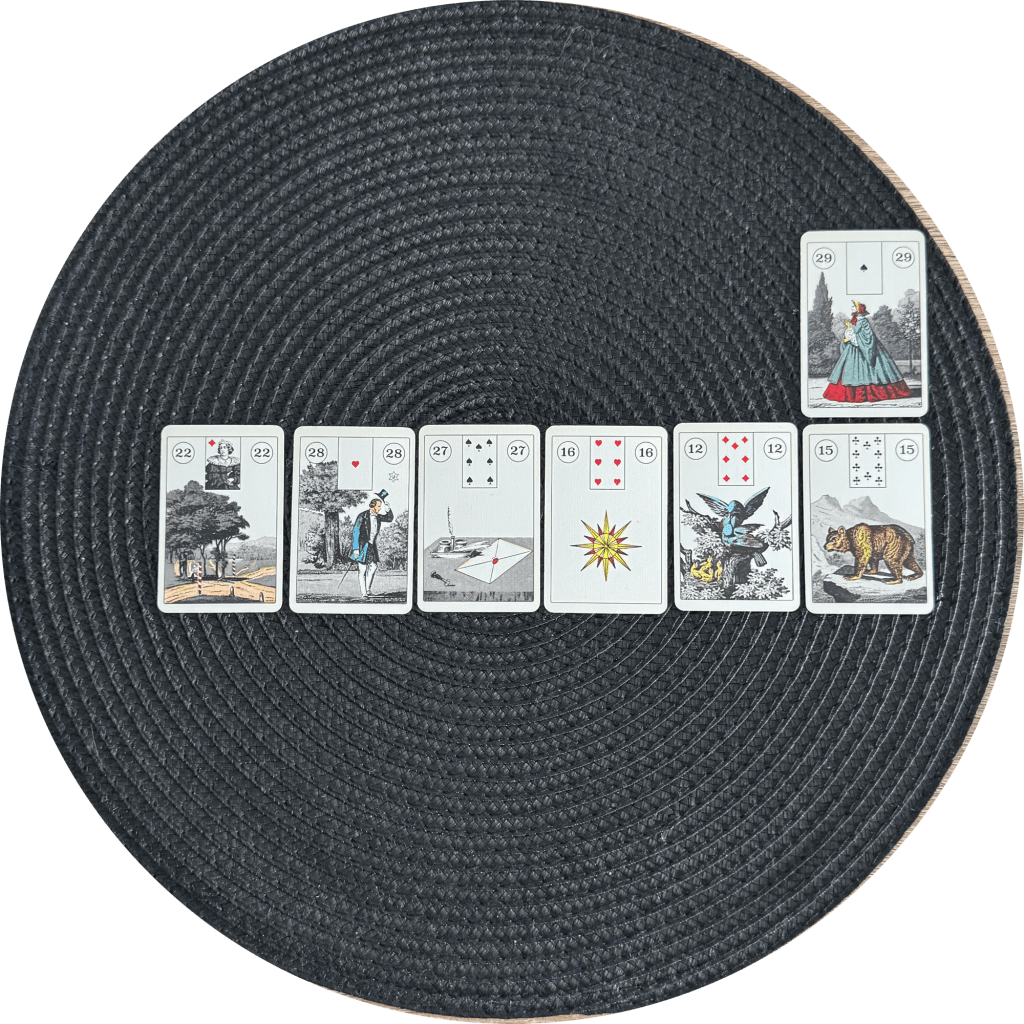
Here we see the Roads, the Lord, the Letter, the Stars, the Birds, and the Bear. Directly above the Bear lay the Lady.

WanderWüst © Jorge/Wandering Oracle

The Lord had fallen in the house of the Birds, whilst the Clouds occupied the house of the Key using the traditional 8 × 4 + 4 method. We need not concern ourselves with the houses here. I mention them only because the Roads appears to the left of the Lord. When the Roads is nearby, it frequently brings a degree of anxiety, as decisions must be made or a course of action determined. Free from the influence of the Clouds, however, it also suggests that any such difficulties can be overcome and that matters will eventually be resolved.

Returning to the line itself, a useful rule of thumb is that when the Letter falls to the right of the significator—or concludes a line—the seeker is generally the recipient of the message. When the Letter precedes the significator, the seeker usually sends the message or initiates the contact. We can therefore see immediately that Fabien is likely to receive an important telephone call or communication.

The call itself would bring considerable concern and agitation, as shown by the Birds and Bear. Here, the Bear strengthens the Birds, suggesting that the worries are significant rather than trivial (the Bear is a big, strong animal). Fabien would find himself engaged in several important conversations, attempting to discover precisely what had happened. The combination of Stars and Birds reinforces this search for clarity through discussion and the exchange of information.

Next comes the Stars. The combination of Letter and Stars can be read as a clear line of communication (or even a clear telephone line!), favourable news, or hearing from someone after a period of absence. In shorter time-frame readings, however, it frequently indicates that the communication arrives at night.

More importantly, the Birds demonstrates its function of disturbance. Prior to the call, the evening had been entirely ordinary. The unexpected communication disrupted plans, created anxiety, demanded immediate attention, and generated a flurry of conversations and enquiries. This is a good example of the card’s essence and function working in tandem. The noise of the Birds lay not merely in the telephone call itself (the Letter), but in the confusion, agitation, and constant exchange of information that followed. Like a flock suddenly taking flight, a single event disturbed the peace and set numerous people in motion.

What was the source of the concern? My immediate impression was that it involved an older relative.

The Lady appeared directly above the Bear, suggesting a family member connected to Fabien’s wife.

This proved to be correct. Fabien’s mother-in-law suffered a fall at her home. A telephone call was received shortly before bedtime, and because she lived abroad, it took some time to establish exactly what had occurred. Fabien’s wife ultimately travelled to Canada in order to assist her mother (Roads = Fabien and his wife decided she should go).

Next we will look at the Ship, then the Cross followed by the Key.

§

Images:

Featured Image:

Pigeons kissing on the monument Ponte dei Trepponti in Comacchio, Italy. Terragio67
Terragio67, CC BY-SA 4.0 https://creativecommons.org/licenses/by-sa/4.0, via Wikimedia Commons
https://commons.wikimedia.org/wiki/File:Pigeons_kissing_-_Ponte_dei_Trepponti_-_Comacchio_(Italy)_-_GT_2024.jpg

Cards:

Lenormand Cards: Jeu Lenormand © Cartamundi, WanderWüst © Jorge/Wandering Oracle, Lenormand Fortune-Telling Cards © Zao-Gelli, The Lenormand Oracle © Verlag für die Frau, Leipzig, Nieuwe Lenormand © Amber Studio/Erna Droesbeke, Lenormand 36 Orakelspielkarten © Königsfurt-Urania

References:

Boroveshengra, A., 2013. Cartomantes’ Cabinet: The Petit Lenormand Course.
Boroveshengra, A., 2015. Lenormand Thirty Six cards. 2nd ed. Create Space.
Rob Hume et al. (2021) Europe’s Birds: An Identification Guide. Princeton University Press.
Marco, M. and Goffinet, J., 1989. Petit Lenormand. Bruxelles: Servranx.
Matthews, C. (2014) The Complete Lenormand Oracle Handbook: Reading the Language and Symbols of the Cards. Rochester, VT: Destiny Books.
Silvestre, C., 2003. Le Petit Lenormand. [Montpellier]: Gange éd.
Svensson, L. et al. (2023) Collins bird guide. London: William Collins.

The Dark Waters of the Clouds: The Clouds Card

He made the darkness his covering, the dark waters of the clouds, his tent. A brightness shone out before him with hailstones and flashes of fire.
Psalm 17:12-13, Grail Translation

It was now about the sixth hour, and there was darkness over the whole land until the ninth hour, while the sun’s light failed
Luke 23:44-45, RSV CE

Clouds, when the light side faces the person, it is a happy sign, but if it is the dark side, then some problem will soon appear
Original Instructions

Card No. 6, the Clouds or the King of Clubs, is among the most intriguing and complex cards in the Petit Lenormand. Does it merely signify confusion? What does “clouding” truly mean? And are there not cards within the deck that are more overtly malefic?

The Essence and Function of the Clouds

The essence of the Clouds is disturbance, and its function is darkening. Disturbance should be understood as a force which dominates a situation and, in so doing, prevents other matters from proceeding unhindered. One might think of a hurricane or a red weather warning: the Clouds engulfs and disrupts circumstances, obscuring clarity and casting a dark shadow over people, situations, and events.

Although storms eventually pass, this does not mean that their effects are trivial. Ask anyone whose home has been flooded, or who has suffered as a consequence of an environmental disaster. The passage of the storm does not immediately restore normality. In this respect, the Clouds also signifies the aftermath of disturbance: consequences, repercussions, and lingering effects.

The most common eikōn of the Clouds depicts dense storm clouds partially or wholly obscuring a bleak or inhospitable landscape. In some decks, one side of the cloud formation is noticeably darker or denser than the other, emphasising imbalance and uncertainty. There may also be indications of rough terrain, marshland, or stagnant water beneath. More minimalist decks, such as the Mertz, present a considerably more abstract representation, with little differentiation.

To understand the Clouds properly, one must appreciate two ideas that were of profound importance to our ancestors and which permeate folklore, mythology, and religious thought.

Darkness and the Loss of Light

Throughout much of human history, the absence of light was regarded not merely as an inconvenience but as an omen. The sun was the great source of warmth, life, order, and stability; its disappearance therefore inspired anxiety and awe.

Solar eclipses, for example, were often interpreted as portents of disaster, divine displeasure, or approaching upheaval. In classical astrology, a planet obscured by the sun through combustion was considered weakened or afflicted, hidden from view by an overpowering force. Likewise, many mythological traditions contain narratives in which the sun is swallowed, stolen, imprisoned, or extinguished, bringing darkness and disorder to the world.

Within the Christian tradition, the darkness said to have fallen upon the land during the Crucifixion serves as one of the most potent examples of this symbolism. Light departs, certainty vanishes, and the world is plunged into confusion and sorrow.

It is therefore unsurprising that clouds, by concealing the heavens and obscuring the sun, became natural symbols of uncertainty, fear, and disorientation. They hide what ought to be visible and cast doubt where clarity once prevailed.

Weather and Survival in Agricultural Societies

The symbolism of the Clouds is also rooted in humanity’s dependence upon the weather. For agricultural societies, the atmosphere was not a matter of mild inconvenience but of survival itself.

Too little rain could mean drought, crop failure, hunger, and deprivation. Too much rain could bring flooding, destruction, and disease. Storms, hurricanes, and other extreme weather events possessed the power to devastate entire communities within a matter of hours.

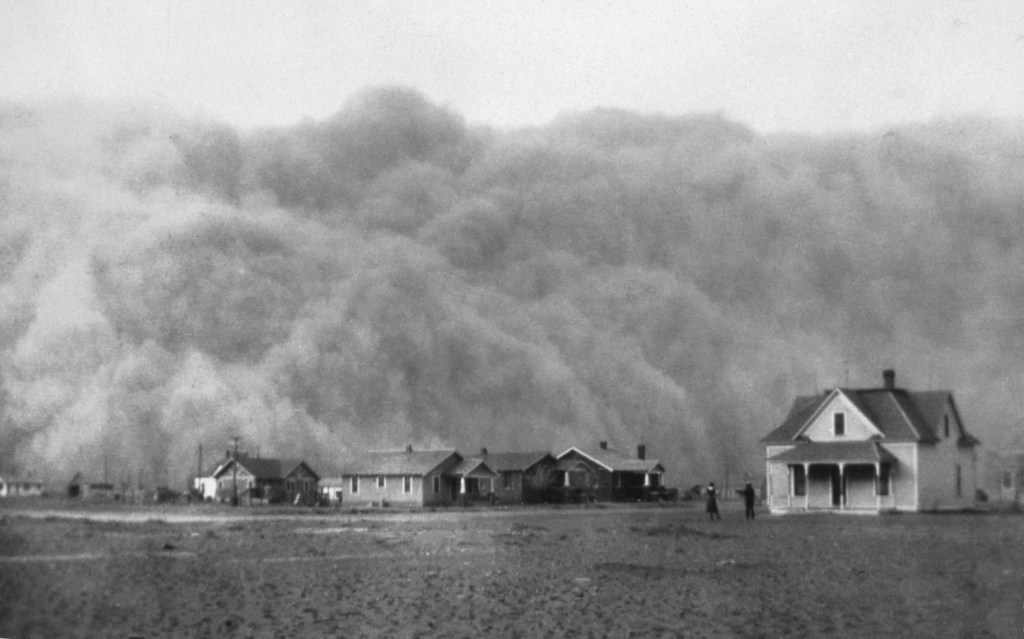
Dust storm approaching Stratford, Texas, 1935 (Wiki Commons, Public Domain)

Unlike many modern inconveniences, these events threatened livelihoods and lives directly. The gathering of dark clouds therefore carried an immediate and tangible significance. They heralded forces beyond human control—forces that could disrupt plans, destroy prosperity, and alter the course of events.

For this reason, clouds became enduring symbols of disturbance, uncertainty, and looming adversity. They represented the moment at which ordinary life was overshadowed by something larger and more powerful than oneself.

A Climate Crisis

Although few of us today rely directly upon the success of a single harvest, the symbolism remains remarkably relevant. We need only consider contemporary concerns surrounding climate change to appreciate the continuing power of weather and environmental disruption. Floods, droughts, storms, and extreme temperatures continue to affect communities, livelihoods, and entire regions.

The Clouds therefore speaks to something timeless. It reminds us that there are periods when clarity is obscured, conditions become unstable, and circumstances are dominated by forces beyond our immediate control. As in ages past, the storm eventually passes—but not always without consequence.

Interpreting the Clouds

In a reading, the Clouds indicates the principal disturbances and difficulties affecting a person’s life. The precise nature of these disturbances is revealed by the surrounding cards, particularly the cartes maîtresses. Thus, the Clouds combined with the Fishes may point towards financial troubles, uncertainty in business affairs, or material setbacks, whilst the Clouds alongside the House may suggest difficulties within the home, family life, or one’s personal foundations. Whatever domain is touched by the Clouds becomes overshadowed and burdened, rendering it more difficult to manage, understand, or navigate with confidence. It is important, however, not to mistake the Clouds for a mere signifier of confusion. The card does not principally denote confusion in and of itself. Rather, confusion is often one of its consequences. The disturbance comes first; bewilderment, uncertainty, and lack of clarity follow in its wake. In this sense, confusion is a symptom of the Clouds, not its cause. The card speaks fundamentally of disruption and darkening—of circumstances becoming troubled, obscured, and more arduous than they would otherwise be.

Coda

Ultimately, the Clouds represents the principal challenges and adversities confronting the seeker. It reveals those areas of life overshadowed by difficulty, uncertainty, and disturbance, where progress is impeded and matters seldom proceed smoothly. As such, it serves as a potent indicator of life’s darker passages—the troubles that must be endured, navigated, and eventually overcome.

Person and Description

The Clouds may also be read as a person and, when appearing in conjunction with a person card, can provide both a physical and temperamental description. In the folklore of playing cards, the roi de trèfle is Alexandre the Great.

Person

As the King of Clubs, the card may signify a man. Depending upon the method employed, this will generally occur when the card appears alongside a social card or is used as a significator in its own right.

In such circumstances, the King ordinarily represents a mature man, often over the age of thirty-five. The Club (Kreuz) suit is associated with labour, burdens, and adversity. Consequently, the King of Clubs frequently denotes a man with whom the seeker has a difficult, strained, or complicated relationship, such as an estranged partner, a stepfather, a troublesome colleague, or another individual whose presence brings challenge rather than ease.

When interpreted primarily as a person, however, the King largely sets aside his Clouds symbolism. In this context, his physical appearance, disposition, and character are determined chiefly by the accompanying cards rather than by the meanings ordinarily associated with the Clouds itself.

Particular attention should be paid when the Clouds appears alongside either the Serpent or the Birch Rod. In the playing-card correspondences, these cards are the Queen and Knave of Clubs respectively, forming a natural association with the Clouds as the King of Clubs. The King and Queen frequently signify a couple whose relationship or influence is central to the matter under consideration, whilst the King and Knave may point towards a father and son, or another senior-junior dynamic of particular importance. 

Physical Description

In matters of physical appearance, the Clouds most commonly describes an individual of average height with a lean or slender build. When accompanied by the Anchor or the Fishes, however, this indication may be modified towards a fuller, heavier, or more substantial frame. A slight stoop or tendency towards a somewhat bowed posture is not uncommon, lending the person a burdened or world-weary appearance.

The eyes are frequently dark in colour and may possess a thoughtful, sombre, or introspective quality. Hair typically ranges from black to dark grey, with salt-and-pepper tones being especially common. Indeed, even in younger individuals, the Clouds can sometimes manifest through premature greying or a generally weathered appearance.

One observation repeatedly borne out in practice is that the Clouds often causes a person to appear older than their years. Whether through expression, bearing, or physical features, those signified by the card frequently convey a sense of gravity, experience, or weariness beyond what their age alone would suggest. As befits a card associated with burdens and adversity, the marks of life’s challenges are often plainly visible upon them.

Temperament

When describing temperament, the Clouds signifies an individual who is reserved, guarded, and restrained in manner. Such a person rarely reveals their thoughts or feelings readily and often possesses a rather rigid set of sensibilities and convictions from which they are not easily moved.

The Clouds quite literally casts a long shadow, and this symbolism is frequently reflected in the personality it describes. Such individuals often have long memories where past grievances are concerned. Slights, disappointments, and injuries may linger in the mind long after others have forgotten them, giving rise to resentment or bitterness. There is often an obstinate quality here, a reluctance to let matters go or to alter one’s position once it has been established.

Above all, however, the Clouds points towards a difficult and mercurial character. Moods may shift unexpectedly, reactions can be unpredictable, and dealings with such a person are seldom straightforward. As with the card itself, there is a sense of obscurity and complication about them, making them challenging to understand and, at times, even more challenging to manage.

Special Features

Proximity and Clouds

In the original instructions, often referred to as the Philippe Lenormand Sheet, interpretation proceeds largely through the principle of proximity, alongside what later practitioners came to call clouding. In practice, however, clouding is not truly a separate interpretative concept. Rather, it is a particular application of proximity viewed from the perspective of the Clouds card itself.

Proximity may be understood as a principle of engagement. Cards engage most strongly with those immediately adjacent to them, creating a direct relationship between the cards involved. The nearer a card lies to the significator, the more immediate and tangible its influence becomes within the life of the querent. Thus, if the Hound lies beside the Lady, we may reasonably conclude that friendship, support, or an entourage plays a prominent role in her circumstances. Likewise, if the Mice appear adjacent to the significator, any losses or diminutions represented by the card become directly experienced and readily perceptible to the querent. Thus, one stands a better chance of recovery.

Clouding operates according to precisely the same principle. The difference lies in the nature of the Clouds card itself. Because its function is darkening, those cards with which it directly engages become overshadowed by its influence. They are, as it were, engulfed within the storm. Cards whose natural qualities are ordinarily positive or illuminating often demonstrate this effect most clearly. The Cloverleaf, which usually signifies opportunity and chance, may find its opportunities obscured or frustrated. The Stars, which bring guidance, direction, and certainty, may lose their clarity. The Lilies, associated with serenity and contentment, may indicate that serenity has become difficult to attain or maintain.

It is important to distinguish this from the influence of other adverse cards. Certainly, cards such as the Coffin, Mountain, Cross, or Birch Rod can negatively affect neighbouring cards. A Mountain beside the Cavalier may impede news; a Coffin beside the Heart may indicate an ending in matters of affection. Yet these cards remain faithful to their own particular natures: the Mountain blocks, the Coffin concludes, the Cross tortures. The Clouds performs a different function. Rather than merely harming or opposing a matter, it obscures it. It shrouds circumstances in uncertainty, casts doubt upon what might otherwise be clear, and makes navigation difficult. Consequently, the essential quality of clouding is not simple negativity but darkening. The matter remains present, but it is hidden beneath shadow, rendered more confused, uncertain, and difficult to apprehend.

Dark and Light

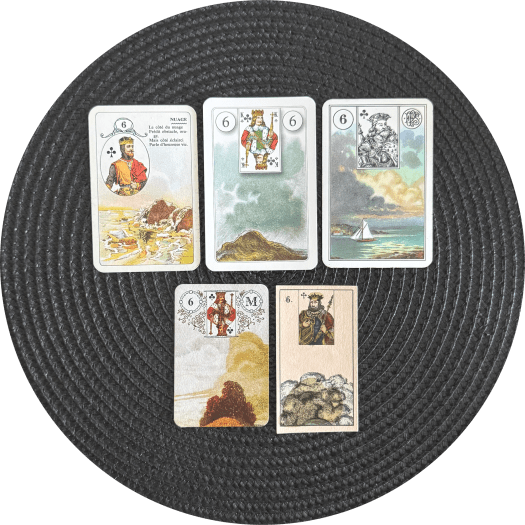
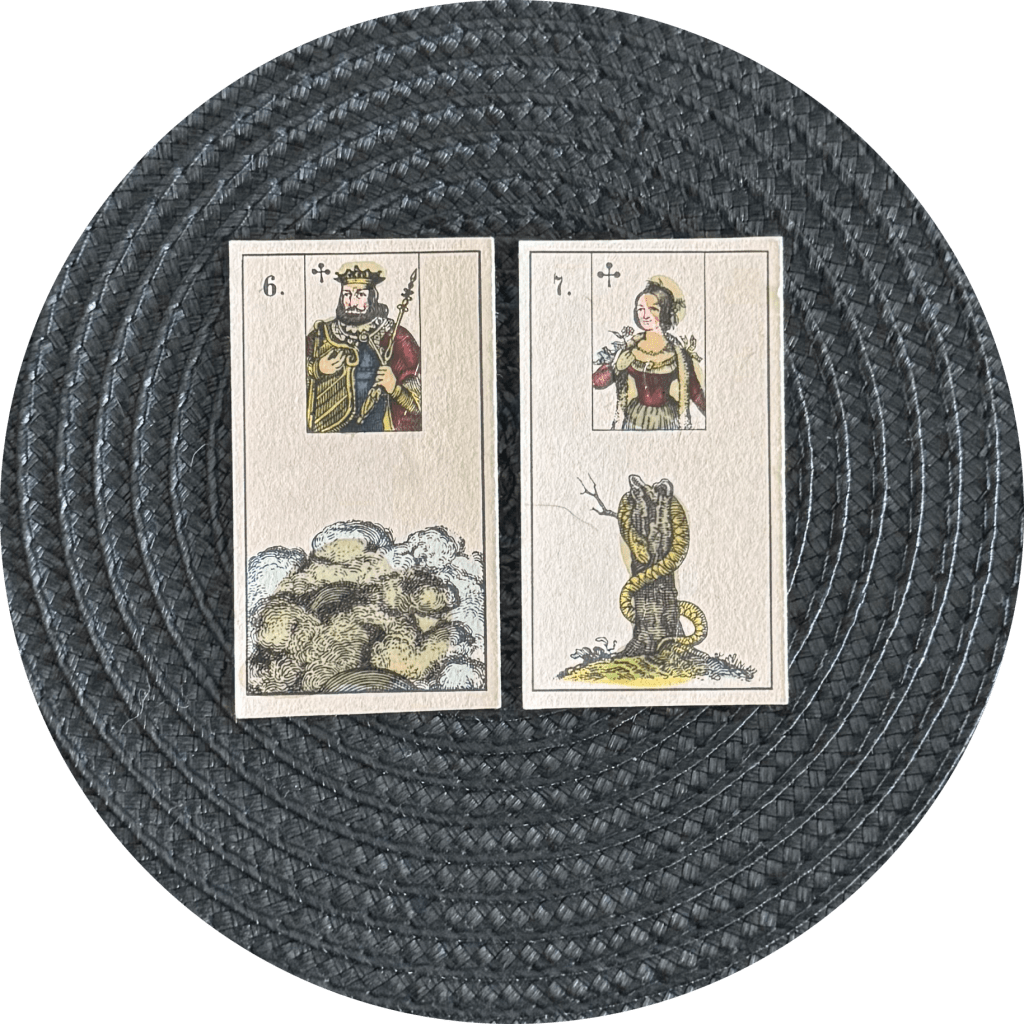
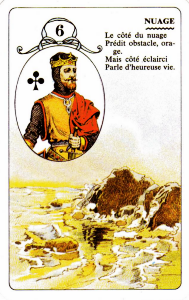
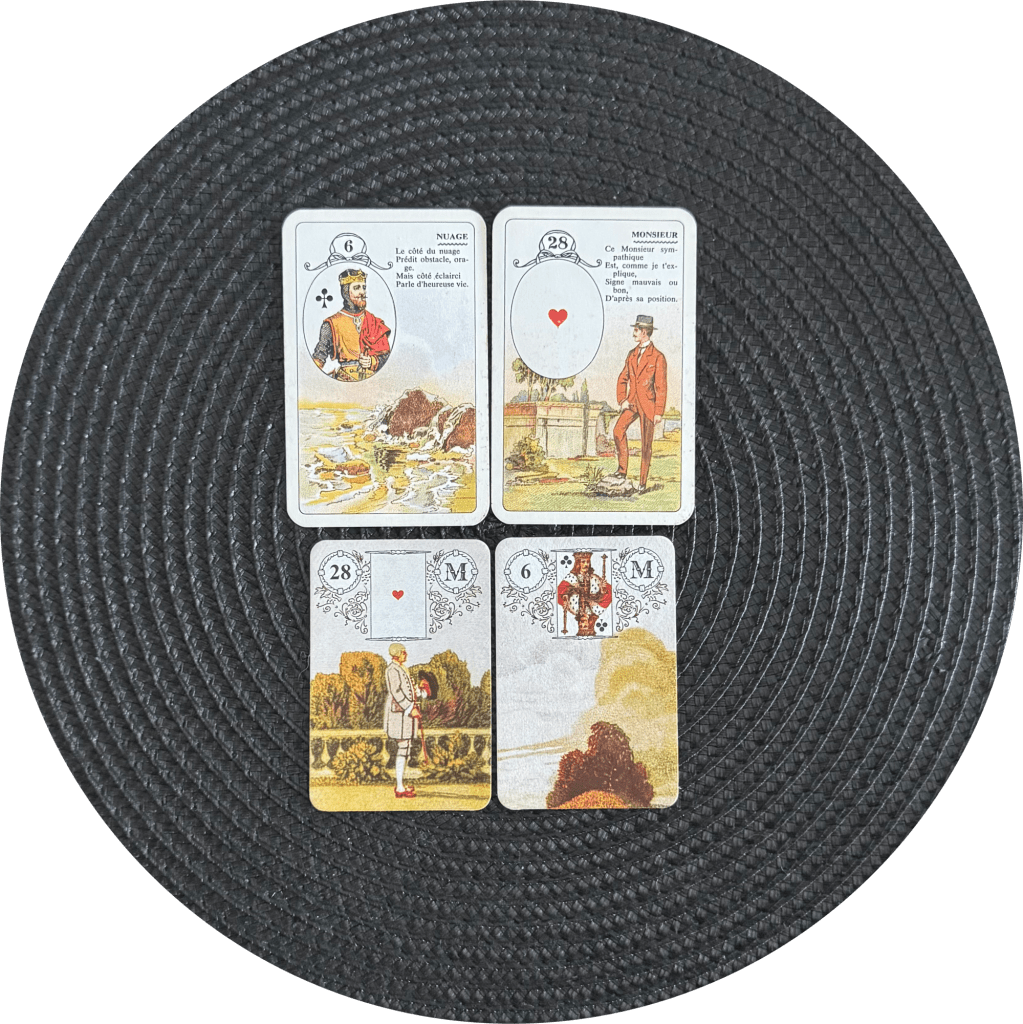
Traditionally, the cartomante paid close attention to the light and dark sides of the Clouds. On many older patterns, the distinction is clearly depicted through the illustration itself, with one portion of the cloud mass appearing noticeably darker and more threatening than the other. Some decks, however, do not provide such an obvious visual cue. In these instances, where the playing-card insert is shown, the direction in which the King of Clubs faces may be used to determine the dark side of the card. In the Carta Mundi deck, which I favour, the King’s orientation places the dark side to the right—a reading further reinforced by the depiction of the rocks and storm-tossed sea on that side of the image.

The original instructions imply that when the light side of the Clouds faces the Significator, the querent may expect good fortune or favourable outcomes. In practice, however, I have never found this interpretation particularly reliable. Experience has suggested a more subtle and consistent approach.

Rather than indicating luck, the light side appears to modify the intensity and duration of the disturbance. When the lighter portion of the Clouds faces the Significator (above, bottom), the difficulties are often already manifest, less severe, more readily understood, or shorter-lived. The storm is present, but it is beginning to break. Conversely, when the dark side faces the Significator (above, top), the obscurity deepens and the difficulties tend to be more serious, prolonged, or difficult to comprehend fully.

The distinction, therefore, is not principally one of good fortune versus ill fortune, but rather one of emphasis and degree. Both sides remain Clouds and both denote disturbance. The difference lies in the severity of the weather. The darker the clouds, the more violent the storm; the lighter the clouds, the sooner one may expect clearer skies.

Weather

Quite naturally, the Clouds also signifies the weather itself. This aspect of the card is most readily observed in short-term readings, such as daily draws or forecasts for the week ahead, where changes in atmospheric conditions often form part of the prediction. Nevertheless, the weather manifestation of the card can appear in larger and more complex spreads as well.

I recall one Grand Tableau in which the Park and Bouquet were accompanied by the Clouds positioned directly above the Park. The client had organised a large celebration to mark her pearl wedding anniversary. Unfortunately, the weather proved unusually inclement for May, and the festivities were somewhat marred by persistent rain and gloomy conditions. In this instance, the Clouds described neither trouble nor adversity in the broader sense, but simply the literal weather affecting the event.

When the Clouds is interpreted meteorologically, the surrounding cards often provide valuable detail regarding the nature of the conditions involved. With the Fishes, one may expect heavy rain, flooding, or excess water. With the Sun, periods of exceptional heat or a heatwave may be indicated. With the Lilies, snowfall, frost, or blizzard-like conditions become more likely. The Stars can point towards hail, sleet, or precipitation falling from an unsettled sky. As ever, the adjacent cards refine and particularise the general disturbance signified by the Clouds.

Timing

In matters of timing, the Clouds is generally regarded as a slow card. It seldom hastens events and more often introduces delays, complications, and diversions from the expected course. Matters governed by the Clouds tend to proceed unevenly, becoming stalled or diverted by circumstances beyond the querent’s immediate control.

Unlike many Lenormand cards, the Clouds possesses few reliable associations with a particular season or time of day. Nevertheless, owing to its obvious meteorological symbolism, it can occasionally point towards hurricane or storm season, particularly the period between August and October when read in an appropriate context.

Health

In health matters, the Clouds is principally associated with the lungs and respiratory system. It governs breathing and those bodily functions connected with the intake and circulation of air.

More generally, the card signifies airborne ailments, seasonal illnesses, and conditions transmitted through the atmosphere. In combination with the Bouquet, it may indicate hay fever, allergies, or sensitivities to flowering plants. Accompanied by the Tree, the emphasis may fall upon tree pollen and related allergic complaints. When found with the Serpent, the card can point towards poisonous fumes, noxious gases, environmental toxins, or other harmful substances carried through the air.

As befits a card whose function is darkening, the Clouds often describes conditions that obscure or impede healthy respiratory function. Congestion, breathlessness, irritation, and susceptibility to seasonal complaints are all natural progressions of its essence.

The Clouds in Action

When reading the Petit Lenormand, one generally favours the more fluid methods of divination, most notably the Grand Tableau, together with lines and squares. From time to time, however, it is advantageous to employ positional layouts in which each card occupies a predefined role. Among those I favour are the Astrological Wheel and the French Cross.

French Cross

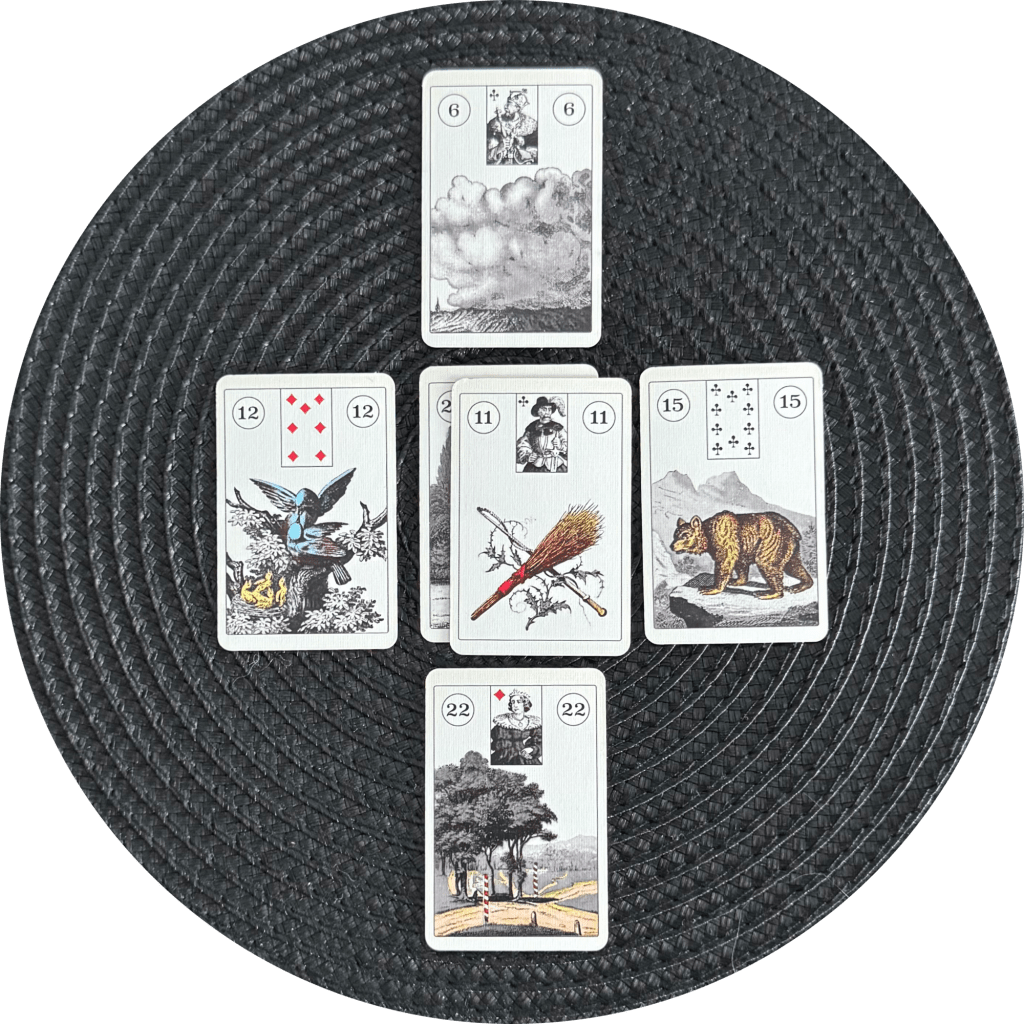
The variation presented here is a synthesis of methods described by Mary Marco, Jeanine Goffinet, Colette Silvestre, and Marie Delclos. Employing five cards, it offers a concise yet remarkably precise response to a specific question and is particularly effective when a clear affirmative or negative answer is sought.

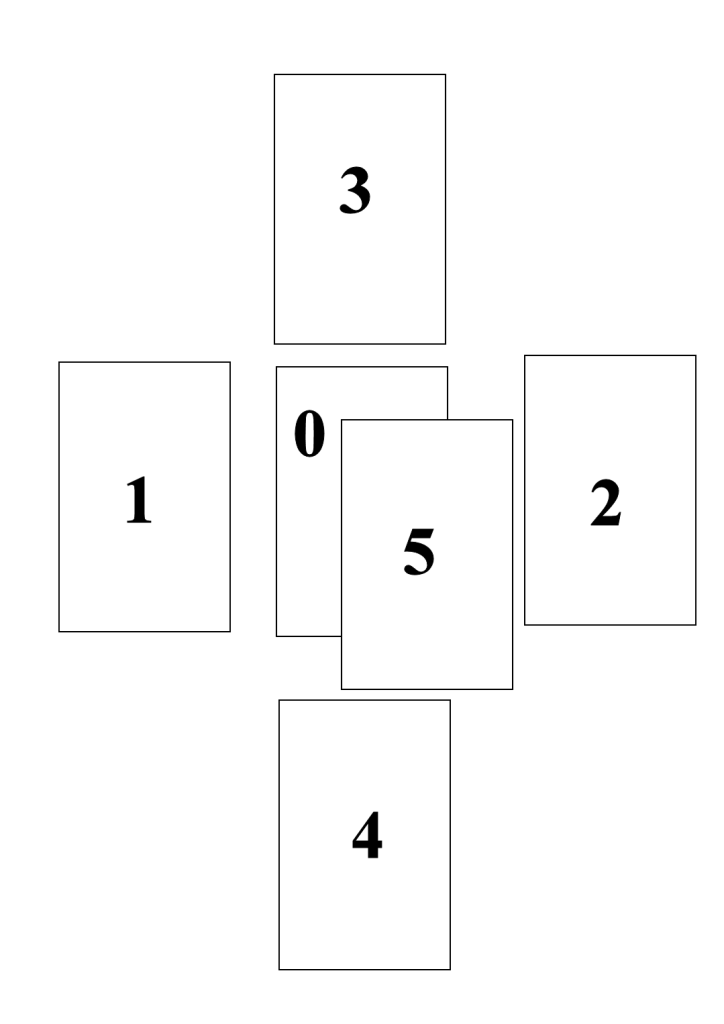
Before shuffling, remove the appropriate significator from the pack. Once the cards have been shuffled, deal five cards around it. Place the first card to the left of the significator, the second to the right, the third above, and the fourth below. The fifth and final card is placed directly upon the significator itself.

The positions are interpreted as follows:

First Card — Represents the consultant in relation to the matter under consideration. It shows their present condition, disposition, or involvement in the question.

Second Card — Indicates the influences acting upon the situation. These may assist progress or impede it, depending upon the nature of the card.

Third Card — Reveals the development that initiates the outcome. It may be understood as the past becoming the present: those circumstances already in motion that will ultimately shape the future.

Fourth Card — Provides the answer to the question and discloses the eventual outcome of the matter.

Fifth Card — Serves as the synthesis of the entire spread, revealing the overall character, tone, or quality of the answer. It should not, however, be mistaken for the answer itself. That role belongs solely to the fourth card, whilst the fifth modifies and colours its expression.

This distinction is of considerable importance, for many otherwise puzzling combinations become readily intelligible once the fifth card is understood as a qualifier rather than an outcome in its own right.

Carrie’s Reading

Carrie was referred to me by a longstanding client in early 2025. She had become engaged to Jack a few months earlier, and the couple were planning to marry during the summer of 2026. Unfortunately, Carrie had a strained relationship with her stepmother and would have preferred not to invite either her half-sister or her stepsister to the wedding. Her father, however, was keen for all three to attend and play a prominent role in the celebrations. The question posed was straightforward: would difficulties arise if Carrie chose not to invite them?

The cards drawn were the Birds, the Bear, the Clouds, the Roads, and the Birch Rod.

At once, one sees that the matter is a source of considerable anxiety. The Birds reflects agitation, worry, and the sort of emotional commotion that distracts and overwhelms. Carrie is clearly unsettled by the situation and acutely aware of the potential consequences of her decision.

The Bear reveals the principal obstacle. She knows there would be significant resistance were she to exclude her stepmother, half-sister, and stepsister, particularly from her father. Whilst the Bear can often represent a specific individual, here it is better understood as a picture of pressure, authority, and opposition. The family dynamic is characterised by a forceful insistence that these relatives be included.

The Clouds occupies the third position and thus reveals the development that initiates the outcome. In this spread, the third card represents those circumstances already taking shape: the past becoming the present and thereby shaping the future. Here, the Clouds shows that Carrie’s proposed course of action would introduce a growing atmosphere of tension, uncertainty, and disharmony. Rather than allowing the matter to settle, it would cast an increasingly long shadow over the wedding preparations. What begins as a personal decision would gradually evolve into a wider family dispute.

The Roads provides the answer and outcome. Guests would be compelled to decide where their loyalties lay, and some might feel obliged to decline the invitation altogether in order to avoid the appearance of taking sides. The card suggests division, competing allegiances, and the necessity of making difficult choices.

The synthesis card, the Birch Rod, confirms that the matter would culminate in conflict and considerable unpleasantness. It is also worth remembering that the Birch Rod may signify correction, adjustment, or the setting of something aright. In practical terms, this suggested that Carrie would ultimately find herself compelled to revise her position and extend an invitation to her stepmother in order to restore harmony and placate those most affected by the dispute.


§

Cards: Jeu Lenormand © Cartamundi, WanderWüst © Jorge/Wandering Oracle, Lenormand 36 Orakelspielkarten © Königsfurt-UraniaNr. 1941 Mlle Lenormand Wahrsagekarten © Piatnik, Lenormand Fortune-Telling Cards © Zao-Gelli, The Lenormand Oracle © Verlag für die Frau, Leipzig (1982).

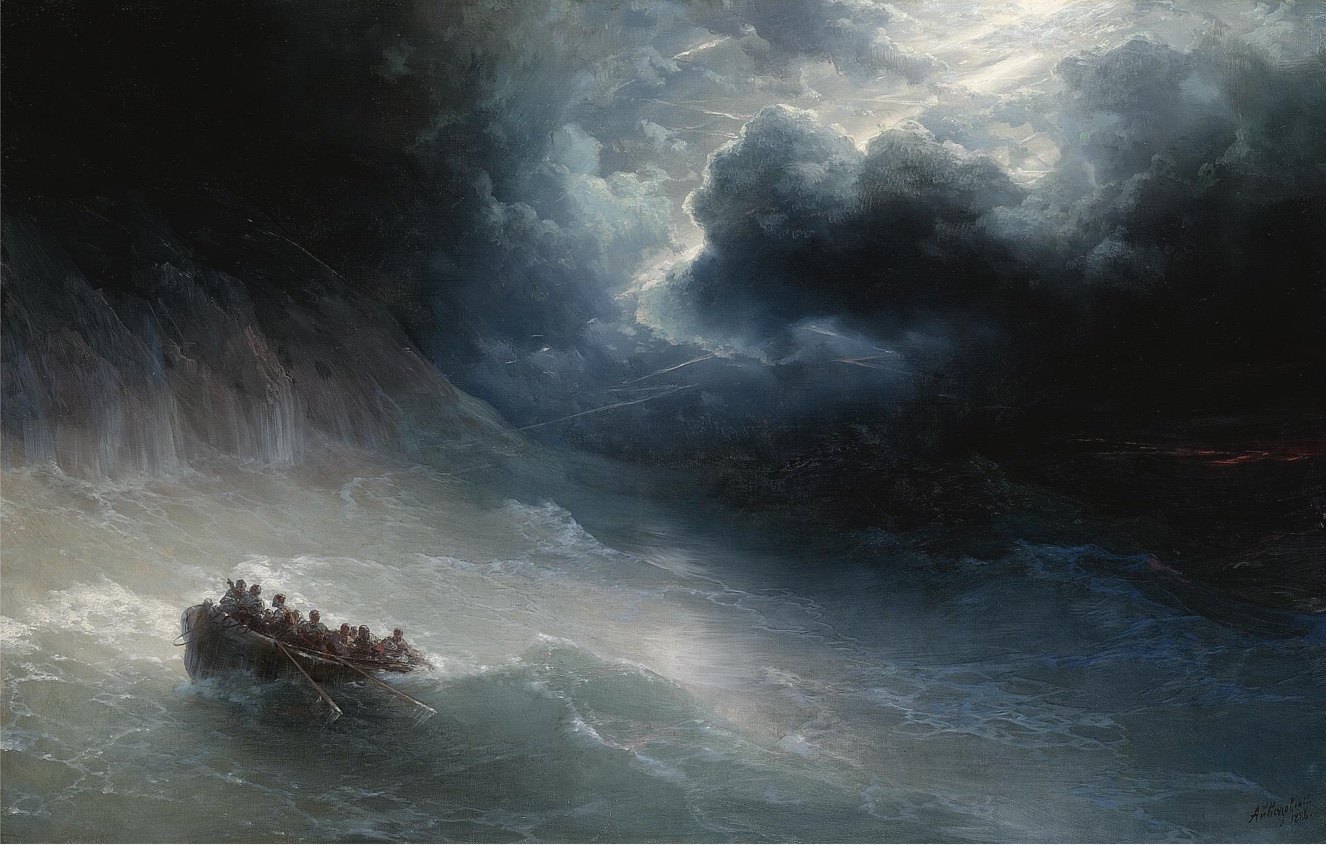
Featured Image: Wrath of the Seas, Ivan Aivazovsky, Wiki Commons/Public Domain

References:

Avelar, H. and Ribeiro, L. (2010) On the Heavenly Spheres: A Treatise on Traditional Astrology. Tempe, AZ: American Federation of Astrologers.
Boroveshengra, A., 2013. Cartomantes’ Cabinet: The Petit Lenormand Course.
Boroveshengra, A., 2015. Lenormand Thirty Six cards. 2nd ed. Create Space.
Delclos, M., 2013. Le Livre du Petit Lenormand. 1st ed. Escalquens: Éd. Trajectoire.
Dykes, B.N. (2013) Astrology of the World I: The Ptolemaic Inheritance. Minneapolis, MN: Cazimi Press.
Marco, M. and Goffinet, J., 1989. Petit Lenormand. Bruxelles: Servranx.
Matthews, C. (2014) The Complete Lenormand Oracle Handbook: Reading the Language and Symbols of the Cards. Rochester, VT: Destiny Books.
Meuris, B., 2018. Petit Lenormand Encyclopaedia: Volume 1. Create Space.
Ptolemaeus, C. and Robbins, F.E. (2001) Tetrabiblos. Cambridge, MA: Harvard Univ. Press.
Silvestre, C., 2003. Le Petit Lenormand. [Montpellier]: Gange éd.