This article continues my series examining the Tarot de Marseille, and begins to introduce the four suits or Lesser Arcana. Like the series on the trumps, it is adapted from my unpublished manuscript, Tarot de Marseille: The Picturebook of Fate. As throughout this series, the emphasis is placed upon the traditional eikōn of the card, its historical context, and the practical significations I have found useful through divinatory practice. The interpretations presented here reflect my own experience of working with the Tarot de Marseille and should be understood as a working method rather than a definitive authority.
The Pip Cards: The Four Suits
Having examined the trumps, we now turn our attention to the remaining fifty-six cards of the Tarot, collectively known as the Pips or Lesser Arcana.
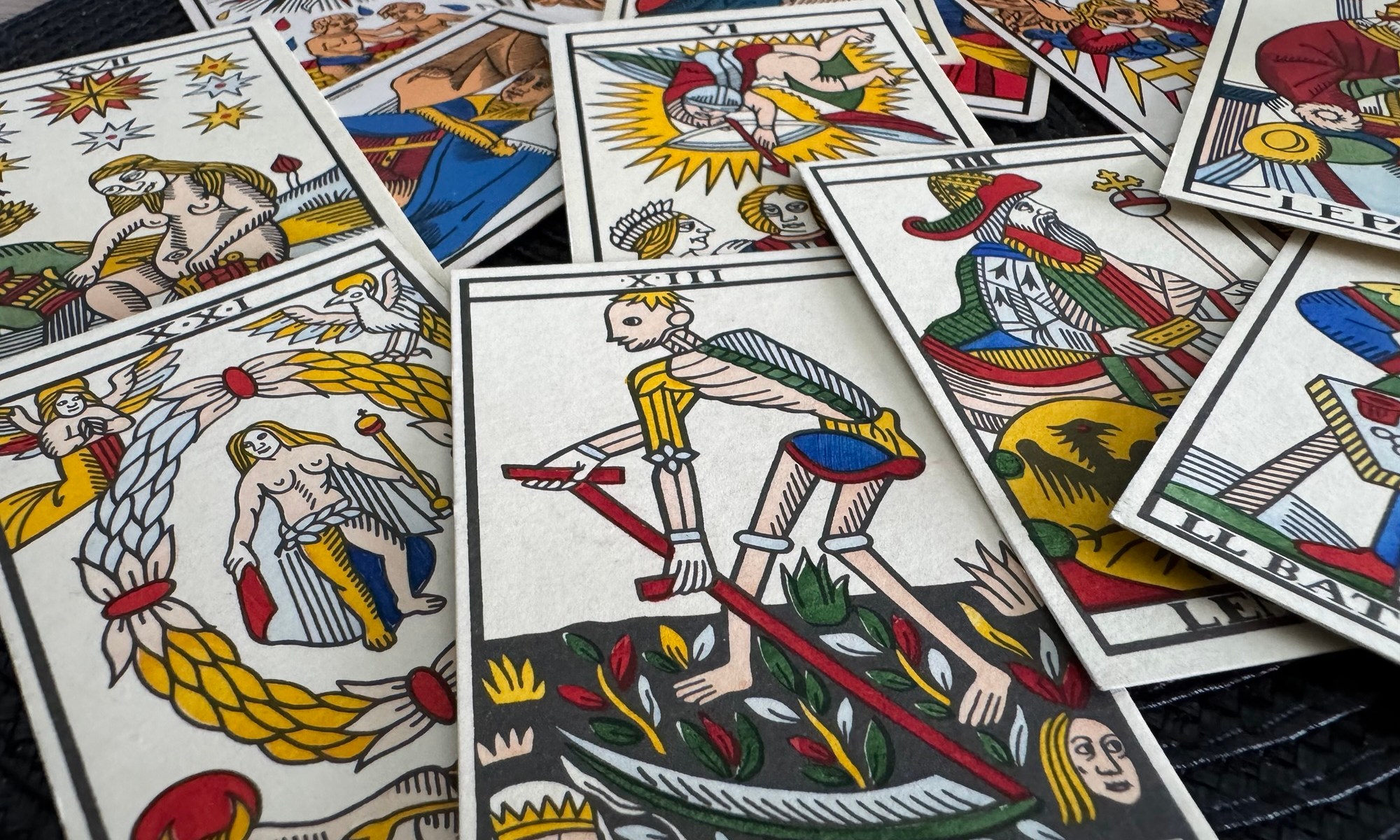
Unlike the trumps, which depict allegorical figures and scenes, the pip cards are divided into four suits. These suits correspond to the four elements and represent the ordinary affairs of life through which the principles illustrated by the trumps manifest themselves. Whilst the trumps reveal universal forces and conditions, the pips describe how those forces express themselves within everyday experience.
The fifty-six pip cards are divided into four suits:
| Italian | French | English | Element |
| Spade | Épées | Swords | Fire |
| Coppe | Couples | Cups | Air |
| Denari | Deniers | Coins | Water |
| Bastoni | Bâtons | Batons | Earth |
This order is not arbitrary. It follows the traditional arrangement of the four elements within the sublunar sphere. According to classical cosmology, Fire occupied the highest position nearest the celestial spheres, followed by Air, then Water, with Earth at the centre of the material world. Since the suits correspond to these elements, they are presented here in the same order.
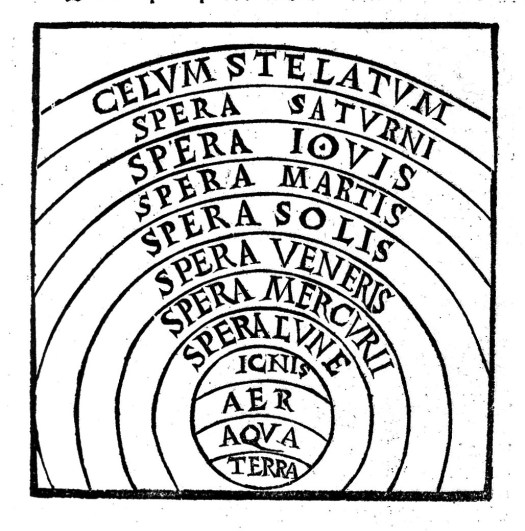
Credit: Wellcome Library, London. Wellcome Images
images@wellcome.ac.uk
http://wellcomeimages.org
Diagram of Earth, Sun and Planets.
Philosophia naturalis
Albertus Magnus
Published: 1506
Copyrighted work available under Creative Commons Attribution only licence CC BY 4.0 http://creativecommons.org/licenses/by/4.0/
Each suit contains fourteen cards, giving a total of fifty-six. Ten of these are numbered cards progressing from Ace through Ten. The remaining four are the Court Cards: the Valet, Knight, Queen, and King.
The numbered cards describe situations, conditions, developments, and experiences.
Their meanings arise from the interaction between number and element. The Court Cards, by contrast, frequently signify people, social roles, characteristic behaviours, and the ways in which individuals express the qualities of a suit.
Before examining the individual cards, however, it is necessary to understand the elemental foundations upon which the suits are built. The four suits do not exist independently of one another. Rather, they arise from the interaction of Fire, Air, Water, and Earth, the four elements long regarded as the building blocks of the created world. It is to these elements that we must now turn.
The Four Elements
Throughout the Middle Ages, the Aristotelian understanding of the four elements dominated European thought. The elements were not regarded as substances in the modern scientific sense, but as combinations of fundamental qualities through which the natural world was understood. Fire, air, water, and earth explained not merely physical processes, but temperament, behaviour, medicine, agriculture, and cosmology.
A proper understanding of the four elements therefore depends less upon the elements themselves than upon the qualities from which they arise. To understand an element, one must first understand its nature and cause.
The four elements arise from the interaction of four primary qualities: heat, cold, dryness, and moisture.
Of these qualities, heat and cold are primary and active, whilst dryness and moisture are secondary and passive. Dryness and moisture arise through the interaction of heat and cold and modify their expression.
- Heat is light, expansive, dynamic, and centrifugal. It seeks movement, activity, and expression.
- Cold is heavy, contractive, still, and centripetal. It seeks stability, preservation, and containment.
- Dryness is hard, structural, resistant, and defining. It creates boundaries and distinctions.
- Moisture is adaptive, cohesive, yielding, and unifying. It joins, blends, and accommodates.
Each of the four elements is formed through the union of one active quality and one passive quality.
Fire
Fire arises from the union of heat and dryness. It is active, forceful, and self-projecting. Fire discriminates, transforms, and imposes itself upon its surroundings.
Air
Air arises from the union of heat and moisture. It is mobile, flexible, and life-giving. Air transports, connects, and adapts, bringing movement and exchange wherever it goes.
Water
Water arises from the union of cold and moisture. It is receptive, adaptive, and conserving. Water gathers, nourishes, and irrigates. It seeks cohesion and continuity rather than expansion.
Earth
Earth arises from the union of cold and dryness. It is stable, enduring, and resistant. Earth preserves structure, establishes boundaries, and provides permanence.
Elemental Relationships
The traditional symbols of the four elements are represented by triangles.
The two upright triangles represent the active elements: Air and Fire. Both derive their primary nature from heat and therefore possess an outward, expansive mode of operation.
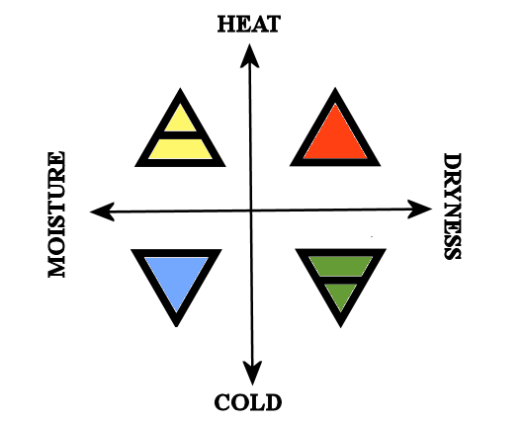
The two inverted triangles represent the passive elements: Water and Earth. Both derive their primary nature from cold and therefore possess an inward, conserving mode of operation.
Elements sharing the same primary quality possess the same mode and are therefore naturally harmonious. Fire and Air are friendly to one another, as are Water and Earth.
Elements sharing a secondary quality differ in mode but possess points of commonality. They neither reinforce one another nor oppose each other strongly and may therefore be regarded as neutral. Fire and Earth share dryness; Air and Water share moisture.
Elements sharing no qualities are fundamentally opposed. Fire and Water neutralise one another, whilst Air and Earth likewise stand in opposition.
Thus, friendly elements appear alongside one another, neutral elements touch, and inimical elements confront one another across the elemental scheme.
§
Tarot Cards: Jean Dodal Tarot via Wikipedia Commons. Public Domain.
Featured Image: Ancient Tarot Major Arcana © BP Grimaud/John Waddington Ltd, Leeds & London, Les Tarot de Marseille Jean Noblet, 1650 © Editions «letarot.com» (2001 [hand stencilled trumps]). Les Tarot de Marseille Jean Dodal, 1701 et 1715 © Editions «letarot.com» (2002 [hand stencilled trumps])
References:
Whilst this article reflects my own interpretations and experience of working with the cards, the principle sources and references that informed its development and the text are provided below for the interested reader.
Augustine and Pine-Coffin, R.S. (2003) Confessions. London, England: Penguin Books.
Saint Augustine of Hippo and Bettenson, H. (2004) City of God. Penguin Books.
Carvalho, H.A. de and Ribeiro, L. (2010) On the heavenly spheres: A treatise on traditional astrology. Tempe, AZ: American Federation of Astrologers.
Benedict et al. (1981) RB 1980: The Rule of St. Benedict. Collegeville, MN: Liturgical Press.
Catholic Truth Society, Catechism of the Catholic Church (2016). London: Catholic Truth Society.
Decker, R., Depaulis, T. and Dummett, M. (2002) A Wicked Pack of Cards: The Origins of the Occult Tarot. London: Duckworth.
Collins UK (2006) The Divine Office, volume I: Daily Prayer for Advent and Christmastide & Weeks 1-9. HarperCollins UK.
Collins UK (2006) The Divine Office, volume II: Daily Prayer for Lent and Eastertide. HarperCollins UK.
Collins UK (2006) The Divine Office, volume III: Daily Prayer for Weeks 6-34 of the Church Year. HarperCollins UK.
Farley, H. (2009) A cultural history of Tarot: From entertainment to esotericism. London: I.B. Tauris.
Ficino, M., Kaske, C.V. and Clark, J.R. (2019) Three Books on Life. Tempe, AZ: Arizona Center for Medieval and Renaissance Studies.
Ficinus, M. and Voss, A. (2009) Marsilio Ficino Edited and Introduced by Angela Voss. Berkeley, Calif: North Atlantic Books.
Frawley, J. (2001) The Real Astrology. London: Apprentice.
Frawley, J. (2002) The Real Astrology Applied: Teachings from the ‘Astrologer’s Apprentice’. London: Apprentice.
Frawley, J. (2011) The Horary textbook. London: Apprentice Books.
Giorgi, R., Zuffi, S. and Giammanco Frongia, R.M. (2005) Angels and Demons in Art. Los Angeles: J. Paul Getty Museum.
Jodorowsky, A., Costa, M. and Graham, J.E. (2009) The Way of Tarot: The Spiritual Teacher in the Cards. Rochester, Vt: Destiny Books.
Jones, A. (1974) The Jerusalem Bible. London: Darton, Longman and Todd.
Jones, M.D.W. (2008) The Counter Reformation: Religion and Society in Early Modern Europe. Cambridge England: Cambridge University Press.
McHugh, J.A., Callan, C.J. and Pius (2017) Catechism of the Council of Trent for Parish Priests: Issued by order of Pope Pius V. Charlotte, NC: TAN Books.
Nees, L. (2002) Early Medieval Art. Oxford: Oxford University Press.
Nouwen, H.J.M. (2007) Behold the beauty of the lord: Praying with icons. Notre Dame, Ind: Ave Maria Press.
Ptolemaeus, C. and Robbins, F.E. (2001) Tetrabiblos. Cambridge, MA: Harvard Univ. Press.
Silvestre, C.H. (1987) ABC des Tarots. Paris: Marabout.
Silvestre, C. (2004) Le Tarot Qui Guérit. Paris: Éd. Trajectoire.
Silvestre, C. (2013) La Roue Astrologique et le Tarot. Escalquens: Éd. Trajectoire.
Silvestre, C. (2016) Rencontre des Arcanes Majeurs et Mineurs du Tarot de Marseille: 1232 Associations Interprétées. Escalquens: Grancher éditions.
Silvestre, C. (2016a) Les 21 Portes des Arcanes du Tarot de Marseille et d’Oswald Wirth. Paris: Éditions Exergue.
Thomas (2018) Summa Theologica: Complete in a Single Volume. Claremont, CA: Coyote Canyon Press.
Unger, T. (1994) Le tarot, Jeu du Gouvernement du Monde: Éclairer votre regard, Choisir Votre partenaire, réussir l’entreprise. Paris: Montorgueil.
Valens, V. and Riley, M.T. (2022) The Anthology. Denver, CO: Amor Fati Publications.
Williams, B. (2003) A Renaissance Tarot: A Guide to the Renaissance Tarot. U.S. Games Systems.
 Journal of a Cartomante