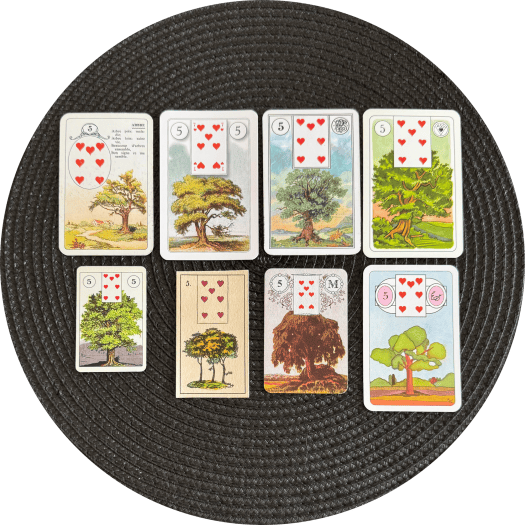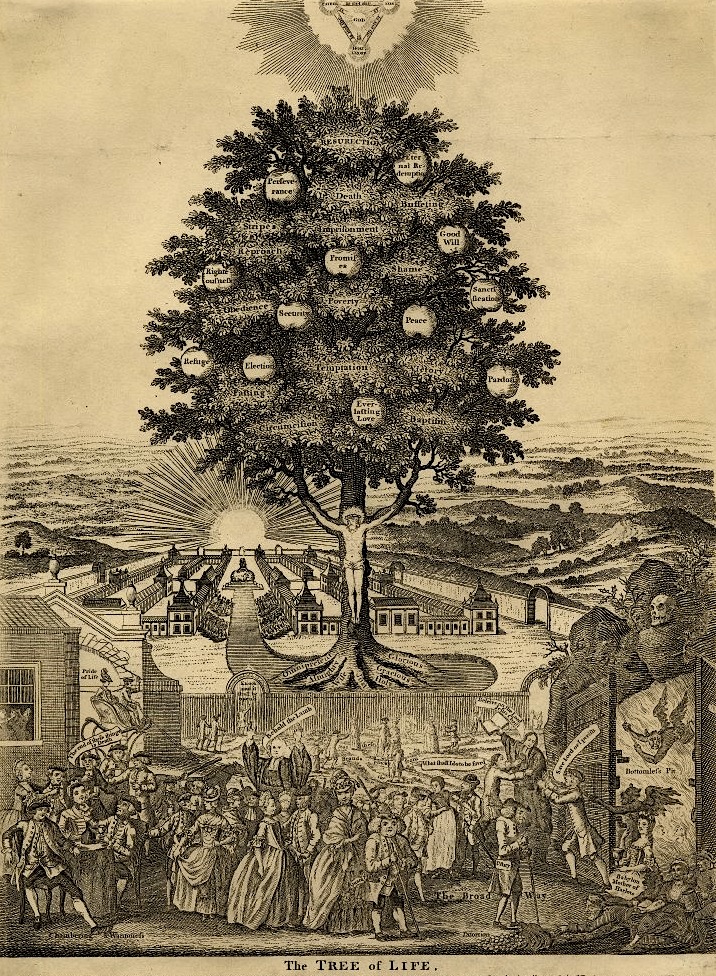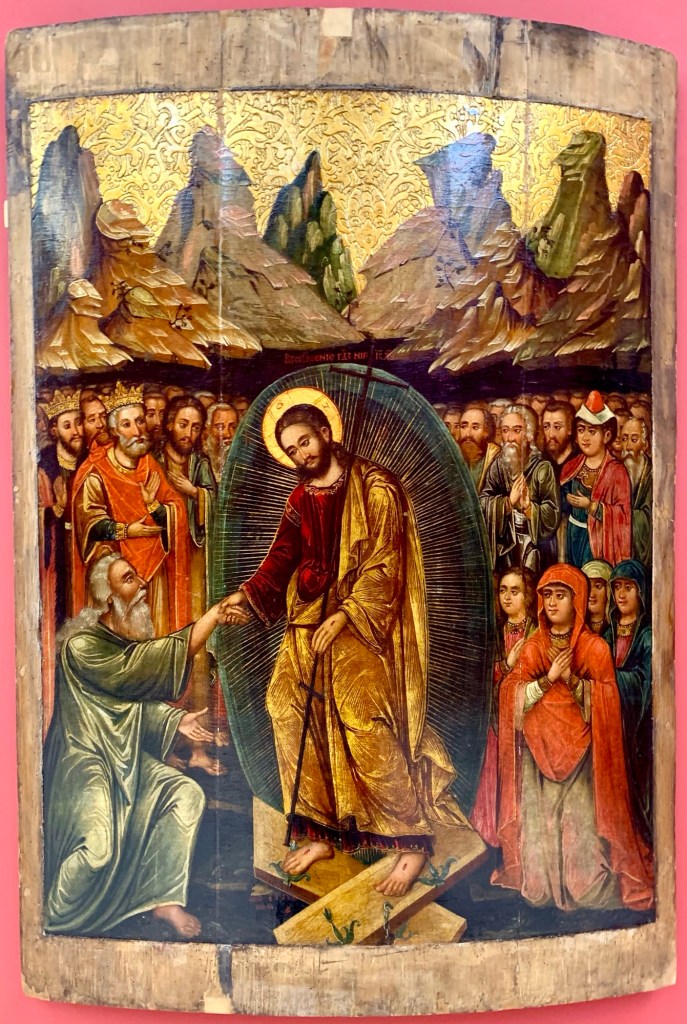
A Painful Correction: The Birch Rod Card

The following article has been revised and expanded, incorporating additional material and restructured to provide a more coherent exploration of the card.

He who spares the rod hates his son, but he who loves him is diligent to discipline him.
Proverbs 13:24 (RCV CE)

He was despised and rejected by men; a man of sorrows, and acquainted with grief; and as one from whom men hide their faces, he was despised, and we esteemed him not. Surely he has borne our grief and carried our sorrows; yet we esteemed him stricken, smitten by God, and afflicted. But he was wounded for our transgressions, he was bruised for our iniquities; upon him was the chastisement that made us whole, and with his stripes we are healed.
Isaiah 53: 1 – 5 (RSV CE)

Then Pilate took Jesus and scourged him. And the soldiers plaited a crown of thorns, and put it on his head, and arrayed him in a purple robe; they came up to him, saying, “Hail, King of the Jews!” and struck him with their hands
John 19:1 – 3 (RSV CE)

A second blow followed the first, then a third, and another and another, and still others. The wheel did not cease to turn, nor the blows to rain down.

Soon the blood burst forth, and could be seen trickling in a thousand threads down the hunchback’s black shoulders; and the slender thongs, in their rotatory motion which rent the air, sprinkled drops of it upon the crowd.
Victor Hugo, Notre Dame de Paris

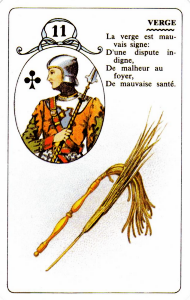
Birch Rod, signifies family quarrels and domestic trouble, dissension between spouses, fever and long illness.
Original Instructions

Card No. 11, the Knave of Clubs or the Birch Rod, often provokes debate. Does it signify something that happens repeatedly? Is it a card of correction or sexuality? Or does it primarily concern conflict and discipline?

The Essence and Function of the Birch Rod

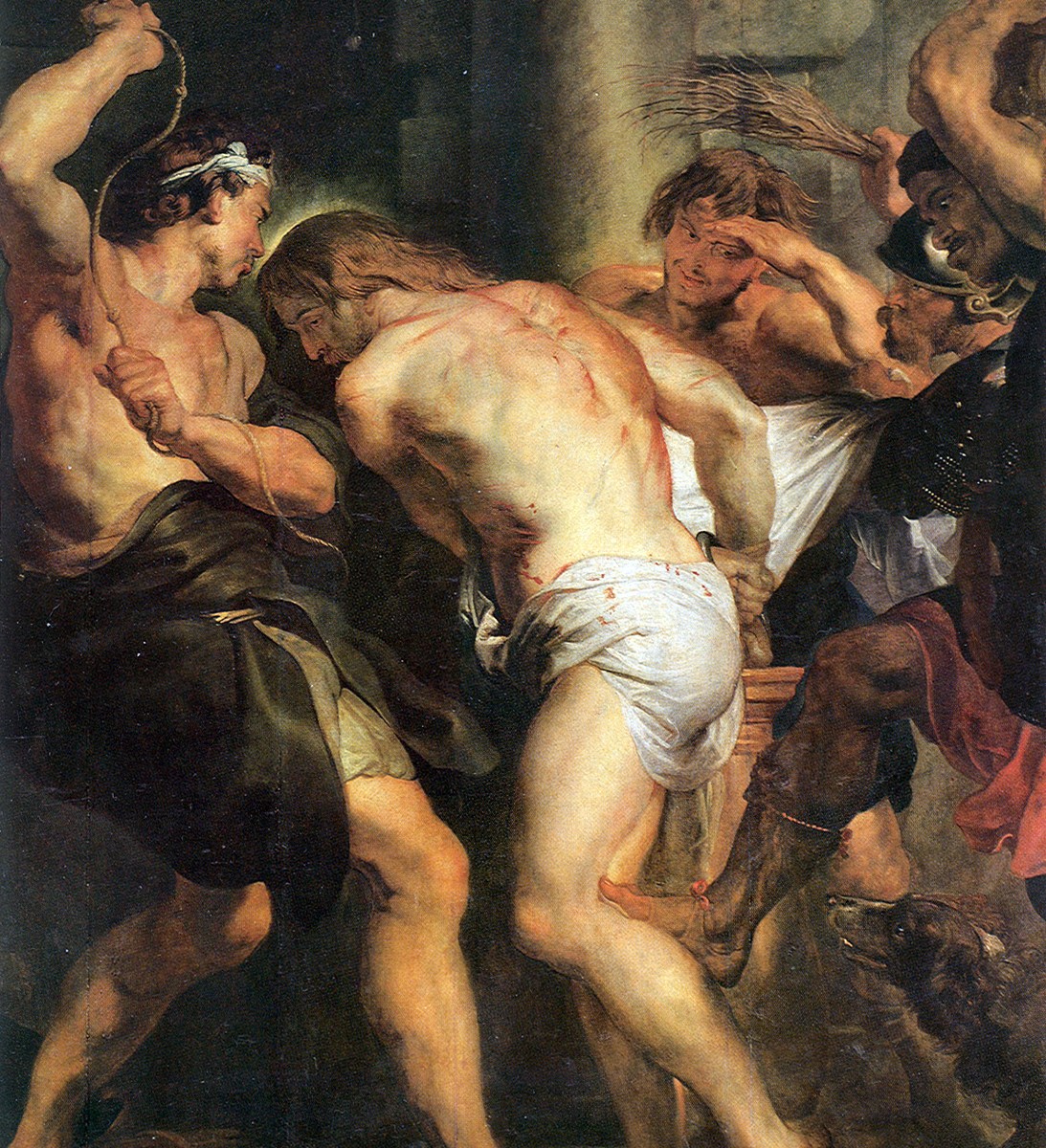
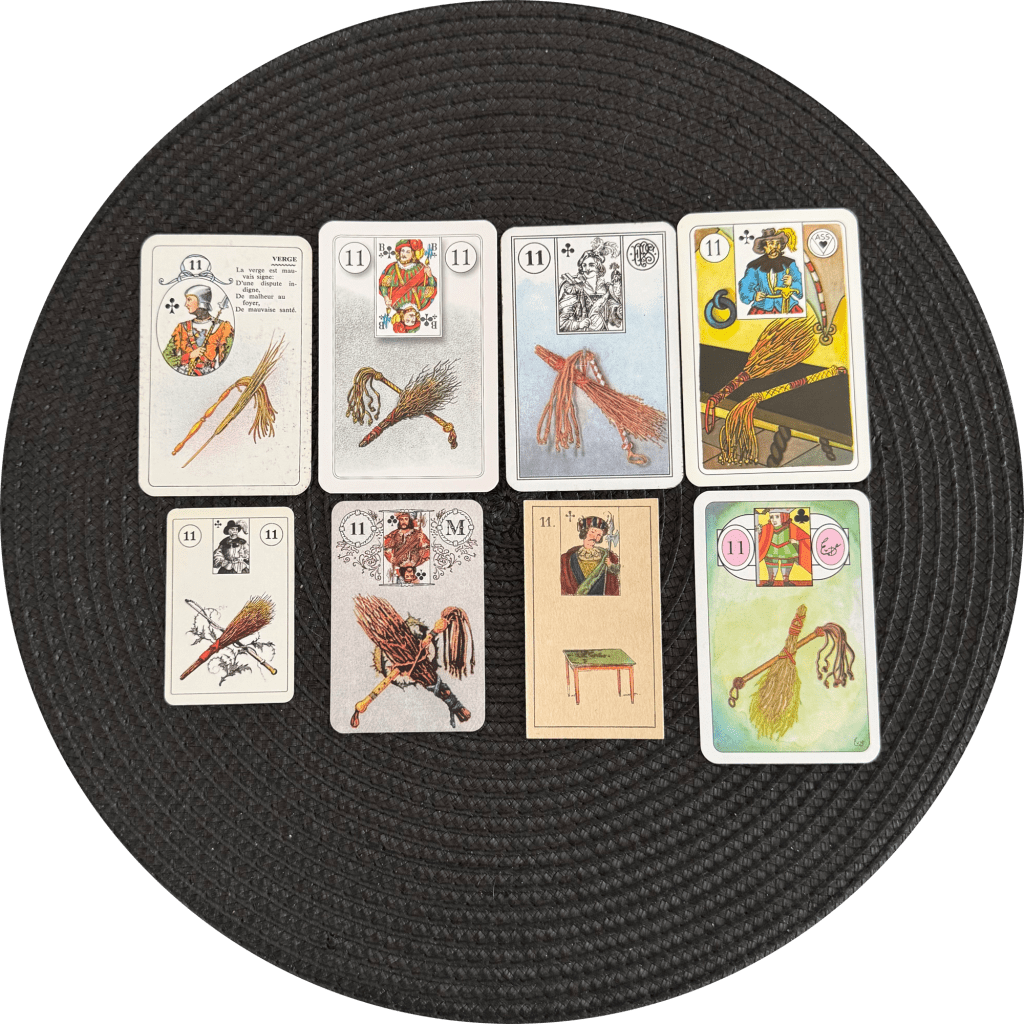
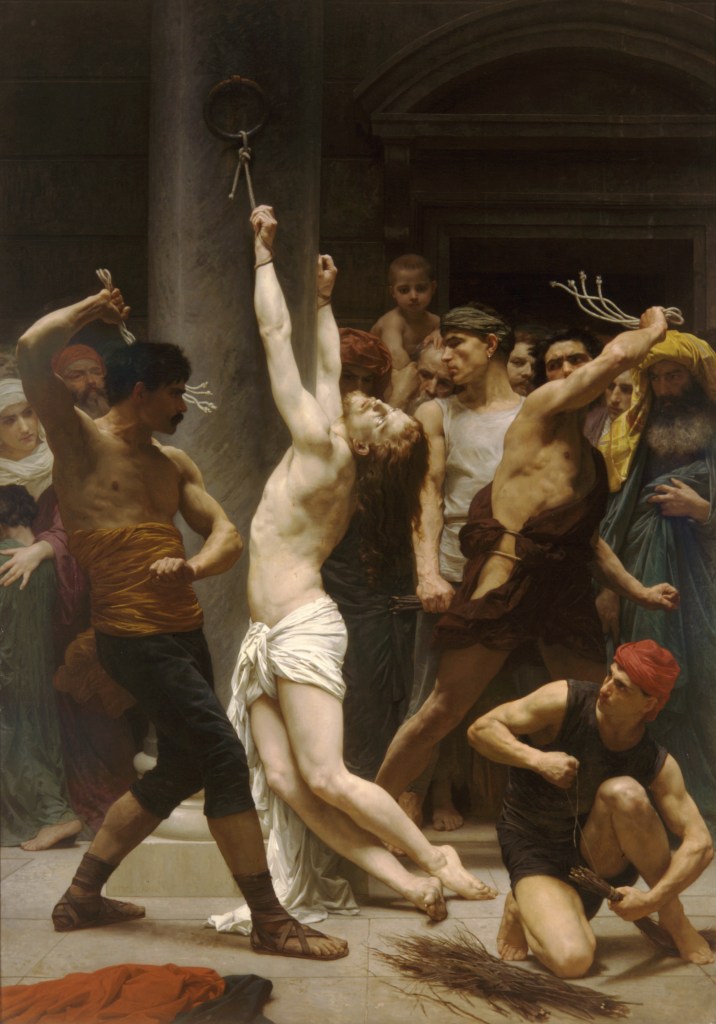
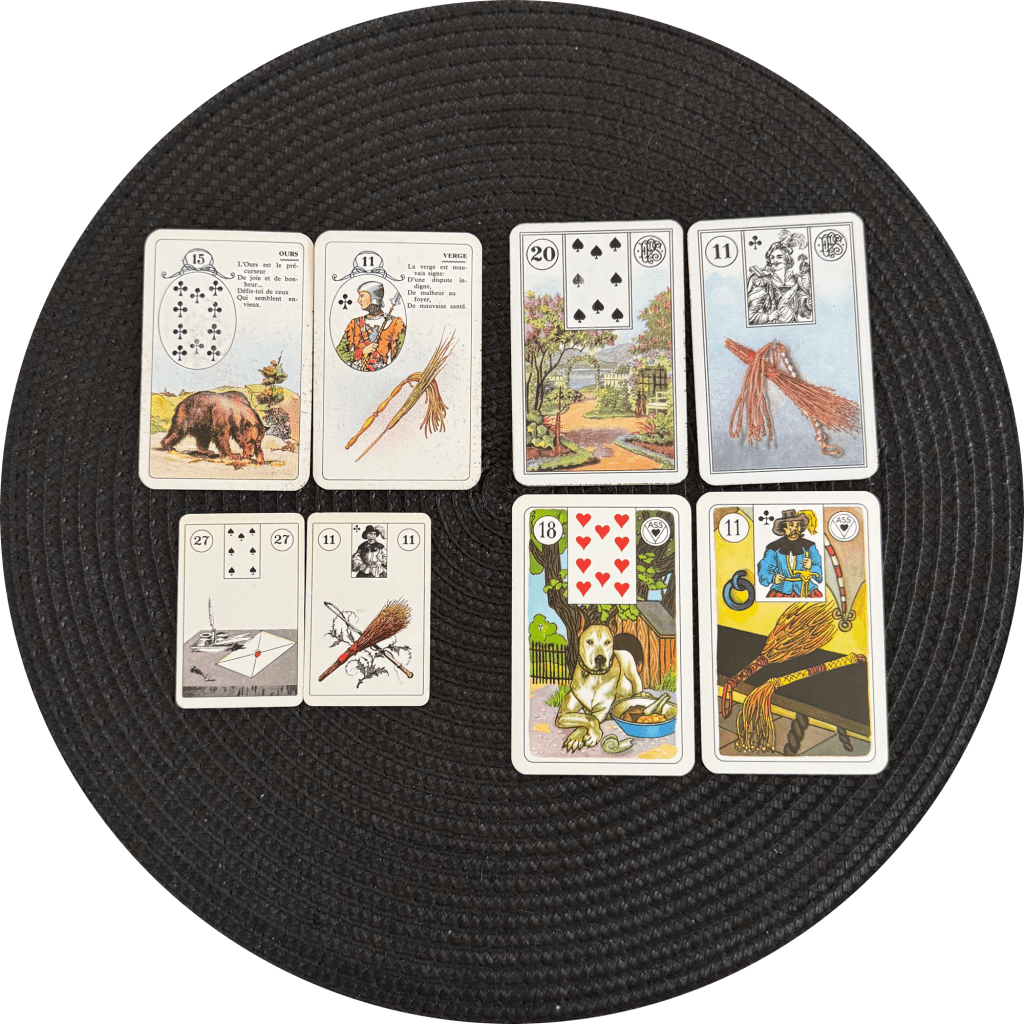
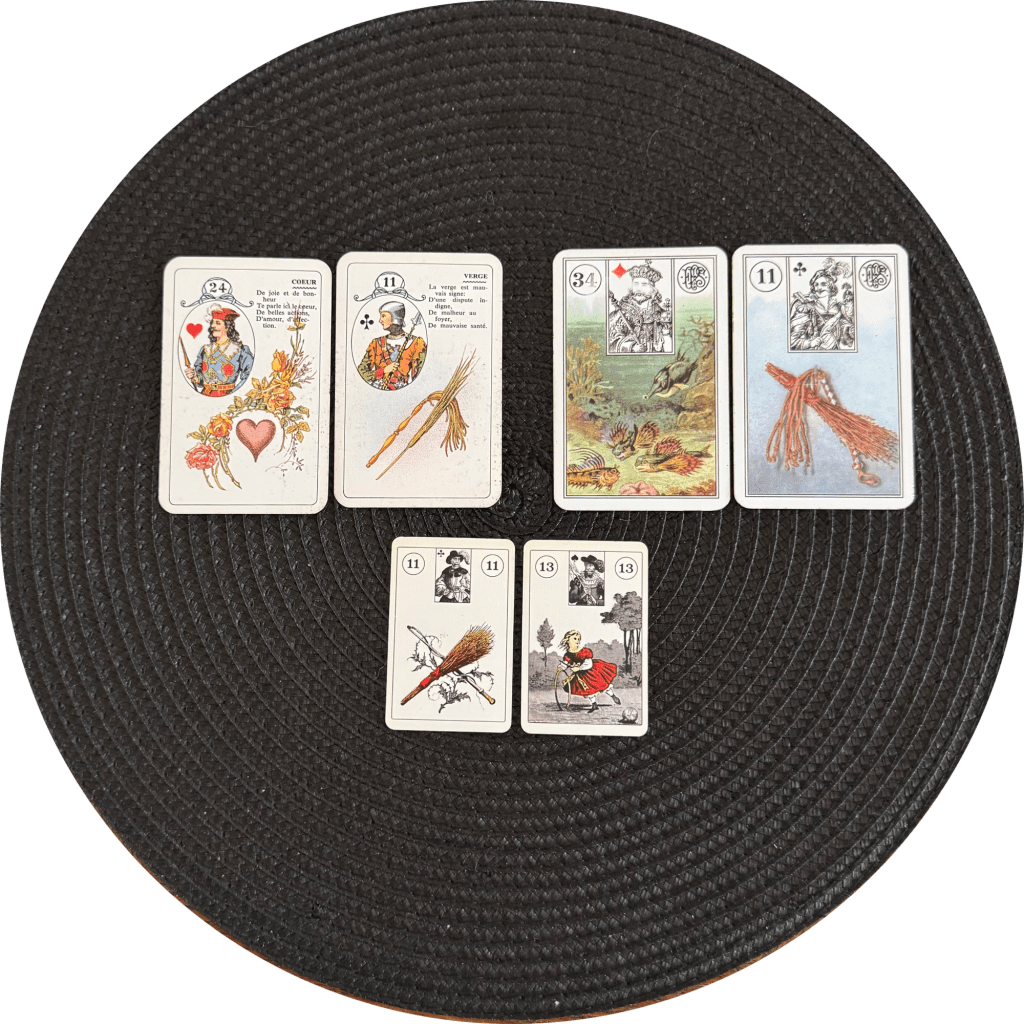
It is not uncommon to see a broom depicted upon modern versions of the card. Traditionally, however, the emblem is a bundle of birch twigs and a scourge. Both were instruments of corporal punishment and discipline, immediately bringing to mind the scourging of Christ prior to the Crucifixion.

This imagery is important.

The essence of the Birch Rod is correction and its function is to discipline.

The scourge was not simply an instrument of pain. It was intended to punish, chastise, and correct behaviour through suffering. Whether one agrees with such methods today is beside the point. The symbolism would have been immediately understood by the people who first played and interpreted these cards.

The Flagellation of Our Lord, William-Adolphe Bouguereau, Public domain, via Wikimedia Commons

The Birch Rod therefore appears whenever something has drifted off course and requires correction.

Some readers regard the Birch Rod as neutral or mixed because correction can ultimately improve a situation. Whilst there is truth in this observation, I nevertheless consider the card fundamentally negative.

Corrections do not occur without cause.

A relationship requires difficult conversations because problems already exist. A student receives criticism because mistakes have been made. A criminal receives punishment because laws have been broken. A warning is issued because somebody has already strayed too close to danger.

Supplice du Grand Knout, Public domain, via Wikimedia Commons

The process may ultimately help.

It is rarely pleasant.

The Birch Rod is therefore a sign that remedial action is required. It forces us to confront circumstances directly, take responsibility, and regain control before matters deteriorate further.

Depending upon the question, this may involve the topic under discussion or the carte maîtresse attended by the Birch Rod.

Occasionally, the card functions pre-emptively.

It may encourage the seeker to redraft a letter, seek additional quotations before employing a tradesperson, gather further references, prepare more thoroughly for an interview, or otherwise address weaknesses before they become problematic.
More often, however, matters have already begun to go awry.

The Birch Rod then becomes a final warning: Act now. Address the problem. Correct the mistake. Or risk receiving a harsher correction later.

One of the most important lessons of the Birch Rod is that neglected problems rarely remain small. The card frequently appears when circumstances have reached the point where action can no longer be postponed. The earlier an issue is addressed, the less painful the correction tends to be.

Contrary to popular belief, quarrels are not the primary essence of the Birch Rod.

Rather, they are one of its most common manifestations.

Two people argue because one or both believe something must change. A disagreement emerges because there is tension requiring resolution. The quarrel is therefore merely the method through which correction attempts to occur.

This explains why matters under the card’s influence often escalate so rapidly.

People become defensive.

Tempers flare.

Somebody says the wrong thing.

Another person reacts.

Soon we find ourselves amidst the disputes and heated arguments for which the Birch Rod is so well known.

Left unchecked, trouble can rain from all sides.

Or, as Björn Meuris succinctly observes, the seeker may have no choice but to throw themselves into battle.

In more difficult combinations, particularly Scythe Birch Rod, there can occasionally be violence or the threat of violence.

Yet conflict is not the only way the Birch Rod seeks correction.

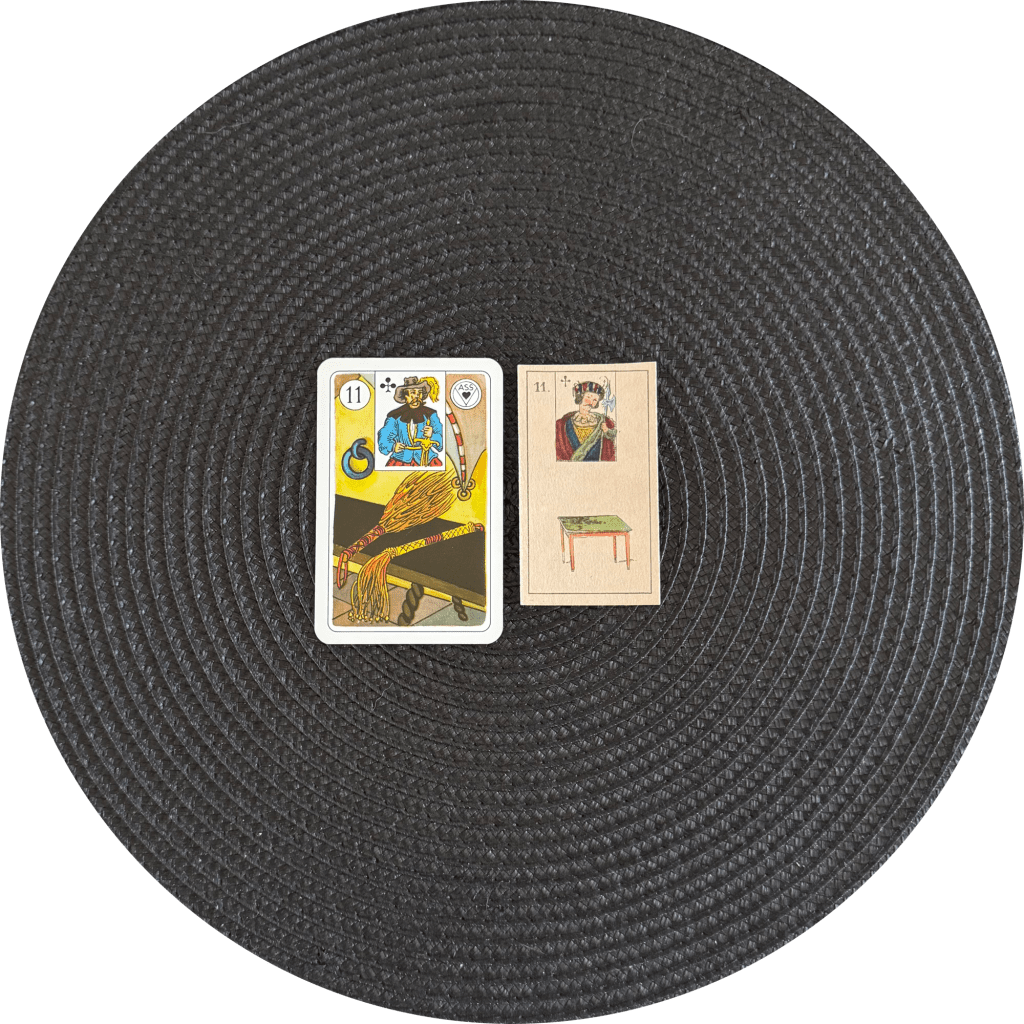
In several traditional decks, including Das Spiel der Hoffnung, the birch rests quietly upon a table rather than being actively wielded. I have always been fond of this motif because it hints at another dimension of the card.

Not every dispute requires a battle.

Sometimes correction occurs through discussion, negotiation, counselling, mediation, arbitration, or simply sitting down with another person and talking things through honestly.

Tempers may flare. Emotions may run high. Nevertheless, a firm hand and willingness to address the problem directly can often restore order.

Because the Birch Rod concerns correction and discipline, it naturally extends to institutions responsible for enforcing rules and standards.

Thus:

  • Bear Birch Rod may indicate a police officer, lawyer, judge, or other authority figure.
  • Park Birch Rod may indicate a police station, courthouse, tribunal, or public institution.
  • Letter Birch Rod may suggest a writ, summons, warning notice, citation, or fine.
  • Hound Birch Rod may reveal a union representative, advocate, mediator, or someone acting on another person’s behalf.

The Birch Rod is often misunderstood because modern readers focus upon the quarrel whilst overlooking its purpose.

The card does not appear simply because people are fighting.

It appears because something is wrong and requires correction.

Arguments, punishment, criticism, discipline, warnings, legal sanctions, and even the scourging of Christ are merely different expressions of the same underlying principle.

Something has gone astray.

The Birch Rod arrives to set it right.

Coda:

The Birch Rod appears when something requires correction.

Arguments, criticism, discipline, illness and even punishment are simply the means through which that correction is achieved. But just as the Clouds card does not mean confusion, the Birch Rod doesn’t mean quarrels. These are symptoms.

It urges us to consider what has gone wrong and how can it be right?

Heed the warning early and the remedy is often mild, ignore it, and the correction is usually far harsher.

Person and Description

Person

As the Birch Rod is also the Valet of Clubs, it can occasionally function as a person card.

This is relatively uncommon. Most often, the Birch Rod appears alongside social cards such as the House, Park, or Hound, where it may identify a specific individual rather than simply describing conflict or correction.

Nicolas-Marie Gatteaux, Public domain, via Wikimedia Commons

When functioning as a court card, the Birch Rod sheds much of its more negative symbolism. Rather than automatically signifying arguments, punishment, or hostility, it becomes a person whose character must be determined through the surrounding cards.

Traditionally, the Valet of Clubs describes a younger person, usually under the age of thirty, although age should always be interpreted relative to the querent.

He may represent a step-sibling, a younger former partner, a junior colleague, apprentice, employee, trainee, or any younger person whose actions have a bearing upon the question. Sometimes it could be used to signify a rather challenging child.

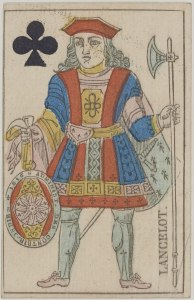
In the folklore of the playing cards, the Valet of Clubs is often identified with Lancelot du Lac. Whilst remembered primarily as a knight of great courage and skill, many versions of the Arthurian legends also portray Lancelot as impulsive, passionate, and prone to moments of anger, frustration, and conflict. These qualities sit comfortably alongside the nature of the Birch Rod itself.

Physical Description

The Birch Rod frequently describes someone who appears tired, stressed, or under pressure.

The individual may look physically worn down, flushed, agitated, or emotionally strained. It is not uncommon for the card to describe someone whose responsibilities, workload, or personal circumstances are placing them under considerable duress.

Because corporal punishment leaves marks upon the skin, the Birch Rod can sometimes indicate redness of the face, neck, or complexion. Likewise, one occasionally encounters people who perspire easily or appear physically overheated.

The build is often lean rather than heavy. Whilst some modern readers associate this card with fitness and athleticism, I have never found exercise to be one of its primary meanings. Personally, I prefer to associate athletic activity with the Cavalier.

Nevertheless, the Birch Rod does frequently describe individuals who possess a wiry, energetic, or slightly restless appearance.

More than anything, the card often depicts someone who appears as though they are carrying tension.

Temperament

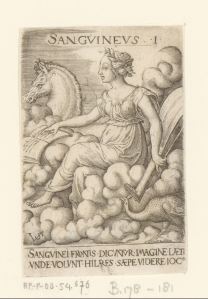
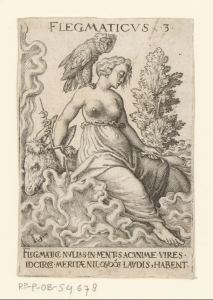
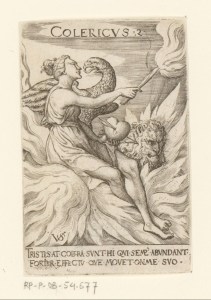
The Birch Rod corresponds most closely to the choleric temperament and possesses strong martial qualities.

These individuals are energetic, direct, driven, and action-oriented. They dislike inactivity and generally prefer confronting a problem to avoiding it.

Choleric, Rijksmuseum, CC0, via Wikimedia Commons

At their best, they are courageous, decisive, disciplined, and willing to tackle difficult situations that others would rather ignore. They often become the people who challenge injustice, address problems directly, and force uncomfortable issues into the open.

At their worst, these same qualities become irritability, impatience, aggression, and recklessness.

They are quick to anger and quick to act.

The difficulty is that they do not always consider the consequences before doing so.

Their speech is often blunt and forceful. Diplomacy is rarely their strongest attribute. Whilst others may spend time carefully choosing their words, Birch Rod people have a tendency to say exactly what they think and deal with the consequences afterwards.

When supported by positive cards, this produces honesty, determination, and strength of character.

When surrounded by negative cards, however, the temperament can become argumentative, confrontational, or even violent.

Like the card itself, Birch Rod people are rarely subtle.

If there is a problem, they will usually confront it. Whether that improves the situation often depends upon how much discipline accompanies their passion.

Special Features

The Birch Rod in the Grand Tableau

The original instructions provide the following augury for the Birch Rod:

“Birch Rod, signifies family quarrels and domestic trouble, dissension between spouses, fever and long illness.”

At first glance, this appears rather severe.

Yet once we consider both the traditional eikōn and the principle of proximity, the instruction becomes remarkably logical.

The traditional image depicts a scourge and a bundle of birch twigs. Both are instruments designed to strike at close quarters. Unlike the Mountain, which obstructs simply through its presence, or the Clouds, whose darkness can spread across a reading, the Birch Rod must physically reach its target in order to have effect.

Consequently, just as the Serpent cannot bite unless she is close enough to strike, neither can the Birch Rod inflict correction unless it falls within reach of the significator.

For this reason, we generally prefer to see the Birch Rod at a distance.

When the Birch Rod falls far from the significator, it is not neutralised. The tensions, disagreements, and difficulties it represents still exist. However, they are removed from the seeker’s immediate experience. The querent possesses sufficient distance to reflect, recover, and address matters more rationally. There remains space in which to breathe.

In practice, this often means that family tensions, domestic disagreements, arguments, or other sources of friction remain in the background of life rather than dominating it entirely.

When the Birch Rod falls close to the significator, however, matters are very different.

Here the correction is experienced directly.

Arguments become personal. Tempers flare. Long-standing frustrations reach a breaking point. Depending upon the surrounding cards, this frequently manifests through disputes involving partners, children, family members, close friends, or other individuals with whom the querent maintains an ongoing relationship.

The source of this disharmony can usually be identified through the cartes maîtresses surrounding the Birch Rod, particularly those within one or two cards of it.

For example:

Roads
Lady Birch RodFishes
House

Here the Birch Rod falls close to both the significator and two cartes maîtresses.
From such a configuration we might reasonably conclude that financial decisions (Roads, Fishes) or domestic finances (House, Fishes) are creating tension within the home (House). In practice, I would expect both to contribute to the situation.

Interestingly, whilst combinations such as Moon Birch Rod can indicate professional ambitions, career pressures, examinations, or job searches becoming a source of stress, it is comparatively rare for the Birch Rod to manifest in the workplace itself outside disciplinary procedures, grievances, complaints, or formal correction.

It has been my consistent experience that the Birch Rod manifests primarily within the home and the seeker’s close circle rather than in professional environments.

Where disciplinary action appears possible, I would look for corroborating testimony from cards such as the Bear (authority figures, managers, employers) and Lilies (conduct, propriety, standards of behaviour).

It is also important to remember that the Birch Rod does not create conflict.

The problem already exists.

The card merely indicates that matters have reached the point where correction can no longer be postponed.

This is one of the reasons I prefer correction as the card’s essence and to discipline as its function. The quarrel, punishment, criticism, intervention, or sanction is not the purpose of the card. It is simply the mechanism through which correction is achieved.

The Birch Rod arrives because something has already drifted off course.

For this reason, the card may sometimes indicate preventative action designed to avoid harsher consequences later. It is often the final warning before circumstances deteriorate further.

Whenever the Birch Rod appears, examine the surrounding cards carefully and advise the querent to address those matters before they evolve into a more serious problem.

Close to the Ring, the Birch Rod frequently indicates a relationship being tested.
Long-suppressed grievances, unresolved disagreements, or incompatible expectations finally demand attention.

Nevertheless, the Birch Rod alone rarely destroys a relationship. Its purpose is correction rather than termination.

Before forecasting separation, I prefer to see corroboration from cards such as the Coffin, Scythe, or Mice acting upon the Ring.

One aspect of the Birch Rod frequently overlooked by modern readers is illness.

Yet the original instructions explicitly mention both fever and prolonged illness. This relationship should not be dismissed.

For this reason, I generally prefer to see the Birch Rod away from the Tree, High Tower, and Coffin.

When the Tree or High Tower falls close to the Birch Rod and near the significator, the severity of illness frequently increases:

With the Tree often points towards conditions affecting the constitution and overall wellbeing. Illness may diminish vitality, require treatment, or place considerable strain upon both body and mind.

With the High Tower often extends the duration of the problem. Recovery may prove prolonged, discomfort persistent, or the seeker may find themselves enduring an extended period of treatment, rehabilitation, or medical supervision.

Should the Clouds also become involved, the severity frequently increases still further.

When all three cards cluster around the significator, illness is often painful, exhausting, or particularly difficult to endure.

At a distance, however, the manifestations are generally less severe. One is more likely to encounter fever, influenza, laryngitis, throat infections, minor inflammatory conditions, or other ailments which, whilst unpleasant, remain comparatively manageable.

Ultimately, the Birch Rod asks a simple question: what requires correction?

Its proximity to the significator reveals how directly the seeker experiences the problem. The surrounding cards reveal whether that correction manifests through argument, discipline, illness, legal intervention, mediation, or some other form of confrontation.

Whatever form it takes, the purpose remains unchanged.

Something has drifted off course.

The Birch Rod has arrived to force it back into line.

Correction Rather Than Repetition

One of the most persistent modern interpretations of the Birch Rod is that it signifies repetition.

I do not subscribe to this interpretation.

The Birch Rod does not indicate repetition.

It indicates correction.

Admittedly, the confusion is understandable.

When something must be corrected, one is often required to do it again. A document may need redrafting. An examination may need resitting. Repairs may need revisiting. A treatment plan may need adjusting. In each case, an action is repeated.

Yet the repetition is merely the consequence.

The correction is the cause.

The Birch Rod therefore does not signify events occurring over and over again. It signifies a situation in which an existing effort, decision, action, or plan has been judged inadequate and requires amendment.

This distinction is important.

If repetition were truly the card’s function, we would expect to see endless cycles and continual recurrence. Yet this is not how the Birch Rod behaves in practice.

Traditionally, the card depicts two corrective instruments: a bundle of birch twigs and a scourge. Likewise, it is Card No. 11, a number composed of two identical digits. At most, the card may therefore suggest a second attempt or effort intended to rectify a mistake.

The emphasis remains firmly upon correction rather than recurrence.

The true card of repetition within the Petit Lenormand is the Ring.

A ring is a circle without beginning or end. It binds, joins, and perpetuates.

Consequently, it naturally signifies cycles, habits, routines, commitments, and circumstances that continue indefinitely through repetition.

The Ring repeats because the cycle continues.

The Birch Rod repeats because something has gone wrong and must be put right.

The Birch Rod corrects.

The Ring locks us in and we keep going round.

Whenever the Birch Rod appears, the question is not: “What keeps happening?”
but rather: “What needs correcting?”

The answer to that question will reveal why a second attempt has become necessary.

What Angers the Birch Rod?

In most readings, the cartes maîtresses surrounding the Birch Rod will reveal the area of life requiring correction.

The Birch Rod tells us that something has drifted off course. The neighbouring master cards tell us where.

Thus:

  • Heart frequently indicates heightened emotions, emotional tension, hurt feelings, or a situation where emotional responses require moderation.
  • Fishes often points towards financial pressures, cash-flow difficulties, spending habits, or disagreements concerning money.
  • Child commonly identifies issues arising through a child or children or about children.

In many cases, this is sufficient.

Occasionally, however, one seeks not merely the area affected but the underlying cause or trigger of the difficulty. This becomes particularly important when several cartes maîtresses surround the Birch Rod or when the card appears without an obvious master card nearby.

In such circumstances, I frequently examine the card towards which the Valet of Clubs is looking.

For me, the playing cards are not decorative embellishments but an integral component of the Petit Lenormand. The Birch Rod is the Valet of Clubs and the Valet of Clubs is the Birch Rod. Traditional cartomancy frequently employed the concept of regards, that is, observing what a court card sees or faces. It remains one of the most useful techniques available to the reader.

I often told my students that the card the Valet of Clubs looks towards is: what angers the Birch Rod.

In other words, it reveals the source of the dissatisfaction, frustration, tension, or error that requires correction.

This approach proves especially valuable in smaller line readings of three or five cards where the Birch Rod may not fall directly beside a carte maîtresse.

For example, if the Birch Rod is looking towards the Letter, the problem may arise through a document, message, correspondence, or administrative matter.

If it regards the Fishes, financial concerns may be the source of the tension.

If it looks towards the Heart, emotional matters become the likely cause.

The principle remains remarkably consistent.

The Birch Rod identifies the need for correction.

The card it regards frequently explains why that correction has become necessary in the first place.

Understanding this distinction often allows the cartomante to move beyond identifying the quarrel and instead identify its cause. After all, no argument emerges from nothing. The Birch Rod appears because something has already gone wrong, and the card it regards often reveals precisely where the trouble began.

The Birch Rod and Sexuality

Some modern readers associate the Birch Rod with sexuality.

Part of this interpretation derives from the French title of the card, « la verge », which can refer both to a rod or switch and to the male member. This linguistic overlap has led some authors to conclude that the Birch Rod should be regarded as a sexual card. Others have gone further still, interpreting it as representing casual encounters, recreational intimacy, or sexual activity distinct from the more affectionate or reproductive symbolism they assign to the Lilies.

I do not find these interpretations particularly persuasive.

Whilst la verge can certainly refer to the male member, the fact that a word possesses multiple meanings does not automatically make every meaning relevant to the card’s function within the Petit Lenormand.

Indeed, where anatomical symbolism is concerned, the system already possesses more appropriate significators. In my own practice, the Lord naturally corresponds to the male genitalia and andrology just as the Lady corresponds to the female genitalia and gynaecology. Consequently, I see no compelling reason to transfer those functions to the Birch Rod simply because of a linguistic ambiguity.

In addition, it seems strange—even chauvinistic—to associate human sexuality with a card that shares its name with the male member.

More importantly, I do not believe there is a single card within the Petit Lenormand that inherently signifies sexual activity.

Questions concerning intimacy are answered by the cards according to their own nature.

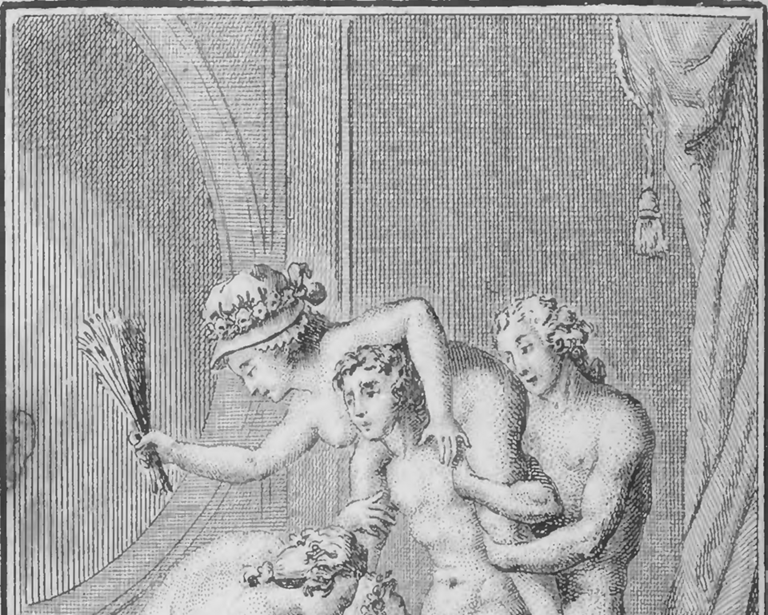
Marquis de Sade, Public domain, via Wikimedia Commons

Thus, if a reading concerns sexuality, the Birch Rod will respond in accordance with its essence of correction and function of discipline. In such contexts, it may describe issues involving power, control, dominance, submission, punishment, restraint, sadomasochism, fetishes or other dynamics naturally arising from the card’s symbolism.

That does not make the Birch Rod a sex card.

It merely means that, when the subject is sex, the Birch Rod responds as the Birch Rod.

Like every other card in the deck, it remains faithful to its own nature regardless of the question being asked.

Tables

One feature of the Birch Rod that is often overlooked originates directly from the traditional eikōn. Beginning with Das Spiel der Hoffnung, the birch and scourge are commonly depicted resting upon a table. This motif survives in several later patterns and provides a number of useful practical interpretations.

Most obviously, the Birch Rod can signify a table, desk, secretaire, escritoire, or other item of furniture associated with writing, study, administration, or work.

This meaning most commonly appears in practical readings involving the location of lost objects. When the Birch Rod appears, I am inclined to look on or near a desk, writing table, work surface, office furniture, or wherever stationery, paperwork, correspondence, or administrative records are normally kept.

In decks that depict a besom or broom rather than a scourge, the card can occasionally indicate places associated with cleaning equipment. One might therefore inspect cupboards, utility rooms, or areas where brooms, mops, brushes, vacuum cleaners, and cleaning products are stored.

The table, however, contains a deeper lesson.

The Birch Rod signifies correction through discussion as much as through conflict.
The table serves as a reminder that correction need not always come through punishment or argument. Problems can often be resolved by bringing them to the table before tensions escalate into open conflict.

When the card appears in this way, it advises the parties involved to sit down and speak honestly. Grievances are aired. Misunderstandings are addressed. Difficult conversations are allowed to occur before resentment hardens into hostility.
In more serious situations, the card may even suggest the involvement of an impartial third party whose role is to mediate, arbitrate, or otherwise keep matters from escalating.

Not every problem requires a battle.

Sometimes the Birch Rod asks us to take a seat and resolve the issue before tempers turn disagreement into discord.

Doubling

One of the more useful descriptive functions of the Birch Rod is its ability to indicate two of something.

Whether this meaning arises from the eikōn, which traditionally depicts both a scourge and a bundle of birch twigs, or from the card’s number, 11, is a matter upon which cartomantes disagree. My own view is that both contribute to the symbolism.

Certainly, most of the decks I work with regularly, including the Brepols, Wüst, and Piatnik patterns, visibly depict two corrective instruments. Yet for many years I also kept the Glück edition of the Leipzig Lenormand on my desk at work, where the imagery is considerably less explicit. The card nevertheless continued to describe pairs and doubles with remarkable consistency.

It is important, however, not to confuse doubling with repetition.

The Birch Rod can indicate two of something. It does not indicate something occurring endlessly or repeatedly.

Thus:

  • Letter Birch Rod may indicate two telephone calls, letters, e-mails, or messages.
  • ChildBirch Rod may indicate two children.

One reason this association may have arisen is that the Birch Rod is fundamentally a corrective card. If something has gone wrong, it may need to be done a second time in order to be put right. This fits with the Roads and Key – two paths, a key which locks and unlocks.

Writing and Conversation

The Birch Rod possesses a longstanding connection with both conversation and writing.

Of the two, conversation is by far the more common manifestation in my experience. Discussions, debates, criticism, mediation, counselling, difficult conversations, and even heated arguments all arise naturally from the card’s corrective nature.

Writing remains a perfectly valid interpretation, but it appears less frequently.

Historically, birch bark served as a writing surface in parts of both Europe and Asia.

Likewise, twigs and similar implements were utilised as primitive pens and writing instruments for centuries. It is therefore not difficult to see how the Birch Rod acquired an association with the written word.

In practice, however, writing under the Birch Rod almost always serves the same purpose as conversation.

It is corrective.

One might encounter amended documents, revised reports, redrafted contracts, written warnings, disciplinary notices, formal complaints, legal correspondence, or letters intended to resolve a misunderstanding.

The card is rarely concerned with writing for its own sake.

Rather, it concerns writing undertaken because something requires correction, clarification, criticism, amendment, or resolution.

Both conversation and writing therefore perform the same function under the Birch Rod.

They are not communications undertaken primarily for pleasure, entertainment, or casual social interaction.

They occur because something must be addressed.

The Birch Rod is consequently less concerned with communication itself than with the reason that communication has become necessary in the first place.

Timing

In matters of timing, the Birch Rod is generally a card of moderate or steady pace. It is neither especially swift like the Stork nor particularly slow like the Tree or Mountain.

Instead, the card tends to indicate that matters unfold at the pace required for correction to occur. Attempts to rush the process often create additional complications, disputes, or mistakes which ultimately require further attention.

This is entirely consistent with the nature of the card.

A disagreement cannot be resolved before the underlying issues have been discussed. A mistake cannot be corrected before it has been identified. A disciplinary matter cannot conclude before the facts have been established.

For this reason, the Birch Rod often rewards patience and careful attention rather than haste.

In general timing questions, I typically associate the card with a period of approximately eleven days to three months, depending upon the nature of the matter and the surrounding cards.

My second teacher associated the Birch Rod with “39.”

Over the years, I have also observed the Birch Rod occasionally referring to the season of Lent, particularly the period between Holy Thursday and Good Friday, and often the morning of Good Friday itself.

The symbolism is readily apparent.

According to Christian tradition, it was during this period that Our Lord was scourged following His condemnation by Pilate. Given the Birch Rod’s association with correction, punishment, chastisement, and the scourge itself, the connection feels entirely natural.

Saint Clare of Assisi and Saint Colette (c. 1520), by the Master of Lourinhã, RickMorais, CC BY-SA 4.0 https://creativecommons.org/licenses/by-sa/4.0, via Wikimedia Commons

More broadly, Lent is a season of penitence, self-examination, and amendment of life. It is a period during which Christians are called to reflect upon their shortcomings and correct that which has gone astray. These themes resonate strongly with the essential nature of the Birch Rod.

Whilst Lent is a movable season and does not fall on fixed calendar dates, it generally occupies portions of February, March, and April. I have occasionally wondered whether the card’s association with this period is reinforced by certain saints particularly connected with the Passion.

One such example is St Colette of Corbie (6 March), who, according to tradition, bore marks corresponding to Christ’s sufferings, including the scourging. Likewise, St Gemma Galgani (11 April) was renowned for her mystical experiences and stigmata, again which included the scourging, which similarly connected her with the sufferings of Christ and the events of the Passion.

St Gemma Galgani, SeraphicVirginLucca, CC0, via Wikimedia Commons

Whether these associations are merely coincidental or represent a deeper current preserved within the card’s symbolism is impossible to say with certainty. Nevertheless, both these Holy Women embody themes of suffering, correction, penance, and spiritual discipline that sit comfortably within the symbolic world of the Birch Rod.

Ultimately, timing under the Birch Rod is less concerned with speed than with resolution.
The question is not: “how quickly will this happen?” but rather: “how long will it take to put this right?”

For that is the purpose of the Birch Rod: not simply to mark a problem, but to ensure that it is finally addressed.

Health

Anatomically, the Birch Rod is associated primarily with the throat and the body’s connective tissues.

This correspondence is entirely consistent with both the traditional instructions and the card’s broader symbolism. The Birch Rod concerns irritation, inflammation, aggravation, correction, and conditions that require proper management before they worsen.

Unlike the Coffin, which often signifies deterioration, decline, or breakdown, the Birch Rod more commonly describes conditions that flare, irritate, inflame, or repeatedly demand attention.

The emphasis is not upon destruction.

It is upon the need for correction.

In practice, when the card points towards health matters, usually because it falls close to the Tree, High Tower, or significator, I most often find it describing inflammatory conditions.

  • These may include:
  • inflammatory bowel disease,
  • connective tissue disorders,
  • psoriasis,
  • reactive arthritis,
  • inflammatory joint conditions,
  • chronic irritation or inflammation.

The exact manifestation will depend upon the surrounding cards and the nature of the question.

The original instructions also mention fever, a correspondence that remains one of the card’s most reliable health expressions.

When the Birch Rod appears at a distance from the significator, particularly alongside health cards, one is more likely to encounter conditions such as influenza, fever, laryngitis, throat infections, sprains, strains, or other painful but comparatively minor ailments.

Distance tends to reduce the severity.

It does not necessarily reduce the need for treatment.

One of the recurring lessons of the Birch Rod is that failure to address a problem properly often results in a second correction becoming necessary later. An illness that is ignored, poorly managed, or insufficiently treated may return demanding further attention.

For this reason, even relatively minor complaints should be taken seriously and allowed sufficient time to heal properly.

The card therefore carries a cautionary message.

Attend to the problem now.

Follow the treatment through diligently.

Correct the issue before it requires a more forceful intervention later.

The Birch Rod rarely rewards neglect.

What is left untreated often returns demanding further correction.

Like the card itself, health matters under the Birch Rod improve not through avoidance, but through discipline, management, and timely correction.

Birch Rod in Action

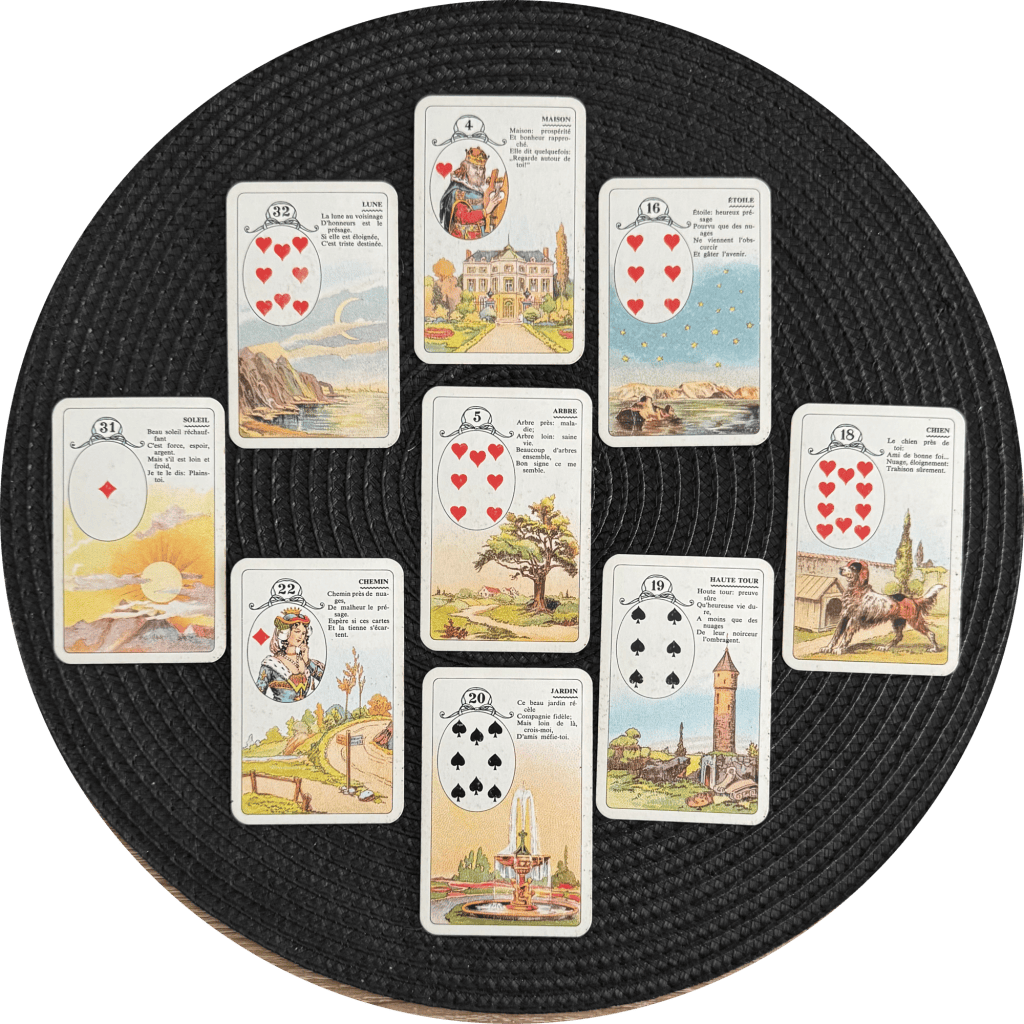
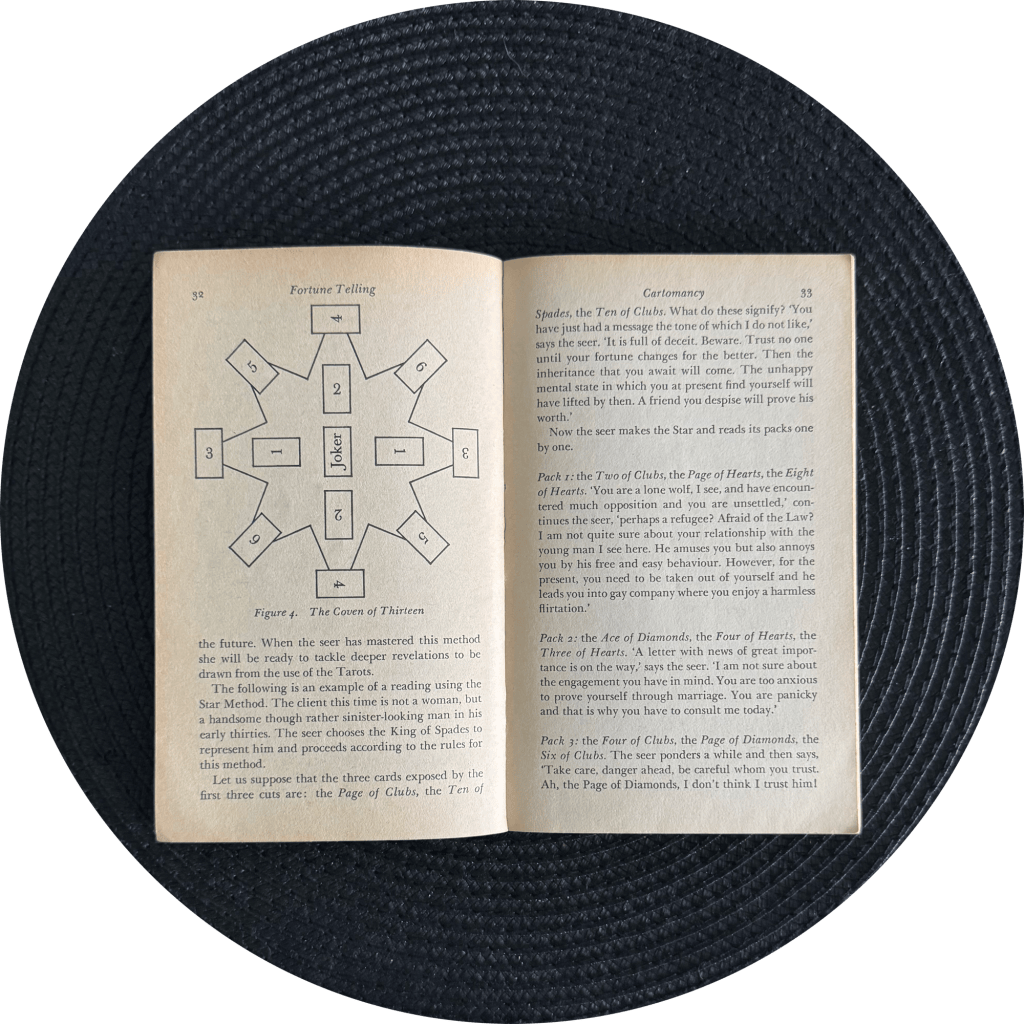
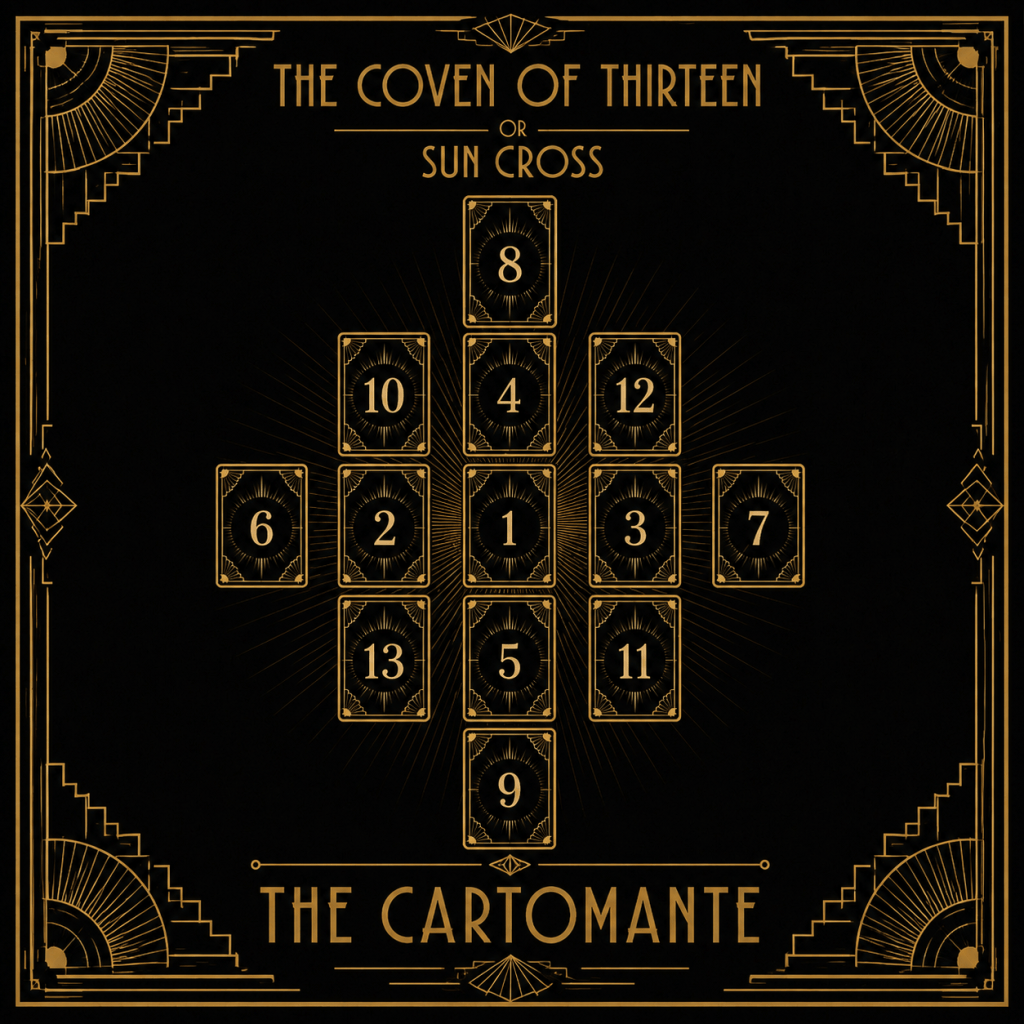
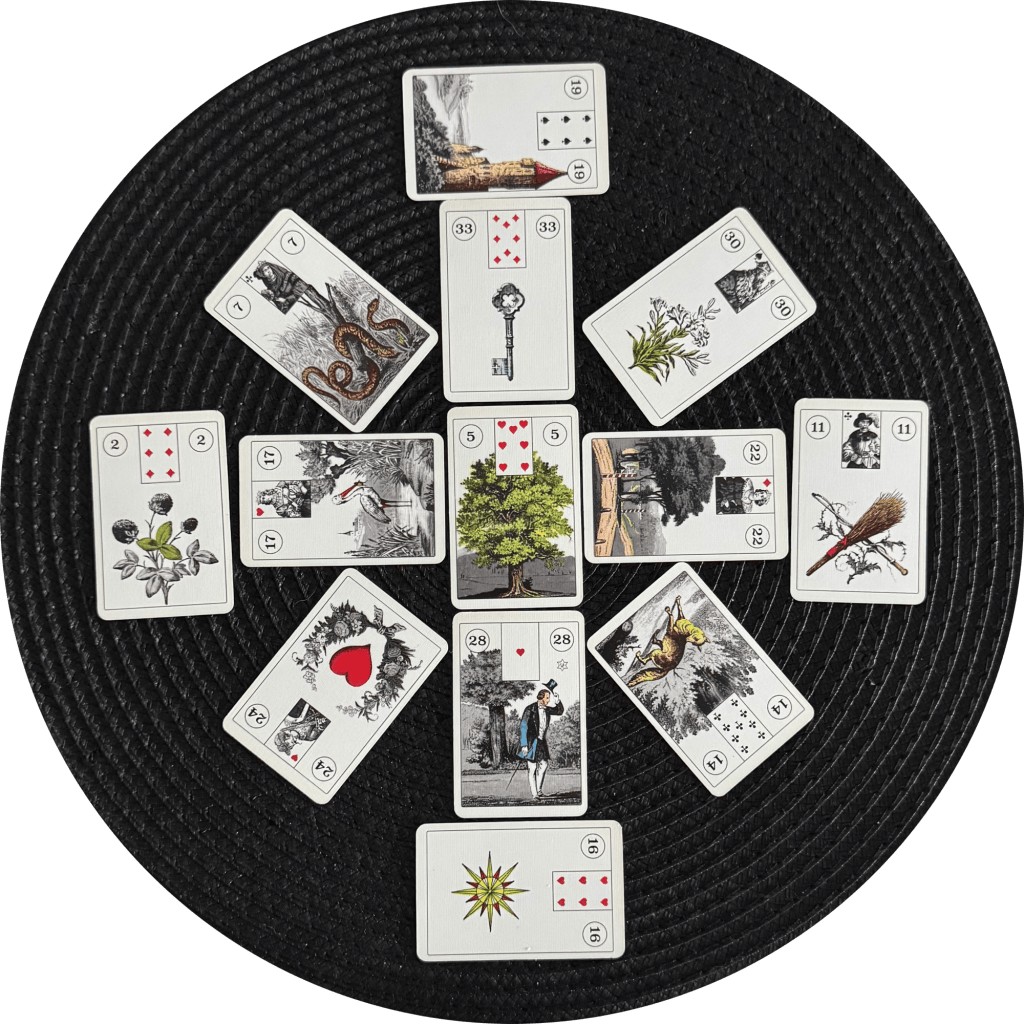
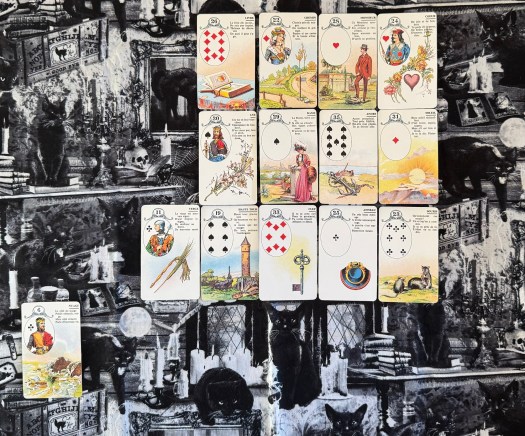
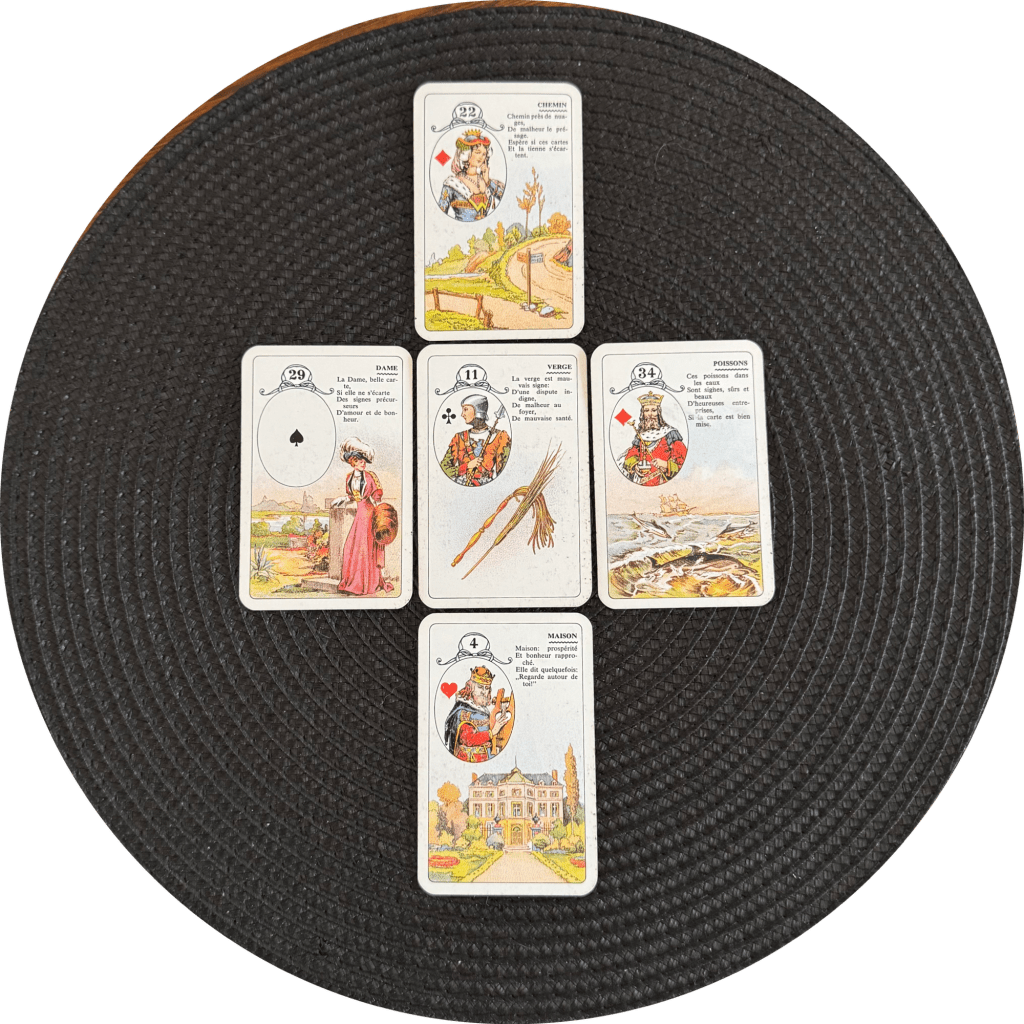
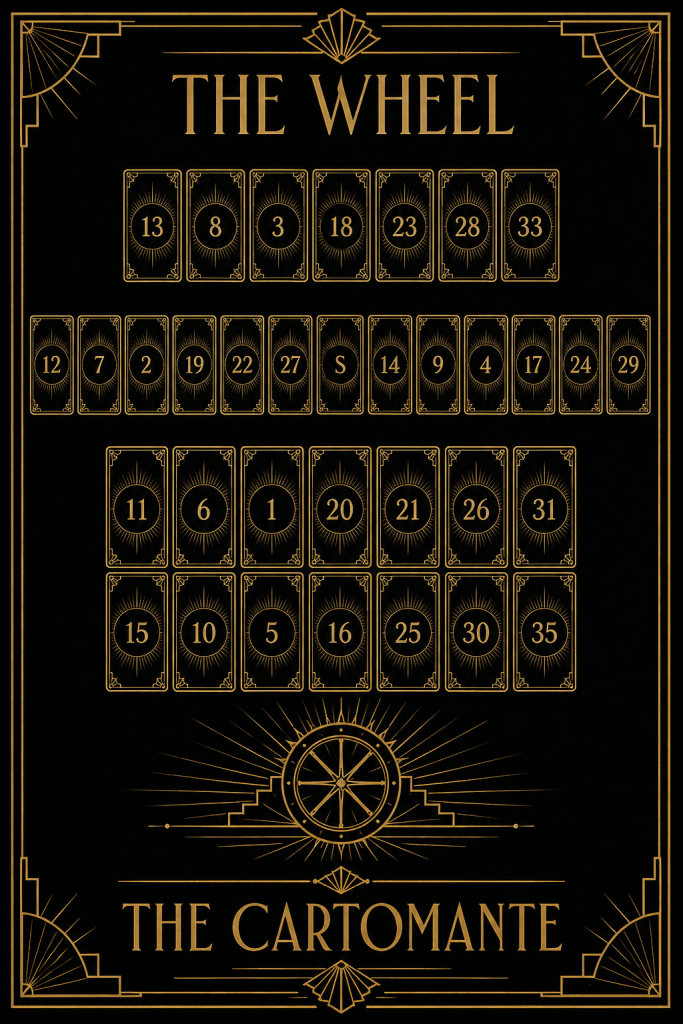
This reading was performed in 2010 using the Wheel Spread developed by Mary Marco and Janine Goffin.

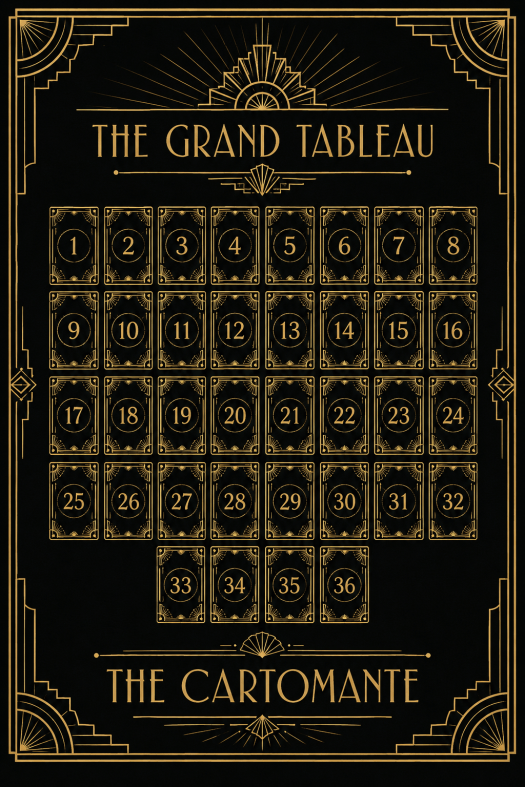
Whilst the spread provides a comprehensive overview of the seeker’s past, present, near future, and more distant future, we shall focus solely upon the relevant section of the Present. These are the cards immediately beneath the significator and start with 11 in the diagram above.

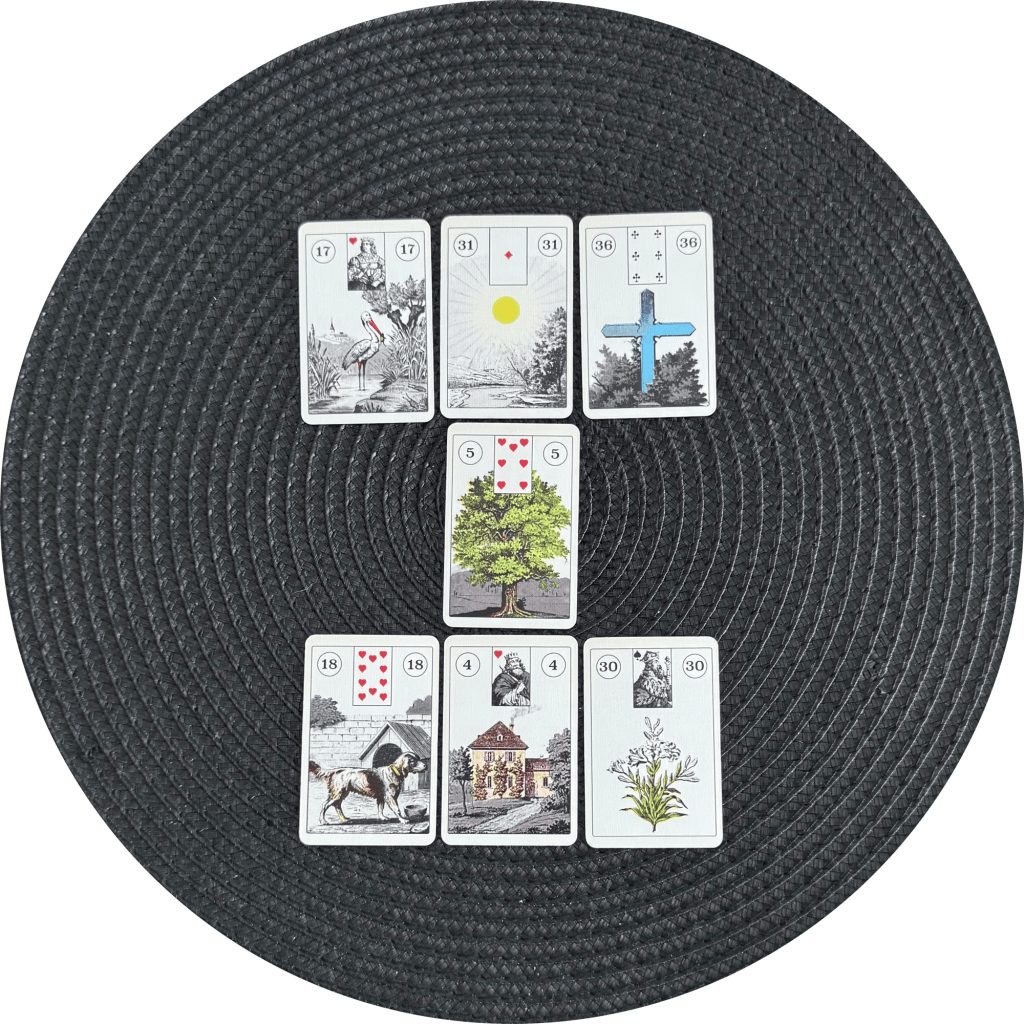
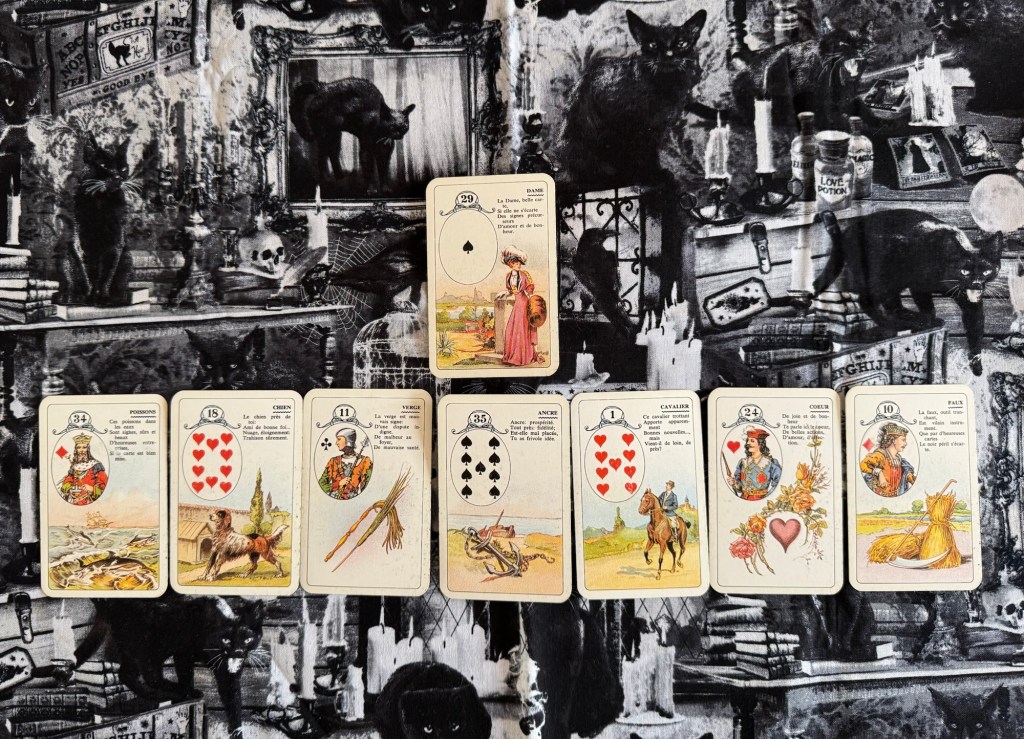
The cards were:

FishesHoundBirch RodAnchor Cavalier Heart Scythe

The first feature that immediately attracts attention is the Birch Rod positioned between the Hound and the Anchor.

Quite frequently, the combination Birch RodAnchor indicates a lingering resentment, grievance, or source of frustration that the seeker continues to carry with them.

Although the Anchor is generally regarded as a favourable card, it can occasionally indicate a blockage or obstacle. It differs significantly from the Mountain. The Mountain represents an obstacle imposed from outside. The Anchor, by contrast, often represents burdens, loyalties, resentments, attachments, and obligations that we continue to carry ourselves.

Here, the querent is carrying (Anchor) an ongoing source of anger or frustration (Birch Rod).

The obvious question is: what is causing it?

As discussed earlier, I often examine the direction in which the Valet of Clubs is looking.

Looking in the direction of the Valet’s regard, we find the Hound. Following the principle outlined previously, the Hound therefore reveals what is angering the Birch Rod.

From this, we can be reasonably confident that the querent is involved in a quarrel (Birch Rod) with a member of her entourage (Hound) and continues to carry the emotional burden of the dispute (Birch RodAnchor).

The Fishes preceding the Hound reveals that money lies at the root of the disagreement.

The cards therefore suggest a dispute involving a friend, acquaintance, colleague, or trusted associate in which financial matters have become a source of tension.

The querent confirmed this interpretation immediately.

She had loaned a friend a considerable sum of money which had not been repaid. The resulting disagreement had become increasingly serious and was beginning to affect her own financial situation.

Because these cards appeared within the Present section of the spread, we know the matter remained active and unresolved.

The Birch Rod also revealed the corrective measures she was being forced to implement.

The Hound can signify familiar and recurring obligations. Combined with the Fishes, it showed regular expenditure that now had to be managed more carefully whilst she absorbed the financial loss and sought to maintain her security.

The latter portion of the line was equally revealing:

Anchor CavalierHeartScythe

The resentment represented by the Anchor was not going away.

Indeed, the Heart feeding directly into the Scythe suggested a sharp emotional rupture. Feelings that had been building beneath the surface for some time would eventually reach a breaking point.

Both the Birch Rod and the Scythe possess a distinctly choleric quality, and together they frequently indicate situations where tensions escalate rapidly.

The presence of the Cavalier suggested movement, contact, or a visit. My suspicion at the time was that matters would come to a head when the friend next approached or contacted the querent.

Sadly, this proved accurate.

The loan was never repaid. The friend insisted that the money had been intended as a gift rather than a loan, and the disagreement intensified dramatically.

The querent ended the friendship that very week. The Cavalier and Heart also forecast a surprise date (Scythe). This also occurred and reminds us that in a reading cards can signify several things.

When working with spreads containing four or more cards, we can often gain additional information from the playing-card values by observing repeated ranks.

In this reading, we find two valets and two nines.

The primary reading had already established the likely outcome, but these repetitions provided additional confirmation.

Traditionally, two valets often indicate that something goes wrong or fails to proceed as expected. The repeated Valets therefore reinforced the difficulties already visible within the line.

The two nines, however, suggested money received. This proved equally accurate. Shortly afterwards, a family member provided financial assistance which helped the querent overcome the immediate difficulties created by the loss.

Events therefore unfolded almost exactly as indicated by the cards.

The Birch Rod had correctly identified not merely the quarrel itself but its underlying cause. Money had strained the relationship beyond repair, and correction ultimately took the form of separation rather than reconciliation.

This serves as an important reminder about the Birch Rod.

Correction does not always restore a relationship.

Sometimes it simply forces the truth into the open and compels those involved to act accordingly.
§

Images:

Featured Image:

Flagellation of Christ, Peter Paul Rubens, CC BY-SA 3.0 http://creativecommons.org/licenses/by-sa/3.0/, via Wikimedia Commons

Cards:

Lenormand Cards: Jeu Lenormand © Cartamundi, WanderWüst © Jorge/Wandering Oracle, Lenormand Fortune-Telling Cards © Zao-Gelli, The Lenormand Oracle © Verlag für die Frau, Leipzig, Nieuwe Lenormand © Amber Studio/Erna Droesbeke, Lenormand 36 Orakelspielkarten © Königsfurt-Urania,

References:

Boroveshengra, A., 2013. Cartomantes’ Cabinet: The Petit Lenormand Course.
Boroveshengra, A., 2015. Lenormand Thirty Six cards. 2nd ed. Create Space.
George, R. 2014 The Essential Lenormand: Your Guide to Precise & Practical Fortunetelling. Woodbury, MN: Llewellyn Publications.
Ignatius Press (2005) Holy Bible RSVCE Compact Zipper. Ignatius Press.
Marco, M. and Goffinet, J., 1989. Petit Lenormand. Bruxelles: Servranx.
Matthews, C. 2014 The Complete Lenormand Oracle Handbook: Reading the Language and Symbols of the Cards. Rochester, VT: Destiny Books.
Meuris, B., 2018. Petit Lenormand Encyclopaedia: Volume 1. Create Space.
Silvestre, C.a, 2003. Le Petit Lenormand. [Montpellier]: Gange éd.

On Reading: Eikōn, Essence, and Function

Before proceeding further, it is worth briefly explaining three terms that recur throughout my articles on the Tarot and Petit Lenormand: eikōn, essence, and function. Together, they form the foundation of my approach to cartomancy and interpretation.

Eikōn

The word eikōn is Greek and simply means image. My use of the term, however, owes much to the Christian tradition of iconography.

Growing up with an exposure to Eastern Catholic and Orthodox influences, religious icons were a familiar sight. Over time, I developed a deep appreciation for the Byzantine tradition and the remarkable skill of iconographers. In that tradition, an icon is not merely a picture. It is “written” according to established rubrics in which colours, gestures, posture, clothing, objects, and composition all possess meaning. These individual elements combine to create a living image that communicates a story, truth, or mystery.

When I began studying the Tarot, particularly the Marseille tradition, the similarities struck me immediately. Like an icon, a Tarot card presents a complete image whose meaning emerges through the interaction of its various parts. The image speaks as a whole.

Christ in Majesty. Note the similarities to the Tarot’s Le Monde Card.
Metropolitan Museum of Art, CC0, via Wikimedia Commons

What I found less convincing was the dominant deconstructive approach employed in many modern Tarot books, where individual symbols are isolated from their wider context and elevated above the image itself. One reader may focus upon a hat, another upon a shoe, whilst someone else becomes preoccupied with the colour of a sleeve. Valuable insights can certainly arise in this way, but the danger is that the card ceases to function as an integrated image and instead becomes a collection of disconnected details. Meaning becomes increasingly subjective and, ultimately, relativistic.

The gestures of the Juggler mean little outside the context of the entire card. Likewise, the direction in which the Ship sails only acquires significance when considered within the wider image and narrative. The whole must always remain greater than the sum of its parts.

Tiberio of Assisi, St Clare of Assisi, CC0, via Wikimedia Commons

Whilst reflecting upon this, I am reminded of Saint Clare of Assisi’s visual approach to prayer, often summarised as gaze, consider, contemplate, and imitate. A visual form of Lectio Divina. It seemed to me that a similar method could be applied to the Tarot. One first observes the image, then reflects upon its meaning, contemplates its deeper significance, and finally applies its lessons to life.

For this reason, I prefer to think of the cards as eikōnes rather than collections of symbols. Each card should be approached as a complete image revealing a story and a principle.

I have deliberately chosen the Greek eikōn rather than the English word icon. Given the mixed reactions many people have towards Christianity, and despite the Tarot’s profoundly Christian origins, the Greek term provides a more neutral expression whilst still preserving the connection with the iconographic tradition from which my thinking developed.

Whilst the cosmological framework used throughout this work owes much to Aristotle and medieval natural philosophy, my approach to interpretation is more heavily influenced by the Christian Neoplatonic tradition. Both viewed the visible world as participating in deeper truths that transcend mere appearances.

The Tarot card is therefore not approached simply as a collection of symbols to be decoded, nor as a puzzle whose meaning is constructed from isolated details. Rather, the eikōn is treated as a unified image revealing an underlying reality. The image points beyond itself without ceasing to be itself. In this respect, the Tarot card functions much like a religious icon, inviting contemplation of the principle it expresses.

The famous Sinai Pantrocrator reveals Christ’s Dyophysitism: God and Human.
Saint Catherine Monastery, Public domain, via Wikimedia Commons

Amongst the figures who have most influenced my thinking in this regard are Saint Augustine, St Benedict, Marsilio Ficino, Giovanni Pico della Mirandola, Thomas Merton and Brian Williams. Despite belonging to very different periods, each recognised the importance of contemplation, discernment, and the search for truth beneath appearances. Their writings encouraged me to approach the Tarot less as a collection of signs and more as a series of images revealing enduring principles.

Essence

If the eikōn is the image, the essence is the fundamental principle or mystery expressed by that image. The essence is not a keyword, nor is it a summary of every possible meaning attached to a card. Rather, it is the card’s underlying nature. It answers the question: what is this card?

My own understanding of essence emerged gradually through the study of Tarot and the Petit Lenormand. When I first learnt to read cards, keywords played little or no role. Instead, attention was given to the nature of a card and how it behaved in different circumstances (order, whether it was near or far, et cetera). It was only later, upon reading modern Tarot literature, that I encountered extensive keyword lists.

Whilst keywords can be useful as memory aids, I often found myself struggling to understand why particular words had been selected. Vocabulary is shaped by culture, language, generation, and personal preference. One author’s keyword might differ entirely from another’s, despite both discussing the same card. The result was often a sense of arbitrariness and made more difficult by my dyslexia.

Over time, I began to notice that things possess an underlying nature that makes them what they are. This differs from a purely symbolic approach in which a card merely stands for something else. The Hermit is not a symbol of prudence. The Hermit is prudent. Prudence belongs to his nature and is therefore expressed whenever he appears.

Matfre Ermengaud di Béziers, Public domain, via Wikimedia Commons

This understanding owes much to the Neoplatonic tradition, particularly as filtered through Saint Augustine and the Renaissance philosopher Marsilio Ficino. Both viewed visible things as participating in deeper realities rather than merely representing them. A thing possesses a nature which allows it to remain itself whilst simultaneously connecting it to broader truths.

In this sense, the essence is not a keyword attached to a card. Nor is it an abstract label. It is the card’s essential self: the underlying principle that unites all of its manifestations and gives coherence to its meanings.

This understanding also emerged naturally from my use of the eikōn. The eikōn reveals the essence. By contemplating the image as a whole, one arrives at the principle that animates it. The image is not merely a collection of symbols; it is the visible expression of an underlying nature.

The Hermit provides a useful example. Prudence is not one meaning of the Hermit amongst many; it is the principle from which the others arise. Whether the Hermit appears as caution, discretion, reflection, solitude, age, experience, patient guidance, or careful planning, prudence remains the common principle linking these manifestations together. Prudence is the Hermit’s essential self. Without prudence, the Hermit would cease to be the Hermit.

Similarly:

  • Justice is Verity.
  • The Pope is Wisdom.
  • The Hound is association.
  • The Fishes is abundance.

Every subsequent meaning associated with a card should arise from that central principle. The essence prevents the card from becoming a collection of disconnected keywords and instead allows its meanings to remain coherent and rooted in its nature.

In this respect, the essence acts as a thread running through every interpretation. It keeps the card unified, ensuring that however many manifestations it may possess, it remains recognisably itself.

Before proceeding further, I should briefly clarify a point of terminology. I am always pleased to see readers engage with and discuss the concept of essence, especially as it has become a useful part of the vocabulary surrounding this type of work. However, I have occasionally noticed the term being used somewhat differently from how I originally intended it. Essence is sometimes treated as little more than a refined keyword or summary phrase. Whilst this is understandable, it is not quite what I mean. A keyword describes a card; an essence reveals what the card is. It is not simply a convenient label attached to a collection of meanings, but the card’s underlying nature and identity. The essence of the Hermit, for example, is not merely a word chosen to summarise the card. It is the principle that makes the Hermit recognisably itself and from which all of its manifestations proceed. In this respect, essence is less a description than a revelation. It seeks to identify the card’s true nature rather than merely describe its appearances.

Essence should therefore not be understood as the most important keyword attached to a card or a vibe or spirit. Keywords remain descriptive; essence is ontological. It concerns the card’s being rather than its attributes. The question is not “How might this card be described?” but “What must this card be in order to be itself?” The answer to that question is what I mean by essence.

Function

If essence describes a card’s nature, function describes its action.

How does this principle operate?

Where essence is relatively static, function is active. The two are inseparable. A card’s function must arise naturally from its essence rather than being imposed upon it from outside.

If the essence describes a card’s nature, the function describes the activity proper to that nature.

For example:

  • Justice is verity that balances.
  • The Pope is wisdom that mediates.
  • The Hound is association that supports and assists.
  • The Fishes is abundance that circulates.

The function therefore represents the manner in which the essence expresses itself. Wisdom may manifest in many ways, but it always mediates between ignorance and understanding. Renewal may appear in many forms, but it always guides growth and recovery. Prudence consistently operates through discernment. The essence remains constant; the function explains its activity.

In many ways, function can be understood through a simple analogy. We understand a knife not merely by what it is, but by what it is for. The proper activity of a knife is to cut. Likewise, we understand a Tarot card more fully when we know both its nature and its operation.

Knowing what a card is allows us to identify it; knowing what it does allows us to interpret it.
Function becomes particularly important when we arrive at what I call the Progressed Meaning.

The progressed meaning is the practical interpretation that emerges during a reading. It is not the essence alone, nor the function alone, but the essence functioning within a specific context.

In other words:

Progressed Meaning = essence functioning in context

or, if one prefers:

Progressed Meaning = essence + function + context

Consider the Hermit. His essence is Prudence and his function is to Discern.

When interpreted in a love reading, we do not suddenly abandon prudence and begin inventing entirely new meanings. Rather, we ask how prudence functions through discernment within that context. The progressed meaning becomes caution, taking time to know another person, exercising discretion, or carefully evaluating a relationship before making commitments.

Likewise, in a business reading, the Hermit may advise reviewing evidence carefully before investing. In a health reading, he may indicate the need to seek additional information before proceeding with treatment. The manifestations differ, but the underlying principle remains unchanged. Prudence continues to operate through discernment.

The same process applies to every card.

Consider the Star. Its essence is Renewal and its function is to Guide. In health, it may indicate recovery and convalescence. In finances, gradual improvement. In relationships, reconciliation and rebuilding trust. In each case, renewal continues to guide circumstances towards restoration.

Death provides another useful example. Death is Demise that Terminates. In a relationship, this may indicate separation. In employment, redundancy. In health, the conclusion of a course of treatment. In each case, the progressed meaning arises from the same essential principle operating within different circumstances.

This leads to an important rule:

The progressed meaning should never contradict the essence.

The manifestation may vary, but the essence remains constant.

Death should never suddenly signify growth. The Devil should never become liberation. Justice should never become deceit. The circumstances may alter how the card appears, but they cannot alter the card’s nature.

Function therefore provides the bridge between a card’s nature and its practical interpretation. Without it, readings become little more than collections of disconnected keywords. With it, meanings develop naturally from the card itself.

The task of the reader is not merely to memorise interpretations, but to understand how the essence functions within the circumstances presented by the question. That process is what produces the progressed meaning.

The essence anchors the card, the function sets it in motion, and the context determines where that motion is directed. Together they produce the progressed meaning encountered in actual divination. When properly understood, the progressed meaning is not an arbitrary interpretation, but the natural consequence of the card’s nature operating within a particular situation.

The reader may therefore notice two distinct influences throughout this article. The structure of the cosmos, the elements, and the temperaments derive largely from the Aristotelian worldview. The method of interpretation, however, owes more to the Christian Neoplatonic tradition of Augustine and Ficino, in which visible images reveal deeper realities. The two approaches are not in opposition.

Indeed, Renaissance thinkers frequently employed both, seeing them as complementary ways of understanding the same creation.

§

Images:

Featured Image: Stadtbibliothek Trier (Wissenschaftliche Bibliothek der Stadt Trier), CC BY-SA 4.0 https://creativecommons.org/licenses/by-sa/4.0, via Wikimedia Commons

References:


Augustine and Pine-Coffin, R.S. (2003) Confessions. London, England: Penguin Books.
Saint Augustine of Hippo and Bettenson, H. (2004) City of God. Penguin Books.
Carvalho, H.A. de and Ribeiro, L. (2010) On the heavenly spheres: A treatise on traditional astrology. Tempe, AZ: American Federation of Astrologers.
Benedict et al. (1981) RB 1980: The Rule of St. Benedict. Collegeville, MN: Liturgical Press.
Farley, H. (2009) A cultural history of Tarot: From entertainment to esotericism. London: I.B. Tauris.
Frawley, J. (2001) The Real Astrology. London: Apprentice.
Guite, M. (2022) Lifting the Veil: Imagination and the Kingdom of God
Hankey, W.J. (2016) Aquinas’s Neoplatonism in the Summa Theologiae on God. St Augustine’s Press.
Nees, L. (2002) Early Medieval Art. Oxford: Oxford University Press.
Nouwen, H.J.M. (2007) Behold the beauty of the lord: Praying with icons. Notre Dame, Ind: Ave Maria Press.
O#Meara, D.J. (1981). Neoplatonism and Christian Thought
Ptolemaeus, C. and Robbins, F.E. (2001) Tetrabiblos. Cambridge, MA: Harvard Univ. Press.
Silvestre, C.H. (1987) ABC des Tarots. Paris: Marabout.
Thomas (2018) Summa Theologica: Complete in a Single Volume. Claremont, CA: Coyote Canyon Press.
Valens, V. and Riley, M.T. (2022) The Anthology. Denver, CO: Amor Fati Publications.
Williams, B. (2003) A Renaissance Tarot: A Guide to the Renaissance Tarot. U.S. Games Systems.

The Lord and The Lady

Then the Lord God said, “It is not good that the man should be alone; I will make him a helper fit for him.” So out of the ground the Lord God formed every beast of the field and every bird of the air, and brought them to the man to see what he would call them; and whatever the man called every living creature, that was its name. The man gave names to all cattle, and to the birds of the air, and to every beast of the field; but for the man there was not found a helper fit for him. So the Lord God caused a deep sleep to fall upon the man, and while he slept took one of his ribs and closed up its place with flesh; and the rib which the Lord God had taken from the man he made into a woman and brought her to the man.
Genesis 2: 18 – 22 (RSV CE)

The fountains mingle with the river
And the rivers with the ocean,
The winds of heaven mix for ever
With a sweet emotion;
Nothing in the world is single;
All things by a law divine
In one spirit meet and mingle.
Why not I with thine?—

See the mountains kiss high heaven
And the waves clasp one another;
No sister-flower would be forgiven
If it disdained its brother;
And the sunlight clasps the earth
And the moonbeams kiss the sea:
What is all this sweet work worth
If thou kiss not me?

Love’s Philosophy, Percy Bysshe Shelley

The Gentleman, is the dominant card in the game, along with card n. 29, and shows us the happiness or misery of the person consulting the cards.

The Lady, is of the same importance, as all is revealed according to its position in the game, despite the perspicacity of the person reading the cards
Original Instructions

Card Nos. 28 and 29 in the Petit Lenormand, the Lord and the Lady, are represented by the Ace of Hearts and the Ace of Spades respectively. Unlike the majority of cards within the deck, they are not primarily concerned with events, circumstances, or conditions. Instead, they identify the people around whom the reading revolves.

Essence and Function of the Lord and the Lady

The traditional eikōn depicts a well-dressed young man and woman respectively. Depending upon the deck, their attire reflects the artistic style of the period in which the cards were produced. The Brepols pattern, for example, places them in the late Belle Époque, whilst the Dondorf adopts a Biedermeier setting. It is also quite common for the Lord and Lady to share the same landscape, so that when placed together they appear to occupy the same location. Conventionally, they face towards one another, although some modern decks abandon this feature.

The essence of the Lord and Lady is identity and their function is to signify.

The Lord and Lady are the two principal significators of the deck and invariably identify the primary actors within the matter under consideration. In most readings, one of these cards will represent the querent because the querent is usually the central figure in the question being asked.

Significators

To understand the Lord and Lady properly, one must first understand the role of a significator.

A divinatory spread functions rather like a mirror or picture of the seeker’s circumstances. The cards reflect people, events, opportunities, challenges, and influences operating within their life. The significator acts as the seeker’s reflection within that picture. It identifies whose story is being told and provides a reference point from which the remainder of the reading may be interpreted.

For this reason, significators are traditionally chosen because they possess some degree of affinity or resemblance to the individual they represent.

Within the Petit Lenormand, this resemblance is ordinarily established through gender. The Lady is generally used for those who identify as women, whilst the Lord is used for those who identify as men.

Signifactors from the Petit Lenormand and Kipperkarten

Naturally, this approach presents certain challenges when working with clients who identify as non-binary or gender-fluid. In such circumstances, it is often best to discuss the matter directly with the client and agree upon an appropriate significator together. The purpose of a significator is identification rather than ideology.

Over the years, I have successfully employed alternative significators such as the Child, the Hound, or a specially created carte blanche. The specific choice is less important than ensuring that both reader and client readily recognise the card as representing the querent within the reading.

Ultimately, the Lord and Lady are less concerned with meaning than perspective. They tell us whose story we are reading.

Same-Sex Relationships

Many modern Petit Lenormand decks now include additional Lord and Lady cards intended specifically for same-sex relationships. A growing number of readers substitute one of these alternative cards when reading for gay or lesbian clients. If that approach works for you and your clients, there is no reason not to employ it.

The essential question, however, is not whether a card represents a man, a woman, or a particular type of relationship, but whether the card can naturally fulfil the function required of it within the reading. The purpose of a significator is not to satisfy a theoretical rule but to identify all the people involved clearly and consistently within the tableau.

When I first learnt the Petit Lenormand, the additional Lord and Lady cards now found in many modern decks simply did not exist. If one wished to read for same-sex relationships, one had little choice but to work with the cards already present in the deck.

For this reason, cartomancers developed their own approaches to interpreting the Lord and Lady cards for same-gender relationships.

Some readers retained both figures but interpreted them as the same gender. For example, when reading for a lesbian client, they might represent the Lord as female.

Others, including Malkiel Dietrich, would assign the Lord to the lesbian client, allowing the Lady to continue representing her love interest. This is reversed for gay men.

My approach arose partly from necessity and partly from observation.

As an LGBTQ+ reader, I spent a great deal of time reading for myself and for other LGBTQ+ friends and clients. Over time, certain patterns emerged with remarkable consistency. The Cavalier and King of Spades (Lilies) repeatedly appeared as male romantic interests and partners in readings concerning myself and other gay men. Likewise, the Queen of Clubs (Serpent) and Queen of Spades (Bouquet) appeared with similar regularity in readings for lesbian friends and clients.

What was striking about these observations was that they arose naturally within the readings themselves. I was not consciously assigning these cards to such roles. Rather, they repeatedly assumed them through practice. Eventually, the pattern became too consistent to ignore.

This should not be particularly surprising. The Cavalier has long signified a male admirer, suitor, romantic interest, or even a chevalier servant. The Lilies, as the King of Spades, likewise has a long-standing association with important male figures. In the same way, the Queen of Clubs or Serpent has traditionally represented a man’s lover, mistress, former partner, or another significant woman in his life, whilst the Queen of Spades or Bouquet card frequently appears as an attractive female admirer or romantic interest.

Indeed, it is perhaps more accurate to say that my use of these cards derives as much from its association with the playing card as from the symbol itself. They are one. Traditional cartomancy had already established the Queen of Clubs as a prominent female figure connected with romantic entanglements, lovers, rivals, and former partners. Extending that role to female partners therefore felt entirely consistent with existing practice.

In other words, the cards were already functioning as romantic significators. The context simply changed.

Likewise, the Hound can be an excellent significator where companionship, loyalty, shared experience, or an existing connection are more important than the romantic qualities emphasised by the Cavalier or Bouquet. Traditionally, the Hound often appears as a male romantic interest, particularly in readings for women. In recent years, however, I have also observed it signifying women on numerous occasions. Most commonly, it represents an ex-partner, former love interest, or someone already known to the seeker.

The Bear may likewise function as a romantic significator. Unlike the Hound, however, the Bear tends to be largely gender-neutral in practice. More often than not, it aligns itself with the seeker’s own preferences and circumstances. The card continues to signify a powerful, influential, protective, or established individual, but their sex is usually determined by context rather than by any intrinsic quality of the card itself.

I have therefore never found that using the Cavalier, Lilies, Bouquet, Serpent, Hound, or Bear in same-sex relationship readings meant somehow “losing” those cards. They are simply continuing to fulfil functions they already perform naturally within the system.

If the Serpent can signify a man’s lover or mistress in a traditional reading, it can just as naturally signify a female partner in a same-sex relationship. Likewise, if the Cavalier can signify a male admirer, the Hound an ex-partner, or the Bear a protective love interest, those functions remain intact regardless of the sexes or genders involved. The context changes, but the function does not.

A practical example may illustrate the point. In early 2025, I read for a woman whose same-sex relationship was clearly approaching its conclusion. The Grand Tableau confirmed that the relationship was nearing its end. The existing partner was represented quite naturally by the Queen of Clubs (Serpent), which had already assumed the role of a female romantic significator within the reading.

The tableau also revealed the arrival of a new love interest. What made the reading particularly interesting was that this individual appeared as the Lord rather than any of the female person cards.

Several months later, she met a man and the two began dating. The client was bisexual, and the Lord had accurately identified the sex of the incoming partner.

I found the reading particularly instructive because it demonstrated that the cards were performing different functions simultaneously. The Queen of Clubs represented the female partner already present in the client’s life, whilst the Lord signified a new male romantic interest entering it. Had I automatically reassigned the Lord to represent a female partner simply because the client happened to be in a same-sex relationship at the time, a useful layer of information would have been lost.

Experiences such as this reinforced my preference for allowing the cards to fulfil the functions they naturally assume within the reading rather than imposing a fixed interpretation upon them in advance.

There is also a practical consideration. Not everyone is exclusively attracted to one sex or gender. Some individuals are bisexual, gender-fluid, or gender-queer. If we remove all cards capable of signifying men and women separately, we can quickly create difficulties when reading for people whose attractions are not limited to one sex or gender. Preserving the traditional functions of the Lord and Lady often makes the tableau easier to interpret because those distinctions remain immediately recognisable.

One practical advantage of this method is that it allows the Lord and Lady to continue signifying the men and women who populate our lives more generally. The Lady did not cease being useful simply because I happened to be reading about a same-sex relationship. She continued to signify the women in my life: friends, lecturers, colleagues, neighbours, relatives, and countless others. The same principle naturally applies to the Lord.

That said, I would encourage readers to experiment with both approaches. Some will find the additional Lord and Lady cards immensely helpful, whilst others may prefer to work with the traditional person cards already present within the deck. The important thing is to discover what works best for you and your clients and to apply that method consistently.

Ultimately, the purpose of a significator is clarity. The method one adopts matters less than whether it allows the people within the tableau to be identified quickly, consistently, and without ambiguity. In my experience, the existing person cards of the Petit Lenormand already provide all the flexibility required to achieve that. Clarity and function should always take precedence over rigid rules.

Person and Description

Person

In most readings, the Lord and Lady will signify an actual person within the seeker’s life. The Lord ordinarily represents a man, and the Lady a woman.

When either card appears, the surrounding cards should be examined carefully. Unlike many other cards in the deck, the Lord and Lady contribute relatively little descriptive content of their own. Instead, the cards around them provide the physical characteristics, temperament, circumstances, and intentions needed to build a complete portrait of the individual.

Because they function primarily as significators, the Lord and Lady are often best understood as blank canvases upon which the surrounding cards paint the details.

Physical Description

Unlike the Bear, Hound, or Cross, the Lord and Lady rarely provide detailed physical descriptions. Their purpose is to identify a person rather than describe them.
When they do contribute descriptive value, the Lord tends to indicate a traditionally masculine presentation, whilst the Lady suggests a traditionally feminine one.

The Lady often points towards colourful attire, flowing garments, jewellery, and a degree of elegance or je ne sais quoi. The emphasis is not necessarily upon beauty itself, but upon presentation and refinement.

The Lord, by contrast, tends towards more restrained colours, simpler forms of dress, practical clothing, and a somewhat conservative appearance.
These descriptions are necessarily broad and should always be refined through the surrounding cards.

Temperament

The Lord and Lady contribute relatively little in terms of temperament compared with cards such as the Bear, Hound, or Stars.

Broadly speaking, the Lord tends towards qualities traditionally regarded as masculine, whilst the Lady tends towards qualities traditionally regarded as feminine. The exact manifestation, however, depends heavily upon the surrounding cards and the context of the reading.

For this reason, it is generally more productive to examine the adjacent cards rather than rely upon the Lord or Lady themselves for character assessment.

Special Features

When Not a Person

As a general rule, the Lord and Lady represent a man and a woman respectively. In the overwhelming majority of readings, this straightforward approach is the correct one and should not be abandoned merely for the sake of novelty. The traditional meanings exist for a reason and are ordinarily the best place to begin.

There are, however, circumstances in which these cards do not signify a particular man or woman but a wider body of people.

For example, if a woman enquires about the outcome of a job interview, the Lord might represent the interview panel itself. Such a panel may contain both men and women or be all female, yet be treated as a single entity within the reading.

In my experience, this tends to occur whenever the card is representing people collectively rather than individually. The card retains its role as a principal significator, but instead of identifying one person it comes to symbolise a group, organisation, institution, authority, or decision-making body. These are in such context the partner. If you are successful they offer you something and you accept or decline. It is a partnership.

The same principle applies in legal matters. If one significator represents the client, the remaining significator will ordinarily represent the opposing party regardless of gender. Thus, if a woman is involved in litigation and is represented by the Lady, the Lord naturally becomes her opponent even if that opponent is another woman, a company, a government agency, or some other legal entity. The card is not describing sex or gender in these circumstances. It is identifying the principal actors within the dispute.

A similar approach may be employed in mundane readings concerning elections, political parties, nations, wars, and other public matters.

Here, the Lord and Lady often become the principal sides within the matter being examined. The choice of which side receives which significator is generally determined by affinity. As the significator functions as a reflection of the querent, the card assigned to them should represent the party, nation, cause, or candidate with whom they most closely identify.

For example, if I were conducting a political reading, the Lord would ordinarily represent the party or candidate I support (Liberal), whilst the Lady would signify the principal opposition. Another reader might legitimately reverse this arrangement. If a woman who supports the Democratic Party were performing a reading, the Lady would naturally represent the Democrats because of its affinity with the reader, whilst the Lord would represent the Republican candidate regardless of that candidate’s gender.

The important principle is consistency. Once the significators have been assigned, they should be read in the ordinary manner. The cards surrounding them, the distance between them, and their position within the tableau will reveal the development of the matter just as they would in a personal reading.

Even in such situations, the underlying principle remains unchanged. The Lord and Lady continue to identify the principal actors within the matter being examined. Only the scale of representation has altered.

That said, these instances remain comparatively uncommon. Unless the context strongly suggests otherwise, the safer and more reliable assumption is that the Lord signifies a man and the Lady signifies a woman. Only when the question itself points clearly towards a collective rather than an individual should a broader interpretation be seriously considered.

The Lord and Lady in the Grand Tableau

The importance of the Lord and Lady becomes especially apparent within the Grand Tableau because they provide the reference point from which the entire tableau may be understood.

Most importantly, close attention should be paid to the cards surrounding the significator. The Grand Tableau functions as a reflection or picture of the seeker’s life. Consequently, cards positioned near the significator describe matters experienced directly and immediately by the seeker, whilst cards further away describe matters that are more distant, indirect, or less significant to their present circumstances.

Some modern readers regard the traditional distinction between near and far as archaic. I have never found this criticism particularly persuasive. The principle is simply a spatial understanding of human experience. We engage more directly with things that are close to us than with things that are distant.

If the Lady has the Mice immediately nearby, she is far more likely to notice losses, theft, waste, or inconvenience as they occur and therefore stands a better chance of addressing the problem quickly. The Mice remains troublesome when distant, but the effect is often less immediate and may be occurring beyond her direct awareness.

Likewise, the Sun provides a useful analogy. It is the same Sun regardless of distance, yet we experience its effects very differently depending upon our proximity to it. Nearness increases intensity; distance diminishes it. The same principle applies within the tableau.

For this reason, proximity1 is not merely a traditional convention but a practical interpretative tool. It helps the reader determine emphasis, relevance, and immediacy. A card lying beside the significator generally deserves greater attention than one situated on the opposite side of the tableau.

This principle allows the cartomante to move beyond broad generalisations and towards more precise observations. The cards reveal not only what is present in the seeker’s life, but also how directly it is being experienced and how important it is likely to be at the present time.

Relationship Dynamics

One of the most valuable applications of the Lord and Lady within the Grand Tableau is assessing relationship dynamics.

In decks where the significators face one another, attention should first be paid to whether they are looking towards or away from each other.

When the Lord and Lady face one another, their attention remains directed towards the relationship. This is not automatically a sign of harmony, but it does suggest that both individuals remain engaged with one another.

When they face away from each other, their attention is directed elsewhere. This does not necessarily indicate conflict or separation. More often, it suggests that other matters have taken precedence. Careers, children, finances, health concerns, or personal ambitions may currently occupy more of their attention than the relationship itself.

The key question is not whether they are looking at one another, but what they are looking at instead.

The cards lying between the Lord and Lady are of particular importance. These cards form a chain and often describe what is passing between the two individuals. They reveal the principal dynamics, concerns, influences, and issues operating within the relationship.

For example:

  • Lord Heart Lady emphasises affection, emotional connection, and mutual feeling.
  • Lord Ring Lady highlights commitment, promises, and shared obligations.
  • Lord Birds Lady suggests excitement, commotion, anxiety, or an abundance of communication passing between them.
  • Lord Mice Lady often indicates that the woman feels the man is gradually pulling away from her. The connection is not usually broken suddenly. Instead, intimacy, communication, or trust is slowly eroded, leaving one party feeling neglected or increasingly uncertain about the relationship.

Another useful technique involves examining intersection points.

This is achieved by tracing horizontal, vertical, and diagonal lines from both significators and identifying cards shared by those lines. These shared cards often reveal areas where the Lord and Lady “meet.”

Such cards frequently indicate common interests, mutual concerns, shared experiences, or circumstances affecting both parties equally.

For example, if both significators intersect upon the House, domestic matters may occupy an important place in the relationship. Shared intersections upon the Child may draw attention to children or new beginnings, whilst intersections upon the Anchor may reveal common goals relating to security, work, or long-term stability.

Taken together, proximity, direction, chains, and intersections provide a remarkably detailed picture of a relationship. The Lord and Lady do not merely identify the people involved; they allow us to observe how those people relate to one another, where their attention is focused, what lies between them, and the interests and concerns they continue to hold in common.

Coda

At their heart, the Lord and Lady are cards of identity. They provide the reference point from which the entire reading is understood. Without them, we know what is happening; with them, we know to whom it is happening. Their true purpose is not to predict events, but to orient the reader within the living picture that is the Petit Lenormand.

§

Images:

Featured Image:

Auguste Toulmouche, Public domain, via Wikimedia Commons

Cards:

Lenormand Cards: Jeu Lenormand © Cartamundi, WanderWüst © Jorge/Wandering Oracle, Lenormand Fortune-Telling Cards © Zao-Gelli, The Lenormand Oracle © Verlag für die Frau, Leipzig, Nieuwe Lenormand © Amber Studio/Erna Droesbeke, Lenormand 36 Orakelspielkarten © Königsfurt-Urania,

References:

Boroveshengra, A., 2013. Cartomantes’ Cabinet: The Petit Lenormand Course.
Boroveshengra, A., 2015. Lenormand Thirty Six cards. 2nd ed. Create Space.
Matthews, C. 2014 The Complete Lenormand Oracle Handbook: Reading the Language and Symbols of the Cards. Rochester, VT: Destiny Books.
Silvestre, C., 2003. Le Petit Lenormand. [Montpellier]: Gange éd.

Footnotes:

  1. Note on Proximity and Tradition: The principle of proximity underpins both my understanding and use of the Petit Lenormand. In recent years, considerable debate has arisen concerning whether particular methods of applying proximity are “correct” or sufficiently “traditional.” Such discussions often overlook the nature of folk divination itself. The original instructions provide the foundation of the technique and illustrate its application, but they were never intended to be an exhaustive manual. Like every living divinatory tradition, cartomancy developed through practice, observation, and the transmission of experience from one generation of readers to the next. Readers refined methods, tested interpretations, discarded what proved unreliable, and preserved what consistently produced results. The tradition therefore evolved not through abandonment of its foundations, but through their continued application. No form of divination remains entirely static for centuries. I consider myself a traditionalist and regard the methods presented in this article and my book (both the published and unpublished Lenormand books [the card articles posted here are adapted from the latter]), including my approach to the Grand Tableau, as belonging firmly within the traditional current of the Petit Lenormand. However, I have little interest in preserving cartomancy merely as a historical curiosity frozen at a particular moment in time. Tradition is not a museum exhibit but a living art. It remains rooted in its origins whilst continuing to grow through practice and experience. For this reason, I would encourage readers to exercise caution when making pronouncements about what is or is not “traditional.” The term is broader, more nuanced, and more dynamic than is sometimes assumed. Much of what is now regarded as tradition was itself once innovation that proved useful enough to survive. ↩︎