When the Emperor Goes to War: The French Cross

Le tirage en croix, or the Cross Spread, is among the most widely practised methods of tarot reading. It appears in the majority of French tarot literature and has long been favoured for its elegance and directness. One of the principal reasons for its enduring popularity is its capacity to provide a clear and decisive response to a question—indeed, it may even yield a simple affirmative or negative where appropriate.

For some practitioners, the notion of using the Tarot to obtain a “yes or no” answer is considered rather objectionable. However, among most continental readers, such an approach is entirely de rigueur. After all, do not many questions, when properly distilled, come down to a straightforward affirmation or refusal? I have always found myself more sympathetic to the continental tradition than to the somewhat diffuse sensibilities of the modern Anglo-style New Age approach. When one consults an oracle, one does so in pursuit of clarity, not greater confusion. A tarot reading ought, in my view, to address the question succinctly; otherwise, one may fairly ask what purpose it serves.

The Cross Spread

Like the Celtic Cross, the Cross Spread exists in a variety of forms. The version presented here is both standard and the one I personally employ:

  • Card 1 (Left): The querent, and their manner of approaching the situation.
  • Card 2 (Right): The situation itself, including external influences, whether favourable or adverse.
  • Card 3 (Above): Advice and guidance.
  • Card 4 (Below): The outcome.
  • Card 5 (Centre): The synthesis.

Unlike the first four cards, the fifth is not drawn but calculated. One adds together the numerical values of the four cards already laid, using the Major Arcana, and reduces the result to a number not exceeding 22.

For example, should one draw the Fool (0), the Devil (15), the Star (17), and the Hermit (9), the calculation is as follows:

0 + 15 + 17 + 9 = 41

As this exceeds 22, one reduces it further: 4 + 1 = 5. The resulting number corresponds to the Pope (or Hierophant), which serves as the synthesis.

It should be evident that this synthesis card is not to be read as an additional outcome; that function is already fulfilled by the fourth card. Rather, the synthesis reveals the underlying dynamics—the deeper currents and governing principles at work within the matter under consideration.

A brief note should be made regarding the Fool. When it appears among the first four cards, it is assigned the numerical value of 0 for the purposes of calculation. However, the matter is treated somewhat differently in the case of the synthesis. Should the final total reduce to 22, the Fool is taken as the synthesis card. In this way, the Fool retains both its numerical absence and its symbolic primacy: it is at once nothing and everything, the beginning and the end. This dual function is entirely in keeping with its role within the Greater Arcana, and it serves as a subtle reminder that, even in the most structured of methods, the Tarot admits of paradox.

On Method and Practice

Some years ago, I encountered an argument—during a rather spirited exchange on Facebook—that while the Cross Spread is well suited to the Tarot de Marseille, it is ill-matched to decks such as the Crowley-Harris Thoth Tarot. The objection rested largely upon the use of the Greater Arcana alone. According to this view, such practice runs counter to the philosophy of certain decks, wherein the Greater and Lesser Arcana are intended to function in close interdependence. It is further argued that the Greater Arcana, taken in isolation, cannot adequately address more mundane concerns.

I must confess that I do not share this opinion. Throughout much of my own practice, I have regularly made use of the Greater Arcana alone. It is true that I feel most at ease with the Marseille tradition; however, I have also worked extensively with the trumps of both the Thoth and Rider–Waite–Smith systems in isolation. At no point have I found these cards incapable of speaking to matters on the material plane. After all, what one is doing in any reading is nothing more than interpreting cards’ essence within context, be it exoteric or esoteric.

Since completing the colouring of my first Builders of the Adytum (B.O.T.A.) deck, I have taken considerable pleasure in working with it—including in the context of the Cross Spread and Astrological Wheel, employing only the Greater Arcana. What follows is an example of such a reading.

Sofia’s Reading

The reading below was conducted during the summer of 2025 for a colleague. Sofia had met her husband whilst at university. They became engaged shortly after graduating and had been married for eleven years. Sadly, the relationship had been under strain for some time. Despite attending relationship counselling and making sincere efforts to begin afresh, the same difficulties persisted. Sofia was increasingly concerned, not only for the marriage itself, but also for the effect the situation was having upon their two young children.

Question: Can this relationship be saved?
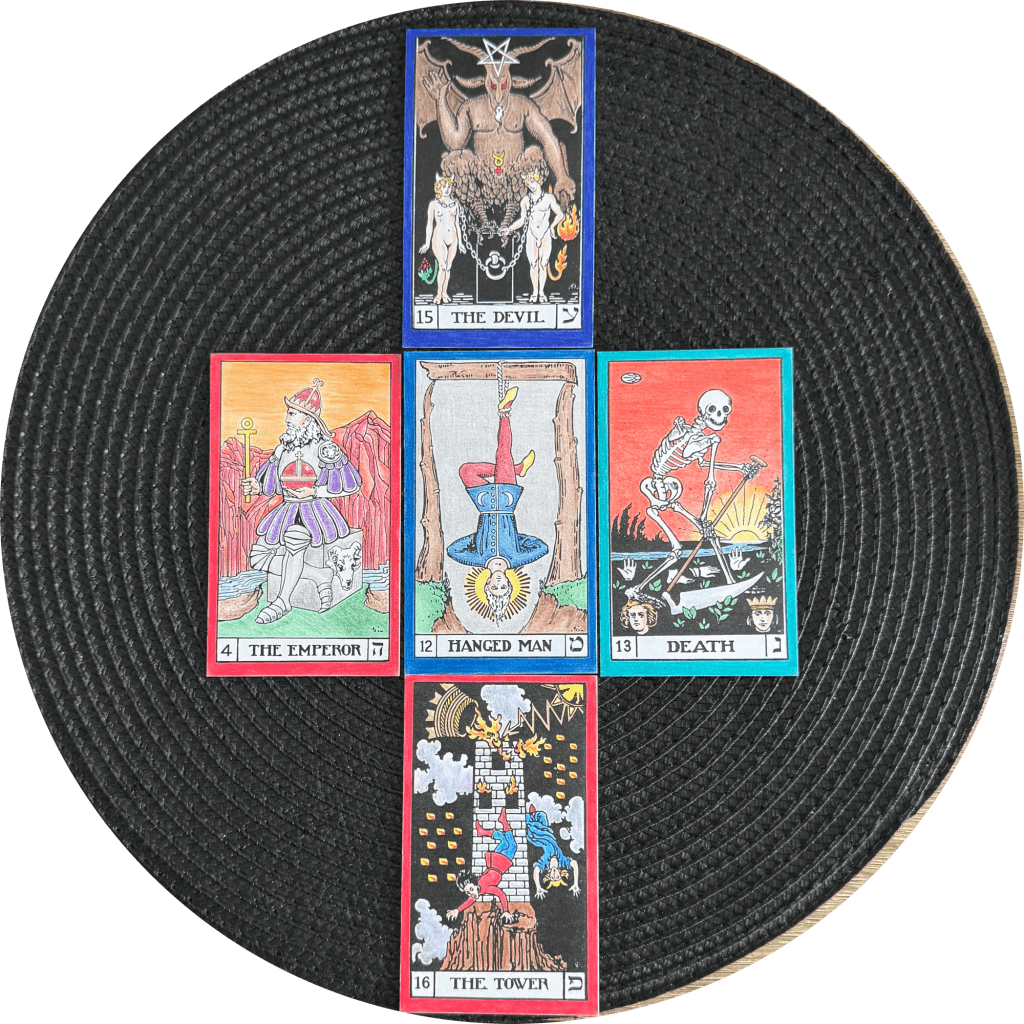
The cards drawn were as follows:

  • The Emperor (4)
  • Death (13)
  • The Devil (15)
  • The Tower (16)

For the synthesis:

4 + 13 + 15 + 16 = 48 = 4 + 8 = 12

The synthesis is therefore the Hanged Man.

I said to Sofia, “Yes, but only if you’re prepared to sacrifice everything and live with ghosts.”

Sofia is signified by the Emperor. In Book T1, one of the attributions given to the Emperor is “war,” and it is clear that Sofia was prepared to fight for her marriage. The Emperor does not readily accept defeat, and the failure of the relationship would feel, at least in part, like a personal failure.

Opposing the Emperor is Death. The image is striking. Sofia is prepared to struggle against forces that have been acting upon the marriage for many years. In relationship readings, the second card often describes either the partner or the relationship itself. Here, Death suggests that time, experience, and changing circumstances have altered the marriage fundamentally. What once bound the couple together no longer operates as it once did. The relationship has reached a point where it must either find a new basis upon which to continue or come to an end.

The advice position is occupied by the Devil. Here, I read the card in terms of material ties and practical obligations. After eleven years of marriage, Sofia and her husband have built a shared life: a home, finances, and the responsibility of raising two children. Should the marriage end, there would be considerable practical consequences. The Devil reminds Sofia to consider not only the emotional realities of the situation, but the material ones as well. From this perspective, the status quo can be retained albeit at a price.

The outcome is the Tower. Rather than a sudden calamity, I see it here as a structure that can no longer support the forces acting upon it. The marriage has changed, but the couple continue to relate to it as though it were the same relationship they entered into eleven years earlier. The Tower suggests this is no longer possible. The structure of the marriage has shifted and can no longer accommodate its present dynamics. What was has gone and cannot be restored.

Yet the reading does not conclude with the Tower. The synthesis is the Hanged Man, which reveals the underlying dynamic of the situation. The card does not suggest that the relationship cannot be saved. Rather, it indicates that it can continue only through sacrifice. Sofia would need to relinquish her expectations for the future and accept the uncomfortable reality that the marriage she once knew no longer exists. The relationship may endure, physically and materially, but only if both parties are prepared to let go of what was and make their peace with what remains. Otherwise, it will be a time-bomb.

Ultimately, the reading is quite simple. Sofia has the grit and determination of the Emperor to preserve the bonds of marriage represented by the Devil. Yet that marriage has been fundamentally altered by Death, and, as the Tower suggests, old bones (all that remains) make poor building blocks. Whether the relationship is worth preserving under such circumstances is the question posed by the Hanged Man. The marriage may survive, but only as a ghost of what it once was.

Sofia and her husband split six months later.

This example also illustrates a point often overlooked in discussions about tarot methods. Whether one is working with the Tarot de Marseille, the Dark Goddess Tarot, the Thoth Tarot, or a B.O.T.A. deck, it is perfectly possible to obtain direct and unambiguous answers. The key lies not in the artwork or even the system itself, but in keeping a firm eye on both essence, function and context. The cards reveal the essential nature of a situation; the reader’s task is to understand that essence within the context of the question asked. Do that consistently, and the Tarot rarely lacks clarity.

§

Cards: BOTA Tarot © Builders of the Adytum


Footnotes:

  1. Regardie, I. (1989) The Golden Dawn: An account of the teachings, rites, and ceremonies of the Hermetic Order of the Golden Dawn (Stella Matutina): A complete course in practical ceremonial magic. Saint Paul, MN: Llewellyn Publications. ↩︎
Divining with the BOTA Tarot

In October 2024, Camille was referred to me by a longstanding client. When we arranged a date and time, she enquired whether I owned or used the Sharman‑Caselli Tarot. Regrettably, I could not oblige.

Her question, however, stirred a number of memories. When I first embarked upon my Tarot studies, books on the subject were not nearly as accessible as they are today. There was no Amazon, and the local bookshop did not stock anything that might be classed as “Occult” (late 1980s).

One of the earliest volumes I encountered was The Complete Book of Tarot1 by Juliet Sharman‑Burke. She later collaborated with Liz Greene on the Mythic Tarot—an old and trusted companion. Although I never adopted her card significations, I was intrigued by her preferred three‑part reading method outlined in The Complete Book of Tarot. For a time, I followed her structured approach, but I also experimented: three Stars, three Celtic Crosses, beginning with the Greater Arcana, then the Lesser, and finally a reading using both.

More than thirty years later, I still appreciate the loose structure this provides. I often begin a Tarot consultation with an astrological wheel using only the Greater Arcana, and I have long felt that the Celtic Cross reveals itself most elegantly when read solely with the Lesser Arcana.

With these recollections stirred, I elected to use Sharman‑Burke’s three‑stage method for Camille: first, a Celtic Cross with the Lesser Arcana; second, a Star spread with the Greater; and finally, a five‑card Horseshoe using the full deck.

I do not own many Tarot decks: the Noblet and Dodal tarots, a mini Grimaud TdM, the Tarocco Soprafino, Visconti-Sforza, the Albano‑Waite, the Thomson‑Leng, the Prediction Tarot, Renaissance Tarot (Brian Williams), and the Rolla Nordic Tarot. For clients, I generally favour either the Noblet, Grimaud (due to their size), Soprafino or the Albano‑Waite. On this occasion, however, I used my BOTA Tarot.

The BOTA Tarot

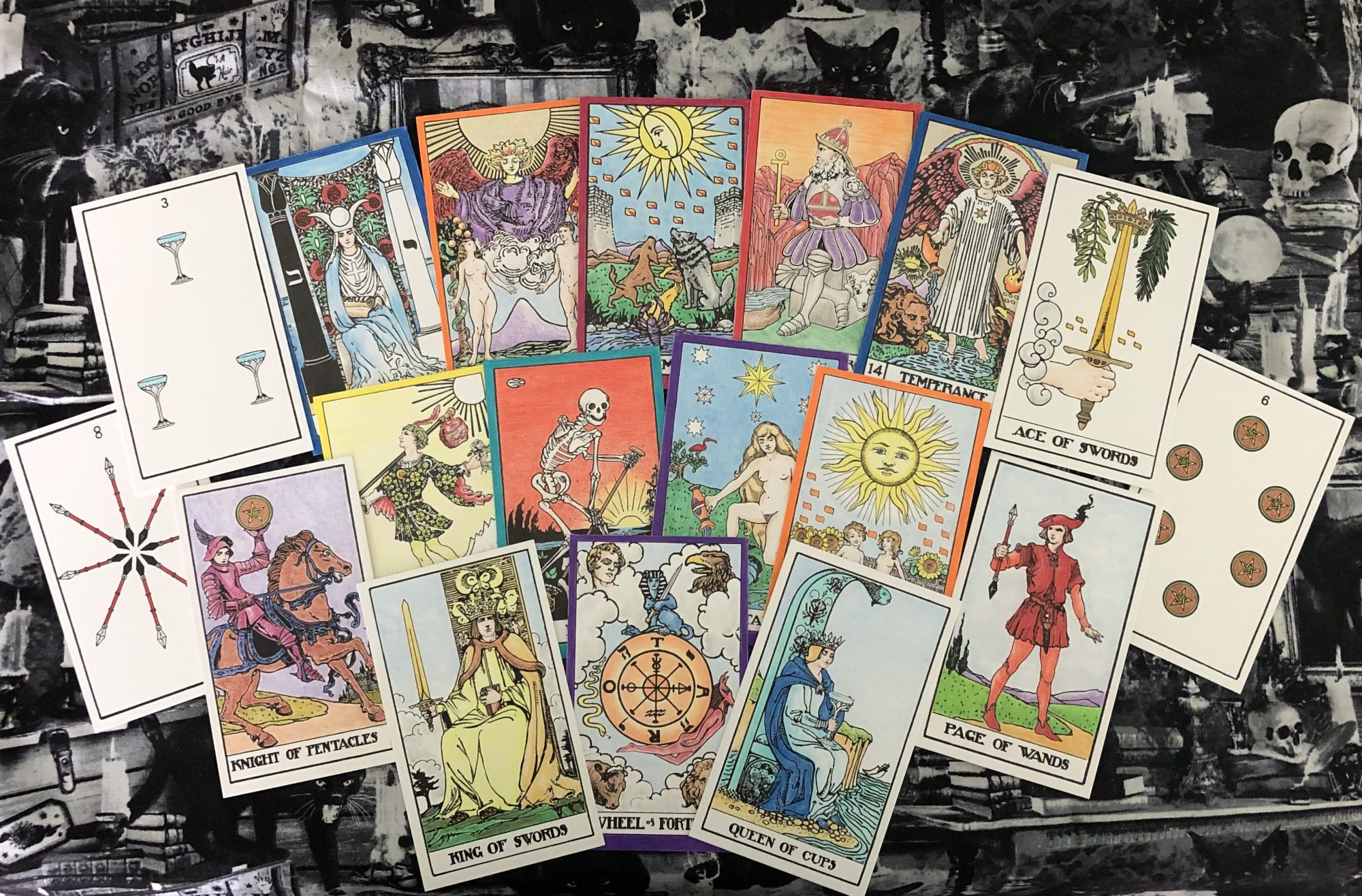
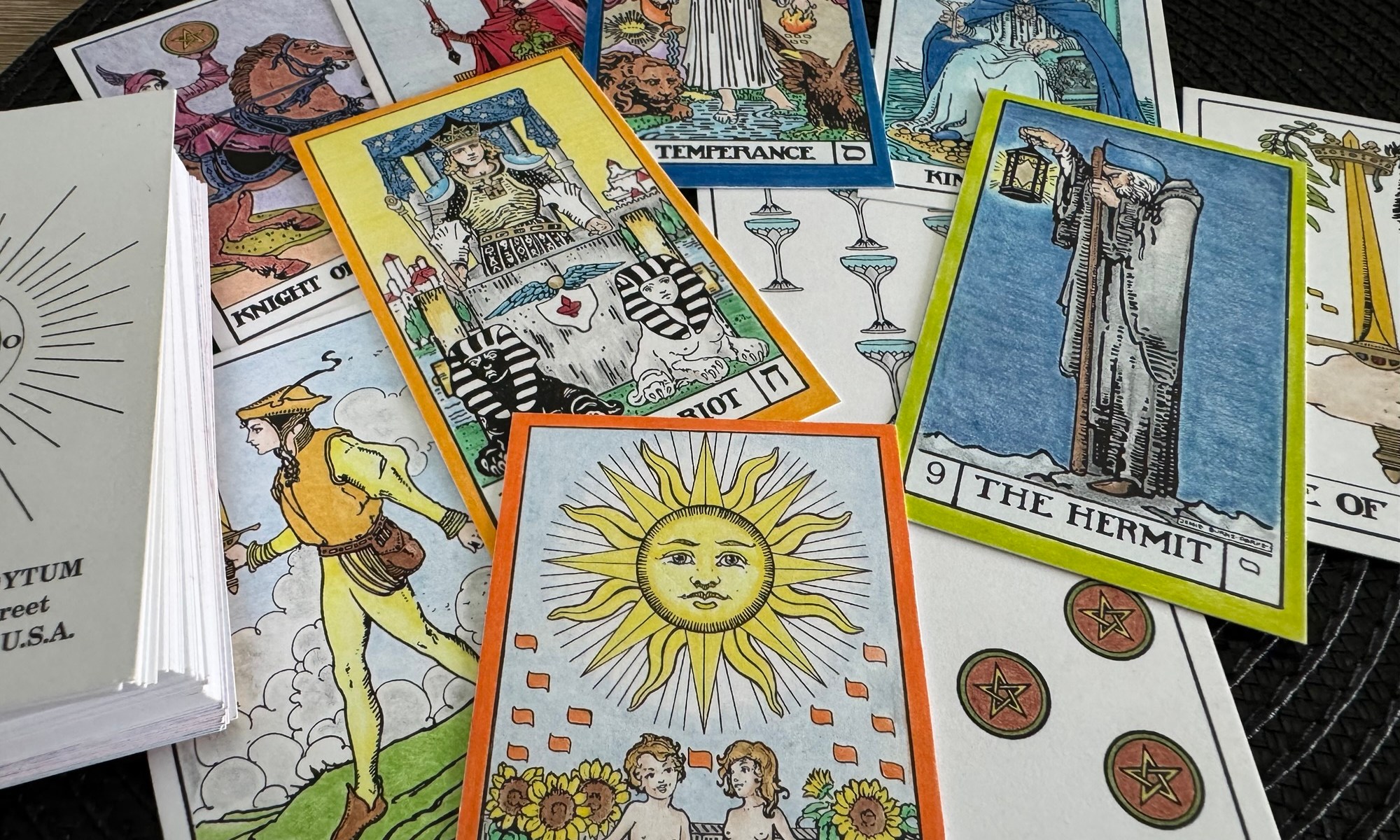
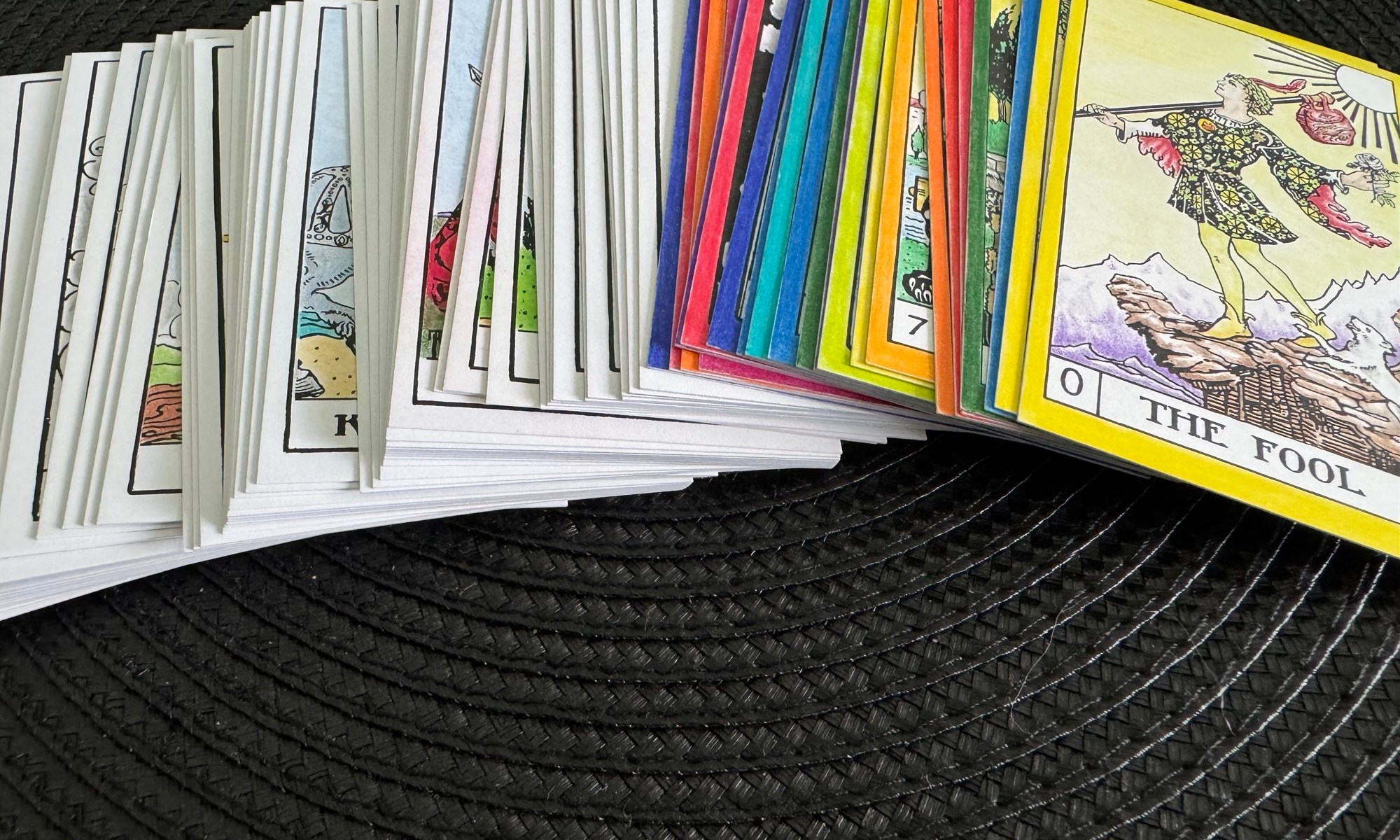
The Builders of the Adytum (BOTA) Tarot, designed under the direction of Paul Foster Case, is a lineal descendant of the Golden Dawn tradition and was created expressly as a vehicle for meditative and initiatory work. The deck is issued in black‑and‑white outline, intended to be coloured by the student according to Case’s precise attributions. My own copy is self‑coloured, following the traditional schema. When reading with it, I employ the significations for the Lesser Arcana given in Book T, which Case himself regarded as authoritative. This lends the deck a clarity and directness that I find particularly effective in structured readings such as the Celtic Cross.

I have, over recent years, coloured three BOTA decks. The version used for Camille’s reading adheres faithfully to Case’s prescribed colour scheme, which I have always found both coherent and aesthetically satisfying. The colouring itself proved a most pleasurable exercise; I completed the Greater Arcana at a pace of one card per week, allowing each image to settle, deepen, and reveal its character as the colours were applied.

Case’s work also provided the foundation for Frankie Albano’s re‑colouring of Pamela Colman‑Smith’s designs. Albano followed Case’s chromatic principles closely, producing a deck of remarkable vibrancy. I have always preferred the Albano‑Waite to the various other iterations of the Waite‑Smith tradition; its colours possess a coherence and luminosity that render the imagery far more intelligible in practice.

The Celtic Cross

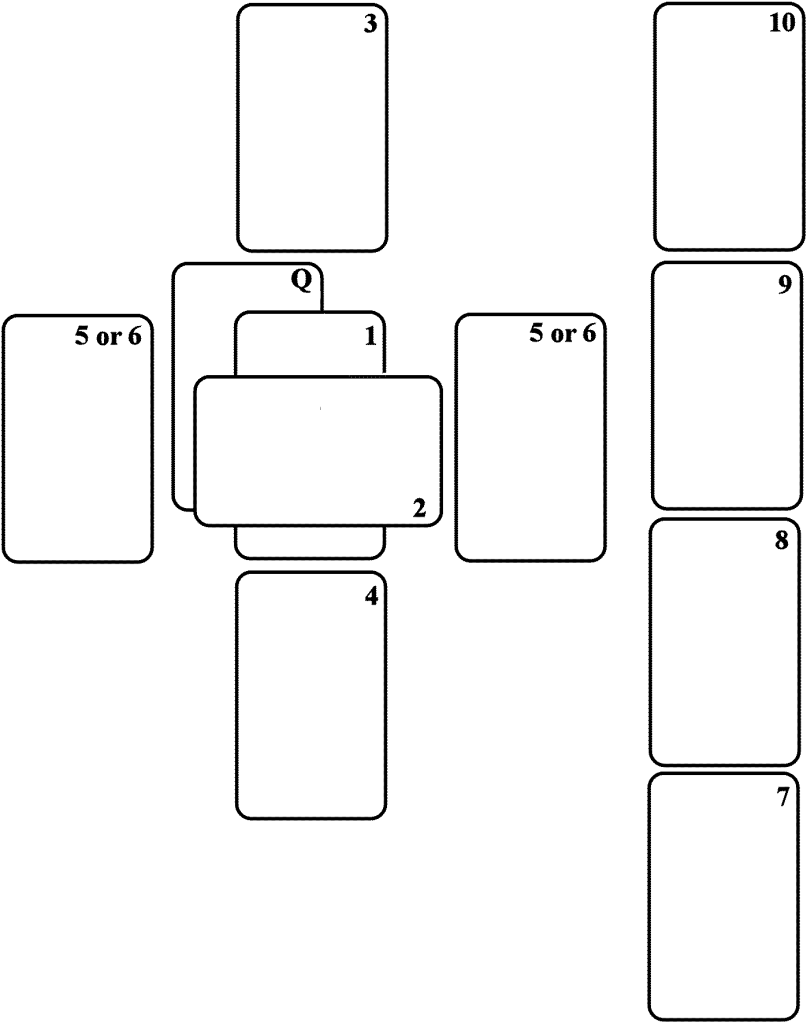
The Celtic Cross exists in several variations. Over the years, I have experimented with different forms, but I find the version outlined by Waite perfectly serviceable. You will observe, however, that I do not read it sequentially.

Reading

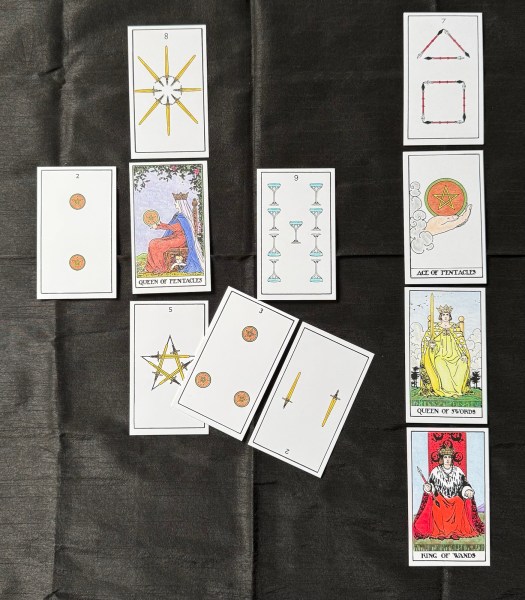
Camille has a classic earth (melancholic) temperament: short, lean, quiet, and reserved. For this reason, the Queen of Pentacles was used as the Questioner card. She faces left, and cards five and six of the Celtic Cross were dealt to the right and left respectively.

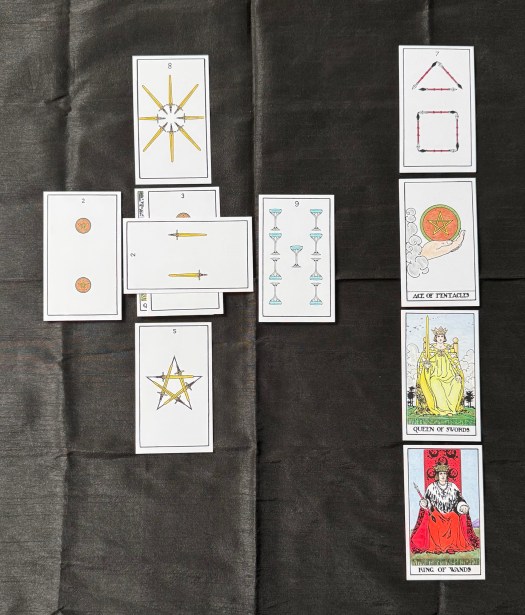
Camille posed no specific question. Experience has shown that when no question is asked, the first two cards will establish the topic. Here, we find the Three of Pentacles (card one, this covers you) and the Two of Swords (card two, this crosses you).

In the Golden Dawn system, these suits belong to opposing elements (earth and air). Followed by three Swords (air) cards, the Three of Pentacles (earth) is “undignified.”

Camille is eager to progress in her life and build upon the foundations she has laid (Three of Pentacles: building up, gain in commercial transactions, rank). Yet circumstances—being undignified—are currently frustrating, with little room for manoeuvre or support (Two of Swords).

From the cards, we may reasonably deduce that this pertains to Camille’s employment (Three of Pentacles: paid work). Traditionally, the Two of Swords indicates lingering tension after a quarrel, but more commonly it signifies a stalemate in which one must accept that one is neither influential nor likely to prevail. There is a strong indication that Camille is not in a position of advantage.

Turning to cards four (beneath) and five (behind), we see the cause of the tension.

Camille had previously been successful and took genuine pleasure in the satisfaction and material rewards her career afforded (Card 5: Nine of Cups). With the Nine of Cups, matters often come easily.

More recently, however, she was unsuccessful in securing advancement or a salary increase (Card 4: Five of Swords). Book T2 gives both “defeat” and “failure” for the Five of Swords, but also “a contest finished and decided against the person.” Looking across the spread, I felt Camille had applied for a higher position—the contest—and had been rejected as too inexperienced or insufficiently performing.

Card three (this crowns you) is the Eight of Swords. As matters stand, Camille will not find it easy to break out of her current position, with no immediate options on the horizon.

Yet all is not lost. In the future position, the Two of Pentacles promises an agreeable change in her circumstances.

The seventh card signifies the Questioner and how she influences the situation. Here we find the King of Wands. A Royal Arcana card may be read in two ways: as traits the Questioner possesses or requires, or as a person who may guide her. Both apply. Camille is a strong, independent, and capable woman; although her confidence has been dented, she must not lose sight of her abilities. These are qualities admired by the King, who is a just and generous benefactor to those he believes in. He will be able to guide Camille towards the best opportunities. In light of the Two of Pentacles, this is a friend of hers.

Card eight is the Queen of Swords, a woman in Camille’s environment. A keen observer, she will assess Camille’s performance and manner swiftly and decisively. Camille will not be granted the luxury of a second impression; she must be at her best from the outset.

The ninth card, the Ace of Pentacles, reveals Camille’s hopes and fears. Some Tarot readers interpret a negative card here as the Questioner’s fears and a positive card as their hopes. I read the card as both: what we hope for, we fear being denied; what we fear, we hope to avert. Camille hopes to advance in her career, securing her financial stability and material aspirations. She fears that failure to do so will leave her without the options and protection she desires.

The Seven of Wands is an interesting outcome card: it promises possible success, but not without challenge. Camille needs to dig deep and show her mettle.

If Camille can regain her footing, she will discover that the restrictions and obstacles (Eight of Swords) can be overcome with effort and tenacity. The Seven is never an effortless victory, but with the proper mindset and support (King of Wands, Two of Pentacles), her goals may indeed be realised.

In summary, I told Camille that she had suffered a setback in her career progression, and that this had left her confidence rather bruised. The cards showed that a positive change would come—the Two of Pentacles indicating an eventual shift in circumstances—but that it would not be immediate. Her present challenge lay in not appearing defeated or a poor loser (Eight of Swords, Five of Swords). If she can dust herself off and apply herself wholeheartedly to an upcoming project, the Seven of Wands shows that success is well within reach.

As we concluded, Camille confided that she had recently applied for the team‑leader position on her current assignment. The role had been awarded to a more experienced external candidate, and Camille felt acutely embarrassed—particularly as the successful applicant would now be her manager. This had prompted her to search, rather desperately, for a new position elsewhere. I reiterated the message of the cards and drew her attention once more to the Queen of Swords: the new manager would, in fact, prove a valuable ally, but she is a woman who forms her judgements swiftly and tends to keep to them. First impressions, therefore, would matter greatly.

Pointing to the Two of Pentacles, I advised Camille that matters would begin to improve around Christmas. The Queen of Pentacles—her significator—faces the Two of Pentacles, a card traditionally associated with the first decan of Capricorn, and thus with that period of the year. It suggested that the shift she longed for would emerge as the year turned, provided she maintained her composure and prepared herself to meet the opportunity when it arrived.

§

  1. Sharman-Burke, J. (1985) The Complete Book of Tarot. London: Pan. ↩︎
  2. Regardie, I. (1989) The Golden Dawn: An account of the teachings, rites, and ceremonies of the Hermetic Order of the Golden Dawn (Stella Matutina): A complete course in practical ceremonial magic. Saint Paul, MN: Llewellyn Publications. ↩︎