On Reading: Eikōn, Essence, and Function

Before proceeding further, it is worth briefly explaining three terms that recur throughout my articles on the Tarot and Petit Lenormand: eikōn, essence, and function. Together, they form the foundation of my approach to cartomancy and interpretation.

Eikōn

The word eikōn is Greek and simply means image. My use of the term, however, owes much to the Christian tradition of iconography.

Growing up with an exposure to Eastern Catholic and Orthodox influences, religious icons were a familiar sight. Over time, I developed a deep appreciation for the Byzantine tradition and the remarkable skill of iconographers. In that tradition, an icon is not merely a picture. It is “written” according to established rubrics in which colours, gestures, posture, clothing, objects, and composition all possess meaning. These individual elements combine to create a living image that communicates a story, truth, or mystery.

When I began studying the Tarot, particularly the Marseille tradition, the similarities struck me immediately. Like an icon, a Tarot card presents a complete image whose meaning emerges through the interaction of its various parts. The image speaks as a whole.

Christ in Majesty. Note the similarities to the Tarot’s Le Monde Card.
Metropolitan Museum of Art, CC0, via Wikimedia Commons

What I found less convincing was the dominant deconstructive approach employed in many modern Tarot books, where individual symbols are isolated from their wider context and elevated above the image itself. One reader may focus upon a hat, another upon a shoe, whilst someone else becomes preoccupied with the colour of a sleeve. Valuable insights can certainly arise in this way, but the danger is that the card ceases to function as an integrated image and instead becomes a collection of disconnected details. Meaning becomes increasingly subjective and, ultimately, relativistic.

The gestures of the Juggler mean little outside the context of the entire card. Likewise, the direction in which the Ship sails only acquires significance when considered within the wider image and narrative. The whole must always remain greater than the sum of its parts.

Tiberio of Assisi, St Clare of Assisi, CC0, via Wikimedia Commons

Whilst reflecting upon this, I am reminded of Saint Clare of Assisi’s visual approach to prayer, often summarised as gaze, consider, contemplate, and imitate. A visual form of Lectio Divina. It seemed to me that a similar method could be applied to the Tarot. One first observes the image, then reflects upon its meaning, contemplates its deeper significance, and finally applies its lessons to life.

For this reason, I prefer to think of the cards as eikōnes rather than collections of symbols. Each card should be approached as a complete image revealing a story and a principle.

I have deliberately chosen the Greek eikōn rather than the English word icon. Given the mixed reactions many people have towards Christianity, and despite the Tarot’s profoundly Christian origins, the Greek term provides a more neutral expression whilst still preserving the connection with the iconographic tradition from which my thinking developed.

Whilst the cosmological framework used throughout this work owes much to Aristotle and medieval natural philosophy, my approach to interpretation is more heavily influenced by the Christian Neoplatonic tradition. Both viewed the visible world as participating in deeper truths that transcend mere appearances.

The Tarot card is therefore not approached simply as a collection of symbols to be decoded, nor as a puzzle whose meaning is constructed from isolated details. Rather, the eikōn is treated as a unified image revealing an underlying reality. The image points beyond itself without ceasing to be itself. In this respect, the Tarot card functions much like a religious icon, inviting contemplation of the principle it expresses.

The famous Sinai Pantrocrator reveals Christ’s Dyophysitism: God and Human.
Saint Catherine Monastery, Public domain, via Wikimedia Commons

Amongst the figures who have most influenced my thinking in this regard are Saint Augustine, St Benedict, Marsilio Ficino, Giovanni Pico della Mirandola, Thomas Merton and Brian Williams. Despite belonging to very different periods, each recognised the importance of contemplation, discernment, and the search for truth beneath appearances. Their writings encouraged me to approach the Tarot less as a collection of signs and more as a series of images revealing enduring principles.

Essence

If the eikōn is the image, the essence is the fundamental principle or mystery expressed by that image. The essence is not a keyword, nor is it a summary of every possible meaning attached to a card. Rather, it is the card’s underlying nature. It answers the question: what is this card?

My own understanding of essence emerged gradually through the study of Tarot and the Petit Lenormand. When I first learnt to read cards, keywords played little or no role. Instead, attention was given to the nature of a card and how it behaved in different circumstances (order, whether it was near or far, et cetera). It was only later, upon reading modern Tarot literature, that I encountered extensive keyword lists.

Whilst keywords can be useful as memory aids, I often found myself struggling to understand why particular words had been selected. Vocabulary is shaped by culture, language, generation, and personal preference. One author’s keyword might differ entirely from another’s, despite both discussing the same card. The result was often a sense of arbitrariness and made more difficult by my dyslexia.

Over time, I began to notice that things possess an underlying nature that makes them what they are. This differs from a purely symbolic approach in which a card merely stands for something else. The Hermit is not a symbol of prudence. The Hermit is prudent. Prudence belongs to his nature and is therefore expressed whenever he appears.

Matfre Ermengaud di Béziers, Public domain, via Wikimedia Commons

This understanding owes much to the Neoplatonic tradition, particularly as filtered through Saint Augustine and the Renaissance philosopher Marsilio Ficino. Both viewed visible things as participating in deeper realities rather than merely representing them. A thing possesses a nature which allows it to remain itself whilst simultaneously connecting it to broader truths.

In this sense, the essence is not a keyword attached to a card. Nor is it an abstract label. It is the card’s essential self: the underlying principle that unites all of its manifestations and gives coherence to its meanings.

This understanding also emerged naturally from my use of the eikōn. The eikōn reveals the essence. By contemplating the image as a whole, one arrives at the principle that animates it. The image is not merely a collection of symbols; it is the visible expression of an underlying nature.

The Hermit provides a useful example. Prudence is not one meaning of the Hermit amongst many; it is the principle from which the others arise. Whether the Hermit appears as caution, discretion, reflection, solitude, age, experience, patient guidance, or careful planning, prudence remains the common principle linking these manifestations together. Prudence is the Hermit’s essential self. Without prudence, the Hermit would cease to be the Hermit.

Similarly:

  • Justice is Verity.
  • The Pope is Wisdom.
  • The Hound is association.
  • The Fishes is abundance.

Every subsequent meaning associated with a card should arise from that central principle. The essence prevents the card from becoming a collection of disconnected keywords and instead allows its meanings to remain coherent and rooted in its nature.

In this respect, the essence acts as a thread running through every interpretation. It keeps the card unified, ensuring that however many manifestations it may possess, it remains recognisably itself.

Before proceeding further, I should briefly clarify a point of terminology. I am always pleased to see readers engage with and discuss the concept of essence, especially as it has become a useful part of the vocabulary surrounding this type of work. However, I have occasionally noticed the term being used somewhat differently from how I originally intended it. Essence is sometimes treated as little more than a refined keyword or summary phrase. Whilst this is understandable, it is not quite what I mean. A keyword describes a card; an essence reveals what the card is. It is not simply a convenient label attached to a collection of meanings, but the card’s underlying nature and identity. The essence of the Hermit, for example, is not merely a word chosen to summarise the card. It is the principle that makes the Hermit recognisably itself and from which all of its manifestations proceed. In this respect, essence is less a description than a revelation. It seeks to identify the card’s true nature rather than merely describe its appearances.

Essence should therefore not be understood as the most important keyword attached to a card or a vibe or spirit. Keywords remain descriptive; essence is ontological. It concerns the card’s being rather than its attributes. The question is not “How might this card be described?” but “What must this card be in order to be itself?” The answer to that question is what I mean by essence.

Function

If essence describes a card’s nature, function describes its action.

How does this principle operate?

Where essence is relatively static, function is active. The two are inseparable. A card’s function must arise naturally from its essence rather than being imposed upon it from outside.

If the essence describes a card’s nature, the function describes the activity proper to that nature.

For example:

  • Justice is verity that balances.
  • The Pope is wisdom that mediates.
  • The Hound is association that supports and assists.
  • The Fishes is abundance that circulates.

The function therefore represents the manner in which the essence expresses itself. Wisdom may manifest in many ways, but it always mediates between ignorance and understanding. Renewal may appear in many forms, but it always guides growth and recovery. Prudence consistently operates through discernment. The essence remains constant; the function explains its activity.

In many ways, function can be understood through a simple analogy. We understand a knife not merely by what it is, but by what it is for. The proper activity of a knife is to cut. Likewise, we understand a Tarot card more fully when we know both its nature and its operation.

Knowing what a card is allows us to identify it; knowing what it does allows us to interpret it.
Function becomes particularly important when we arrive at what I call the Progressed Meaning.

The progressed meaning is the practical interpretation that emerges during a reading. It is not the essence alone, nor the function alone, but the essence functioning within a specific context.

In other words:

Progressed Meaning = essence functioning in context

or, if one prefers:

Progressed Meaning = essence + function + context

Consider the Hermit. His essence is Prudence and his function is to Discern.

When interpreted in a love reading, we do not suddenly abandon prudence and begin inventing entirely new meanings. Rather, we ask how prudence functions through discernment within that context. The progressed meaning becomes caution, taking time to know another person, exercising discretion, or carefully evaluating a relationship before making commitments.

Likewise, in a business reading, the Hermit may advise reviewing evidence carefully before investing. In a health reading, he may indicate the need to seek additional information before proceeding with treatment. The manifestations differ, but the underlying principle remains unchanged. Prudence continues to operate through discernment.

The same process applies to every card.

Consider the Star. Its essence is Renewal and its function is to Guide. In health, it may indicate recovery and convalescence. In finances, gradual improvement. In relationships, reconciliation and rebuilding trust. In each case, renewal continues to guide circumstances towards restoration.

Death provides another useful example. Death is Demise that Terminates. In a relationship, this may indicate separation. In employment, redundancy. In health, the conclusion of a course of treatment. In each case, the progressed meaning arises from the same essential principle operating within different circumstances.

This leads to an important rule:

The progressed meaning should never contradict the essence.

The manifestation may vary, but the essence remains constant.

Death should never suddenly signify growth. The Devil should never become liberation. Justice should never become deceit. The circumstances may alter how the card appears, but they cannot alter the card’s nature.

Function therefore provides the bridge between a card’s nature and its practical interpretation. Without it, readings become little more than collections of disconnected keywords. With it, meanings develop naturally from the card itself.

The task of the reader is not merely to memorise interpretations, but to understand how the essence functions within the circumstances presented by the question. That process is what produces the progressed meaning.

The essence anchors the card, the function sets it in motion, and the context determines where that motion is directed. Together they produce the progressed meaning encountered in actual divination. When properly understood, the progressed meaning is not an arbitrary interpretation, but the natural consequence of the card’s nature operating within a particular situation.

The reader may therefore notice two distinct influences throughout this article. The structure of the cosmos, the elements, and the temperaments derive largely from the Aristotelian worldview. The method of interpretation, however, owes more to the Christian Neoplatonic tradition of Augustine and Ficino, in which visible images reveal deeper realities. The two approaches are not in opposition.

Indeed, Renaissance thinkers frequently employed both, seeing them as complementary ways of understanding the same creation.

§

Images:

Featured Image: Stadtbibliothek Trier (Wissenschaftliche Bibliothek der Stadt Trier), CC BY-SA 4.0 https://creativecommons.org/licenses/by-sa/4.0, via Wikimedia Commons

References:


Augustine and Pine-Coffin, R.S. (2003) Confessions. London, England: Penguin Books.
Saint Augustine of Hippo and Bettenson, H. (2004) City of God. Penguin Books.
Carvalho, H.A. de and Ribeiro, L. (2010) On the heavenly spheres: A treatise on traditional astrology. Tempe, AZ: American Federation of Astrologers.
Benedict et al. (1981) RB 1980: The Rule of St. Benedict. Collegeville, MN: Liturgical Press.
Farley, H. (2009) A cultural history of Tarot: From entertainment to esotericism. London: I.B. Tauris.
Frawley, J. (2001) The Real Astrology. London: Apprentice.
Guite, M. (2022) Lifting the Veil: Imagination and the Kingdom of God
Hankey, W.J. (2016) Aquinas’s Neoplatonism in the Summa Theologiae on God. St Augustine’s Press.
Nees, L. (2002) Early Medieval Art. Oxford: Oxford University Press.
Nouwen, H.J.M. (2007) Behold the beauty of the lord: Praying with icons. Notre Dame, Ind: Ave Maria Press.
O#Meara, D.J. (1981). Neoplatonism and Christian Thought
Ptolemaeus, C. and Robbins, F.E. (2001) Tetrabiblos. Cambridge, MA: Harvard Univ. Press.
Silvestre, C.H. (1987) ABC des Tarots. Paris: Marabout.
Thomas (2018) Summa Theologica: Complete in a Single Volume. Claremont, CA: Coyote Canyon Press.
Valens, V. and Riley, M.T. (2022) The Anthology. Denver, CO: Amor Fati Publications.
Williams, B. (2003) A Renaissance Tarot: A Guide to the Renaissance Tarot. U.S. Games Systems.

Burning Like a Silver Flame

She that fain would fly, she shall quickly follow,
She that now rejects, yet with gifts shall woo thee,
She that heeds thee not, soon shall love to madness,
Love thee, the loth one! 

Sappho, Ode to Aphrodite.

Long-term readers will know that I have a preference for linear and classical carrés and stars over positional draws. However, from time to time, the cards will fall on my table in crosses, horoscopes, horseshoes and CCs.

Below I use two medium sized spreads that can be utilised for looking for love questions. Credit for the patterns go to Colette Silvestre[1] and Teresa Michelsen[2].

L’étoile de Vénus

This draw is designed purely for relationship development questions. The five cards are as follows:

1
2    3
4        5

  • The first card represents the consultant.
  • The second card represents the present influences.
  • The third card represents influences that can either support or oppose the consultant.
  • The fourth card is the consultant’s hopes.
  • The fifth card is the outcome.

In her many books, ranging from TdM to L’oracle de Belline and both the petit Lenormand and grand jeu de Mademoiselle Lenormand, Mme Silvestre focuses on giving concise answers and emphasises cards’ behaviour. In this reading, great weight is thus given to passivity versus activeness and help versus hindrance.

Reading:

The first question comes from a young man, in his early twenties, referred hereafter to as the cavalier d’épée. He is currently single, having parted way with a young woman recently, and wanted to know if he would meet someone ‘new’ soon.

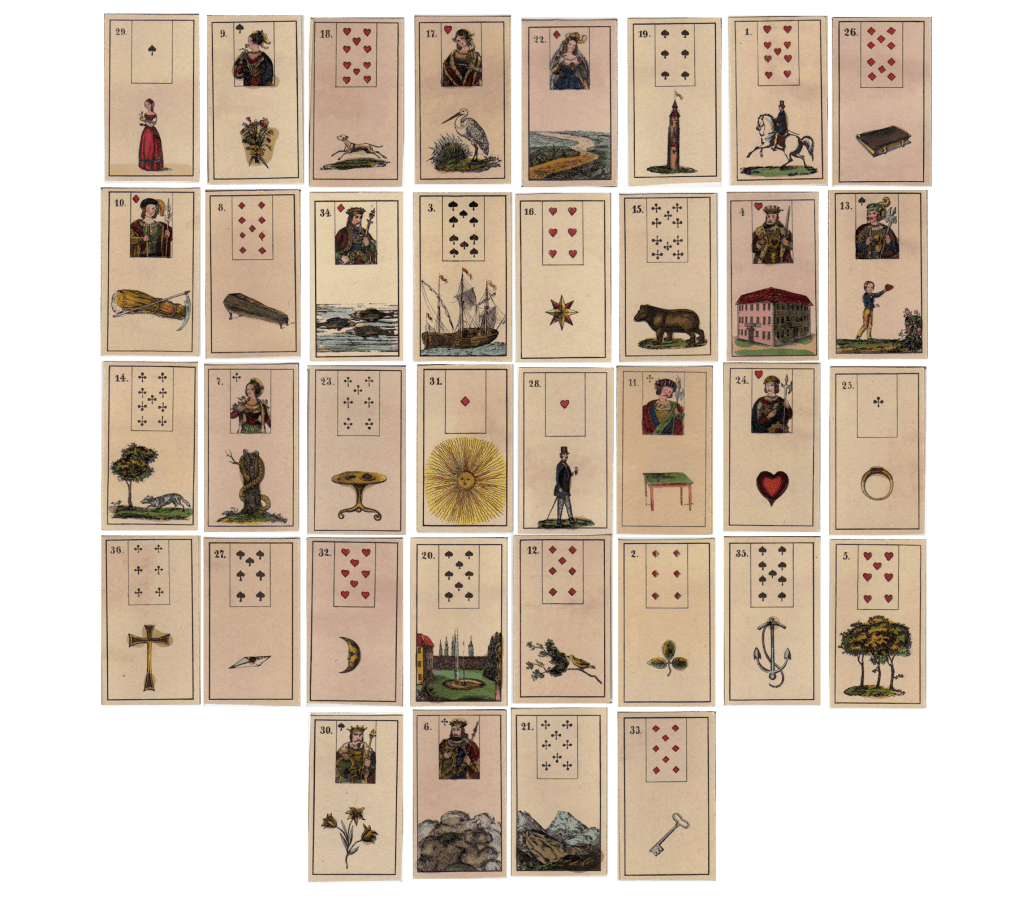
The cards as they fell:
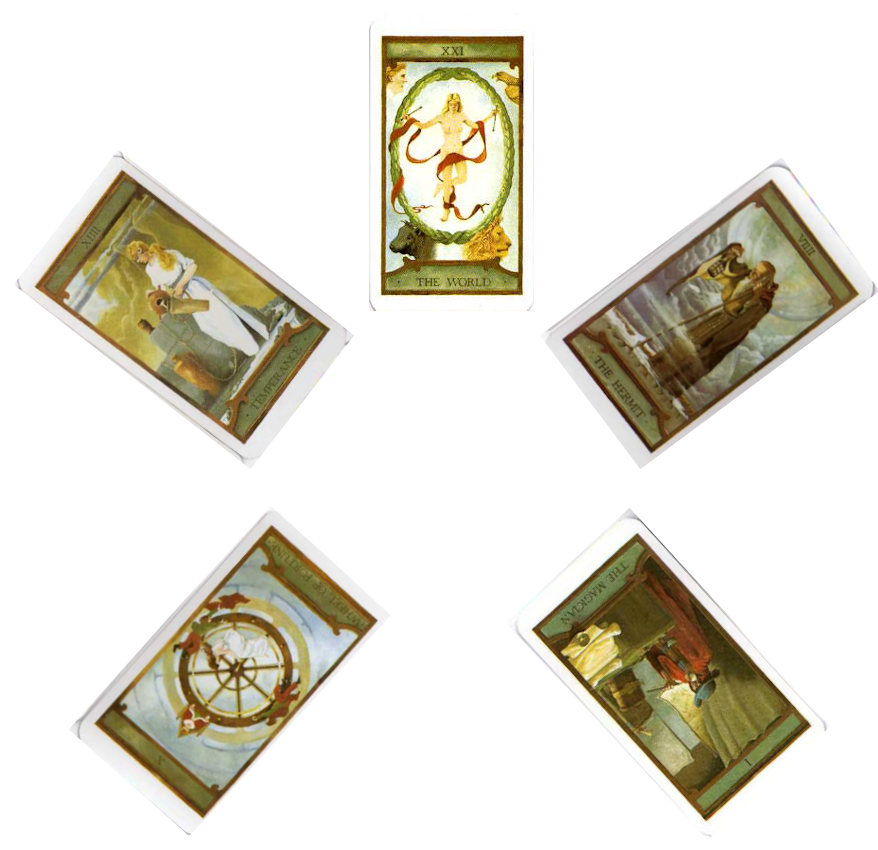
I replied: ‘Yes, if you’re prepared to be a gambler.’

The cavalier d’épée loftily stands to survey his domain (le monde), calm and collected (tempérance), but hesitant (l’ermite). He hopes for change and new encounters (the la roue de fortune). He can have this, but only if he takes a risk and seizes his opportunities (the le bateleur).

I often see the le bateleur card as ‘yes, but.’[3] Le bateleur knows success occurs when opportunity meets preparation. He is prepared to seize any opportunity, to take a risk. Is the cavalier limiting his opportunities in some way? The L’ermite says yes. Some cards, such as tempérance, are actively passive. To achieve perfect measure or understanding, and thus peace the the fruit of the virtue, she must actively engage in passivity. That helps, here. The l’érmite, however, challenges tempérance on whether she has found the right measure or moment.

We lay two pip cards over the l’érmite, to see what he’s contemplating: dix de denier and deux d’épée. failure, or the loss of success and he runs from this. But philosophers have always said abstinence is easier than temperance. I don’t think the Hermit knows there is no contingencies in affairs of the heart. You take a risk. Or you stop alone.

I think the cavalier d’épée will find himself surprised at the possibility that presents itself.

Looking for Love:

Teresa Michelsen outlined this spread in her book, Designing Your Own Tarot Spreads.

  • The first card describes why you have not yet found your ideal partner.
  • The second card tells you how to overcome issues expressed in the previous card.
  • The third card advises you on the most positive action you can take to find your partner.
  • The fourth card describes who will be the right person for you.
  • The fifth card tells you where you will find this person.
  • The sixth card tells you when you will find your partner.

Reading:

This question was posed by a divorcée hereafter referred to as the Queen of Coins. The Queen had a two-parted question, why she was unsuccessful in finding a partner and when this would change. You will see Teresa Michelsen’s layout beautifully addresses these factors.

The cards as they fell:
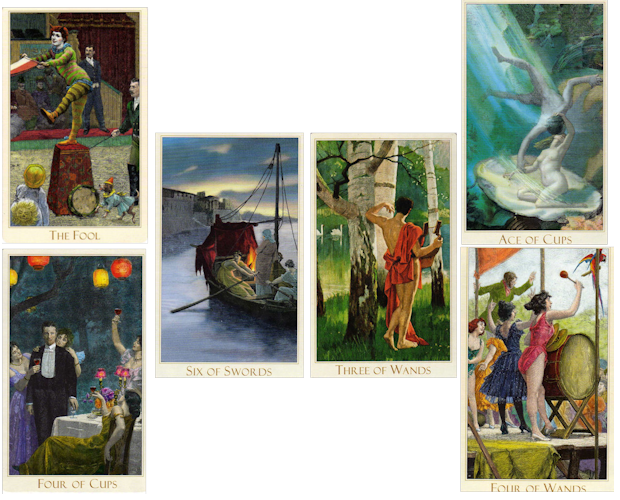
My answer is: her social circle is not conducive to a new relationship and this will change when she relocates and meets new people.

Despite her emotional stability, the Queen finds herself with indifferent and listless men (4 of Cups) and will need to destabilise and breakout from the status quo (the Fool). The most positive thing she can do is leave her coterie and cut ties with a crowd that does not serve her needs (6 of Swords).

She will find her ideal partner in a festive and lively crowd (4 of Wands) when she builds a new home for herself and feels revitalised (Ace of Cups).

Traditionally, when we see the 4 of Cups, we often talk about feeling secure, real emotional intelligence and fairness (being the sanguine, air suit). It’s also the home of friends. However, here, we see a man so secure that he is apathetic and inert and unresponsive to the Queen’s needs. In the face of this, the 6 of Swords tells the Queen to leave the party and sail away to the troubadours’ party in the 4 of Wands.

If we look at the 3 of Wands, as who will be right for the Queen, we say a man who has forsaken his white-tie for a red toga. He’s imaginative, probably musical, but keeps his bare feet on the ground. He balances reliability with inscrutability (both earth qualities), creativity and dint of effort. Whatta man, in the words of Salt-n-Pepa.

The Ace of Cups, in timing, can be read as the first week of autumn, that is the week commencing September 24. A change of residence is supported by both the 6 of Swords and 4 of Wands, and to a lesser extent the Fool. I thus favour a literal move rather than a figurative fresh-start. The Queen told me, after the reading, all her friends were attached. She is due to be rehoused by the local authorities in the summer. I wish her well.

§

Cards: The Prediction Tarot (Peter Richardson), Aquarian Press 1985; The Victorian Romantic Tarot (Alex Ukolov & Karen Mahony), Magic Realist Press 2006.

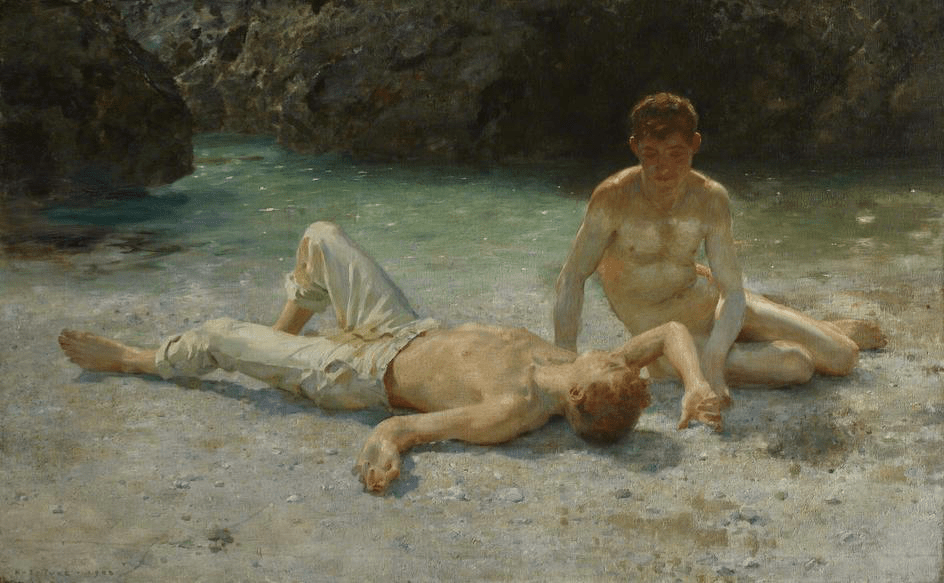
Featured Image: Fresco from Pompei, Casa dei Venus, 1st century AD. Unknown ancient Rome artist, photo of Stephen Haynes [Public domain], via Wikimedia Commons.

Title: Venus, by Shocking Blue.

Notes:

[1] Silvestre-Haéberlé, C. (2001). Les 12 meilleures méthodes pour tirer les tarots. 1st ed. Paris: Grancher.
[2]Michelsen, T. (2003). Designing your own tarot spreads. 1st ed. St. Paul, Minn.: Llewellyn Publications.
[3]Of note, he takes this precise meaning in the different versions of le tirage immediat sometimes called the rapid response.
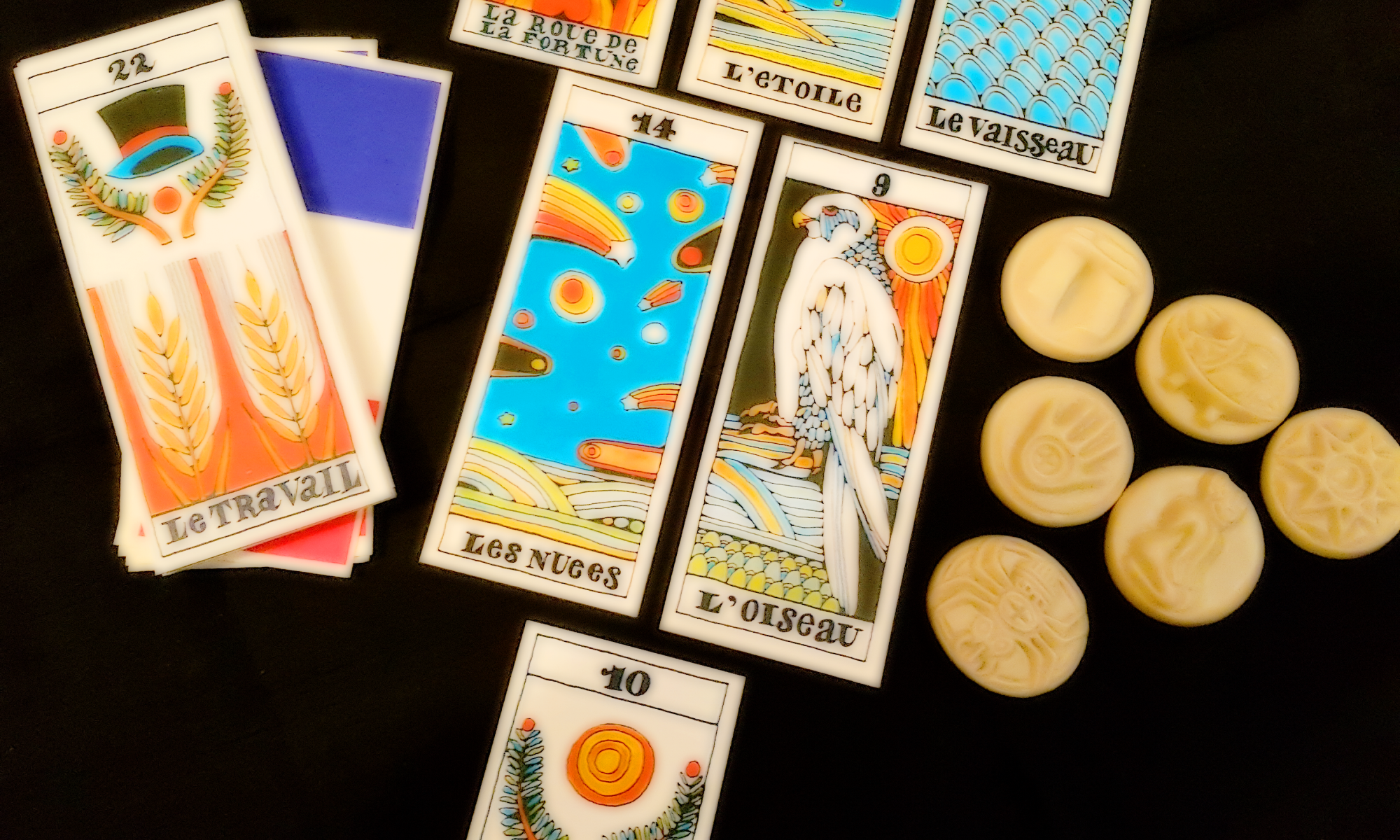
Horseshoe

Programme two of my one-to-one tuition course with the Marseille tarots focuses on helping deliver the same precise and succinct answers, delivered with the linear draws, with spreads and positional draws of various sizes. The plan was developed in response to numerous e-mails and comments from readers, and my earliest students. Often students find themselves becoming hesitant or losing focus when reading cards in patterns, especially those with positional contexts. Here we prevent such habits, building proficiency and incisiveness.

Quite often students tell me how surprised they are that a Celtic Cross or the Widdershins’ Star can be read as a snappy sentence, just as one can a line of five or nine cards. But the reality is they can be. It is all just a matter of orientation.

The linear draws flow from the first card to the last card. Leaving aside reflection, cards relate solely through progressive attendance. Thus, there is no question of a positional relationship found in a draw such as Astrological Wheel or Celtic Cross. The challenge for the cartomante, therefore, is to cultivate the same sense of directional ease through knowing where each place falls in the course of the narrative.

The Horseshoe

« Le fer a cheval » or horseshoe spread is cartomantic standard. In addition to providing clear answers to precise questions – including yes or no – it offers useful advice on how to solve problems or situations.

It is the first draw covered in the second programme.

Although we focus on the Marseille tarot, here, it can be employed with the l’oracle de Belline, the Petit Lenormand, l’oracle de la Triade and le tarot persan de Madame Indira, et cetera. It is thus extremely versatile and, therefore, a useful addition to the cartomante’s repertoire.

The Basics

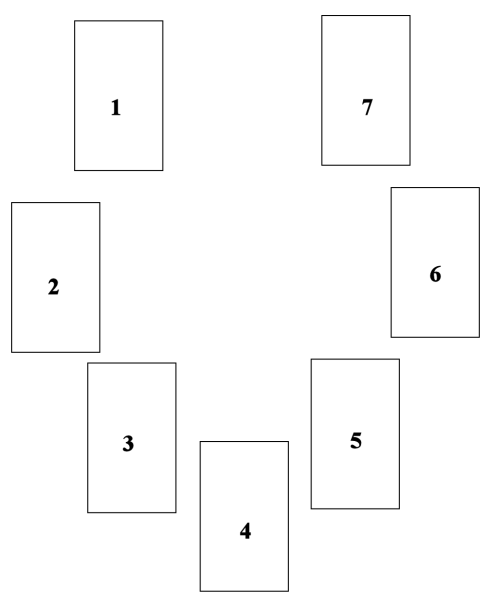
The draw is composed of seven cards, which are to be arranged as shown below. As with numerous spreads, there are variations to be found. The one described, here, has served me well. I also use a second variation which can be seen in a later article.

    • Card one determines the consultant in the face of her question giving insight into her attitude and position.
    • Card two defines the present situation in relation to the question which can either aid or hinder or shed let on external influences or individuals.
    • Card three represents the future and how matters will play out.
    • Cards four and five advise on the direction the consultant should take, what to do and how best to act.
    • Card six is the main obstacle to be overcome and can provide guidance on where to forbear.
  • Card seven is the response.

Relating the Cards

Although the reader can advance through the cards in numerical order one can then struggle to formulate the core answer. The core answer is a succinct pronunciation that summarises the cards’ response taking into consideration how the cards relate to and engage with each other.

A sequential stroll through the cards will thus provide a disjointed and pedestrian answer. One also runs the risk of turning the reading into seven one-card readings, rather than a seven-card reading. Unfortunately, the majority of Anglo-Saxon cartomantes fall into this trap and have made the latter a virtue of necessity.

Narration

The first card advises the cartomante on the temperament and position the client occupies in relation to her question. It is thus the point of departure and also can be seen as a significator.

Both card two (the present state of affairs) and card six are connected with the latter describing the main obstacle arising out of the present situation.

Now that the cartomante is appraised of both the situation and difficulties he turns to the fourth and fifth cards. These two cards advise the seeker on how she can best proceed to resolve the challenges she faces. Thus, both cards are key to offsetting card six.

Naturally, card seven and card three are closely connected. The cartomante will need weigh these two cards against each other and see if there are signs of dissonance.

For example, the cartomante finds himself reading for a client who wants to know if she will reconcile with an ex-partner: the seventh card is le soleil and the third card is le diable. The disparity between these cards indicates that although the two will reconcile (le soleil) she will find herself in hellfire (le diable). Transpose the two cards then the answer is negative, but le soleil would, as occupying the future position, foretell warmer times and love in the near future.

Example Reading

At the end of January one of my mother’s friends asked if someone could read for her daughter. After 52-weeks’ maternity leave, the daughter had returned to the employment to discover her role (secretarial) had changed and was somewhat unhappy to find herself working for a different person. Due to the complex laws surrounding maternity leave, the seeker felt that there were grounds for complaint, although was somewhat wary of initiating a grievance.

Her question was: “Will I be able to resolve this to my advantage?”

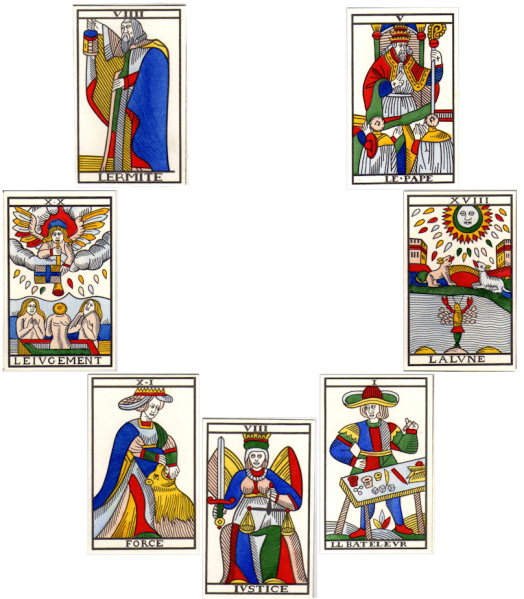
The cards as they fell:

Answer:

Yes, but with the aid of a steward or mediator; you can then cut through the mess and find yourself in a satisfying condition.

Delineation:

For clarity, we will breakdown the spread and delineation.

The client appears as l’Ermite which shows the client is searching for a solution and guidance, not being in a position where she can act autonomously.

Presently, her employer is undertaking some form of restructuring, that has come at the same time the seeker returns to work (Jugement), which has resulted in considerable confusion (la Lune).

With La Lune in mind, the client will need to solicit advice from one who can weigh the situation appropriately (la Justice) and, therefore, identify the right moment to act and deal the winning card (le Bateleur). It is important that she keeps her feet firmly on the ground (la Lune contrasted with la Justice and le Bateleur).

Thus, with the appropriate aid (le Pape), she will be in a strong position to resolve the situation to her satisfaction (la Force). We notice that both l’Ermite and le Pape are turned from each other – the seeker has not sort appropriate advice and would benefit from either union representation or some mediation (le Pape).

Despite the draw utilising positional contexts, we are able to retain the incisiveness of a linear draw. We just need to know how positions relate to each other in the same way attendance in lines flows. As with all of cartomancy, it comes down to looking.

§


Cards: Les Tarots Marseille de Jean Noblet, Paris, vers 1650 © Éditions Letarot.com (2001).