Application, Separation, Frustration… Is Horary All About Aspects?

Editorial Note: This article was originally written during a period in which I was experimenting with whole-sign houses. It is presented substantially as originally written.

One of the most common misconceptions about horary astrology is that judgement consists merely of locating an aspect between two significators and pronouncing a simple yes or no. If the ruler of the ascendant applies to the ruler of the seventh, the answer is yes; if not, the answer is no.

The reality is rather more nuanced.

Aspects themselves have several layers of meaning that must be considered: application and separation, frustration, prohibition, collection and translation of light, reception, and a host of other factors. A chart may indicate the perfection of a matter whilst simultaneously showing obstacles, delays, or even a subsequent change of circumstances.

A horary consultation from earlier that year serves as an excellent illustration.

The querent, Dimitra, wished to know whether she would be offered a position for which she had recently been interviewed.

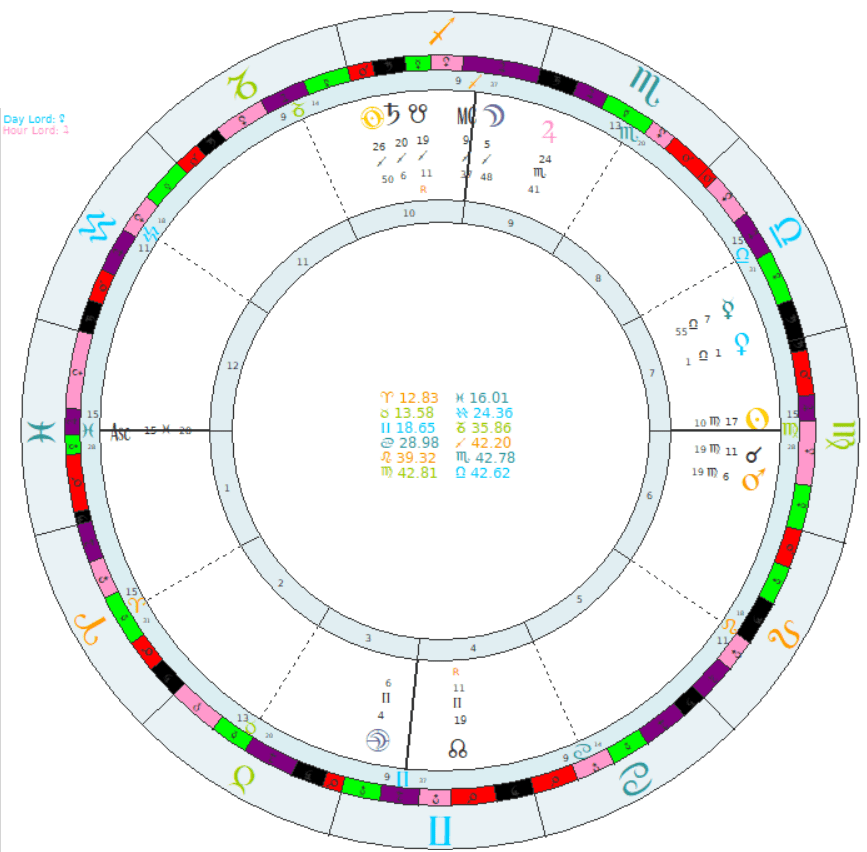
I cast the chart for the time and date at which I read and understood her question. The figure was displayed using house division; however, my topical analysis was conducted using whole-sign houses.

In horary astrology, the rising sign and its ruler signify the querent. The matter being enquired about—the quesited—is represented by the appropriate house and its ruler. The Moon, as the general significator of events and developments, may also co-signify the querent provided she is not simultaneously ruling the quesited.

Cancer rises in this figure, making the Moon Dimitra’s principal significator.

In terms of the considerations before judgement, the chart is radical. It was cast during the hour of the Moon, who both rules Cancer and serves as one of the triplicity rulers of the water signs.

The Moon is placed in the second house and is therefore in aversion to the ascendant. When the querent’s significator is averse to the first place, we may conclude that the matter is not entirely within the querent’s control.

As part of my practice, I also examined the twelfth-part of the ascendant, which falls at 6° Aries in the tenth place. Employment is a tenth-house matter1. According to Hephaestion of Thebes, the twelfth-part associated with this portion of Cancer concerns “rulership and rank and a priesthood and what is like that2.” Whilst not decisive in itself, such testimony is certainly relevant given the nature of the enquiry.

The central question, however, remains straightforward: will Dimitra be offered the position?

To determine this, we must establish whether there is a means of bringing together the querent and the quesited. This may occur through direct application between significators or through a translation of light.

The answer appears immediately.

The Moon, signifying Dimitra, is at 27° Leo. Mars, signifying the position itself, is at 27° Aries. The two are joined by an exceptionally close trine, with less than a degree remaining before perfection. This detail is important, for the aspect is still applying. Had the trine already separated, it would instead suggest parting: rejection, withdrawal, dismissal, or a conclusion already reached.

At first glance, therefore, the answer appears to be yes.

Yet judgement does not end there.

The next step is to determine whether the Moon perfects another aspect before reaching Mars. Were there such a planet, the trine could be frustrated. In this chart, no such frustration occurs. Mars is not stationing, nor is there any prohibition arising from retrogradation. Whilst the Moon eventually squares Jupiter, that aspect perfects only after the trine to Mars and is therefore irrelevant to the immediate question.

A more intriguing consideration lies elsewhere.

The Moon is at 27° Leo and has fewer than three degrees remaining before entering Virgo. As the Moon is the swiftest of the seven traditional planets, this change occurs quickly. Once in Virgo, she becomes averse to the tenth place.

In my experience, this is highly significant. Although the querent obtains the desired object—in this case, the offer of employment—she subsequently turns away from it. Such testimony frequently indicates a decision to decline an offer or pursue another opportunity.

We may also note that the Moon’s previous completed aspect was a trine to Saturn. Saturn rules both Capricorn and Aquarius; here, Capricorn occupies the seventh place, signifying competitors or other candidates. Technically speaking, this represents a translation of light between Saturn and Mars by way of the Moon.

Dimitra’s question was not whether she would accept the position, however. It was whether the position would be offered to her.

My judgement was therefore affirmative.

I also advised her that the chart suggested she would ultimately decline the role and that it would subsequently pass to another candidate.

That is precisely what occurred.

Shortly after receiving the offer, Dimitra was presented with a more attractive opportunity by her existing employer. Once the Moon enters Virgo, she begins to apply by opposition to the Sun in the ninth place. The Sun is both exalted ruler of the tenth and one of its triplicity rulers, further describing the alternative path that eventually emerged.

Because the trine between the Moon and Mars was so close to perfection, I further advised Dimitra that she was likely to hear the outcome extremely quickly. The chart was cast at 14:10 in London. Two days later, she informed me that the offer had arrived that very evening and that she had formally withdrawn two days afterwards.

I sought Dimitra’s permission to publish this case following a discussion with one of my Tarot de Marseille students who had recently begun exploring horary astrology. During the conversation, the student suggested that horary amounted to little more than locating an aspect and declaring a positive or negative outcome.

The belief is not uncommon.

It is, however, mistaken.

As this example demonstrates, meaningful judgement requires consideration of numerous factors. Nor are all horary questions judged in precisely the same manner. A chart concerning employment differs substantially from one concerning illness, a missing object, or allegations of malefic magic.

For those interested in studying horary astrology, there are many worthwhile starting points. I began with Derek Appleby, Olivia Barclay and William Lilly’s Christian Astrology (Books I and II)3. Today, I would also recommend John Frawley’s The Horary Textbook and Christopher Warnock’s Horary Case Book. My own favourite authorities, however, remain al-Kindī4 and Sahl5, particularly in Benjamin Dykes’s  translations. Dykes’s translation of Bonatti6 is also highly recommended.

§

References

Featured image: Jacopo188, CC BY-SA 3.0 https://creativecommons.org/licenses/by-sa/3.0, via Wikimedia Commons

Chart generated using Delphic Oracle.

Notes:

  1. During the twentieth century, it became fashionable to associate employment with the sixth place. Such an attribution has little basis in the traditional sources. Averse to the ascendant, the sixth is known as the Place of Bad Fortune and is associated with slaves, illness, injury, enmity, and affliction (Brennan, 2017; Valens, Anthologies). Modern astrologers frequently attempt to whitewash the ancient designation of “servants” as “service,” and from this conclude that employment ought to be judged from the sixth place. This is an entirely erroneous assumption. It is both historically anachronistic and culturally relativistic, presupposing that employment is fundamentally an act of service. The ancient sources make no such argument because they possessed sufficient common sense to distinguish between the native and the native’s servants. The slaves signified by the sixth place belong to the native; they are not the native himself. Consequently, however humble one’s occupation, the tenth place remains the proper house of profession, office, advancement, reputation, and employment, whilst the sixth more naturally signifies those over whom one exercises authority or responsibility. ↩︎
  2. Hermann of Carinthia and Dykes, B. (2011). The Search of the Heart. Minneapolis, MN: Cazimi Press, p. 201. ↩︎
  3. Lilly, W. and Roell, D. (2004). Christian Astrology. Bel Air, MD: Astrology Classics. ↩︎
  4. Dykes, B. and al-Kindī (2011). The Forty Chapters of al-Kindī. Minneapolis, MN: Cazimi Press. ↩︎
  5. Dykes, B. (2011). The Book of the Nine Judges. Minneapolis, MN: Cazimi Press. ↩︎
  6. Bonatti, G. and Dykes, B. (2010). Bonatti on Horary: Guido Bonatti’s Book of Astronomy, Treatise 6: On Questions. Minneapolis, MN: Cazimi Press. ↩︎

The Case of Mercury and Venus and the Missing Cards

In November 2019, my principal Lenormand deck was nowhere to be found.

Ordinarily, once a reading has been completed, the cards are returned to their proper place. On opening the appropriate drawer in an old apothecary cabinet, however, I discovered that the deck was absent. Drawer after drawer was searched. Everything else was where it ought to have been, but the cards themselves had vanished.

The missing deck was the Carta Mundi Lenormand. Since first acquiring that edition, I had developed a particularly strong affinity with it. It was neither the first nor the last Lenormand deck to enter my life, yet it had very much become my Lenormand, both personally and professionally.

I was thoroughly dismayed. Where could they possibly have gone? I had last used them the previous day whilst performing a Grand Tableau.

Thus began an increasingly desperate search.

The process was not helped by my cats, who appeared deeply offended by the amount of attention being lavished upon a pack of cards. Their displeasure was unmistakable.

After more than forty minutes of fruitless searching, I concluded that the most sensible course of action was to employ a traditional where-is-it? horary. I noted the time, opened my laptop, and cast the figure.

Chart:

We find 6° Leo rising, with the chart cast in the hour of Jupiter. Jupiter is the nocturnal lord of the eastern (fire) triplicity. None of the usual considerations of judgement suggest that the chart should not be judged.

With Leo ascending, the Sun signifies the querent—that is, myself. The object sought is known in horary as the quesited.

Various authorities offer differing approaches to identifying the significator of a lost object. Al-Kindī advocates the Moon1, the natural significator of lost possessions. As Dr Benjamin Dykes observes, the use of the Moon rather than the ruler of the second house acknowledges that the item is no longer in the owner’s possession. Should the Moon apply to the ascendant, it is often regarded as a strong indication that the object will be recovered.

Others favour the rulers of the second or fourth houses, particularly in questions concerning inanimate objects. In my own practice, the second house generally proves sufficient.

In this chart, Virgo occupies the second house and is ruled by Mercury. For a deck of divinatory cards, Mercury is an entirely appropriate significator. Accordingly, I took Mercury to represent the missing deck.

Where, then, was Mercury?

We find him at 3° Scorpio in the fourth house and conjunct Venus. The fourth house is one of the angles, and in charts concerning missing possessions an angular significator frequently indicates that the object is nearby. Mercury is also retrograde. As Lilly notes2, a retrograde significator often signifies the return of a missing article.

Mercury’s angularity and retrogradation were simultaneously reassuring and perplexing. If the deck was nearby, surely I should have found it already? Moreover, Mercury’s proximity to the cusp appeared significant, though I was unable immediately to determine how.

Time was passing, and no cards had appeared.

I forced myself to begin again from first principles.

The fourth house is associated with cellars and underground places—neither of which was applicable here. It also pertains to the sitting room, family rooms, and places of domestic comfort. The last place I had used the cards was indeed the sitting room, which I had already searched repeatedly.

Mercury occupies the first five degrees of Scorpio and is separating from Venus. The closer a planet lies to a house cusp, the nearer the object is often found to a doorway or threshold3. The third house can indicate a study or office but may also describe passages, hallways, and corridors on the ground floor.

My thoughts turned briefly to an antique fall-front desk standing in one corner of the room. I searched it thoroughly, but again to no avail.

Scorpio, in domestic questions, often signifies bathrooms, cupboards, storage areas, and places where cleaning materials are kept. Venus likewise has associations with cleanliness, adornment, and clothing.

At that moment, the answer became obvious.

Immediately opposite the sitting-room door is a small cupboard beneath the staircase. It serves as a cloak cupboard, containing coats, umbrellas, scarves, and similar items.

Several garments were hanging there in readiness for collection by the dry cleaner the following day.

Among them was a coat that I had intended to wear on the previous afternoon. Owing to heavy rain, I had changed my mind at the last moment and selected a different jacket instead.

I removed the coat from its hanger and searched the pockets.

There were the cards.

Mercury—the missing deck—had been concealed within an item of clothing signified by Venus, awaiting cleaning in a Scorpionic place of storage, beneath the stairs and therefore appropriately described by the fourth house. Mercury’s retrograde motion in a fixed water sign neatly reflected my last-minute change of mind on account of the weather.

In retrospect, the symbolism was remarkably straightforward.

My error had been to focus almost exclusively upon Mercury’s retrogradation and angularity whilst largely ignoring Venus. Yet Venus was clearly integral to the testimony. She was not only conjunct Mercury but also in a partile square to the ascendant, making a direct connection with me and the circumstances of the loss.

Thankfully, my Lenormand deck was restored to its rightful place.

The cats seemed pleased as well.

At last, I was able to retire for the night.

Images:

Featured Image: Sebald Beham, Mercury, NGA 4358. National Gallery of Art, CC0, via Wikimedia Commons

Chart: Delphic Oracle.

References

  1. Dykes, B., and al-Kindī. (2011). The Forty Chapters of al-Kindī. Minneapolis, Minnesota: Cazimi Press. ↩︎
  2. Lilly, W. (1985). Christian Astrology. London: Regulus. ↩︎
  3. Frawley, J. (2005). The Horary Textbook. London: Apprentice Books. ↩︎

The Cat Who Walked By Herself


One of the many things I enjoy about horary1 astrology is its combination of speed and elegance. Questions can often be answered remarkably quickly, yet at the same time horary demonstrates astrology’s extraordinary capacity for literal expression. Cases involving lost objects—or, better still, missing animals—are among my favourites.

Long-term readers will know that I am very much a cat person. One of my cats, who came from a feral litter, is an inveterate wanderer and has been the subject of numerous astrological enquiries, horary and otherwise.

This chart was cast last year. At the time, I had been unwell and was staying with a friend for a week or so. On the Sunday, the person caring for my pets telephoned to inform me that this particular cat had not been seen since the Friday.

My immediate thought was simple: Where is she? Glancing at my watch, I noted the time. In horary astrology, a chart is cast for the moment the question is asked—or, if the question has come from another person, the moment it is both read and understood by the astrologer.

Here is the chart2 (recast in Delphic Oracle, although the original was calculated using iPhemeris).

The querent—in this instance, myself—is represented by the ascendant and, more specifically, by the ruler of the rising sign. Here, Libra rises, making Venus my significator.

In terms of the considerations before judgement3, the chart is radical, albeit with Libra rising in its early degrees. It was cast during the hour of Mercury, who is one of the triplicity rulers of the sanguine signs: Gemini, Libra, and Aquarius.

Venus is situated in the eleventh place, the house of friends. The literalness is already becoming apparent. Al-Kindī (who, alongside Sahl, remains one of my favourite authorities on horary)4 states that if the ruler of the ascendant is separating from, or placed in, the house of the Sun (Leo), this may indicate that the sudden and unforeseen arrival of a friend contributed to the loss of the object being sought.

In my case, unforeseen circumstances had necessitated my staying with a friend rather than remaining at home.

Our next significator is the quesited—the subject of the enquiry itself. This is represented by the sixth place, which governs pets5 (or, in traditional terms, animals smaller than a goat).

Pisces is on the cusp of the sixth house. Jupiter, as ruler of Pisces, therefore signifies the cat.

Jupiter is in Libra and conjunct the ascendant.

In other words, Jupiter occupies the place that signifies me.

This was peculiar.

The condition of Jupiter can also tell us something about the cat’s circumstances. Jupiter, like Mercury, is one of the triplicity rulers of the air signs, although it possesses little else in the way of essential dignity here. The cat, therefore, was not especially comfortable.

She was not, however, with me. The question remained: where exactly was she?

In terms of physical location, the chart provides a straightforward answer. Jupiter is in an angular house, indicating proximity, whereas the cadent houses tend to suggest greater distance6. Given Jupiter’s conjunction with the ascendant, I became convinced that the cat was still on the property.

The first place signifies the front of a property: the porch, front door, vestibule, or entrance hall. Libra, being a sanguine sign, is frequently associated with windows, bright and airy spaces, shelving, and elevated locations.

At this point, the answer became obvious.

In the porch there was a cupboard where I frequently instructed couriers to leave parcels. Inside were several shelves.

And there was the missing cat.

On the Friday, Amazon Logistics had delivered a couple of parcels—rather fittingly, cat litter—and evidently had not shut the cupboard door properly. At some later point the door was closed, trapping her inside.

Quite why she had chosen to be in the porch in the first place remains something of a mystery.

Needless to say, couriers no longer use that cupboard, and it is now kept locked.

The cat, however, continued to roam.

§

Images:

Featured Image: Louis Wain, Public domain, via Wikimedia Commons. Chart from Delphic Oracle.

Footnotes

  1. Horary astrology (from the Latin hora, meaning “hour” is an astrological technique used to answer specific questions by casting a horoscope for the moment a question is asked and understood. ↩︎
  2. This article was written in 2017, before adopting a sidereal framework and while I was exploring the use of whole-sign houses. It is reproduced largely in its original form. ↩︎
  3. Considerations before judgement do not prohibit a chart from being read or deemed fit for purpose. Rather, they serve as cautions that there may be factors not immediately apparent to the astrologer. A Moon in the Via Combusta or Saturn in the seventh does not automatically invalidate a chart. ↩︎
  4. Dykes, B. and al-Kindī (2011). The Forty Chapters of al-Kindī. Minneapolis, MN: Cazimi Press, p. 134. ↩︎
  5. The Moon is the natural significator of lost objects, particularly animate ones, and al-Kindī generally preferred the Moon to the ruler of the relevant house. Whilst I never ignore the Moon, I have frequently found—as in this chart—that the appropriate house ruler provides the clearest testimony. Here, the Moon is also in an angular house and separating from a trine with the Sun (signifying my friend) and a sextile with Saturn (signifying the illness from which I was suffering). Had we followed the Moon alone, however, we might have expected the cat to be in a cellar, on the ground, or somewhere low down—traditional fourth-house and Capricornian indications—which she decidedly was not. ↩︎
  6. The angular houses are the first, fourth, seventh, and tenth places. Traditional authors often refer to these as the pivots. The cadent houses are the third, sixth, ninth, and twelfth places, traditionally called the declines. These classifications are important when assessing the proximity of a missing person, animal, or object. ↩︎