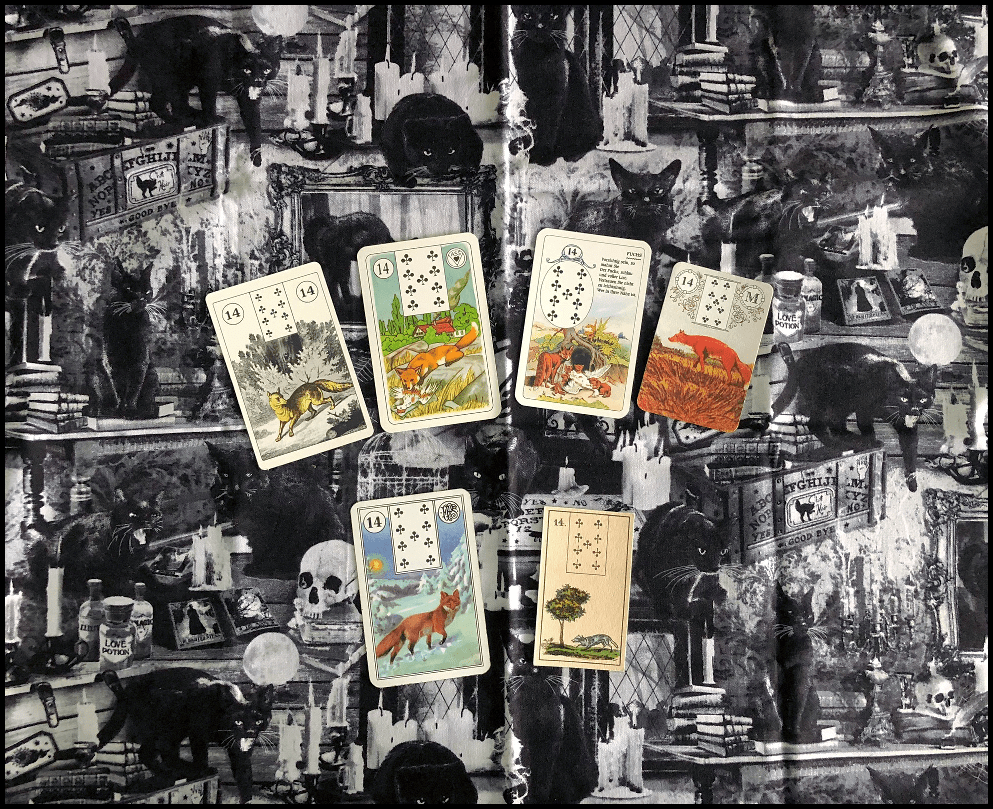
Fox Associations

In the sixteen years since I first began to write about the Petit Lenormand, requests for “combination lists” have been both frequent and persistent. They are, however, something I have consistently declined to produce. My view has always been that it is far better to learn how to combine cards properly before committing any fixed pairing to memory. Of course, certain traditional associations do exist, and many of them hold true. Even so, you will not require them every time those cards appear together in a reading.

Times also change. In the early 2000s, I was working in the healthcare sector and read for a great many doctors, nurses, physiotherapists and the like. At that time, the Letter–Birds combination appeared endlessly. Do you remember pagers? I cannot recall when that combination was last appropriate. What was once ubiquitous has now become an historical curiosity.

The other difficulty with combination lists is that they are entirely devoid of context. They must be written—and read—as though everything were equal, which is almost never the case in practice. Some might even describe them as a form of creative fiction: neat, tidy, and occasionally useful, but never a substitute for genuine interpretative skill.

Of all the cards I was asked for combinations list, six appear with striking regularity: the Clouds, the Scythe, the Fox, the Mice, the Key and the Cross. Five of the nine traditional negative cards, and one can understand why they provoke anxiety. I can also understand the Key, too. Yet the Fox is the card that tops the list, time and again. I eventually realised that this was often because the person asking used the Fox as a work card; when it appeared outside professional matters, they struggled to relate it to the rest of life.

It is profoundly unhelpful to think in such terms. No Lenormand card means work, finance or sex in and of itself. Some cards have an affinity with certain spheres of life, certainly, and when examining a particular topic in a reading—especially in the Grand Tableau—you may draw upon these affinities to build a fuller and more nuanced picture. But they are contributory functions, not categorical definitions. To treat any card as the exclusive representative of a core concept is to limit the system and, ultimately, to limit one’s own interpretative ability.

So, for what it may be worth, here are some Fox associations—again, all things being equal, and I genuinely would not attempt to memorise them.
14 – 01: An untrustworthy visitor or confidence trickster. Something is amiss with the car, motorcycle, bicycle or horse, and there may be cheating in sport.

14 – 02: A day of misfortune. A lie told off the cuff, and someone feigning happiness or “putting on a front.”

14 – 03: An unprofitable enterprise. A warning against travel, as any journey undertaken is likely to encounter difficulties.

14 – 04: Domestic discomfort and tension behind closed doors. Something is wrong with the property. As a person: an unreliable man.

14 – 05: Poor lifestyle choices causing long‑term issues. A possible misdiagnosis or need for a second opinion (contrast with 14 – 05). Entrapment in long‑standing lies.

14 – 06: Deceit comes to light, though matters remain less transparent than they appear. As a person: an untrustworthy and unpleasant (usually older) man.

14 – 07: Temptation, inducement and spite; lies, intrigue and hidden agendas. A caution against detours. As a person: an untrustworthy and unpleasant (often older) woman.

14 – 08: Wrong treatment or a poor reaction to it (compare with 14 – 05). Feigning illness or grief for advantage. Ignorance, or a secret taken to the grave.

14 – 09: A charm offensive or douceur with strings attached. Occasionally, difficulties involving a woman.

14 – 10: A sudden display of aggression or intimidation. Sabotage of your efforts, often in work. Sometimes, criminal fraud.

14 – 11: Wrong punishment. Arguments arising from deception, or pointless quarrelling. Writing something known to be untrue, even libel.

14 – 12: Baseless rumour or speculation, though often dismissed as unfounded worry. Rarely, slander or a false‑positive pregnancy test. As a person: an untrustworthy couple.

14 – 13: A deceitful or manipulative child, though often a “little white lie.” Vivid imagination. Very occasionally, questions of biological parentage.

14 – 15: An older person acting out of character, or a sign something is wrong with them. Rarely, controlling behaviour or extreme jealousy. Very rare: a wig or hairpiece.

14 – 16: Poor timing: the stars are not aligned. A warning against proceeding now. Sometimes, overconfidence in skill or ability.

14 – 17: Not the right moment for change. Frustration, false starts and matters failing to take off. As a person: unreliable, hyperactive.

14 – 18: Dishonesty from someone close, or a false friend. A dishonest employee or rivalry at work. Something amiss with a pet. Rarely, peer pressure.

14 – 19: A need for assistance, as your perspective lacks objectivity. General struggle with life. Rarely, passing off something as antique or lying about one’s age.

14 – 20: Propaganda, fake news and grooming. Social discomfort or being amongst people not to your taste/caution when going out. Rarely, internet or social‑media scammers.

14 – 21: Walking into a misjudged situation that will require effort to resolve. Occasionally, giving up prematurely or overstating a problem.

14 – 22: A wrong choice or misguided direction. Problems with a commute or planned route. Expect delays.

14 – 23: Safeguard against theft or vandalism. More often, an unwelcome truth about a person or situation comes to light.

14 – 24: Loving the wrong person and heading for heartache. A third party or love rival. Emotional manipulation used to exploit or control.

14 – 25: A contract with hidden obligations or unfair terms—check the small print. A relationship moving in the wrong direction. Repeating the same mistake.

14 – 26: Discovering the truth, or a warning of paperwork problems. Rarely, falsified documents or qualifications.

14 – 27: Post going astray, intercepted mail or deliberate tampering. Sometimes, a wrong number or telemarketing scam. Text to the wrong person!

14 – 28: An untrustworthy man. Occasionally, self‑delusion.

14 – 29: A dishonest woman. She may also be deluding herself.

14 – 30: Absence of a moral compass; infidelity. Abuse of position or power. Unhealthy family dynamics.

14 – 31: Success fails at the final hurdle. Matters will not go well—contingency planning is essential. Occasionally, heating problems.

14 – 32: Defamation or the deliberate falsification of credentials—lying on a CV or providing false references. Your performance is being watched closely, and any mistake will be used to someone’s advantage. Occasionally, an undeserved reputation.

14 – 33: You’re being lied to. Security is compromised—change passwords and locks. Occasionally, a lie uncovered but the realisation comes too late.

14 – 34: A fraudulent transaction or financial scam. Otherwise, a warning to budget as money will soon be tight. Moonshine.

14 – 35: No stability in relationships, work, finances or home life. Too much baggage; difficulty moving on. As a person: a fair‑weather friend.

14 – 36: The mask slips and truth emerges; trial by fire. Treachery is left behind and you are ready to move on. Occasionally, suffering caused by deceit.

§

Cards: WanderWüst © Jorge/Wandering Oracle

Featured Image: WanderWüst © Jorge/Wandering Oracle, Lenormand (Symbole): Die echten Altenburg-Spielkarten © Königsfurt-Urania,Jeu Lenormand © Cartamundi, Lenormand Fortune-Telling Cards © Zao-Gelli, Nr. 1941 Mlle Lenormand Wahrsagekarten © Piatnik, The Lenormand Oracle © Verlag für die Frau, Leipzig (1982).
The Three Rs: Reading the Combos in the Petit Lenormand

For those first lessons, reading, writing and arithmetic, I thought as great a burden and penalty as any Greek. And yet whence was this too, but from the sin and vanity of this life, because I was flesh, and a breath that passeth away and cometh not again? For those first lessons were better certainly, because more certain; by them I obtained, and still retain, the power of reading what I find written

St. Augustine, Confessions (Pusey, trans.)

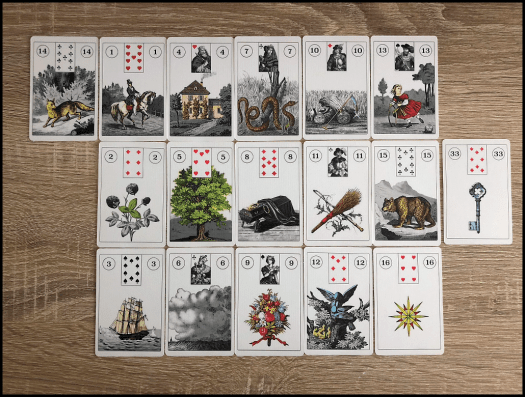
Like most older readers, my Petit Lenormand apprenticeship was the “Grand Tableau.” These days, people prefer to “work up” to the full board via trios, squares and lines of varying length. Personally, I feel the GT is a good introduction; however, I can understand its intimidating appearance. It was, for this reason, I designed both my courses and mentoring around a structure designed to lead into the 36-card spread: line of three, 3 x 3 (teaches vertical and diagonal trios), line of five (can be read in mirror), line of nine (echoes the 9 x 4).

Combinations:

When I first started writing about the Petit Lenormand, there was a prevailing view that one had to memorise copious lists of different pairs, trios, &c. Most now know such ideas are nonsense: additional cards and directional nuances of specific decks all influence a combination.

However, the most significant modifiers are context and individual circumstances. If two people ask how their financial circumstances will progress, two identical pairings would have a different nuance for a wealthy entrepreneur and a single parent on benefits. Having a diverse clientele, I see this often. So they cannot be fixed.

It is, for this reason, I do not offer combination lists. Outside of a few essential pairs or trios (often for timing), it is far better from the start to focus on honing the necessary skill to combine cards in actual reading.

Forming Combinations:

There are several forms of combinations. But the three primaries are: by proximity, by touching and by correlation.

I refer to combinations of cards that touch – horizontally, vertically, or diagonally – as attendance. Other names include contact and encounter cards. The process is two-parted: narration and specification.

Narration:

Narration is when cards read like a storyboard: we start with the first card and move along, forming a narrative using the cards’ essence or core topic. Once the core significations are learned, most cartomantes find this method natural if not effortless.

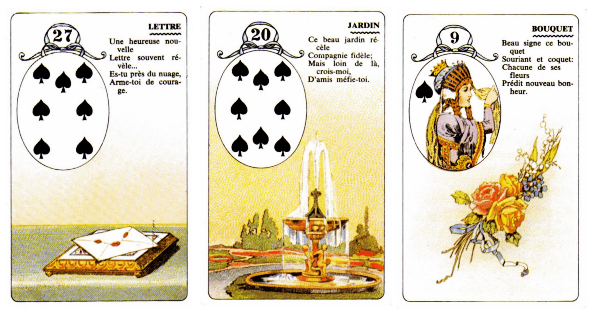
For example, let us consider the following:

Letter: You receive a message (Letter, 7♠).

Letter + Park: You receive a message (Letter, 7♠) and go out (Park, 8♠).

Letter + Park + Bouquet: You receive a message (Letter, 7♠) and go out somewhere (Park, 8♠) and have a pleasant time (Bouquet, Q♠).

As you can see, building a flowing narrative is straightforward. It gives us the bare bones of an answer. However, it is vague and non-specific and needs to be fine-tuned, which is done through specification.

Specification:

Specification, or pairing, is the A – B method. Just as the word “feed” describes something different if preceded by the word “animal” or “social,” cards will be qualified by their attending partner. So, in A – B, B modifies or describes A.

When I first started writing about the cards I likened card A to a noun and card B to an adjective or verb. Nouns denote a person, object or place. Adjectives describe or seek to qualify a noun, and verbs express conditions or actions. Essentially, card B is the description or guise taken by card A.

To illustrate this, we will return to the above trio.

The first pairing is the Letter (7♠ ) and the Park (8♠). The topic of the Letter is often a ‘phone call, DM, e-mail or a letter. Our clue to its nature is the Park. It describes something as being in the open or en masse. The Letter + Park can thus be read as a flyer or advertisement.

The second pairing is the Park (8♠) and the Bouquet (Q♠). In this pairing, the Park is the subject. The Park’s essence is community, and thus is often either a place or group one mixes in. It is for this reason that the Park is the card of social networks such as Twitter, Instagram, Facebook, &c.

Considering the first pairing, we can take the Park as an event that the Bouquet describe. The Bouquet is the card of artistry and beauty. Describing the Park, the Park + Bouquet would refer to a craft fair, exhibition or horticulture event.

Now we know that the message received was an advertisement for an event or exhibition connected to crafts or horticulture. Which, from the narration, we see the client will attend and enjoy herself. She might take a girlfriend, as the Bouquet is also a person-card (queen of spades).

It should be clear then that narration gives the bare bones and specification the details. Using a line of three allows you the chance to practice combinations of attendance and get a feel of the cards.

Below are three clients readings done over the last few months.

Reading #1:

The first reading was for a female client who asked: will my presentation be well received?

The cards as they fell:

Cards: The Stars (6♥), the Lilies (K♠) and the Bear (10♣).

The narrative tells us that the Querent’s presentation will be clear (Stars) and go without any problems (Lilies), putting her in a strong position (Bear).

Let us refine it. The Stars is the cards of clarity and precision. The Lilies describes this as coming from focus and sensitivity. The Querent knows her stuff (clarity and focus) and knows how to put it across effectively (precision and sensitivity).

The final pairing is the Lilies and the Bear. When read as a topic, the Lilies is more often than not a man. Described by the Bear, we have a senior or older man in a position of power. We associate the Lilies with family, which would be someone within your team or department rather than higher management in professional terms.

Put together: we can say yes, it will go well and impress her immediate line manager. That she did. And has been given more responsibility as a result.

Reading #2:

The second reading was for a male consultant. He had just started his first job after University. He asked: should I come out to my colleagues?

The cards as they fell:

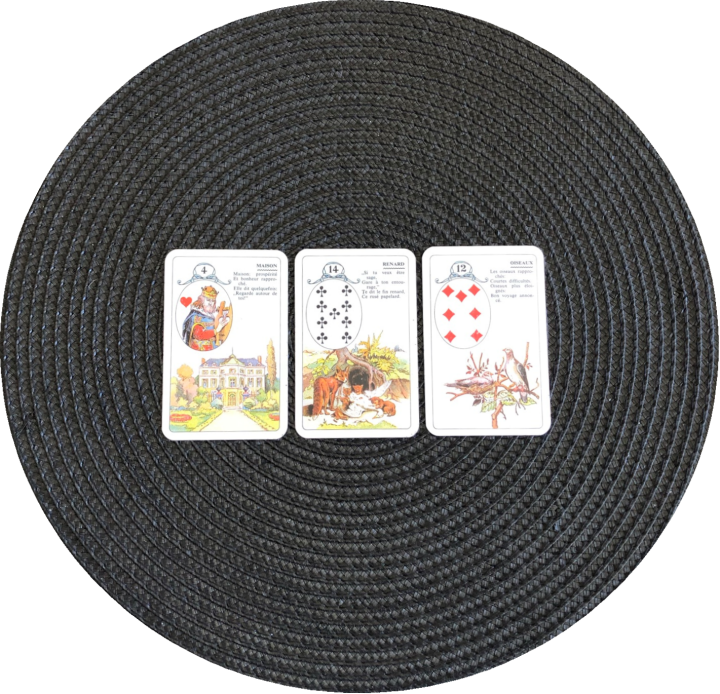
Cards: The House (K♥), the Fox (9♣) and the Birds (7♦).

The primary narration says that discussing his personal life (House) would be a mistake (Fox) and cause some upset at this time (Birds).

Why? The House signifies our home but also our personal life. Here, the Fox indicates the necessary steps taken to keep this private, e.g. the environment he is in is one where he needs to be discreet, not too open (House + Fox).

The reason is shown by the Fox + Birds: To avoid fuelling a two-faced colleague or gossips. Here, the Fox is the topic. Card no. 14 is the red flag card and indicates that something is wrong or lies. It is described by the Birds, which indicates noise and ruffled feathers. Often the Fox + Birds is an unfounded rumour — the Birds put 2 + 2 together and come up with 5.

So the answer is no, it is best to keep one’s private life private or risk causing up set by fuelling the office gossip.

Reading #3:

The third reading was for a female Querent. She was unemployed, and wanted to know: will I find a job soon?

On discussion with the Querent, we defined soon as a month.

The cards as they fell:

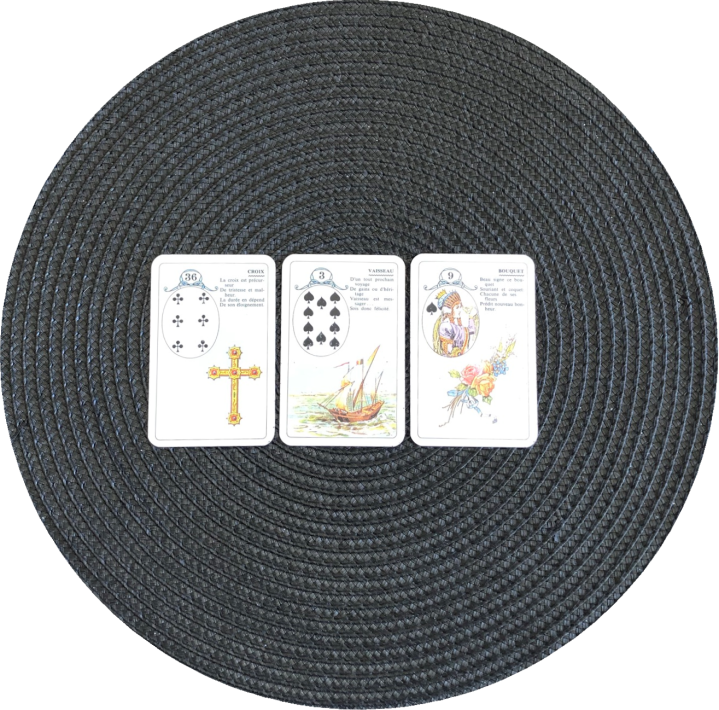
Cards: The Cross (6♣), the Boat (10♠) and the Bouquet (Q♠).

The narration tells us that there is still a difficult (Cross) wait (Boat) for a job offer (Bouquet).

The Cross is a time-card and always indicates the present. In terms of topic, it signifies hardship and pain. The Ship tells us that the hardship is being cast adrift. Nothing is moving, and she is lost (Cross + Boat).

The Ship + Bouquet tells us of a wait to hear of a job offer. The Boat is a long journey, or significant movement. The Bouquet , in this context, and be seen as an offer as it signifies arrangements (remember it shows cut flowers arranged in a bouquet).

So, the answer is no, not this month. But note that the Boat + Bouquet come after the Cross. The job is coming, but not this month.

This reading was done in February. In March, the Querent received a call-back for a second interview and was offered the job.

So, there you have a basic line of three and combinations.

§

Cards:  Jeu Lenormand © Carta Mundi

Featured Image: GBSmithArt, CC BY-SA 4.0 https://creativecommons.org/licenses/by-sa/4.0, via Wikimedia Commons

Eikṓn Equals Essence: The Pictures on the Petit Lenormand

Twelve o’clock.
Along the reaches of the street
Held in a lunar synthesis,
Whispering lunar incantations
Dissolve the floors of memory
And all its clear relations
Its divisions and precisions…

T.S. Eliot, Rhapsody on a Windy Night

It is now over ten years since I first started writing about the Petit Lenormand. Not that it was ever the intention or purpose of my then website. Within a few months of launching my DarkMoon, questions about the 36-cards and how to read them equalled and sometimes surpassed reading requests. Some even booked GTs to see how they were done and read.

So, I started writing a few short articles. The first was on the Serpent and the Mice cards. The second on trigger and heart (later changed to “hinge”) cards. However, most subsequent articles focused on building combinations. Most people (contacting me) knew the cards’ broadest significations but struggled to link them together in a coherent manner. It was at that point I first utilised the noun and adjective/adverbs.

Within the context of card combinations, nouns and adjectives are just an analogy. For me, it was never a rule or scheme followed indefinitely. It simply illustrated how, in most pairings, the second card describes or modifies the first. It also did not reflect how either I learned or read. Like most, my apprenticeship centred on the classical full-board or grand tableau. Cards were not understood through keywords but as events or happenings. I still see the cards that way, which is the basis of the concept of “essence” or “topic.”

As such, rather than having a student write three or four nouns and several adjectives, I recommend focusing on the essential nature of each picture in the game. Students are encouraged to thoroughly inspect their deck’s iconography and thereby penetrate the essence. If you know the core nature or topic of a card, you cannot go wrong (most of the time). Besides, essence often helps one come to understand some of the folklore or more obscure associations – all of which come from the picture!

That brings us to both a common misunderstanding and the subject of this entry:

We often hear that the images in the Petit Lenormand have no value. That is incorrect. Each card’s signification comes from its emblem. However, the Petit Lenormand emphasises the whole image over the symbol. You do not devote 300 words to the Boat’s sails. The image, when read, can be likened to an eikṓn or logogram. It, therefore, differs from the deconstructive method common to English-speaking diviners where, for example, a single detail on a card (snail, flag, etching on a goblet and so on) may be the focus rather than the image within which it is contained.

It is an issue of emphasis.

Details do matter to the Petit Lenormand reader. Directional clues (dark v. light, spine v. page, turret v. ground) add nuance. Card no. 15, the Bear (10♣), can describe someone as strong or muscular and a brunette. But if one is reading with the Schmid or Gilded Reverie, that would not be so. Why? Polar bears are not brown. The descriptive value thus changes to: strong or muscular and blonde.

Going further, replacing the child with a baby or cupid on card no. 13, the Child (Kn♠), would completely change the card’s signification. The Child is not a neonate but a preadolescent. The same with a dagger on card no. 11, the Birch Rod (Kn ♣ ).

Images are therefore important. Within them lies the cards’ essence and, therefore, signification. If you are struggling, it is often because you have not linked with a card’s (or several) core nature. Failure to do so prohibits access to (for a lack of better words) the collective memory and objective psyche.

For example, let us take the MOON card (8♥). Often people approach this card as they do the Tarot’s XVIII atout. The cards are entirely different, something which is confirmed by its icongraphy. Card no. 32 is the card of recognition and reputation.

Why? We have to remember what the Moon is.

Our Moon is the Earth’s single natural satellite. It has no light source and instead reflects the sun’s rays. Being but a reflection, it cannot illuminate the heavens as does the sun. Thus, as some points will be bathed in moonlight, others will remain cloaked in darkness. If one studies the iconography of traditional patterns — such as the Brepols, the Dondorf, the C.L. Wüst or the Blaue/Rote Eules — we see a partially lit landscape.

All we have done is identified what it is, its function and its behaviour. Neither you nor I could do so without the image. How does it work in a reading?

Traditionally, the Moon card falling near the Significator presaged great honour or fame. The moonlight shines upon you, leaving the rest in the dark. Far away, the opposite is true. If we remember that the moonlight is a reflection of the sun’s rays, we can understand the card with little difficulty. It is a shimmer of the Sun card as reflected in others’ eyes — hence the fame and honours.

Primarily, the Moon refers to our status, particularly in terms of professional or financial standing and whether we are deemed successful or not by society and our peers. Most people achieve fame through their career. If you are going for a job interview, a strong Moon-card is desirable. After all, you need to look good in the eyes of the interview panel! Of course, it can be one’s set or the trends and fashions observed in other contexts.

Consequently, we can think of the Moon in terms of essence and topic, as reflection and status, respectively.

Let us consider a second picture. In recent times card no. 19, the HIGH TOWER (6♠), has seen a significant revision of its core theme. It is now a card of government bureaucracy. And yet, a government is a group of people governing and hence a matter for the Park (often combined with the Bear).

One will note that the High Tower is traditionally portrayed as a tower-house. It is often located at a boundary, crowned with a lookout.

Perusing some of the traditional patterns, one will also note it is distinctly earlier period to the House (K♥) or Park (8♠) cards. The overall impression is not one of the arrogant bureaucrats but the distance in terms of time (old), height (looking out) and location (at a distance).

After such considerations, the old references to a long life and retirement does not look so archaic or strange. It has continued to live in the deck’s roots and can be found in several combinations. The “high” also translates into vertical combinations when considering the ground level (card below) versus the turret or apex (card above). It is for that reason I continue to refer to it as the High Tower.

Replacing the traditional tower-house with a skyscraper, or even the Empire State Building or la tour Effiel changes the card’s core essence and therefore meaning. A citadel would also make the governmental associations even more erroneous.

We will turn our attention now to card no. 18, the HOUND (10♥). Most readers see this card as the symbol of faithfulness par excellence.

The traditional image of this card was never a lapdog or even the family pet. Older Petit Lenormand decks had a working dog or sighthound (such as a Deutscher, Brittany Spaniel or Braque Saint-Germain). The dog is seen outside with its kennel, sometimes looking up as if it had heard or sensed something. It is, therefore, quite evident that this dog is not just a family pet. It has a role and fulfils a service. It is for this reason I prefer the title Hound.

The essence of the Hound card is the entourage. Entourage refers to people surrounding, but also attending to, a person. It talks about the people in your environment. Your doctor, plumber and colleagues will appear as the Hound.

Long-term readers of my work will know I often read the Hound as a colleague, employee, or professional acquaintance. It is a natural association – not least because I saw working-dogs growing up in a rural area!

Similarly, next to the House card, it can indicate a neighbour or someone living nearby. Why? Remember the Hound has a doghouse in its owner’s garden. It lives on the homestead. Its kennel is analogous to our neighbours’ property.

The loyalty of these people, friend or otherwise, can only be reckoned by the surrounding cards.

We can briefly consider a fourth and final card: card no. 1, the Cavalier (9♥).

Our traditional image is a well-dressed young man in either a tailcoat or frockcoat with Hessian boots and pantaloons. He is riding a horse. He is often but not invariably shown on the road and riding away from a château or maison de maître, he thus en route.

The Cavalier is a heard sent forth. He is riding out and has a destination but will return soon return to his abode. The most common reason for such action is to visit or deliver some tidings. For this reason, I have never referred to the card as the rider as it does not evoke the function or nature of the eikon: that is, a messenger.

Traditionally, the Cavalier was often said to denote news from abroad when falling far from the Significator. When one remembers that proximity refers to engagement, it is not hard to understand.

Far away, the Cavalier crosses a greater distance. However, it is equally possible that the news does not pertain directly to the querent.

We use the card as a “male person” because it shows a male person. If the Cavalier is female, it cannot be read thus. The male-figure can function as the chevalier servant. If a married female consultant has a lover, the Cavalier would represent him.

Similarly, its association with vehicles and exercise comes from the horse. That was the car or bicycle of the day. Equestrianism is a sport, no?

These are all what I refer to as progressed meanings, which is progressing each card’s essential nature on a functional level. That is, reading the card at the first indexical level of semiotics.

That has been the way in all forms of cartomancy, from the Tarot to the Oracle Gé and everything in-between.

When mentoring new readers, I encourage them to work with one or two decks. I advise them to study the cards closely and distil the information into an essence or core concept. That becomes there starting point for combinations. They will also become (if used) the houses’ significations in a full board.

Here is a basic list (given purely for reference for future articles):

  • Card no. 01 – The Cavalier (9♥) is herald.
  • Card no. 02 – The Cloverleaf (6♦) is chance.
  • Card no. 03 – The Boat (10♠) is travel.
  • Card no. 04 – The House (K♥) is home.
  • Card no. 05 – The Tree (7♥) is constitution.
  • Card no. 06 – The Clouds (K♣) is disturbance.
  • Card no. 07 – The Serpent (Q♣) is venom.
  • Card no. 08 – The Coffin (9♦) is endings.
  • Card no. 09 – The Flowers (Q♠) is arrangements.
  • Card no. 10 – The Scythe (Kn♦) is severance.
  • Card no. 11 – The Birch Rod (Kn♣) is correction.
  • Card no. 12 – The Birds (7♦) is noise.
  • Card no. 13 – The Child (Kn♠) is youthfulness.
  • Card no. 14 – The Fox (9♣) is falsehood.
  • Card no. 15 – The Bear (10♣) is strength.
  • Card no. 16 – The Stars (6♥) is navigation.
  • Card no. 17 – The Stork (Q♥) is change.
  • Card no. 18 – The Hound (10♥) is the entourage.
  • Card no. 19 – The High Tower (6♠) is distance.
  • Card no. 20 – The Park (8♠) is community.
  • Card no. 21 – The Mountain (8♣) is barriers.
  • Card no. 22 – The Path (Q♦) is intersections.
  • Card no. 23 – The Mice (7♣) is erosion.
  • Card no. 24 – The Heart (Kn♥) is emotions.
  • Card no. 25 – The Ring (A♣) is unions.
  • Card no. 26 – The Book (10♦) is knowledge.
  • Card no. 27 – The Letter (7♠) is communication.
  • Card no. 28 – The Gentleman (A♥) is male.
  • Card no. 29 – The Lady (A♠) is female.
  • Card no. 30 – The Lilies (K♠) is serenity.
  • Card no. 31 – The Sun (A♦) is illumination.
  • Card no. 32 – The Moon (8♥) is reflection.
  • Card no. 33 – The Key (8♦) is accessibility.
  • Card no. 34 – The Fishes (K♦) is resources.
  • Card no. 35 – The Anchor (9♠) is stability.
  • Card no. 36 – The Cross (6♣) is pain.


It should also be stressed to forget (for now) ideas such as “work cards” and whether a card is a mother or the father, male and female, or about “sex”. Such significations do not touch upon the cards’ essence. No card on an elementary level is work or sex

§

Featured Image: English: Ikona u Manastiru Svetog Romana via Wiki Commons.