Tarot de Marseille: The Picturebook of Fate: The Excuse

This article continues my series examining the trumps of the Tarot de Marseille, adapted from my unpublished manuscript, Tarot de Marseille: The Picturebook of Fate. As throughout this series, the emphasis is placed upon the traditional eikōn of the card, its historical context, and the practical significations I have found useful through divinatory practice. The interpretations presented here reflect my own experience of working with the Tarot de Marseille and should be understood as a working method rather than a definitive authority.

The Excuse: the Madman or the Fool

Le Mat, also known as Le Fou, the Madman or the Fool, is perhaps the most misunderstood figure in the Tarot. Is he the free spirit celebrated by modern Tarot writers, embarking upon a new adventure filled with endless possibilities? Does he represent originality, spontaneity, and fresh beginnings? Or is he something far less flattering and considerably more cautionary?

Unlike the other trumps, Le Mat bears neither a number nor a fixed position within the sequence. Historically, he occupied a unique status within the game itself. He was not a trump at all, but an excuse, a special card exempt from the ordinary rules governing play. This peculiar position reflects his character perfectly. The Madman stands outside the established order, exempt from the constraints that govern others, yet at the same time deprived of the protections that those constraints provide.

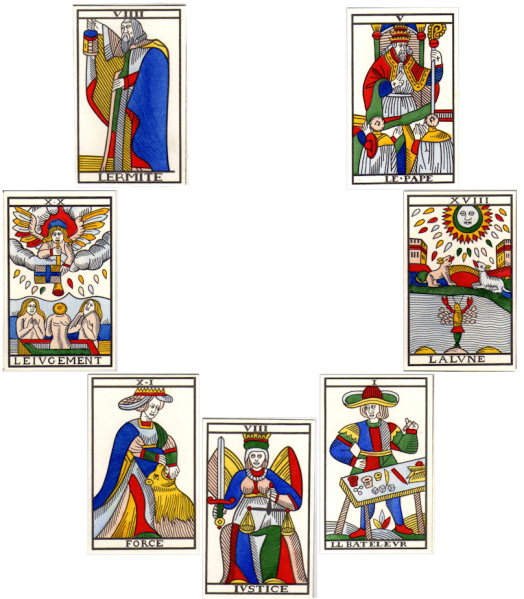
The traditional eikōn depicts a traveller carrying a staff and bundle over his shoulder. His clothing is worn and ragged, suggesting a life of wandering and instability. Behind him an animal claws at his hose, tearing at his garments as he moves forward. Whilst later traditions often interpret the creature as a dog, the Marseille image frequently appears more feline in character. This detail is significant.

The essence of the Madman is folly; his function is to derail.

The Madman is not a sage, nor a visionary, nor a misunderstood genius. He is precisely what his title suggests: a fool. He represents the self functioning without reason and therefore without Wisdom. If the Pope embodies Wisdom, the Hermit Prudence, and Justice Verity, the Madman stands at the opposite end of the spectrum. He acts without proper reflection, pursues desires without discernment, and mistakes impulse for freedom.

The animal at his heels provides an important clue. In medieval and early modern folklore, cats shared many symbolic associations with the fox. Both were linked with cunning, falsity, deceit, laziness, and treachery. The famous Tybalt, prince of cats, was regarded as the cousin of Renard the Fox, both belonging to a tradition in which animal figures embodied vice and moral weakness. That the creature attacks the Madman unnoticed is significant. He proceeds as though nothing is wrong. His folly lies not merely in poor judgement, but in his inability to recognise danger even when it is already upon him.

For this reason, we must question the modern tendency to associate the card with originality, new beginnings, or taking a leap of faith. Nothing in the image suggests a promising commencement. The Madman has no destination, no plan, and no evident purpose. Unlike the Hermit, whose lantern illuminates the next step, the Madman simply wanders. His movement lacks direction because it lacks discernment.

At a deeper level, the card warns against moral blindness. The Madman is governed by preference rather than principle, impulse rather than reason. In modern terms, one might speak of relativism: the belief that truth is subjective and that every choice is equally valid provided it satisfies the individual. The Madman embodies the dangers of such thinking. Without objective standards by which to judge our actions, we become incapable of distinguishing wisdom from folly or good from evil. We drift wherever circumstances and appetites happen to lead us.

This explains why the card so often appears when a person is attempting too many things at once, lacking commitment, or refusing to accept guidance. The old saying that one may become a jack of all trades and master of none belongs firmly within the Madman’s domain. Energy is expended, but little is accomplished. Activity substitutes for direction.

When Le Mat appears in a reading, he frequently indicates rashness, stupidity, poor judgement, selfishness, and a refusal to listen to good advice. The querent may be acting impulsively, avoiding responsibility, or persisting in a course of action that sensible reflection would abandon. At other times the card warns that another person involved in the matter is behaving in precisely this manner. In either case, the result is the same: plans are disrupted, opportunities squandered, and progress derailed.

The Madman reminds us that freedom without reason is not freedom at all. Left unguided by Wisdom and Prudence, we become vulnerable to every impulse, every distraction, and every passing whim. The card therefore serves as a warning: before taking the next step, one must first ask whether one truly knows where the path leads.

Because Le Mat is an excuse rather than a trump, he can sometimes lack specificity in a reading. We know that folly is present, but not necessarily the form it takes. In such instances, it is often useful to cover the Madman with another card. This allows us to “name and shame” him. The covering card identifies the nature of the foolishness, whether that be the Juggler’s cunning, the Lover’s vacillation, the Devil’s enslavement, or some other defect. The Madman remains the underlying problem; the second card merely reveals its particular expression.

General: Poor judgement, rash decisions, and a failure to heed good advice lead to setbacks, complications, and unnecessary difficulties. The card often appears when the querent is repeating old mistakes or acting without proper consideration of the consequences. Selfishness, impulsiveness, and hot-headed behaviour undermine otherwise promising opportunities. Cave canem — or rather, cave felem.

Love: The Madman has an unfortunate tendency to derail and destabilise relationships. Poor judgement, boredom, and an unwillingness to take responsibility can encourage one partner to look elsewhere or make reckless decisions. Competing commitments and misplaced priorities place additional strain upon the relationship. For those seeking love, opportunities certainly exist, but they are seldom built upon stable foundations. Expectations often differ and one or both parties may be ignoring obvious warning signs. If reconciliation is under consideration, the Madman advises extreme caution. Whatever caused the original difficulties is unlikely to have changed.

Career: The Madman is associated with casual work, undeclared employment, drifters, and individuals lacking a clear professional direction. More commonly, however, he signifies dissatisfaction and poor judgement within one’s career. The temptation to resign impulsively, neglect responsibilities, arrive late, leave early, or take unnecessary risks can be difficult to resist. The card warns that actions have consequences. For job seekers, the Madman frequently indicates unrealistic expectations, inadequate preparation, or applications for positions beyond one’s qualifications or experience. A more honest assessment of the situation is required.

Finance: Financial difficulties often arise through poor planning and unwise decisions. The card may signify borrowing from Peter to pay Paul, living beyond one’s means, or ignoring financial realities until they become unavoidable. Assistance is available, but the querent is unlikely to resolve matters alone. The Madman advises honesty, humility, and a willingness to learn from previous mistakes.

Health: The Madman frequently warns of injuries caused by poor judgement, carelessness, or unnecessary risk-taking. Accidents involving vehicles, tools, sport, or simple inattention may occur. The card also possesses a notable association with animals, including dog bites, cat scratches, falls from horses, insect bites, and similar incidents. Occasionally, seemingly minor injuries may result in longer-term complications.

Essence: Folly.
Function: Derail.
Polarity: Negative.
Astrological Association: None.
Timing: None.

§

Tarot Cards: Jean Dodal Tarot via Wikipedia Commons. Public Domain.

Featured Image: Ancient Tarot Major Arcana © BP Grimaud/John Waddington Ltd, Leeds & London, Les Tarot de Marseille Jean Noblet, 1650 © Editions «letarot.com» (2001 [hand stencilled trumps]). Les Tarot de Marseille Jean Dodal, 1701 et 1715 © Editions «letarot.com» (2002 [hand stencilled trumps])

Tarot de Marseille: The Picturebook of Fate: The Nines Part 2

This article continues my series examining the trumps of the Tarot de Marseille, adapted from my unpublished manuscript, Tarot de Marseille: The Picturebook of Fate. As throughout this series, the emphasis is placed upon the traditional eikōn of the card, its historical context, and the practical significations I have found useful through divinatory practice. The interpretations presented here reflect my own experience of working with the Tarot de Marseille and should be understood as a working method rather than a definitive authority.

The Nines: the Hermit and the Moon

Trump XVIII, La Lune, or the Moon, is one of the most evocative and unsettling cards in the Tarot. Does it signify intuition and hidden knowledge? Is it a card of dreams, psychic powers, and the unconscious mind? Or does the Moon warn us that appearances can be misleading and that not everything is as it seems?

The traditional eikōn of the Moon is amongst the most distinctive in the Marseille Tarot. A great moon dominates the heavens, gazing down upon the scene below. Two canines stand facing one another, howling towards the moon’s light. Between them rises a crayfish from a pool of water. In the distance stand two towers which frame the landscape and create a sense of confinement and uncertainty. Overhead, droplets or sparks descend from the heavens.

The essence of the Moon is reflection; its function is to distort.

The relationship between light and its absence has long played an important role in divination, religion, and folklore. Light is traditionally associated with truth, clarity, and understanding. Darkness, by contrast, represents the absence of truth or our inability to perceive it properly. This explains why eclipses were feared throughout the ancient and medieval worlds and why so many myths concern the loss or obscuring of the sun. Humanity has always understood that without light, certainty becomes difficult.

The Moon has never been understood independently of the Sun. The moon possesses no light of its own but reflects the light of the sun. In classical astrology, the Sun represents the soul and vital life force, whilst the Moon signifies the body through which that life is expressed. We cannot perceive the soul directly; we know it through the living body. Yet the body is mutable. It grows, changes, declines, and ultimately perishes. Unlike the Sun’s constant illumination, the Moon waxes and wanes. It is therefore associated with instability and change.

For this reason, the Tarot’s Moon is concerned not with reflection as a gift, but with its limitations. Reflected light is partial, shifting, and uncertain. It reveals, but it also obscures. Like an imperfect mirror, it may distort what it reflects. The Moon therefore aligns itself with ambiguity, confusion, half-truths, uncertainty, voluntary change, and forces that operate beyond conscious control. Rather than producing clarity, it complicates matters. It introduces questions where certainty once existed and doubt where confidence once prevailed.

The imagery reinforces this interpretation. The crayfish emerging from the water may be understood as a symbol of Cancer, the zodiacal domicile of the Moon. It rises from the depths towards a world it does not yet fully understand, embodying the tentative emergence of something hidden or poorly defined. Like the Cancerian crab, the querent may not be able to proceed directly towards their goal. Circumstances may require a sideways movement, a detour, or an indirect approach. The shortest route is not always the wisest. Sometimes progress is achieved not by pressing forward, but by adapting to changing conditions and finding an alternative path. The canines howl towards the moon as symbols of instability, agitation, and frustration. They react to influences they neither comprehend nor control. Between them stretches a narrow path, overlooked by the towers and lit only by uncertain moonlight.

Unlike the Star, which provides reliable guidance, the Moon often signifies a situation in which reliable guidance is lacking. Facts may be incomplete. People may not be telling the whole truth. Equally, the querent may not be seeing matters clearly themselves. The card frequently appears when anxiety, assumption, gossip, rumour, and speculation have begun to take the place of certainty. Under such conditions, perception becomes distorted and poor decisions can follow.

The Moon is also a card of changeability and shifting conditions. Just as the moon waxes and wanes, circumstances rarely remain fixed for long under its influence. The card frequently appears when an unexpected development, new piece of information, or change in circumstances is about to alter the situation entirely. Plans may need to be revised, assumptions reconsidered, and expectations adjusted. What appears certain today may look very different tomorrow. For this reason, the Moon often advises against committing prematurely to a course of action whilst important factors remain in flux.

When the Moon appears in a reading, it suggests that matters are not what they appear to be. Something remains concealed, misunderstood, exaggerated, or distorted. The card does not necessarily indicate deceit, though deception is certainly possible. More often, it points towards confusion, uncertainty, and imperfect understanding. It may also indicate that circumstances are still evolving and that an impending change will alter the situation before a final outcome can be reached. The Moon therefore advises patience, caution, adaptability, and a healthy degree of scepticism. Until the Sun rises, we should be careful about what we think we see.

General: The beginning of a period of instability, uncertainty, or change. Circumstances remain in flux and people may prove unreliable or inconsistent. Judgement may be clouded by fear, assumption, wishful thinking, or an overactive imagination. Plans are liable to change as new information emerges. The Moon advises caution and adaptability until matters become clearer.

Love: Existing relationships are often characterised by peaks and troughs under the Moon. Fluctuating moods, misunderstandings, and emotional uncertainty can undermine the sense of connection between partners. The instability will usually pass; in the meantime, open and honest communication is essential. For those seeking love, the Moon offers opportunities to meet new people and enjoy new experiences. However, caution is advised. Do not become too invested too quickly, for things may look rather different in the light of day.

Career: The Moon frequently signifies instability within the professional environment. The querent may worry about redundancy, changing responsibilities, or whether contracts will be renewed. Unfortunately, certainty is often lacking and prudent contingency planning is advisable. For job seekers, opportunities may be limited and offers can arrive with unfavourable terms or conditions requiring careful scrutiny. Matters do improve, but the querent must first pass through the night. Professions associated with the Moon include fishing, trawling, sailing, commercial diving, brewing, bar work, cleaning, photography, courier services, and other occupations connected with irregular hours. More generally, it is associated with night workers and temporary or casual employment.

Finance: Financial circumstances are liable to fluctuate, making budgeting and long-term planning more difficult than usual. Unexpected expenses and changing priorities may place pressure upon resources. It is important to understand fully the terms, conditions, and small print attached to loans, purchases, and financial agreements. Assumptions can prove costly under the Moon, which has an unfortunate habit of revealing hidden fees, penalties, and unpleasant surprises.

Health: The Moon is associated with sleep disorders, including insomnia, somnambulism, sleep apnoea, circadian rhythm disturbances, and restless legs syndrome. It may also indicate eyesight complaints such as cataracts, floaters, and photosensitivity. More generally, the card signifies fluctuating symptoms, uncertain diagnoses, fatigue, and conditions whose severity varies over time. Recovery may be uneven, requiring patience and careful observation.

Essence: Reflection.
Function: Distort.
Polarity: Negative.
Astrological Association: The Moon.
Timing: Monday. Twenty-eight days, or at the Full Moon.

§

Tarot Cards: Jean Dodal Tarot via Wikipedia Commons. Public Domain.

Featured Image: Ancient Tarot Major Arcana © BP Grimaud/John Waddington Ltd, Leeds & London, Les Tarot de Marseille Jean Noblet, 1650 © Editions «letarot.com» (2001 [hand stencilled trumps]). Les Tarot de Marseille Jean Dodal, 1701 et 1715 © Editions «letarot.com» (2002 [hand stencilled trumps])

Tarot de Marseille: The Picturebook of Fate: The Nines Part 1

This article continues my series examining the trumps of the Tarot de Marseille, adapted from my unpublished manuscript, Tarot de Marseille: The Picturebook of Fate. As throughout this series, the emphasis is placed upon the traditional eikōn of the card, its historical context, and the practical significations I have found useful through divinatory practice. The interpretations presented here reflect my own experience of working with the Tarot de Marseille and should be understood as a working method rather than a definitive authority.

The Nines: The Hermit and the Moon

Trump VIIII, L’Hermite, or the Hermit, is one of the most enigmatic figures in the Tarot. Does he signify withdrawal, loneliness, and isolation? Is he merely the wise old man of later occult traditions? Or does he represent something more practical: the ability to discern the correct path when others have lost their way?

The traditional eikōn of the Hermit is both simple and profound. We see an elderly man wrapped in heavy robes. In one hand he carries a staff upon which he leans for support; in the other he holds a lantern, partially concealed beneath his cloak. Unlike the Charioteer, who moves boldly forward in public triumph, the Hermit advances cautiously and deliberately. His attention is directed not towards the horizon, but to the ground immediately before him.

The essence of the Hermit is prudence; his function is to discern.

Prudence is often misunderstood as excessive caution or timidity. In reality, it is far more important than that. Prudence is the virtue which disposes us to exercise true reason and to choose the proper means of achieving a good end. The Catechism of the Catholic Church observes that the prudent man “looks where he is going.” This is precisely what the Hermit is doing. His progress may be slow, but it is purposeful. He advances carefully because he wishes to arrive safely.

The Hermit is therefore a guided figure. He is not distracted by the pleasures, temptations, or vanities of the world. His heavy robes separate him from such concerns. Rather than pursuing immediate gratification, he seeks to understand the right path and the right means of following it. The lantern does not illuminate the entire road ahead. Instead, it reveals only the next few steps. Prudence seldom provides certainty about the distant future; it enables us to make good decisions in the present.

The monastic tradition provides an excellent example of this principle in practice. Saint Benedict, often regarded as the father of Western monasticism, did not build his Rule upon dramatic acts of self-denial or extraordinary spiritual experiences. Instead, he emphasised the virtues of obedience, stability, and conversion of life1. Obedience required attentiveness to wisdom beyond one’s own preferences. Stability required remaining faithful to one’s commitments rather than constantly seeking novelty. Conversion of life demanded the continual examination and correction of one’s conduct. All three are expressions of prudence, for they require the individual to discern what is truly good and to order their life accordingly.

The Hermit embodies this same spirit. He understands that meaningful growth rarely comes through sudden revelation or dramatic action. More often, it arises through patient reflection, self-knowledge, and the steady alignment of one’s life with what is right and true.

For this reason, the Hermit is often misunderstood as a card of inactivity. In truth, he is moving, but he does so carefully and with deliberation. The card frequently appears when haste would be counterproductive and when reflection is necessary before action can be taken. The Hermit teaches that wisdom does not always reside in moving quickly. More often, it lies in knowing when to pause, observe, and proceed cautiously.

The Hermit also values discretion. In an age in which every thought, opinion, and experience can be broadcast instantly through social media, this aspect of the card is easily overlooked. Prudence teaches us that not every matter should be shared with everyone. Some things are best kept private; others should be entrusted only to those who have earned our confidence. When accompanied by more difficult cards, the Hermit frequently warns that discretion is required. Not everyone around the querent can be trusted, and sharing too much information may prove unwise.

A common manifestation of the Hermit is a period of withdrawal following disappointment, hardship, separation, or personal upheaval. Such periods are not necessarily negative. Indeed, they often serve an important purpose. Unlike the Popess, who studies facts, evidence, and external sources, the Hermit reflects upon experience itself. His focus is inward rather than outward. He seeks not information but understanding. The card therefore signifies a time of regrouping, reassessment, and quiet reflection before the next stage of the journey begins.

The Hermit also possesses strong associations with age, maturity, and perspective. In this respect, he calls to mind both Saint Benedict and Saint Simeon. Benedict teaches us the value of a life ordered by prudent discernment, whilst Simeon exemplifies the patient wisdom that comes with waiting faithfully for the fulfilment of a promise. Upon beholding the infant Christ, Simeon uttered the words of the Nunc Dimittis: “At last, all-powerful Master you give leave to your servant to go in peace…2 His joy arose not from worldly achievement, but from recognising that God’s promises had been fulfilled. The Hermit embodies something of this spirit. He understands that not every success is immediate and that some truths reveal themselves only through patience, experience, and perseverance.

When the Hermit appears in a reading, he frequently advises caution, discernment, and reflection. The card suggests that the querent already possesses many of the answers they seek, but that these answers may only emerge through careful consideration rather than hurried action. Progress is still possible, but it must be guided by prudence rather than impulse. The Hermit’s lantern shows the next step. For now, that is enough.

General: A period of solitude, reflection, and quiet reassessment. The Hermit advises patience, discretion, and careful consideration before action is taken. Progress may seem slow, but it is not absent. The card frequently appears during periods of convalescence, recovery, or personal regrouping, when prudence and discernment are more valuable than outward activity.

Love: The Hermit often appears after a disappointment, betrayal, separation, or other emotional hurt that has left a lasting impression. Trust may have been damaged, making it difficult to place confidence in others once more. The card signifies a need for time alone to process the past so that it no longer exerts undue influence upon the future. Consequently, the Hermit rarely promises the immediate arrival of a new relationship. If the question concerns whether someone can be trusted, the card urges caution and discernment. In established relationships, the Hermit may indicate misunderstandings, emotional distance, or the need for both parties to reflect seriously upon the future of the partnership.

Career: Progress under the Hermit is often gradual rather than dramatic. The card frequently appears when someone is experiencing burnout, questioning their direction in life, or feeling drawn towards change. Nevertheless, the Hermit advises caution. This is a time for reflection, planning, and careful preparation rather than impulsive decisions. Existing responsibilities should continue to be approached with diligence and professionalism. For job seekers, the card often signifies delays and frustrations, although progress is quietly being made behind the scenes. Occupations associated with the Hermit include work with the elderly, homeless, or socially isolated, as well as antiques, agriculture, mining, plumbing, sanitation, and other professions that involve solitary or largely independent work. It may also signify remote working or self-directed employment.

Finance: Prudence is essential in financial matters. Before making investments, lending money, or entering into financial agreements, the Hermit advises obtaining independent advice and ensuring that all details have been examined carefully. Second opinions are rarely wasted under the Hermit. If something appears too good to be true, it probably is. The card frequently warns against speculative ventures and money lent to others which may never be repaid. More positively, it favours long-term financial planning, pensions, insurance, inheritance planning, and the gradual accumulation of security for the future.

Health: The Hermit is strongly associated with ageing, chronic conditions, rehabilitation, and convalescence. Recovery may be slower than desired, but steady improvement is generally indicated. Anatomically, the card is associated with the skeletal system, joints, and conditions related to advancing years. More broadly, it advises patience, rest, and allowing the body adequate time to heal.

Essence: Prudence.
Function: Discern.
Polarity: Neutral.
Astrological Association: Saturn.
Timing: Saturday. 29 ½ months or years. By 3 February.

§

Tarot Cards: Jean Dodal Tarot via Wikipedia Commons. Public Domain.

Featured Image: Ancient Tarot Major Arcana © BP Grimaud/John Waddington Ltd, Leeds & London, Les Tarot de Marseille Jean Noblet, 1650 © Editions «letarot.com» (2001 [hand stencilled trumps]). Les Tarot de Marseille Jean Dodal, 1701 et 1715 © Editions «letarot.com» (2002 [hand stencilled trumps])

Footnotes:

  1. See Chapter 58 of the Rule. Benedict et al. (1981) RB 1980: The Rule of St. Benedict. Collegeville, MN: Liturgical Press. ↩︎
  2. Nunc Dimittis is recited at Night Prayer/Compline in the Liturgy of the Hours. Trans. given here from Collins The Divine Office. Divine Office. vol. 1 (2006). London: Collins. ↩︎