This article continues my series examining the trumps of the Tarot de Marseille, adapted from my unpublished manuscript, Tarot de Marseille: The Picturebook of Fate. As throughout this series, the emphasis is placed upon the traditional eikōn of the card, its historical context, and the practical significations I have found useful through divinatory practice. The interpretations presented here reflect my own experience of working with the Tarot de Marseille and should be understood as a working method rather than a definitive authority.
The Excuse: the Madman or the Fool
Le Mat, also known as Le Fou, the Madman or the Fool, is perhaps the most misunderstood figure in the Tarot. Is he the free spirit celebrated by modern Tarot writers, embarking upon a new adventure filled with endless possibilities? Does he represent originality, spontaneity, and fresh beginnings? Or is he something far less flattering and considerably more cautionary?
Unlike the other trumps, Le Mat bears neither a number nor a fixed position within the sequence. Historically, he occupied a unique status within the game itself. He was not a trump at all, but an excuse, a special card exempt from the ordinary rules governing play. This peculiar position reflects his character perfectly. The Madman stands outside the established order, exempt from the constraints that govern others, yet at the same time deprived of the protections that those constraints provide.
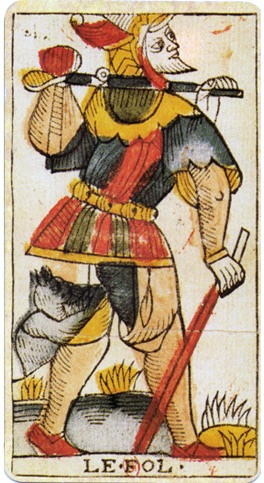
The traditional eikōn depicts a traveller carrying a staff and bundle over his shoulder. His clothing is worn and ragged, suggesting a life of wandering and instability. Behind him an animal claws at his hose, tearing at his garments as he moves forward. Whilst later traditions often interpret the creature as a dog, the Marseille image frequently appears more feline in character. This detail is significant.
The essence of the Madman is folly; his function is to derail.
The Madman is not a sage, nor a visionary, nor a misunderstood genius. He is precisely what his title suggests: a fool. He represents the self functioning without reason and therefore without Wisdom. If the Pope embodies Wisdom, the Hermit Prudence, and Justice Verity, the Madman stands at the opposite end of the spectrum. He acts without proper reflection, pursues desires without discernment, and mistakes impulse for freedom.
The animal at his heels provides an important clue. In medieval and early modern folklore, cats shared many symbolic associations with the fox. Both were linked with cunning, falsity, deceit, laziness, and treachery. The famous Tybalt, prince of cats, was regarded as the cousin of Renard the Fox, both belonging to a tradition in which animal figures embodied vice and moral weakness. That the creature attacks the Madman unnoticed is significant. He proceeds as though nothing is wrong. His folly lies not merely in poor judgement, but in his inability to recognise danger even when it is already upon him.
For this reason, we must question the modern tendency to associate the card with originality, new beginnings, or taking a leap of faith. Nothing in the image suggests a promising commencement. The Madman has no destination, no plan, and no evident purpose. Unlike the Hermit, whose lantern illuminates the next step, the Madman simply wanders. His movement lacks direction because it lacks discernment.
At a deeper level, the card warns against moral blindness. The Madman is governed by preference rather than principle, impulse rather than reason. In modern terms, one might speak of relativism: the belief that truth is subjective and that every choice is equally valid provided it satisfies the individual. The Madman embodies the dangers of such thinking. Without objective standards by which to judge our actions, we become incapable of distinguishing wisdom from folly or good from evil. We drift wherever circumstances and appetites happen to lead us.
This explains why the card so often appears when a person is attempting too many things at once, lacking commitment, or refusing to accept guidance. The old saying that one may become a jack of all trades and master of none belongs firmly within the Madman’s domain. Energy is expended, but little is accomplished. Activity substitutes for direction.
When Le Mat appears in a reading, he frequently indicates rashness, stupidity, poor judgement, selfishness, and a refusal to listen to good advice. The querent may be acting impulsively, avoiding responsibility, or persisting in a course of action that sensible reflection would abandon. At other times the card warns that another person involved in the matter is behaving in precisely this manner. In either case, the result is the same: plans are disrupted, opportunities squandered, and progress derailed.
The Madman reminds us that freedom without reason is not freedom at all. Left unguided by Wisdom and Prudence, we become vulnerable to every impulse, every distraction, and every passing whim. The card therefore serves as a warning: before taking the next step, one must first ask whether one truly knows where the path leads.
Because Le Mat is an excuse rather than a trump, he can sometimes lack specificity in a reading. We know that folly is present, but not necessarily the form it takes. In such instances, it is often useful to cover the Madman with another card. This allows us to “name and shame” him. The covering card identifies the nature of the foolishness, whether that be the Juggler’s cunning, the Lover’s vacillation, the Devil’s enslavement, or some other defect. The Madman remains the underlying problem; the second card merely reveals its particular expression.
General: Poor judgement, rash decisions, and a failure to heed good advice lead to setbacks, complications, and unnecessary difficulties. The card often appears when the querent is repeating old mistakes or acting without proper consideration of the consequences. Selfishness, impulsiveness, and hot-headed behaviour undermine otherwise promising opportunities. Cave canem — or rather, cave felem.
Love: The Madman has an unfortunate tendency to derail and destabilise relationships. Poor judgement, boredom, and an unwillingness to take responsibility can encourage one partner to look elsewhere or make reckless decisions. Competing commitments and misplaced priorities place additional strain upon the relationship. For those seeking love, opportunities certainly exist, but they are seldom built upon stable foundations. Expectations often differ and one or both parties may be ignoring obvious warning signs. If reconciliation is under consideration, the Madman advises extreme caution. Whatever caused the original difficulties is unlikely to have changed.
Career: The Madman is associated with casual work, undeclared employment, drifters, and individuals lacking a clear professional direction. More commonly, however, he signifies dissatisfaction and poor judgement within one’s career. The temptation to resign impulsively, neglect responsibilities, arrive late, leave early, or take unnecessary risks can be difficult to resist. The card warns that actions have consequences. For job seekers, the Madman frequently indicates unrealistic expectations, inadequate preparation, or applications for positions beyond one’s qualifications or experience. A more honest assessment of the situation is required.
Finance: Financial difficulties often arise through poor planning and unwise decisions. The card may signify borrowing from Peter to pay Paul, living beyond one’s means, or ignoring financial realities until they become unavoidable. Assistance is available, but the querent is unlikely to resolve matters alone. The Madman advises honesty, humility, and a willingness to learn from previous mistakes.
Health: The Madman frequently warns of injuries caused by poor judgement, carelessness, or unnecessary risk-taking. Accidents involving vehicles, tools, sport, or simple inattention may occur. The card also possesses a notable association with animals, including dog bites, cat scratches, falls from horses, insect bites, and similar incidents. Occasionally, seemingly minor injuries may result in longer-term complications.
Essence: Folly.
Function: Derail.
Polarity: Negative.
Astrological Association: None.
Timing: None.
§
Tarot Cards: Jean Dodal Tarot via Wikipedia Commons. Public Domain.
Featured Image: Ancient Tarot Major Arcana © BP Grimaud/John Waddington Ltd, Leeds & London, Les Tarot de Marseille Jean Noblet, 1650 © Editions «letarot.com» (2001 [hand stencilled trumps]). Les Tarot de Marseille Jean Dodal, 1701 et 1715 © Editions «letarot.com» (2002 [hand stencilled trumps])

