This article continues my series examining the trumps of the Tarot de Marseille, adapted from my unpublished manuscript, Tarot de Marseille: The Picturebook of Fate. As throughout this series, the emphasis is placed upon the traditional eikōn of the card, its historical context, and the practical significations I have found useful through divinatory practice. The interpretations presented here reflect my own experience of working with the Tarot de Marseille and should be understood as a working method rather than a definitive authority.
The Nines: the Hermit and the Moon
Trump XVIII, La Lune, or the Moon, is one of the most evocative and unsettling cards in the Tarot. Does it signify intuition and hidden knowledge? Is it a card of dreams, psychic powers, and the unconscious mind? Or does the Moon warn us that appearances can be misleading and that not everything is as it seems?
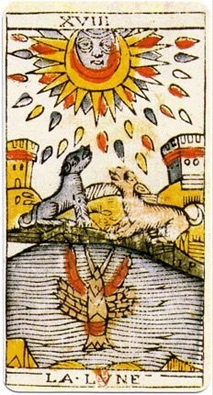
The traditional eikōn of the Moon is amongst the most distinctive in the Marseille Tarot. A great moon dominates the heavens, gazing down upon the scene below. Two canines stand facing one another, howling towards the moon’s light. Between them rises a crayfish from a pool of water. In the distance stand two towers which frame the landscape and create a sense of confinement and uncertainty. Overhead, droplets or sparks descend from the heavens.
The essence of the Moon is reflection; its function is to distort.
The relationship between light and its absence has long played an important role in divination, religion, and folklore. Light is traditionally associated with truth, clarity, and understanding. Darkness, by contrast, represents the absence of truth or our inability to perceive it properly. This explains why eclipses were feared throughout the ancient and medieval worlds and why so many myths concern the loss or obscuring of the sun. Humanity has always understood that without light, certainty becomes difficult.
The Moon has never been understood independently of the Sun. The moon possesses no light of its own but reflects the light of the sun. In classical astrology, the Sun represents the soul and vital life force, whilst the Moon signifies the body through which that life is expressed. We cannot perceive the soul directly; we know it through the living body. Yet the body is mutable. It grows, changes, declines, and ultimately perishes. Unlike the Sun’s constant illumination, the Moon waxes and wanes. It is therefore associated with instability and change.
For this reason, the Tarot’s Moon is concerned not with reflection as a gift, but with its limitations. Reflected light is partial, shifting, and uncertain. It reveals, but it also obscures. Like an imperfect mirror, it may distort what it reflects. The Moon therefore aligns itself with ambiguity, confusion, half-truths, uncertainty, voluntary change, and forces that operate beyond conscious control. Rather than producing clarity, it complicates matters. It introduces questions where certainty once existed and doubt where confidence once prevailed.
The imagery reinforces this interpretation. The crayfish emerging from the water may be understood as a symbol of Cancer, the zodiacal domicile of the Moon. It rises from the depths towards a world it does not yet fully understand, embodying the tentative emergence of something hidden or poorly defined. Like the Cancerian crab, the querent may not be able to proceed directly towards their goal. Circumstances may require a sideways movement, a detour, or an indirect approach. The shortest route is not always the wisest. Sometimes progress is achieved not by pressing forward, but by adapting to changing conditions and finding an alternative path. The canines howl towards the moon as symbols of instability, agitation, and frustration. They react to influences they neither comprehend nor control. Between them stretches a narrow path, overlooked by the towers and lit only by uncertain moonlight.
Unlike the Star, which provides reliable guidance, the Moon often signifies a situation in which reliable guidance is lacking. Facts may be incomplete. People may not be telling the whole truth. Equally, the querent may not be seeing matters clearly themselves. The card frequently appears when anxiety, assumption, gossip, rumour, and speculation have begun to take the place of certainty. Under such conditions, perception becomes distorted and poor decisions can follow.
The Moon is also a card of changeability and shifting conditions. Just as the moon waxes and wanes, circumstances rarely remain fixed for long under its influence. The card frequently appears when an unexpected development, new piece of information, or change in circumstances is about to alter the situation entirely. Plans may need to be revised, assumptions reconsidered, and expectations adjusted. What appears certain today may look very different tomorrow. For this reason, the Moon often advises against committing prematurely to a course of action whilst important factors remain in flux.
When the Moon appears in a reading, it suggests that matters are not what they appear to be. Something remains concealed, misunderstood, exaggerated, or distorted. The card does not necessarily indicate deceit, though deception is certainly possible. More often, it points towards confusion, uncertainty, and imperfect understanding. It may also indicate that circumstances are still evolving and that an impending change will alter the situation before a final outcome can be reached. The Moon therefore advises patience, caution, adaptability, and a healthy degree of scepticism. Until the Sun rises, we should be careful about what we think we see.
General: The beginning of a period of instability, uncertainty, or change. Circumstances remain in flux and people may prove unreliable or inconsistent. Judgement may be clouded by fear, assumption, wishful thinking, or an overactive imagination. Plans are liable to change as new information emerges. The Moon advises caution and adaptability until matters become clearer.
Love: Existing relationships are often characterised by peaks and troughs under the Moon. Fluctuating moods, misunderstandings, and emotional uncertainty can undermine the sense of connection between partners. The instability will usually pass; in the meantime, open and honest communication is essential. For those seeking love, the Moon offers opportunities to meet new people and enjoy new experiences. However, caution is advised. Do not become too invested too quickly, for things may look rather different in the light of day.
Career: The Moon frequently signifies instability within the professional environment. The querent may worry about redundancy, changing responsibilities, or whether contracts will be renewed. Unfortunately, certainty is often lacking and prudent contingency planning is advisable. For job seekers, opportunities may be limited and offers can arrive with unfavourable terms or conditions requiring careful scrutiny. Matters do improve, but the querent must first pass through the night. Professions associated with the Moon include fishing, trawling, sailing, commercial diving, brewing, bar work, cleaning, photography, courier services, and other occupations connected with irregular hours. More generally, it is associated with night workers and temporary or casual employment.
Finance: Financial circumstances are liable to fluctuate, making budgeting and long-term planning more difficult than usual. Unexpected expenses and changing priorities may place pressure upon resources. It is important to understand fully the terms, conditions, and small print attached to loans, purchases, and financial agreements. Assumptions can prove costly under the Moon, which has an unfortunate habit of revealing hidden fees, penalties, and unpleasant surprises.
Health: The Moon is associated with sleep disorders, including insomnia, somnambulism, sleep apnoea, circadian rhythm disturbances, and restless legs syndrome. It may also indicate eyesight complaints such as cataracts, floaters, and photosensitivity. More generally, the card signifies fluctuating symptoms, uncertain diagnoses, fatigue, and conditions whose severity varies over time. Recovery may be uneven, requiring patience and careful observation.
Essence: Reflection.
Function: Distort.
Polarity: Negative.
Astrological Association: The Moon.
Timing: Monday. Twenty-eight days, or at the Full Moon.
§
Tarot Cards: Jean Dodal Tarot via Wikipedia Commons. Public Domain.
Featured Image: Ancient Tarot Major Arcana © BP Grimaud/John Waddington Ltd, Leeds & London, Les Tarot de Marseille Jean Noblet, 1650 © Editions «letarot.com» (2001 [hand stencilled trumps]). Les Tarot de Marseille Jean Dodal, 1701 et 1715 © Editions «letarot.com» (2002 [hand stencilled trumps])
 Journal of a Cartomante