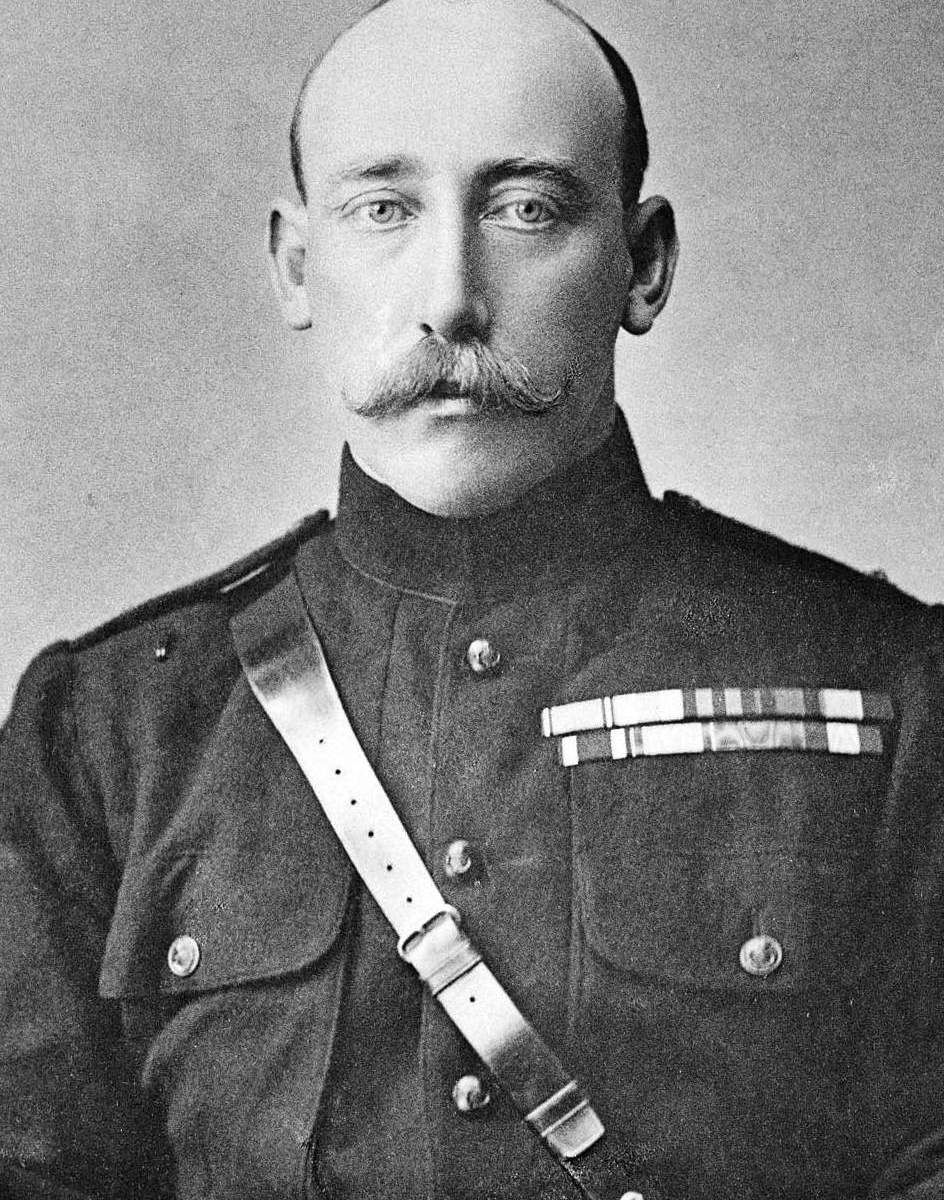
In the preceding post1, we reviewed the length-of-life technique known as horimæa as outlined by Ptolemy in Book III of the Tetrabiblos2.
Like many length-of-life techniques3, Ptolemy’s method focuses on the apheta or hyleg and its primary directions. We analyzed the birth chart of Christian Victor of Schleswig-Holstein and directed his hyleg according to Ptolemy’s instructions.
In this second post, our focus will be on analyzing Christian Victor’s birth chart and the predictive techniques that might foreshadow his death in 1900.
The Sun, the Moon and Mars
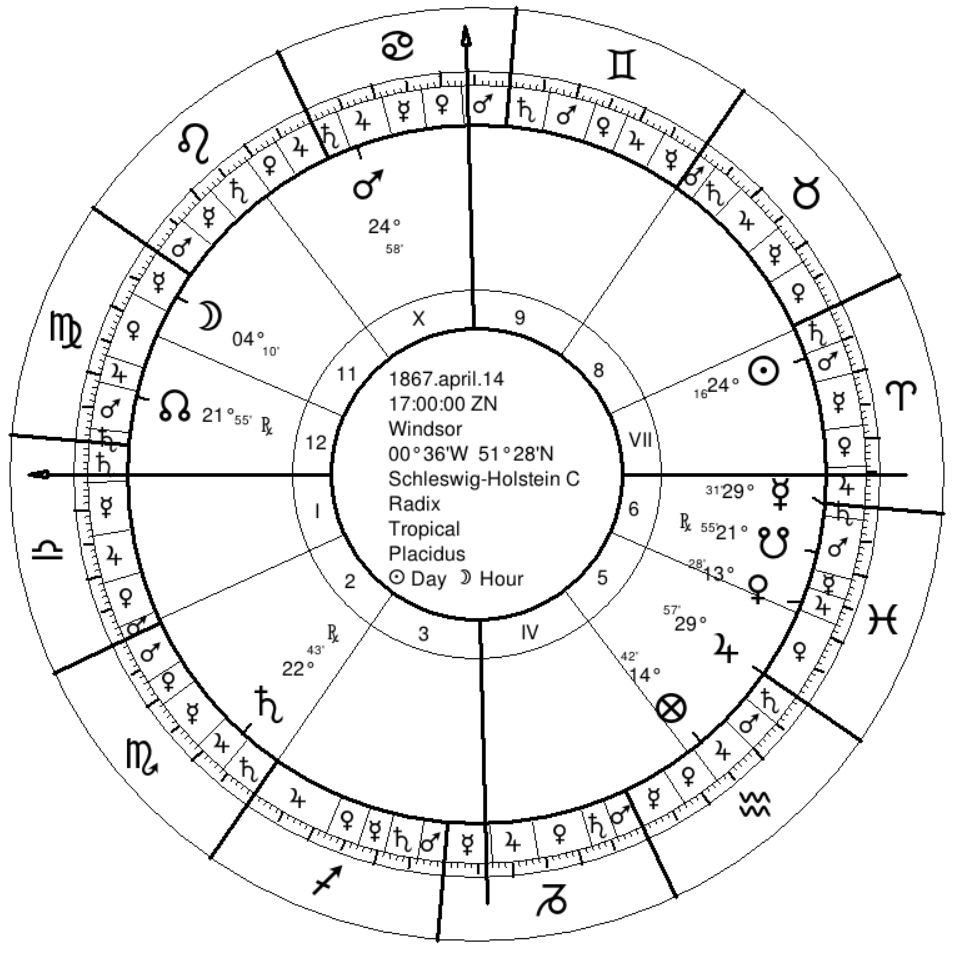
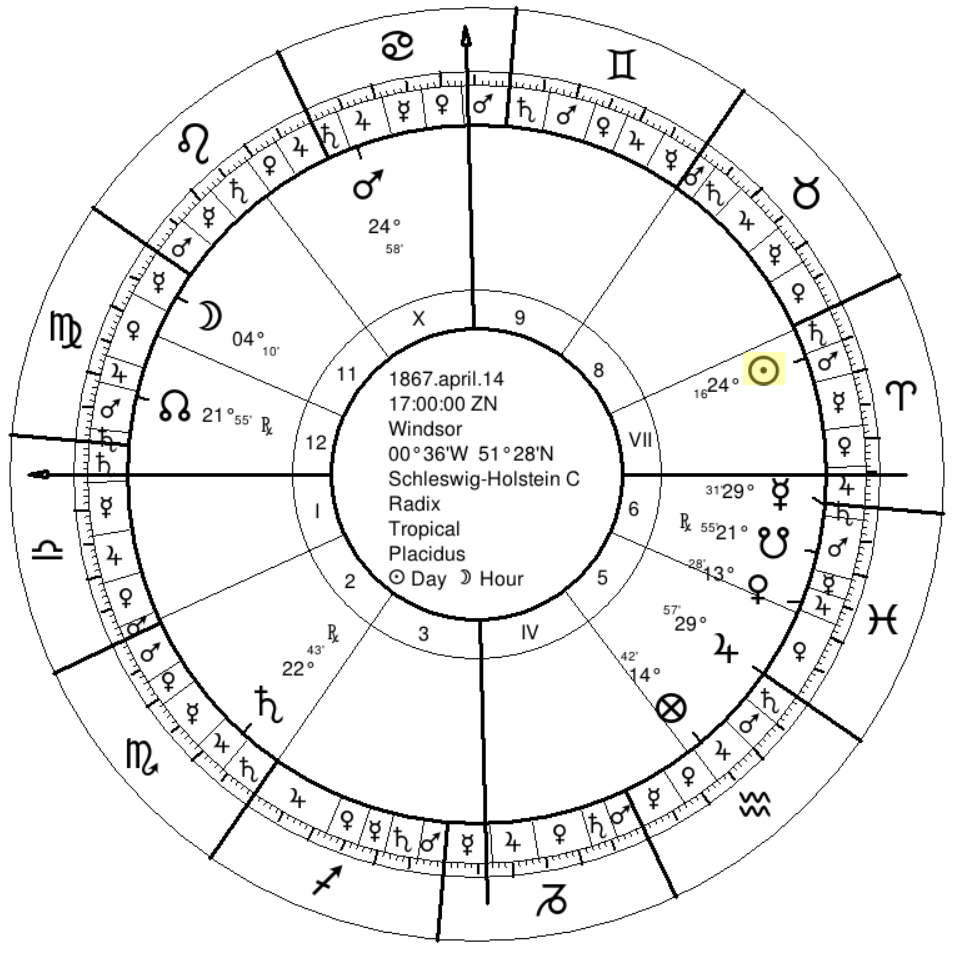
Christian Victor’s Mars occupies a prominent position. It is in the tenth house and advancing to the MC, which falls in Mars’s terms and triplicity. He also co-rules the second house, which Paulus Alexandrinus4 considered second only to the tenth house regarding profession/vocation. Of the lords of action (Mercury, Venus and Mars), he is the emphasized. Mars would therefore be pertinent to Christian Victor’s status and occupation.
Cricket, Mars and the MC
Christian Victor was a major in the English colonial army. Mars is also associated with athleticism, and Christian Victor was (according to Wikipedia) a gifted cricketer making a “first-class” appearance. The square from the exalted Sun (which Mars receives) adds some prestige.
In Book IV of the Tetrabiblos5, Ptolemy states that directions of the midheaven will provide information on our actions, friendships and the begetting of children.
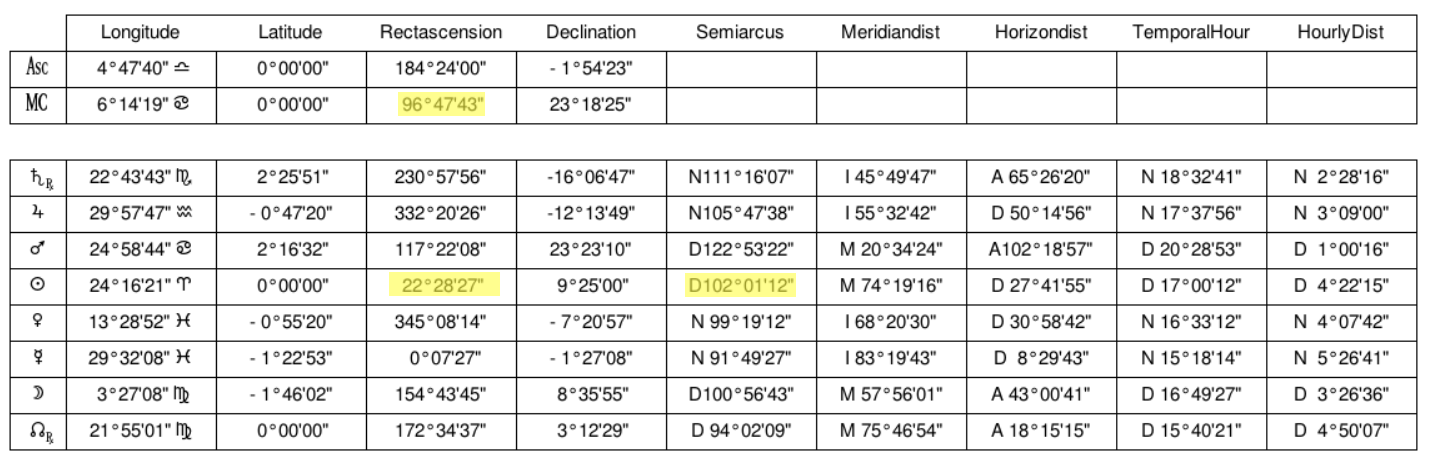
Directing Mars to the MC, should coincide with a time of an increase in status. Such a direction is the simplest. We simply need the right ascension (RA) of Mars and the MC.
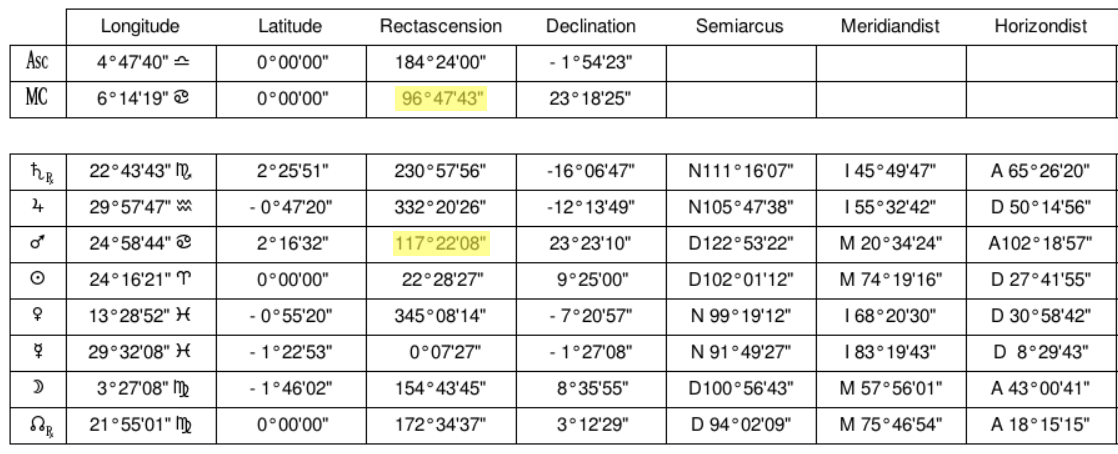
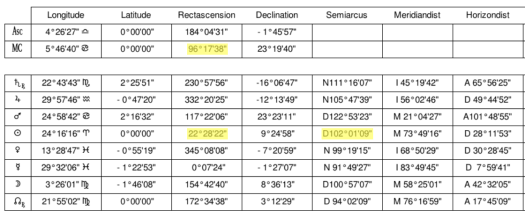
Direction = 117°22’08” – 96°17’38” = 20°34’25” or 20.573.
Morinus confirms our calculation:

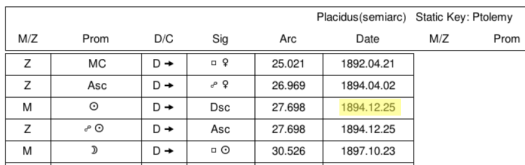
In 1887, Christian Victor played his first-class appearance for I Zingari. Then, in 1888, he was commissioned after leaving Sandhurst.
Again, if he had been born two minutes earlier, the above direction would have been timed to 1888. The MC square to the Sun would have been in 1887 and likely refers to his cricket appearance.
The Problematic Mars, the Sun & the Moon
Career aside, Mars is slow, in fall, and is the out-of-sect malefic, which is often the most troublesome planet in a birth chart.
The Moon, Mars’ ruler, is the traditional significator of the body, and we find her in the twelfth sign. The twelfth sign is known as the bad spirit. Vettius Valens says it signifies “foreign lands, hostility, slaves, injuries, dangers, tribunals, disease, death, and sickness.6” Mars overcomes the Moon’s twelfth-part, which falls in the ascendant (see below). Both portend injury or danger of a martial nature.
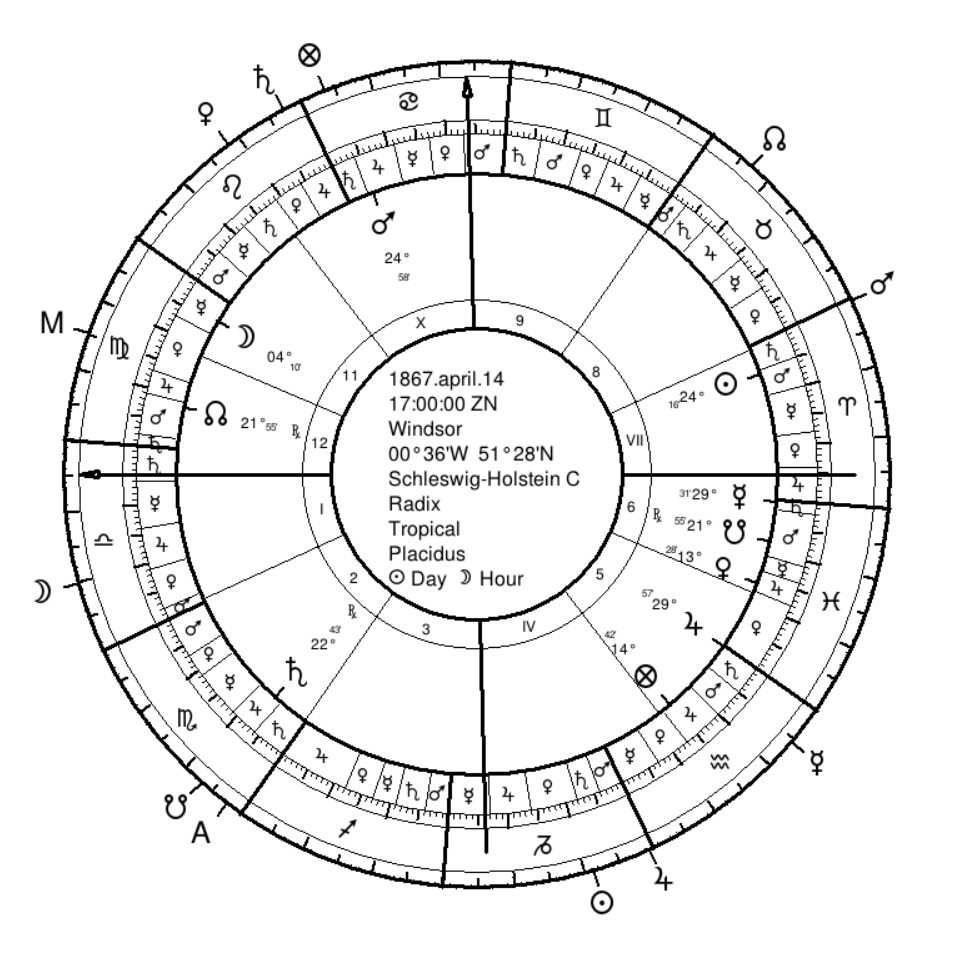
Whereas the Moon pertains to the body, the Sun signifies the spirit and life force. Rhetorius tells us that “the Sun in the 7th becomes the cause of sickness and injuries according to the nature of the star that is in conjunction or aspect with it.7” Again, that would be martial. Mars is associated with burning fevers and several symptoms common to malaria and typhoid.
The Sun-Mars square is strongly emphasized in the chart. It is the tightest aspect and they are the only two planets to be angular. The interplay between the two is confirmed by Mars’ twelfth-part being conjunct with the Sun (see above). Mars does receive the Sun, which is dignified and in its exaltation and will therefore be able to curtail some of Mars’ difficulties – albeit not prevent them.
Venus rules both the ascendant and the eighth sign. Despite being in her exaltation, Venus is cadent. Sahl B. Bishr states that if the eighth sign’s ruler is falling, it indicates death will occur while traveling8. Christian Victor died abroad and was due to return when he fell ill.
Time-Lords and the Death of Christian Victor
In our analysis of Christian Victor’s birth chart we have seen how the Sun, the Moon and Mars all foreshadow ill health and also indicators of this occurring outside of the UK. Do they foreshadow his death? Yes. But why did he die in 1900 and not 1895? The answer lies less in horimæa but in the activation of these planets as a series of time-lords.
The absence of time-lords in modern astrology is one of the noticeable differences between it and “traditional” practice. It is perhaps also the reason for the former’s overreliance on transits.
Each day, the planets rise in the east, set in the west, and never cease to traverse through the zodiac. Yet, despite this continual motion (i.e., transits), they do not have a daily effect on us – despite the regular warnings whenever Mercury is going retrograde. This is because although the planets are constantly moving, they are not continually active in each individual person’s life.
An activated planet is referred to as a time-lord or chronocrator from the Greek chronokratōr. It is said to rule over specific periods of life when it can influence and manifest its promise set in the birth chart.
In Book IV of the Tetrabiblos9, Ptolemy outlines a tier of time-lords, and we will largely follow his scheme. A transiting planet will need to be activate on several levels before it can effect us.
General Time-Lords: Ages of Man, Firdaria & Primary Directions
The general time-lords are seen to preside over different stages of life or longer periods, e.g. more than a year. Often, they overlap with life’s milestones. Ptolemy considered primary directions and the Ages of Man to be general time-lords.
Although we will focus on directions, the Seven Ages and Firdaria are two other systems of considerable merit. Aged 33, Christian Victor was in the period of the Sun (Seven Ages) and a Moon-Saturn period (Firdaria).
With the Moon, the ascendant is the primary significator of the body, particularly in terms of the physical constitution, vitality, and health. Valens states it is “…life, steering-oar, body, breath.” For this reason, it is usually the significator of choice used in predictive techniques to look at health.
Throughout life, the ascendant can be directed through the terms (also known as bounds), which are uneven sub-sections of a sign. This is sometimes referred to as aphesis or releasing.
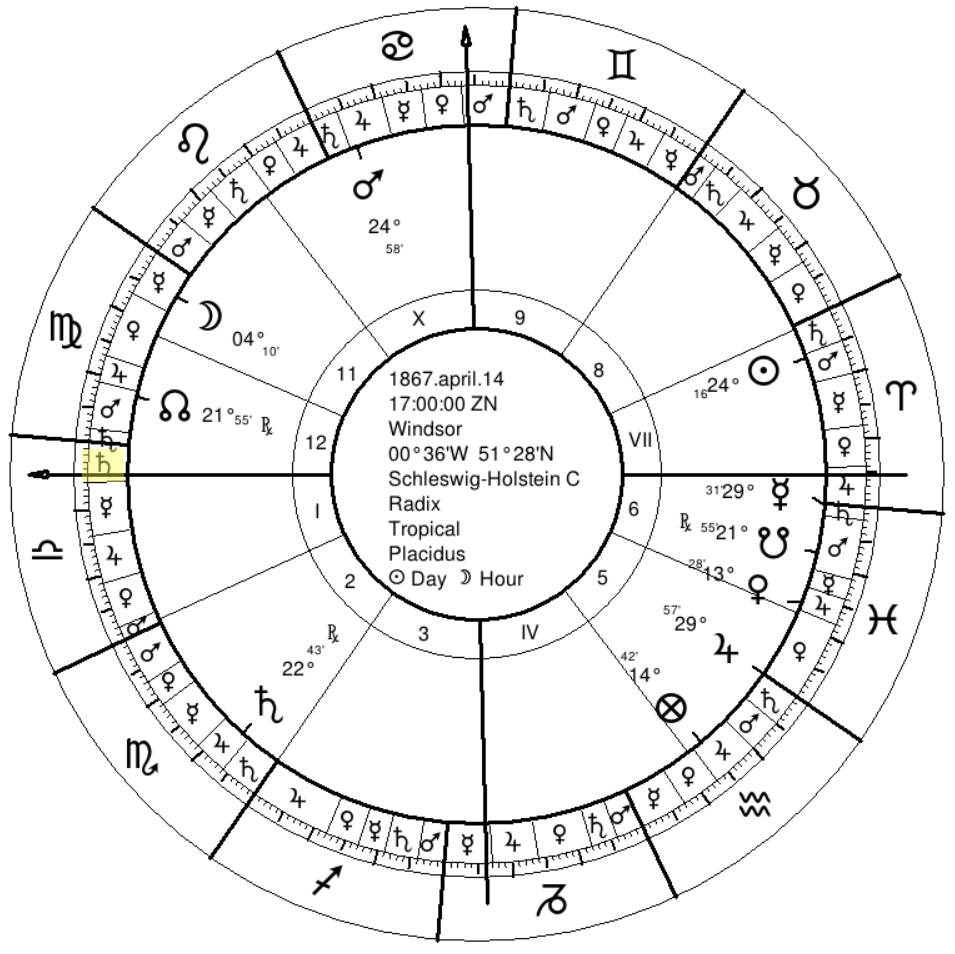
At birth, Christian Victor’s ascendant was in the term of Saturn but entered the term of Mercury in December 1868. The directed term is referred to as the division or distribution, and its ruler is the divisor or distributer.
As the ascendant is directed, it will reach the planet’s bodies (conjunction) or aspects (sextile, square, trine, or opposition). This planet is known as the promissor or partner and remains so until a subsequent aspect is reached.
The ascendant’s division, divisor and promissor are important general time-lords.
On April, 1900, the ascendant was directed to the terms of Mars in Libra, and Mars was also the current promissor.
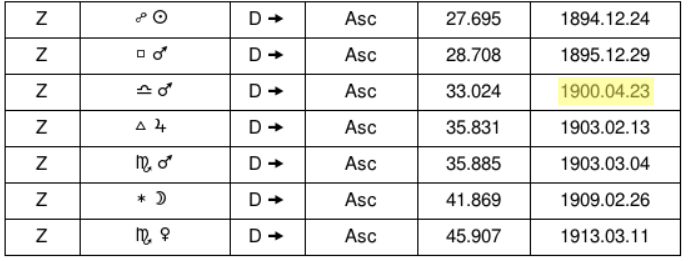
In January 1900, there was a converse direction where Mars was brought to the sextile of the Sun. As Mars was the divisor and promissor of the ascendant, the sextile will have also activated the Sun.

Annual Time-Lords: Profections & Solar Revolutions
As the name suggests, annual time-lords are which change annually at the time of our birthday. These time-lords can be seen to execute the agenda of the general time-lords, either constructively or obstructively.
Profections are one of the oldest techniques in predictive astrology, forming part of the annual time-lords.
When introducing profections, Dortheus of Sidon explains, “When a native is born, then the lord of the year is the lord of the house in which the native was born. And count likewise from the Ascendant, a year for each sign, until it ends up at the year which you want: for the lord of the year is the lord of that house.10”
At birth, Christian Victor’s ascendant is 4° Libra. On his first birthday (age 1), it advances to 4° Scorpio. It moves to 4° Sagittarius on the second birthday (age 2). This advancement continues throughout life, with the profection returning to the first house at ages 12, 24, 36, 48, 60, 72, and 84.
Dorotheus, and most sources, use the sign’s ruler as the lord of the year. Vettius Valens preferred a planet or planets occupying the sign in the natal or solar revolution chart. I find planets in the natal chart are indeed emphasized and can be seen as co-rulers of the year.
Christian Victor died at age 33. The profected ascendant reached Cancer with the Moon and Mars were thus the year’s rulers.
From the above, we know that Mars was activated at the time of Christian Victor’s death. He was divisor and promissor of the ascendant and co-ruler of the year.
To see how these manifest, we can turn to the annual revolution, also known as the solar revolution or solar return. This chart is for when the Sun returns to its natal position, usually on or around one’s birthday.
However, it must be read in conjunction with the natal chart, not independently. Particularly, we pay attention to so-called “repetitions” and placements of the time-lords.
The 1900 solar return is shown below:
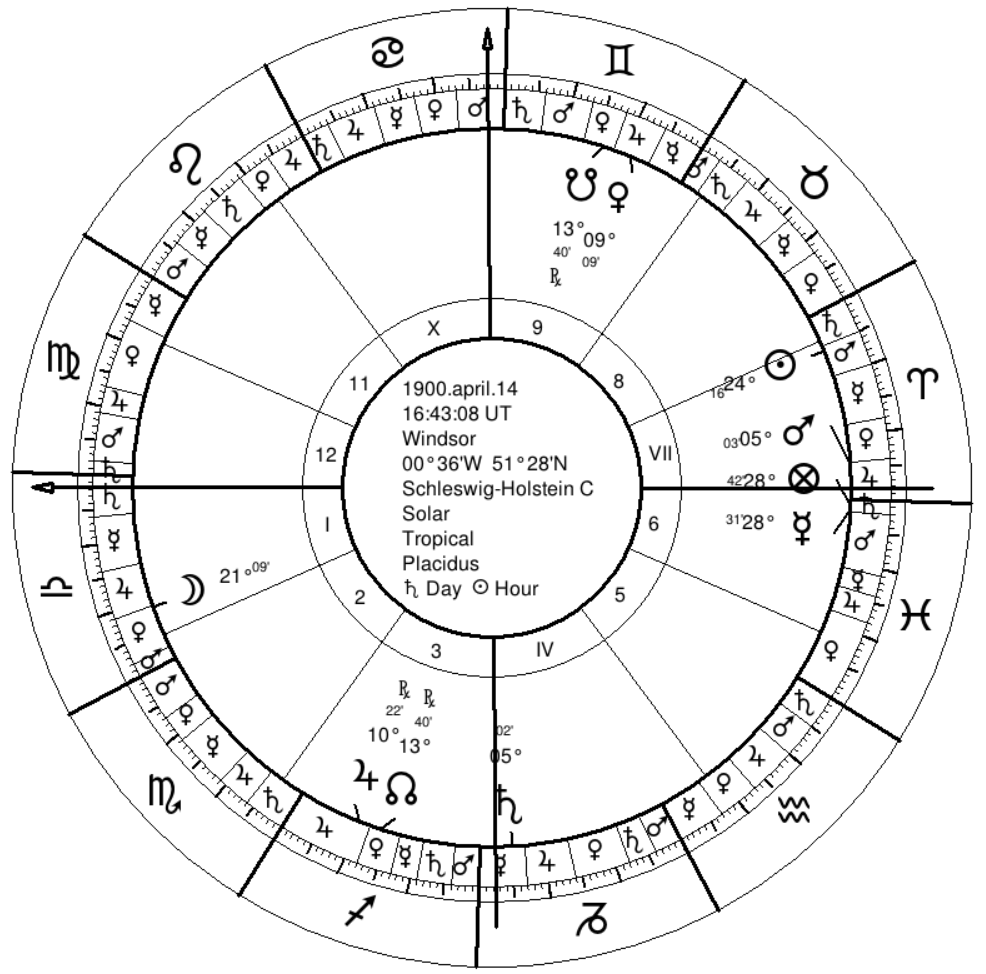
We first notice that the Libra rises as in the birth chart; the four angles have returned to the same signs. I find this an important “repetition.”
Our first focus is on the position of the relevant time-lords, the Moon and Mars. Of particular note is whether these are in a strong or weak position. Both are angular: the Moon in the first house and Mars in the seventh. This means that they were in a strong position in 1900 to release their natal promises.
Now, let us consider the two charts together:
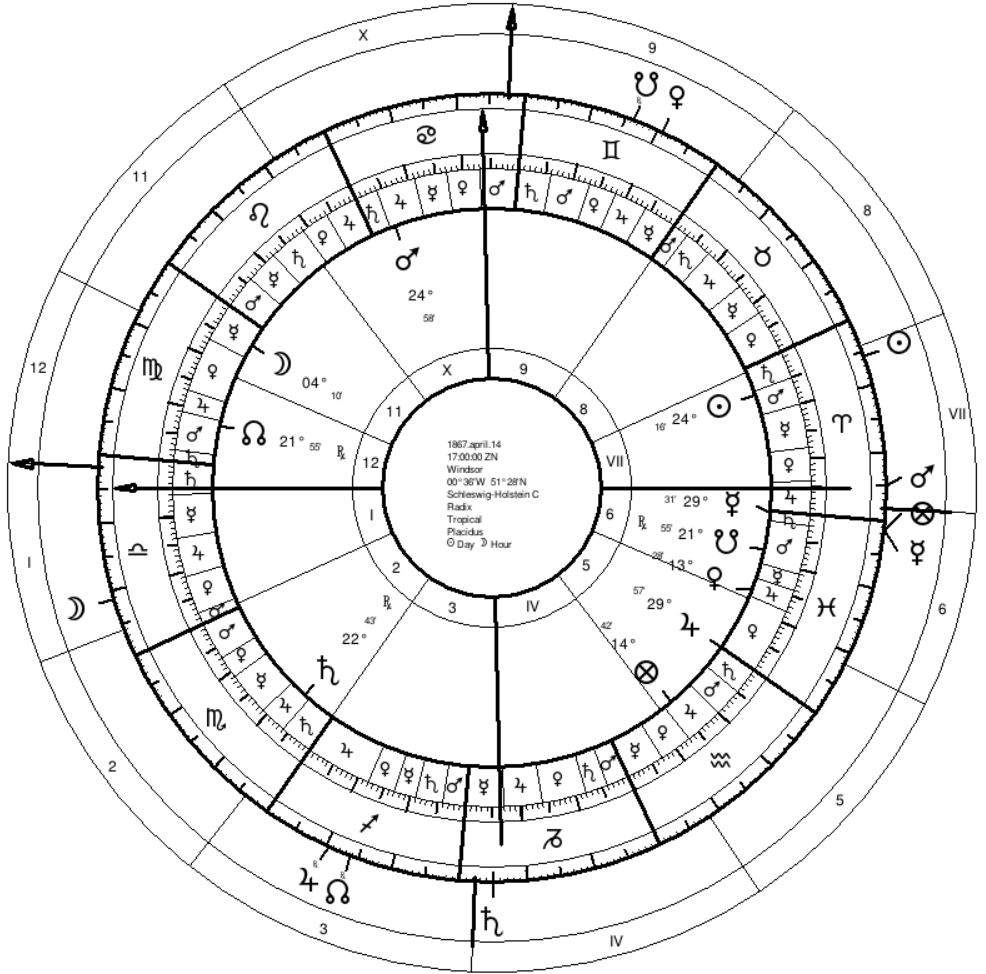
For clarity, I will use N- and SR- to denote planets and points in the nativity and revolution, respectively.
The SR-Moon is overcome by the N-Mars and in a close opposition to N-Sun. At the same time, the SR-Mars is conjunct to the natal descendent and, therefore, in a partile opposition to the natal ascendant.
Venus, the ruler of both the natal and revolution ascendant, is without any dignity in revolution. In a cadent house, squaring her natal position (the sixth house of illness), there is a strong inference of a weakened constitution. Interestingly, she falls in the ninth house of foreign travel, and her antiscia lies with N-Mars.
Saturn-SR is conjunct to the N-IC and scrutinizing the N-Moon by trine. Christian Victor’s Firdaria was a Moon-Saturn period.
Short-Term Time-Lords: Monthly Profections, Lunar Revolution and Transits
In addition to the annual profection, we can also advance the ascendant each month and daily. Below are Christian Victor’s profections from Delphic Oracle:
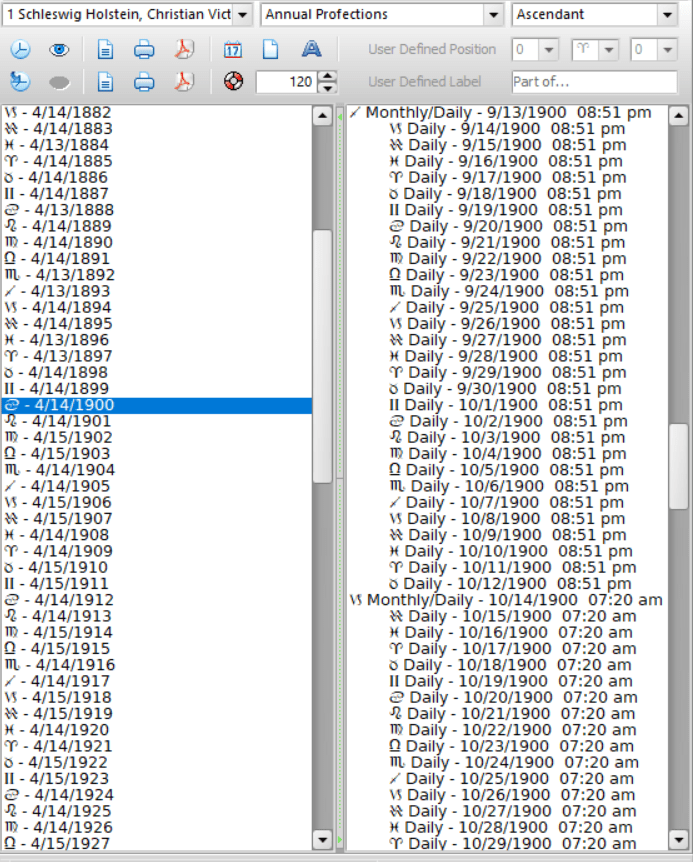
When Christian Victor “took to his bed,” (October 10) the monthly profection was at Sagittarius (third house). The daily profection was to Pisces (sixth house). According to Victoria’s diary, Christian Victor was in the process of preparing to return to England (cadent house are associated with travel). The sixth house is the house of illness.
On October 14, 1900, Christian Victor’s monthly profection reached Capricorn (the exaltation of Mars), the fourth natal house which traditionally pertained to end-of-life conditions. On the day he died, October 29, it reached Aries which is ruled by Mars and the Sun (exaltation).
After the solar revolution, we can use the lunar revolution charts to identify critical months in the solar year. Again our focus is on repetition, and the chart must be considered against 1) the birth chart and 2) the solar revolution. No revolution is ever read as an independent chart.
In Christian Victor’s final lunar revolution (below), Cancer was rising. The Sun was in a partile opposition to his natal position and overcome by natal Mars. The Sun is in fall in the natal and solar revolution ascendant and conjunct the SR-Moon. This configuration released the promise of natal Mars-Sun/Moon that month.
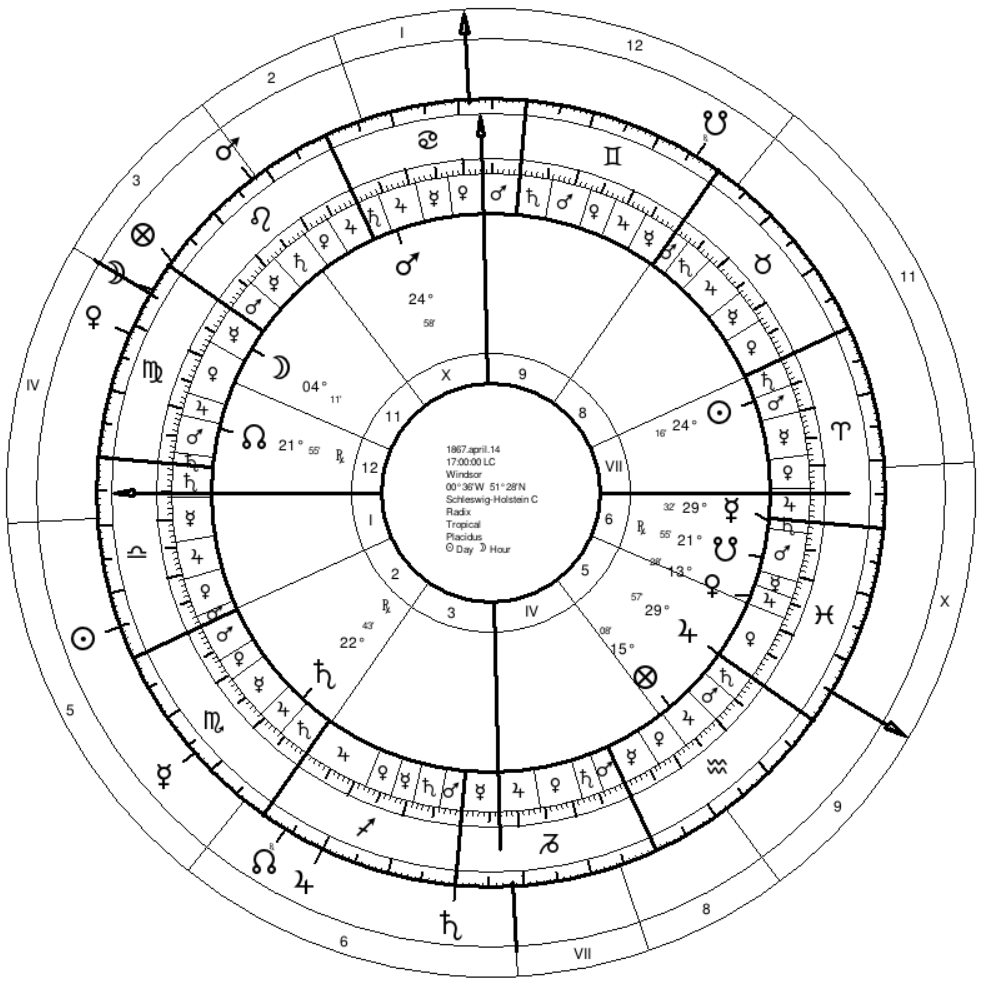
On Christian Victor’s death, the transiting (relocated) Moon was applying to a conjunction with the natal IC and Saturn-SR.
In most cases, we can content ourselves with primary directions, annual profections, and the solar and lunar revolutions. Although Ptolemy included transits (ingresses), they are less reliable than the monthly and daily profections.
§
- Like the first article, this article was written for my old blog. ↩︎
- Ptolemaeus, C. and Robbins, F.E. (2001) Tetrabiblos. Cambridge, MA: Harvard Univ. Press ↩︎
- See Dortheus of Sidon and Ptolemy’s younger contemporary, Vettius Valens ↩︎
- Paulus et al. (2001) Late classical astrology: Paulus Alexandrinus and olympiodorus: With the Scholia from later commentators. Reston, VA: Arhat. ↩︎
- Ptolemaeus, C. and Robbins, F.E. (2001) Tetrabiblos. Cambridge, MA: Harvard Univ. Press. Page 449 ↩︎
- Valens, V. and Riley, M.T. (2022) The Anthology. Denver, CO: Amor Fati Publications. You can read the text for free here ↩︎
- Holden, J.H. (2009) Rhetorius the Egyptian: Astrological Compendium. Tempe, Az.: Amer. Federation of Astrology ↩︎
- Bishr, S. ibn and Dykes, B.N. (2019) The astrology of Sahl B. Bishr: Translated from the Arabic. Minneapolis, MN: Cazimi Press. ↩︎
- Ptolemaeus, C. and Robbins, F.E. (2001) Tetrabiblos. Cambridge, MA: Harvard Univ. Press. Book IV.10. Read here. ↩︎
- Ptolemaeus, C. and Robbins, F.E. (2001) Tetrabiblos. Cambridge, MA: Harvard Univ. Press. Book IV.10. Read here. ↩︎
 Journal of a Cartomante