Trigon Lords of the Sect Light: Lena Zavaroni

I inform you that every thing which is decided and indicated comes to be from the lords of the triplicities. And for every thing of tribulation and hardship which afflicts people of the world and generality of men, the lords of the triplicities decide it [1]

Carmen Astrologicum, Dorotheus of Sidon

Dorotheus of Sidon’s emphatic endorsement of triplicity underpins much of his monumental treatise on Hellenistic practice and he uses them extensively. One technique, the triplicity lords of the sect-light, also features prominently in Vettius Valens’ Anthology. It aims to provide an overview of one’s success and prosperity, and the ease and dis-ease of life over extended periods.

Triplicity, or trigons, refer to the division of the twelve signs into four groups of three, each being 120° from each other. Each triplicity was first associated with one of the four winds (Eurus, Notus, Zephyrus, and Boreas) and later still, one of the four elements.

Each triplicity is connected with three planets:

  • Aries, Leo and Sagittarius have, by day, the Sun, Jupiter, and Saturn, and by night, Jupiter, the Sun, and Saturn.
  • Taurus, Virgo and Capricorn have, by day, Venus, the Moon, and Mars ; and by night, the Moon, Venus, and Mars.
  • Gemini, Libra and Aquarius have, by day, Saturn, Mercury, and Jupiter ; and by night, Mercury, Saturn, and Jupiter.
  • Cancer, Scorpio and Pisces have, by day, Venus, Mars, and the Moon ; and by night, Mars, Venus, and the Moon.

As you can see, the order changes depending on whether the chart is diurnal (Sun above the horizon) or nocturnal (Sun below the horizon). The division between day (diurnal) and night (nocturnal) charts is known as sect.

For this technique, we note whether the chart is diurnal or nocturnal and then locate either the Sun (for day charts) or the Moon (for night charts). After considering its state, one moves to considering its triplicity lords. For example, if you have a day chart, we look at the Sun and its condition. If the Sun is in Cancer, we consider its lords which, by day, is Venus, Mars, and the Moon.

Both Dorotheus and Valens, and their early successors, divided life between the first two triplicity lords, and saw the third as participating throughout life as an assistant. I find dividing life between the three planets yields a better dividend, with the first ruling the first third, the second the next third and the final third is governed by the third lord.

Let us consider the chart of the late Scottish signer, Lena Zavaroni [2]:
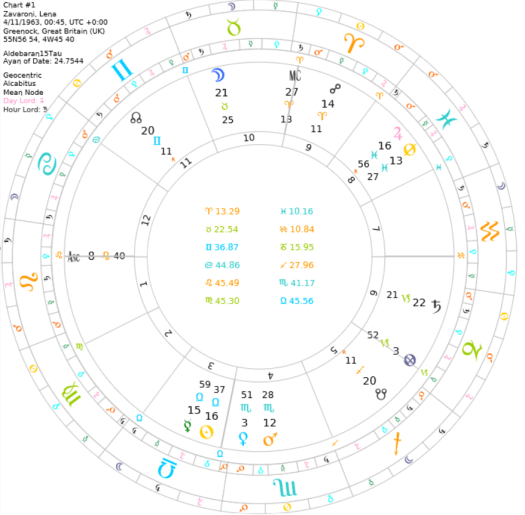
With the Sun in the third place, the chart is nocturnal, and we must turn to the Moon and then the three triplicity lords of the Moon. We find her in Taurus. The order is thus the Moon, Venus, and Mars, respectively.

Lena Zavaroni in 1974

On first glance, we see the Moon is quite strong. She is in the house of her exaltation, of the sect and in her triplicity, and occupies a pivot. Such conditions are favourable in keeping the Moon comfortable in her significations, as well as some prominence in the public eye [3]. However, she suffers a tight aspect with Saturn. As this is a night-chart, Saturn is the out-of-sect malefic and is in a dark place (the sixth house of illness). The Moon’s twelfth part also falls with Saturn, too. Valens emphasises the importance of the domicile lord. Sadly, that is Venus, who is not in great shape. Traversing Scorpio, her singular strength is angularity. Otherwise, she is the house and bound of Mars with whom she is in wide conjunction. The third ruler is Mars, also in Scorpio. Mars is in a loose aspect with the diurnal Jupiter, who is retrograde and in a dark house (house of death).

Having considered the triplicity lords of the sect-light, we now have a broad understanding of the flow or ease of success and prosperity throughout life. Here, we see a strong start, with some prominence, too, before a sudden downward turn with things evening out towards the end. It is not in itself a quantitive indicator. Strong sect-lights cannot overrule a weak financial promise, but they can soften the blow.

For determining the individual time-period of each lord, Vettius Valens [5] considers the ascension times [6], or the ‘cyclical return of the chronocractor (time-lord).’ Chris Brennan identifies the latter as the minor years of the planets [7] – an important, and underused, timing tool. For me, the latter has proven the more reliable.

Lena was born in November, 1963. The minor years of the Moon, Venus, and Mars are 25, 8, and 15, respectively. Thus, the Moon would rule until 1988 ; Venus until 1996 ; and Mars until 2011. The ascensional times of Taurus and Scorpio are 22.54 and 41.17, respectively. We convert these into years, saying Venus rules for 22-years, and Venus and Mars for 41 each. These time-frames are broad indicators and refined further through additional predictive techniques, such as releasing of the hyleg, profections and solar revolutions[8].

Zavaroni rose to fame at the age of ten, winning a talent show and becoming the youngest person to have a Top 10 UK album and hosted her own television shows in the late 1970s and early 80s. Sadly, at the age of 13, Zavaroni developed anorexia nervosa and never recovered. It is pertinent to note, that in addition to its aspect with Saturn (who brings illness), the Moon rules the twelfth sign.

Lena Zavaroni in later life

In 1989, she married but divorced eighteen months later. That year, her mother died of an overdose. Again, we can note that Venus and Mars are both in the house of family, but also rule the tenth (mother) and fourth (father) places, respectively. Also, Venus is inherently reliant on Mars and Zavaroni moved to live near her father, who was her primary support.

Zavaroni underwent a psychosurgical procedure in 1999. Despite initial signs of success, she developed pneumonia and died aged just 35. She had been living on benefits. Sadly, she is primarily remembered for her tragic career and death.

As you can see, one can tell much from such a simple technique. Try it. Since studying it frequently, after reading Abū’Ali al-Khayyāt [9], I’ve been consistently impressed.

§

References:
[1] Dykes, B. (2017). Carmen Astrologicum. Minneapolis, Minn.,: The Cazimi Press, pp. 61 – 62, and 98 – 106.
[2] Chart cast when using Sidereal system.
[3] Of course, not everyone who has their sect-light in the tenth place can expect celebrity or world fame. However, such placement is conducive to prominence within a chosen field, or social circle.
[4]The dark places are the second, sixth, eighth and twelfth. These four are all in aversion to the ascendant. As the joys of Mars and Saturn, the sixth and twelfth are considered the most malefic.
[5] Valens, V. (2010). Anthologies (Riley, Translation), PDF: http://www.csus.edu/indiv/r/rileymt/Vettius%20Valens%20entire.pdf
[6]Each sign takes a different length of time to rise over the horizon depending on location. The ascension times refers to the number of degrees that pass the midheaven in the time it takes for a sign to rise in the east.
[7] Brennan, C. (2017). Hellenistic Astrology: The Study of Fate and Fortune. 1st ed. Denver, Colorado: Amor Fati Publications, p.495 – 510.
[8]For the astrologer, the prediction is primarily concerned with timing events found in the birth chart. Nothing can ever be forecast if it is not promised in the nativity. Contrary to contemporary practice, transits themselves were never considered to either influence or cause events, and not all planets are active either at the same time or throughout life – hence the importance of the time-lords (chronocrators).
[9] Dykes, B. (2009). Persian Nativities Volume I: Māsha’allāh & Abū’Ali al-Khayyāt. 1st ed. Minneapolis, MN: Cazimi Press, pp. 240 – 256

Article was written in 2019

On the Death of a Victorian Prince Part II: Cricket and Time Lords

In the preceding post1, we reviewed the length-of-life technique known as horimæa as outlined by Ptolemy in Book III of the Tetrabiblos2.

Like many length-of-life techniques3, Ptolemy’s method focuses on the apheta or hyleg and its primary directions. We analyzed the birth chart of Christian Victor of Schleswig-Holstein and directed his hyleg according to Ptolemy’s instructions.

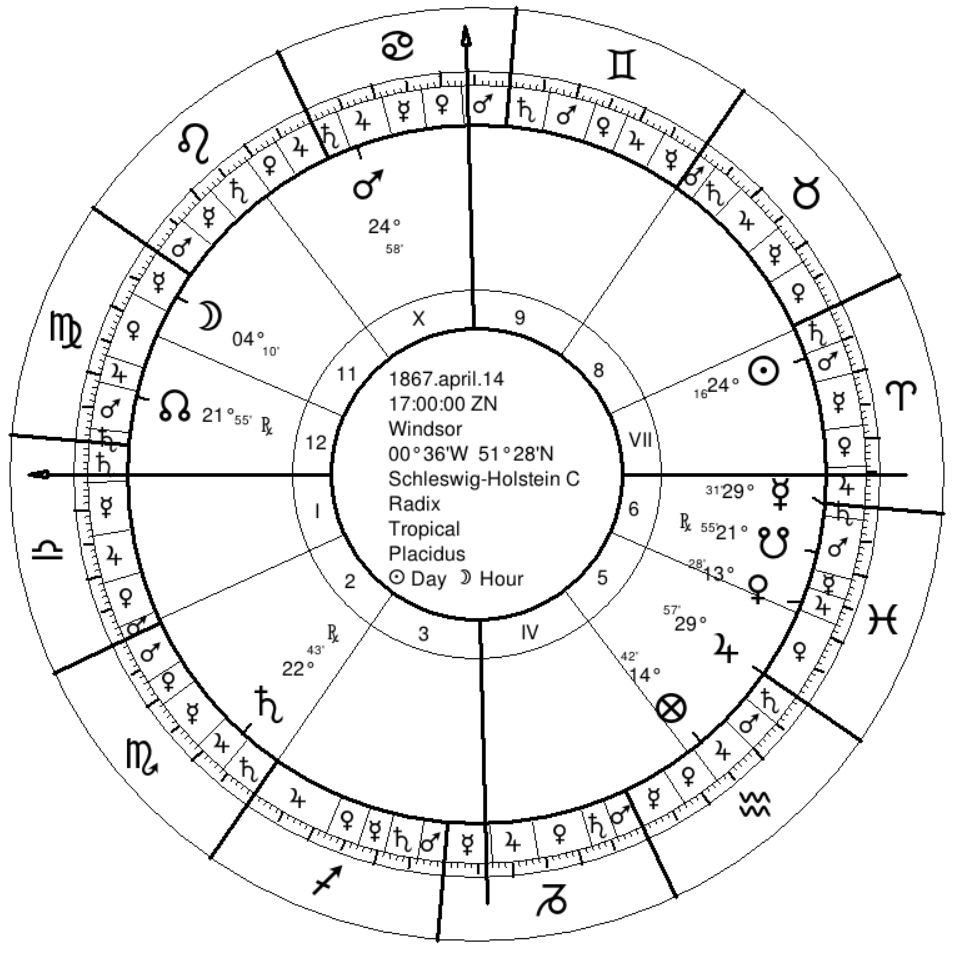
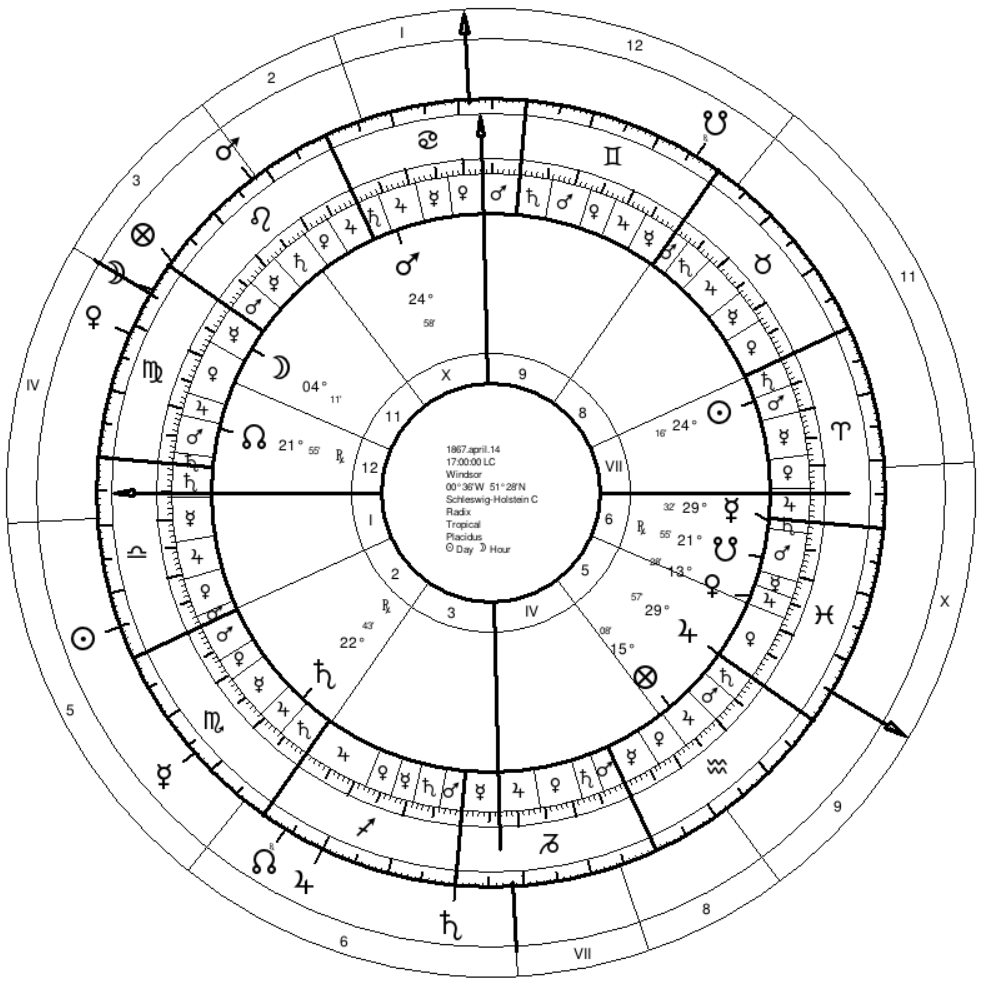
In this second post, our focus will be on analyzing Christian Victor’s birth chart and the predictive techniques that might foreshadow his death in 1900.

The Sun, the Moon and Mars

Christian Victor’s Mars occupies a prominent position. It is in the tenth house and advancing to the MC, which falls in Mars’s terms and triplicity. He also co-rules the second house, which Paulus Alexandrinus4 considered second only to the tenth house regarding profession/vocation. Of the lords of action (Mercury, Venus and Mars), he is the emphasized. Mars would therefore be pertinent to Christian Victor’s status and occupation.

Cricket, Mars and the MC

Christian Victor was a major in the English colonial army. Mars is also associated with athleticism, and Christian Victor was (according to Wikipedia) a gifted cricketer making a “first-class” appearance. The square from the exalted Sun (which Mars receives) adds some prestige.

In Book IV of the Tetrabiblos5, Ptolemy states that directions of the midheaven will provide information on our actions, friendships and the begetting of children.

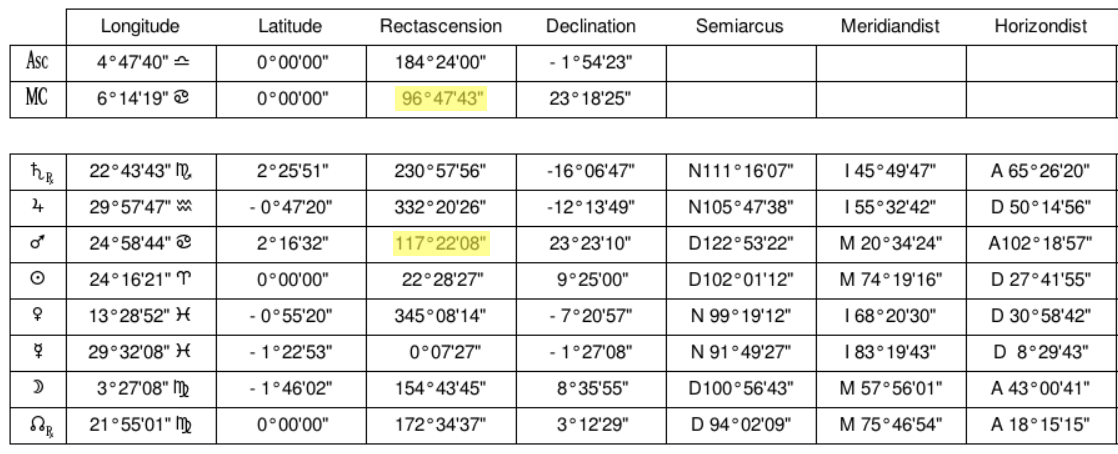
Directing Mars to the MC, should coincide with a time of an increase in status. Such a direction is the simplest. We simply need the right ascension (RA) of Mars and the MC.

Direction = 117°22’08” – 96°17’38” = 20°34’25” or 20.573.

Morinus confirms our calculation:

In 1887, Christian Victor played his first-class appearance for I Zingari. Then, in 1888, he was commissioned after leaving Sandhurst.

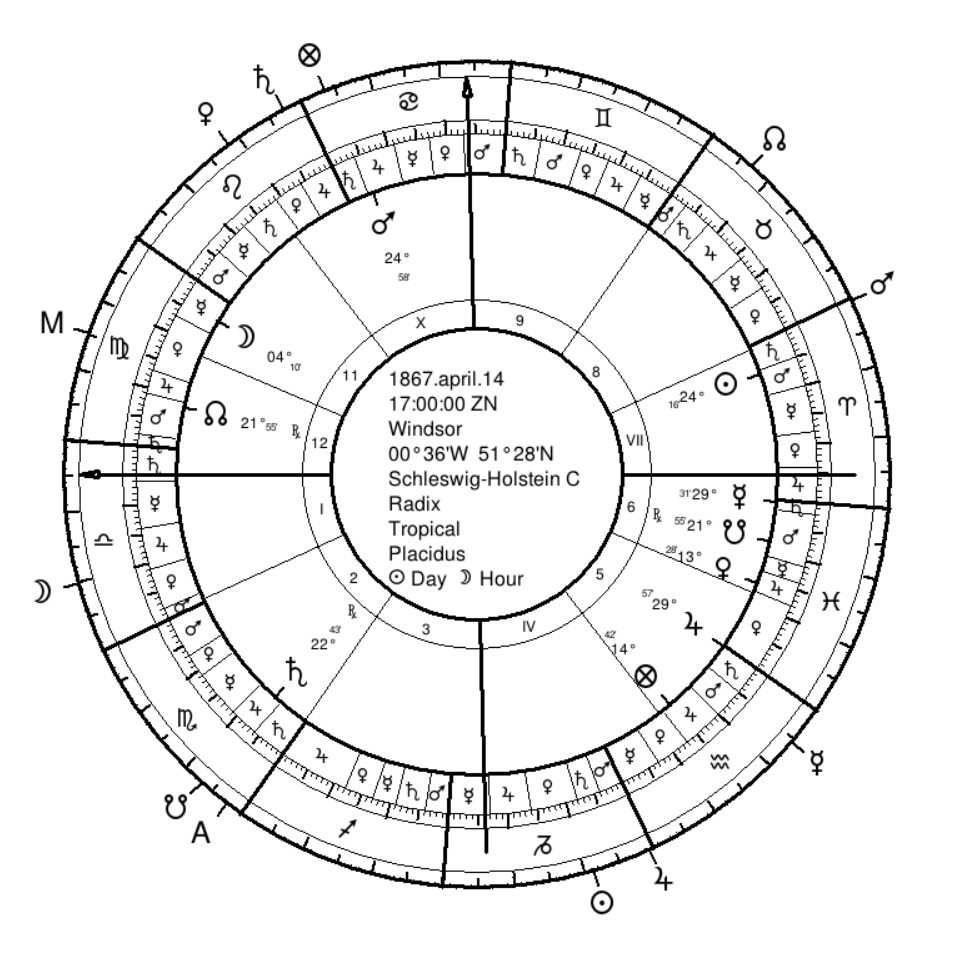
Again, if he had been born two minutes earlier, the above direction would have been timed to 1888. The MC square to the Sun would have been in 1887 and likely refers to his cricket appearance.

The Problematic Mars, the Sun & the Moon

Career aside, Mars is slow, in fall, and is the out-of-sect malefic, which is often the most troublesome planet in a birth chart.

The Moon, Mars’ ruler, is the traditional significator of the body, and we find her in the twelfth sign. The twelfth sign is known as the bad spirit. Vettius Valens says it signifies “foreign lands, hostility, slaves, injuries, dangers, tribunals, disease, death, and sickness.6” Mars overcomes the Moon’s twelfth-part, which falls in the ascendant (see below). Both portend injury or danger of a martial nature.

Whereas the Moon pertains to the body, the Sun signifies the spirit and life force. Rhetorius tells us that “the Sun in the 7th becomes the cause of sickness and injuries according to the nature of the star that is in conjunction or aspect with it.7” Again, that would be martial. Mars is associated with burning fevers and several symptoms common to malaria and typhoid.

The Sun-Mars square is strongly emphasized in the chart. It is the tightest aspect and they are the only two planets to be angular. The interplay between the two is confirmed by Mars’ twelfth-part being conjunct with the Sun (see above). Mars does receive the Sun, which is dignified and in its exaltation and will therefore be able to curtail some of Mars’ difficulties – albeit not prevent them.

Venus rules both the ascendant and the eighth sign. Despite being in her exaltation, Venus is cadent. Sahl B. Bishr states that if the eighth sign’s ruler is falling, it indicates death will occur while traveling8. Christian Victor died abroad and was due to return when he fell ill.

Time-Lords and the Death of Christian Victor

In our analysis of Christian Victor’s birth chart we have seen how the Sun, the Moon and Mars all foreshadow ill health and also indicators of this occurring outside of the UK. Do they foreshadow his death? Yes. But why did he die in 1900 and not 1895? The answer lies less in horimæa but in the activation of these planets as a series of time-lords.

The absence of time-lords in modern astrology is one of the noticeable differences between it and “traditional” practice. It is perhaps also the reason for the former’s overreliance on transits.

Each day, the planets rise in the east, set in the west, and never cease to traverse through the zodiac. Yet, despite this continual motion (i.e., transits), they do not have a daily effect on us – despite the regular warnings whenever Mercury is going retrograde. This is because although the planets are constantly moving, they are not continually active in each individual person’s life.

An activated planet is referred to as a time-lord or chronocrator from the Greek chronokratōr. It is said to rule over specific periods of life when it can influence and manifest its promise set in the birth chart.

In Book IV of the Tetrabiblos9, Ptolemy outlines a tier of time-lords, and we will largely follow his scheme. A transiting planet will need to be activate on several levels before it can effect us.

General Time-Lords: Ages of Man, Firdaria & Primary Directions

The general time-lords are seen to preside over different stages of life or longer periods, e.g. more than a year. Often, they overlap with life’s milestones. Ptolemy considered primary directions and the Ages of Man to be general time-lords.

Although we will focus on directions, the Seven Ages and Firdaria are two other systems of considerable merit. Aged 33, Christian Victor was in the period of the Sun (Seven Ages) and a Moon-Saturn period (Firdaria).

With the Moon, the ascendant is the primary significator of the body, particularly in terms of the physical constitution, vitality, and health. Valens states it is “…life, steering-oar, body, breath.” For this reason, it is usually the significator of choice used in predictive techniques to look at health.

Throughout life, the ascendant can be directed through the terms (also known as bounds), which are uneven sub-sections of a sign. This is sometimes referred to as aphesis or releasing.

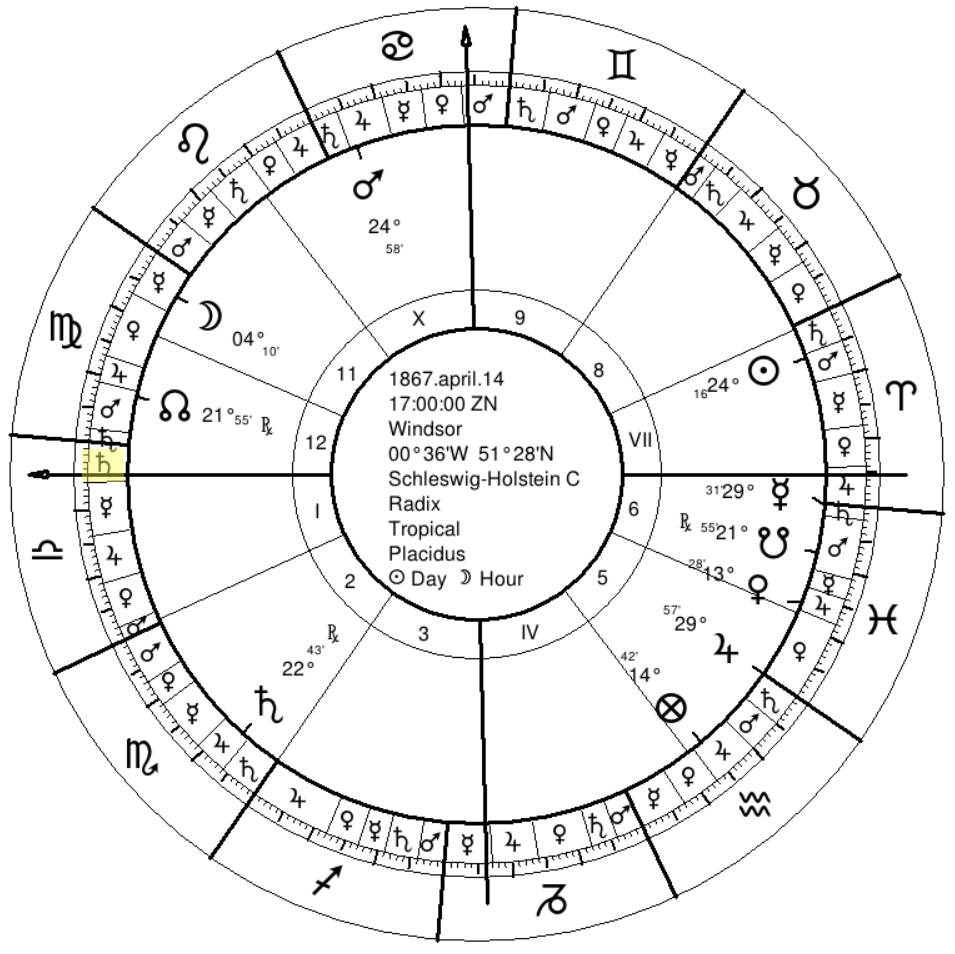
At birth, Christian Victor’s ascendant was in the term of Saturn but entered the term of Mercury in December 1868. The directed term is referred to as the division or distribution, and its ruler is the divisor or distributer.

As the ascendant is directed, it will reach the planet’s bodies (conjunction) or aspects (sextile, square, trine, or opposition). This planet is known as the promissor or partner and remains so until a subsequent aspect is reached.

The ascendant’s division, divisor and promissor are important general time-lords.

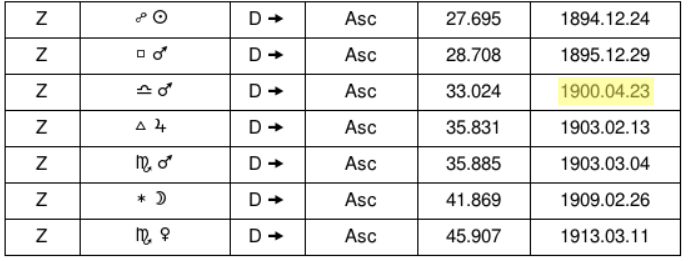
On April, 1900, the ascendant was directed to the terms of Mars in Libra, and Mars was also the current promissor.

In January 1900, there was a converse direction where Mars was brought to the sextile of the Sun. As Mars was the divisor and promissor of the ascendant, the sextile will have also activated the Sun.

Annual Time-Lords: Profections & Solar Revolutions

As the name suggests, annual time-lords are which change annually at the time of our birthday. These time-lords can be seen to execute the agenda of the general time-lords, either constructively or obstructively.

Profections are one of the oldest techniques in predictive astrology, forming part of the annual time-lords.

When introducing profections, Dortheus of Sidon explains, “When a native is born, then the lord of the year is the lord of the house in which the native was born. And count likewise from the Ascendant, a year for each sign, until it ends up at the year which you want: for the lord of the year is the lord of that house.10

At birth, Christian Victor’s ascendant is 4° Libra. On his first birthday (age 1), it advances to 4° Scorpio. It moves to 4° Sagittarius on the second birthday (age 2). This advancement continues throughout life, with the profection returning to the first house at ages 12, 24, 36, 48, 60, 72, and 84.

Dorotheus, and most sources, use the sign’s ruler as the lord of the year. Vettius Valens preferred a planet or planets occupying the sign in the natal or solar revolution chart. I find planets in the natal chart are indeed emphasized and can be seen as co-rulers of the year.

Christian Victor died at age 33. The profected ascendant reached Cancer with the Moon and Mars were thus the year’s rulers.

From the above, we know that Mars was activated at the time of Christian Victor’s death. He was divisor and promissor of the ascendant and co-ruler of the year.

To see how these manifest, we can turn to the annual revolution, also known as the solar revolution or solar return. This chart is for when the Sun returns to its natal position, usually on or around one’s birthday.

However, it must be read in conjunction with the natal chart, not independently. Particularly, we pay attention to so-called “repetitions” and placements of the time-lords.

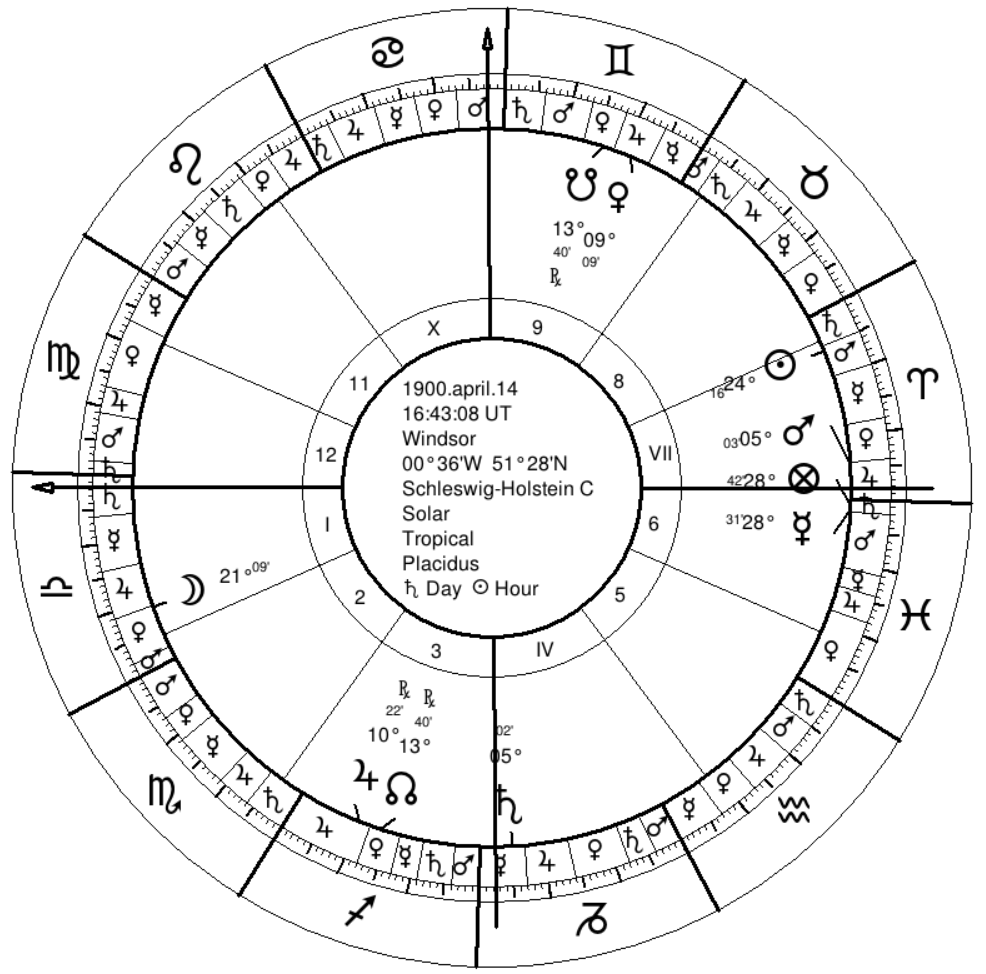
The 1900 solar return is shown below:

We first notice that the Libra rises as in the birth chart; the four angles have returned to the same signs. I find this an important “repetition.”

Our first focus is on the position of the relevant time-lords, the Moon and Mars. Of particular note is whether these are in a strong or weak position. Both are angular: the Moon in the first house and Mars in the seventh. This means that they were in a strong position in 1900 to release their natal promises.

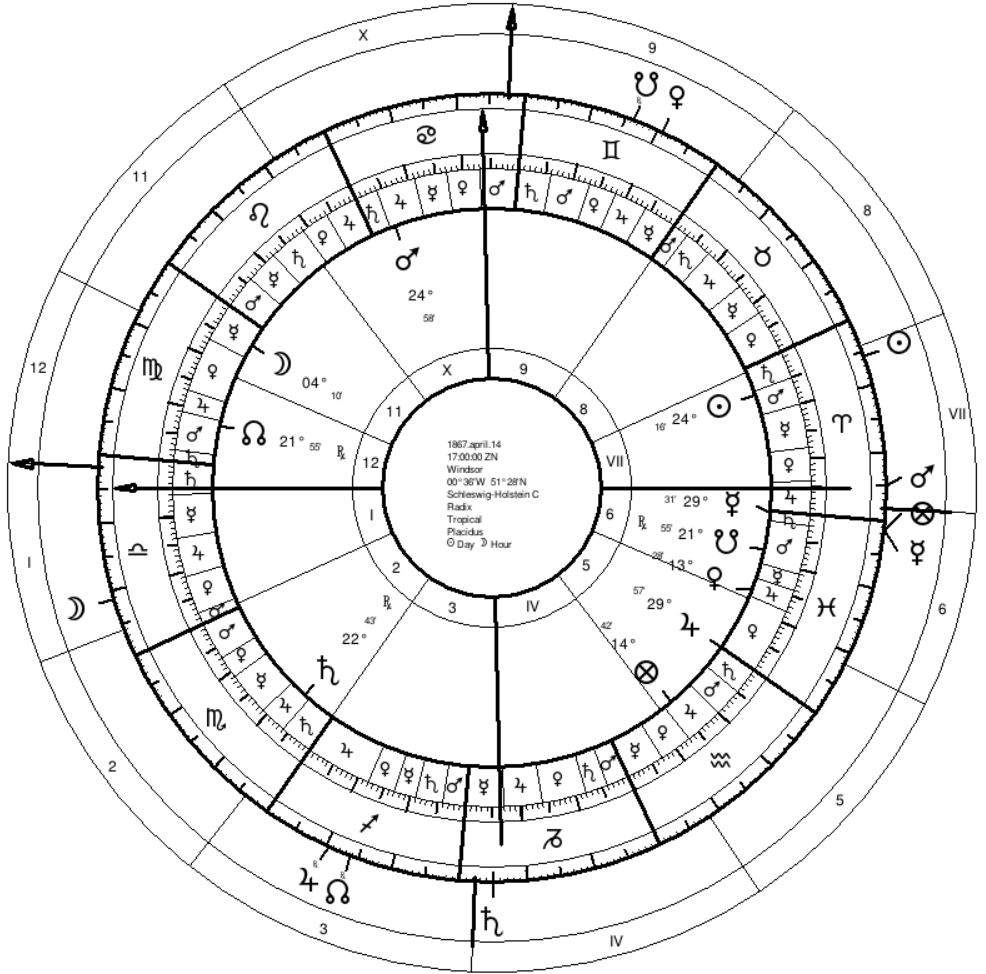
Now, let us consider the two charts together:

For clarity, I will use N- and SR- to denote planets and points in the nativity and revolution, respectively.

The SR-Moon is overcome by the N-Mars and in a close opposition to N-Sun. At the same time, the SR-Mars is conjunct to the natal descendent and, therefore, in a partile opposition to the natal ascendant.

Venus, the ruler of both the natal and revolution ascendant, is without any dignity in revolution. In a cadent house, squaring her natal position (the sixth house of illness), there is a strong inference of a weakened constitution. Interestingly, she falls in the ninth house of foreign travel, and her antiscia lies with N-Mars.

Saturn-SR is conjunct to the N-IC and scrutinizing the N-Moon by trine. Christian Victor’s Firdaria was a Moon-Saturn period.

Short-Term Time-Lords: Monthly Profections, Lunar Revolution and Transits

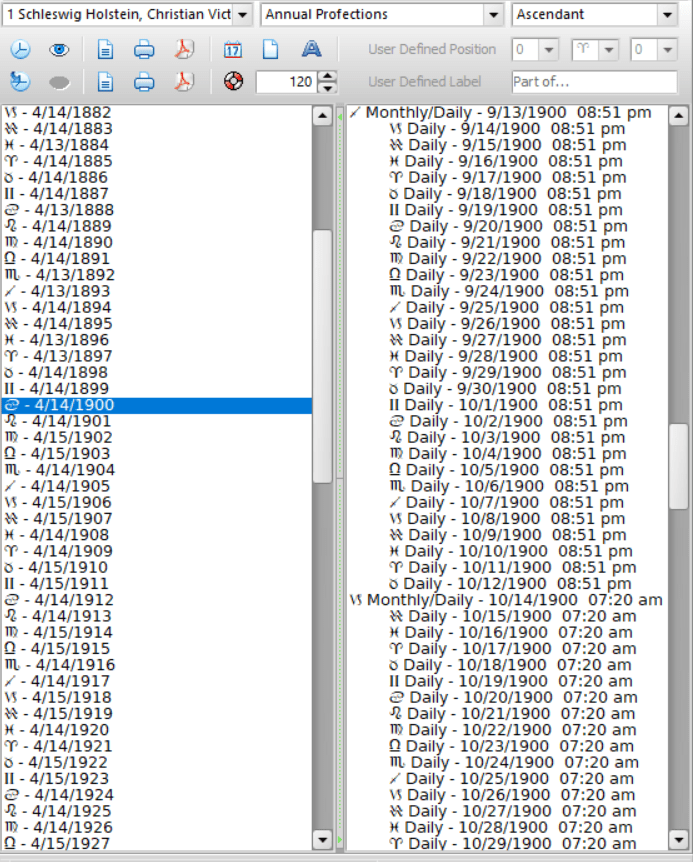
In addition to the annual profection, we can also advance the ascendant each month and daily. Below are Christian Victor’s profections from Delphic Oracle:

When Christian Victor “took to his bed,” (October 10) the monthly profection was at Sagittarius (third house). The daily profection was to Pisces (sixth house). According to Victoria’s diary, Christian Victor was in the process of preparing to return to England (cadent house are associated with travel). The sixth house is the house of illness.

On October 14, 1900, Christian Victor’s monthly profection reached Capricorn (the exaltation of Mars), the fourth natal house which traditionally pertained to end-of-life conditions. On the day he died, October 29, it reached Aries which is ruled by Mars and the Sun (exaltation).


After the solar revolution, we can use the lunar revolution charts to identify critical months in the solar year. Again our focus is on repetition, and the chart must be considered against 1) the birth chart and 2) the solar revolution. No revolution is ever read as an independent chart.

In Christian Victor’s final lunar revolution (below), Cancer was rising. The Sun was in a partile opposition to his natal position and overcome by natal Mars. The Sun is in fall in the natal and solar revolution ascendant and conjunct the SR-Moon. This configuration released the promise of natal Mars-Sun/Moon that month.

On Christian Victor’s death, the transiting (relocated) Moon was applying to a conjunction with the natal IC and Saturn-SR.

In most cases, we can content ourselves with primary directions, annual profections, and the solar and lunar revolutions. Although Ptolemy included transits (ingresses), they are less reliable than the monthly and daily profections.

§

  1. Like the first article, this article was written for my old blog. ↩︎
  2. Ptolemaeus, C. and Robbins, F.E. (2001) Tetrabiblos. Cambridge, MA: Harvard Univ. Press ↩︎
  3. See Dortheus of Sidon and Ptolemy’s younger contemporary, Vettius Valens  ↩︎
  4. Paulus et al. (2001) Late classical astrology: Paulus Alexandrinus and olympiodorus: With the Scholia from later commentators. Reston, VA: Arhat. ↩︎
  5. Ptolemaeus, C. and Robbins, F.E. (2001) Tetrabiblos. Cambridge, MA: Harvard Univ. Press. Page 449 ↩︎
  6. Valens, V. and Riley, M.T. (2022) The Anthology. Denver, CO: Amor Fati Publications. You can read the text for free here ↩︎
  7. Holden, J.H. (2009) Rhetorius the Egyptian: Astrological Compendium. Tempe, Az.: Amer. Federation of Astrology ↩︎
  8. Bishr, S. ibn and Dykes, B.N. (2019) The astrology of Sahl B. Bishr: Translated from the Arabic. Minneapolis, MN: Cazimi Press. ↩︎
  9. Ptolemaeus, C. and Robbins, F.E. (2001) Tetrabiblos. Cambridge, MA: Harvard Univ. Press. Book IV.10. Read here. ↩︎
  10. Ptolemaeus, C. and Robbins, F.E. (2001) Tetrabiblos. Cambridge, MA: Harvard Univ. Press. Book IV.10. Read here. ↩︎