Tarot de Marseille: The Picturebook of Fate: The Sevens Part 3

This article continues my series examining the trumps of the Tarot de Marseille, adapted from my unpublished manuscript, Tarot de Marseille: The Picturebook of Fate. As throughout this series, the emphasis is placed upon the traditional eikōn of the card, its historical context, and the practical significations I have found useful through divinatory practice. The interpretations presented here reflect my own experience of working with the Tarot de Marseille and should be understood as a working method rather than a definitive authority.

The Sevens: The Charioteer and the House of God

Let us now review another reading and, in doing so, introduce a new spread.

The Mundane Cross

The Mundane Cross is a draw I utilise with all the card systems I work with, including the Tarot de Marseille, Petit Lenormand, Oracle Belline, Tarot Persan de Madame Indira, Oracle de la Triade, and the Victorian Flower Oracle. I developed the spread from certain conventions found in older cartomancy and eventually gave it its name because its layout resembles the traditional glyph of the Earth.

The spread is particularly well suited to questions focused upon a difficulty, obstacle, or challenge that the seeker either anticipates or is presently experiencing.

The 21 trumps and Madman card are shuffled, cut, and dealt in the following manner. The first card is placed at the centre. The second is placed below it, the third above it, the fourth to its left, and the fifth to its right. The resulting layout appears as follows:

03
04 01 05
02

  • Position 1: The Present.
  • Position 2: The Past.
  • Position 3: The Future.
  • Position 4: Unhelpful Influences or What to Avoid.
  • Position 5: Helpful Influences or How to Act.

These days, we are often encouraged to view the past on the left and the future on the right. Yet many older cartomantic methods employed a vertical axis instead. If one considers archaeology, the symbolism becomes rather intuitive: the past lies beneath us because it forms the foundation upon which the present rests. Likewise, the future appears above because it represents what is yet to be built.

A similar logic informs the horizontal axis. The Latin words for left and right are sinister and dexter respectively. Traditionally, the left-hand side was associated with difficulties, complications, and disruptive influences, whilst the right conveyed assistance, remedy, and favourable action.

The Mundane Cross retains these older associations.

The vertical line (Positions 2-1-3) describes the development of the situation from past through present into future. The horizontal line reveals what hinders and what helps. Even where the future appears difficult, the spread frequently reveals practical steps by which matters may be improved.

Stephen’s Reading

Ana is one of my oldest friends. Her eldest son, Stephen, had found himself in some trouble during his teenage years and made a number of foolish mistakes. He eventually dropped out of university and, now in his early twenties, was struggling to secure permanent employment.

Ana was less concerned with predicting exactly what would happen than with understanding how she could best help him move forwards.

The cards dealt were:

  • Position 1: The House of God
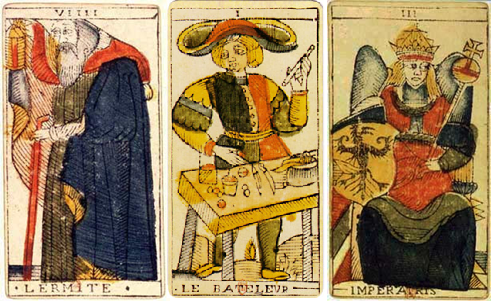
  • Position 2: The Juggler
  • Position 3: The Angel
  • Position 4: Death
  • Position 5: The Hermit

The reading begins with the Juggler in the position of the past. The card suggested wasted potential, poor judgement, and a tendency to treat serious matters too lightly. Stephen possessed ability and opportunity, but lacked clear direction. As a consequence, he made choices that drew the wrong sort of attention and closed doors that might otherwise have remained open.

The Juggler can be energetic and talented, but he is not always prudent. In Stephen’s case, the card seemed to describe someone experimenting with life without fully appreciating the consequences of his actions.

The present was represented by the House of God.

Stephen was now experiencing the consequences of his earlier decisions. Although uncomfortable, the process served a corrective purpose.

In my own work, I frequently associate the House of God with Purgatory. Contrary to popular imagination, Purgatory is not primarily concerned with punishment but with purification. It is the process by which what is disordered, harmful, or incomplete is gradually transformed and made ready for something better.

Seen in this light, the House of God suggested that Stephen was passing through a necessary period of correction. His mistakes were not being ignored, nor were they being permitted to define him forever. Rather, they were being exposed, confronted, and purified through experience.

Importantly, the card did not simply indicate change. It indicated visible change. It would not be enough for Stephen to claim that he had learned from his mistakes. He would need to demonstrate it through his actions and conduct. The House of God tears down what is unsound so that something stronger may eventually be built in its place.

Far from indicating destruction for its own sake, the card suggested that Stephen was in the middle of a transformative process. Much like Purgatory itself, the discomfort served a purpose: preparing him for the renewal promised by the Angel that follows.

The future was represented by the Angel, one of the most hopeful cards in the traditional tarot.

The Angel is a card of resurrection, restoration, and second chances. It suggests that something believed lost may yet be recovered. Opportunities previously squandered may return, provided the lessons of the past have genuinely been learned.

For this reason, I felt there was a strong possibility that Stephen would eventually return to education or training. More broadly, the card suggested a vocation or calling waiting to be rediscovered. Once the errors of the past had been corrected and put behind him, he would be free to move forwards.

The card in the position of what to avoid was Death.

In this context, Death did not represent literal endings but rather the temptation to abandon hope. The card warned against writing himself off, defining himself by his mistakes, or concluding that his future had already been determined by his past.
The danger represented by Death was the belief that it was all over. Stephen needed to avoid becoming trapped by regret, resentment, or self-condemnation. The card warned him not to abandon the struggle.

The card showing how to act was the Hermit.

The Hermit advised prudence, reflection, and careful consideration. Rather than applying for jobs indiscriminately, Stephen needed to think seriously about what he actually wanted to achieve and how best to reach that goal.

The card also suggested discernment in the opportunities he pursued. Simply seeking any employment without purpose or direction would do little to demonstrate maturity. The Hermit encouraged him to develop a plan, reflect upon his past mistakes, and identify a meaningful path forwards.

Patience was essential. The Hermit does not rush. He illuminates the road one step at a time.

Taken together, the spread tells a remarkably coherent story.

The Juggler represents youthful mistakes and wasted opportunities. The House of God shows those mistakes being exposed, corrected, and purified through difficult experience. The Angel reveals the possibility of restoration and a second chance. Death warns against despair, whilst the Hermit advises a deliberate and thoughtful approach to the future.

The vertical axis tells a story not of downfall, but of redemption. The Juggler represents youthful errors and wasted opportunities. The House of God shows those errors being purified and corrected through experience. The Angel then reveals the possibility of restoration and a second chance. Stephen’s difficulties were therefore not the end of his story, but the means by which he was being prepared for a better one.

This example illustrates one of the great strengths of the Mundane Cross. The spread not only reveals the challenge itself but also identifies both the principal danger and the most effective remedy. Even when circumstances appear difficult, it often points towards a constructive path forward.

§

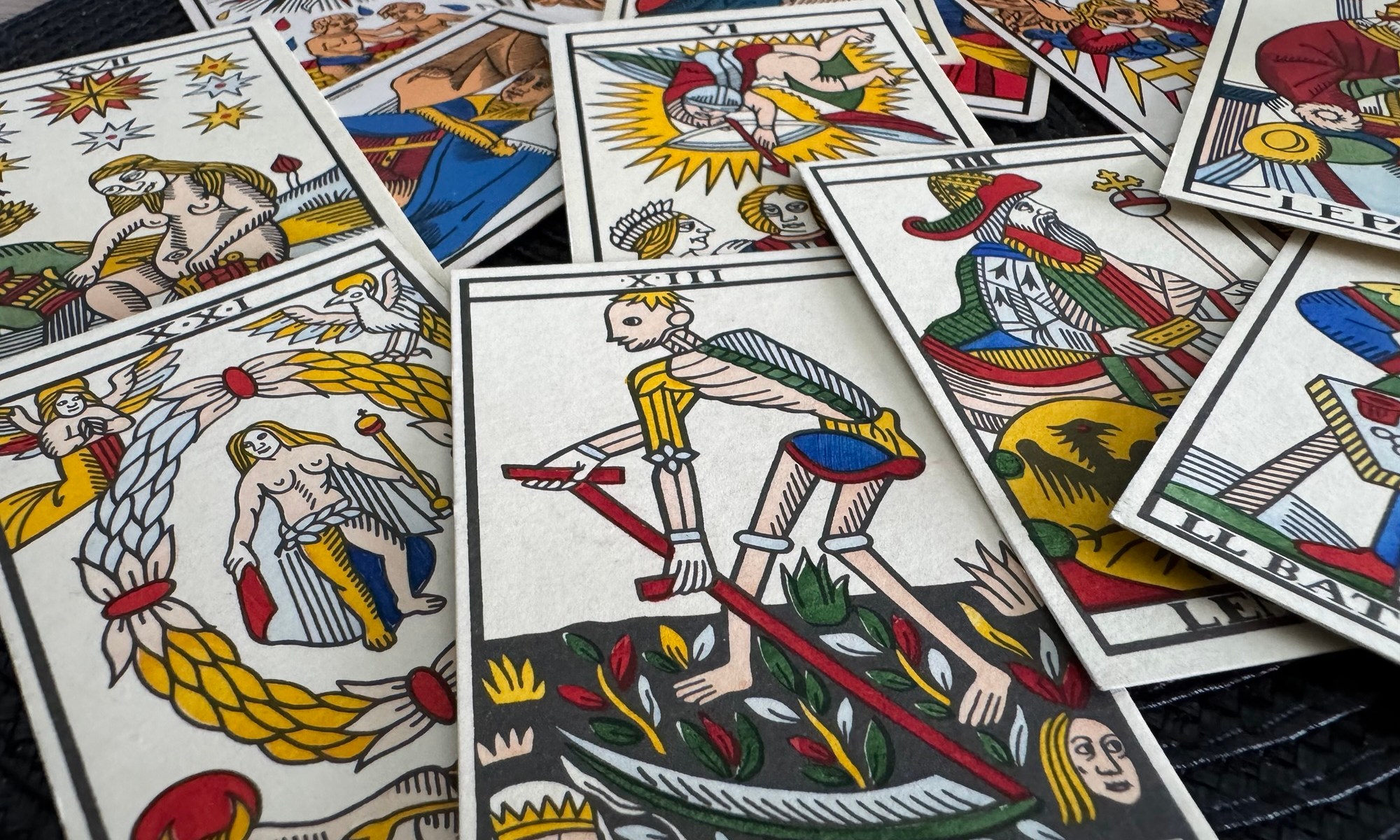
Tarot Cards: Jean Dodal Tarot via Wikipedia Commons. Public Domain.

Featured Image: Ancient Tarot Major Arcana © BP Grimaud/John Waddington Ltd, Leeds & London, Les Tarot de Marseille Jean Noblet, 1650 © Editions «letarot.com» (2001 [hand stencilled trumps]). Les Tarot de Marseille Jean Dodal, 1701 et 1715 © Editions «letarot.com» (2002 [hand stencilled trumps])
Tarot de Marseille: The Picturebook of Fate: The Sixes Part 3

This article continues my series examining the trumps of the Tarot de Marseille, adapted from my unpublished manuscript, Tarot de Marseille: The Picturebook of Fate. As throughout this series, the emphasis is placed upon the traditional eikōn of the card, its historical context, and the practical significations I have found useful through divinatory practice. The interpretations presented here reflect my own experience of working with the Tarot de Marseille and should be understood as a working method rather than a definitive authority.

The Sixes: The Lover and the Devil

Let us now turn to another example and, in doing so, introduce a different variation of the classic Cross Spread.

One of the principal reasons for this spread’s enduring popularity is its ability to provide a clear and decisive response to a question. Indeed, where appropriate, it may even yield a simple affirmative or negative answer.

In this instance, however, we shall employ an older variation, one often likened to a court hearing. It is perhaps fitting that the querent in this example was herself a barrister, for the structure of the spread closely resembles a legal proceeding.

The twenty-one trumps and the Madman are shuffled and cut, after which four cards are dealt in the form of a cross.

03
01 05 02
04

  • Card 1 (Left): The card arguing in favour of the matter, including helpful influences and supporting evidence.
  • Card 2 (Right): The card arguing against the matter, including obstacles and hostile influences.
  • Card 3 (Above): The judge, who weighs the evidence and clarifies the question.
  • Card 4 (Below): The outcome or verdict.
  • Card 5 (Centre): The synthesis.

Unlike the first four cards, the fifth is not drawn but calculated. One adds together the numerical values of the four cards already laid, using the numbering of the Major Arcana, and reduces the result to a number not exceeding twenty-two.

For example, should one draw the Star (17), the Madman (0), Temperance (14), and the Charioteer (7), the calculation is as follows:

17 + 0 + 14 + 7 = 38

As this exceeds twenty-two, one reduces it further:

3 + 8 = 11

The resulting number corresponds to Fortitude, which serves as the synthesis.

It should be evident that this synthesis card is not to be read as an additional outcome; that function is already fulfilled by the fourth card. Rather, the synthesis reveals the underlying dynamics of the matter, the deeper currents and governing principles operating behind the question.

Oswald Wirth, who was the first author to document this spread in print, advocated reading the synthesis before interpreting the other cards, regarding it as the key to understanding the reading as a whole.

A brief note should be made regarding the Madman. When it appears amongst the first four cards, it is assigned the numerical value of zero for the purposes of calculation. However, the matter is treated somewhat differently in the case of the synthesis. Should the final total reduce to twenty-two, the Madman itself becomes the synthesis card.

Example

This reading was conducted in 2008.

Janine was in her late forties and enjoyed a successful career as a barrister. Three years earlier she had divorced her husband, Ben, following an infidelity. Since they shared two children, Ben remained a regular presence in her life. Recently he had approached her with a proposal that they attempt a reconciliation.
Her question was:

“Should I give him another chance?”

The cards drawn were:

  • Position 1: Temperance (14)
  • Position 2: The Devil (15)
  • Position 3: The Wheel of Fortune (10)
  • Position 4: The Madman (0)


Let us calculate the synthesis:

14 + 15 + 10 + 0 = 39

As this exceeds twenty-two, we reduce it further:

3 + 9 = 12

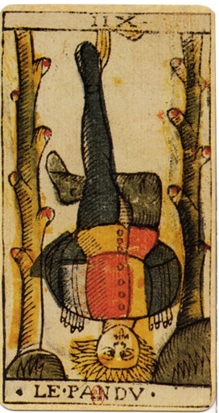
The synthesis is Trump XII, the Hanged Man. The essence of the Hanged Man is dishonour and advises that past problems—and the loss of trust—still have an influence on the relationship.

The card arguing in favour of reconciliation was Temperance.

Temperance suggested that a genuine degree of harmony had already been achieved between Janine and Ben. Through considerable effort, clear boundaries, and mutual concern for their children, the former couple had established a workable relationship. Communication had improved, conflict had subsided, and they had learned to co-operate effectively as parents.

In short, the card acknowledged that something valuable had been gained since the divorce. A degree of peace and balance had emerged from what had once been a difficult situation.

Arguing against the proposal was the Devil.

The Devil suggested that the unhealthy dynamic which had contributed to the breakdown of the marriage had not truly disappeared. Old patterns of control, dependency, and imbalance remained present beneath the surface.

The card did not necessarily imply malice on Ben’s part. Rather, it questioned whether the underlying nature of the relationship had genuinely changed. Ben appeared eager for reconciliation, but the Devil raised doubts about his motives and, more importantly, about his ability to escape familiar patterns of behaviour.

The judge was the Wheel of Fortune.

This is where the reading became particularly revealing.

The Wheel asked a simple question: what has actually changed?

Relationships often end because the same patterns repeat themselves. The Wheel is not concerned with promises, intentions, or hopes. It is concerned with cycles.

Every previous attempt at improving the relationship had followed a recognisable pattern. Things improved for a time, old difficulties resurfaced, conflict returned, and both parties eventually found themselves back where they had started.

The Wheel therefore reminded Janine that cycles tend to repeat unless something fundamental alters their course.

The outcome was represented by the Madman.

The Madman did not suggest liberation or adventure. Rather, he represented a return to uncertainty, instability, and lack of direction. The card suggested acting without sufficient evidence that the circumstances had materially changed would be a mistake.

One is reminded of the familiar observation that people often repeat the same behaviour whilst hoping for a different result.

From the perspective of the spread’s judicial structure, the verdict was clear. Revisiting the relationship would place Janine back upon an uncertain road whose destination was already largely known.

The synthesis was the Hanged Man, and it confirmed this interpretation.

The Hanged Man revealed the deeper dynamic underlying the question. Janine remained suspended between the past and the future. Part of her still felt the pull of what the marriage had once been, whilst another part recognised the life she had built since the divorce. She still couldn’t forget Ben’s betrayal and loss of trust.

The synthesis therefore suggested that reconciliation would not resolve this state of suspension. On the contrary, it was likely to prolong it. Rather than moving forwards, Janine risked becoming trapped once again within circumstances she had already spent years trying to escape.

My conclusion was that Janine should not give Ben another chance.

The cards did not suggest that reconciliation was impossible, but they strongly indicated that the conditions necessary for a successful reconciliation were absent. Temperance showed that a healthy co-parenting relationship had already been established. The Devil suggested that unhealthy dynamics remained unresolved. The Wheel of Fortune questioned whether anything fundamental had changed, whilst the Madman warned against returning to uncertainty and repeating familiar mistakes.

The Hanged Man ultimately revealed that revisiting the relationship would leave Janine suspended between the life she had left behind and the future she was attempting to create.

This example illustrates an important principle of the Cross Spread. The verdict alone is not the whole answer. The judge explains why the verdict is reached, whilst the synthesis reveals the deeper principle operating beneath the entire matter. Here, both the verdict and the synthesis pointed away from genuine progress. The Madman offered movement without direction, whilst the Hanged Man offered suspension without resolution. Together, they suggested that the cycle was far more likely to repeat than to change.

§

Tarot Cards: Jean Dodal Tarot via Wikipedia Commons. Public Domain.

Featured Image: Ancient Tarot Major Arcana © BP Grimaud/John Waddington Ltd, Leeds & London, Les Tarot de Marseille Jean Noblet, 1650 © Editions «letarot.com» (2001 [hand stencilled trumps]). Les Tarot de Marseille Jean Dodal, 1701 et 1715 © Editions «letarot.com» (2002 [hand stencilled trumps])
On Reading: Eikōn, Essence, and Function

Before proceeding further, it is worth briefly explaining three terms that recur throughout my articles on the Tarot and Petit Lenormand: eikōn, essence, and function. Together, they form the foundation of my approach to cartomancy and interpretation.

Eikōn

The word eikōn is Greek and simply means image. My use of the term, however, owes much to the Christian tradition of iconography.

Growing up with an exposure to Eastern Catholic and Orthodox influences, religious icons were a familiar sight. Over time, I developed a deep appreciation for the Byzantine tradition and the remarkable skill of iconographers. In that tradition, an icon is not merely a picture. It is “written” according to established rubrics in which colours, gestures, posture, clothing, objects, and composition all possess meaning. These individual elements combine to create a living image that communicates a story, truth, or mystery.

When I began studying the Tarot, particularly the Marseille tradition, the similarities struck me immediately. Like an icon, a Tarot card presents a complete image whose meaning emerges through the interaction of its various parts. The image speaks as a whole.

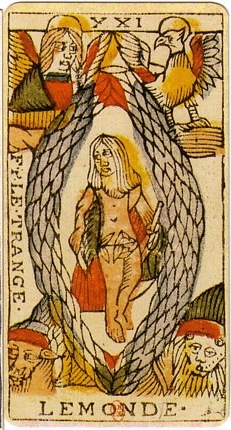
Christ in Majesty. Note the similarities to the Tarot’s Le Monde Card.
Metropolitan Museum of Art, CC0, via Wikimedia Commons

What I found less convincing was the dominant deconstructive approach employed in many modern Tarot books, where individual symbols are isolated from their wider context and elevated above the image itself. One reader may focus upon a hat, another upon a shoe, whilst someone else becomes preoccupied with the colour of a sleeve. Valuable insights can certainly arise in this way, but the danger is that the card ceases to function as an integrated image and instead becomes a collection of disconnected details. Meaning becomes increasingly subjective and, ultimately, relativistic.

The gestures of the Juggler mean little outside the context of the entire card. Likewise, the direction in which the Ship sails only acquires significance when considered within the wider image and narrative. The whole must always remain greater than the sum of its parts.

Tiberio of Assisi, St Clare of Assisi, CC0, via Wikimedia Commons

Whilst reflecting upon this, I am reminded of Saint Clare of Assisi’s visual approach to prayer, often summarised as gaze, consider, contemplate, and imitate. A visual form of Lectio Divina. It seemed to me that a similar method could be applied to the Tarot. One first observes the image, then reflects upon its meaning, contemplates its deeper significance, and finally applies its lessons to life.

For this reason, I prefer to think of the cards as eikōnes rather than collections of symbols. Each card should be approached as a complete image revealing a story and a principle.

I have deliberately chosen the Greek eikōn rather than the English word icon. Given the mixed reactions many people have towards Christianity, and despite the Tarot’s profoundly Christian origins, the Greek term provides a more neutral expression whilst still preserving the connection with the iconographic tradition from which my thinking developed.

Whilst the cosmological framework used throughout this work owes much to Aristotle and medieval natural philosophy, my approach to interpretation is more heavily influenced by the Christian Neoplatonic tradition. Both viewed the visible world as participating in deeper truths that transcend mere appearances.

The Tarot card is therefore not approached simply as a collection of symbols to be decoded, nor as a puzzle whose meaning is constructed from isolated details. Rather, the eikōn is treated as a unified image revealing an underlying reality. The image points beyond itself without ceasing to be itself. In this respect, the Tarot card functions much like a religious icon, inviting contemplation of the principle it expresses.

The famous Sinai Pantrocrator reveals Christ’s Dyophysitism: God and Human.
Saint Catherine Monastery, Public domain, via Wikimedia Commons

Amongst the figures who have most influenced my thinking in this regard are Saint Augustine, St Benedict, Marsilio Ficino, Giovanni Pico della Mirandola, Thomas Merton and Brian Williams. Despite belonging to very different periods, each recognised the importance of contemplation, discernment, and the search for truth beneath appearances. Their writings encouraged me to approach the Tarot less as a collection of signs and more as a series of images revealing enduring principles.

Essence

If the eikōn is the image, the essence is the fundamental principle or mystery expressed by that image. The essence is not a keyword, nor is it a summary of every possible meaning attached to a card. Rather, it is the card’s underlying nature. It answers the question: what is this card?

My own understanding of essence emerged gradually through the study of Tarot and the Petit Lenormand. When I first learnt to read cards, keywords played little or no role. Instead, attention was given to the nature of a card and how it behaved in different circumstances (order, whether it was near or far, et cetera). It was only later, upon reading modern Tarot literature, that I encountered extensive keyword lists.

Whilst keywords can be useful as memory aids, I often found myself struggling to understand why particular words had been selected. Vocabulary is shaped by culture, language, generation, and personal preference. One author’s keyword might differ entirely from another’s, despite both discussing the same card. The result was often a sense of arbitrariness and made more difficult by my dyslexia.

Over time, I began to notice that things possess an underlying nature that makes them what they are. This differs from a purely symbolic approach in which a card merely stands for something else. The Hermit is not a symbol of prudence. The Hermit is prudent. Prudence belongs to his nature and is therefore expressed whenever he appears.

Matfre Ermengaud di Béziers, Public domain, via Wikimedia Commons

This understanding owes much to the Neoplatonic tradition, particularly as filtered through Saint Augustine and the Renaissance philosopher Marsilio Ficino. Both viewed visible things as participating in deeper realities rather than merely representing them. A thing possesses a nature which allows it to remain itself whilst simultaneously connecting it to broader truths.

In this sense, the essence is not a keyword attached to a card. Nor is it an abstract label. It is the card’s essential self: the underlying principle that unites all of its manifestations and gives coherence to its meanings.

This understanding also emerged naturally from my use of the eikōn. The eikōn reveals the essence. By contemplating the image as a whole, one arrives at the principle that animates it. The image is not merely a collection of symbols; it is the visible expression of an underlying nature.

The Hermit provides a useful example. Prudence is not one meaning of the Hermit amongst many; it is the principle from which the others arise. Whether the Hermit appears as caution, discretion, reflection, solitude, age, experience, patient guidance, or careful planning, prudence remains the common principle linking these manifestations together. Prudence is the Hermit’s essential self. Without prudence, the Hermit would cease to be the Hermit.

Similarly:

  • Justice is Verity.
  • The Pope is Wisdom.
  • The Hound is association.
  • The Fishes is abundance.

Every subsequent meaning associated with a card should arise from that central principle. The essence prevents the card from becoming a collection of disconnected keywords and instead allows its meanings to remain coherent and rooted in its nature.

In this respect, the essence acts as a thread running through every interpretation. It keeps the card unified, ensuring that however many manifestations it may possess, it remains recognisably itself.

Before proceeding further, I should briefly clarify a point of terminology. I am always pleased to see readers engage with and discuss the concept of essence, especially as it has become a useful part of the vocabulary surrounding this type of work. However, I have occasionally noticed the term being used somewhat differently from how I originally intended it. Essence is sometimes treated as little more than a refined keyword or summary phrase. Whilst this is understandable, it is not quite what I mean. A keyword describes a card; an essence reveals what the card is. It is not simply a convenient label attached to a collection of meanings, but the card’s underlying nature and identity. The essence of the Hermit, for example, is not merely a word chosen to summarise the card. It is the principle that makes the Hermit recognisably itself and from which all of its manifestations proceed. In this respect, essence is less a description than a revelation. It seeks to identify the card’s true nature rather than merely describe its appearances.

Essence should therefore not be understood as the most important keyword attached to a card or a vibe or spirit. Keywords remain descriptive; essence is ontological. It concerns the card’s being rather than its attributes. The question is not “How might this card be described?” but “What must this card be in order to be itself?” The answer to that question is what I mean by essence.

Function

If essence describes a card’s nature, function describes its action.

How does this principle operate?

Where essence is relatively static, function is active. The two are inseparable. A card’s function must arise naturally from its essence rather than being imposed upon it from outside.

If the essence describes a card’s nature, the function describes the activity proper to that nature.

For example:

  • Justice is verity that balances.
  • The Pope is wisdom that mediates.
  • The Hound is association that supports and assists.
  • The Fishes is abundance that circulates.

The function therefore represents the manner in which the essence expresses itself. Wisdom may manifest in many ways, but it always mediates between ignorance and understanding. Renewal may appear in many forms, but it always guides growth and recovery. Prudence consistently operates through discernment. The essence remains constant; the function explains its activity.

In many ways, function can be understood through a simple analogy. We understand a knife not merely by what it is, but by what it is for. The proper activity of a knife is to cut. Likewise, we understand a Tarot card more fully when we know both its nature and its operation.

Knowing what a card is allows us to identify it; knowing what it does allows us to interpret it.
Function becomes particularly important when we arrive at what I call the Progressed Meaning.

The progressed meaning is the practical interpretation that emerges during a reading. It is not the essence alone, nor the function alone, but the essence functioning within a specific context.

In other words:

Progressed Meaning = essence functioning in context

or, if one prefers:

Progressed Meaning = essence + function + context

Consider the Hermit. His essence is Prudence and his function is to Discern.

When interpreted in a love reading, we do not suddenly abandon prudence and begin inventing entirely new meanings. Rather, we ask how prudence functions through discernment within that context. The progressed meaning becomes caution, taking time to know another person, exercising discretion, or carefully evaluating a relationship before making commitments.

Likewise, in a business reading, the Hermit may advise reviewing evidence carefully before investing. In a health reading, he may indicate the need to seek additional information before proceeding with treatment. The manifestations differ, but the underlying principle remains unchanged. Prudence continues to operate through discernment.

The same process applies to every card.

Consider the Star. Its essence is Renewal and its function is to Guide. In health, it may indicate recovery and convalescence. In finances, gradual improvement. In relationships, reconciliation and rebuilding trust. In each case, renewal continues to guide circumstances towards restoration.

Death provides another useful example. Death is Demise that Terminates. In a relationship, this may indicate separation. In employment, redundancy. In health, the conclusion of a course of treatment. In each case, the progressed meaning arises from the same essential principle operating within different circumstances.

This leads to an important rule:

The progressed meaning should never contradict the essence.

The manifestation may vary, but the essence remains constant.

Death should never suddenly signify growth. The Devil should never become liberation. Justice should never become deceit. The circumstances may alter how the card appears, but they cannot alter the card’s nature.

Function therefore provides the bridge between a card’s nature and its practical interpretation. Without it, readings become little more than collections of disconnected keywords. With it, meanings develop naturally from the card itself.

The task of the reader is not merely to memorise interpretations, but to understand how the essence functions within the circumstances presented by the question. That process is what produces the progressed meaning.

The essence anchors the card, the function sets it in motion, and the context determines where that motion is directed. Together they produce the progressed meaning encountered in actual divination. When properly understood, the progressed meaning is not an arbitrary interpretation, but the natural consequence of the card’s nature operating within a particular situation.

The reader may therefore notice two distinct influences throughout this article. The structure of the cosmos, the elements, and the temperaments derive largely from the Aristotelian worldview. The method of interpretation, however, owes more to the Christian Neoplatonic tradition of Augustine and Ficino, in which visible images reveal deeper realities. The two approaches are not in opposition.

Indeed, Renaissance thinkers frequently employed both, seeing them as complementary ways of understanding the same creation.

§

Images:

Featured Image: Stadtbibliothek Trier (Wissenschaftliche Bibliothek der Stadt Trier), CC BY-SA 4.0 https://creativecommons.org/licenses/by-sa/4.0, via Wikimedia Commons

References:


Augustine and Pine-Coffin, R.S. (2003) Confessions. London, England: Penguin Books.
Saint Augustine of Hippo and Bettenson, H. (2004) City of God. Penguin Books.
Carvalho, H.A. de and Ribeiro, L. (2010) On the heavenly spheres: A treatise on traditional astrology. Tempe, AZ: American Federation of Astrologers.
Benedict et al. (1981) RB 1980: The Rule of St. Benedict. Collegeville, MN: Liturgical Press.
Farley, H. (2009) A cultural history of Tarot: From entertainment to esotericism. London: I.B. Tauris.
Frawley, J. (2001) The Real Astrology. London: Apprentice.
Guite, M. (2022) Lifting the Veil: Imagination and the Kingdom of God
Hankey, W.J. (2016) Aquinas’s Neoplatonism in the Summa Theologiae on God. St Augustine’s Press.
Nees, L. (2002) Early Medieval Art. Oxford: Oxford University Press.
Nouwen, H.J.M. (2007) Behold the beauty of the lord: Praying with icons. Notre Dame, Ind: Ave Maria Press.
O#Meara, D.J. (1981). Neoplatonism and Christian Thought
Ptolemaeus, C. and Robbins, F.E. (2001) Tetrabiblos. Cambridge, MA: Harvard Univ. Press.
Silvestre, C.H. (1987) ABC des Tarots. Paris: Marabout.
Thomas (2018) Summa Theologica: Complete in a Single Volume. Claremont, CA: Coyote Canyon Press.
Valens, V. and Riley, M.T. (2022) The Anthology. Denver, CO: Amor Fati Publications.
Williams, B. (2003) A Renaissance Tarot: A Guide to the Renaissance Tarot. U.S. Games Systems.