I am pleased to announce that work is underway on my second Lenormand book:
Final Cover to be Revealed
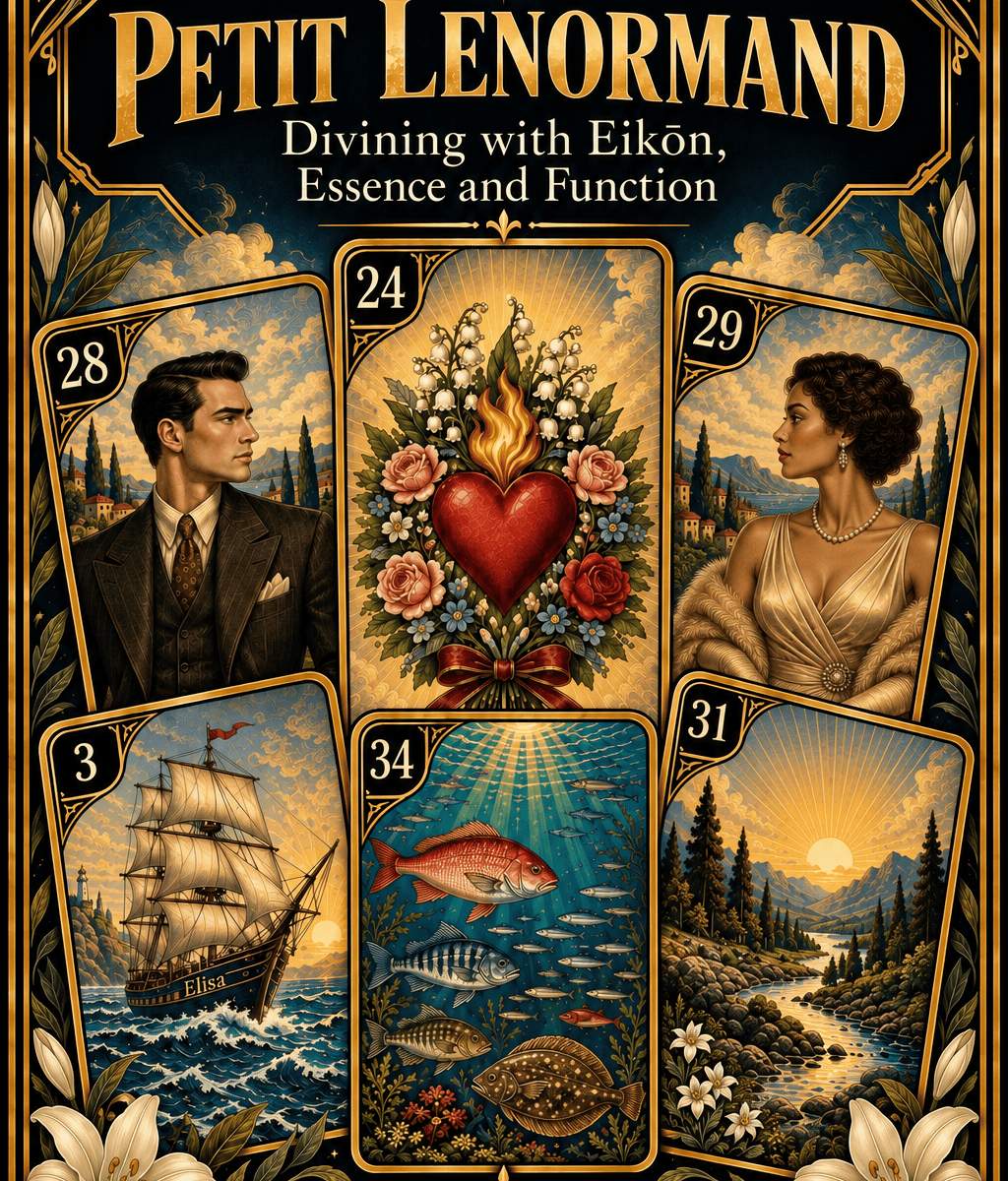
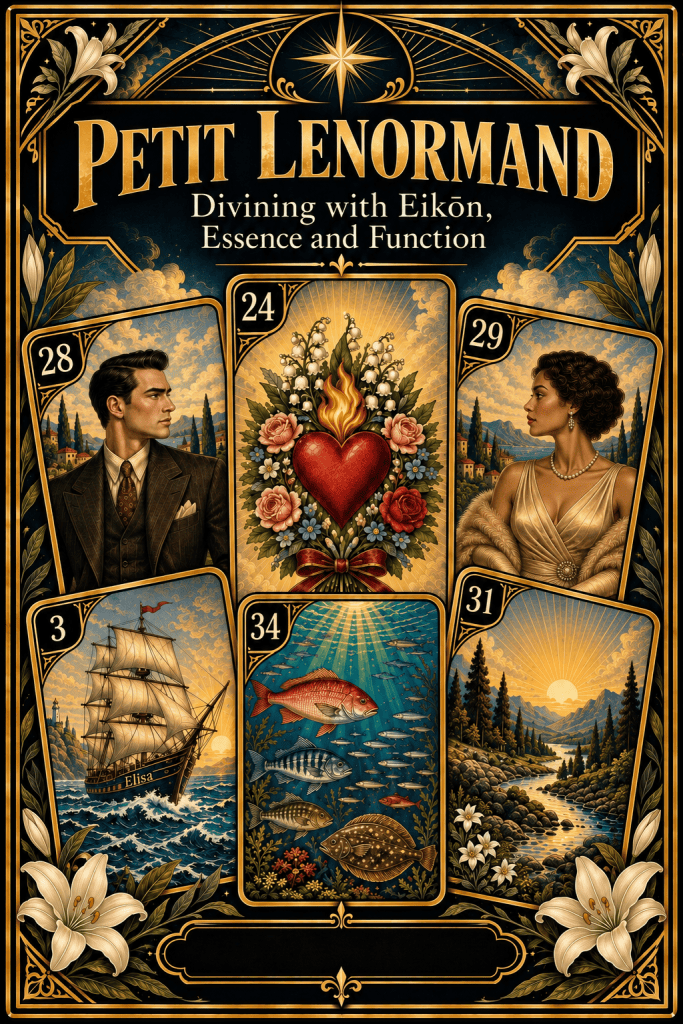
Petit Lenormand: Divining with Eikōn, Essence and Function
Planned for publication in late 2027, this volume seeks to provide a comprehensive and practical approach to the Petit Lenormand, drawing upon traditional methods whilst offering a structured framework for understanding and interpreting the cards.
Part I: The Foundations of Lenormand
The opening section explores the history of the Petit Lenormand, its place within the broader tradition of European cartomancy, and the development of its modern practice.
Each of the thirty-six cards is then examined in detail through the lens of three fundamental concepts:
Eikōn – the image and what it depicts;
Essence – the inherent nature of the card;
Function – what the card does within a reading.
For each card we consider their descriptions, the Grand Tableau, professions, timing, special abilities, health and trumping.
This section concludes with a discussion of master cards, context cards, thematic divisions, polarity, folklore, spiritual meaning and other structural principles that underpin the system.
Part II: Building Meaning Through Association
The second section focuses on card combinations and the development of narrative meaning.
Readers will learn how cards interact through attendance, pairing and proximity, building coherent interpretations from combinations of two, three, four, and five cards. Particular attention is given to understanding how meaning develops organically rather than through memorised keywords.
Part III: Spreads and Methods of Divination
The final and most extensive section examines a wide variety of Lenormand spreads, from concise question-based readings to the complexities of the Grand Tableau.
Question-Based Methods
Yes or No
The French Cross
The Mundane Cross
The Master Card Spread
Minetta’s Star
General Readings
The Method of Thirteen
The Partners Spread
The Chi-Rho Spread
The Great Wheel
The Astrological Wheel
The Grand Tableau
Four distinct Grand Tableaus are explored in detail, together with a broad range of interpretative techniques, including:
Houses
Counting
Meeting Points
Reflections
Direction
Surprise
People Cards
…and more
Rather than presenting multiple techniques in one draw, the book examines four different readings in full. In each GT, two or three techniques are used showing what each method is designed to reveal and when it is most appropriately employed.
Additional Topics
The work also addresses a number of subjects frequently discussed yet seldom examined in depth, including:
Fate and free will
Timing
Locations
Traditional practice and what is truly meant by “traditional” Lenormand
Reversals
Use of the cards in magic, dream work and spiritual paths
Above all, this book aims to provide beginners but more intermediate readers with a practical and coherent system for understanding the Petit Lenormand as a complete divinatory art rather than a collection of disconnected techniques.
Publication is anticipated for late 2027 (I am hoping for All Saints Day, 1 November)
For family reasons I will be away for a few weeks, but hope to give you some updates and launch my YouTube channel soon. I’d also be interested in hearing what people would like to know more about – I cannot promise that I will include it but I am open to suggestions.
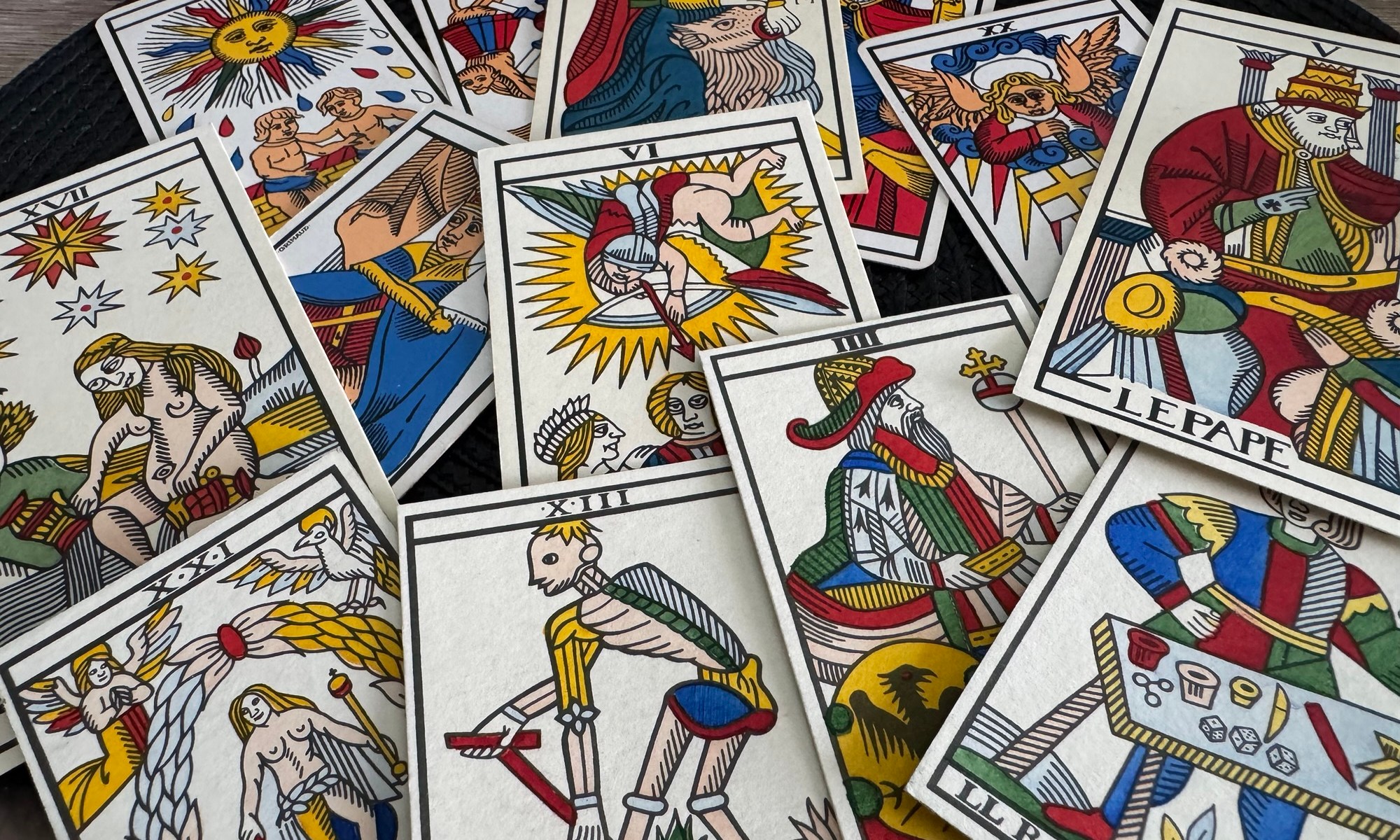
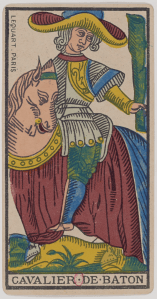
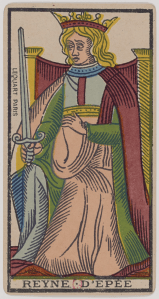
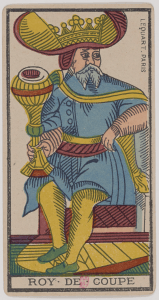
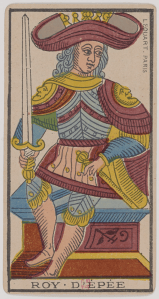
This article continues my series examining the Tarot de Marseille, and begins to introduce the Court Cards. Like the series on the trumps, it is adapted from my unpublished manuscript, Tarot de Marseille: The Picturebook of Fate. As throughout this series, the emphasis is placed upon the traditional eikōn of the card, its historical context, and the practical significations I have found useful through divinatory practice. The interpretations presented here reflect my own experience of working with the Tarot de Marseille and should be understood as a working method rather than a definitive authority.
The Pip Cards: The Court Cards
One of the challenges of divination is that life rarely concerns abstract principles alone. Most of our joys, frustrations, opportunities, and difficulties involve other people. We interact daily with family members, friends, colleagues, neighbours, professionals, authority figures, and countless acquaintances. If the Tarot is to function as a picturebook of life, it must possess cards capable of representing the people who populate that life.
This is the primary role of the Court Cards.
The Tarot contains sixteen such figures: four ranks across four suits. Whilst the Court Cards have many uses—and can represent character, behaviour, actions, and social roles—their most straightforward application is as significators of people.
Unfortunately, real life is considerably more complicated than sixteen cards would suggest. Any serious reading may involve dozens of individuals. Consequently, a single Court Card can signify different people in different contexts and combinations. This becomes particularly apparent in larger layouts, such as the Grand Tableau, which uses all 56 cards of the “Lesser Arcana.”
It is also important to remember that Court Cards describe relationships and roles rather than fixed personalities. A person may appear as different Court Cards in different readings depending upon the role they occupy within the matter under consideration. A friend may appear as a Cup when acting as a friend, or a Sword when exercising authority as your boss. The card reflects the relationship, not the whole person.
Nevertheless, a useful starting point is to use the rank to identify age and gender, and the suit to identify the area of life in which the individual operates.
The Four Ranks
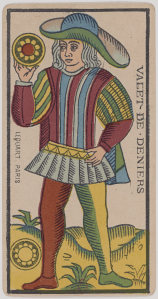
Valets
Valets generally signify young women, girls, or babies. They may also represent those who are dependent, inexperienced, subordinate, or still learning their place within a particular environment.
Cavaliers
Cavaliers generally signify young men, boys, or younger individuals. Like the Valet, they often indicate people who are still developing their skills, responsibilities, or social standing.
Children of either sex may be represented by either card, although the Valet more often inclines towards girls and the Cavalier towards boys.
Queens
Queens generally signify adult women, often over the age of thirty-five or forty. More importantly, however, they signify women who have assumed an established role within their family, profession, or community.
Kings
Kings generally signify adult men, often over the age of thirty-five or forty. As with the Queen, the card frequently points towards someone whose position, responsibilities, or life circumstances are settled and established.
The age guidelines should not be applied too rigidly. Circumstances are often more important than chronology. A married couple in their twenties raising a child may readily appear as a King and Queen, whilst their son or daughter appears as the Valet or Cavalier. The Court Cards frequently reflect a person’s role within a family or social structure rather than their exact age.
The Four Suits
Whilst the rank identifies the sort of person we are dealing with, the suit explains the role they play in our lives.
Swords
Swords signify people with whom we experience force, authority, challenge, or conflict. These include employers, supervisors, police officers, lawyers, officials, rivals, former partners, and others with whom relationships may be difficult or demanding. The connection is defined by power, conflict, obligation, or authority rather than affection.
Cups
Cups signify those people amongst whom we belong. They include spouses, partners, family members, close friends, pets, mentors, fellow worshippers, and religious figures. These relationships are characterised by affection, loyalty, fellowship, and belonging.
Coins
Coins signify those people from whom we obtain resources, expertise, or services. Doctors, accountants, consultants, contractors, electricians, travel agents, interior designers, tradespeople, influencers, content creators, online educators, and countless other professionals belong here. The relationship is one of exchange, expertise, and utility.
Batons
Batons signify those who provide support and practical assistance. Colleagues, neighbours, carers, nurses, maintenance workers, assistants, home-help workers, and dependable acquaintances frequently belong to this suit. These relationships are characterised by cooperation, support, and shared activity.
Examples
Using this approach, a Court Card can signify many different people depending upon context.
A King of Swords might represent a male employer, a stepfather, an ex-partner, a solicitor, a police officer, or even a male occult practitioner. What unites them is not personality but their relationship to the querent through authority, force, challenge, or conflict.
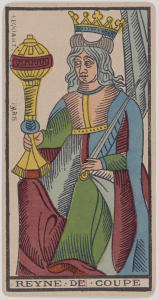
A Queen of Cups might represent a wife, mother, female best friend, church member, religious sister, or another woman through whom the querent experiences belonging, affection, and emotional support.
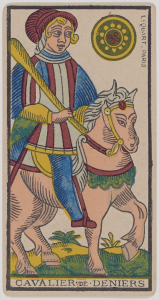
A Cavalier of Coins could be a young electrician rewiring a house, a junior doctor, a travel consultant, a flight attendant, or a social media personality whose expertise is regularly sought. In each case, the relationship centres upon resources, knowledge, or services.
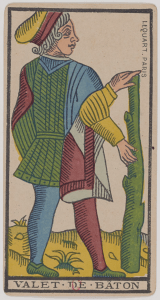
A Valet of Batons might signify a young female colleague, the neighbour’s daughter, a student nurse, a home-help worker, or another young woman providing practical support within everyday life.
This method may appear simplistic, yet it provides a reliable foundation. Before we can understand the deeper meanings of the Court Cards, we must first learn to recognise the people they represent. In most readings, that is where their story.
However, the Court Cards possess a deeper layer of meaning. Beyond age, gender, and social role, they also describe characteristic temperaments and modes of behaviour. It is to these that we turn to next.
Cards: 1748 Arnoult Tarot. Lequart (Paris), Public domain, via Wikimedia Commons
References:
Whilst this article reflects my own interpretations and experience of working with the cards, the principle sources and references that informed its development and the text are provided below for the interested reader.
Carvalho, H.A. de and Ribeiro, L. (2010) On the heavenly spheres: A treatise on traditional astrology. Tempe, AZ: American Federation of Astrologers. Decker, R., Depaulis, T. and Dummett, M. (2002) A Wicked Pack of Cards: The Origins of the Occult Tarot. London: Duckworth. Farley, H. (2009) A cultural history of Tarot: From entertainment to esotericism. London: I.B. Tauris. Ficino, M., Kaske, C.V. and Clark, J.R. (2019) Three Books on Life. Tempe, AZ: Arizona Center for Medieval and Renaissance Studies. Ficinus, M. and Voss, A. (2009) Marsilio Ficino Edited and Introduced by Angela Voss. Berkeley, Calif: North Atlantic Books. Jodorowsky, A., Costa, M. and Graham, J.E. (2009) The Way of Tarot: The Spiritual Teacher in the Cards. Rochester, Vt: Destiny Books. Nees, L. (2002) Early Medieval Art. Oxford: Oxford University Press. Silvestre, C.H. (1987) ABC des Tarots. Paris: Marabout. Silvestre, C. (2004) Le Tarot Qui Guérit. Paris: Éd. Trajectoire. Silvestre, C. (2013) La Roue Astrologique et le Tarot. Escalquens: Éd. Trajectoire. Silvestre, C. (2016) Rencontre des Arcanes Majeurs et Mineurs du Tarot de Marseille: 1232 Associations Interprétées. Escalquens: Grancher éditions. Silvestre, C. (2016a) Les 21 Portes des Arcanes du Tarot de Marseille et d’Oswald Wirth. Paris: Éditions Exergue. Unger, T. (1994) Le tarot, Jeu du Gouvernement du Monde: Éclairer votre regard, Choisir Votre partenaire, réussir l’entreprise. Paris: Montorgueil. Williams, B. (2003) A Renaissance Tarot: A Guide to the Renaissance Tarot. U.S. Games Systems.
This article continues my series examining the Tarot de Marseille, and begins to introduce the four suits or Lesser Arcana. Like the series on the trumps, it is adapted from my unpublished manuscript, Tarot de Marseille: The Picturebook of Fate. As throughout this series, the emphasis is placed upon the traditional eikōn of the card, its historical context, and the practical significations I have found useful through divinatory practice. The interpretations presented here reflect my own experience of working with the Tarot de Marseille and should be understood as a working method rather than a definitive authority.
The Pip Cards: The Four Suits
Having considered the nature and behaviour of the four elements, we turn our attention to the suits’ eikōns which reveal their individual essences and functions.
The Suit of Swords
The suit of Swords is often regarded as one of the most troubling within the Tarot.
Modern interpretations frequently associate it with intellect, communication, and the rational mind. Whilst such meanings may have their place elsewhere, they arise only indirectly from the sword itself. A sword is first and foremost a weapon. It exists to impose force upon the world.
As the elemental representative of Fire, the suit concerns activity, power, conflict, and the ability to impose one’s will. Fire is penetrating, transformative, and discriminating. Likewise, the sword cuts, separates, and divides.
Traditionally, Fire was associated with the Sun and Mars. The Sun contributes vitality, authority, leadership, and the power to command, whilst Mars provides courage, aggression, competition, and the willingness to act decisively.
The suit governs conflict, authority, law, criminality, danger, competition, officialdom, defence, illness, immunity, separation, and decisive action. Anatomically, it is associated with the elimination system.
Ultimately, the suit of Swords concerns force in all its forms. Whether that force protects or destroys depends upon the circumstances and the cards around it.
Swords at a Glance
Essence: Force. Function: Attack and Defend. Element: Fire. Direction: East. Season: Spring. Planetary Associations: Sun and Mars. Basic Significations: Authority, conflict, competition, danger, separation, bureaucracy, law, criminality, official matters, pressure, illness, immunity, decisive action, challenge, force. Yes/No: No.
The Suit of Cups
The suit of Cups is often reduced to love, emotions, and romance. Whilst such matters undoubtedly belong to the suit, they represent only part of a much broader principle. Cups concern those people, places, and institutions that sustain us, provide us with fellowship, and give us a sense of being at home in the world.
Lequart (Paris), Public domain, via Wikimedia Commons
Essence: Belonging. Function: Contain.
As the elemental representative of Air, Cups embody the most life-affirming of the four elements. Air is formed through the union of heat and moisture. It is active, expansive, adaptive, and unifying.
Traditionally, Air was associated with Jupiter and Venus, the Greater and Lesser Benefics. Together they promote harmony, fellowship, generosity, mercy, and mutual support.
The corresponding temperament is the sanguine, characterised by curiosity, forgiveness, sociability, affection, and mercy.
The symbolism of the cup reinforces these meanings. We keep our cups within the home and do not ordinarily share them with strangers. A cup implies familiarity, trust, welcome, and participation.
The suit concerns family, friendship, marriage, hospitality, faith, religion, community, fellowship, belonging, and shared identity. It governs those things that make life meaningful rather than merely possible.
The suit is often associated with feelings, but not emotions. Emotions occur throughout all four suits. Cups concern the conscious experiences of attachment, affection, loyalty, mercy, and belonging.
In matters of health, the suit governs the cardiopulmonary, circulatory, and endocrine systems.
Ultimately, Cups pertain to all essence that touch on where we feel we belong and are safe.
The suit of Coins is often reduced to money, wealth, and possessions. Whilst such matters certainly belong to the suit, they represent only part of a much wider principle. Coins concern the resources that enable life to function and flourish.
As the elemental representative of water, Coins concern the aggregation, preservation, and circulation of resources.
Traditionally, Water was associated with the Moon and Venus. The Moon governs growth, nourishment, fertility, and resource management, whilst Venus governs prosperity, comfort, and exchange.
Consequently, Coins tell us what is available to us and how effectively those resources are being employed. The suit concerns money, property, food, health, transport, commerce, expertise, access, opportunities, and material wellbeing.
Money behaves much like water itself. It flows. When resources circulate correctly they nourish individuals and communities. When they stagnate, difficulties soon arise.
The suit also possesses strong associations with merchants, trade, travel, shipping, transportation, and professional expertise. Wherever value is exchanged, Coins are present.
In matters of health, the suit governs the brain and lymphatic system, both of which distribute and regulate resources throughout the body.
Ultimately, the suit of Coins concerns the means by which life is sustained and improved. It asks: What resources are available, and how are they being used?
The suit of Batons is often associated with work, activity, and practical affairs. Whilst these themes certainly belong to the suit, they arise from a deeper principle. Unlike the other suits, the baton is not fashioned from metal or coinage, nor is it a vessel. It is a piece of the natural world itself.
As the elemental representative of Earth, Batons embody stability, endurance, and persistence.
Traditionally, Earth was associated with Saturn and Mercury. Saturn contributes responsibility, perseverance, and endurance, whilst Mercury supplies practical skill, adaptability, and everyday competence.
The baton itself is a support. A staff assists the traveller, bears weight, and aids movement. For this reason, the suit is associated with practical assistance, service, maintenance, labour, and support.
Unlike Coins, which represent specialised knowledge and resources, Batons concern practical effort and hands-on assistance. Carers, cleaners, labourers, maintenance workers, agricultural workers, and similar professions naturally belong here.
The suit also governs nature, husbandry, agriculture, forestry, conservation, neighbours, colleagues, and local communities. These are the everyday support networks upon which society depends.
The darker side of the suit includes drudgery, stagnation, exhaustion, overwork, and excessive responsibility.
In matters of health, Batons govern the skeletal system, connective tissues, joints, and the body’s supporting structures.
Ultimately, Batons concern the systems of support that allow life to continue.
It is now quite fashionable to dismiss the idea of positive, neutral and negative cards. However, such a stance simply reflects a misunderstanding of the terms and their usage.
The terms positive, negative, and neutral should not be understood as moral judgements. Nor do they correspond exactly to benefic and malefic influences.
Rather, they describe a card’s capacity to facilitate or impede developments.
Positive cards help things move forward. Negative cards obstruct, delay, terminate, or diminish. Neutral cards possess the capacity to do either depending upon context.
Thus, Death is not evil, yet it ends. The Hanged Man is not wicked, yet he suspends progress. Likewise, Swords sever and divide.
By contrast, Cups facilitate. As the hot and moist element, Air creates the conditions in which life and relationships may flourish. Similarly, the Sun illuminates and the Pope offers wisdom and guidance.
Neutral cards occupy a middle position. The Emperor’s control may be exercised wisely or badly. The Wheel of Fortune changes circumstances but remains indifferent to whether those changes are good or bad.
The same principle applies to the suits. Coins possess resources and thus make things possible, whilst Batons require effort and labour and therefore indicate that something is achievable only through sustained work.
Positive, negative, and neutral therefore describe facilitation rather than morality.
§
Tarot Cards: Arnoult Tarot, Lequart (Paris), Public domain, via Wikimedia Commons
Whilst this article reflects my own interpretations and experience of working with the cards, the principle sources and references that informed its development and the text are provided below for the interested reader.
Augustine and Pine-Coffin, R.S. (2003) Confessions. London, England: Penguin Books. Saint Augustine of Hippo and Bettenson, H. (2004) City of God. Penguin Books. Carvalho, H.A. de and Ribeiro, L. (2010) On the heavenly spheres: A treatise on traditional astrology. Tempe, AZ: American Federation of Astrologers. Benedict et al. (1981) RB 1980: The Rule of St. Benedict. Collegeville, MN: Liturgical Press. Catholic Truth Society, Catechism of the Catholic Church (2016). London: Catholic Truth Society. Decker, R., Depaulis, T. and Dummett, M. (2002) A Wicked Pack of Cards: The Origins of the Occult Tarot. London: Duckworth. Collins UK (2006) The Divine Office, volume I: Daily Prayer for Advent and Christmastide & Weeks 1-9. HarperCollins UK. Collins UK (2006) The Divine Office, volume II: Daily Prayer for Lent and Eastertide. HarperCollins UK. Collins UK (2006) The Divine Office, volume III: Daily Prayer for Weeks 6-34 of the Church Year. HarperCollins UK. Farley, H. (2009) A cultural history of Tarot: From entertainment to esotericism. London: I.B. Tauris. Ficino, M., Kaske, C.V. and Clark, J.R. (2019) Three Books on Life. Tempe, AZ: Arizona Center for Medieval and Renaissance Studies. Ficinus, M. and Voss, A. (2009) Marsilio Ficino Edited and Introduced by Angela Voss. Berkeley, Calif: North Atlantic Books. Frawley, J. (2001) The Real Astrology. London: Apprentice. Frawley, J. (2002) The Real Astrology Applied: Teachings from the ‘Astrologer’s Apprentice’. London: Apprentice. Frawley, J. (2011) The Horary textbook. London: Apprentice Books. Giorgi, R., Zuffi, S. and Giammanco Frongia, R.M. (2005) Angels and Demons in Art. Los Angeles: J. Paul Getty Museum. Jodorowsky, A., Costa, M. and Graham, J.E. (2009) The Way of Tarot: The Spiritual Teacher in the Cards. Rochester, Vt: Destiny Books. Jones, A. (1974) The Jerusalem Bible. London: Darton, Longman and Todd. Jones, M.D.W. (2008) The Counter Reformation: Religion and Society in Early Modern Europe. Cambridge England: Cambridge University Press. McHugh, J.A., Callan, C.J. and Pius (2017) Catechism of the Council of Trent for Parish Priests: Issued by order of Pope Pius V. Charlotte, NC: TAN Books. Nees, L. (2002) Early Medieval Art. Oxford: Oxford University Press. Nouwen, H.J.M. (2007) Behold the beauty of the lord: Praying with icons. Notre Dame, Ind: Ave Maria Press. Ptolemaeus, C. and Robbins, F.E. (2001) Tetrabiblos. Cambridge, MA: Harvard Univ. Press. Silvestre, C.H. (1987) ABC des Tarots. Paris: Marabout. Silvestre, C. (2004) Le Tarot Qui Guérit. Paris: Éd. Trajectoire. Silvestre, C. (2013) La Roue Astrologique et le Tarot. Escalquens: Éd. Trajectoire. Silvestre, C. (2016) Rencontre des Arcanes Majeurs et Mineurs du Tarot de Marseille: 1232 Associations Interprétées. Escalquens: Grancher éditions. Silvestre, C. (2016a) Les 21 Portes des Arcanes du Tarot de Marseille et d’Oswald Wirth. Paris: Éditions Exergue. Thomas (2018) Summa Theologica: Complete in a Single Volume. Claremont, CA: Coyote Canyon Press. Unger, T. (1994) Le tarot, Jeu du Gouvernement du Monde: Éclairer votre regard, Choisir Votre partenaire, réussir l’entreprise. Paris: Montorgueil. Valens, V. and Riley, M.T. (2022) The Anthology. Denver, CO: Amor Fati Publications. Williams, B. (2003) A Renaissance Tarot: A Guide to the Renaissance Tarot. U.S. Games Systems.