This article continues my series examining the Tarot de Marseille, and begins to introduce the Court Cards. Like the series on the trumps, it is adapted from my unpublished manuscript, Tarot de Marseille: The Picturebook of Fate. As throughout this series, the emphasis is placed upon the traditional eikōn of the card, its historical context, and the practical significations I have found useful through divinatory practice. The interpretations presented here reflect my own experience of working with the Tarot de Marseille and should be understood as a working method rather than a definitive authority.
The Pip Cards: The Court Cards
One of the challenges of divination is that life rarely concerns abstract principles alone. Most of our joys, frustrations, opportunities, and difficulties involve other people. We interact daily with family members, friends, colleagues, neighbours, professionals, authority figures, and countless acquaintances. If the Tarot is to function as a picturebook of life, it must possess cards capable of representing the people who populate that life.
This is the primary role of the Court Cards.
The Tarot contains sixteen such figures: four ranks across four suits. Whilst the Court Cards have many uses—and can represent character, behaviour, actions, and social roles—their most straightforward application is as significators of people.
Unfortunately, real life is considerably more complicated than sixteen cards would suggest. Any serious reading may involve dozens of individuals. Consequently, a single Court Card can signify different people in different contexts and combinations. This becomes particularly apparent in larger layouts, such as the Grand Tableau, which uses all 56 cards of the “Lesser Arcana.”
It is also important to remember that Court Cards describe relationships and roles rather than fixed personalities. A person may appear as different Court Cards in different readings depending upon the role they occupy within the matter under consideration. A friend may appear as a Cup when acting as a friend, or a Sword when exercising authority as your boss. The card reflects the relationship, not the whole person.
Nevertheless, a useful starting point is to use the rank to identify age and gender, and the suit to identify the area of life in which the individual operates.
The Four Ranks
Valets
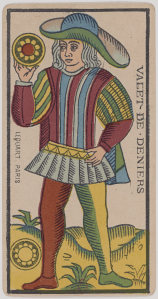
Valets generally signify young women, girls, or babies. They may also represent those who are dependent, inexperienced, subordinate, or still learning their place within a particular environment.
Cavaliers
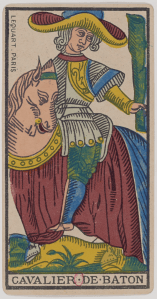
Cavaliers generally signify young men, boys, or younger individuals. Like the Valet, they often indicate people who are still developing their skills, responsibilities, or social standing.
Children of either sex may be represented by either card, although the Valet more often inclines towards girls and the Cavalier towards boys.
Queens
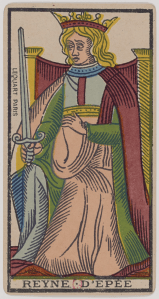
Queens generally signify adult women, often over the age of thirty-five or forty. More importantly, however, they signify women who have assumed an established role within their family, profession, or community.
Kings
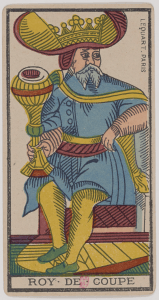
Kings generally signify adult men, often over the age of thirty-five or forty. As with the Queen, the card frequently points towards someone whose position, responsibilities, or life circumstances are settled and established.
The age guidelines should not be applied too rigidly. Circumstances are often more important than chronology. A married couple in their twenties raising a child may readily appear as a King and Queen, whilst their son or daughter appears as the Valet or Cavalier. The Court Cards frequently reflect a person’s role within a family or social structure rather than their exact age.
The Four Suits
Whilst the rank identifies the sort of person we are dealing with, the suit explains the role they play in our lives.
Swords

Swords signify people with whom we experience force, authority, challenge, or conflict. These include employers, supervisors, police officers, lawyers, officials, rivals, former partners, and others with whom relationships may be difficult or demanding. The connection is defined by power, conflict, obligation, or authority rather than affection.
Cups

Cups signify those people amongst whom we belong. They include spouses, partners, family members, close friends, pets, mentors, fellow worshippers, and religious figures. These relationships are characterised by affection, loyalty, fellowship, and belonging.
Coins

Coins signify those people from whom we obtain resources, expertise, or services. Doctors, accountants, consultants, contractors, electricians, travel agents, interior designers, tradespeople, influencers, content creators, online educators, and countless other professionals belong here. The relationship is one of exchange, expertise, and utility.
Batons

Batons signify those who provide support and practical assistance. Colleagues, neighbours, carers, nurses, maintenance workers, assistants, home-help workers, and dependable acquaintances frequently belong to this suit. These relationships are characterised by cooperation, support, and shared activity.
Examples
Using this approach, a Court Card can signify many different people depending upon context.
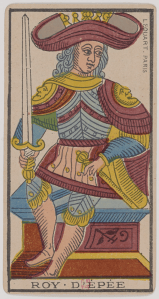
A King of Swords might represent a male employer, a stepfather, an ex-partner, a solicitor, a police officer, or even a male occult practitioner. What unites them is not personality but their relationship to the querent through authority, force, challenge, or conflict.
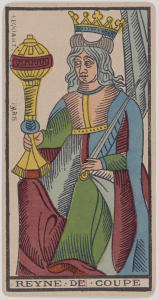
A Queen of Cups might represent a wife, mother, female best friend, church member, religious sister, or another woman through whom the querent experiences belonging, affection, and emotional support.
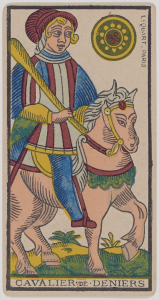
A Cavalier of Coins could be a young electrician rewiring a house, a junior doctor, a travel consultant, a flight attendant, or a social media personality whose expertise is regularly sought. In each case, the relationship centres upon resources, knowledge, or services.
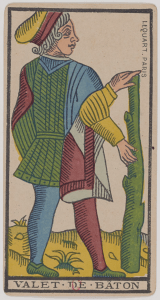
A Valet of Batons might signify a young female colleague, the neighbour’s daughter, a student nurse, a home-help worker, or another young woman providing practical support within everyday life.
This method may appear simplistic, yet it provides a reliable foundation. Before we can understand the deeper meanings of the Court Cards, we must first learn to recognise the people they represent. In most readings, that is where their story.
However, the Court Cards possess a deeper layer of meaning. Beyond age, gender, and social role, they also describe characteristic temperaments and modes of behaviour. It is to these that we turn to next.
§
Images:
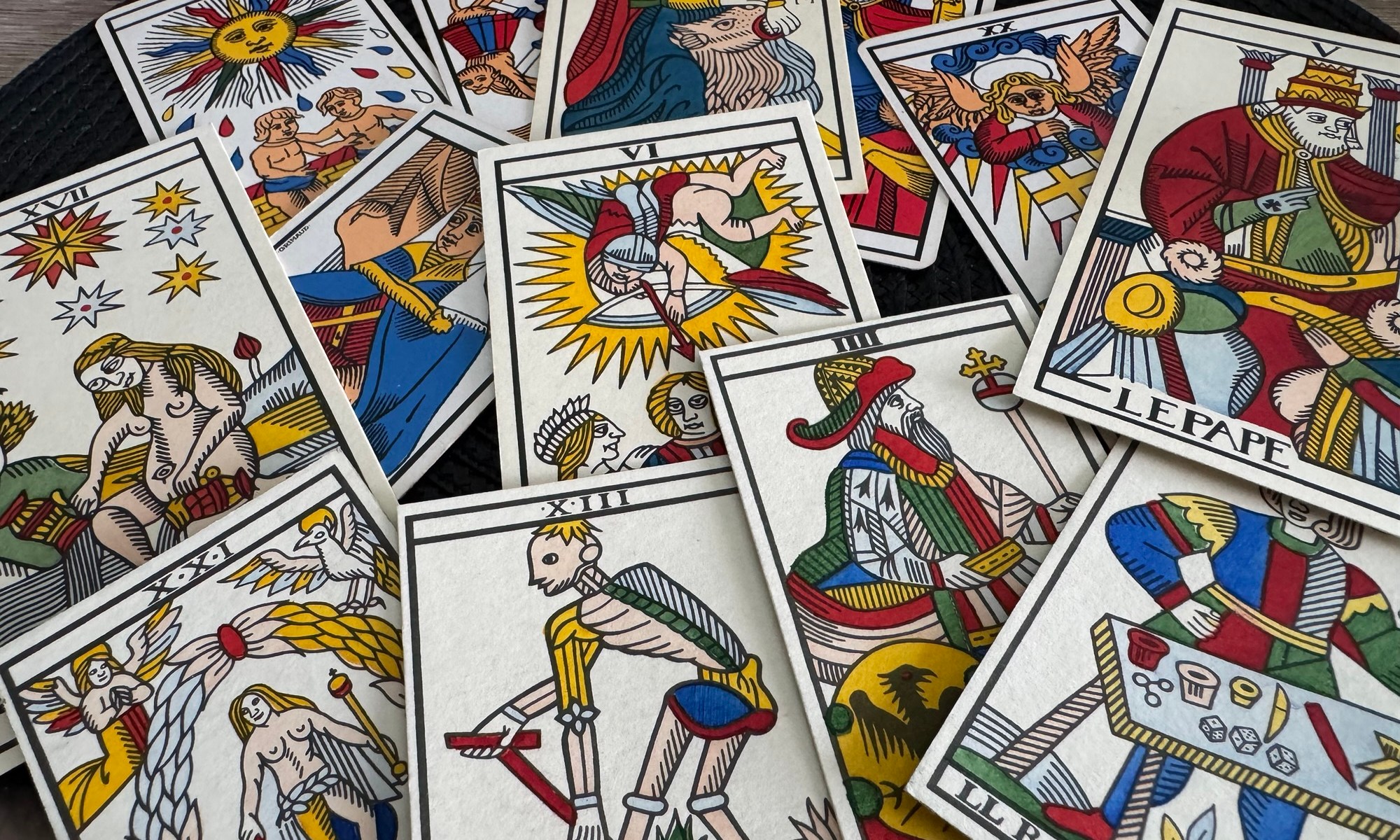
Featured Image: Ancient Tarot Major Arcana © BP Grimaud/John Waddington Ltd, Leeds & London, Les Tarot de Marseille Jean Noblet, 1650 © Editions «letarot.com» (2001 [hand stencilled trumps]). Les Tarot de Marseille Jean Dodal, 1701 et 1715 © Editions «letarot.com» (2002 [hand stencilled trumps])
Cards: 1748 Arnoult Tarot. Lequart (Paris), Public domain, via Wikimedia Commons
References:
Whilst this article reflects my own interpretations and experience of working with the cards, the principle sources and references that informed its development and the text are provided below for the interested reader.
Carvalho, H.A. de and Ribeiro, L. (2010) On the heavenly spheres: A treatise on traditional astrology. Tempe, AZ: American Federation of Astrologers.
Decker, R., Depaulis, T. and Dummett, M. (2002) A Wicked Pack of Cards: The Origins of the Occult Tarot. London: Duckworth.
Farley, H. (2009) A cultural history of Tarot: From entertainment to esotericism. London: I.B. Tauris.
Ficino, M., Kaske, C.V. and Clark, J.R. (2019) Three Books on Life. Tempe, AZ: Arizona Center for Medieval and Renaissance Studies.
Ficinus, M. and Voss, A. (2009) Marsilio Ficino Edited and Introduced by Angela Voss. Berkeley, Calif: North Atlantic Books.
Jodorowsky, A., Costa, M. and Graham, J.E. (2009) The Way of Tarot: The Spiritual Teacher in the Cards. Rochester, Vt: Destiny Books.
Nees, L. (2002) Early Medieval Art. Oxford: Oxford University Press.
Silvestre, C.H. (1987) ABC des Tarots. Paris: Marabout.
Silvestre, C. (2004) Le Tarot Qui Guérit. Paris: Éd. Trajectoire.
Silvestre, C. (2013) La Roue Astrologique et le Tarot. Escalquens: Éd. Trajectoire.
Silvestre, C. (2016) Rencontre des Arcanes Majeurs et Mineurs du Tarot de Marseille: 1232 Associations Interprétées. Escalquens: Grancher éditions.
Silvestre, C. (2016a) Les 21 Portes des Arcanes du Tarot de Marseille et d’Oswald Wirth. Paris: Éditions Exergue.
Unger, T. (1994) Le tarot, Jeu du Gouvernement du Monde: Éclairer votre regard, Choisir Votre partenaire, réussir l’entreprise. Paris: Montorgueil.
Williams, B. (2003) A Renaissance Tarot: A Guide to the Renaissance Tarot. U.S. Games Systems.
 Journal of a Cartomante