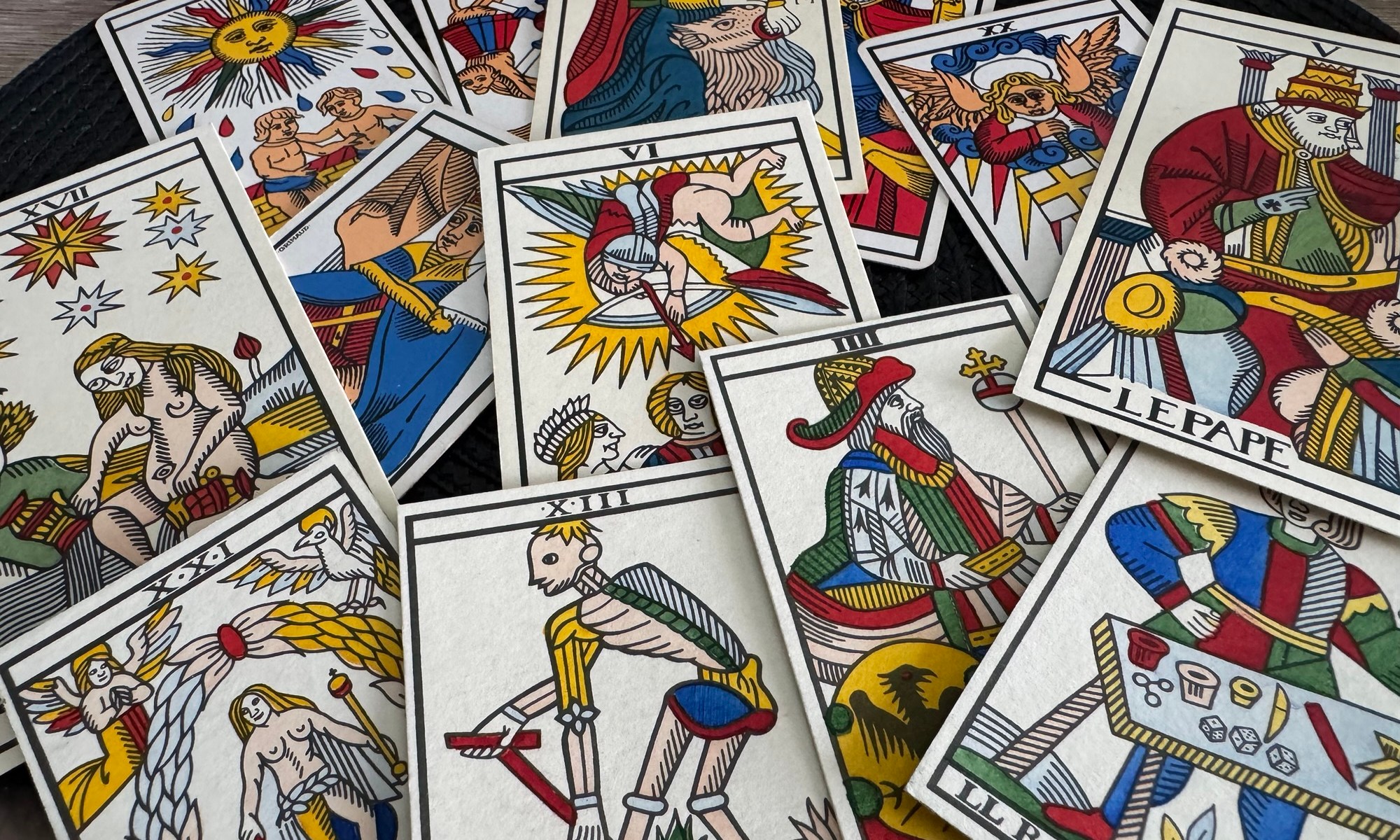
Le tirage en croix, or the Cross Spread, is among the most widely practised methods of tarot reading. It appears in the majority of French tarot literature and has long been favoured for its elegance and directness. One of the principal reasons for its enduring popularity is its capacity to provide a clear and decisive response to a question—indeed, it may even yield a simple affirmative or negative where appropriate.
For some practitioners, the notion of using the Tarot to obtain a “yes or no” answer is considered rather objectionable. However, among most continental readers, such an approach is entirely de rigueur. After all, do not many questions, when properly distilled, come down to a straightforward affirmation or refusal? I have always found myself more sympathetic to the continental tradition than to the somewhat diffuse sensibilities of the modern Anglo-style New Age approach. When one consults an oracle, one does so in pursuit of clarity, not greater confusion. A tarot reading ought, in my view, to address the question succinctly; otherwise, one may fairly ask what purpose it serves.
The Cross Spread
Like the Celtic Cross, the Cross Spread exists in a variety of forms. The version presented here is both standard and the one I personally employ:
- Card 1 (Left): The querent, and their manner of approaching the situation.
- Card 2 (Right): The situation itself, including external influences, whether favourable or adverse.
- Card 3 (Above): Advice and guidance.
- Card 4 (Below): The outcome.
- Card 5 (Centre): The synthesis.
Unlike the first four cards, the fifth is not drawn but calculated. One adds together the numerical values of the four cards already laid, using the Major Arcana, and reduces the result to a number not exceeding 22.
For example, should one draw the Fool (0), the Devil (15), the Star (17), and the Hermit (9), the calculation is as follows:
0 + 15 + 17 + 9 = 41
As this exceeds 22, one reduces it further: 4 + 1 = 5. The resulting number corresponds to the Pope (or Hierophant), which serves as the synthesis.
It should be evident that this synthesis card is not to be read as an additional outcome; that function is already fulfilled by the fourth card. Rather, the synthesis reveals the underlying dynamics—the deeper currents and governing principles at work within the matter under consideration.
A brief note should be made regarding the Fool. When it appears among the first four cards, it is assigned the numerical value of 0 for the purposes of calculation. However, the matter is treated somewhat differently in the case of the synthesis. Should the final total reduce to 22, the Fool is taken as the synthesis card. In this way, the Fool retains both its numerical absence and its symbolic primacy: it is at once nothing and everything, the beginning and the end. This dual function is entirely in keeping with its role within the Greater Arcana, and it serves as a subtle reminder that, even in the most structured of methods, the Tarot admits of paradox.
On Method and Practice
Some years ago, I encountered an argument—during a rather spirited exchange on Facebook—that while the Cross Spread is well suited to the Tarot de Marseille, it is ill-matched to decks such as the Crowley-Harris Thoth Tarot. The objection rested largely upon the use of the Greater Arcana alone. According to this view, such practice runs counter to the philosophy of certain decks, wherein the Greater and Lesser Arcana are intended to function in close interdependence. It is further argued that the Greater Arcana, taken in isolation, cannot adequately address more mundane concerns.
I must confess that I do not share this opinion. Throughout much of my own practice, I have regularly made use of the Greater Arcana alone. It is true that I feel most at ease with the Marseille tradition; however, I have also worked extensively with the trumps of both the Thoth and Rider–Waite–Smith systems in isolation. At no point have I found these cards incapable of speaking to matters on the material plane. After all, what one is doing in any reading is nothing more than interpreting cards’ essence within context, be it exoteric or esoteric.
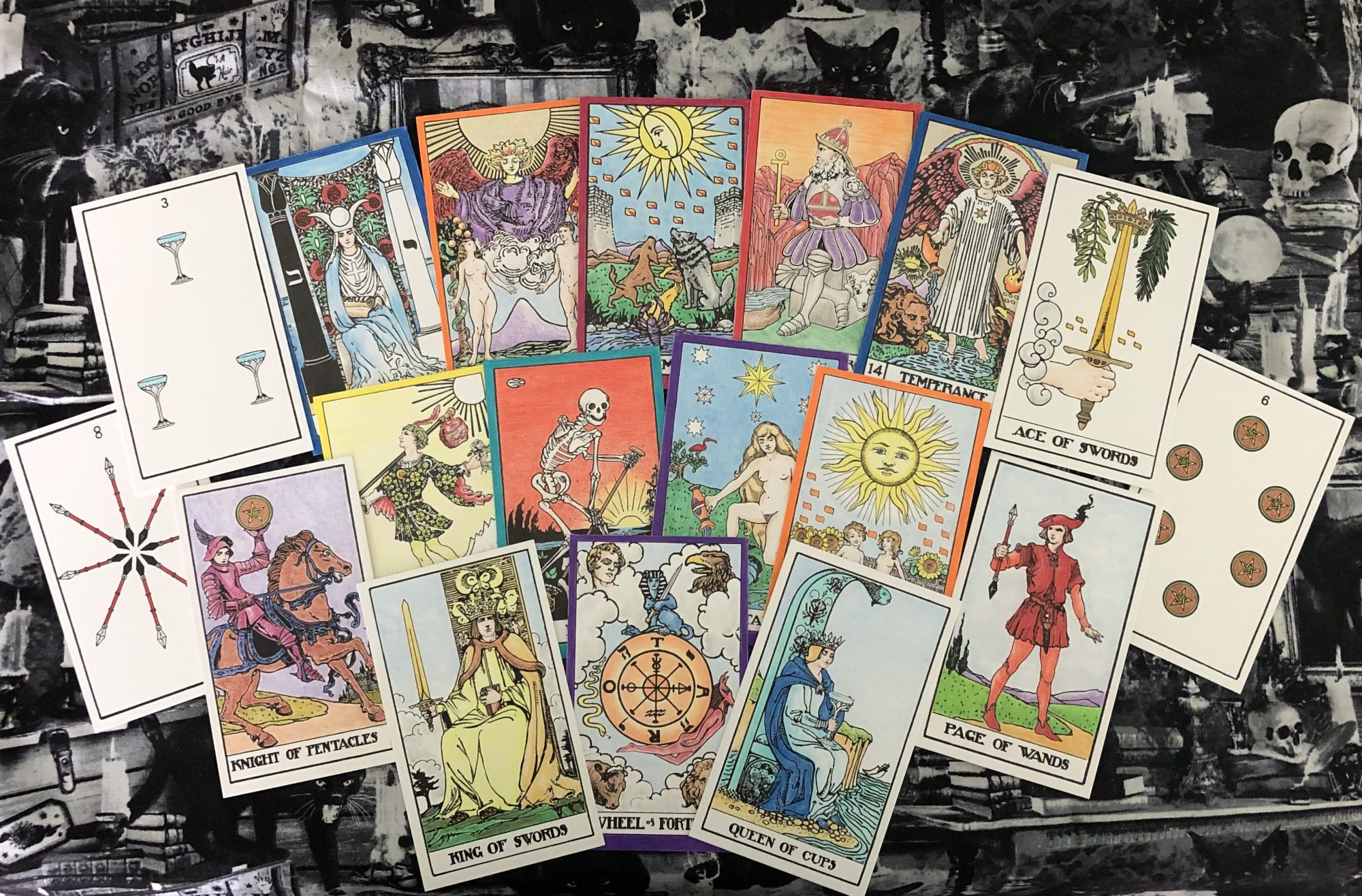
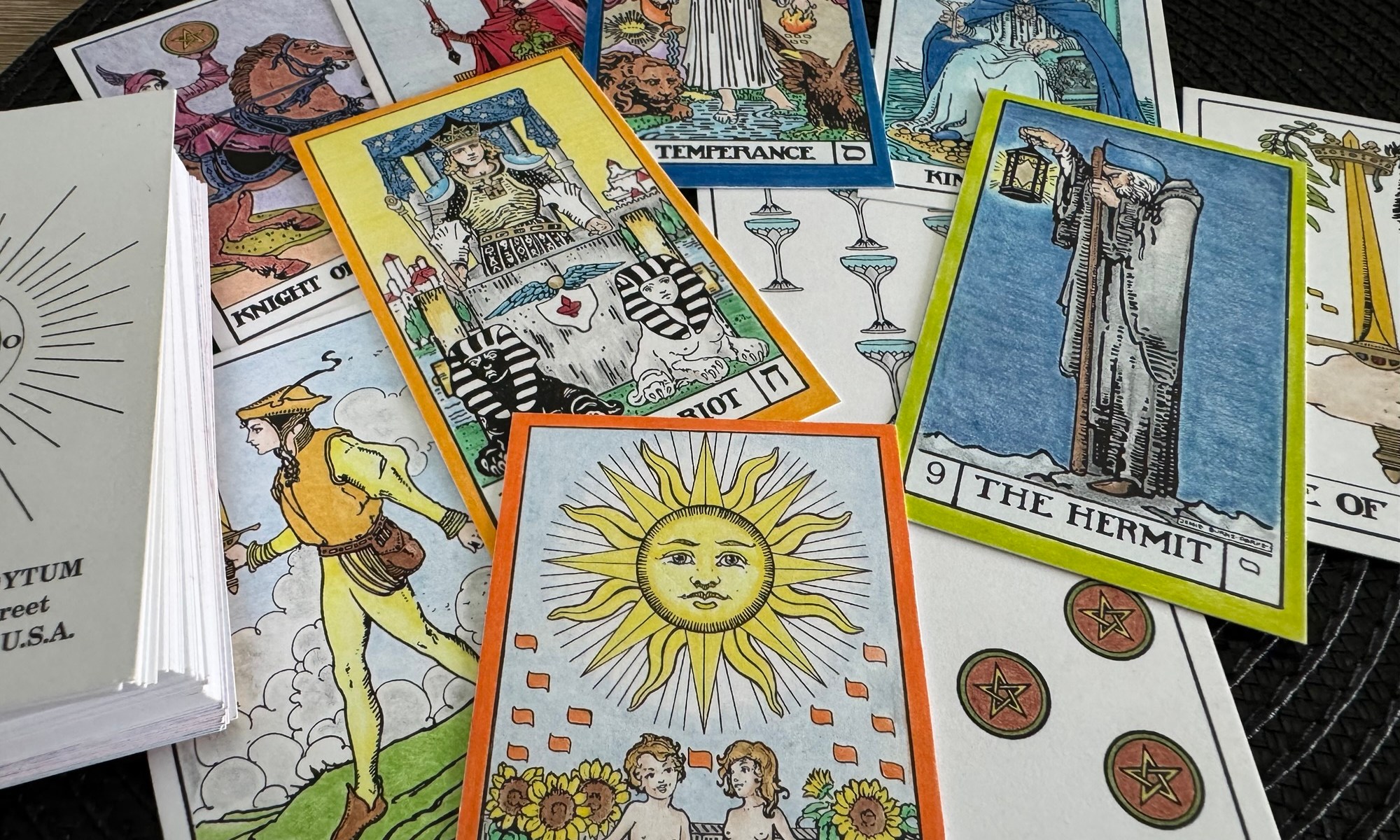
Since completing the colouring of my first Builders of the Adytum (B.O.T.A.) deck, I have taken considerable pleasure in working with it—including in the context of the Cross Spread and Astrological Wheel, employing only the Greater Arcana. What follows is an example of such a reading.
Sofia’s Reading
The reading below was conducted during the summer of 2025 for a colleague. Sofia had met her husband whilst at university. They became engaged shortly after graduating and had been married for eleven years. Sadly, the relationship had been under strain for some time. Despite attending relationship counselling and making sincere efforts to begin afresh, the same difficulties persisted. Sofia was increasingly concerned, not only for the marriage itself, but also for the effect the situation was having upon their two young children.
Question: Can this relationship be saved?
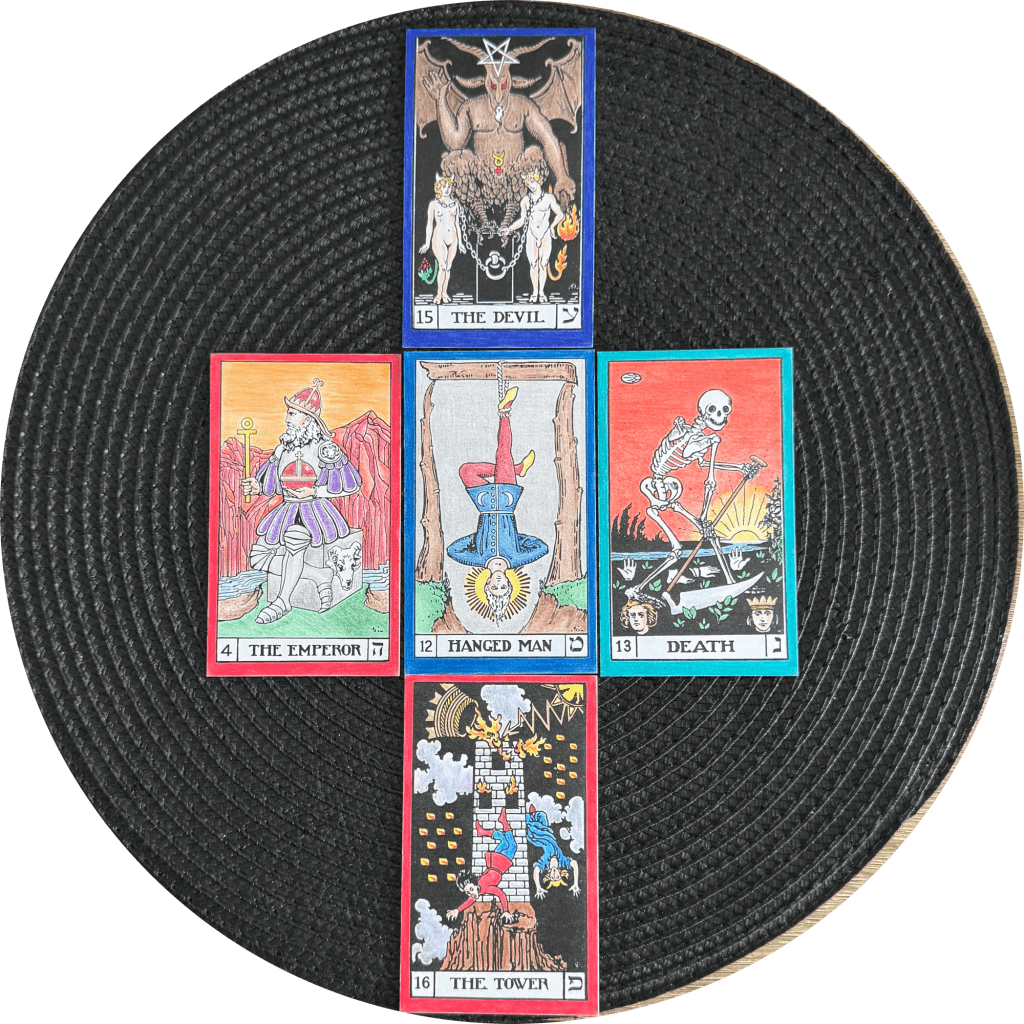
The cards drawn were as follows:
- The Emperor (4)
- Death (13)
- The Devil (15)
- The Tower (16)
For the synthesis:
4 + 13 + 15 + 16 = 48 = 4 + 8 = 12
The synthesis is therefore the Hanged Man.
I said to Sofia, “Yes, but only if you’re prepared to sacrifice everything and live with ghosts.”
Sofia is signified by the Emperor. In Book T1, one of the attributions given to the Emperor is “war,” and it is clear that Sofia was prepared to fight for her marriage. The Emperor does not readily accept defeat, and the failure of the relationship would feel, at least in part, like a personal failure.
Opposing the Emperor is Death. The image is striking. Sofia is prepared to struggle against forces that have been acting upon the marriage for many years. In relationship readings, the second card often describes either the partner or the relationship itself. Here, Death suggests that time, experience, and changing circumstances have altered the marriage fundamentally. What once bound the couple together no longer operates as it once did. The relationship has reached a point where it must either find a new basis upon which to continue or come to an end.
The advice position is occupied by the Devil. Here, I read the card in terms of material ties and practical obligations. After eleven years of marriage, Sofia and her husband have built a shared life: a home, finances, and the responsibility of raising two children. Should the marriage end, there would be considerable practical consequences. The Devil reminds Sofia to consider not only the emotional realities of the situation, but the material ones as well. From this perspective, the status quo can be retained albeit at a price.
The outcome is the Tower. Rather than a sudden calamity, I see it here as a structure that can no longer support the forces acting upon it. The marriage has changed, but the couple continue to relate to it as though it were the same relationship they entered into eleven years earlier. The Tower suggests this is no longer possible. The structure of the marriage has shifted and can no longer accommodate its present dynamics. What was has gone and cannot be restored.
Yet the reading does not conclude with the Tower. The synthesis is the Hanged Man, which reveals the underlying dynamic of the situation. The card does not suggest that the relationship cannot be saved. Rather, it indicates that it can continue only through sacrifice. Sofia would need to relinquish her expectations for the future and accept the uncomfortable reality that the marriage she once knew no longer exists. The relationship may endure, physically and materially, but only if both parties are prepared to let go of what was and make their peace with what remains. Otherwise, it will be a time-bomb.
Ultimately, the reading is quite simple. Sofia has the grit and determination of the Emperor to preserve the bonds of marriage represented by the Devil. Yet that marriage has been fundamentally altered by Death, and, as the Tower suggests, old bones (all that remains) make poor building blocks. Whether the relationship is worth preserving under such circumstances is the question posed by the Hanged Man. The marriage may survive, but only as a ghost of what it once was.
Sofia and her husband split six months later.
This example also illustrates a point often overlooked in discussions about tarot methods. Whether one is working with the Tarot de Marseille, the Dark Goddess Tarot, the Thoth Tarot, or a B.O.T.A. deck, it is perfectly possible to obtain direct and unambiguous answers. The key lies not in the artwork or even the system itself, but in keeping a firm eye on both essence, function and context. The cards reveal the essential nature of a situation; the reader’s task is to understand that essence within the context of the question asked. Do that consistently, and the Tarot rarely lacks clarity.
§
Cards: BOTA Tarot © Builders of the Adytum
Footnotes:
- Regardie, I. (1989) The Golden Dawn: An account of the teachings, rites, and ceremonies of the Hermetic Order of the Golden Dawn (Stella Matutina): A complete course in practical ceremonial magic. Saint Paul, MN: Llewellyn Publications. ↩︎
 Journal of a Cartomante