Tarot de Marseille: The Picturebook of Fate: The Threes Part 3

This article continues my series examining the trumps of the Tarot de Marseille, adapted from my unpublished manuscript, Tarot de Marseille: The Picturebook of Fate. As throughout this series, the emphasis is placed upon the traditional eikōn of the card, its historical context, and the practical significations I have found useful through divinatory practice. The interpretations presented here reflect my own experience of working with the Tarot de Marseille and should be understood as a working method rather than a definitive authority.

The Threes: The Empress, the Hanged Man and the World

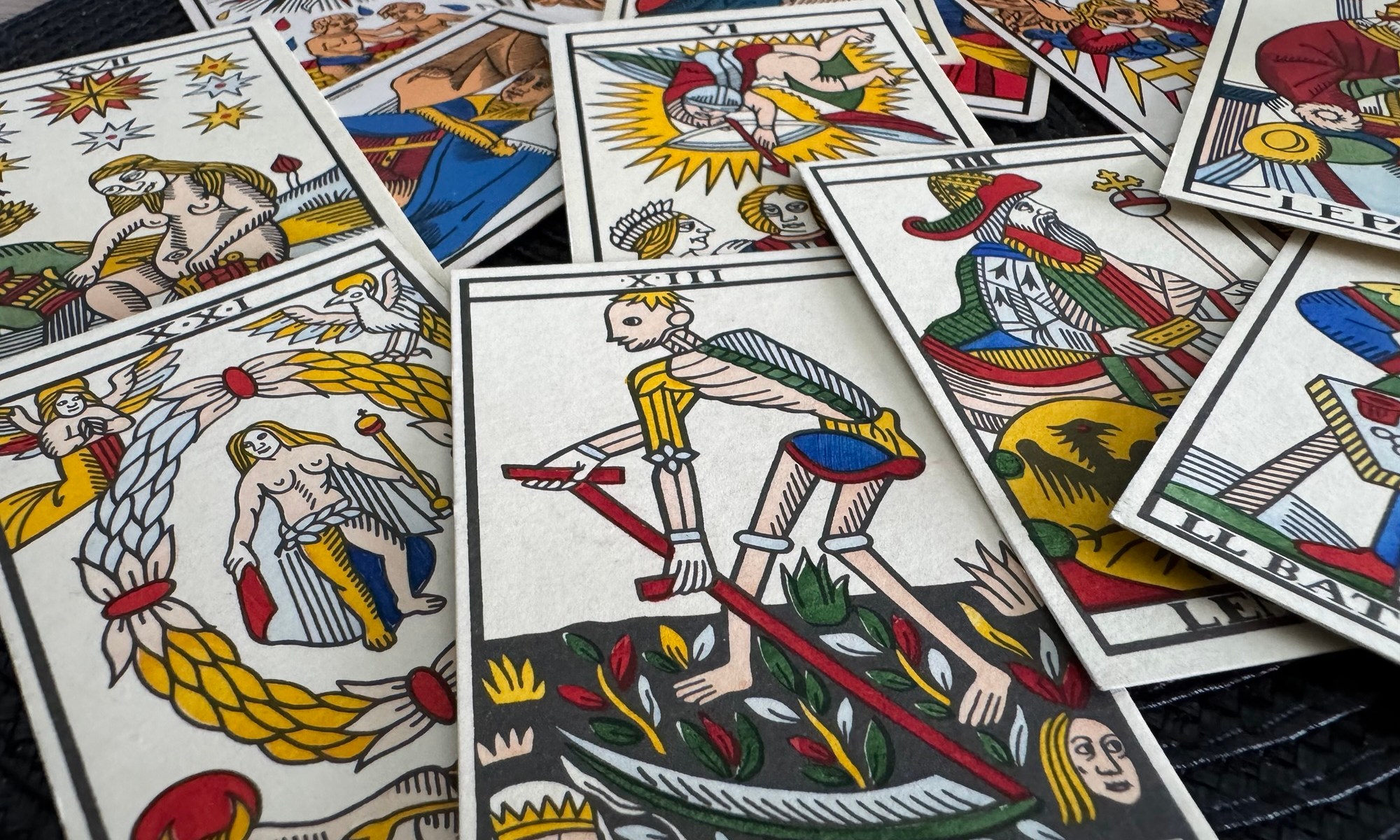
Trump XXI, Le Monde, or the World, is one of the most recognisable cards in the Tarot. Does it signify the integration of opposites and the harmonising of the anima and animus? Is it merely a card of completion and success? Or does it speak of travel, the wider world, and horizons broadened by experience? Whilst each of these interpretations contains an element of truth, the Marseille World speaks above all of attainment, fulfilment, and wholeness.

The essence of the World is totality; its function is to elevate. Here we encounter a state in which something has reached its proper fulfilment and been raised to its highest condition. The card therefore signifies completion, accomplishment, and the realisation of a long-sought objective.

The traditional eikōn of the World is both familiar and strangely abstract. At its centre stands a figure balanced upon one leg and enclosed within a mandorla. In the four corners appear an angel, a lion, a bull, and an eagle. Whilst later traditions have offered a variety of interpretations, the image is clearly indebted to the medieval Maiestas Domini, or Christ in Glory. In such images, Christ is depicted enthroned within a mandorla and accompanied by the symbols of the four Evangelists: Saint Matthew, Saint Mark, Saint Luke, and Saint John. The Tarot omits Christ Himself, replacing Him with a more ambiguous figure that may be understood as the Soul, Wisdom, or perfected humanity.
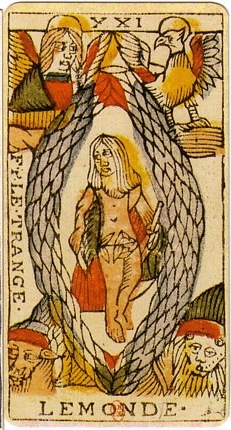
The significance of the image lies in its attainment of the highest possible condition. The World represents the fulfilment of a desire that has long motivated effort and aspiration. Saint Augustine of Hippo wrote that the human heart remains restless until it rests in God1. Saint Thomas Aquinas developed this idea through his teaching on the Beatific Vision, in which the soul finally beholds and enjoys its Creator directly. Likewise, the life of Saint Francis demonstrates the profound joy that comes from orientating oneself wholly towards the highest good — Deus meus et omnia2. Whether one interprets the card in explicitly religious terms or not, the underlying principle remains the same: the attainment of that which has been sought above all else.

For this reason, the World signifies the fulfilment of the soul’s desire. It is not merely success, nor simply the completion of a project. Rather, it is the moment at which striving gives way to attainment and aspiration to satisfaction. The journey has reached its proper conclusion and the goal stands before us.

In divination, the World is one of the most welcome cards. It often indicates that a venture, phase of life, or long-term undertaking is nearing its successful completion. One graduates from university, receives the long-desired promotion, purchases a dream home, or meets the person one will marry. Whatever the matter under consideration, the card brings a sense of having arrived. The destination has been reached and the effort justified.

The fulfilment promised by the World differs subtly from that of the Sun. The Sun is characterised by shared happiness, warmth, and mutuality; the World by personal attainment and individual accomplishment. It is worth remembering that the central figure stands alone. Others may celebrate our success, but the achievement itself belongs to us. The World therefore represents the satisfaction that comes from accomplishing something meaningful through our own efforts.

The World also possesses strong associations with travel, foreign countries, and a cosmopolitan outlook. The horizons of the querent are broadened and the limits of the familiar surpassed. Whether through travel, education, or experience, the individual is elevated beyond their previous condition. Thus the World signifies not merely an end, but the successful completion of one stage of life and the threshold of another.

General: A sense of personal gratification and triumph with the outcome or the realisation of a personal goal. Matters reaching their natural conclusion and synthesis. Travel and at times emigration or relocating.

Love: If a prominent position the World often shows a relationship entering a milestone be it going steady, to celebrating an important anniversary. The relationship is a source of pride and pleasure, with a sense of belonging. People looking for love will often find opportunities to meet new people, especially during travel or visiting new places.

Career: The card does point towards the travel sector especially roles which involves travelling (pilot, cabin crew, travel representative) as well as translators, interpreters and anthropologists. It can indicate a promotion especially if it involves the need for relocation or moving work premises.

Finances: Incomes are stable, and a sense of material stability and independence is felt. In times of hardship the World often indicates opportunities and assistance are available to turn things around.

Health: The World card pertains to viruses and infections that are transmitted between people or through the environment. This includes influenza and herpes simplex.

Essence: Totality.
Function: Elevate.
Polarity: Neutral.
Astrological Association: None.
Timing: None.

§

Tarot Cards: Jean Dodal Tarot via Wikipedia Commons. Public Domain.

Featured Image: Ancient Tarot Major Arcana © BP Grimaud/John Waddington Ltd, Leeds & London, Les Tarot de Marseille Jean Noblet, 1650 © Editions «letarot.com» (2001 [hand stencilled trumps]). Les Tarot de Marseille Jean Dodal, 1701 et 1715 © Editions «letarot.com» (2002 [hand stencilled trumps])
  1. For thou hast made us for thyself and restless is our heart until it comes to rest in thee. Confessions, Book I: Chapter I ↩︎
  2. My God and My All ↩︎

Tarot de Marseille: The Picturebook of Fate: The Threes Part 2

This article continues my series examining the trumps of the Tarot de Marseille, adapted from my unpublished manuscript, Tarot de Marseille: The Picturebook of Fate. As throughout this series, the emphasis is placed upon the traditional eikōn of the card, its historical context, and the practical significations I have found useful through divinatory practice. The interpretations presented here reflect my own experience of working with the Tarot de Marseille and should be understood as a working method rather than a definitive authority.

The Threes: The Empress, the Hanged Man and the World

Trump XII, Le Pendu, or the Hanged Man, is both an intriguing and unsettling card. Does it signify self-sacrifice and the promise of future rewards? Is it merely a card of stasis and stagnation? Or does it ask us to view the world from a different perspective? Whilst such themes are often associated with the card, they do not fully explain its peculiar image. The Marseille Hanged Man is less concerned with enlightenment than with disgrace, exclusion, and the consequences of damaged reputation.

The essence of the Hanged Man is dishonour; its function is to suspend. Although these concepts may initially seem severe, they provide the key to understanding the card’s operation in a reading. The Hanged Man does not move freely within the world. Something has happened which prevents progress. Whether deserved or not, his ability to act has been curtailed, his position compromised, and his affairs placed on hold.

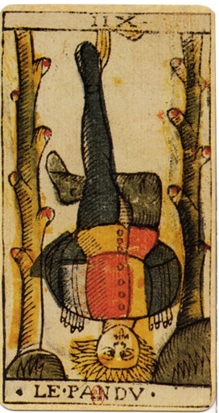
The traditional eikōn is both striking and historically grounded. We see a man suspended by one ankle, hanging upside down from a wooden frame. To modern eyes the image appears strange, yet it derives from a genuine early modern practice known as pitture infamanti or defaming portraits. Such images were displayed upon public buildings in order to shame individuals accused of fraud, bankruptcy, debt, treason, or other offences against the community. The subjects were often prominent figures whose standing and reputation were essential to their influence. Public dishonour became a means of public punishment.

The image is reinforced by long-standing associations between hanging and disgrace. Through its connection with Judas Iscariot, hanging came to be regarded as a particularly dishonourable end. The Hanged Man therefore depicts not simply punishment, but the loss of standing, credibility, and trust.

From this, the card’s function becomes clear. The purpose of defamation is not merely to embarrass, but to undermine. A damaged reputation limits opportunities, erodes confidence, and impedes action. In short, it suspends. The principle remains recognisable today. Rumours, gossip, false allegations, public scandal, and social ostracism all operate in much the same way. Whether justified or unjustified, the result is often that a person’s progress grinds to a halt.

When the Hanged Man appears in a reading, it frequently indicates that the past is hindering the present. A previous mistake, poor financial history, unfavourable references, damaged relationships, or an unfortunate reputation may be creating obstacles. Sometimes these concerns are real; at other times they arise from perception rather than reality. The surrounding cards will usually reveal whether the difficulties are justified, exaggerated, or entirely unfounded.

In practical divination, the Hanged Man is frequently a sign of delay, frustration, and suspended progress. Aspirations are postponed, plans encounter obstacles, and forward movement becomes difficult. It often marks a downward turn in fortune, not necessarily permanent, but sufficient to require patience whilst circumstances run their course. Before progress can resume, the matter causing the suspension must first be addressed.

General: The arrival of a difficult period marked by delays, setbacks, and frustration. Plans may be suspended, opportunities withdrawn, and progress slowed by circumstances beyond the querent’s control. The card frequently signifies defamation, gossip, scandal, or modern forms of public shaming. Past mistakes, whether real or alleged, may return with unwelcome consequences. The Hanged Man reminds us that reputation, once damaged, can be difficult to restore.

Love: The Hanged Man is seldom a welcome sight in matters of the heart. For those who are single, it often signifies a lack of meaningful opportunities or the pursuit of relationships that are unlikely to endure. The querent may be misled, kept waiting, or investing in someone who cannot offer a genuine commitment. In established relationships, previous mistakes, old grievances, or unresolved issues may resurface and place the partnership under considerable strain. Progress becomes difficult until these matters are confronted directly.

Career: The Hanged Man is associated with prisons, probation services, and occupations connected with punishment, rehabilitation, and social reintegration. It may also signify charitable work, particularly involving disadvantaged individuals, vulnerable groups, or young people. In career matters more generally, the card often points towards obstacles to employment, promotion, or advancement arising from past mistakes, poor references, financial difficulties, or a damaged reputation.

Finance: Delays, restrictions, or setbacks affecting financial affairs. Previous decisions may have consequences that limit present opportunities. Credit difficulties, unpaid debts, or problems arising from reputation may feature prominently. Bankruptcy.

Health: Anatomically, the Hanged Man is associated with the knees and the legs. More generally, the card frequently signifies delayed recovery, prolonged treatment, or conditions that restrict movement and activity. Progress may be slower than desired, requiring patience and perseverance.

Essence: Dishonour.
Function: Suspend.
Polarity: Negative.
Astrological Association: Capricorn.
Timing: January.

§

Tarot Cards: Jean Dodal Tarot via Wikipedia Commons. Public Domain.

Featured Image: Ancient Tarot Major Arcana © BP Grimaud/John Waddington Ltd, Leeds & London, Les Tarot de Marseille Jean Noblet, 1650 © Editions «letarot.com» (2001 [hand stencilled trumps]). Les Tarot de Marseille Jean Dodal, 1701 et 1715 © Editions «letarot.com» (2002 [hand stencilled trumps])
Tarot de Marseille: The Picturebook of Fate: The Threes Part 1

This article continues my series examining the trumps of the Tarot de Marseille, adapted from my unpublished manuscript, Tarot de Marseille: The Picturebook of Fate. As throughout this series, the emphasis is placed upon the traditional eikōn of the card, its historical context, and the practical significations I have found useful through divinatory practice. The interpretations presented here reflect my own experience of working with the Tarot de Marseille and should be understood as a working method rather than a definitive authority.

The Threes: The Empress, the Hanged Man and the World

Trump III, L’Impératrice, or the Empress, is one of the most overlooked and misunderstood trumps. Is she the archetypal mother, a representation of some ancient goddess, or a promise of earthly sensuality and domestic bliss? Such interpretations are common, yet they find little support in the card itself. The Marseille Empress is neither pregnant nor idle. She is a ruler occupied with the demands of office, administration, and responsibility.

The essence of the Empress is communication; her function is to interact. Unlike the Popess, who withdraws in order to study and reflect, the Empress engages with the world around her. She is concerned with the exchange of information, the delegation of responsibilities, and the maintenance of relationships through effective communication. Progress depends upon people working together, understanding one another, and acting with a common purpose.

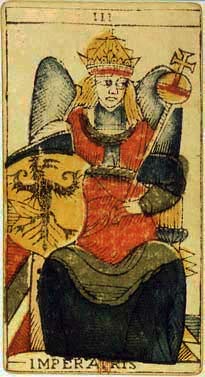
The traditional eikōn depicts a richly dressed woman adorned with the regalia of empire. In one hand she holds an oversized sceptre, the emblem of authority, whilst in the other she bears a shield displaying the imperial eagle. This is not Venusian imagery, nor is there anything to suggest motherhood or pregnancy. Instead, we are presented with a woman whose hands are already full. She is a figure of responsibility, governance, and practical engagement with the affairs of the world.

Significantly, the Empress faces the viewer directly rather than appearing in profile. This is a woman who meets our gaze. She is approachable, communicative, and fully engaged in her duties. She is capable of offering support, assistance, and guidance, but she expects clarity in return. Ambiguity, hesitation, and poor communication find little favour with her. She acts with purpose and efficiency and expects others to do the same.

When the Empress appears in a reading, it often heralds a busy period filled with activity, correspondence, meetings, and opportunities. Plans must be organised carefully and responsibilities distributed appropriately. Communication becomes essential, for there may be little opportunity to retrace one’s steps or correct misunderstandings later. The card frequently accompanies important news, announcements, or information which alters the direction of events.

Historically, an important function of a consort was intercession: the ability to appeal, mediate, and secure assistance on behalf of others. This aspect remains visible within the card. The Empress often indicates that help is available, provided one is willing to ask for it. Doors may be opened through diplomacy, introductions, recommendations, and well-maintained relationships. Success rarely comes through isolation.

This is the heart of the Empress. We live in an age of increasing solipsism, in which attention is directed ever more towards the self and ever less towards others. As our capacity to interact diminishes, misunderstandings multiply and progress becomes more difficult. The Empress stands as a corrective to this tendency. She reminds us that clear communication, co-operation, and meaningful engagement with other people are not merely desirable virtues, but necessities for success.

General: The commencement of a promising period of activity, growth, and new initiatives. The card often heralds important news, correspondence, meetings, or discussions that move matters forward. It signifies cooperation, effective communication, and the ability to bring people together for a common purpose. The Empress may also indicate an offer of assistance, an introduction, or someone willing to intercede on the querent’s behalf.

Love: The Empress promises comfort, companionship, and emotional fulfilment. Relationships are characterised by communication, mutual support, and shared objectives. The card frequently appears when partners are undertaking a joint venture, establishing a home together, or building a future as a team. For those seeking love, the Empress often signifies an introduction through friends, family, colleagues, or social networks. Rarely does the relationship arise in isolation; someone usually helps bring the parties together.

Career: The Empress is associated with professions centred upon communication and interaction, including journalism, public relations, marketing, publishing, editing, translation, broadcasting, and administration. It may also signify roles involving mediation, liaison, or client relations. For men, the card can indicate occupations traditionally associated with women, such as childcare, personal assistance, beauty therapy, hairdressing, and similar caring or supportive professions. More generally, success comes through effective communication and the ability to work with others.

Finance: Financial progress through networking, communication, and co-operation. Assistance or advice may be available from others. The card favours careful organisation and the sensible management of resources.

Health: Anatomically, the Empress is associated with the chest, breasts, ribs, and spleen. The card frequently points towards gynaecological matters, including menstrual disorders, cervical conditions, Bartholin’s cysts, and related concerns. It may also indicate illnesses more commonly encountered in women, such as hyperthyroidism and rheumatoid arthritis. More generally, the Empress advises attention to the body’s need for care, support, and proper maintenance.

Essence: Communication.
Function: Interaction.
Polarity: Neutral.
Astrological Association: Cancer.
Timing: July.

§

Tarot Cards: Jean Dodal Tarot via Wikipedia Commons. Public Domain.

Featured Image: Ancient Tarot Major Arcana © BP Grimaud/John Waddington Ltd, Leeds & London, Les Tarot de Marseille Jean Noblet, 1650 © Editions «letarot.com» (2001 [hand stencilled trumps]). Les Tarot de Marseille Jean Dodal, 1701 et 1715 © Editions «letarot.com» (2002 [hand stencilled trumps])