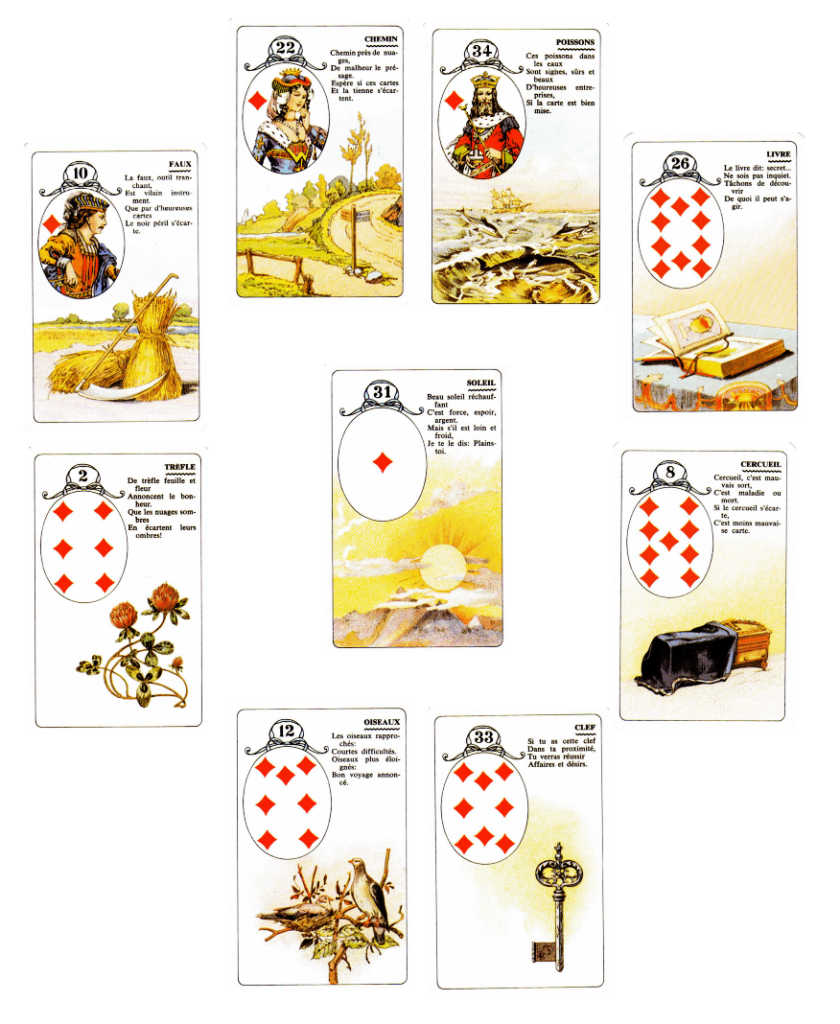
Knowing That Looks Can Lie

These days, one does not entertain much interest in the social networks and communities. Earlier this month, however, there was an interesting discussion concerning the directionality of the cartomantic values of the Lenormand.

Although the use of direction in the Lenormand is a topic that arises episodically, few readers ever discuss the regards of the honneurs. Of course, the silence reflects the fact that little attention is given to the very personage of the queen of hearts (the Stork) or the king of diamonds (the Fishes), let alone their eyes. The taciturnity of our references, here, thus matches that of the paucity of sources on reading the four valets as people.

However, there is some folklore to be found. Interestingly, just as with the directional traditions, we find the susurration focused on the persons found in the least wholesome of our four suits: the king of clubs (the Clouds), the queen of clubs (the Serpent), and the knave of clubs (the Birch Rod).
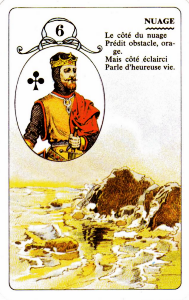
The Clouds is a card that causes much confusion for readers. Unfortunately, we live in a time that struggles to understand the differences between object and function, and cause and symptom. This is evident in all practices of modern divination.

Although the Clouds can leave one ‘confused’ and uncertain these are symptoms of the card, rather than cause. Does one become confused each time a cloud is seen in the sky? No. The Clouds is a disturbance in the environment that engulfs and obfuscates situations, and people, that can and does result in serious implications. Thus, the card functions much like cumulonimbus storm cells and dense fogs.

From the earliest times, the absence of light or its causes (eclipses, et cetera) were malefic omens. In agricultural societies, the weather can be destructive – ruining harvests, flooding homes, destroying crops. Cards engulfed in the Clouds’ fog become tempestuous and difficult terrain. It is for this reason that certain cards that deal with direction and precision – the Road and the Stars  – suffer so. The Clouds is thus the Lenormand Oracle’s greater malefic.

Traditionally, one judges the severity of the Clouds from the placement of the dark and light side of the clouds. However, there are Lenormand Oracles where no clear differentia exists, such as the traditional Dondorf pattern, or the more recent Maybe Lenormand. How does one thus judge the card’s effect?

If one has the good fortune to be utilising a deck with the full playing-cards, the dark clouds can be ascertained from the regard of the king of clubs. Without clear differentiation, the direction he faces can be taken as the darkest side, or the eye of the storm.

Certain sources, usually Anglo-Saxon, report that the direction the king of clubs faces is the light-side. Such reversals overlook the problematic nature of this figure and the power of the “gaze” (think of deochi/yakhalo and traditional aspect theories).

In the cartomantic tradition, the kreuz-könig is considered a man who is to be treated with extreme caution and a dishonest figure (as is his consort). He casts darks shadows wherever he encroaches. The German card-reader, Birgitt Kraheck-Liecke, described him as someone who does not put all his cards on the table, which echoes the Petit Lenormand tradition.

In the pairing of the Clouds and the Tree, we can see serious health concerns resulting in a touch-and-go situation. The client will find herself undermined and a disquieting in her affairs.

Certain Lenormand Oracles have designs that contradict this simple rule, such as Piatnik’s Mlle Lenormand Wahrsagekarten. Sometimes this is because the publishers changed the designs of the playing-card inserts.  In these decks, the regard of the card cannot be taken as the indicator of the dark side (image here trumps folklore), but the gaze still reveals from where the storm blows or the king of clubs’s focus or domain if functioning as a person.

We now reach the above’s divisive consort, the queen of clubs (the Serpent).
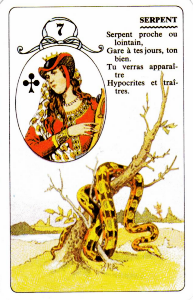
Like the king the Serpent has suffered much from the stressing of a symptom over the cause. Whereas the former had an acute case of confusion, here we have complications. Again the card can cause complications but that is a side effect. There is also an unusual inclination to interpret the card as a constricting python, rather than a likelier venomous species such as vipera ursinii[1].

For some, the Serpent is the mother or another maternal figure in the querent’s life. Such association derives from the Germanic kreuz-queen who, although sometimes interpreted as an older female, is still primarily interpreted – vis-à-vis the suit – as a woman from whom little good can be expected from (Kraheck-Liecke, 2008[2]). Without the direct presence of herzkarten, she is never kin. Such maternal significations become arbitrary when we notice that Lenormand readers do not elevate the kreuz-könig to a similiar paternal figure. As consorts, the king and queen should share such associations.

Although meadow vipers are known to be bad-tempered and aggressive, with quite toxic venom, it cannot bite unless one is in close enough proximity for the Serpent to strike. The malefic attributes of this particular queen focus on situations with close emotional ties denoting some form of close presence. Therefore, this is a woman one does not want too close – serpent in bosom – but can be and is neutralised with distance.  Nevertheless we must never forget that the Serpent keeps her belly and ear to the ground and therefore is wise and intelligent.

It may be that the queen is better viewed as someone with whom one exercises caution but suspicion must be balanced with respect. In the game, the regard of the queen of clubs can be used to ascertain what she withholds from you. Thus, the card she turns from can be read as what she hides from you, or lies about.

Perhaps we see the queen of clubs combined with the Heart card. The queen deceives us about how she feels.

We could read this as loving another (the Serpent ‘has’ the heart), seduction and enticement (including adultery or seducing someone with no real feelings for gain), as well as trust/relationship problems in general. This harmful encounter brings the Serpent’s venom greater toxicity (in health it is sepsis) and although a classical adultery indicator it also warns of toxic love-affairs and dangerous partners.

Our king and queen’s offspring is a similarly troublesome card.
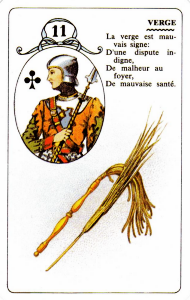
The knave of clubs (the Birch Rod) is a pugnacious figure but also a disciplinary one, associated with correction and lawsuits and thus well positioned in the game can prevent matters escalating into unmanageable conditions and hostility. He can also clear up affairs (besom). A less fortunate placed valet leaves one subject to scathing and hurtful slurs, violent outbursts and the general sense of feeling broken and beaten.

As such he has a dual nature: disciplinarian and aggressor. For fear of rubbing « la verge » up the wrong way, I will leave aside any potential phallic associations. Suffice it to say, there are readers who take this valet’s member very, very seriously. Personally, it’s a little too Freudian for me.

Quite often the reader can pinpoint the cause of tension (presence of a master card or the question posed). If, however, there is doubt it is useful to consider the card the knave of clubs looks towards. This card can identify what will anger our bellicose knave.

For example, we find the Key to the left of the Knave of Clubs. Does he find a solution disagreeable?

Therein lies the regards of the court of the clubs. As you can see, the regards offered details that were also consistent with the order. Herein lies an important directional lesson that will be touched on in future articles.

§

Notes:

Cards: Jeu Lenormand © Cartamundi (1982).

Title, taken from See All Her Faces by Dusty Springfield.  Featured Image, via Wiki Commons Antakya Archaeology Museum Evil eye mosaic Dosseman https://commons.wikimedia.org/wiki/File:Antakya_Archaeological_Museum_Evil_Eye_Mosaic_in_2019_08.jpg#Licensing

[1] During the Eocene Epoch, pythons were native to South-eastern and Eastern Europe. Although certain Lenormand Oracles have represented the Elapidae classes, the typical design is closer to the meadow viper native to Central, South-eastern and Eastern Europe.

The emphasis on the card’s proximity to the significator – a method built around the concept of direct or indirect engagement – mirrors the logical inferences of these species of snakes.

Johann Kaspar Hechtel could indeed have known what a python was; however I am quite confident they were still extinct in Nuremberg in the eighteenth century.

[2]Kraheck-Liecke, B. (2008). Birgitt Kraheck-Liecke [online].
The Kinship of Suits

A traditional, 36-card Petit Lenormand contains several different divisions and rankings:

  • A spectrum of positivity and negativity, which relates to facilitation and ease.
  • Classification as either a significator, carte maîtresse, or carte d’ambiance which determines a player, life area, and the atmosphere and circumstances.
  • Thematic fraternity which links cards through leitmotifs, such as the celestial cards and the communicational cards.
  • Whether the cards’ emblem shows an animal (agency), verdure (amelioration), object (whatchamacallit), environment (place).
  • Directional cards, such as the Coffin or the Mice cards, that have an added nuance or emphasis determined from their iconography.

As the reader progresses and gains experience, these different classifications and groupings take on greater importance. However, one of the most visible and most significant rankings is both presently underplayed and ignored. This downplaying contributes to a severe weakness in the cartomante’s utilisation of the Lenormand.

I am referring here to the couleurs/ enseignes françaises, or suits[1].

Our Lenormand Oracle is comprised of thirty-six playing cards. It is important for the reader to recognise this classification. We are not with the Kipperkarten or l’oracle de la Triade classification of oracles. The Lenormand Oracle is of the same family as the le petit cartomancien or l’oracolo della Vera Sibilla.

The dominant Anglo-Saxon literature portrays the playing-cards as an arbitrary association, or distractive motif. However, this is not so. The Boat is the Ten of Spades, and the Ten of Hearts is the Dog. The two are one.

As such, the savvy reader recognises and remembers that there are four realms: clubs, diamonds, hearts, and spades. These are committed to the mind and are exploited.

Each realm contains nine cards: ace, king, queen, knave, ten, nine, eight, seven, and a six.

Cards within a realm share an affinity or kinship with each other.

The four aces each have dominion over their respective families. For example, the Sun card (Ace of Diamonds) is a yellow dwarf star and the gravitational centre of the solar system and provides food energy (photosynthesis), warmth, light and the precipitation needed for life. Thus, it is often held to be the luckiest card.

Similarly, if one considers the clubs, we see a domain of toil, effort, and pressure, that befits a family of the melancholic persuasion. The Ring (the Ace of Clubs) ties one to obligations, and where one is obligated, one expends energy. Plus, as the busy fortune-teller can attest, relationships are often hard work. It heads eight cards that bring riches and losses, answers and choices. In the Lenormand, this is the family of capricious fortune and one that requires a cool head and clear-sightedness.

To understand these relationships, the student is invited to put the four aces in front of them and deal the remaining eight cards around their chieftain.

Now we come to the two premier suits: the hearts and the spades. The two aces, here, are the primary significators, the Lord and the Lady. Dependent upon their gender and providing that they are over the age of sixteen – in which case they take the valet of spades, regardless of gender – the client, or person of interest, will take one of the two aces for themselves.

We do not know where the Lenormand’s creator, Johann Kaspar Hechtel[2], took all his inspiration. It is common in Germanic practice to utilise the heart courts for both male and female clients. However, much like Etteilla, Hechtel associated hearts and spades with men and women, respectively.

Thus, in the Lenormand Oracle, a client becomes affiliated with one suit. Within the reading, this association can orient the game in several ways:

The spades and hearts suit are the maternal and paternal line of the client’s heritage. Such a division can determine the origin of a legacy and inheritance, or genetic disorders and inherited diseases. The information is revealed by the encounter of the appropriate suit with the cards in question, e.g. the Lilies (King of Spades) found directly below the Tree (Seven of Hearts) is a maternal inclination.

Dependent upon context our two suits also denote consanguinity (the suit of the significator), or a relative by marriage (the suit of the partner). This can be useful in determining allegiance or hindrance (the clichéd madame Tremaine or Carabosse). It can also tell us about the birth-family, and the adoptive-family.

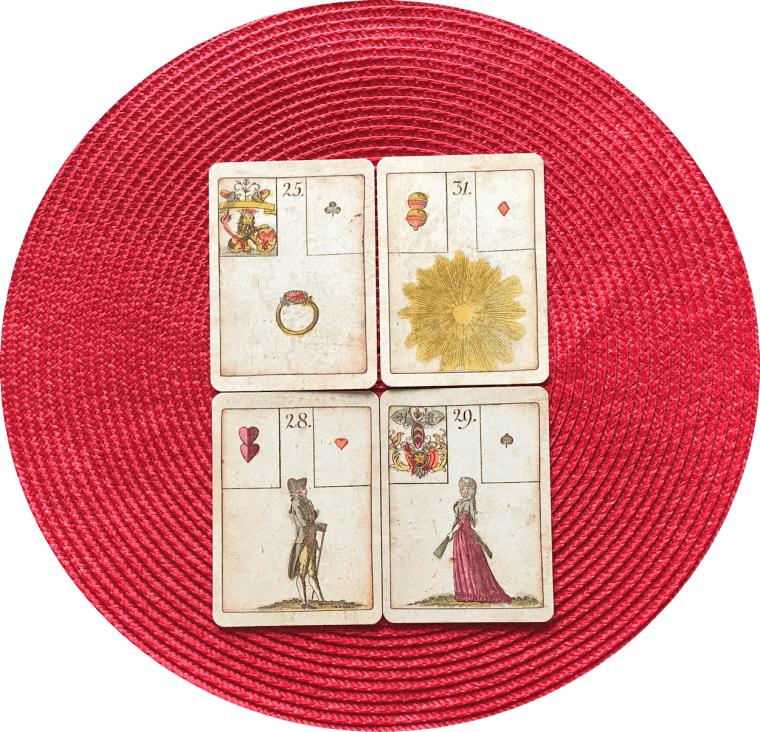
If the reader utilises cards with the appropriate full playing-cards, the regards of the kings and queens can show goodwill, or enmity.

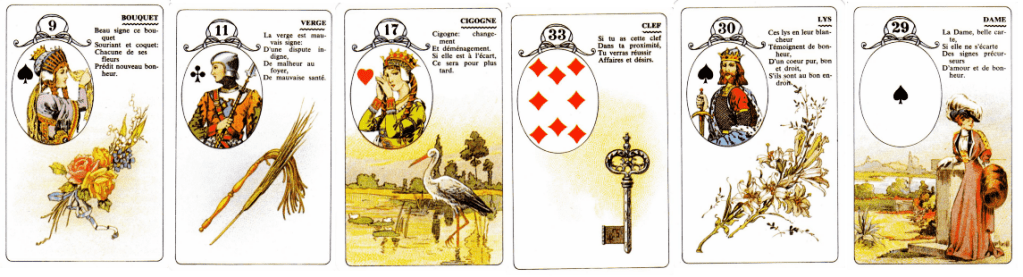
To illustrate this concept, I present an extract of a client’s reading. It is the main past-line for a female querent, represented by the Lady.

We see, here, that the Bouqet (Queen of Spades) and the Stork (Queen of Hearts) chain the Birch Rod (Knave of Clubs). Both Queens regard each other. Two women, one of the client’s own house, are in conflict. The client turns away, putting the battle in her past.

The woman in question had become engaged to a man of different ethnicity and creed. Organising the wedding had resulted in considerable opposition between the mother of the bride and the mother of the groom. A solution had come via the petition of a third party, resulting in appeasement of sorts. Such action is seen quite clearly in the Key securing the Lilies.

The Lenormand has several layers of interpretation that are revealed through practice and explored by the attentive reader in their usage of the cards. Do not let your eyes deceive you, keep them on the pips. They are there for a reason. As any real diviner knows: nothing on the card is irrelevant.

§

References:

Cards: Jeu Lenormand © Cartamundi (1982). Header: User:Duja – Wikimedia Commons

[1] It is not within the scope of this article to discuss the pictorial differences of the Germanic pattern and the French pattern, or the associations. I have therefore used the Anglo-terminology for the suits as a neutral term.

[2] Johann Kaspar Hechtel, creator of the Das Spiel der Hoffnung, motivations and inspirations are unknown. We have no primary sources from Hechtel and assertions that he adapted the so-called Coffee Cards are derived through similarity alone, and not historical fact. It is clear that he was aware of the suit associations; however, as these associations were primarily seasonal (ace of acorns is winter as still evidenced on Hungarian examples), we should exercise caution with attributing motivation.

L’Amour Blea: Grand Tableau

The entry you are about to read first appeared on NéosFortune, in May 2017.

I have been getting to know a junior doctor, hereafter called Hugo. Hugo was intrigued to learn that I read the Lenormand Orace as these are the cards read by one of his mother’s friends, back in Martigny (Switzerland). After dancing around the issue, Hugo eventually asked me if I would ever read for him. He wanted to know where his boyfriend stood on their relationship.

My office is on the top floor of a now little-used area of a 1930s building, that is said to be haunted (but that is for another post). This means few people come up to see me especially after 6 p.m. when I am often still working. In my top drawer, I keep a Lenormand Oracle which is small enough to both go unnoticed and be spread on a desk.

Firstly, let us consider what Hugo is asking us to answer. He wants to know where his ‘boyfriend’ stands on their relationship. Although Hugo is the person asking the question, it will be the boyfriend’s tableau. The boyfriend, therefore, is the Lord-card and Hugo the Cavalier[1].

Hugo’s question also asks where the Lord-card stands ‘now.’ That inference necessitates the introduction of an epochal scheme. For me, in this structure, what is to the left of the significator, is the past, and what is to the right, is the future. We, however, do not stop there. A full reading requires that we read the cards, not just left-to-right, but also in a helical formation. I include a complete example in my book[2]. For privacy reasons, at Hugo’s request, I omit the step in this post.

Here are five key steps followed. In this post, I will, however, not present them in sequential order. I do this to avoid repetition and to an enhance flow.

A QUICK BREAKDOWN:

  1. The most important thing always is the keep the focus on the cards, not the techniques. Let your eyes wander over the tableau; it’s the big picture, after all. What is going on? Where are the players? Are they near to each other, or far? How are things engaging? That is an important step, as it trains the brain to see the real picture (the process of intellection).
  2. I note the trigger card (first card) and read it with the two cards that follow it. I see the first three cards as a direct message, a terse statement, on the current state of affairs. Consider these in isolation first. Then they can be regarded in the wider context.
  3. Read the four corners, as these frame the situation, by showing dominant influences. I recommend reading them both diagonally and, again, in a helical manner.
  4. Read the present, the past, and then the future lines. If you require further information on a card (often the last card in a line, if it ends on an ambiguous note, e.g. the Clouds, the Fox, or the Ring), you can count on to the ninth card, and then to the thirteenth card. You then have three cards to read as an additional sentence.
  5. The final four cards are the quintessence, or perhaps best seen as the root or triggering events. You can expand on these, noting a degree of causality, by reading cards 33 and 34 with cards 27 and 28 and then cards 5 and 6. Cards 35 and 36 will be read with cards 29 and 30, and then cards 3 and 4.

Now to the tableau: ‘Where does the Lord currently stand in the relationship with Hugo?’

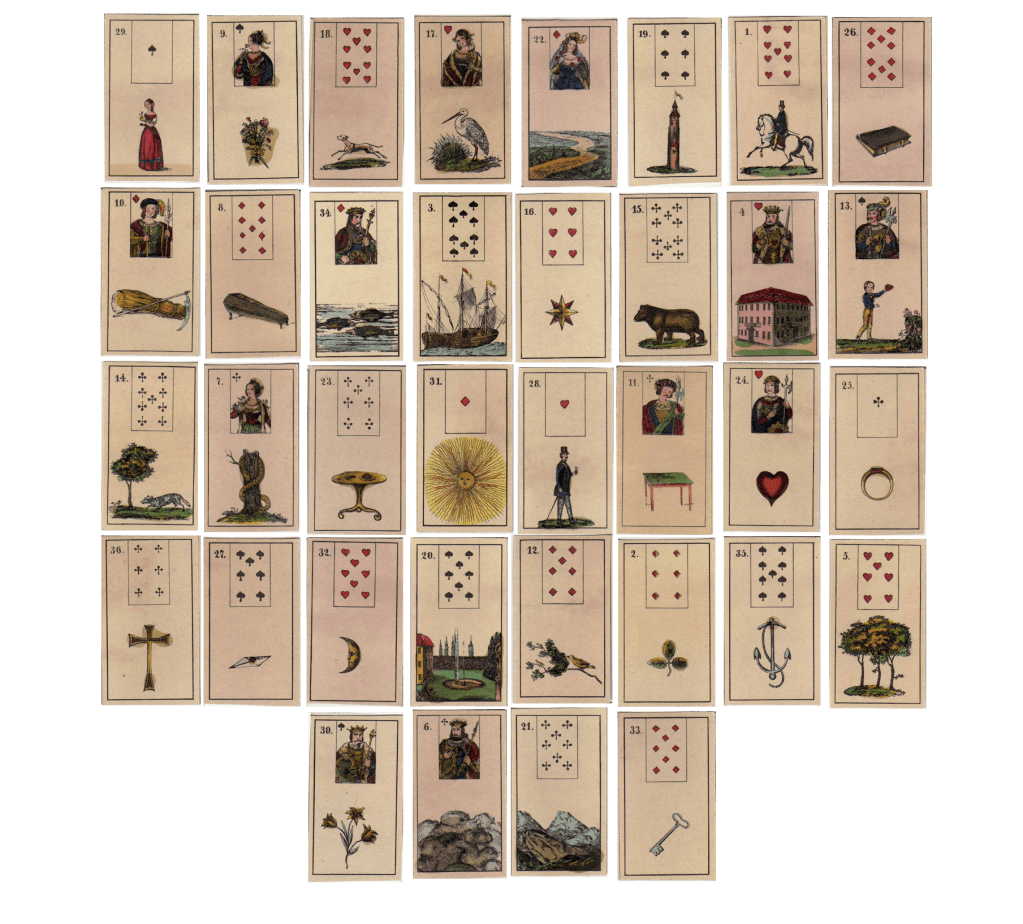
The cards as they fell:

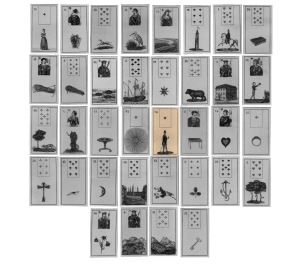
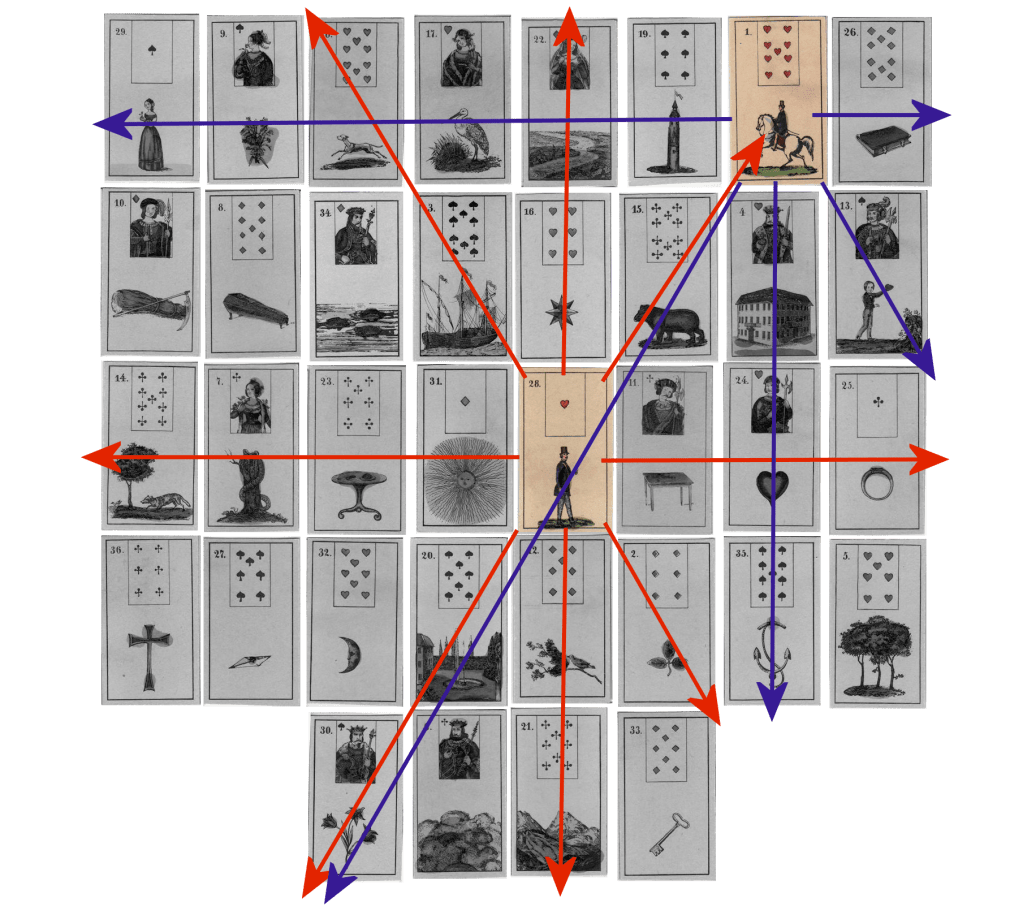
Cards: Lady, Bouquet, Dog, Stork, Roads, High Tower, Cavalier, Book; Scythe, Coffin, Fish, Ship, Stars, Bear, House, Child; Fox, Serpent, Mice, Sun, Lord, Whip, Heart, Ring; Cross, Letter, Moon, Garden, Birds, Cloverleaf, Anchor, Tree; Lilies, Clouds, Mountain, and Key.

Schematically, this is an interesting picture. It is, at first glance, well-balanced. The Lord-card has four cards to his left and three to his right (four thus being the farthest, see below right). There are two rows above him, but just one below. So the past is heavier. Ahead of him is both the Heart and the Ring. Some would rejoice. However, dear reader, before we prepare our confetti, I see the path to the Heart is via the Whip (which connects, obliquely, to the Birds at the Lord-card’s feet – stressed and upset people lash out). But what is more interesting is the appearance, right at the start, of the Lady-card. And this Lady occupies Hugo’s natural position (that of the Cavalier). As said before, some would like to see the Lady-card as Hugo. But, alas, when I checked he had trousers on not a dress.

In a draw, the first card dealt is always the trigger card. It tells you about an event or dynamic that has triggered events discussed or elaborated on in the other cards. It’s thus the starting point, the project at hand. Here, we find the Lady. Having a person card fall first can be likened to a conductor (which is more evidenced when we consider the corners). But let us return to the task at hand. What statement is made by the first three cards? A woman proffered (Bouquet) the hand of friendship (Dog).

Now, where does the Lord-card stand in this relationship? Presently, he is divided about what direction he wishes (Stars) it to take long-term. The Paths, which crown the Lord-card, always carry a degree of conflict over which direction to choose. The High Tower is a difficult card in a relationship, as it can presage a robust and stable outlook or conflicting self-interest. Paired with the Paths, it shows indecision and self-doubt about what one wants long term preventing progress. Sadly, with the Storks involved, this is: ‘Should I stay, or go?’ The Lord-card is considering if he’s better off flying solo. So it’s not surprising to find he is presently stressed and upset and feels like he is banging his head against a brick-wall (Birds and Mountain).

Note the Ship right next to him, he’ll be off soon.

The future doesn’t look too promising. Obviously, the Ring is the relationship, but it is also the card of repetition and going-round-in-circles. Following the Whip and Heart, it shows recriminations and passionate disputes, even controlling behaviour, that does not have an end in sight.[3]

The cause of this lies in the past. There is a clear sign of misplaced trust and betrayal (the Fox, the Serpent, the Mice). Our Lord survived to fight another day but felt drained rather than victorious (we find the Mice with the Serpent and the Sun either side).

In love, the Fox, a charming and skilled seducer, always warns of the risk of being cheated, and the Serpent, emotional wrangling, and perfidy. If we look closer at the two cards, we can see the Serpent mirrors the Heart, in the future, showing the venom is still to be felt as keenly tomorrow. Is this the right relationship, the Fox asks?

Now, from where did all this start? Some might point the finger of suspicion at the Cavalier. He sits in the Serpent’s house, after all. Such is a misunderstanding of the houses: the Cavalier is unjustly constricted by the Serpent, as he is its guest.[4]

We cannot directly connect the Serpent to anyone, other than the Lord-card. However, the Fox combines with both the Lord-card and the Lady-card, who indirectly relates to the Serpent vis-à-vis the Bouquet and the Fox (knighting, an indirect correlation). A closer inspection of the Lady-card confirms this. Her vertical line shows the serious harm and damage caused through deceitful actions (the Scythe, the Fox, the Cross). The horizontal line and chain indicates her exit, stage left, occurred at the appearance of Hugo. The Lady-card and the Cavalier meet in the clouded Garden, also, from which we can infer that the did not ‘click.’ In her negative aspect, the Serpent is a seditious figure who is very fond of spreading poisonous words and likes to isolate people from her prey. This is borne out here across the tableau.

Although this Lady has – quite clearly (if we consider the diagonal and horizontal lines) – left the Lord’s life, where he stands is directly in her wake. The four corners beautifully reiterate this: the Lady-card causes long-lasting grief (the Lady, the Book, the Tree, and the Cross) which means she cannot be forgotten (the Lady and the Tree) and that’s a painful lesson to digest (the Book and the Cross).

What can say about the Lord-card and his Cavalier? Imagine drawing an ‘+’ and an ‘x’ from both cards and see where they meet. Here that is the Dog, the Bear, and the Heart.

The Bear’s essence is power, and this manifests as strength, authority, and courage. In love, this can be felt somewhat heavily, but it is sincere and reliable (emphasised by the Heart). If we look at the Bear, we can see the strong potential for a fresh start in their personal life (horizontal line). But the Lord needs to do some serious thinking (the Paths).

Looking at the last four cards, what can we see? The Mountain adds greater density or an opaque look to the Clouds. It thus makes it harder to see a solution (the Key) to the current upset (Lily, clouded). This is further evidenced by the additional pairings, most notably the Birds and the Cloverleaf. But there is a solution.

If we return to the Ring, we can count to the ninth and then the thirteenth cards. That gives us the Ring, the Tree, and the Key. From this, we infer that the relationship can be fixed (Key). The Tree encourages taking some time out and contemplating the situation more neutrally. A holiday may be the answer (remember the Ship?).

So, to summarise, the cards say that the Lord stands at a crossroads considering whether it would be better for him to call a day on the relationship or invest enough time to sort it out.

As you can see, reading for a same-sex or gender couple is no different than reading for a straight couple. Both need to be open to parties of the same and other gender. Hence why I do not replace the Lord-card or Lady-card or pretend them to be genderswapping entities.

§

Cards: The Lenormand Oracle © Verlag für die Frau, Leipzig (1982).
Featured Picture: Copyright The Tuke Collection / Supplied by The Public Catalogue Foundation

References:

[1] There are several differing viewpoints on the topic of significators in same-sex relationships.
[2]Boroveshengra, A. (2015). Lenormand Thirty-Six Cards: An Introduction to the Petit Lenormand. 2nd edition. CreateSpace. Pages, 181 – 202.
[3]In such circumstances counting can help. The ninth card from the Ring is the Tree, and the thirteenth card is the Key.
[4]A house is a domicile. It has four walls. If you find yourself in the Coffin’s house, you’re sleeping in a casket. In the Fox’s den? Think Jemima Puddle-Duck.