Editorial Note: This article was originally written during a period in which I was experimenting with whole-sign houses. It is presented substantially as originally written.
One of the most common misconceptions about horary astrology is that judgement consists merely of locating an aspect between two significators and pronouncing a simple yes or no. If the ruler of the ascendant applies to the ruler of the seventh, the answer is yes; if not, the answer is no.
The reality is rather more nuanced.
Aspects themselves have several layers of meaning that must be considered: application and separation, frustration, prohibition, collection and translation of light, reception, and a host of other factors. A chart may indicate the perfection of a matter whilst simultaneously showing obstacles, delays, or even a subsequent change of circumstances.
A horary consultation from earlier that year serves as an excellent illustration.
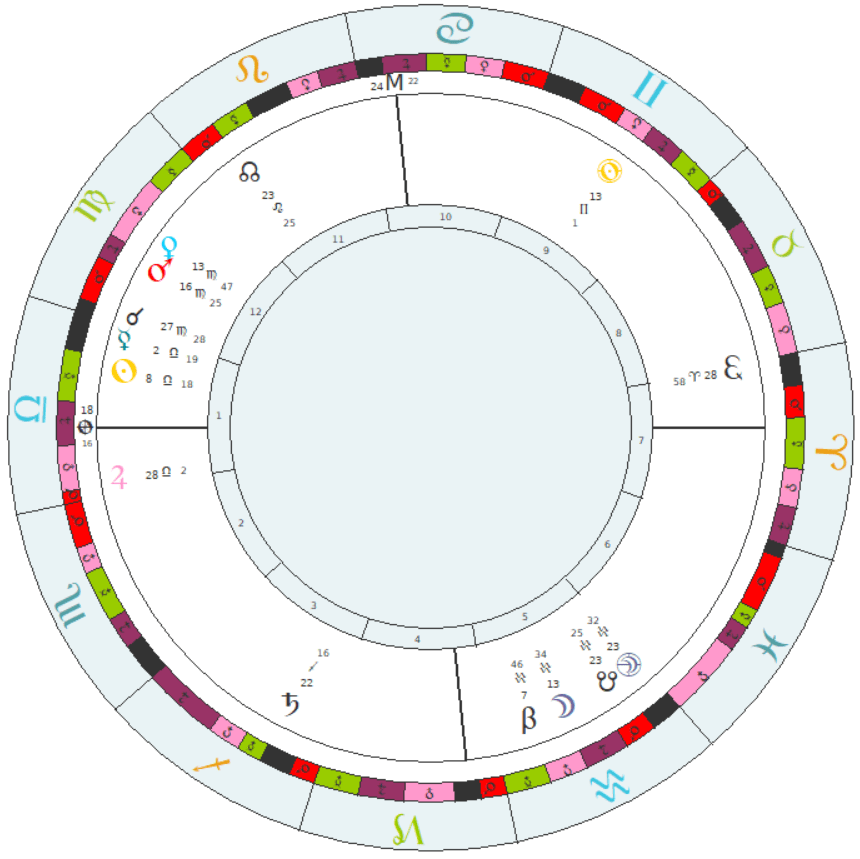
The querent, Dimitra, wished to know whether she would be offered a position for which she had recently been interviewed.
I cast the chart for the time and date at which I read and understood her question. The figure was displayed using house division; however, my topical analysis was conducted using whole-sign houses.
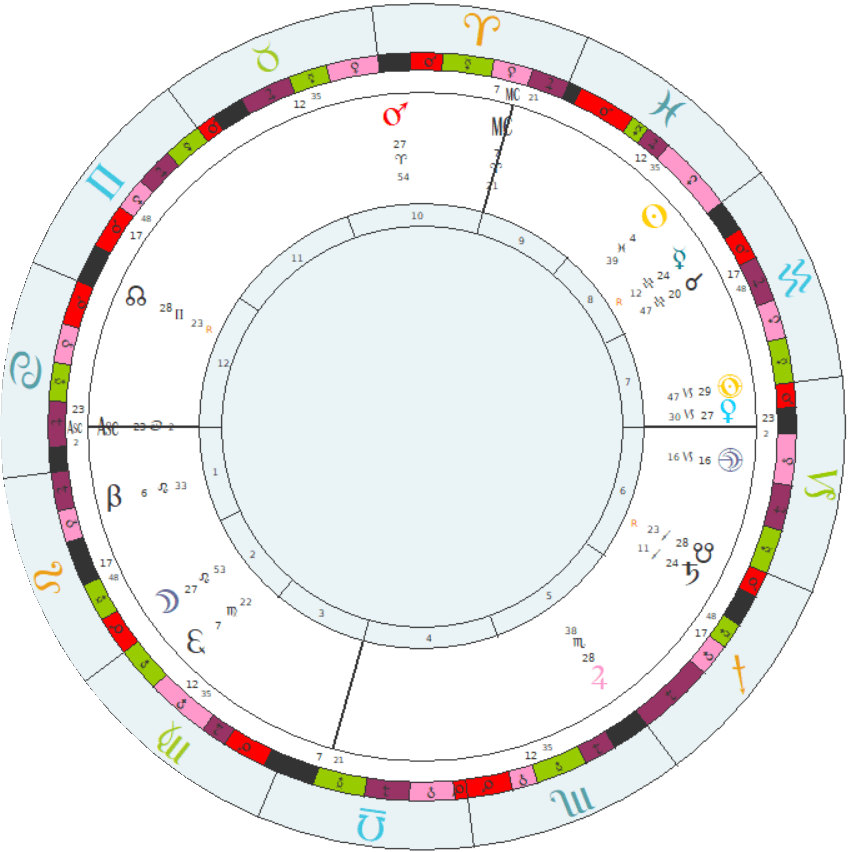
In horary astrology, the rising sign and its ruler signify the querent. The matter being enquired about—the quesited—is represented by the appropriate house and its ruler. The Moon, as the general significator of events and developments, may also co-signify the querent provided she is not simultaneously ruling the quesited.
Cancer rises in this figure, making the Moon Dimitra’s principal significator.
In terms of the considerations before judgement, the chart is radical. It was cast during the hour of the Moon, who both rules Cancer and serves as one of the triplicity rulers of the water signs.
The Moon is placed in the second house and is therefore in aversion to the ascendant. When the querent’s significator is averse to the first place, we may conclude that the matter is not entirely within the querent’s control.
As part of my practice, I also examined the twelfth-part of the ascendant, which falls at 6° Aries in the tenth place. Employment is a tenth-house matter1. According to Hephaestion of Thebes, the twelfth-part associated with this portion of Cancer concerns “rulership and rank and a priesthood and what is like that2.” Whilst not decisive in itself, such testimony is certainly relevant given the nature of the enquiry.
The central question, however, remains straightforward: will Dimitra be offered the position?
To determine this, we must establish whether there is a means of bringing together the querent and the quesited. This may occur through direct application between significators or through a translation of light.
The answer appears immediately.
The Moon, signifying Dimitra, is at 27° Leo. Mars, signifying the position itself, is at 27° Aries. The two are joined by an exceptionally close trine, with less than a degree remaining before perfection. This detail is important, for the aspect is still applying. Had the trine already separated, it would instead suggest parting: rejection, withdrawal, dismissal, or a conclusion already reached.
At first glance, therefore, the answer appears to be yes.
Yet judgement does not end there.
The next step is to determine whether the Moon perfects another aspect before reaching Mars. Were there such a planet, the trine could be frustrated. In this chart, no such frustration occurs. Mars is not stationing, nor is there any prohibition arising from retrogradation. Whilst the Moon eventually squares Jupiter, that aspect perfects only after the trine to Mars and is therefore irrelevant to the immediate question.
A more intriguing consideration lies elsewhere.
The Moon is at 27° Leo and has fewer than three degrees remaining before entering Virgo. As the Moon is the swiftest of the seven traditional planets, this change occurs quickly. Once in Virgo, she becomes averse to the tenth place.
In my experience, this is highly significant. Although the querent obtains the desired object—in this case, the offer of employment—she subsequently turns away from it. Such testimony frequently indicates a decision to decline an offer or pursue another opportunity.
We may also note that the Moon’s previous completed aspect was a trine to Saturn. Saturn rules both Capricorn and Aquarius; here, Capricorn occupies the seventh place, signifying competitors or other candidates. Technically speaking, this represents a translation of light between Saturn and Mars by way of the Moon.
Dimitra’s question was not whether she would accept the position, however. It was whether the position would be offered to her.
My judgement was therefore affirmative.
I also advised her that the chart suggested she would ultimately decline the role and that it would subsequently pass to another candidate.
That is precisely what occurred.
Shortly after receiving the offer, Dimitra was presented with a more attractive opportunity by her existing employer. Once the Moon enters Virgo, she begins to apply by opposition to the Sun in the ninth place. The Sun is both exalted ruler of the tenth and one of its triplicity rulers, further describing the alternative path that eventually emerged.
Because the trine between the Moon and Mars was so close to perfection, I further advised Dimitra that she was likely to hear the outcome extremely quickly. The chart was cast at 14:10 in London. Two days later, she informed me that the offer had arrived that very evening and that she had formally withdrawn two days afterwards.
I sought Dimitra’s permission to publish this case following a discussion with one of my Tarot de Marseille students who had recently begun exploring horary astrology. During the conversation, the student suggested that horary amounted to little more than locating an aspect and declaring a positive or negative outcome.
The belief is not uncommon.
It is, however, mistaken.
As this example demonstrates, meaningful judgement requires consideration of numerous factors. Nor are all horary questions judged in precisely the same manner. A chart concerning employment differs substantially from one concerning illness, a missing object, or allegations of malefic magic.
For those interested in studying horary astrology, there are many worthwhile starting points. I began with Derek Appleby, Olivia Barclay and William Lilly’s Christian Astrology (Books I and II)3. Today, I would also recommend John Frawley’s The Horary Textbook and Christopher Warnock’s Horary Case Book. My own favourite authorities, however, remain al-Kindī4 and Sahl5, particularly in Benjamin Dykes’s translations. Dykes’s translation of Bonatti6 is also highly recommended.
§
References
Featured image: Jacopo188, CC BY-SA 3.0 https://creativecommons.org/licenses/by-sa/3.0, via Wikimedia Commons
Chart generated using Delphic Oracle.
Notes:
- During the twentieth century, it became fashionable to associate employment with the sixth place. Such an attribution has little basis in the traditional sources. Averse to the ascendant, the sixth is known as the Place of Bad Fortune and is associated with slaves, illness, injury, enmity, and affliction (Brennan, 2017; Valens, Anthologies). Modern astrologers frequently attempt to whitewash the ancient designation of “servants” as “service,” and from this conclude that employment ought to be judged from the sixth place. This is an entirely erroneous assumption. It is both historically anachronistic and culturally relativistic, presupposing that employment is fundamentally an act of service. The ancient sources make no such argument because they possessed sufficient common sense to distinguish between the native and the native’s servants. The slaves signified by the sixth place belong to the native; they are not the native himself. Consequently, however humble one’s occupation, the tenth place remains the proper house of profession, office, advancement, reputation, and employment, whilst the sixth more naturally signifies those over whom one exercises authority or responsibility. ↩︎
- Hermann of Carinthia and Dykes, B. (2011). The Search of the Heart. Minneapolis, MN: Cazimi Press, p. 201. ↩︎
- Lilly, W. and Roell, D. (2004). Christian Astrology. Bel Air, MD: Astrology Classics. ↩︎
- Dykes, B. and al-Kindī (2011). The Forty Chapters of al-Kindī. Minneapolis, MN: Cazimi Press. ↩︎
- Dykes, B. (2011). The Book of the Nine Judges. Minneapolis, MN: Cazimi Press. ↩︎
- Bonatti, G. and Dykes, B. (2010). Bonatti on Horary: Guido Bonatti’s Book of Astronomy, Treatise 6: On Questions. Minneapolis, MN: Cazimi Press. ↩︎
 Journal of a Cartomante