On Reading: Eikōn, Essence, and Function

Before proceeding further, it is worth briefly explaining three terms that recur throughout my articles on the Tarot and Petit Lenormand: eikōn, essence, and function. Together, they form the foundation of my approach to cartomancy and interpretation.

Eikōn

The word eikōn is Greek and simply means image. My use of the term, however, owes much to the Christian tradition of iconography.

Growing up with an exposure to Eastern Catholic and Orthodox influences, religious icons were a familiar sight. Over time, I developed a deep appreciation for the Byzantine tradition and the remarkable skill of iconographers. In that tradition, an icon is not merely a picture. It is “written” according to established rubrics in which colours, gestures, posture, clothing, objects, and composition all possess meaning. These individual elements combine to create a living image that communicates a story, truth, or mystery.

When I began studying the Tarot, particularly the Marseille tradition, the similarities struck me immediately. Like an icon, a Tarot card presents a complete image whose meaning emerges through the interaction of its various parts. The image speaks as a whole.

Christ in Majesty. Note the similarities to the Tarot’s Le Monde Card.
Metropolitan Museum of Art, CC0, via Wikimedia Commons

What I found less convincing was the dominant deconstructive approach employed in many modern Tarot books, where individual symbols are isolated from their wider context and elevated above the image itself. One reader may focus upon a hat, another upon a shoe, whilst someone else becomes preoccupied with the colour of a sleeve. Valuable insights can certainly arise in this way, but the danger is that the card ceases to function as an integrated image and instead becomes a collection of disconnected details. Meaning becomes increasingly subjective and, ultimately, relativistic.

The gestures of the Juggler mean little outside the context of the entire card. Likewise, the direction in which the Ship sails only acquires significance when considered within the wider image and narrative. The whole must always remain greater than the sum of its parts.

Tiberio of Assisi, St Clare of Assisi, CC0, via Wikimedia Commons

Whilst reflecting upon this, I am reminded of Saint Clare of Assisi’s visual approach to prayer, often summarised as gaze, consider, contemplate, and imitate. A visual form of Lectio Divina. It seemed to me that a similar method could be applied to the Tarot. One first observes the image, then reflects upon its meaning, contemplates its deeper significance, and finally applies its lessons to life.

For this reason, I prefer to think of the cards as eikōnes rather than collections of symbols. Each card should be approached as a complete image revealing a story and a principle.

I have deliberately chosen the Greek eikōn rather than the English word icon. Given the mixed reactions many people have towards Christianity, and despite the Tarot’s profoundly Christian origins, the Greek term provides a more neutral expression whilst still preserving the connection with the iconographic tradition from which my thinking developed.

Whilst the cosmological framework used throughout this work owes much to Aristotle and medieval natural philosophy, my approach to interpretation is more heavily influenced by the Christian Neoplatonic tradition. Both viewed the visible world as participating in deeper truths that transcend mere appearances.

The Tarot card is therefore not approached simply as a collection of symbols to be decoded, nor as a puzzle whose meaning is constructed from isolated details. Rather, the eikōn is treated as a unified image revealing an underlying reality. The image points beyond itself without ceasing to be itself. In this respect, the Tarot card functions much like a religious icon, inviting contemplation of the principle it expresses.

The famous Sinai Pantrocrator reveals Christ’s Dyophysitism: God and Human.
Saint Catherine Monastery, Public domain, via Wikimedia Commons

Amongst the figures who have most influenced my thinking in this regard are Saint Augustine, St Benedict, Marsilio Ficino, Giovanni Pico della Mirandola, Thomas Merton and Brian Williams. Despite belonging to very different periods, each recognised the importance of contemplation, discernment, and the search for truth beneath appearances. Their writings encouraged me to approach the Tarot less as a collection of signs and more as a series of images revealing enduring principles.

Essence

If the eikōn is the image, the essence is the fundamental principle or mystery expressed by that image. The essence is not a keyword, nor is it a summary of every possible meaning attached to a card. Rather, it is the card’s underlying nature. It answers the question: what is this card?

My own understanding of essence emerged gradually through the study of Tarot and the Petit Lenormand. When I first learnt to read cards, keywords played little or no role. Instead, attention was given to the nature of a card and how it behaved in different circumstances (order, whether it was near or far, et cetera). It was only later, upon reading modern Tarot literature, that I encountered extensive keyword lists.

Whilst keywords can be useful as memory aids, I often found myself struggling to understand why particular words had been selected. Vocabulary is shaped by culture, language, generation, and personal preference. One author’s keyword might differ entirely from another’s, despite both discussing the same card. The result was often a sense of arbitrariness and made more difficult by my dyslexia.

Over time, I began to notice that things possess an underlying nature that makes them what they are. This differs from a purely symbolic approach in which a card merely stands for something else. The Hermit is not a symbol of prudence. The Hermit is prudent. Prudence belongs to his nature and is therefore expressed whenever he appears.

Matfre Ermengaud di Béziers, Public domain, via Wikimedia Commons

This understanding owes much to the Neoplatonic tradition, particularly as filtered through Saint Augustine and the Renaissance philosopher Marsilio Ficino. Both viewed visible things as participating in deeper realities rather than merely representing them. A thing possesses a nature which allows it to remain itself whilst simultaneously connecting it to broader truths.

In this sense, the essence is not a keyword attached to a card. Nor is it an abstract label. It is the card’s essential self: the underlying principle that unites all of its manifestations and gives coherence to its meanings.

This understanding also emerged naturally from my use of the eikōn. The eikōn reveals the essence. By contemplating the image as a whole, one arrives at the principle that animates it. The image is not merely a collection of symbols; it is the visible expression of an underlying nature.

The Hermit provides a useful example. Prudence is not one meaning of the Hermit amongst many; it is the principle from which the others arise. Whether the Hermit appears as caution, discretion, reflection, solitude, age, experience, patient guidance, or careful planning, prudence remains the common principle linking these manifestations together. Prudence is the Hermit’s essential self. Without prudence, the Hermit would cease to be the Hermit.

Similarly:

  • Justice is Verity.
  • The Pope is Wisdom.
  • The Hound is association.
  • The Fishes is abundance.

Every subsequent meaning associated with a card should arise from that central principle. The essence prevents the card from becoming a collection of disconnected keywords and instead allows its meanings to remain coherent and rooted in its nature.

In this respect, the essence acts as a thread running through every interpretation. It keeps the card unified, ensuring that however many manifestations it may possess, it remains recognisably itself.

Before proceeding further, I should briefly clarify a point of terminology. I am always pleased to see readers engage with and discuss the concept of essence, especially as it has become a useful part of the vocabulary surrounding this type of work. However, I have occasionally noticed the term being used somewhat differently from how I originally intended it. Essence is sometimes treated as little more than a refined keyword or summary phrase. Whilst this is understandable, it is not quite what I mean. A keyword describes a card; an essence reveals what the card is. It is not simply a convenient label attached to a collection of meanings, but the card’s underlying nature and identity. The essence of the Hermit, for example, is not merely a word chosen to summarise the card. It is the principle that makes the Hermit recognisably itself and from which all of its manifestations proceed. In this respect, essence is less a description than a revelation. It seeks to identify the card’s true nature rather than merely describe its appearances.

Essence should therefore not be understood as the most important keyword attached to a card or a vibe or spirit. Keywords remain descriptive; essence is ontological. It concerns the card’s being rather than its attributes. The question is not “How might this card be described?” but “What must this card be in order to be itself?” The answer to that question is what I mean by essence.

Function

If essence describes a card’s nature, function describes its action.

How does this principle operate?

Where essence is relatively static, function is active. The two are inseparable. A card’s function must arise naturally from its essence rather than being imposed upon it from outside.

If the essence describes a card’s nature, the function describes the activity proper to that nature.

For example:

  • Justice is verity that balances.
  • The Pope is wisdom that mediates.
  • The Hound is association that supports and assists.
  • The Fishes is abundance that circulates.

The function therefore represents the manner in which the essence expresses itself. Wisdom may manifest in many ways, but it always mediates between ignorance and understanding. Renewal may appear in many forms, but it always guides growth and recovery. Prudence consistently operates through discernment. The essence remains constant; the function explains its activity.

In many ways, function can be understood through a simple analogy. We understand a knife not merely by what it is, but by what it is for. The proper activity of a knife is to cut. Likewise, we understand a Tarot card more fully when we know both its nature and its operation.

Knowing what a card is allows us to identify it; knowing what it does allows us to interpret it.
Function becomes particularly important when we arrive at what I call the Progressed Meaning.

The progressed meaning is the practical interpretation that emerges during a reading. It is not the essence alone, nor the function alone, but the essence functioning within a specific context.

In other words:

Progressed Meaning = essence functioning in context

or, if one prefers:

Progressed Meaning = essence + function + context

Consider the Hermit. His essence is Prudence and his function is to Discern.

When interpreted in a love reading, we do not suddenly abandon prudence and begin inventing entirely new meanings. Rather, we ask how prudence functions through discernment within that context. The progressed meaning becomes caution, taking time to know another person, exercising discretion, or carefully evaluating a relationship before making commitments.

Likewise, in a business reading, the Hermit may advise reviewing evidence carefully before investing. In a health reading, he may indicate the need to seek additional information before proceeding with treatment. The manifestations differ, but the underlying principle remains unchanged. Prudence continues to operate through discernment.

The same process applies to every card.

Consider the Star. Its essence is Renewal and its function is to Guide. In health, it may indicate recovery and convalescence. In finances, gradual improvement. In relationships, reconciliation and rebuilding trust. In each case, renewal continues to guide circumstances towards restoration.

Death provides another useful example. Death is Demise that Terminates. In a relationship, this may indicate separation. In employment, redundancy. In health, the conclusion of a course of treatment. In each case, the progressed meaning arises from the same essential principle operating within different circumstances.

This leads to an important rule:

The progressed meaning should never contradict the essence.

The manifestation may vary, but the essence remains constant.

Death should never suddenly signify growth. The Devil should never become liberation. Justice should never become deceit. The circumstances may alter how the card appears, but they cannot alter the card’s nature.

Function therefore provides the bridge between a card’s nature and its practical interpretation. Without it, readings become little more than collections of disconnected keywords. With it, meanings develop naturally from the card itself.

The task of the reader is not merely to memorise interpretations, but to understand how the essence functions within the circumstances presented by the question. That process is what produces the progressed meaning.

The essence anchors the card, the function sets it in motion, and the context determines where that motion is directed. Together they produce the progressed meaning encountered in actual divination. When properly understood, the progressed meaning is not an arbitrary interpretation, but the natural consequence of the card’s nature operating within a particular situation.

The reader may therefore notice two distinct influences throughout this article. The structure of the cosmos, the elements, and the temperaments derive largely from the Aristotelian worldview. The method of interpretation, however, owes more to the Christian Neoplatonic tradition of Augustine and Ficino, in which visible images reveal deeper realities. The two approaches are not in opposition.

Indeed, Renaissance thinkers frequently employed both, seeing them as complementary ways of understanding the same creation.

§

Images:

Featured Image: Stadtbibliothek Trier (Wissenschaftliche Bibliothek der Stadt Trier), CC BY-SA 4.0 https://creativecommons.org/licenses/by-sa/4.0, via Wikimedia Commons

References:


Augustine and Pine-Coffin, R.S. (2003) Confessions. London, England: Penguin Books.
Saint Augustine of Hippo and Bettenson, H. (2004) City of God. Penguin Books.
Carvalho, H.A. de and Ribeiro, L. (2010) On the heavenly spheres: A treatise on traditional astrology. Tempe, AZ: American Federation of Astrologers.
Benedict et al. (1981) RB 1980: The Rule of St. Benedict. Collegeville, MN: Liturgical Press.
Farley, H. (2009) A cultural history of Tarot: From entertainment to esotericism. London: I.B. Tauris.
Frawley, J. (2001) The Real Astrology. London: Apprentice.
Guite, M. (2022) Lifting the Veil: Imagination and the Kingdom of God
Hankey, W.J. (2016) Aquinas’s Neoplatonism in the Summa Theologiae on God. St Augustine’s Press.
Nees, L. (2002) Early Medieval Art. Oxford: Oxford University Press.
Nouwen, H.J.M. (2007) Behold the beauty of the lord: Praying with icons. Notre Dame, Ind: Ave Maria Press.
O#Meara, D.J. (1981). Neoplatonism and Christian Thought
Ptolemaeus, C. and Robbins, F.E. (2001) Tetrabiblos. Cambridge, MA: Harvard Univ. Press.
Silvestre, C.H. (1987) ABC des Tarots. Paris: Marabout.
Thomas (2018) Summa Theologica: Complete in a Single Volume. Claremont, CA: Coyote Canyon Press.
Valens, V. and Riley, M.T. (2022) The Anthology. Denver, CO: Amor Fati Publications.
Williams, B. (2003) A Renaissance Tarot: A Guide to the Renaissance Tarot. U.S. Games Systems.

Consequences Spread and Playing Cards

Some Readers prefer to amass an extensive collection of spreads, whereas others like to create new ones for each reading. I like to keep to a small pool that can be used with different decks and are easily adapted to different contexts. The familiarity ensures I don’t have to worry about forgetting what a position signifies and can be 100% focused on the cards. But there is no right or wrong. If an arsenal of spreads works for you, that’s great.

Popularised by Sasha Fenton, the “Consequences” spread was once quite popular in the 1980s and 1990s. I saw several Readers still using this in the 1990s but by 2000 it seemed to have vanished. I first came across it in Sasha Fenton’s Tarot In Action!, which I primarily purchased because it was illustrated with the deck I then worked with (the beautiful The Prediction Tarot). I found the Consequences spread a helpful layout and used it a lot, especially when I started doing readings for other people.

The Consequences Spread, can be adapted to all contexts (love, work, finances, health). You can also use Tarot cards, Kipper Cards, the Petit Lenormand Oracle, the Oracle Gé, or Playing Cards. I used the latter in early June for a woman considering resigning from her job.

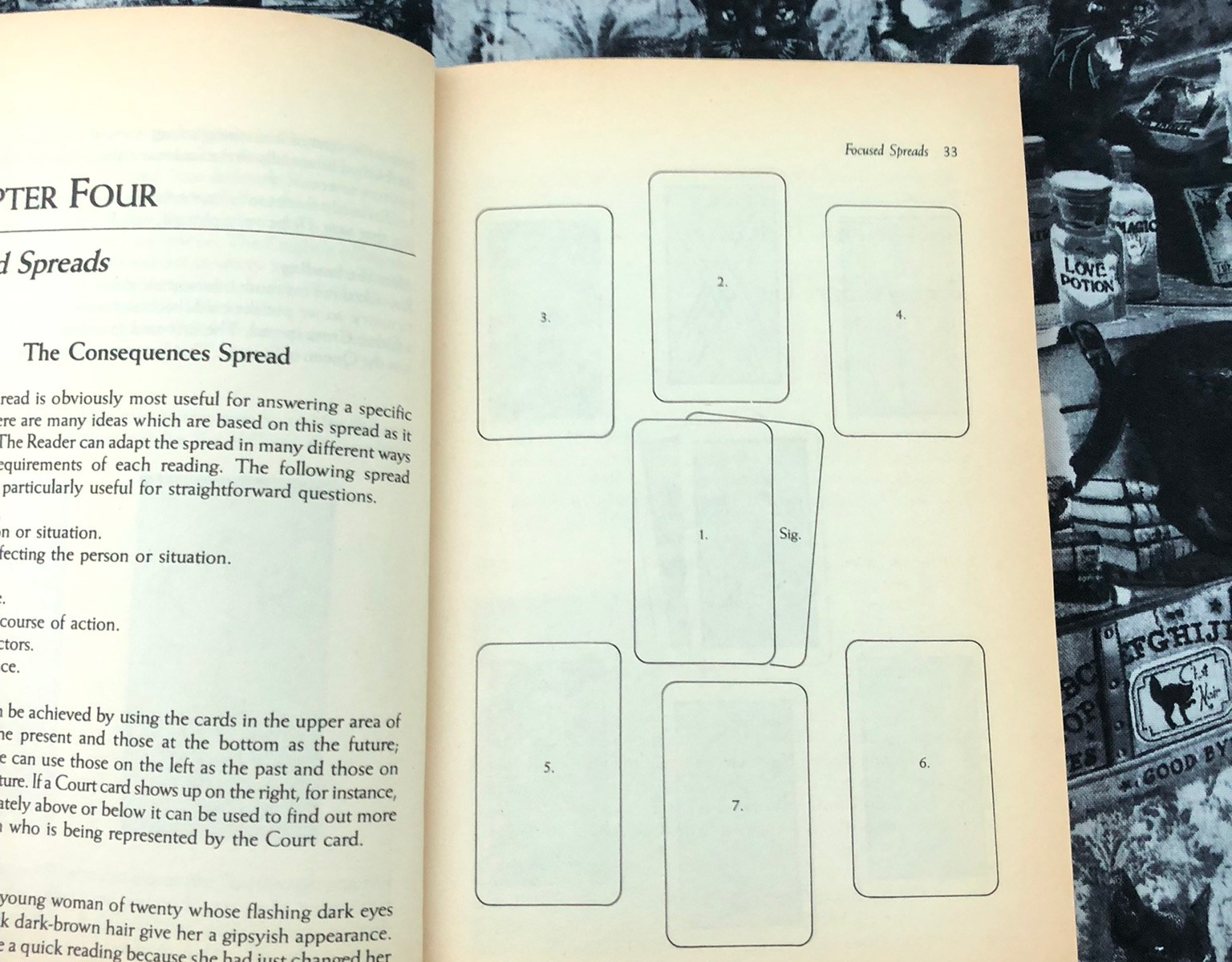
The Consequences Spread is dealt as shown below.
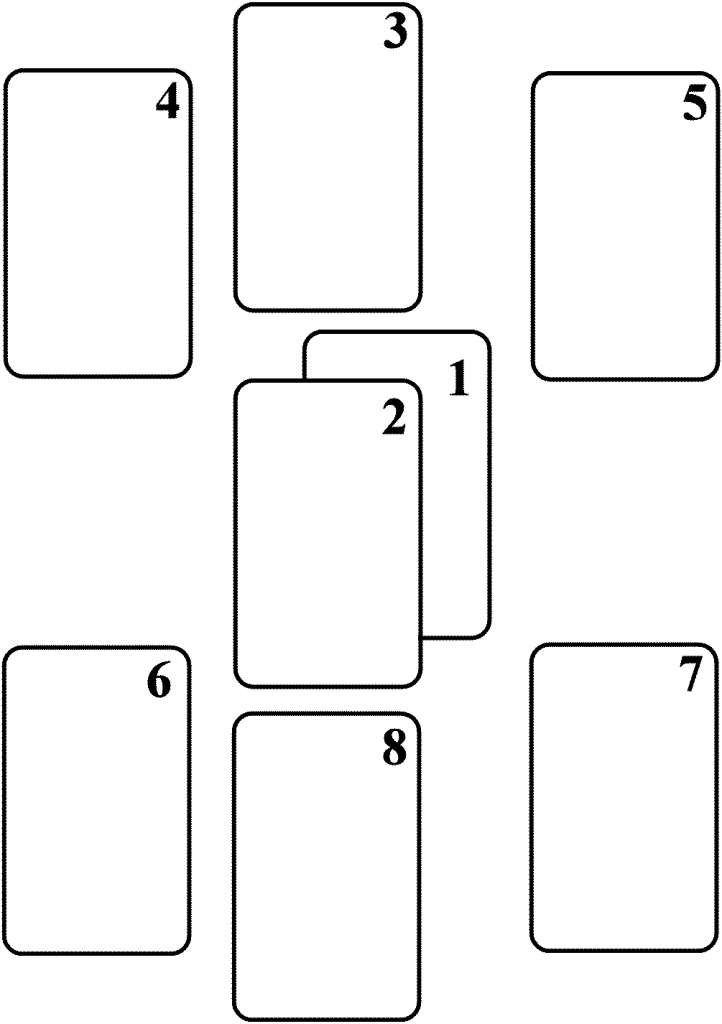
  1. The Questioner’s card.
  2. The person or situation.
  3. Matters affecting the person or situation.
  4. The past.
  5. The future.
  6. Suggested course of action.
  7. Outside factors.
  8. Consequence.

Rebekah has dark-blonde hair and is in her forties, so I selected the Queen of Hearts as the Questioner card. The remaining 51 cards were shuffled, cut and dealt as below.
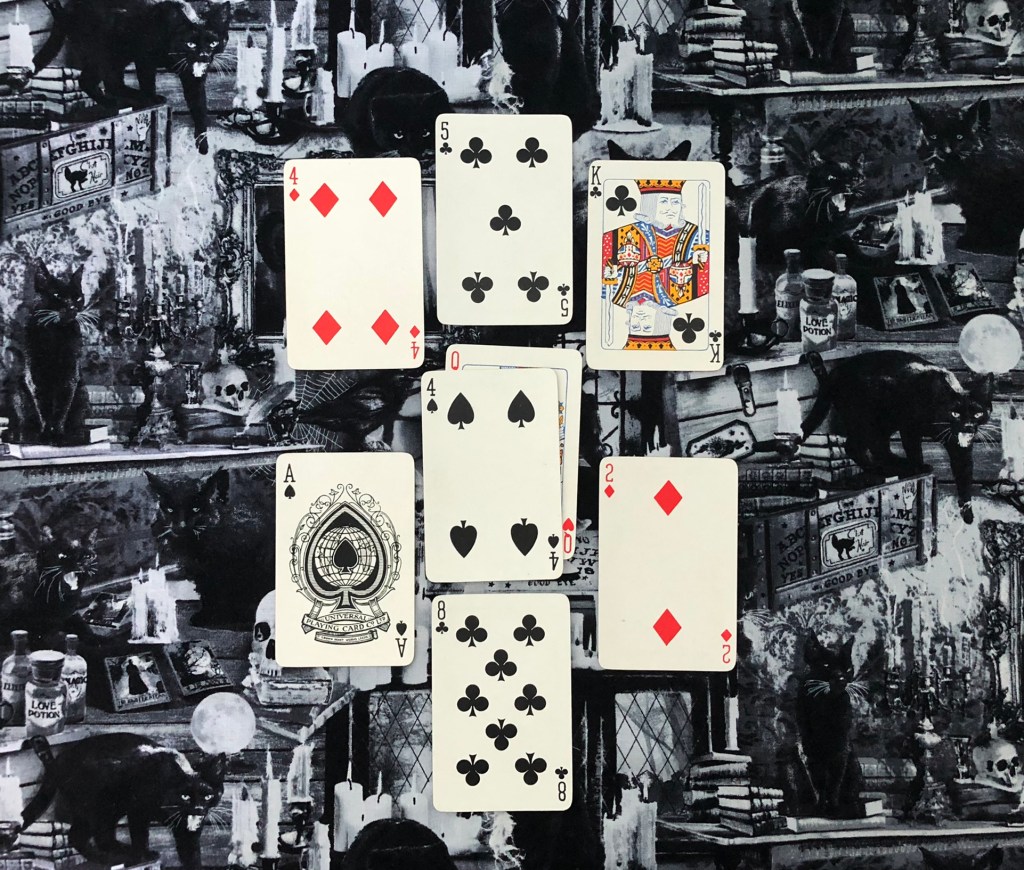

Cards #2 and #3 were the 4 of Spades and 5 of Clubs. Rebekah feels physically and mentally exhausted (4 of Spades) after returning to a busy and demanding role (5 of Clubs). Rebekah had been off work for some time due to illness. The combination of Spades and Clubs emphasizes that Rebekah is severely taxed with a heavy workload.

The 4 of Diamonds, as card #4, can indicate sitting behind a desk. Rebekah is no stranger to the office. She has worked for the company for almost 15 years at the same desk and in the same role. However, Regina Russell also states that the card signifies the office or den in the home. On putting this forward, Rebekah told me she had worked from home for almost 12 months before returning to her place of work. She now finds the commute tiring.

The fifth card signifies the future. Here we find the King of Clubs, which would represent Rebekah’s boss. In my experience, when a Court Card falls here (card #5), it identifies who will initiate the events or circumstances revealed in card #7, here, occupied by the 2 of Diamonds:

There are meaningful discussions to be had soon. During these talks, Rebekah’s boss will put forward different ideas and scenarios to help Rebekah. As the 2 of Diamonds is also said to indicate imagination, these could well be things that have not occurred to Rebekah. Likewise, Rebekah can put forward suggestions and ideas.

After these discussions, Rebekah can decide what she thinks is best for her (card #6 Ace of Spades), and in doing so, she will be able to move forward.

Traditionally, the Ace of Spades is a card of endings, but I did not read it as tendering her resignation. Why? Intuition. The consequence, 8 of Clubs, can show a new job, but also new duties or transfers. I said that after discussing different scenarios, Rebekah would choose (Ace of Spades) to transfer to a new role (8 of Clubs) that is less stressful for her in her current role. Rebekah is an insurance underwriter but her new role will likely be more administrative or secretarial (the 8 of Clubs falls next to the 2 of Diamonds).

When? There are a couple of timing methods available. First, clubs are associated with weeks. So we could say in eight weeks (end of July). Clubs are also the suit of earth and summer, which would indicate around the third week of August. Both point towards July/August.

§

Deck: Deluxe Playing Cards (Alf Cooke), c. 1930 – 1940.

Consequences Spread: Tarot In Action! by Sasha Fenton, published by Aquarian Press in 1987.
The Card Reader’s Fifteen Card Spread

My friend, Hugh, acquired Regina Russell’s well-regarded Card Reader’s Handbook earlier this year. He was impressed. Valuing his opinion, I took the plunge. It is a brilliant treatise on the art of cartomancy. The cards’ significations are close to those I use and echo Dr. Leo Martello.

In her text, Russell introduces a three-stage reading process. Before the 1970s/80s, such sequential readings were not uncommon. Even Juliet Sharman-Burke included the practice in her correspondence course and book, The Complete Book of Tarot. However, then as now, you can use each spread individually.

The fifteen-card spread, which Russell starts her readings with, has become a personal favorite. You can use it outside the staged process. Since acquiring the book, I’ve used it with Playing Cards and Tarot cards in addition to the Mlle Lenormand Oracle and Kipperkarten cards. It’s brilliant.

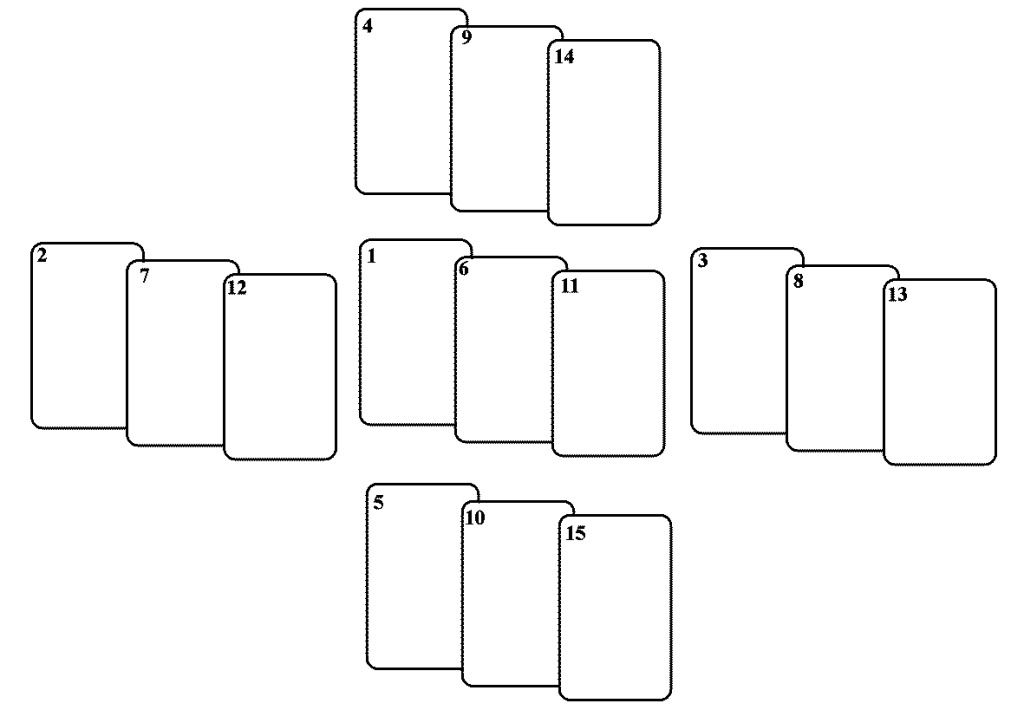
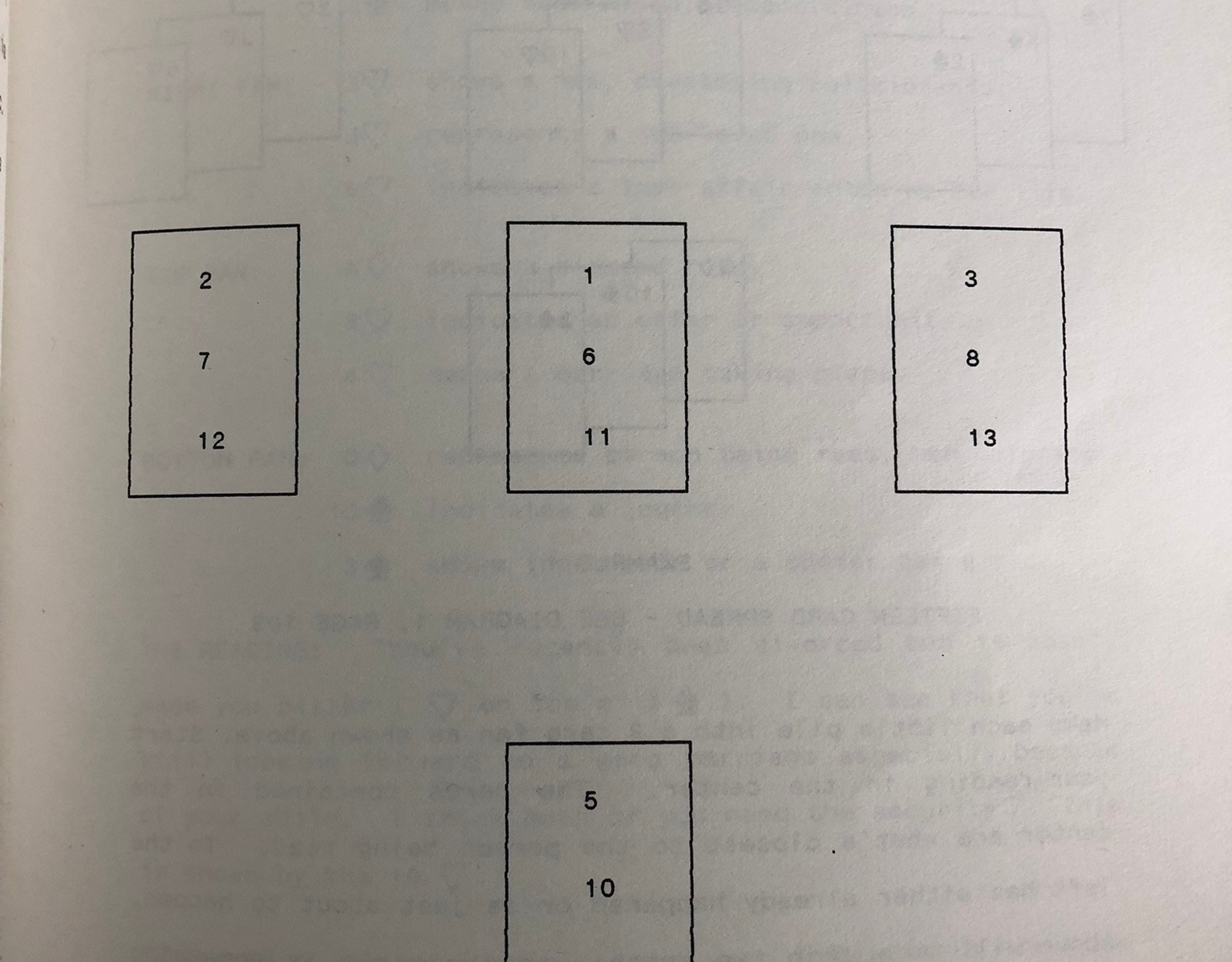
Essentially, the spread is five fans of three cards. They are laid out as follows:

The cards in the center are what is closest to the Questioner. To the left is the recent past or something just about to happen. The cards to the right are something new coming into the Questioner’s life. The cards above are set to occur within two months—those below in two months’ time.

Last month I used the spread to read for a husband and wife, Niamh and Fionn. Niamh and I met several years ago. Fionn is self-employed and in February underwent an emergency ileostomy.

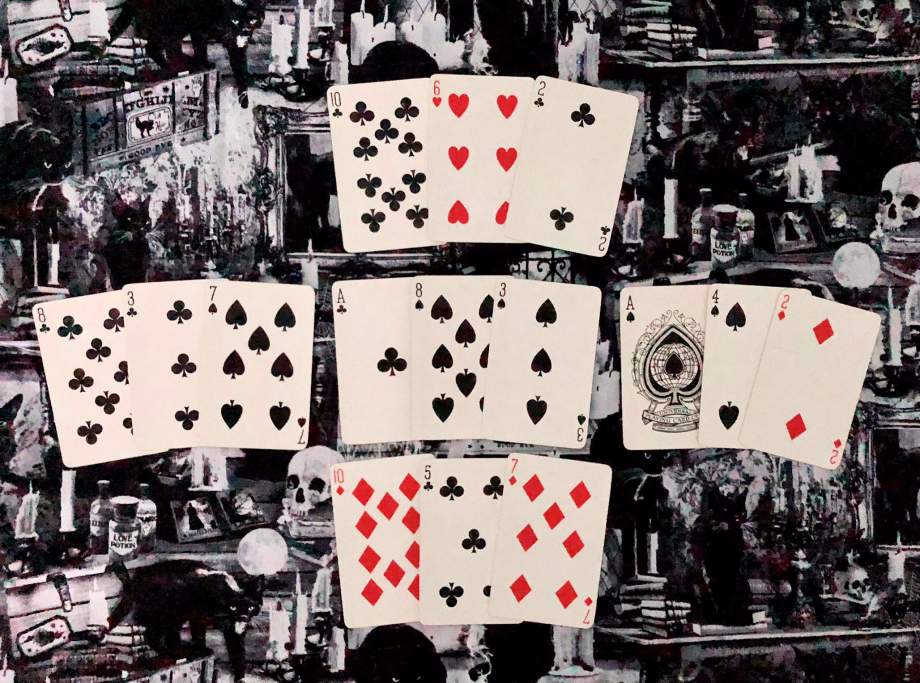
Fionn’s reading was as shown below.

Most of the cards are black, and clubs and spades are in the majority, so Fionn has his work cut out (clubs) to overcome his challenges (spades). The difficulties are financial (3 Diamonds).

Considering Fionn’s circumstances, the presence of the 8 of Spades at the center is unsurprising. It is the card of the doctor. Next to it is the Ace of Clubs: we have a hospital. Fionn had an appointment that week and would have some investigations (3 of Spades). On turning the 3 of Spades over, I immediately seized on x-rays. Fionn said “no” to this, but I said he might be surprised. However, the 3 of Spades covers all tests and investigations.

The Ace of Clubs also signifies documents, particularly official ones, and his treating physician (8 of Spades) may be asked to clarify some matters regarding his needs (3 of Spades + the fan on the right). Essentially, we have a medical report.

The trio to the left can signify the recent past and present. Fionn is worried about his surgery’s effect on his business (7 of Spades). 8 of Clubs often indicates our work. He runs a small landscape gardening and block paving company. Before his admission, things had been going well with a slight expansion and taking on a part-time trainee (3 of Clubs). This has now stalled (7 of Spades) as Fionn cannot lift, is in pain, tires quickly, etc. Fionn wants clarity on his recovery time.

The three cards to the right describe events occurring within a month or something new coming in Fionn’s life. Remembering the Ace of Clubs, we can see a decision (Ace of Spades) will be made within a month regarding what financial assistance Fionn is entitled to (4 of Spades + 2 of Diamonds). As the 2 of Diamonds falls last, we can be reasonably sure it is favorable. Fionn will get some form of social assistance. There will also be a discussion about realistic recovery times and how Fionn might need to adapt and slow down (Ace of Spades + 4 of Spades). Some of these changes will also be diet-related (2 of Diamonds) due to changes in digestion (Spades = elimination system).

The three cards above and below the center cards refer to events occurring within two months and in two months, respectively.

Fionn will receive a further helping hand (2 of Clubs) within the next two months following a business deal with a man (10 of Clubs + 6 of Heart). The 6 of Hearts is often a friend, brother, son, or son-in-law. Whoever he is, he’s got good business sense and ideas (10 of Clubs). Sometimes the 10 of Clubs is a journey, usually over water, and I wondered if this could be one of Fionn’s relatives from Ireland. Otherwise, Fionn will be traveling to see a friend who is supportive.

Let’s look at the final fan. Russell states that the three cards below can indicate something the Questioner doesn’t want to happen, associating the position with delay and dislike. I’ve not found this to be the case all the time. Sometimes it is just something occurring in two months’ time.

The 5 of Clubs can indicate reorganization and reevaluating. With the 10 of Diamonds, Fionn will need to look at his business plan and make changes to cover him until he can return to work (5 of Clubs). He can do things more efficiently and cheaply, and should look at supplies, etc. I also suspect this could be via further investment (10 of Diamonds) from either a loan or his earlier dividends (7 of Diamonds). The 7 of Diamonds at the end promises benefit in the long run even if Fionn is reluctant.

Fionn had his appointment with his consultant and was given a form for a chest x-ray because he had a drain fitted during his admission due to fluid build-up. He was surprised. When something seizes the Reader, it is best to go with it even if the Questioner disagrees. Time will tell. You or they may be wrong. The cards will invariably be right.

Fionn was also advised that his consultant had been contacted about his benefits claim. I’ve asked Fionn to keep me up-to-date.

§

Deck: Deluxe Playing Cards (Alf Cooke), c. 1930 – 1940.

Card Reader’s Handbook, self published by Regina Russell in 1976.
The Complete Book of Tarot by Juliet Sherman-Burke, published by Pan Macmillan in 1985.