Review: The Dreaming Way Lenormand

The Dreaming Way Lenormand was a birthday present with the La Santa Muerte Lenormand. Unlike the latter, The Dreaming Way Lenormand was published several years ago. Although I had seen some images, it’s not a deck that caught my attention.

The 36 cards—there are no extra cards—come in a small but sturdy lift-off box and include a clear but concise book written by Lynn Araujo.

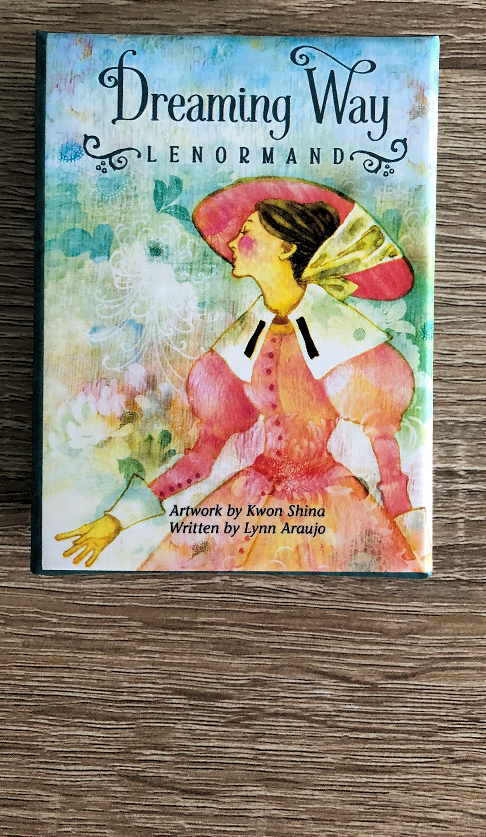
Kwon Shina’s artwork is deceptively simple, quaint, and almost mischievous. The colour palette is soft pastels. The backgrounds are beautiful, with some lovely embellishments or textures. As the cards are borderless, this also adds a homogeneous touch. There are no playing card inserts, but a suit symbol and rank are shown next to the titles. I’ve never seen much point in such notations.
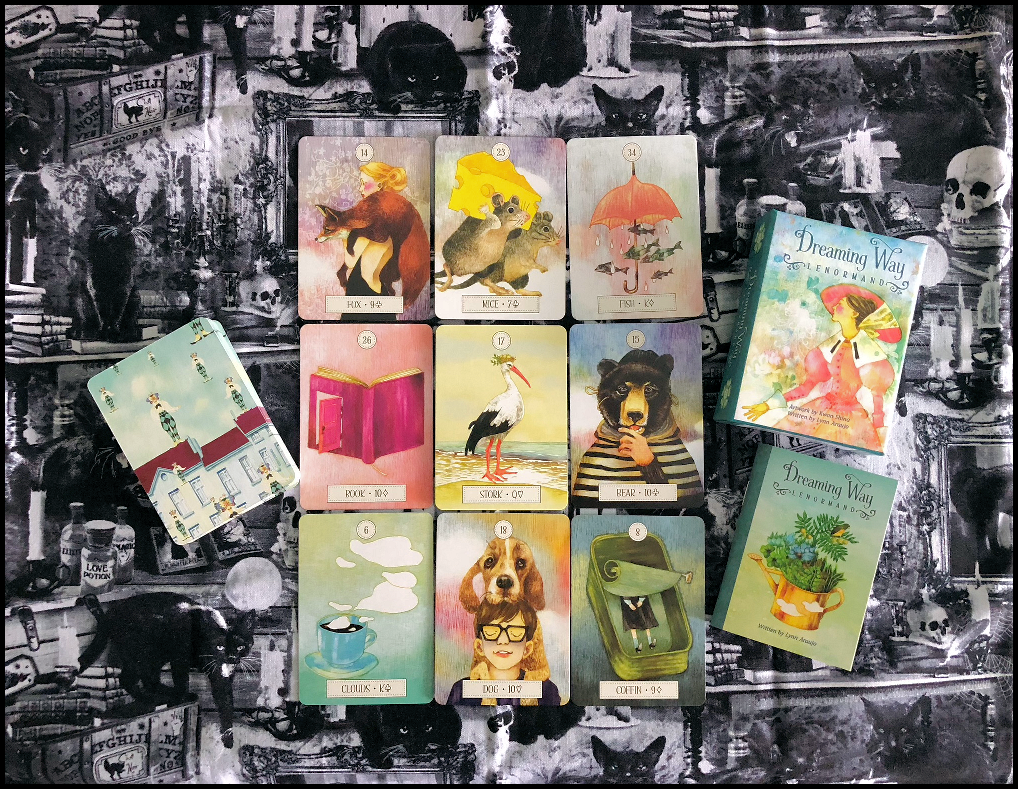
Most of the traditional symbols are reinterpreted in a whimsical, dream-like fashion. Several cards show people, such as the Snake and the Dog. My favorite cards are the Birds, the Book, and the Fox. The Hound/Dog, the Ring, and the Clouds are my least liked.

Kwon Shina seems to have tried to preserve some of the cards’ traditional directional features but with a surreal twist. Whereas we often see a pall or wreath on the Coffin card, we see a half-open sardine can here. How successful Kwon Shina was will be dependent upon the reader. But I do like the Birds and the Book.

Lynn Araujo’s book is concise and relatively standard and echoes the German literature more than the French. It was helpful to understand some artistic choices, such as why a woman is on the Fox card. There are a couple of short readings, but the full board/die große tafel is absent.

As is my practice, I asked the deck to introduce itself via a cut. The cards’ response was the Stars and the Sun. And there is a clarity and warmth to the cards. Despite my misgivings, it’s an accessible deck to read, and I have used it several times. But I cannot say it is (or ever see it being) a first choice for a reading.

§

The Dream Way Lenormand, illustrated by Kwon Shina with a guidebook by Lynn Araujo, is published by US Games Systems, Inc.

Review: La Santa Muerte Lenormand

When the Lenormand Oracle entered my life over three decades ago, packs were far from scarce. But there was little variety. The cards of Piatnik and Carta Mundi were the two most prevalent patterns. When the AG Müller cards were sold, it was often the version with German or French lyrics.

Things have changed over the last decade. For me, the (often independent) publications of historical decks have been the particular focus. In particular, the Wanderwust Lenormand—a creative remix of the C.L. Wüst pack —has become a firm favourite. The early diet of Carta Mundi or Piatnik seems to cast long shadows, so I haven’t much explored the themed offerings.

La Santa Muerte Lenormand is a themed deck combining the traditional 36 pictures with Our Lady of the Holy Death. It was one of two Lenormand Oracle birthday gifts I found waiting for me. Not being involved in the cult of Santa Muerte or a deck collector, I was unaware of its publication but recognised the artist from the popular Rana George Lenormand.

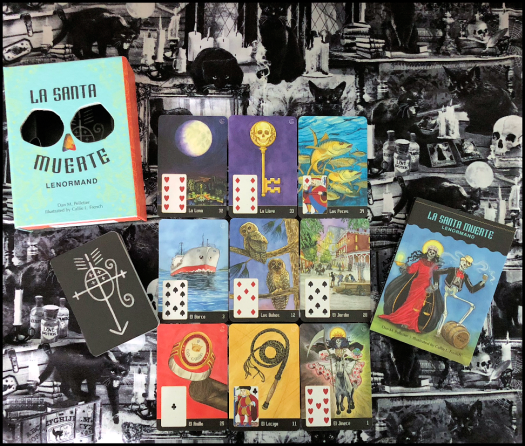
The cards come in a sturdy, beautiful scull-themed box and number 38. There are two Lord and Lady cards. Inside, the cards sit in a small well. When the book is placed over the cards and the box shut, the two “eye-sockets” offer a glimpse of the book’s cover.

Callie L. French’s artwork is superb, with beautiful, rich, deep colors. My favorite cards are the Key, the Park, the Owls, the Moon, and the Fishes; the Ring, the Rider, and the Letter cards are my least liked. Full playing card inserts are in the lower right corner, with the cards’ titles in Spanish. I would have liked the cards completely borderless, but the Spanish titles seem appropriate. The cardstock is excellent, and the deck shuffles smoothly.

Dan M. Pelletier writes the small companion book, and it is a serviceable introduction from the Lenormand perspective. Mr. Pelletier attributes much to an Eastern European school of thought. There are no references or sources, but you can see the influence of several uncredited authors. The book also demonstrates the care and attention to detail in the art, from candle colors to Mexican culture.

Mr. Pelletier states it is not the object of the guidebook to introduce the reader to the cult of La Santa Muerte. He assumes the reader is or soon will be.

It has become my practice with new decks to seek a small introduction. After a good shuffle, I cut the deck into two piles and the La Santa Muerte Lenormand introduced itself with the Key and Lilies—a promising but pertinent opener.

Since receiving the cards, they have sat beside my journal and Carène fountain pen. I find they lend themselves for late evening and night-time deals. Although not a follower of the cult of Santa Muerte, the cards will open their wisdom if approached with respect as the cut shows.

§

La Santa Muerte Lenormand by Dan M. Pelletier and illustrated by Callie L. French is published by Schiffer Publishing Ltd.