This article continues my series examining the trumps of the Tarot de Marseille, adapted from my unpublished manuscript, Tarot de Marseille: The Picturebook of Fate. As throughout this series, the emphasis is placed upon the traditional eikōn of the card, its historical context, and the practical significations I have found useful through divinatory practice. The interpretations presented here reflect my own experience of working with the Tarot de Marseille and should be understood as a working method rather than a definitive authority.
The Sixes: The Lover and the Devil
Let us now turn to another example and, in doing so, introduce a different variation of the classic Cross Spread.
One of the principal reasons for this spread’s enduring popularity is its ability to provide a clear and decisive response to a question. Indeed, where appropriate, it may even yield a simple affirmative or negative answer.
In this instance, however, we shall employ an older variation, one often likened to a court hearing. It is perhaps fitting that the querent in this example was herself a barrister, for the structure of the spread closely resembles a legal proceeding.
The twenty-one trumps and the Madman are shuffled and cut, after which four cards are dealt in the form of a cross.
03
01 – 05 – 02
04
- Card 1 (Left): The card arguing in favour of the matter, including helpful influences and supporting evidence.
- Card 2 (Right): The card arguing against the matter, including obstacles and hostile influences.
- Card 3 (Above): The judge, who weighs the evidence and clarifies the question.
- Card 4 (Below): The outcome or verdict.
- Card 5 (Centre): The synthesis.
Unlike the first four cards, the fifth is not drawn but calculated. One adds together the numerical values of the four cards already laid, using the numbering of the Major Arcana, and reduces the result to a number not exceeding twenty-two.
For example, should one draw the Star (17), the Madman (0), Temperance (14), and the Charioteer (7), the calculation is as follows:
17 + 0 + 14 + 7 = 38
As this exceeds twenty-two, one reduces it further:
3 + 8 = 11
The resulting number corresponds to Fortitude, which serves as the synthesis.
It should be evident that this synthesis card is not to be read as an additional outcome; that function is already fulfilled by the fourth card. Rather, the synthesis reveals the underlying dynamics of the matter, the deeper currents and governing principles operating behind the question.
Oswald Wirth, who was the first author to document this spread in print, advocated reading the synthesis before interpreting the other cards, regarding it as the key to understanding the reading as a whole.
A brief note should be made regarding the Madman. When it appears amongst the first four cards, it is assigned the numerical value of zero for the purposes of calculation. However, the matter is treated somewhat differently in the case of the synthesis. Should the final total reduce to twenty-two, the Madman itself becomes the synthesis card.
Example
This reading was conducted in 2008.
Janine was in her late forties and enjoyed a successful career as a barrister. Three years earlier she had divorced her husband, Ben, following an infidelity. Since they shared two children, Ben remained a regular presence in her life. Recently he had approached her with a proposal that they attempt a reconciliation.
Her question was:
“Should I give him another chance?”
The cards drawn were:
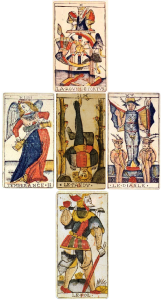
- Position 1: Temperance (14)
- Position 2: The Devil (15)
- Position 3: The Wheel of Fortune (10)
- Position 4: The Madman (0)
Let us calculate the synthesis:
14 + 15 + 10 + 0 = 39
As this exceeds twenty-two, we reduce it further:
3 + 9 = 12
The synthesis is Trump XII, the Hanged Man. The essence of the Hanged Man is dishonour and advises that past problems—and the loss of trust—still have an influence on the relationship.
The card arguing in favour of reconciliation was Temperance.
Temperance suggested that a genuine degree of harmony had already been achieved between Janine and Ben. Through considerable effort, clear boundaries, and mutual concern for their children, the former couple had established a workable relationship. Communication had improved, conflict had subsided, and they had learned to co-operate effectively as parents.
In short, the card acknowledged that something valuable had been gained since the divorce. A degree of peace and balance had emerged from what had once been a difficult situation.
Arguing against the proposal was the Devil.
The Devil suggested that the unhealthy dynamic which had contributed to the breakdown of the marriage had not truly disappeared. Old patterns of control, dependency, and imbalance remained present beneath the surface.
The card did not necessarily imply malice on Ben’s part. Rather, it questioned whether the underlying nature of the relationship had genuinely changed. Ben appeared eager for reconciliation, but the Devil raised doubts about his motives and, more importantly, about his ability to escape familiar patterns of behaviour.
The judge was the Wheel of Fortune.
This is where the reading became particularly revealing.
The Wheel asked a simple question: what has actually changed?
Relationships often end because the same patterns repeat themselves. The Wheel is not concerned with promises, intentions, or hopes. It is concerned with cycles.
Every previous attempt at improving the relationship had followed a recognisable pattern. Things improved for a time, old difficulties resurfaced, conflict returned, and both parties eventually found themselves back where they had started.
The Wheel therefore reminded Janine that cycles tend to repeat unless something fundamental alters their course.
The outcome was represented by the Madman.
The Madman did not suggest liberation or adventure. Rather, he represented a return to uncertainty, instability, and lack of direction. The card suggested acting without sufficient evidence that the circumstances had materially changed would be a mistake.
One is reminded of the familiar observation that people often repeat the same behaviour whilst hoping for a different result.
From the perspective of the spread’s judicial structure, the verdict was clear. Revisiting the relationship would place Janine back upon an uncertain road whose destination was already largely known.
The synthesis was the Hanged Man, and it confirmed this interpretation.
The Hanged Man revealed the deeper dynamic underlying the question. Janine remained suspended between the past and the future. Part of her still felt the pull of what the marriage had once been, whilst another part recognised the life she had built since the divorce. She still couldn’t forget Ben’s betrayal and loss of trust.
The synthesis therefore suggested that reconciliation would not resolve this state of suspension. On the contrary, it was likely to prolong it. Rather than moving forwards, Janine risked becoming trapped once again within circumstances she had already spent years trying to escape.
My conclusion was that Janine should not give Ben another chance.
The cards did not suggest that reconciliation was impossible, but they strongly indicated that the conditions necessary for a successful reconciliation were absent. Temperance showed that a healthy co-parenting relationship had already been established. The Devil suggested that unhealthy dynamics remained unresolved. The Wheel of Fortune questioned whether anything fundamental had changed, whilst the Madman warned against returning to uncertainty and repeating familiar mistakes.
The Hanged Man ultimately revealed that revisiting the relationship would leave Janine suspended between the life she had left behind and the future she was attempting to create.
This example illustrates an important principle of the Cross Spread. The verdict alone is not the whole answer. The judge explains why the verdict is reached, whilst the synthesis reveals the deeper principle operating beneath the entire matter. Here, both the verdict and the synthesis pointed away from genuine progress. The Madman offered movement without direction, whilst the Hanged Man offered suspension without resolution. Together, they suggested that the cycle was far more likely to repeat than to change.
§
Tarot Cards: Jean Dodal Tarot via Wikipedia Commons. Public Domain.
Featured Image: Ancient Tarot Major Arcana © BP Grimaud/John Waddington Ltd, Leeds & London, Les Tarot de Marseille Jean Noblet, 1650 © Editions «letarot.com» (2001 [hand stencilled trumps]). Les Tarot de Marseille Jean Dodal, 1701 et 1715 © Editions «letarot.com» (2002 [hand stencilled trumps])

