
This article continues my series examining the trumps of the Tarot de Marseille, adapted from my unpublished manuscript, Tarot de Marseille: The Picturebook of Fate. As throughout this series, the emphasis is placed upon the traditional eikōn of the card, its historical context, and the practical significations I have found useful through divinatory practice. The interpretations presented here reflect my own experience of working with the Tarot de Marseille and should be understood as a working method rather than a definitive authority.
The Nines: The Hermit and the Moon
Trump VIIII, L’Hermite, or the Hermit, is one of the most enigmatic figures in the Tarot. Does he signify withdrawal, loneliness, and isolation? Is he merely the wise old man of later occult traditions? Or does he represent something more practical: the ability to discern the correct path when others have lost their way?
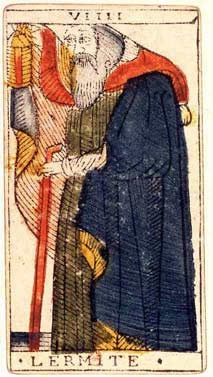
The traditional eikōn of the Hermit is both simple and profound. We see an elderly man wrapped in heavy robes. In one hand he carries a staff upon which he leans for support; in the other he holds a lantern, partially concealed beneath his cloak. Unlike the Charioteer, who moves boldly forward in public triumph, the Hermit advances cautiously and deliberately. His attention is directed not towards the horizon, but to the ground immediately before him.
The essence of the Hermit is prudence; his function is to discern.
Prudence is often misunderstood as excessive caution or timidity. In reality, it is far more important than that. Prudence is the virtue which disposes us to exercise true reason and to choose the proper means of achieving a good end. The Catechism of the Catholic Church observes that the prudent man “looks where he is going.” This is precisely what the Hermit is doing. His progress may be slow, but it is purposeful. He advances carefully because he wishes to arrive safely.
The Hermit is therefore a guided figure. He is not distracted by the pleasures, temptations, or vanities of the world. His heavy robes separate him from such concerns. Rather than pursuing immediate gratification, he seeks to understand the right path and the right means of following it. The lantern does not illuminate the entire road ahead. Instead, it reveals only the next few steps. Prudence seldom provides certainty about the distant future; it enables us to make good decisions in the present.
The monastic tradition provides an excellent example of this principle in practice. Saint Benedict, often regarded as the father of Western monasticism, did not build his Rule upon dramatic acts of self-denial or extraordinary spiritual experiences. Instead, he emphasised the virtues of obedience, stability, and conversion of life1. Obedience required attentiveness to wisdom beyond one’s own preferences. Stability required remaining faithful to one’s commitments rather than constantly seeking novelty. Conversion of life demanded the continual examination and correction of one’s conduct. All three are expressions of prudence, for they require the individual to discern what is truly good and to order their life accordingly.
The Hermit embodies this same spirit. He understands that meaningful growth rarely comes through sudden revelation or dramatic action. More often, it arises through patient reflection, self-knowledge, and the steady alignment of one’s life with what is right and true.
For this reason, the Hermit is often misunderstood as a card of inactivity. In truth, he is moving, but he does so carefully and with deliberation. The card frequently appears when haste would be counterproductive and when reflection is necessary before action can be taken. The Hermit teaches that wisdom does not always reside in moving quickly. More often, it lies in knowing when to pause, observe, and proceed cautiously.
The Hermit also values discretion. In an age in which every thought, opinion, and experience can be broadcast instantly through social media, this aspect of the card is easily overlooked. Prudence teaches us that not every matter should be shared with everyone. Some things are best kept private; others should be entrusted only to those who have earned our confidence. When accompanied by more difficult cards, the Hermit frequently warns that discretion is required. Not everyone around the querent can be trusted, and sharing too much information may prove unwise.
A common manifestation of the Hermit is a period of withdrawal following disappointment, hardship, separation, or personal upheaval. Such periods are not necessarily negative. Indeed, they often serve an important purpose. Unlike the Popess, who studies facts, evidence, and external sources, the Hermit reflects upon experience itself. His focus is inward rather than outward. He seeks not information but understanding. The card therefore signifies a time of regrouping, reassessment, and quiet reflection before the next stage of the journey begins.
The Hermit also possesses strong associations with age, maturity, and perspective. In this respect, he calls to mind both Saint Benedict and Saint Simeon. Benedict teaches us the value of a life ordered by prudent discernment, whilst Simeon exemplifies the patient wisdom that comes with waiting faithfully for the fulfilment of a promise. Upon beholding the infant Christ, Simeon uttered the words of the Nunc Dimittis: “At last, all-powerful Master you give leave to your servant to go in peace…”2 His joy arose not from worldly achievement, but from recognising that God’s promises had been fulfilled. The Hermit embodies something of this spirit. He understands that not every success is immediate and that some truths reveal themselves only through patience, experience, and perseverance.
When the Hermit appears in a reading, he frequently advises caution, discernment, and reflection. The card suggests that the querent already possesses many of the answers they seek, but that these answers may only emerge through careful consideration rather than hurried action. Progress is still possible, but it must be guided by prudence rather than impulse. The Hermit’s lantern shows the next step. For now, that is enough.
General: A period of solitude, reflection, and quiet reassessment. The Hermit advises patience, discretion, and careful consideration before action is taken. Progress may seem slow, but it is not absent. The card frequently appears during periods of convalescence, recovery, or personal regrouping, when prudence and discernment are more valuable than outward activity.
Love: The Hermit often appears after a disappointment, betrayal, separation, or other emotional hurt that has left a lasting impression. Trust may have been damaged, making it difficult to place confidence in others once more. The card signifies a need for time alone to process the past so that it no longer exerts undue influence upon the future. Consequently, the Hermit rarely promises the immediate arrival of a new relationship. If the question concerns whether someone can be trusted, the card urges caution and discernment. In established relationships, the Hermit may indicate misunderstandings, emotional distance, or the need for both parties to reflect seriously upon the future of the partnership.
Career: Progress under the Hermit is often gradual rather than dramatic. The card frequently appears when someone is experiencing burnout, questioning their direction in life, or feeling drawn towards change. Nevertheless, the Hermit advises caution. This is a time for reflection, planning, and careful preparation rather than impulsive decisions. Existing responsibilities should continue to be approached with diligence and professionalism. For job seekers, the card often signifies delays and frustrations, although progress is quietly being made behind the scenes. Occupations associated with the Hermit include work with the elderly, homeless, or socially isolated, as well as antiques, agriculture, mining, plumbing, sanitation, and other professions that involve solitary or largely independent work. It may also signify remote working or self-directed employment.
Finance: Prudence is essential in financial matters. Before making investments, lending money, or entering into financial agreements, the Hermit advises obtaining independent advice and ensuring that all details have been examined carefully. Second opinions are rarely wasted under the Hermit. If something appears too good to be true, it probably is. The card frequently warns against speculative ventures and money lent to others which may never be repaid. More positively, it favours long-term financial planning, pensions, insurance, inheritance planning, and the gradual accumulation of security for the future.
Health: The Hermit is strongly associated with ageing, chronic conditions, rehabilitation, and convalescence. Recovery may be slower than desired, but steady improvement is generally indicated. Anatomically, the card is associated with the skeletal system, joints, and conditions related to advancing years. More broadly, it advises patience, rest, and allowing the body adequate time to heal.
Essence: Prudence.
Function: Discern.
Polarity: Neutral.
Astrological Association: Saturn.
Timing: Saturday. 29 ½ months or years. By 3 February.
§
Tarot Cards: Jean Dodal Tarot via Wikipedia Commons. Public Domain.
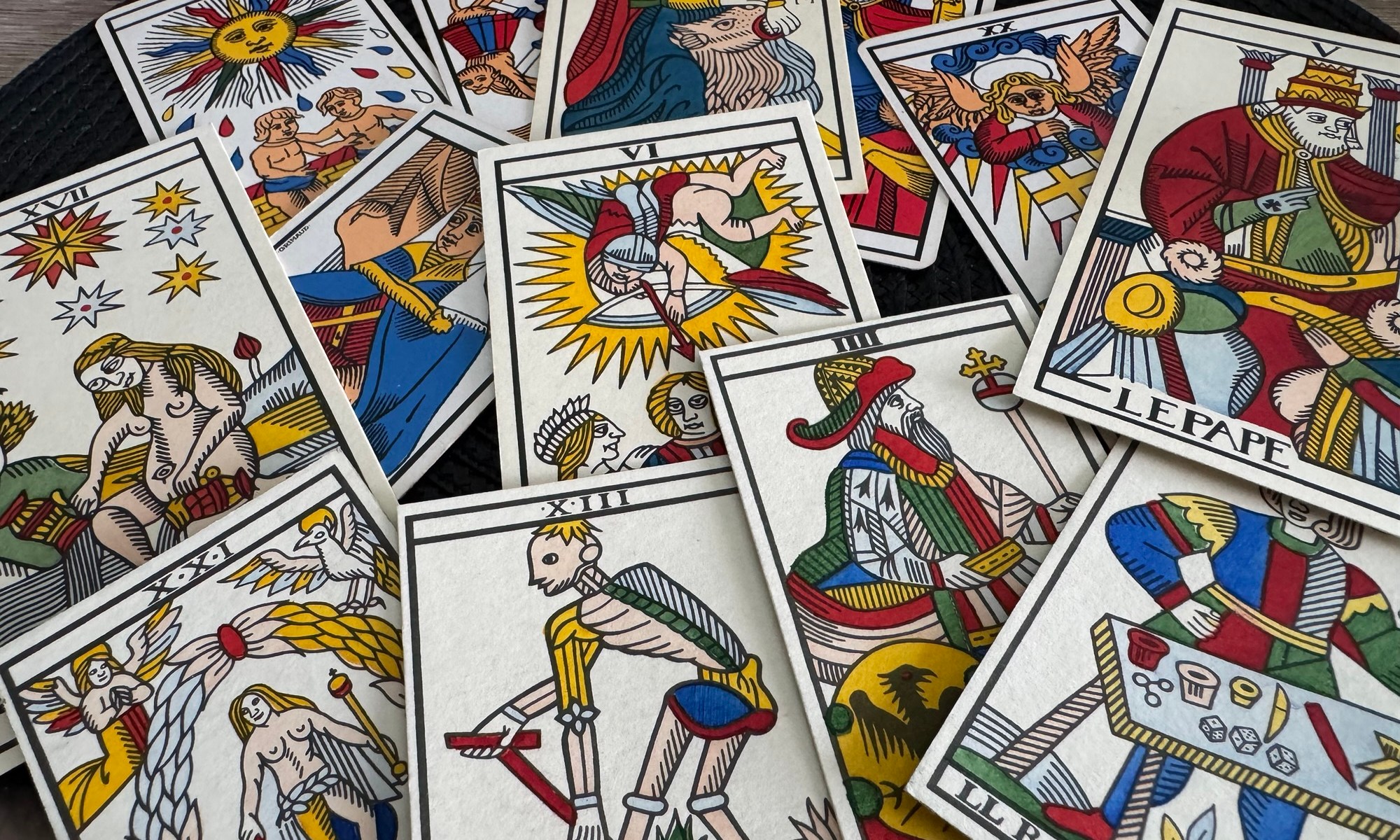
Featured Image: Ancient Tarot Major Arcana © BP Grimaud/John Waddington Ltd, Leeds & London, Les Tarot de Marseille Jean Noblet, 1650 © Editions «letarot.com» (2001 [hand stencilled trumps]). Les Tarot de Marseille Jean Dodal, 1701 et 1715 © Editions «letarot.com» (2002 [hand stencilled trumps])
Footnotes:
- See Chapter 58 of the Rule. Benedict et al. (1981) RB 1980: The Rule of St. Benedict. Collegeville, MN: Liturgical Press. ↩︎
- Nunc Dimittis is recited at Night Prayer/Compline in the Liturgy of the Hours. Trans. given here from Collins The Divine Office. Divine Office. vol. 1 (2006). London: Collins. ↩︎

