Go forth Christian soul, from this world; in the Name of God the Father Almighty, Who created you; in the Name of Jesus Christ, Son of the Living God, Who suffered for you; in the Name of the Holy Ghost, Who was poured forth upon you; in the name of the glorious and ever blessed Virgin Mary, Mother of God…
Proficiscere, anima Christiana, de hoc mundo!
I have lost a treasure, such a sister, such a friend as never can have been surpassed. She was the sun of my life, the gilder of every pleasure, the soother of every sorrow; I had not a thought concealed from her, and it is as if I had lost a part of myself. I loved her only too well — not better than she deserved, but I am conscious that my affection for her made me sometimes unjust to and negligent of others; and I can acknowledge, more than as a general principle, the justice of the Hand which has struck this blow.
Letter from Cassandra Austen to Fanny Knight, July 1817
Life is the twofold internal movement of composition and decomposition at once general and continuous.
Henri Marie Ducrotay de Blainville
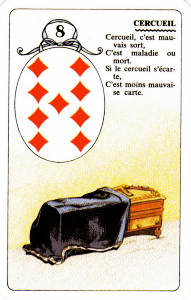
Coffin, close to the person, signifies chronic serious illness, death and the loss of all fortune. When away from the person card it is less dangerous.
Original Instructions
Card No. 8 in the Petit Lenormand, the Coffin, is represented by the Nine of Diamonds. Does it signify transformation? Or is a card of endings and grief? If it signifies illness, what is the difference between the Coffin and the Tree?
The Essence and Function of the Coffin
Owing to its subject matter, the traditional eikōn is remarkably consistent across the older decks, with variations generally confined to embellishment rather than substance.
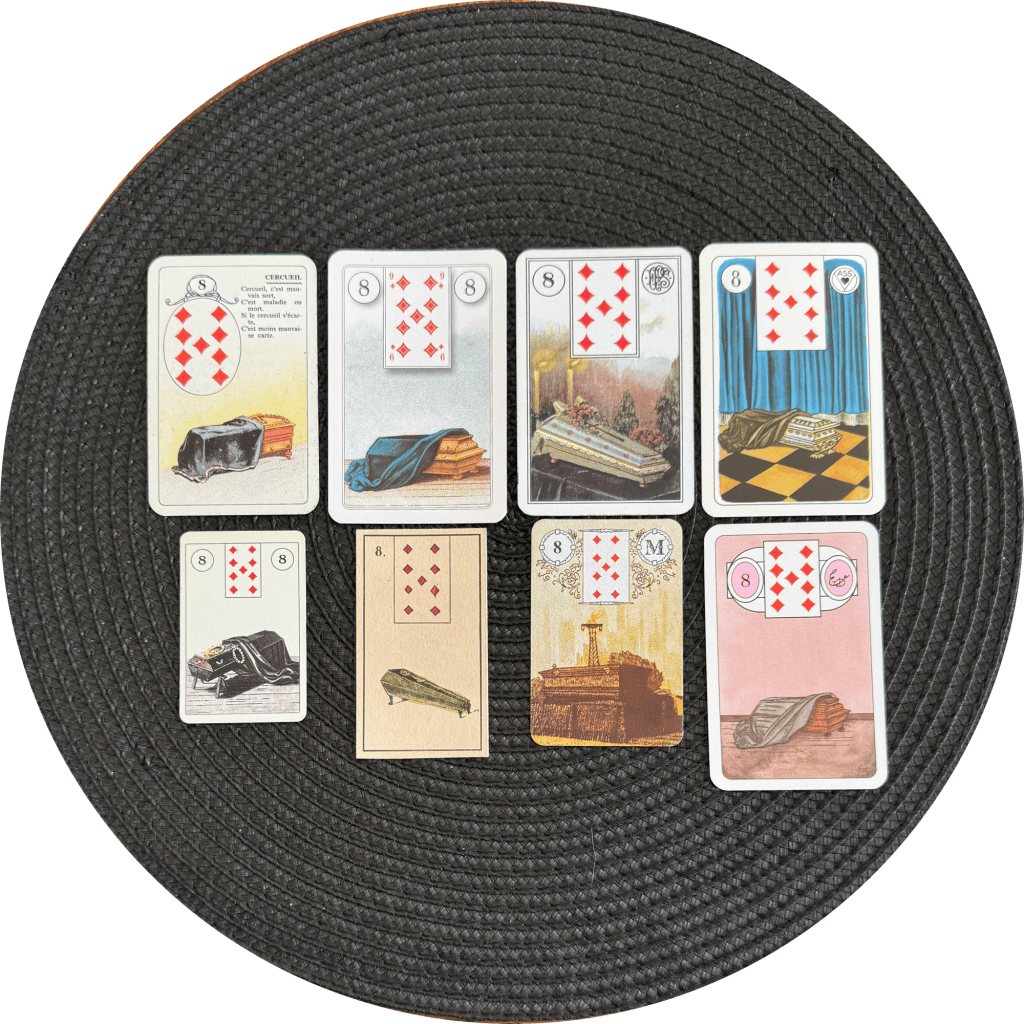
The image invariably depicts a closed coffin or casket. Depending upon the deck, it may be draped with a funeral pall, adorned with a wreath, or displayed upon a bier. The Blaue Eule, for example, shows the coffin lying in state with burning tapers, whilst the Mystical Lenormand depicts an Egyptian-style sarcophagus. Despite these differences, the underlying symbolism remains the same.
The essence of the Coffin is expiration and its function is to dispose.
To understand the Coffin properly, we must set aside the euphemisms commonly employed when discussing death. The purpose of a coffin is profoundly practical. Once life has departed, the body begins to decompose. The coffin therefore serves as a receptacle for what has expired and awaits burial or cremation. Its role is not transformation but disposal.
This distinction is important.
Modern interpretations often associate the Coffin with transformation. I have never found this particularly convincing. Transformation belongs to what follows an ending, not to the ending itself. The Coffin merely identifies the point at which something expires. What emerges afterwards is determined by other cards, not by the Coffin.
Consequently, the Coffin signifies that something within our lives has reached its natural conclusion. A cycle has completed itself. A condition no longer continues. Something is over.
Finished.
The nature of the ending is determined by the surrounding cards. A relationship, project, ambition, illness, circumstance, or chapter of life may all come within its domain. Whatever the subject matter, the Coffin indicates that it can no longer continue in its present form.
The card also exerts a particularly strong influence upon the cards immediately adjacent to it. We shall examine this phenomenon in greater detail later. In practice, however, the Coffin often behaves as a point of cessation within a chain of cards. What precedes it has frequently reached its conclusion, whilst what follows often becomes weakened, burdened, painful, or subject to decline.
The Coffin belongs to the suit of Bells or Diamonds. This is perhaps the most mercurial of the four suits. Within it are found some of the deck’s most fortunate cards, such as the Cloverleaf, Key, and Sun, alongside some of its most disruptive. Fortune appears quickly and departs just as readily. It is therefore unsurprising that the Coffin acquired its traditional associations with illness, loss, and misfortune.
A useful distinction may be drawn between the Tree and the Coffin.
The Tree concerns vitality, constitution, growth, and the forces that sustain life. The Coffin concerns the deterioration, exhaustion, or breakdown of those same qualities. If the Tree asks how strong the life force is, the Coffin asks what is causing it to fail.
For this reason, the illnesses associated with the Coffin are often significant. They are less concerned with transient discomfort and more concerned with conditions that bring plans to an end, force difficult decisions, or mark a turning point in life. The illness itself is often less important than its consequences. A period of poor health may alter priorities, derail ambitions, or divide life into a “before” and an “after.”
Traditional instructions also associate the Coffin with financial losses, often describing them as “great” losses or even “the loss of all good fortune.” Such statements should be interpreted carefully.
Greatness is relative.
A loss is significant not because of the amount involved but because of the effect it has upon the individual. One person may lose thousands and barely notice. Another may lose a comparatively modest sum and find important plans suddenly impossible to realise.
The Coffin therefore signifies the death of an expectation, ambition, or opportunity as much as the loss itself. A long-awaited holiday may no longer be affordable. A hoped-for purchase must be abandoned. A cherished aspiration may be postponed indefinitely. The amount is secondary. What matters is that something the seeker anticipated or valued can no longer continue.
This brings us once again to the card’s essential nature.
The Coffin asks a simple question: What has reached the end of its usefulness?
Whether that thing is a relationship, a sum of money, a period of health, a long-held plan, or an entire chapter of life, the Coffin tells us that it has expired. Its role is not to transform, renew, or rebirth.
Its role is to bring the matter to an end.
Person and Description
Unlike many cards within the Petit Lenormand, the Coffin does not ordinarily signify a person. Its purpose is to describe conditions, states, endings, losses, illnesses, and processes rather than individuals.
Nevertheless, when appearing alongside a significator or person card, the Coffin can contribute valuable information regarding that individual’s appearance, temperament, circumstances, and general condition.
The card therefore functions descriptively rather than representationally. It does not tell us who the person is. Instead, it describes something of their physical state, outlook, or manner.
Physical Description
When contributing to a physical description, the Coffin often imparts a thin, angular, or somewhat emaciated appearance. The individual frequently possesses sharp facial features, prominent cheekbones, or a gaunt quality. There is often a sense of leanness about the person, regardless of their actual weight.
The card can also create an impression of diminished vitality. Whatever the person’s natural complexion or skin tone, they may appear tired, drawn, exhausted, or lacking in colour and vigour. The effect is not necessarily one of illness, although it can be. More often, the person simply looks as though life has been weighing heavily upon them.
In terms of dress, the Coffin tends towards sombre, restrained, or traditional colours. In many European contexts this may manifest as black, white, grey, mauve, or other colours associated with mourning and remembrance. Naturally, cultural practices will modify the expression of this symbolism, but the overall impression is usually one of restraint rather than flamboyance.
The card rarely describes someone whose appearance is bright, youthful, or exuberant. Even when physically attractive, there is often a seriousness or austerity that distinguishes them from the more vibrant personalities represented by the Sun, the Bouquet, or the Cavalier.
Temperament
The Coffin most closely corresponds to the traditional melancholic temperament, particularly its dry and introspective qualities.
Such individuals are often thoughtful, reflective, serious, and acutely aware of life’s limitations. They rarely approach the world with the optimism of the Stars or the confidence of the Sun. Instead, they tend towards realism, introspection, and careful consideration.
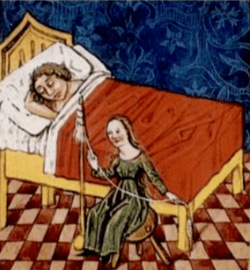
At their best, Coffin people possess remarkable depth of character. They frequently display sensitivity, compassion, emotional intelligence, and an ability to understand suffering in both themselves and others. They are often drawn towards history, memory, art, religion, psychology, and other subjects concerned with the deeper aspects of the human experience.
At their worst, however, these same qualities can become pessimism, withdrawal, fatalism, excessive caution, or an inability to let go of past disappointments. Life may be viewed through the lens of loss rather than possibility.
Interestingly, many often associate the Coffin with music and musical ability. At first glance this may seem an unlikely connection, but it becomes easier to understand when viewed in its historical context.
During the eighteenth and nineteenth centuries, many people’s primary encounter with sophisticated music came through the Mass and religious observance. Churches remained important patrons of musicians, composers, and singers. Funeral music and requiems occupied a significant place within European culture, and works such as Mozart’s famous Requiem would have been widely known. Later composers such as Luigi Cherubini also became celebrated for their settings of the Mass for the Dead. The connection between death, remembrance, mourning, and music was therefore far stronger than many modern readers might initially appreciate.
In practice, I have found this traditional attribution surprisingly reliable. The Coffin frequently appears around musicians, singers, composers, and individuals with a deep appreciation for music. Whilst I would not rely upon the card alone for such a judgement, the association has appeared with sufficient regularity to merit mention.
Above all, the Coffin describes someone who understands endings. Whether this manifests as wisdom, artistic sensitivity, compassion, or melancholy depends largely upon the surrounding cards. Like the Coffin itself, such individuals often remind us that all things eventually pass and that there is value in acknowledging what has reached its conclusion.
Special Features:
The Coffin in the Grand Tableau
In the original instructions for the game, sometimes referred to as the Philippe Lenormand sheet, the Coffin is given the following augury:
“Coffin, close to the person, signifies chronic serious illness, death and the loss of all fortune. When away from the person card it is less dangerous.”
The Coffin provides one of the clearest illustrations of what proximity, often described as near and far, actually represents within the Grand Tableau.
The Coffin does not become a different card merely because it is distant from the significator. A distant Coffin remains a Coffin. It still signifies endings, losses, illnesses, and expiration. What changes is the degree to which the seeker experiences these matters directly and intensely.
Cards that fall close to the significator generally represent circumstances that engage the seeker immediately and personally. Cards located further away often describe matters that are more indirect, less urgent, or whose effects are felt less intensely.
The traditional instruction therefore makes perfect sense. A nearby Coffin is not necessarily bringing a different outcome. Rather, the ending, loss, or difficulty is experienced at close quarters and exerts a greater influence upon the seeker’s life.
Illness
The original instruction begins with chronic illness, leading many readers to ask when the Coffin should be interpreted medically rather than financially or symbolically.
In truth, there is no absolute rule.
In my experience, however, illness becomes a stronger possibility whenever the Coffin falls adjacent to the significator or within one or two cards of it. The closer the Coffin stands to the seeker, the more likely health concerns become an important part of the interpretation.
My concern increases further whenever the Coffin combines with cards such as the Tree, High Tower, Birch Rod, or Cross.
The Tree governs vitality, constitution, and the body’s capacity for life. The High Tower concerns longevity and the long-term trajectory of health. The Birch Rod frequently introduces pain, inflammation, or ongoing physical complaints, whilst the Cross emphasises suffering and burdens.
Whenever the Coffin appears in combination with the Tree or High Tower, I pay particularly close attention to health matters. These combinations elevate the significance of the Coffin and warrant careful consideration. Even when these cards are somewhat distant from the significator, I would still consider illness amongst the possible interpretations and advise the seeker to consult their physician where appropriate.
Illness itself will be discussed in greater detail later in this article.
Financial Loss
Financial losses may occur regardless of the Coffin’s proximity to the significator. The card’s fundamental nature remains unchanged.
Proximity simply determines how directly and intensely the loss is experienced.
A nearby Coffin often indicates a loss that the seeker feels acutely in the present. A more distant Coffin may describe losses occurring elsewhere in life or whose consequences have not yet fully materialised.
Particular caution should be exercised when the Coffin appears close to the Fishes, House, or Bear.
- Coffin–Fishes often indicates the loss of money, income, or cash flow.
- Coffin–House may point towards losses involving property, housing, or domestic security.
- Coffin–Bear frequently affects reserves, savings, investments, or other accumulated resources.
The Fox, Serpent, and Mice can all intensify these combinations further.
- The Fox introduces dishonesty, deception, or fraud.
- The Serpent may bring betrayal, intrigue, or malicious interference.
- The Mice often signifies theft, erosion, waste, or gradual depletion.
As discussed earlier, the magnitude of the loss is always relative to the seeker’s circumstances. What matters is not the amount itself but the effect the loss has upon their plans, opportunities, and sense of security.
Death
Death is best understood through the principle established earlier in this chapter: the Coffin signifies endings.
Whilst the card has indeed signified physical death in my own readings, such occurrences have been comparatively rare and seldom unexpected. More commonly, the Coffin indicates the death of a situation, opportunity, ambition, relationship, or chapter of life.
When physical death has been indicated, the Coffin has usually appeared alongside cards such as the Tree or High Tower, often in conjunction with person cards such as the Hound or Bear.
Even then, the wider context always remains essential.
The Coffin never operates in isolation.
The Clouds and the Coffin
Particular attention should be paid whenever the Clouds and Coffin appear together.
When the Clouds stand close to the Coffin, I generally regard this as an indication that the seeker is entering a dark chapter of life. There is often a profound sense of bleakness, uncertainty, grief, or emotional heaviness surrounding the matter.
What makes this combination especially difficult is that the underlying causes are frequently obscured. The seeker may struggle to identify why events are unfolding as they are, or they may find themselves confronting circumstances that lie largely beyond their control.
The result is often a situation that proves difficult to resolve because the source of the problem cannot easily be identified or addressed.
Delineation
Above all, the cartomante should resist the temptation to read the Coffin in isolation.
The first task is to note its proximity to the significator and its relationship to cards such as the Clouds.
The second is to examine the surrounding cards carefully in order to determine exactly what the Coffin is ending.
The Coffin itself merely states that something has expired. The surrounding cards reveal what that thing is.
For example:
Serpent
Bear – Coffin – Moon
Stars
Here we can see that through the spiteful or manipulative actions of another person (Serpent) and the misuse of influence or authority (Bear), the seeker suffers a significant loss (Coffin) that ultimately ends (Coffin) a hoped-for opportunity involving professional recognition or advancement (Moon, Stars).
These cards appeared for a woman who lost a promotion after an unfair and unofficial reference was provided by a former manager who resented the seeker’s close working relationship with another colleague.
A second example might be:
Cross
Lord – Coffin – Fishes
Tree
Here a painful illness (Cross, Coffin, Tree) results in financial consequences (Coffin, Fishes). The precise nature of the illness would require further delineation through the surrounding cards, particularly the Cross and Fishes, but the general pattern is already clear.
In both examples, the Coffin performs the same function. It identifies the point at which something expires. Whether that ending manifests as illness, financial loss, professional disappointment, or another form of closure depends entirely upon the company the card keeps.
Illness
The Coffin is the principal carte maîtresse of sickness and illness within the Petit Lenormand. This should not be confused with health, vitality, or constitution, all of which belong primarily to the Tree.
The two cards form a natural pair. The Tree represents life and the forces that sustain it. The Coffin represents the deterioration, interruption, exhaustion, or loss of those same qualities. If the Tree asks how strong the life force is, the Coffin asks what is causing it to fail.
Some cartomantes maintain that the Coffin specifically indicates illnesses that have been formally diagnosed or whose cause has already been identified. This is not a distinction I have personally observed in practice, nor was it transmitted through the tradition in which I was taught. My aunt simply taught the Coffin as illness.
What I have consistently observed over the years is that Coffin illnesses demand intervention, adaptation, or accommodation. The seeker cannot simply ignore them and hope they pass.
A person may need surgery, medication, physiotherapy, specialist investigation, prolonged rest, or significant lifestyle adjustments. Equally, they may be forced to cancel travel plans, take extended leave from work, or alter future expectations. In every case, an ending of some sort occurs. The illness interrupts the normal course of life and compels change.
This is one of the principal differences between the Coffin and the Birch Rod.
Even when the Birch Rod signifies fever, inflammation, infection, or viral illness, the condition is often acute and self-limiting. Rest, time, or simple treatment may be sufficient. Coffin illnesses tend to be more consequential. They frequently require targeted treatment, medical investigation, or substantial changes to the seeker’s plans and circumstances.
The majority of Petit Lenormand cards possess both anatomical and pathological associations. The Bouquet frequently appears in connection with allergies, whilst the Stork often governs the legs and mobility. The associations I utilise and teach arose through observation, tracking readings, and obtaining feedback from clients.
In addition, I spent several years working in healthcare and read for numerous healthcare professionals. Over time, I began to notice certain conditions appearing repeatedly, particularly when they were complicated, chronic, or difficult to manage.
From this experience, I learned two important lessons.
Firstly, it is virtually impossible to avoid health matters appearing in readings. The Coffin repeatedly reveals illness, whilst the Tree repeatedly reveals vitality and health. The only way to prevent this would be to remove them from the pack.
Secondly, illness and anatomical correspondences should arise naturally from the eikōn and the card’s essence. The Stork governs legs and mobility because it is a stork. The House governs the skeleton because a house provides structure and support. The Coffin governs illness because it represents decline, expiration, and the breakdown of normal function.
The illness should arise from the card rather than being attached to it arbitrarily.
As such, the nature of an illness is usually decoded through the cards surrounding the Coffin.
Particular emphasis should be given to the card immediately following the Coffin. In my experience, this card frequently reveals the affected system, body part, or principal manifestation of the illness. In larger layouts such as the Grand Tableau, the card beneath the Coffin is often equally important. Other neighbouring cards then refine the picture further by indicating severity, complications, causes, symptoms, or consequences.
For example:
Birch Rod
Mountain – Coffin – Birds
Lilies
Here the card to the right of the Coffin helps identify the affected area, whilst the card beneath provides further insight into the underlying condition
Birds (12) points towards the eyes.
Lilies (30) governs hormones and the endocrine system.
Birch Rod (11) indicates a relapse or recurrence.
Mountain (21) frequently signifies swelling, protrusions, lumps, bulges, or obstructions.
These cards formed part of a Grand Tableau describing a relapse (Birch Rod) of Graves’ disease, an autoimmune thyroid condition (Lilies), resulting in the characteristic bulging (Mountain) of the eyes (Birds).
The Coffin therefore does not merely indicate illness. It indicates a process through which some aspect of normal functioning is breaking down, expiring, or being forced to cease. The surrounding cards reveal what that process affects and how it is likely to be experienced.
A Word of Caution
You must never attempt to diagnose, treat, or medically advise someone based upon the cards, whether the issue appears physical, emotional, psychological, or spiritual.
Even if one possesses medical qualifications, being consulted in the capacity of a card reader rather than a healthcare professional may create significant ethical, legal, professional, and insurance concerns depending upon the jurisdiction in question.
I share these observations solely for illustrative and educational purposes. If a reading raises concerns regarding someone’s health, the appropriate response is to consult a qualified healthcare professional or tactfully encourage the seeker to do so.
The cards may alert us to the possibility of illness. They do not replace proper medical assessment, diagnosis, or treatment.
Sinister and Dexter
Amongst the more challenging cards of the deck, the Coffin possesses a particularly strong influence upon the cards immediately adjacent to it. Like the Scythe, Mice, and Cross, it rarely leaves its neighbours unaffected.
In practice, the cards to the left and right of the Coffin often behave quite differently.
The card to the Coffin’s left has generally reached its conclusion. Whatever it represents has expired and can no longer continue in its previous form. The matter has ended and now belongs to the past.
For example:
Ship – Coffin may indicate a cancelled journey, abandoned move, or an end to movement and progress within the seeker’s life.
Hound – Coffin often signifies the end of a friendship, a colleague leaving, the death of a friend, or some other event that permanently dissolves the connection.
Moon – Coffin can indicate the loss of reputation, status, public recognition, employment, or professional standing.
In these combinations, the Coffin acts as the receptacle of the preceding card. Whatever the left-hand card signifies may be deeply mourned and bitterly regretted, but it must nevertheless be left behind.
It is over.
Finished.
The card to the Coffin’s right behaves somewhat differently.
Rather than showing something that has already ended, it frequently describes something entering a period of deterioration, weakness, or decline. The process of expiration has begun, but its conclusion has not necessarily been reached.
Thus:
Coffin – Ship may show uncertainty regarding travel, relocation, or the future direction of one’s life. In some circumstances it may also indicate matters relating to death and inheritance.
Coffin – Hound often describes a friendship that is gradually weakening as people drift apart, spend less time together, or become less reliable and supportive. There is grief over a dying association.
Coffin – Moon may signify declining popularity, waning status, diminishing professional recognition, or a gradual erosion of reputation.
Unlike the card to the Coffin’s left, the card to its right is not always beyond saving. The matter is sickly, weakened, or struggling, but there may still be an opportunity for intervention. Appropriate action can sometimes prevent the decline from reaching its conclusion.
These observations can be understood through the concepts of sinister and dexter, the Latin words for left and right.
In several older cartomantic traditions, the left side was associated with difficulties, challenges, losses, and areas where one might be attacked or diminished. This corresponds remarkably well with the behaviour of the Coffin. The loss of whatever stands to its left is often painful, upsetting, and permanent.
The right side, by contrast, was traditionally associated with remedy, assistance, and possible solutions. The card to the Coffin’s right is failing, but not necessarily dead. It may still respond to treatment, intervention, or corrective action.
Interestingly, many older Petit Lenormand decks provide a visual reminder of this principle.
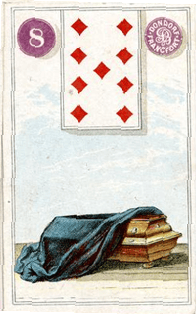
The funeral pall, wreath, or other mourning adornments frequently appear on the left-hand side of the Coffin. Whether intentional or not, I have always found this a useful aide-mémoire. That side represents what has already passed away and is now being mourned.
Indeed, I sometimes compare it to the committal doors of a crematorium that a coffin passes through or the curtains that close around the coffin during the committal service. Once the coffin passes beyond that point, there is no return.
The undraped side tells a different story.
It shows what is sick, failing, weakening, or entering decline. The process has begun, but the conclusion has not yet been reached.
Whilst these observations should never be applied mechanically, they provide a valuable starting point when interpreting the Coffin. The card to its left is often mourned because it has already ended. The card to its right frequently reveals what is now declining, weakening, or becoming unsustainable.
One belongs to the past.
The other still possesses a future, however uncertain that future may presently appear.
Receptacles
The Coffin is, quite literally, a container. Before it becomes a symbol of endings, illness, and loss, it functions as a receptacle. This simple observation explains a number of practical meanings that might otherwise seem unusual.
The card frequently signifies boxes, drawers, chests, lockers, containers, and other objects designed to hold or store things. Whenever the emphasis falls upon what contains rather than what is contained, the Coffin often appears quite naturally.
A second and closely related manifestation concerns disposal. Because a coffin receives what has expired, the card readily extends to rubbish bins, refuse chutes, skips, waste-disposal areas, and similar locations. This is one reason the Coffin frequently appears in mundane daily draws. Rather than heralding catastrophe, it may simply indicate taking out the rubbish, sorting unwanted items, clearing clutter, or dealing with waste and debris.
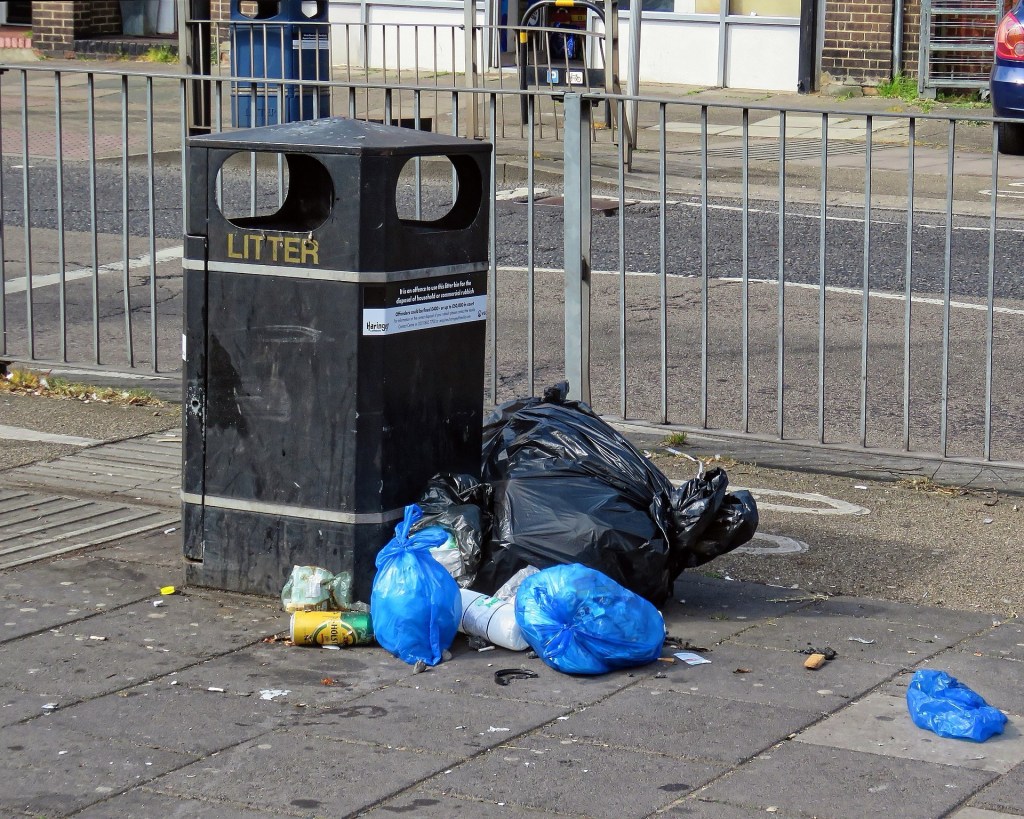
For example, Coffin–Fox has appeared repeatedly in connection with refuse scattered by foxes and other scavenging animals. In such cases, the Coffin does not signify death but rubbish, waste, and the practical realities of disposal.
A more curious association was taught to me by my second Lenormand teacher, a French lady, who maintained that the Coffin could also signify safes and jewellery boxes. I initially struggled with this idea. A safe seemed more naturally associated with cards such as the Book and Key, both of which possess strong connections with secrecy, security, and restricted access.
With time, however, I began to understand her reasoning.
The association is not founded upon secrecy but value.
Whilst a coffin receives a deceased body, it nevertheless contains something regarded as precious by those left behind. Throughout much of Europe, Christian tradition viewed the care and burial of the dead as a sacred duty. The deceased body retained dignity and significance, particularly in light of beliefs concerning bodily resurrection, and was treated with considerable respect. In this sense, the coffin functioned not merely as a container but as a protective vessel for something valued.
Over time, particularly in lost-object readings, I found the Coffin repeatedly identifying safes, jewellery boxes, keepsake chests, lockboxes, and other containers used to protect valuable possessions. The association remains comparatively specialised, yet it has appeared with sufficient consistency to merit mention.
The common thread running through all these manifestations is not death but containment.
Whether the Coffin contains something precious, something discarded, or something that has reached the end of its usefulness, it remains a receptacle. Its contents may change, but its function remains the same.
Underground and Hidden Places
Another useful feature of the Coffin is its ability to signify things that are beneath the surface, underground, or below ground level.
Because coffins are traditionally buried beneath the earth, the card naturally acquires associations with basements, cellars, vaults, crypts, tunnels, service ducts, and other places situated below ground level.
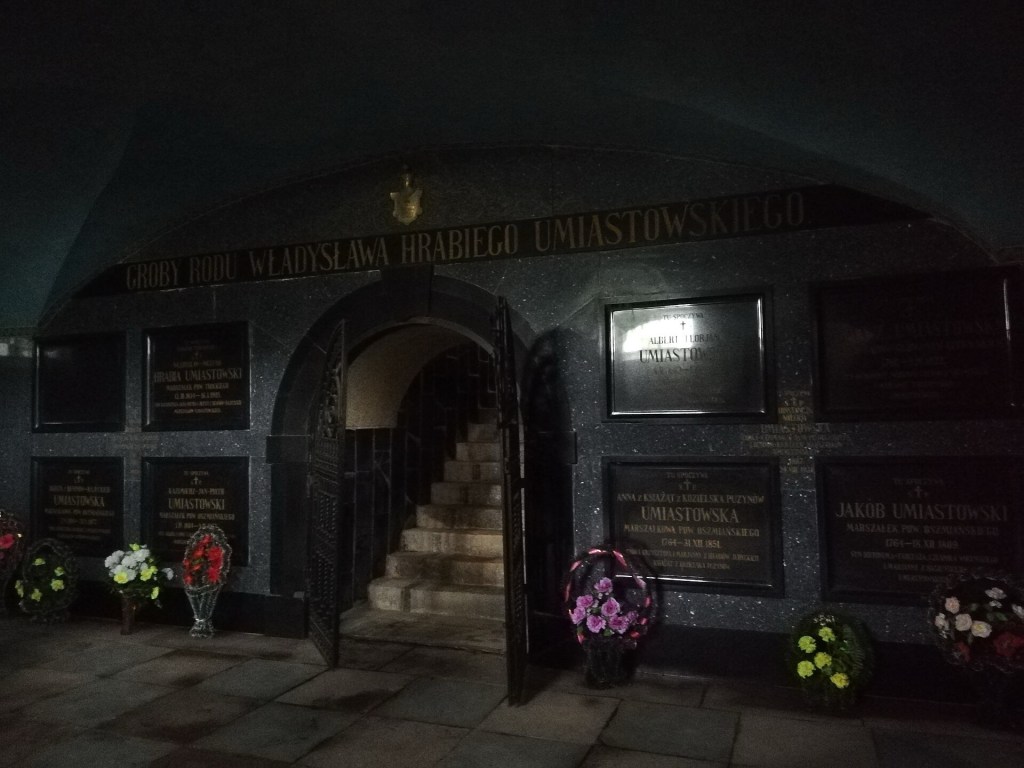
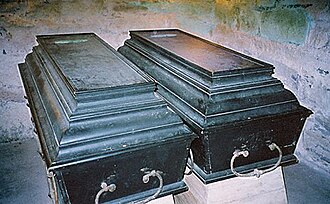
Umiastoŭskija Crypt, Dzyanis Kurhan, CC BY-SA 4.0 https://creativecommons.org/licenses/by-sa/4.0, via Wikimedia Commons
I first became aware of this meaning when I was about eleven years old.
A friend of mine, Luc, asked for a reading. The cards included Coffin – Scythe – Fishes. Confident in my interpretation, I informed him that there would be a significant and unexpected financial loss. As we were both children, neither of us could make much sense of the prediction.
What I had failed to appreciate was that the House stood directly above the Coffin.
In retrospect, the symbolism was remarkably clear: the problem lay beneath the home itself.
A week later, a water pipe burst beneath Luc’s family home and flooded the basement. The property was a large Georgian house and the resulting repairs proved extremely expensive. The family ultimately cancelled their annual holiday in order to pay for the damage.
The reading has remained with me ever since. Not only did it demonstrate the remarkable precision sometimes possible with the Petit Lenormand, but it also taught me the importance of examining every card carefully before settling upon an interpretation. It also taught me the difference between influence v. influenced. The loss was indeed financial (Scythe–Fishes), but the cause was a flooded basement signified by the Coffin beneath the House.
Like many of the Coffin’s more practical meanings, this interpretation most commonly appears in lost-object readings and questions concerning physical locations.
In lost-object readings, the Coffin frequently directs the seeker to look down rather than out.
Thus, the Coffin may indicate that a missing item is:
- in a basement or cellar,
- beneath the house,
- in a cupboard beneath the stairs,
- in a lower drawer,
- in a storage box beneath other objects,
- underground,
- in a vault or safe,
- or otherwise concealed below something else.
The common thread is not death, but what lies beneath the surface.
In this respect, the Coffin remains entirely consistent with its symbolism. What it represents often lies beneath, behind, or below something else. Whether a basement, a buried object, a lower drawer, or a concealed compartment, the card directs our attention beneath the surface. The lesson is not one of death, but of depth, concealment, and what has been placed out of sight.
Timing
In matters of timing, the Coffin is a slow-moving card. Its influence frequently introduces delay, fatigue, and a sense of diminished momentum into a reading.
Unlike the Mountain, which delays through obstruction, the Coffin slows through exhaustion, decline, and the gradual loss of vitality. Matters continue to move, but they do so reluctantly and often with far less energy than before. For this reason, the Coffin seldom produces immediate outcomes. More commonly, circumstances unfold gradually as situations deteriorate, conclude, or reach their natural point of expiration.
The card can therefore exert a noticeable influence upon surrounding timing cards, often slowing the pace at which events develop.
In shorter-term readings, I have repeatedly observed an interesting relationship between the Coffin and the Sun.
Coffin–Sun frequently indicates the period between dawn and sunrise, when darkness is receding but daylight has not yet fully established itself.
By contrast, Sun–Coffin often describes the period between sunset and dusk, as daylight fades and gives way to darkness.
Naturally, these observations are most useful in readings covering short time frames, yet I have found them surprisingly reliable in practice.
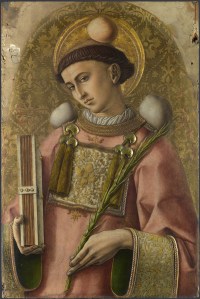
On occasion, I have also observed the Coffin referring to the period between 26 and 29 December. This is not a traditional attribution that I have encountered in older cartomantic literature, but a personal observation arising from practice. The association stems from the traditional connection between these dates and St Stephen the Protomartyr, who is regarded as the patron saint of coffin makers. Whether the connection is symbolic or coincidental, I have seen it recur often enough to merit mention, although I regard it as considerably less reliable than the card’s broader indications of slowness, decline, and conclusion.
Whether interpreted as a time of day, a seasonal influence, or a point in the calendar, the Coffin remains true to its essential nature. It signifies periods in which things are slowing, concluding, or approaching their natural end. Time itself appears to move more heavily beneath its influence.
Health
Because the Coffin’s health meanings have already been discussed in detail, only a few additional observations are required here.
The Coffin is the deck’s principal carte maîtresse for illness and disease. This should not be confused with the Tree, which governs health, vitality, constitution, and the body’s capacity to sustain life. The Tree describes the presence of vitality; the Coffin describes its loss, interruption, deterioration, or exhaustion.
In practice, the Coffin most frequently appears in connection with chronic, degenerative, or life-altering conditions. The card commonly describes illnesses that require ongoing management, adaptation, or substantial changes to the seeker’s circumstances. Conditions such as myalgic encephalomyelitis, Parkinson’s disease, multiple sclerosis, and other long-term disorders fall naturally within its sphere because they often force the individual to alter how they live, work, travel, and plan for the future.
The defining feature is not necessarily severity, but consequence.
What distinguishes a Coffin illness is that it changes something fundamental about the seeker’s life. The person may remain capable, fulfilled, and productive, yet they can no longer continue exactly as before. New limitations, treatments, routines, or expectations become part of daily life.
This reflects the card’s essential nature. The issue is not merely the illness itself, but the fact that some aspect of the seeker’s former life has effectively come to an end.
In shorter readings and daily draws, however, the Coffin frequently manifests in a more modest fashion. A migraine, severe headache, the onset of a cold, influenza, or another temporary illness may all appear under this card. Even when the condition is temporary, there is usually a reduction in vitality, normal functioning, or resilience. The individual feels weakened and is often forced to put plans on hold until recovery takes place.
Whether chronic or temporary, the Coffin seldom describes robust health. Its appearance usually signals that the body requires rest, treatment, attention, or adaptation. The surrounding cards will determine whether the condition is relatively minor and short-lived or something more substantial that affects the seeker’s life for an extended period.
What makes the Coffin distinctive is that the illness often marks an ending. It may be the end of a period of good health, the end of a particular lifestyle, or the end of assumptions about what the future will look like. The card therefore directs our attention not only towards the illness itself, but also towards its wider consequences.
Ultimately, the Coffin reminds us that illness is frequently experienced as a form of loss. Whether that loss concerns comfort, independence, certainty, mobility, opportunity, or a former way of life, the card directs our attention towards what is passing away and what must now be adapted to. Understanding that loss is often just as important as understanding the illness itself.
The Coffin in Action
Let us now turn to a practical example.
When I first began studying the Petit Lenormand, it was through the traditional Grand Tableau which, like most tableau-style readings, did not divide the reading into rigid past, present, and future sections. The first source through which I encountered this approach was Erna Droesbeke. Whilst I experimented with the method, it never connected with me entirely.
Part of the reason was that I later acquired Mary Marco and Janine Goffin’s work, which included a draw known as the Wheel. Although somewhat cumbersome to lay out, it is an excellent spread that provides detailed insight into the past, present, near future, and more distant future. It also includes a dedicated section for the seeker’s thoughts, offering a glimpse into their state of mind, concerns, hopes, aspirations, and fears.
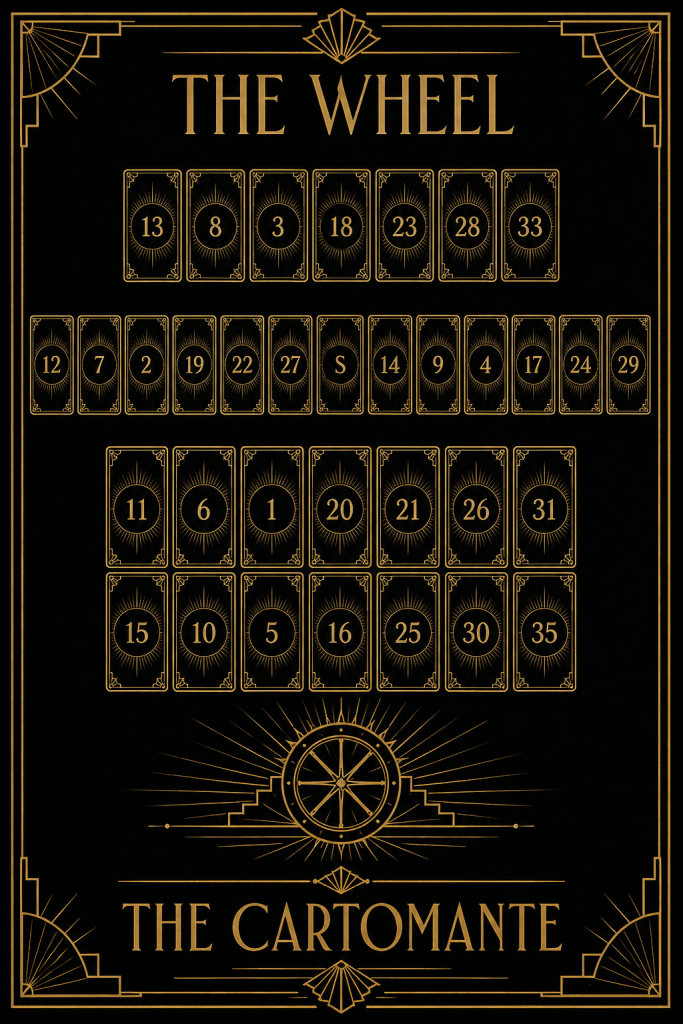
I found this approach considerably more useful than dividing the Grand Tableau into temporal zones, particularly because a significator’s position can sometimes make such divisions impractical.
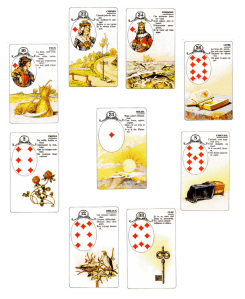
This reading was performed in early 2025 using the Wheel Spread. For the purposes of this example, however, we shall focus solely upon the Thoughts section. These are the cards above the significator starting with card 13 in the diagram above.
Lara was a married woman in her mid-thirties with two young children.
The cards were:
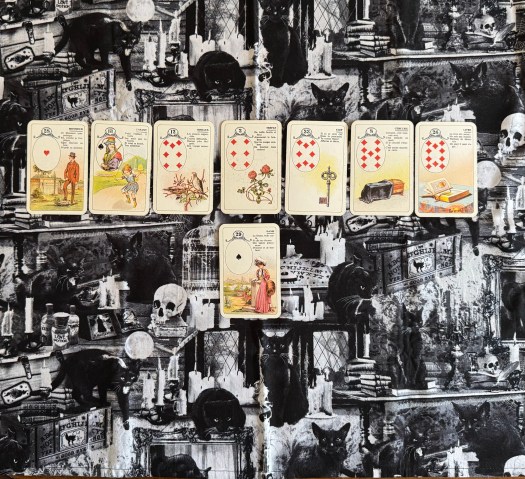
Lord – Child – Birds – Cloverleaf – Key – Coffin – Book
The presence of the Lord and Child immediately reveals the two people foremost in Lara’s thoughts: her husband and one of her children.
It is comparatively uncommon to find the partner card and Child in close proximity without family concerns becoming a major theme of the reading. Such combinations frequently appear when a couple already have children or are actively considering expanding their family.
The combination of Child – Birds immediately raises two possibilities.
On the one hand, like many readers I associate the pairing with conception and pregnancy. On the other, the Birds also signifies worry, anxiety, nervous discussion, and agitation.
The surrounding cards quickly clarify the situation.
The Cloverleaf following the Birds suggests that whatever is causing concern is temporary and likely to improve quickly. The Key then opens the Cloverleaf, transforming a temporary worry into a fortunate outcome. Whatever concern currently exists is likely to prove short-lived and ultimately reassuring.
The most instructive part of the sequence, however, is:
Key – Coffin – Book
The Key seals the Coffin, confirming that an illness or physical problem has genuinely occurred. The Coffin then acts upon the Book.
In practical terms, knowledge diminishes.
The cause remains hidden. Explanations remain incomplete. Questions remain unanswered. This is not merely illness. It is illness whose origin cannot yet be adequately explained.
The draped side of the Coffin touching the Key further suggested that investigations had already been undertaken. The immediate health concern had passed, but certainty had not been obtained. The illness had effectively been locked away, whilst its cause remained unknown.
My intuition at the time was that Lara and her husband were indeed considering extending their family. However, I felt that the more pressing concern involved one of their children.
The child had been unwell.
This had created a period of anxiety and worry (Birds), but the situation was improving (Cloverleaf) and would ultimately resolve favourably (Key). What would remain, however, was uncertainty regarding the underlying cause (Coffin – Book).
Lara confirmed this interpretation.
One of her daughters had recently experienced an illness which had caused considerable concern. Despite medical investigations, no tests had been able to determine a definitive cause.
The cards accurately reflected both the illness itself and Lara’s lingering anxiety surrounding the unanswered questions.
Importantly, however, the surrounding combinations were significantly more reassuring than the Coffin alone might suggest.
The child had recovered.
The immediate danger had passed.
The sequence of Birds – Cloverleaf – Key described a movement from anxiety, to relief, to confirmation that things would be well again.
As for pregnancy, Lara confirmed that she and her husband had indeed been trying for another child, although without success thus far. Both Lara and her husband were hoping this would change soon (Lord – Child – Birds – Cloverleaf). Because the Child – Birds combination appeared within the Thoughts section, I advised that the cards reflected their hopes and discussions regarding another child rather than offering a reliable prediction of conception itself.
What makes this example particularly instructive is that the Coffin did not solely describe illness. It described uncertainty surrounding illness. The illness itself passed. The questions remained. This is entirely consistent with Coffin – Book, where knowledge concerning a problem is hidden from view even after the problem itself has begun to recede. The presence of the Key is especially important.
Throughout these articles I have stressed that the Key both opens and secures. Here, the Key does not open the Coffin. It secures and seals it. The matter is effectively closed and placed beyond further examination. As a result, the Coffin carries the Book to the grave. The child recovers, the danger passes, and life moves forward. Yet the true cause remains buried. The tests provide no definitive answer and the mystery remains unsolved. The Key therefore confirms both the resolution of the illness and the permanence of the uncertainty surrounding its origin.
§
Images:
Featured Image:
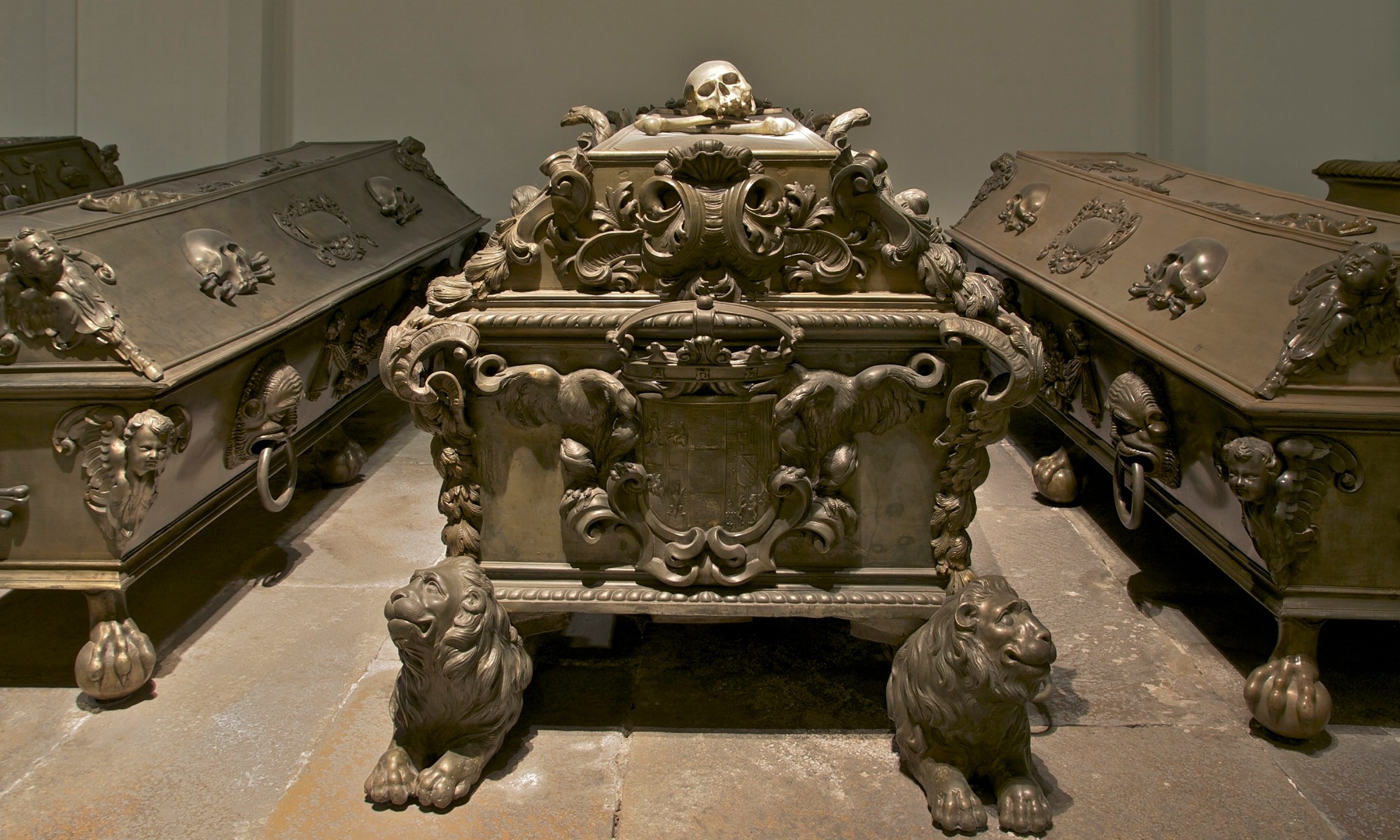
Jebulon, CC0, via Wikimedia Commons
Cards:
Lenormand Cards: Jeu Lenormand © Cartamundi, WanderWüst © Jorge/Wandering Oracle, Lenormand Fortune-Telling Cards © Zao-Gelli, The Lenormand Oracle © Verlag für die Frau, Leipzig, Nieuwe Lenormand © Amber Studio/Erna Droesbeke, Lenormand 36 Orakelspielkarten © Königsfurt-Urania,
References:
Boroveshengra, A., 2013. Cartomantes’ Cabinet: The Petit Lenormand Course.
Boroveshengra, A., 2015. Lenormand Thirty Six cards. 2nd ed. Create Space.
George, R. 2014 The Essential Lenormand: Your Guide to Precise & Practical Fortunetelling. Woodbury, MN: Llewellyn Publications.
Marco, M. and Goffinet, J., 1989. Petit Lenormand. Bruxelles: Servranx.
Matthews, C. 2014 The Complete Lenormand Oracle Handbook: Reading the Language and Symbols of the Cards. Rochester, VT: Destiny Books.
Meuris, B., 2018. Petit Lenormand Encyclopaedia: Volume 1. Create Space.
Silvestre, C., 2003. Le Petit Lenormand. [Montpellier]: Gange éd.


