Programme two of my one-to-one tuition course with the Marseille tarots focuses on helping deliver the same precise and succinct answers, delivered with the linear draws, with spreads and positional draws of various sizes. The plan was developed in response to numerous e-mails and comments from readers, and my earliest students. Often students find themselves becoming hesitant or losing focus when reading cards in patterns, especially those with positional contexts. Here we prevent such habits, building proficiency and incisiveness.
Quite often students tell me how surprised they are that a Celtic Cross or the Widdershins’ Star can be read as a snappy sentence, just as one can a line of five or nine cards. But the reality is they can be. It is all just a matter of orientation.
The linear draws flow from the first card to the last card. Leaving aside reflection, cards relate solely through progressive attendance. Thus, there is no question of a positional relationship found in a draw such as Astrological Wheel or Celtic Cross. The challenge for the cartomante, therefore, is to cultivate the same sense of directional ease through knowing where each place falls in the course of the narrative.
The Horseshoe
« Le fer a cheval » or horseshoe spread is cartomantic standard. In addition to providing clear answers to precise questions – including yes or no – it offers useful advice on how to solve problems or situations.
It is the first draw covered in the second programme.
Although we focus on the Marseille tarot, here, it can be employed with the l’oracle de Belline, the Petit Lenormand, l’oracle de la Triade and le tarot persan de Madame Indira, et cetera. It is thus extremely versatile and, therefore, a useful addition to the cartomante’s repertoire.
The Basics
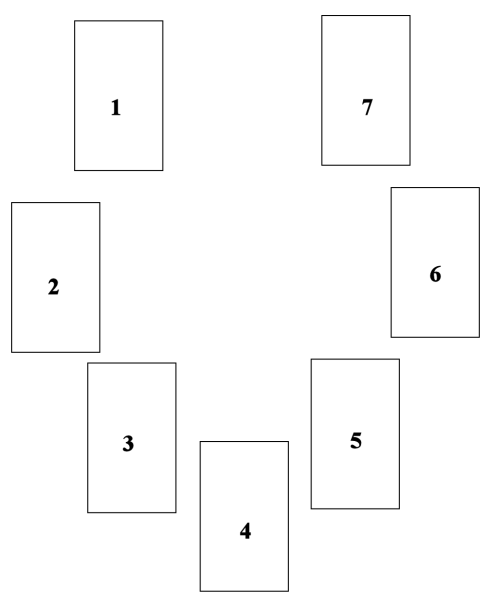
The draw is composed of seven cards, which are to be arranged as shown below. As with numerous spreads, there are variations to be found. The one described, here, has served me well. I also use a second variation which can be seen in a later article.
-
- Card one determines the consultant in the face of her question giving insight into her attitude and position.
-
- Card two defines the present situation in relation to the question which can either aid or hinder or shed let on external influences or individuals.
-
- Card three represents the future and how matters will play out.
-
- Cards four and five advise on the direction the consultant should take, what to do and how best to act.
-
- Card six is the main obstacle to be overcome and can provide guidance on where to forbear.
- Card seven is the response.
Relating the Cards
Although the reader can advance through the cards in numerical order one can then struggle to formulate the core answer. The core answer is a succinct pronunciation that summarises the cards’ response taking into consideration how the cards relate to and engage with each other.
A sequential stroll through the cards will thus provide a disjointed and pedestrian answer. One also runs the risk of turning the reading into seven one-card readings, rather than a seven-card reading. Unfortunately, the majority of Anglo-Saxon cartomantes fall into this trap and have made the latter a virtue of necessity.
Narration
The first card advises the cartomante on the temperament and position the client occupies in relation to her question. It is thus the point of departure and also can be seen as a significator.
Both card two (the present state of affairs) and card six are connected with the latter describing the main obstacle arising out of the present situation.
Now that the cartomante is appraised of both the situation and difficulties he turns to the fourth and fifth cards. These two cards advise the seeker on how she can best proceed to resolve the challenges she faces. Thus, both cards are key to offsetting card six.
Naturally, card seven and card three are closely connected. The cartomante will need weigh these two cards against each other and see if there are signs of dissonance.
For example, the cartomante finds himself reading for a client who wants to know if she will reconcile with an ex-partner: the seventh card is le soleil and the third card is le diable. The disparity between these cards indicates that although the two will reconcile (le soleil) she will find herself in hellfire (le diable). Transpose the two cards then the answer is negative, but le soleil would, as occupying the future position, foretell warmer times and love in the near future.
Example Reading
At the end of January one of my mother’s friends asked if someone could read for her daughter. After 52-weeks’ maternity leave, the daughter had returned to the employment to discover her role (secretarial) had changed and was somewhat unhappy to find herself working for a different person. Due to the complex laws surrounding maternity leave, the seeker felt that there were grounds for complaint, although was somewhat wary of initiating a grievance.
Her question was: “Will I be able to resolve this to my advantage?”
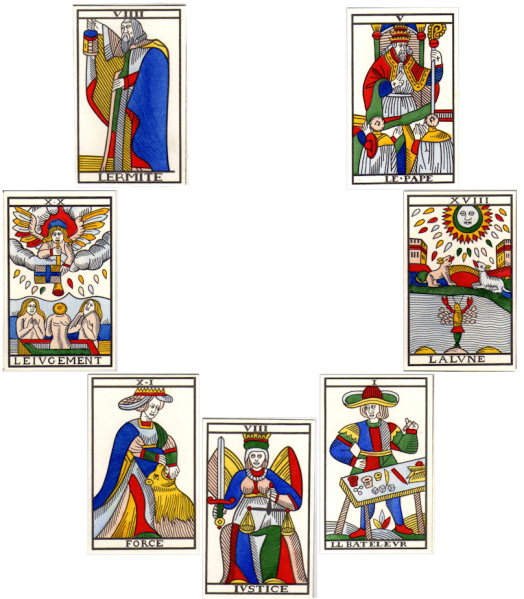
The cards as they fell:
Answer:
Yes, but with the aid of a steward or mediator; you can then cut through the mess and find yourself in a satisfying condition.
Delineation:
For clarity, we will breakdown the spread and delineation.
The client appears as l’Ermite which shows the client is searching for a solution and guidance, not being in a position where she can act autonomously.
Presently, her employer is undertaking some form of restructuring, that has come at the same time the seeker returns to work (Jugement), which has resulted in considerable confusion (la Lune).
With La Lune in mind, the client will need to solicit advice from one who can weigh the situation appropriately (la Justice) and, therefore, identify the right moment to act and deal the winning card (le Bateleur). It is important that she keeps her feet firmly on the ground (la Lune contrasted with la Justice and le Bateleur).
Thus, with the appropriate aid (le Pape), she will be in a strong position to resolve the situation to her satisfaction (la Force). We notice that both l’Ermite and le Pape are turned from each other – the seeker has not sort appropriate advice and would benefit from either union representation or some mediation (le Pape).
Despite the draw utilising positional contexts, we are able to retain the incisiveness of a linear draw. We just need to know how positions relate to each other in the same way attendance in lines flows. As with all of cartomancy, it comes down to looking.
§
Cards: Les Tarots Marseille de Jean Noblet, Paris, vers 1650 © Éditions Letarot.com (2001).
 Journal of a Cartomante