The entry you are about to read first appeared on NéosFortune, in May 2017.
I have been getting to know a junior doctor, hereafter called Hugo. Hugo was intrigued to learn that I read the Lenormand Orace as these are the cards read by one of his mother’s friends, back in Martigny (Switzerland). After dancing around the issue, Hugo eventually asked me if I would ever read for him. He wanted to know where his boyfriend stood on their relationship.
My office is on the top floor of a now little-used area of a 1930s building, that is said to be haunted (but that is for another post). This means few people come up to see me especially after 6 p.m. when I am often still working. In my top drawer, I keep a Lenormand Oracle which is small enough to both go unnoticed and be spread on a desk.
Firstly, let us consider what Hugo is asking us to answer. He wants to know where his ‘boyfriend’ stands on their relationship. Although Hugo is the person asking the question, it will be the boyfriend’s tableau. The boyfriend, therefore, is the Lord-card and Hugo the Cavalier[1].
Hugo’s question also asks where the Lord-card stands ‘now.’ That inference necessitates the introduction of an epochal scheme. For me, in this structure, what is to the left of the significator, is the past, and what is to the right, is the future. We, however, do not stop there. A full reading requires that we read the cards, not just left-to-right, but also in a helical formation. I include a complete example in my book[2]. For privacy reasons, at Hugo’s request, I omit the step in this post.
Here are five key steps followed. In this post, I will, however, not present them in sequential order. I do this to avoid repetition and to an enhance flow.
A QUICK BREAKDOWN:
- The most important thing always is the keep the focus on the cards, not the techniques. Let your eyes wander over the tableau; it’s the big picture, after all. What is going on? Where are the players? Are they near to each other, or far? How are things engaging? That is an important step, as it trains the brain to see the real picture (the process of intellection).
- I note the trigger card (first card) and read it with the two cards that follow it. I see the first three cards as a direct message, a terse statement, on the current state of affairs. Consider these in isolation first. Then they can be regarded in the wider context.
- Read the four corners, as these frame the situation, by showing dominant influences. I recommend reading them both diagonally and, again, in a helical manner.
- Read the present, the past, and then the future lines. If you require further information on a card (often the last card in a line, if it ends on an ambiguous note, e.g. the Clouds, the Fox, or the Ring), you can count on to the ninth card, and then to the thirteenth card. You then have three cards to read as an additional sentence.
- The final four cards are the quintessence, or perhaps best seen as the root or triggering events. You can expand on these, noting a degree of causality, by reading cards 33 and 34 with cards 27 and 28 and then cards 5 and 6. Cards 35 and 36 will be read with cards 29 and 30, and then cards 3 and 4.
Now to the tableau: ‘Where does the Lord currently stand in the relationship with Hugo?’
The cards as they fell:
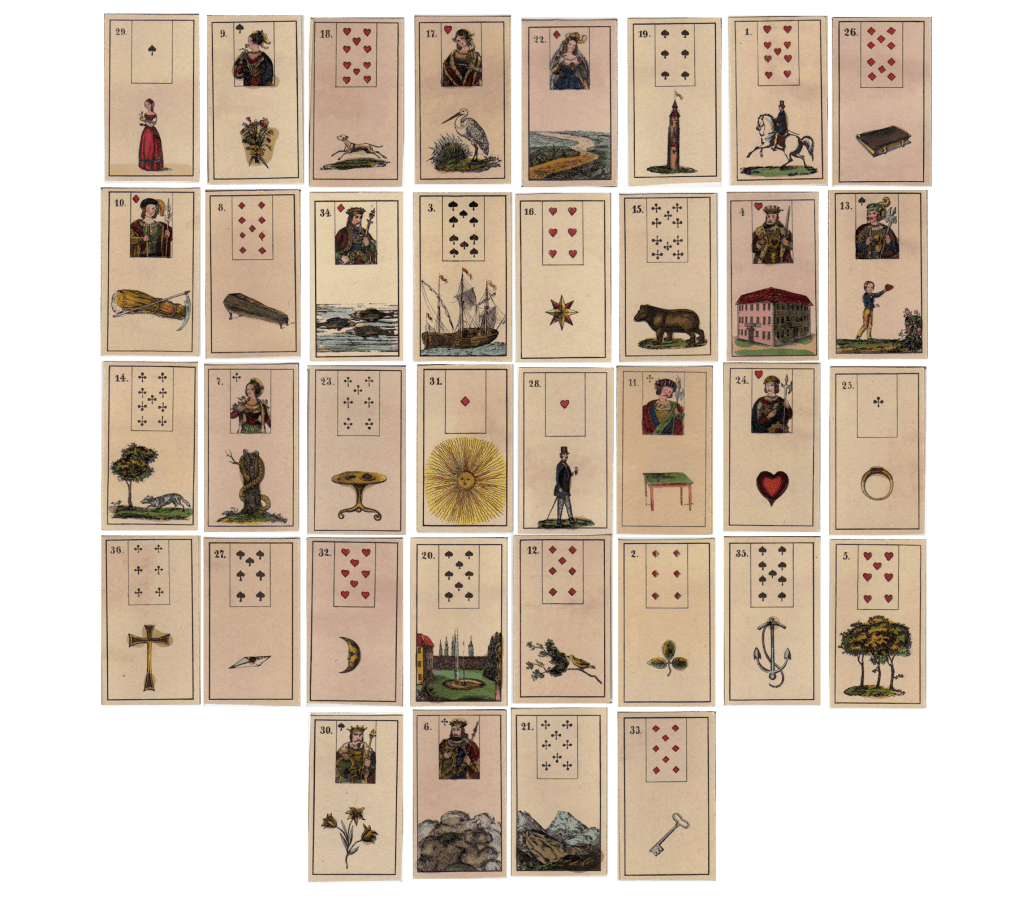
Cards: Lady, Bouquet, Dog, Stork, Roads, High Tower, Cavalier, Book; Scythe, Coffin, Fish, Ship, Stars, Bear, House, Child; Fox, Serpent, Mice, Sun, Lord, Whip, Heart, Ring; Cross, Letter, Moon, Garden, Birds, Cloverleaf, Anchor, Tree; Lilies, Clouds, Mountain, and Key.
Schematically, this is an interesting picture. It is, at first glance, well-balanced. The Lord-card has four cards to his left and three to his right (four thus being the farthest, see below right). There are two rows above him, but just one below. So the past is heavier. Ahead of him is both the Heart and the Ring. Some would rejoice. However, dear reader, before we prepare our confetti, I see the path to the Heart is via the Whip (which connects, obliquely, to the Birds at the Lord-card’s feet – stressed and upset people lash out). But what is more interesting is the appearance, right at the start, of the Lady-card. And this Lady occupies Hugo’s natural position (that of the Cavalier). As said before, some would like to see the Lady-card as Hugo. But, alas, when I checked he had trousers on not a dress.
In a draw, the first card dealt is always the trigger card. It tells you about an event or dynamic that has triggered events discussed or elaborated on in the other cards. It’s thus the starting point, the project at hand. Here, we find the Lady. Having a person card fall first can be likened to a conductor (which is more evidenced when we consider the corners). But let us return to the task at hand. What statement is made by the first three cards? A woman proffered (Bouquet) the hand of friendship (Dog).
Now, where does the Lord-card stand in this relationship? Presently, he is divided about what direction he wishes (Stars) it to take long-term. The Paths, which crown the Lord-card, always carry a degree of conflict over which direction to choose. The High Tower is a difficult card in a relationship, as it can presage a robust and stable outlook or conflicting self-interest. Paired with the Paths, it shows indecision and self-doubt about what one wants long term preventing progress. Sadly, with the Storks involved, this is: ‘Should I stay, or go?’ The Lord-card is considering if he’s better off flying solo. So it’s not surprising to find he is presently stressed and upset and feels like he is banging his head against a brick-wall (Birds and Mountain).
Note the Ship right next to him, he’ll be off soon.
The future doesn’t look too promising. Obviously, the Ring is the relationship, but it is also the card of repetition and going-round-in-circles. Following the Whip and Heart, it shows recriminations and passionate disputes, even controlling behaviour, that does not have an end in sight.[3]
The cause of this lies in the past. There is a clear sign of misplaced trust and betrayal (the Fox, the Serpent, the Mice). Our Lord survived to fight another day but felt drained rather than victorious (we find the Mice with the Serpent and the Sun either side).
In love, the Fox, a charming and skilled seducer, always warns of the risk of being cheated, and the Serpent, emotional wrangling, and perfidy. If we look closer at the two cards, we can see the Serpent mirrors the Heart, in the future, showing the venom is still to be felt as keenly tomorrow. Is this the right relationship, the Fox asks?
Now, from where did all this start? Some might point the finger of suspicion at the Cavalier. He sits in the Serpent’s house, after all. Such is a misunderstanding of the houses: the Cavalier is unjustly constricted by the Serpent, as he is its guest.[4]
We cannot directly connect the Serpent to anyone, other than the Lord-card. However, the Fox combines with both the Lord-card and the Lady-card, who indirectly relates to the Serpent vis-à-vis the Bouquet and the Fox (knighting, an indirect correlation). A closer inspection of the Lady-card confirms this. Her vertical line shows the serious harm and damage caused through deceitful actions (the Scythe, the Fox, the Cross). The horizontal line and chain indicates her exit, stage left, occurred at the appearance of Hugo. The Lady-card and the Cavalier meet in the clouded Garden, also, from which we can infer that the did not ‘click.’ In her negative aspect, the Serpent is a seditious figure who is very fond of spreading poisonous words and likes to isolate people from her prey. This is borne out here across the tableau.
Although this Lady has – quite clearly (if we consider the diagonal and horizontal lines) – left the Lord’s life, where he stands is directly in her wake. The four corners beautifully reiterate this: the Lady-card causes long-lasting grief (the Lady, the Book, the Tree, and the Cross) which means she cannot be forgotten (the Lady and the Tree) and that’s a painful lesson to digest (the Book and the Cross).
What can say about the Lord-card and his Cavalier? Imagine drawing an ‘+’ and an ‘x’ from both cards and see where they meet. Here that is the Dog, the Bear, and the Heart.
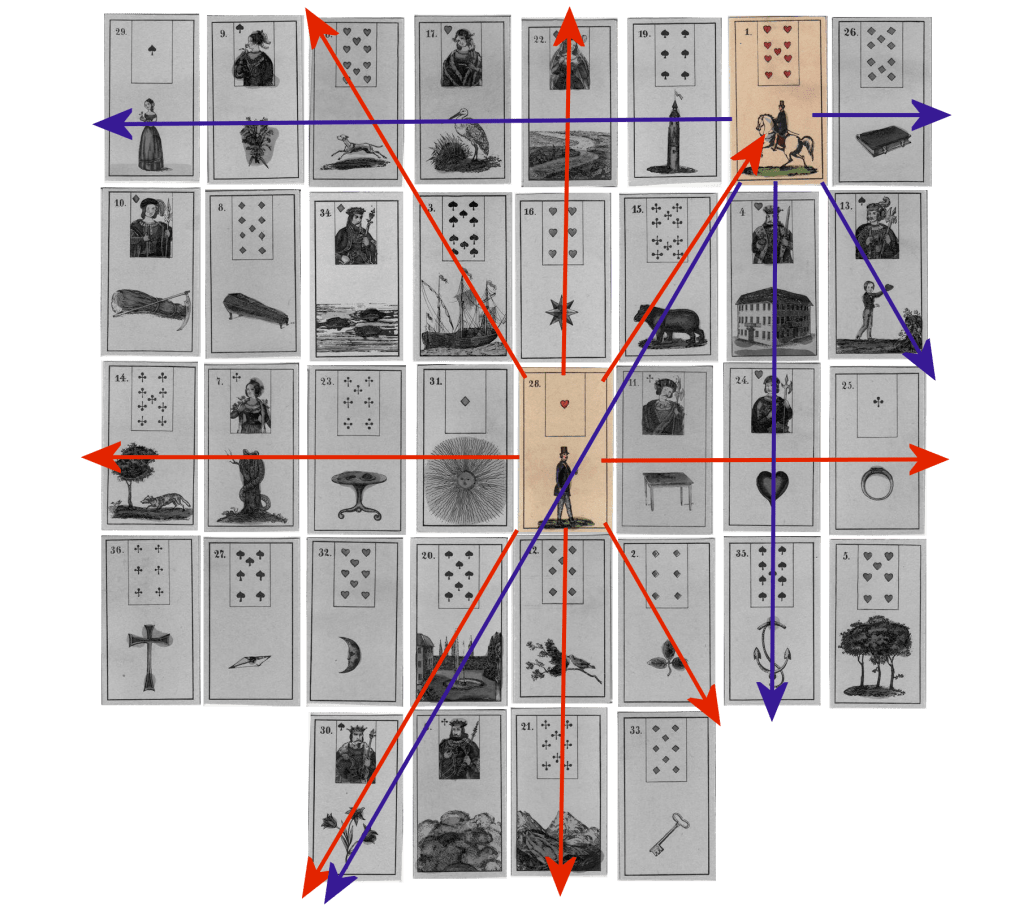
The Bear’s essence is power, and this manifests as strength, authority, and courage. In love, this can be felt somewhat heavily, but it is sincere and reliable (emphasised by the Heart). If we look at the Bear, we can see the strong potential for a fresh start in their personal life (horizontal line). But the Lord needs to do some serious thinking (the Paths).
Looking at the last four cards, what can we see? The Mountain adds greater density or an opaque look to the Clouds. It thus makes it harder to see a solution (the Key) to the current upset (Lily, clouded). This is further evidenced by the additional pairings, most notably the Birds and the Cloverleaf. But there is a solution.
If we return to the Ring, we can count to the ninth and then the thirteenth cards. That gives us the Ring, the Tree, and the Key. From this, we infer that the relationship can be fixed (Key). The Tree encourages taking some time out and contemplating the situation more neutrally. A holiday may be the answer (remember the Ship?).
So, to summarise, the cards say that the Lord stands at a crossroads considering whether it would be better for him to call a day on the relationship or invest enough time to sort it out.
As you can see, reading for a same-sex or gender couple is no different than reading for a straight couple. Both need to be open to parties of the same and other gender. Hence why I do not replace the Lord-card or Lady-card or pretend them to be genderswapping entities.
§
Cards: The Lenormand Oracle © Verlag für die Frau, Leipzig (1982).
Featured Picture: Copyright The Tuke Collection / Supplied by The Public Catalogue Foundation
References:
[1] There are several differing viewpoints on the topic of significators in same-sex relationships.
[2]Boroveshengra, A. (2015). Lenormand Thirty-Six Cards: An Introduction to the Petit Lenormand. 2nd edition. CreateSpace. Pages, 181 – 202.
[3]In such circumstances counting can help. The ninth card from the Ring is the Tree, and the thirteenth card is the Key.
[4]A house is a domicile. It has four walls. If you find yourself in the Coffin’s house, you’re sleeping in a casket. In the Fox’s den? Think Jemima Puddle-Duck.
 Journal of a Cartomante