He who spares the rod hates his son, but he who loves him is diligent to discipline him.
Proverbs 13:24 (RCV CE)
Birch Rod, signifies family quarrels and domestic trouble, dissension between spouses, fever and long illness.
Original Instructions
Card no. 11, the Knave of Clubs or the BIRCH ROD, often provokes debate. Does it mean something that happens repeatedly? Is it the picture for exercise or the gym bunnies? Or is it about correction?
The Essence and Function of the Birch Rod:
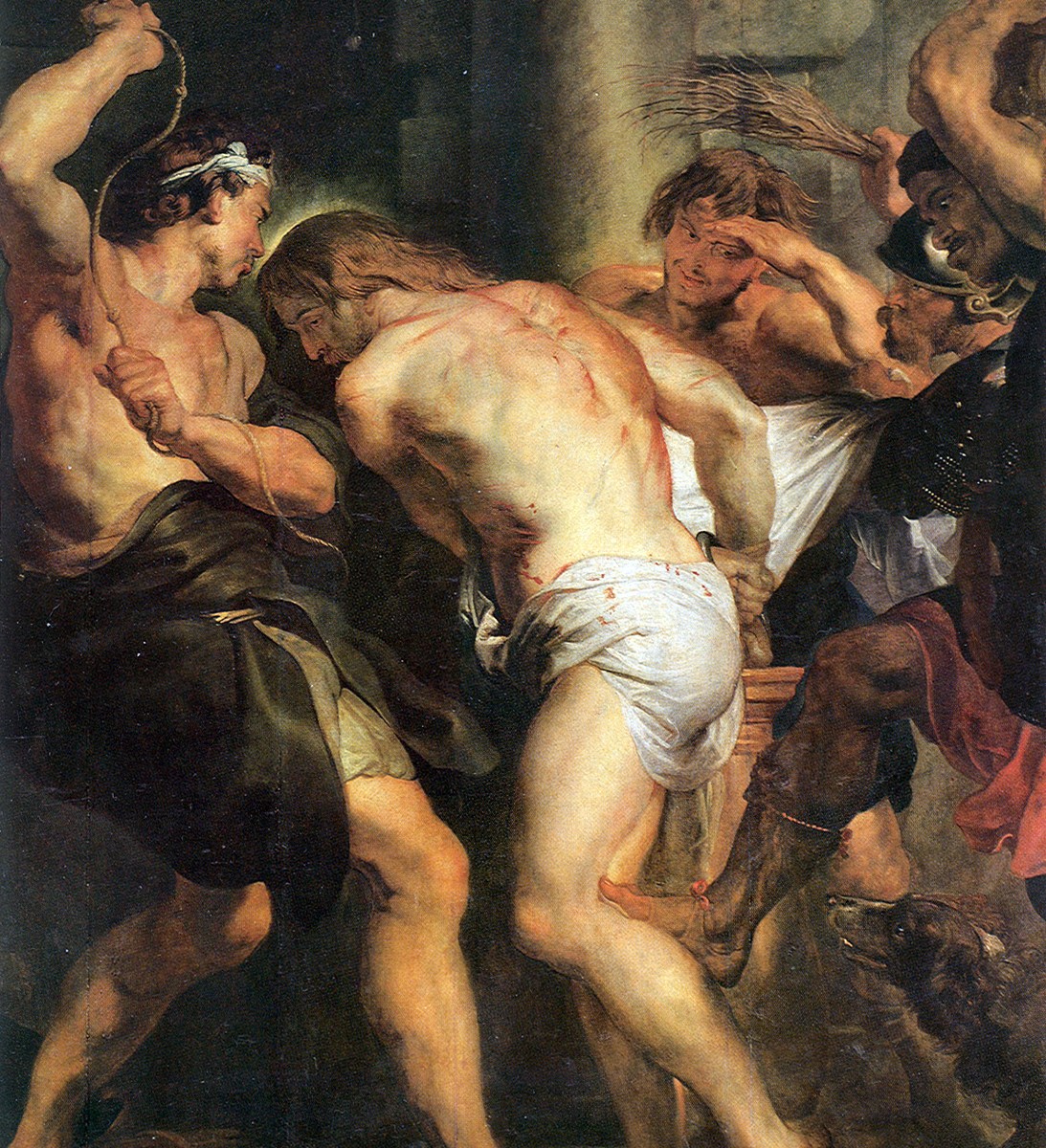
The essence and function of the Birch Rod card is correction and discipline, respectively. It is not uncommon to see a broom on the Knave of Clubs’ card; however, the traditional emblem is a bundle of birch twigs and scourge. Both are tools of corporal punishment and call to mind the scourging of Christ.
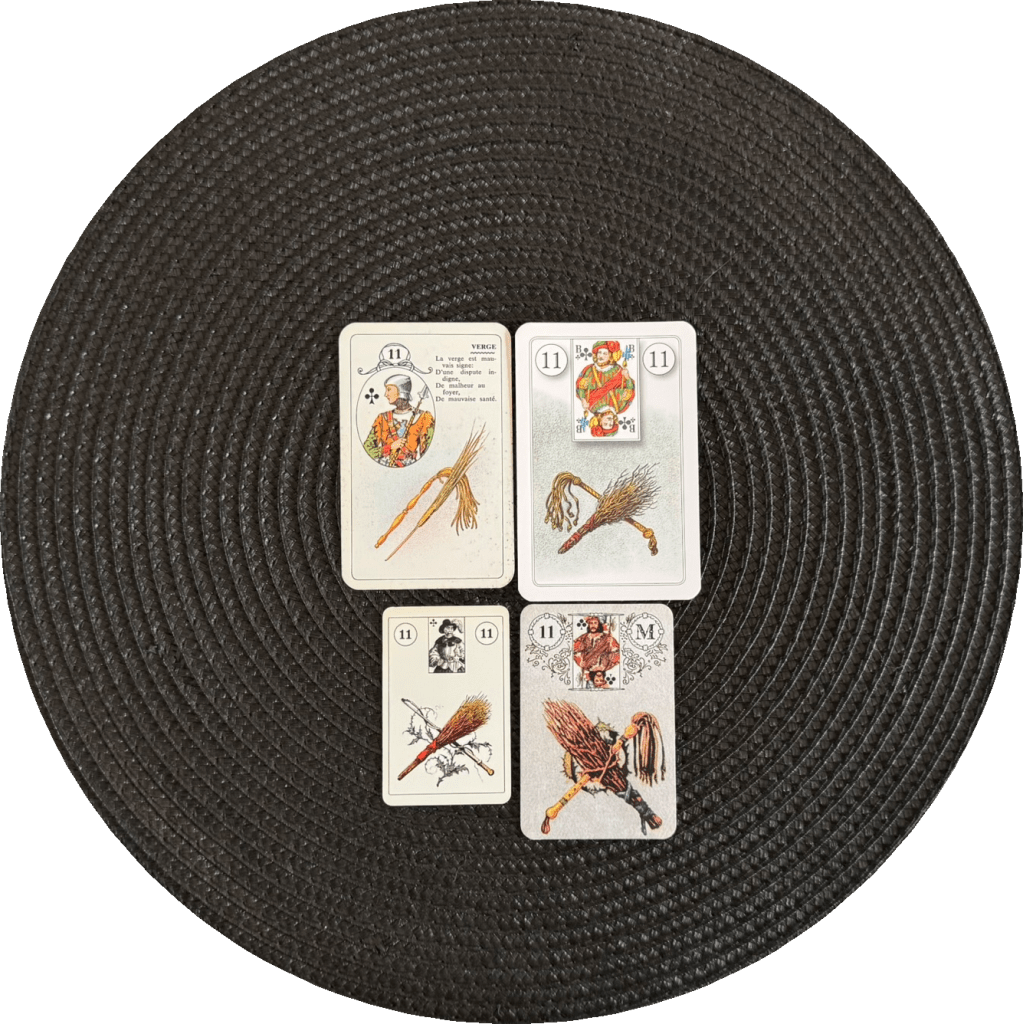
Some readers see the Birch Rod as neutral or neutral-negative/mixed. Others rate it negative. I agree with the latter.
Seeing the Birch Rod in the game is a sign that some remedial action is required. It forces us to confront the situation head-on and regain control of our affairs and correct any mistakes.
Depending on the draw, this will be in the topic queried or the carte maitresse (master card) the Birch Rod attends.
It can be pre-emptive: re-drafting the e-mail, seeking extra references or quotes before hiring a building or doing more preparation work for a job interview. It is far likelier, however, that a matter has already gone awry. The Birch Rod then is the final warning from Dame Fate. Act. Now. Or run the risk of a blow from Fate’s hand.
Matters under the card’s influence degenerate fast. It ignites a fight or flight response. People become defensive; someone says or does the wrong thing. Then we see the heated quarrels the Birch Rod is famed for. Left-unchecked, trouble can rain from all sides! Or as Björn Meuris says, you have to throw yourself into battle!
Occasionally, there can be violence, especially if one sees the Scythe + the Birch Rod.
It is not uncommon for a third party to have to intervene. In the Das Spiel der Hoffnung, the birch is resting on a table. We see this motif in several older packs. I quite like it. The problem or issue cited by the Birch Rod can often be solved by sitting down with someone and thrashing it out. Tempers may flare, yes. However, if carefully mediated by a firm hand, matters can be cleared up.
As the birch and scourge were tools for corporal punishment, the card carries such nuance. We see shades of the fasces, too.
Paired with the Bear or Park cards, one might see a police officer (Bear) or police station (Park) or lawyer or judge (Bear) or courthouse (Park). If seen with the Letter, one might receive a writ or fine. With the Hound card, however, one might detect a Union Representative.
Person and Description:
Card no. 11 is the Knave of Clubs and can therefore be read as a person. It is not common to do so. But from time to time, the Birch Rod will appear connected with social cards (Park, House, and so on) where it makes sense to read him as a person.
Ordinarily, the Knave is a younger man (<30) often said to have brown or black hair. He has a serious disposition and is quite astute. It is not uncommon for him to be an ex or step-sibling. The cards around him will tell us more about his appearance and temperament.
If the Birch Rod pairs with a person card, it can be read as a description. It will describe both the appearance and psychological state. This can be the Querent’s card or another figure in the game.
It has become common to associate the Birch Rod with virility, athleticism, and a go-getter or boss in recent times. I prefer the older descriptions in French literature, such as from Mary Marco and Jeanine Goffinet or Marie Delclos. Neither subscribed to such views.
The Birch Rod indicates someone who is extremely fatigued, browbeaten and defensive. It is easy to rouse the fight or flight response, and the person can be blunt or aggressive in his manner.
Special Features:
Some cartomantes have equated the corrective value of the Birch Rod with repetition or something that happens over and over again. That is a misunderstanding. The Birch Rod can force someone to re-do something to correct an error or perform a form of reparation; however, one does not do it repeatedly. Repetition is a matter for card no. 25, the Ace of Clubs or Ring.
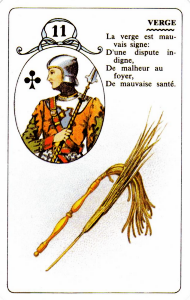
It is seldom difficult to pinpoint where the Birch Rod will manifest. If there is a master card nearby (the Ring, the House, the Coffin), that will be a strong candidate. Otherwise, it will be concerning the question. If, however, there is some doubt, look and see what the Knave of Clubs faces. This card can identify what will anger our bellicose knave.
So, if using the Jeu Lenormand (above left), we would look to the card on the left.
If you are reading the Grand Tableau, or a draw where the Birch Rod and the Consultant Card (the Gentleman, the Lady or the Child) both appear, see if the Knave of Clubs looks at or away from the consultant. It is easier to reach concord if the Knave of Clubs meets your eye.
It is not uncommon to see the Birch Rod when you receive a fine (parking ticket, late payment, and so on).
Professions associated with the Birch Rod are law enforcement, tax, customs and excise, law, stationery, and cleaning.
Objects signified by the Birch Rod include whips, scourges, rulers, walking sticks, pens and pencils, paintbrushes, brooms and cleaning equipment. In Cræft, the Birch Rod is the besom and tools of Arte (wand, cord, knife) used to conjure, control and redirect energy to circumvent present circumstances.
Well-Being:
In health, the Birch Rod is often inflammatory illnesses and noted to flare, such as connective tissue disease, psoriasis, reactive arthritis, inflammatory bowel disease, &c. Anatomically, it is throat and connective tissues.
Seeing the Birch Rod in the vicinity of the Tree card shows that the Querent’s constitution requires attention. It has become undermined and is no longer robust. If she fails to prioritise her well-being, she runs the risk of a period of ill-health in the near future. Go. See. A. Doctor.
Some cartomantes associate the Birch Rod with exercise. I disagree. The Cavalier is the card of exercise: equestrianism is a sport and form of exercise, no? Birching is neither a sport nor exercise.
The Birch Rod in Action:
One of the first readings I did for a client had the Heart and the Birch Rod together. The spread was the Great Wheel and the two cards were in this first packet. The Ring was the only master card in that grouping. I remembered that Mary Marco had included the pairing in the section on combinations with the cartes maîtresses. She noted that the pairing could see lovers come to blows.
It was accurate: the Querent suspected her husband of cheating and had lashed out. Sadly, her suspicion proved wrong. The Birch Rod has a particularly potent and nasty effect on relationships and home-life.
In another reading, the Birch Rod fell between the Fishes and the House cards. Both are master cards.
Here, the Querent had failed to notify the Department of Works and Pensions of a change in circumstances. It had resulted in an overpayment. The Querent was left with a bill (deduction on benefits), causing a lot of stress at home due to money shortages.
So there you have some of my thoughts on the Birch Rod card.
Illustrations:
Cards: Jeu Lenormand © Cartamundi, WanderWüst © Jorge/Wandering Oracle, Cartes Lenormand ©Dondorf, Lenormand Fortune-Telling Cards © Zao-Gelli, Petit Lenormand © Daveluy (Author’s Collection).
Featured Image: Flagellation of Christ by Ruben via Wiki Commons: http://www.aiwaz.net/uploads/gallery/flagellation-of-christ-3728.jpg.
References & Further Reading:
Boroveshengra, A., 2015. Lenormand Thirty Six cards. 2nd ed. Create Space.
Delclos, M., 2013. Le Livre du Petit Lenormand. 1st ed. Escalquens: Éd. Trajectoire.
Marco, M. and Goffinet, J., 1989. Petit Lenormand. Bruxelles: Servranx.
Meuris, B., 2018. Petit Lenormand Encyclopaedia: Volume 1. Create Space.
Silvestre, C., 2003. Le Petit Lenormand. [Montpellier]: Gange éd.
 Journal of a Cartomante

Thank you for the wonderful article, Andy! I wonder what is meant by “the carte maitresse (master card)”? I have seen you referring to it in more than one article, for example in the one describing the Fox where you said under the Special Features heading: “You can see these cards as being red-flagged. They will be areas where caution must be
exercised to avoid traps or pitfalls. Of course, any carte maîtresse falling here becomes a key
life area of concern.”
LikeLike
Thank you very much for your comment. A carte maîtresse, or master card, is simply a topical significator — the principal card governing a given subject. Thus the Ring serves as the master card for relationships and contracts.
As far as I am aware, the term was first applied to the Lenormand Oracle by Mary Marco and Jeanine Goffinet in their Petit Lenormand: Méthode de Cartomancie. For them, the Ring, the House, the Fox and Fishes, the Heart, the Coffin, the Child and the Bear constituted the master cards, with the remaining cards (apart from the Lord and Lady) functioning as cartes d’ambiance — descriptive rather than topical.
I do not agree with their particular list, as I do not believe a single card can adequately represent every nuance of an important topic. In a Grand Tableau, for example, I would consider the Ring, the Heart and the Anchor together when examining relationships, as the Ring seldom encompasses the emotional dimension signified by the Heart or the foundational, long‑term stability indicated by the Anchor. But for a short reading, you might just use the Ring (if you’re doing something like the Lost Man spread).
My apologies for not explaining this in the article itself; I have not yet been able to retrieve every piece from the archive, including the one in which I originally discussed significators and master cards.
LikeLike
Thank you for taking the time to explain it so clearly. Your blog is an absolute treasure and I’m really happy that you’re back!
LikeLike