This article continues my series examining the trumps of the Tarot de Marseille, adapted from my unpublished manuscript, Tarot de Marseille: The Picturebook of Fate. As throughout this series, the emphasis is placed upon the traditional eikōn of the card, its historical context, and the practical significations I have found useful through divinatory practice. The interpretations presented here reflect my own experience of working with the Tarot de Marseille and should be understood as a working method rather than a definitive authority.
The Twos: The Popess, Fortitude and the Angel
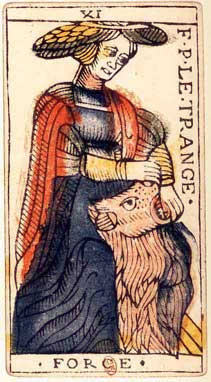
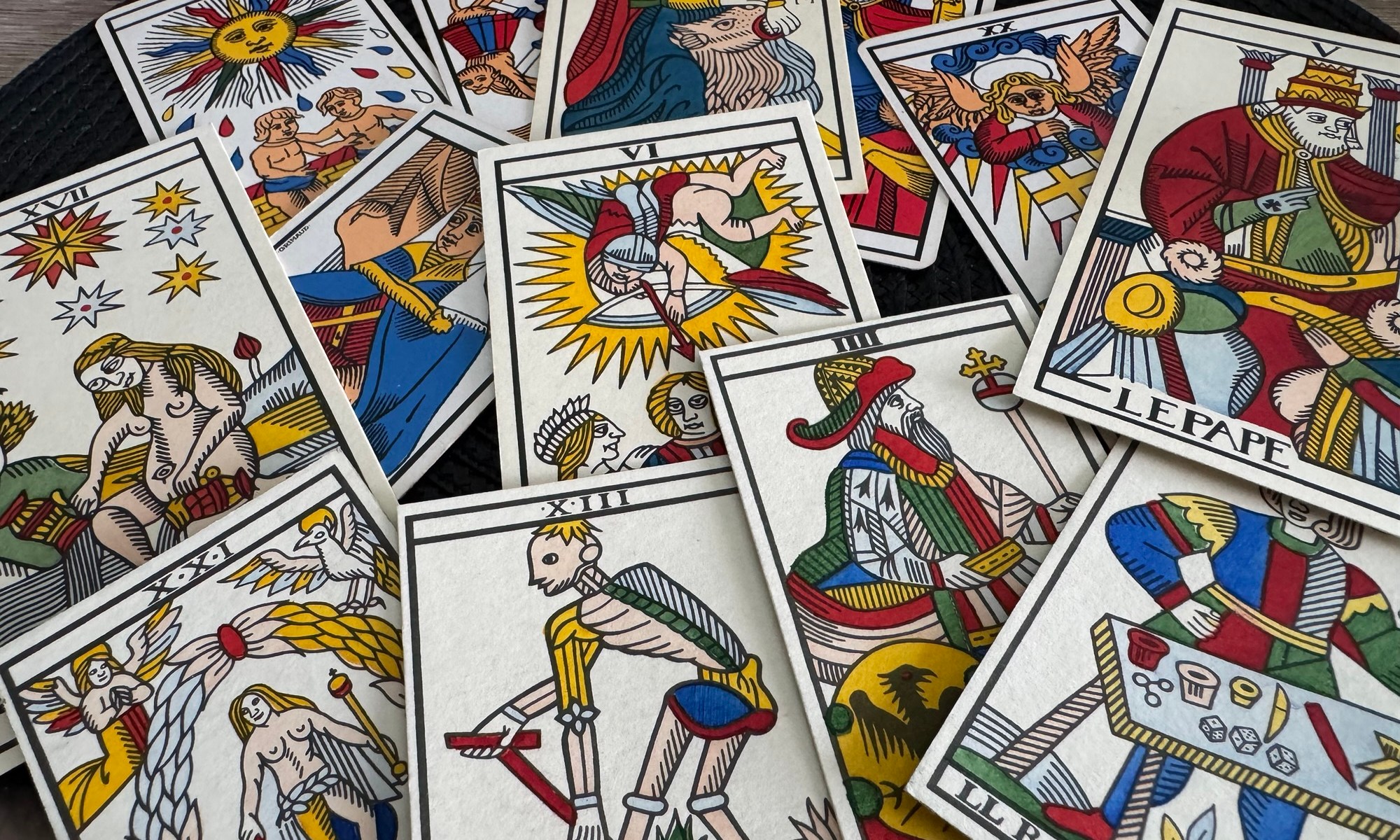
Trump XI, La Force, or Fortitude, is one of the most iconic images within the Tarot pack. Yet its meaning is often misunderstood. Does it merely signify endurance? Why do some speak of integrating the shadow? And what has the card to do with magnetism and attraction? Fortitude is not concerned with brute strength or domination. Rather, it describes the capacity to persevere, to remain steadfast, and to overcome adversity through constancy of purpose.
The traditional eikōn of Fortitude is remarkably consistent throughout the early modern period. We see a well-dressed woman calmly opening the jaws of a majestic lion with her bare hands. There is no suggestion of violence, struggle, or fear. The lion is not beaten into submission, nor is the woman portrayed as physically overpowering it. Instead, the image conveys mastery through composure. She prevails not through force, but through the quiet confidence of one who possesses complete command of herself.
The essence of Fortitude is endurance; its function is to overcome. The card concerns those situations in which success cannot be achieved through talent alone, nor by force, but only through perseverance. It speaks of resolve in the face of resistance and the determination to continue when easier alternatives present themselves.
Fortitude has long been regarded as one of the cardinal virtues and is also counted amongst the seven gifts of the Holy Spirit bestowed through the sacrament of confirmation. Yet Fortitude is not simply the capacity to endure hardship. One may suffer unwillingly and possess no virtue at all. Rather, Fortitude is the willingness to persevere in pursuit of the good despite adversity, discomfort, opposition, or fear.As a gift of the Holy Spirit, Fortitude equips a person not merely to withstand difficulty, but to act rightly in the face of it. It provides the resolve necessary to continue when enthusiasm fades and the constancy required to fulfil one’s obligations when they cease to be enjoyable. The virtue manifests itself not only in moments of crisis, but also in the ordinary demands of daily life. Commitment, discipline, perseverance, and reliability all belong to the sphere of Fortitude.
The lion represents more than instinct or passion. It signifies those fears, desires, discomforts, and difficulties that tempt us to abandon our duties. The woman prevails not by destroying the lion, but by mastering it. Fortitude is therefore not domination of others, but mastery of oneself. True strength lies in governing one’s own impulses and remaining committed to what is right, even when doing so is difficult.
For this reason, the card frequently appears when a person must overcome disinterest, discouragement, or a perceived lack of aptitude. It reminds us that character is not formed by doing only what comes naturally, but by persevering when circumstances become difficult. Obstacles are not necessarily signs that one should abandon a course of action. More often, they are the means through which resilience, self-mastery, and strength of character are developed.
In a reading, Fortitude points towards the need to cultivate the virtue itself. The querent may be required to temper impulses, restrain unhelpful urges, and act with patience rather than haste. The card advises standing firm, remaining committed, and pursuing the highest good despite opposition or inconvenience. Success is unlikely to come through force of will alone; rather, it is achieved through steady application and unwavering resolve. Fortitude teaches that true strength is revealed not in domination, but in endurance.
General: Courage in the face of adversity. Difficulties are overcome through perseverance, self-discipline, and steadfast resolve. The card signifies the successful harnessing of natural forces, whether internal or external, and the capacity to master emotional reactions, impulses, and fears. Though challenges may be considerable, Fortitude promises that they can be endured and overcome.
Love: Relationships often encounter testing circumstances under this card, and one or both partners may feel tempted to walk away. Fortitude confirms, however, that all is not lost. The road ahead may be difficult, but the love, loyalty, and support necessary to repair the relationship remain available. Success depends upon patience, commitment, and the willingness to persevere. For those who are single, the card is highly favourable, promising strong attraction, personal magnetism, and the potential for a passionate and enduring connection.
Career: Fortitude is naturally associated with professions involving animals, including veterinary medicine, conservation, animal welfare, training, breeding, and grooming. It also governs occupations concerned with rehabilitation, development, and support, such as physiotherapy, occupational therapy, chiropractic practice, speech and language therapy, and similar fields. More generally, the card favours careers requiring patience, resilience, and the ability to work through gradual improvement.
Finance: Steady improvement through patience and perseverance. Financial difficulties can be overcome, though progress may be gradual. The card advises discipline, restraint, and avoiding impulsive expenditure.
Health: Anatomically, Fortitude is associated with the abdomen, intestines, and liver. It frequently points towards digestive complaints and disorders of the gastrointestinal tract. The card may also indicate conditions affecting the liver, including fatty liver disease and problems arising from excessive alcohol consumption. More generally, however, Fortitude is a positive indicator, signifying a strong constitution, resilience, and the determination to persevere in the face of illness or adversity.
This article continues my series examining the trumps of the Tarot de Marseille, adapted from my unpublished manuscript, Tarot de Marseille: The Picturebook of Fate. As throughout this series, the emphasis is placed upon the traditional eikōn of the card, its historical context, and the practical significations I have found useful through divinatory practice. The interpretations presented here reflect my own experience of working with the Tarot de Marseille and should be understood as a working method rather than a definitive authority.
The Twos: The Popess, Fortitude and the Angel
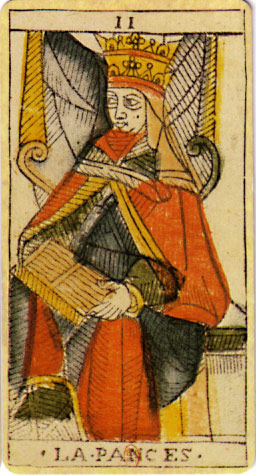
Trump II, La Papesse, or the Popess, is a fascinating and often polarising card. Does she represent the occult sciences and intuition? Is she Pope Joan, a symbol of heresy and forbidden knowledge? Or does she appear to remind us that there are things we do not yet know? The Popess is a card which resists certainty. Rather than providing answers, she compels us to ask questions.
The essence of the Popess is contemplation; her function is to examine. Where other trumps encourage action, movement, or decision, the Popess calls for reflection. She urges us to pause, reconsider, and investigate before proceeding. Her lesson is simple: matters are not yet sufficiently understood.
The traditional eikōn of the Popess is remarkably consistent. We see a seated woman holding an open book. She wears a cappa magna over monastic dress and is crowned with the Triregnum, the triple crown traditionally associated with the papacy. The image is immediately arresting precisely because it appears impossible. We are told that no woman can ascend to the Petrine ministry, yet here she sits enthroned. The Popess presents a challenge. She asks a simple but unsettling question: Why? Assumptions, conventions, and accepted truths are all subjected to scrutiny in her presence.
When the Popess appears in a reading, we are often being asked to think again. Something remains unknown, overlooked, or poorly understood. There is information yet to be gathered, a perspective yet to be considered, or an assumption that requires re-examination. Until this work has been done, progress is difficult. The card therefore cautions against rushing to conclusions or acting upon incomplete knowledge.
For this reason, the Popess is closely associated with education, study, research, and scholarship. She signifies the acquisition of knowledge, the development of new skills, and the disciplined pursuit of understanding. Her book is not a decorative object but a working tool. She reminds us that ignorance is remedied not by wishing to know, but by undertaking the effort required to learn.
It is, however, somewhat facetious to attribute intuition to the Popess. This is not a figure operating upon divination, instinct or vague impressions. The Popess has a book. She consults primary sources, examines evidence, and interrogates what she finds. Her conclusions are informed rather than intuitive or divined. If the High Priestess of other traditions may rely upon hidden insight, the Marseille Popess relies upon careful thought and diligent study.
Yet contemplation has its drawbacks. The Popess is a taciturn and withdrawn figure. She speaks little and reveals less. Consequently, the card can signify poor communication, emotional withdrawal, secrecy, and a tendency to bottle matters up rather than address them openly. For this reason, it is not generally regarded as a particularly favourable card in matters of love and relationships, whether new or established. Reflection may be useful, but excessive reserve can create distance between people.
The Popess also appears when motives are being questioned and rumours are circulating. People speculate, assumptions multiply, and half-truths acquire the appearance of fact. In such circumstances the card offers a straightforward warning: do not believe everything you hear. Nor should you accept everything that is said at face value. The Popess asks us to verify, examine, and investigate. Only then does she allow us to turn the page.
General: Unforeseen developments requiring a reassessment of existing plans. The card advises observation rather than action, reflection rather than reaction. Difficulties are resolved through common sense, careful examination, and logical thought. Answers emerge through study combined with contemplation.
Love: For those who are single, the Popess generally indicates a period of waiting. The right person may not yet have appeared, and greater effort will be required to leave one’s comfort zone, socialise, or pursue new interests. The card often favours classes, courses, and educational settings as avenues through which relationships may develop. In established relationships, the Popess frequently points towards poor communication, unspoken concerns, and assumptions left unchallenged. Partners need to talk openly and honestly. More often than not, what we imagine is worse than the reality.
Career: The Popess is associated with professions involving records, information, and the preservation of knowledge. Typical occupations include archivists, librarians, curators, bookkeepers, accountants, actuaries, and those employed within the insurance sector. The card may also signify women entering professions traditionally dominated by men. In matters of employment, the Popess often indicates a gap in knowledge, qualifications, or experience. Additional study, training (including an apprenticeship), or the acquisition of new skills may be required before progress can be made.
Finance: A need to review finances carefully and gather more information before making commitments. The card favours research, budgeting, and long-term planning over speculation. Important details may be hidden or overlooked.
Health: The Popess is associated with otorhinolaryngology, particularly conditions affecting the throat and voice. Communication disorders may occasionally be indicated. More commonly, the card points towards investigation, testing, specialist referrals, and second opinions. It advises gathering more information before reaching conclusions.
He made the darkness his covering, the dark waters of the clouds, his tent. A brightness shone out before him with hailstones and flashes of fire. Psalm 17:12-13, Grail Translation
It was now about the sixth hour, and there was darkness over the whole land until the ninth hour, while the sun’s light failed Luke 23:44-45, RSV CE
Clouds, when the light side faces the person, it is a happy sign, but if it is the dark side, then some problem will soon appear Original Instructions
Card No. 6, the Clouds or the King of Clubs, is among the most intriguing and complex cards in the Petit Lenormand. Does it merely signify confusion? What does “clouding” truly mean? And are there not cards within the deck that are more overtly malefic?
The Essence and Function of the Clouds
The essence of the Clouds is disturbance, and its function is darkening. Disturbance should be understood as a force which dominates a situation and, in so doing, prevents other matters from proceeding unhindered. One might think of a hurricane or a red weather warning: the Clouds engulfs and disrupts circumstances, obscuring clarity and casting a dark shadow over people, situations, and events.
Although storms eventually pass, this does not mean that their effects are trivial. Ask anyone whose home has been flooded, or who has suffered as a consequence of an environmental disaster. The passage of the storm does not immediately restore normality. In this respect, the Clouds also signifies the aftermath of disturbance: consequences, repercussions, and lingering effects.
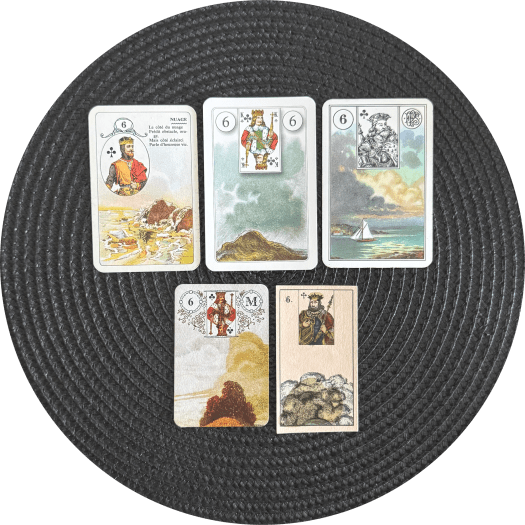
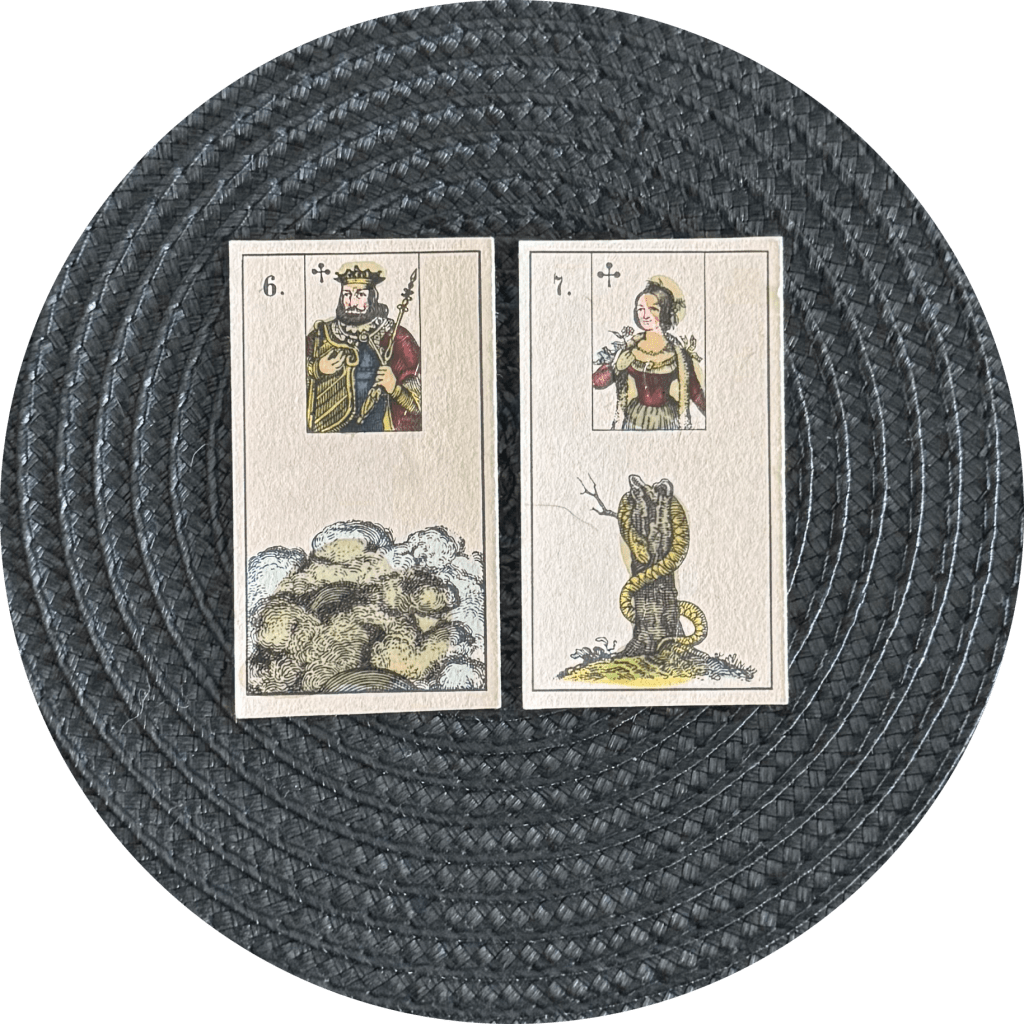
The most common eikōn of the Clouds depicts dense storm clouds partially or wholly obscuring a bleak or inhospitable landscape. In some decks, one side of the cloud formation is noticeably darker or denser than the other, emphasising imbalance and uncertainty. There may also be indications of rough terrain, marshland, or stagnant water beneath. More minimalist decks, such as the Mertz, present a considerably more abstract representation, with little differentiation.
To understand the Clouds properly, one must appreciate two ideas that were of profound importance to our ancestors and which permeate folklore, mythology, and religious thought.
Darkness and the Loss of Light
Throughout much of human history, the absence of light was regarded not merely as an inconvenience but as an omen. The sun was the great source of warmth, life, order, and stability; its disappearance therefore inspired anxiety and awe.
Solar eclipses, for example, were often interpreted as portents of disaster, divine displeasure, or approaching upheaval. In classical astrology, a planet obscured by the sun through combustion was considered weakened or afflicted, hidden from view by an overpowering force. Likewise, many mythological traditions contain narratives in which the sun is swallowed, stolen, imprisoned, or extinguished, bringing darkness and disorder to the world.
Within the Christian tradition, the darkness said to have fallen upon the land during the Crucifixion serves as one of the most potent examples of this symbolism. Light departs, certainty vanishes, and the world is plunged into confusion and sorrow.
It is therefore unsurprising that clouds, by concealing the heavens and obscuring the sun, became natural symbols of uncertainty, fear, and disorientation. They hide what ought to be visible and cast doubt where clarity once prevailed.
Weather and Survival in Agricultural Societies
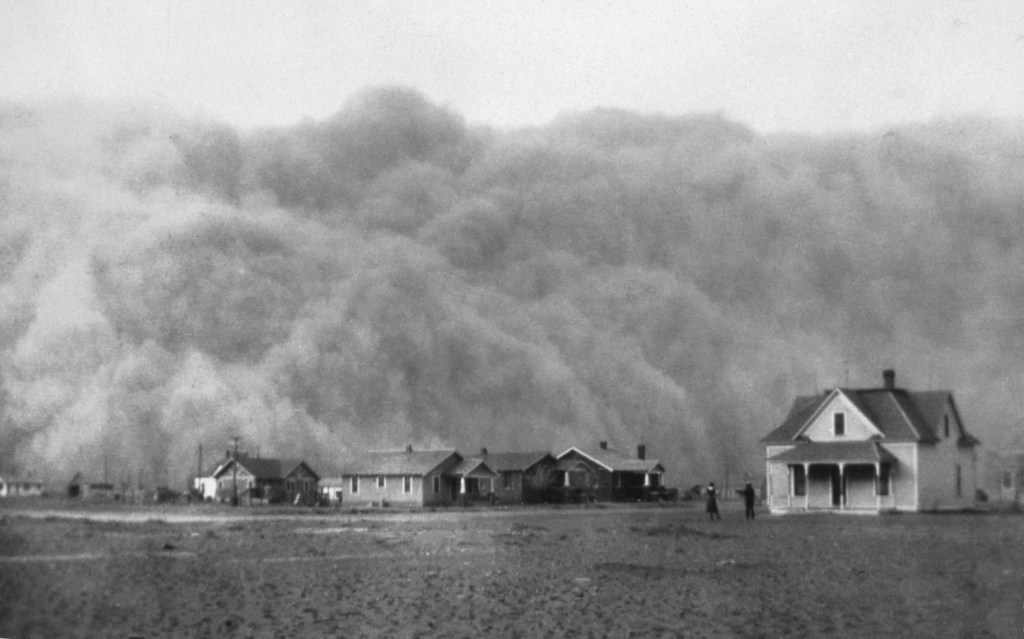
The symbolism of the Clouds is also rooted in humanity’s dependence upon the weather. For agricultural societies, the atmosphere was not a matter of mild inconvenience but of survival itself.
Too little rain could mean drought, crop failure, hunger, and deprivation. Too much rain could bring flooding, destruction, and disease. Storms, hurricanes, and other extreme weather events possessed the power to devastate entire communities within a matter of hours.
Dust storm approaching Stratford, Texas, 1935 (Wiki Commons, Public Domain)
Unlike many modern inconveniences, these events threatened livelihoods and lives directly. The gathering of dark clouds therefore carried an immediate and tangible significance. They heralded forces beyond human control—forces that could disrupt plans, destroy prosperity, and alter the course of events.
For this reason, clouds became enduring symbols of disturbance, uncertainty, and looming adversity. They represented the moment at which ordinary life was overshadowed by something larger and more powerful than oneself.
A Climate Crisis
Although few of us today rely directly upon the success of a single harvest, the symbolism remains remarkably relevant. We need only consider contemporary concerns surrounding climate change to appreciate the continuing power of weather and environmental disruption. Floods, droughts, storms, and extreme temperatures continue to affect communities, livelihoods, and entire regions.
The Clouds therefore speaks to something timeless. It reminds us that there are periods when clarity is obscured, conditions become unstable, and circumstances are dominated by forces beyond our immediate control. As in ages past, the storm eventually passes—but not always without consequence.
Interpreting the Clouds
In a reading, the Clouds indicates the principal disturbances and difficulties affecting a person’s life. The precise nature of these disturbances is revealed by the surrounding cards, particularly the cartes maîtresses. Thus, the Clouds combined with the Fishes may point towards financial troubles, uncertainty in business affairs, or material setbacks, whilst the Clouds alongside the House may suggest difficulties within the home, family life, or one’s personal foundations. Whatever domain is touched by the Clouds becomes overshadowed and burdened, rendering it more difficult to manage, understand, or navigate with confidence. It is important, however, not to mistake the Clouds for a mere signifier of confusion. The card does not principally denote confusion in and of itself. Rather, confusion is often one of its consequences. The disturbance comes first; bewilderment, uncertainty, and lack of clarity follow in its wake. In this sense, confusion is a symptom of the Clouds, not its cause. The card speaks fundamentally of disruption and darkening—of circumstances becoming troubled, obscured, and more arduous than they would otherwise be.
Coda
Ultimately, the Clouds represents the principal challenges and adversities confronting the seeker. It reveals those areas of life overshadowed by difficulty, uncertainty, and disturbance, where progress is impeded and matters seldom proceed smoothly. As such, it serves as a potent indicator of life’s darker passages—the troubles that must be endured, navigated, and eventually overcome.
Person and Description
The Clouds may also be read as a person and, when appearing in conjunction with a person card, can provide both a physical and temperamental description. In the folklore of playing cards, the roi de trèfle is Alexandre the Great.
Person
As the King of Clubs, the card may signify a man. Depending upon the method employed, this will generally occur when the card appears alongside a social card or is used as a significator in its own right.
In such circumstances, the King ordinarily represents a mature man, often over the age of thirty-five. The Club (Kreuz) suit is associated with labour, burdens, and adversity. Consequently, the King of Clubs frequently denotes a man with whom the seeker has a difficult, strained, or complicated relationship, such as an estranged partner, a stepfather, a troublesome colleague, or another individual whose presence brings challenge rather than ease.
When interpreted primarily as a person, however, the King largely sets aside his Clouds symbolism. In this context, his physical appearance, disposition, and character are determined chiefly by the accompanying cards rather than by the meanings ordinarily associated with the Clouds itself.
In the folklore of the cards, this king is associated with Alexander the Great.
Particular attention should be paid when the Clouds appears alongside either the Serpent or the Birch Rod. In the playing-card correspondences, these cards are the Queen and Knave of Clubs respectively, forming a natural association with the Clouds as the King of Clubs. The King and Queen frequently signify a couple whose relationship or influence is central to the matter under consideration, whilst the King and Knave may point towards a father and son, or another senior-junior dynamic of particular importance.
Physical Description
In matters of physical appearance, the Clouds most commonly describes an individual of average height with a lean or slender build. When accompanied by the Anchor or the Fishes, however, this indication may be modified towards a fuller, heavier, or more substantial frame. A slight stoop or tendency towards a somewhat bowed posture is not uncommon, lending the person a burdened or world-weary appearance.
The eyes are frequently dark in colour and may possess a thoughtful, sombre, or introspective quality. Hair typically ranges from black to dark grey, with salt-and-pepper tones being especially common. Indeed, even in younger individuals, the Clouds can sometimes manifest through premature greying or a generally weathered appearance.
One observation repeatedly borne out in practice is that the Clouds often causes a person to appear older than their years. Whether through expression, bearing, or physical features, those signified by the card frequently convey a sense of gravity, experience, or weariness beyond what their age alone would suggest. As befits a card associated with burdens and adversity, the marks of life’s challenges are often plainly visible upon them.
Temperament
When describing temperament, the Clouds signifies an individual who is reserved, guarded, and restrained in manner. Such a person rarely reveals their thoughts or feelings readily and often possesses a rather rigid set of sensibilities and convictions from which they are not easily moved.
The Clouds quite literally casts a long shadow, and this symbolism is frequently reflected in the personality it describes. Such individuals often have long memories where past grievances are concerned. Slights, disappointments, and injuries may linger in the mind long after others have forgotten them, giving rise to resentment or bitterness. There is often an obstinate quality here, a reluctance to let matters go or to alter one’s position once it has been established.
Above all, however, the Clouds points towards a difficult and mercurial character. Moods may shift unexpectedly, reactions can be unpredictable, and dealings with such a person are seldom straightforward. As with the card itself, there is a sense of obscurity and complication about them, making them challenging to understand and, at times, even more challenging to manage.
Special Features
Proximity and Clouds
In the original instructions, often referred to as the Philippe Lenormand Sheet, interpretation proceeds largely through the principle of proximity, alongside what later practitioners came to call clouding. In practice, however, clouding is not truly a separate interpretative concept. Rather, it is a particular application of proximity viewed from the perspective of the Clouds card itself.
Proximity may be understood as a principle of engagement. Cards engage most strongly with those immediately adjacent to them, creating a direct relationship between the cards involved. The nearer a card lies to the significator, the more immediate and tangible its influence becomes within the life of the querent. Thus, if the Hound lies beside the Lady, we may reasonably conclude that friendship, support, or an entourage plays a prominent role in her circumstances. Likewise, if the Mice appear adjacent to the significator, any losses or diminutions represented by the card become directly experienced and readily perceptible to the querent. Thus, one stands a better chance of recovery.
Clouding operates according to precisely the same principle. The difference lies in the nature of the Clouds card itself. Because its function is darkening, those cards with which it directly engages become overshadowed by its influence. They are, as it were, engulfed within the storm. Cards whose natural qualities are ordinarily positive or illuminating often demonstrate this effect most clearly. The Cloverleaf, which usually signifies opportunity and chance, may find its opportunities obscured or frustrated. The Stars, which bring guidance, direction, and certainty, may lose their clarity. The Lilies, associated with serenity and contentment, may indicate that serenity has become difficult to attain or maintain.
It is important to distinguish this from the influence of other adverse cards. Certainly, cards such as the Coffin, Mountain, Cross, or Birch Rod can negatively affect neighbouring cards. A Mountain beside the Cavalier may impede news; a Coffin beside the Heart may indicate an ending in matters of affection. Yet these cards remain faithful to their own particular natures: the Mountain blocks, the Coffin concludes, the Cross tortures. The Clouds performs a different function. Rather than merely harming or opposing a matter, it obscures it. It shrouds circumstances in uncertainty, casts doubt upon what might otherwise be clear, and makes navigation difficult. Consequently, the essential quality of clouding is not simple negativity but darkening. The matter remains present, but it is hidden beneath shadow, rendered more confused, uncertain, and difficult to apprehend.
Dark and Light
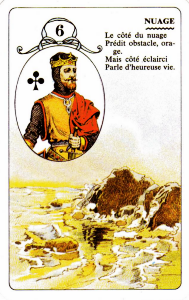
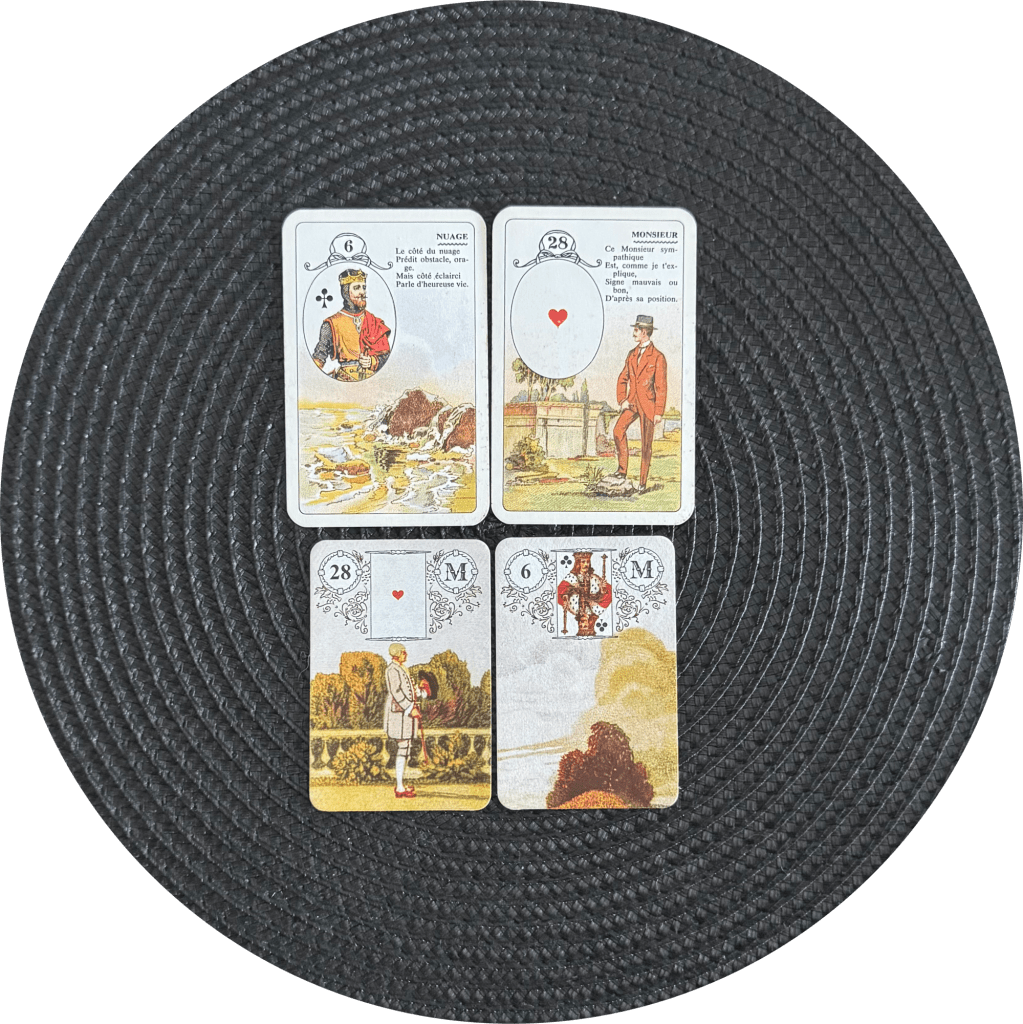
Traditionally, the cartomante paid close attention to the light and dark sides of the Clouds. On many older patterns, the distinction is clearly depicted through the illustration itself, with one portion of the cloud mass appearing noticeably darker and more threatening than the other. Some decks, however, do not provide such an obvious visual cue. In these instances, where the playing-card insert is shown, the direction in which the King of Clubs faces may be used to determine the dark side of the card. In the Carta Mundi deck, which I favour, the King’s orientation places the dark side to the right—a reading further reinforced by the depiction of the rocks and storm-tossed sea on that side of the image.
The original instructions imply that when the light side of the Clouds faces the Significator, the querent may expect good fortune or favourable outcomes. In practice, however, I have never found this interpretation particularly reliable. Experience has suggested a more subtle and consistent approach.
Rather than indicating luck, the light side appears to modify the intensity and duration of the disturbance. When the lighter portion of the Clouds faces the Significator (above, bottom), the difficulties are often already manifest, less severe, more readily understood, or shorter-lived. The storm is present, but it is beginning to break. Conversely, when the dark side faces the Significator (above, top), the obscurity deepens and the difficulties tend to be more serious, prolonged, or difficult to comprehend fully.
The distinction, therefore, is not principally one of good fortune versus ill fortune, but rather one of emphasis and degree. Both sides remain Clouds and both denote disturbance. The difference lies in the severity of the weather. The darker the clouds, the more violent the storm; the lighter the clouds, the sooner one may expect clearer skies.
Weather
Quite naturally, the Clouds also signifies the weather itself. This aspect of the card is most readily observed in short-term readings, such as daily draws or forecasts for the week ahead, where changes in atmospheric conditions often form part of the prediction. Nevertheless, the weather manifestation of the card can appear in larger and more complex spreads as well.
I recall one Grand Tableau in which the Park and Bouquet were accompanied by the Clouds positioned directly above the Park. The client had organised a large celebration to mark her pearl wedding anniversary. Unfortunately, the weather proved unusually inclement for May, and the festivities were somewhat marred by persistent rain and gloomy conditions. In this instance, the Clouds described neither trouble nor adversity in the broader sense, but simply the literal weather affecting the event.
When the Clouds is interpreted meteorologically, the surrounding cards often provide valuable detail regarding the nature of the conditions involved. With the Fishes, one may expect heavy rain, flooding, or excess water. With the Sun, periods of exceptional heat or a heatwave may be indicated. With the Lilies, snowfall, frost, or blizzard-like conditions become more likely. The Stars can point towards hail, sleet, or precipitation falling from an unsettled sky. As ever, the adjacent cards refine and particularise the general disturbance signified by the Clouds.
Timing
In matters of timing, the Clouds is generally regarded as a slow card. It seldom hastens events and more often introduces delays, complications, and diversions from the expected course. Matters governed by the Clouds tend to proceed unevenly, becoming stalled or diverted by circumstances beyond the querent’s immediate control.
Unlike many Lenormand cards, the Clouds possesses few reliable associations with a particular season or time of day. Nevertheless, owing to its obvious meteorological symbolism, it can occasionally point towards hurricane or storm season, particularly the period between August and October when read in an appropriate context.
Health
In health matters, the Clouds is principally associated with the lungs and respiratory system. It governs breathing and those bodily functions connected with the intake and circulation of air.
More generally, the card signifies airborne ailments, seasonal illnesses, and conditions transmitted through the atmosphere. In combination with the Bouquet, it may indicate hay fever, allergies, or sensitivities to flowering plants. Accompanied by the Tree, the emphasis may fall upon tree pollen and related allergic complaints. When found with the Serpent, the card can point towards poisonous fumes, noxious gases, environmental toxins, or other harmful substances carried through the air.
As befits a card whose function is darkening, the Clouds often describes conditions that obscure or impede healthy respiratory function. Congestion, breathlessness, irritation, and susceptibility to seasonal complaints are all natural progressions of its essence.
The Clouds in Action
When reading the Petit Lenormand, one generally favours the more fluid methods of divination, most notably the Grand Tableau, together with lines and squares. From time to time, however, it is advantageous to employ positional layouts in which each card occupies a predefined role. Among those I favour are the Astrological Wheel and the French Cross.
French Cross
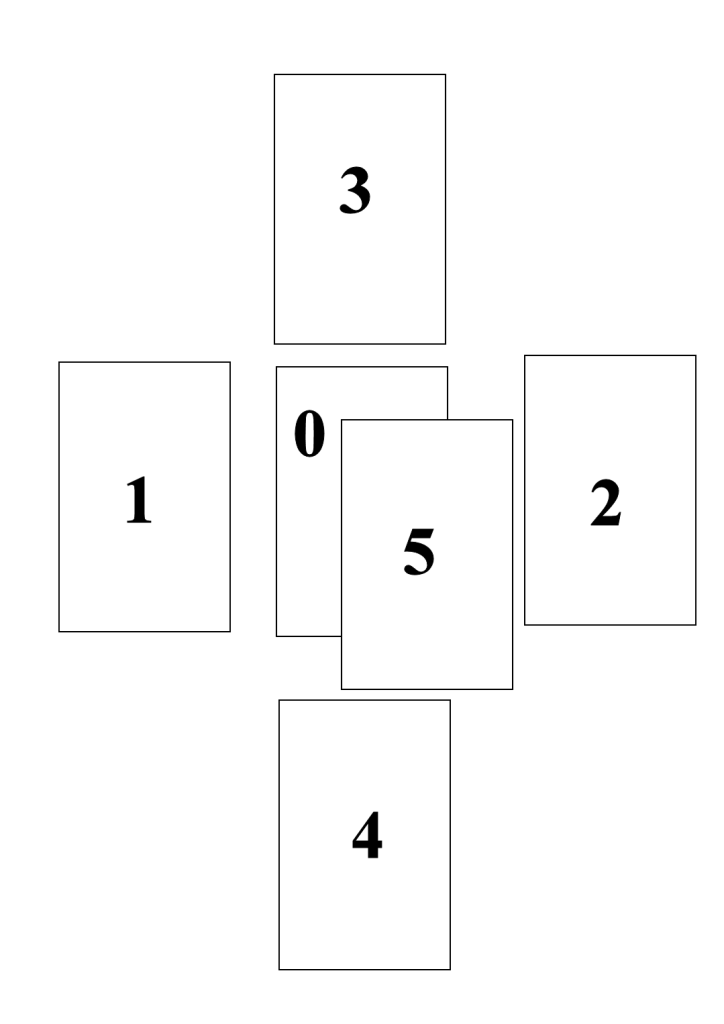
The variation presented here is a synthesis of methods described by Mary Marco, Jeanine Goffinet, Colette Silvestre, and Marie Delclos. Employing five cards, it offers a concise yet remarkably precise response to a specific question and is particularly effective when a clear affirmative or negative answer is sought.
Before shuffling, remove the appropriate significator from the pack. Once the cards have been shuffled, deal five cards around it. Place the first card to the left of the significator, the second to the right, the third above, and the fourth below. The fifth and final card is placed directly upon the significator itself.
The positions are interpreted as follows:
First Card — Represents the consultant in relation to the matter under consideration. It shows their present condition, disposition, or involvement in the question.
Second Card — Indicates the influences acting upon the situation. These may assist progress or impede it, depending upon the nature of the card.
Third Card — Reveals the development that initiates the outcome. It may be understood as the past becoming the present: those circumstances already in motion that will ultimately shape the future.
Fourth Card — Provides the answer to the question and discloses the eventual outcome of the matter.
Fifth Card — Serves as the synthesis of the entire spread, revealing the overall character, tone, or quality of the answer. It should not, however, be mistaken for the answer itself. That role belongs solely to the fourth card, whilst the fifth modifies and colours its expression.
This distinction is of considerable importance, for many otherwise puzzling combinations become readily intelligible once the fifth card is understood as a qualifier rather than an outcome in its own right.
Carrie’s Reading
Carrie was referred to me by a longstanding client in early 2025. She had become engaged to Jack a few months earlier, and the couple were planning to marry during the summer of 2026. Unfortunately, Carrie had a strained relationship with her stepmother and would have preferred not to invite either her half-sister or her stepsister to the wedding. Her father, however, was keen for all three to attend and play a prominent role in the celebrations. The question posed was straightforward: would difficulties arise if Carrie chose not to invite them?
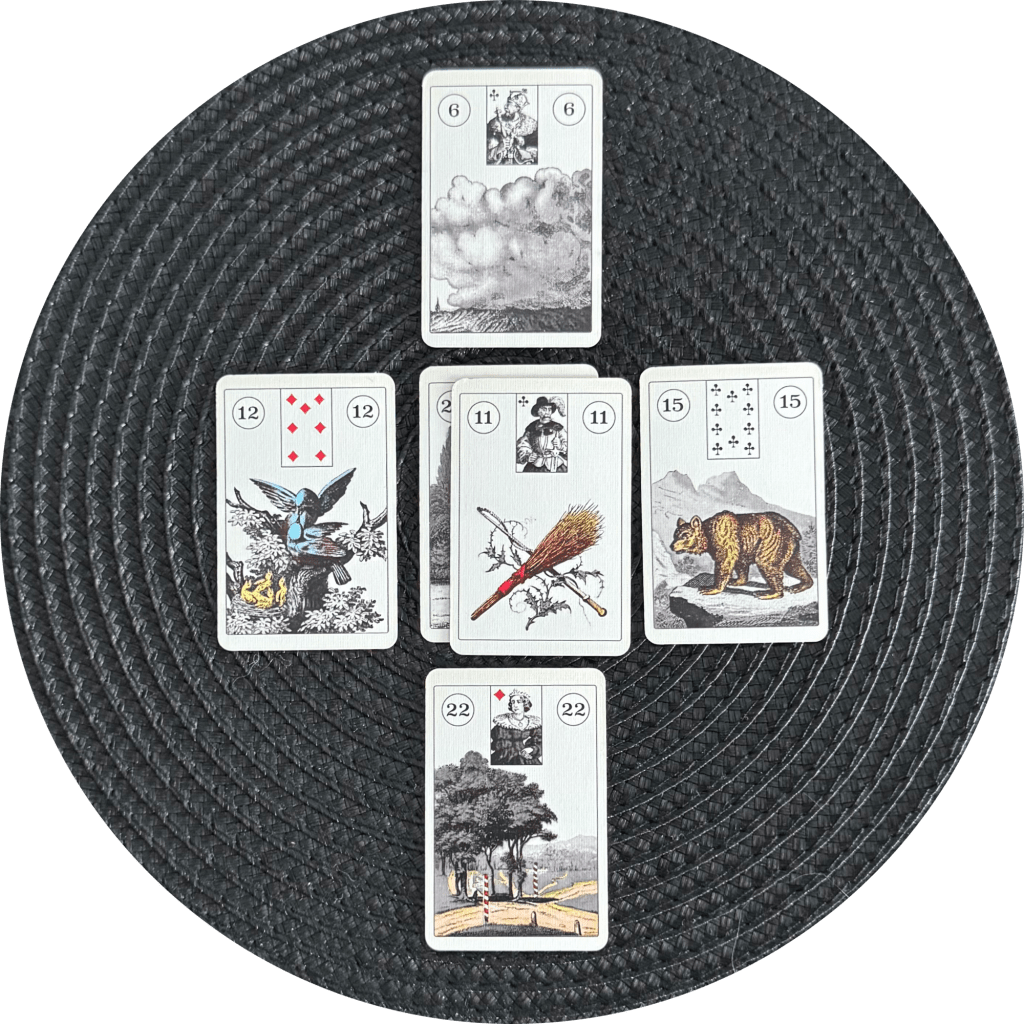
The cards drawn were the Birds, the Bear, the Clouds, the Roads, and the Birch Rod.
At once, one sees that the matter is a source of considerable anxiety. The Birds reflects agitation, worry, and the sort of emotional commotion that distracts and overwhelms. Carrie is clearly unsettled by the situation and acutely aware of the potential consequences of her decision.
The Bear reveals the principal obstacle. She knows there would be significant resistance were she to exclude her stepmother, half-sister, and stepsister, particularly from her father. Whilst the Bear can often represent a specific individual, here it is better understood as a picture of pressure, authority, and opposition. The family dynamic is characterised by a forceful insistence that these relatives be included.
The Clouds occupies the third position and thus reveals the development that initiates the outcome. In this spread, the third card represents those circumstances already taking shape: the past becoming the present and thereby shaping the future. Here, the Clouds shows that Carrie’s proposed course of action would introduce a growing atmosphere of tension, uncertainty, and disharmony. Rather than allowing the matter to settle, it would cast an increasingly long shadow over the wedding preparations. What begins as a personal decision would gradually evolve into a wider family dispute.
The Roads provides the answer and outcome. Guests would be compelled to decide where their loyalties lay, and some might feel obliged to decline the invitation altogether in order to avoid the appearance of taking sides. The card suggests division, competing allegiances, and the necessity of making difficult choices.
The synthesis card, the Birch Rod, confirms that the matter would culminate in conflict and considerable unpleasantness. It is also worth remembering that the Birch Rod may signify correction, adjustment, or the setting of something aright. In practical terms, this suggested that Carrie would ultimately find herself compelled to revise her position and extend an invitation to her stepmother in order to restore harmony and placate those most affected by the dispute.
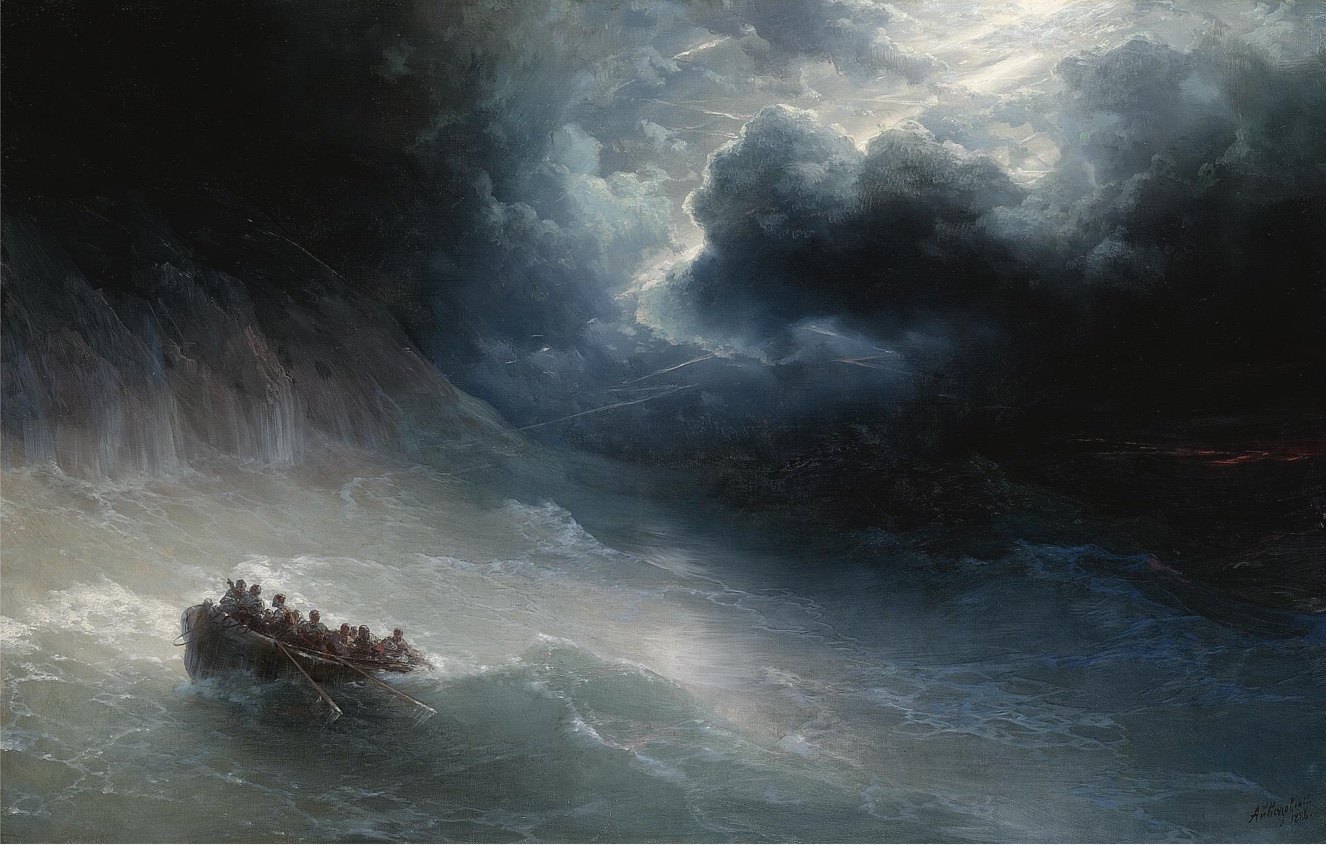
Featured Image: Wrath of the Seas, Ivan Aivazovsky, Wiki Commons/Public Domain
References:
Avelar, H. and Ribeiro, L. (2010) On the Heavenly Spheres: A Treatise on Traditional Astrology. Tempe, AZ: American Federation of Astrologers. Boroveshengra, A., 2013. Cartomantes’ Cabinet: The Petit Lenormand Course. Boroveshengra, A., 2015. Lenormand Thirty Six cards. 2nd ed. Create Space. Delclos, M., 2013. Le Livre du Petit Lenormand. 1st ed. Escalquens: Éd. Trajectoire. Dykes, B.N. (2013) Astrology of the World I: The Ptolemaic Inheritance. Minneapolis, MN: Cazimi Press. Marco, M. and Goffinet, J., 1989. Petit Lenormand. Bruxelles: Servranx. Matthews, C. (2014) The Complete Lenormand Oracle Handbook: Reading the Language and Symbols of the Cards. Rochester, VT: Destiny Books. Meuris, B., 2018. Petit Lenormand Encyclopaedia: Volume 1. Create Space. Ptolemaeus, C. and Robbins, F.E. (2001) Tetrabiblos. Cambridge, MA: Harvard Univ. Press. Silvestre, C., 2003. Le Petit Lenormand. [Montpellier]: Gange éd.