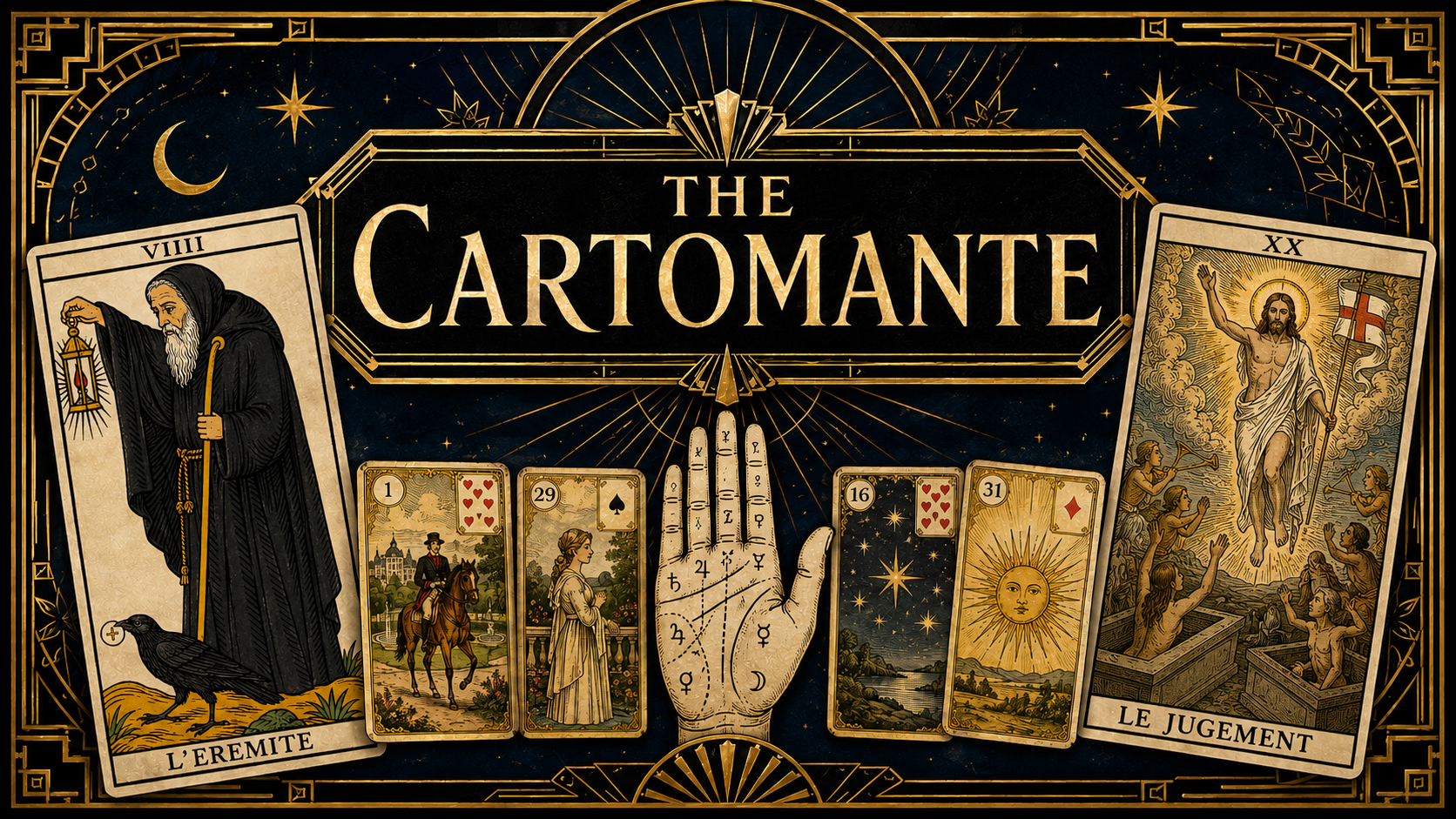
Eikṓn Equals Essence: The Pictures on the Petit Lenormand

Twelve o’clock.
Along the reaches of the street
Held in a lunar synthesis,
Whispering lunar incantations
Dissolve the floors of memory
And all its clear relations
Its divisions and precisions…

T.S. Eliot, Rhapsody on a Windy Night

It is now over ten years since I first started writing about the Petit Lenormand. Not that it was ever the intention or purpose of my then website. Within a few months of launching my DarkMoon, questions about the 36-cards and how to read them equalled and sometimes surpassed reading requests. Some even booked GTs to see how they were done and read.

So, I started writing a few short articles. The first was on the Serpent and the Mice cards. The second on trigger and heart (later changed to “hinge”) cards. However, most subsequent articles focused on building combinations. Most people (contacting me) knew the cards’ broadest significations but struggled to link them together in a coherent manner. It was at that point I first utilised the noun and adjective/adverbs.

Within the context of card combinations, nouns and adjectives are just an analogy. For me, it was never a rule or scheme followed indefinitely. It simply illustrated how, in most pairings, the second card describes or modifies the first. It also did not reflect how either I learned or read. Like most, my apprenticeship centred on the classical full-board or grand tableau. Cards were not understood through keywords but as events or happenings. I still see the cards that way, which is the basis of the concept of “essence” or “topic.”

As such, rather than having a student write three or four nouns and several adjectives, I recommend focusing on the essential nature of each picture in the game. Students are encouraged to thoroughly inspect their deck’s iconography and thereby penetrate the essence. If you know the core nature or topic of a card, you cannot go wrong (most of the time). Besides, essence often helps one come to understand some of the folklore or more obscure associations – all of which come from the picture!

That brings us to both a common misunderstanding and the subject of this entry:

We often hear that the images in the Petit Lenormand have no value. That is incorrect. Each card’s signification comes from its emblem. However, the Petit Lenormand emphasises the whole image over the symbol. You do not devote 300 words to the Boat’s sails. The image, when read, can be likened to an eikṓn or logogram. It, therefore, differs from the deconstructive method common to English-speaking diviners where, for example, a single detail on a card (snail, flag, etching on a goblet and so on) may be the focus rather than the image within which it is contained.

It is an issue of emphasis.

Details do matter to the Petit Lenormand reader. Directional clues (dark v. light, spine v. page, turret v. ground) add nuance. Card no. 15, the Bear (10♣), can describe someone as strong or muscular and a brunette. But if one is reading with the Schmid or Gilded Reverie, that would not be so. Why? Polar bears are not brown. The descriptive value thus changes to: strong or muscular and blonde.

Going further, replacing the child with a baby or cupid on card no. 13, the Child (Kn♠), would completely change the card’s signification. The Child is not a neonate but a preadolescent. The same with a dagger on card no. 11, the Birch Rod (Kn ♣ ).

Images are therefore important. Within them lies the cards’ essence and, therefore, signification. If you are struggling, it is often because you have not linked with a card’s (or several) core nature. Failure to do so prohibits access to (for a lack of better words) the collective memory and objective psyche.

For example, let us take the MOON card (8♥). Often people approach this card as they do the Tarot’s XVIII atout. The cards are entirely different, something which is confirmed by its icongraphy. Card no. 32 is the card of recognition and reputation.

Why? We have to remember what the Moon is.

Our Moon is the Earth’s single natural satellite. It has no light source and instead reflects the sun’s rays. Being but a reflection, it cannot illuminate the heavens as does the sun. Thus, as some points will be bathed in moonlight, others will remain cloaked in darkness. If one studies the iconography of traditional patterns — such as the Brepols, the Dondorf, the C.L. Wüst or the Blaue/Rote Eules — we see a partially lit landscape.

All we have done is identified what it is, its function and its behaviour. Neither you nor I could do so without the image. How does it work in a reading?

Traditionally, the Moon card falling near the Significator presaged great honour or fame. The moonlight shines upon you, leaving the rest in the dark. Far away, the opposite is true. If we remember that the moonlight is a reflection of the sun’s rays, we can understand the card with little difficulty. It is a shimmer of the Sun card as reflected in others’ eyes — hence the fame and honours.

Primarily, the Moon refers to our status, particularly in terms of professional or financial standing and whether we are deemed successful or not by society and our peers. Most people achieve fame through their career. If you are going for a job interview, a strong Moon-card is desirable. After all, you need to look good in the eyes of the interview panel! Of course, it can be one’s set or the trends and fashions observed in other contexts.

Consequently, we can think of the Moon in terms of essence and topic, as reflection and status, respectively.

Let us consider a second picture. In recent times card no. 19, the HIGH TOWER (6♠), has seen a significant revision of its core theme. It is now a card of government bureaucracy. And yet, a government is a group of people governing and hence a matter for the Park (often combined with the Bear).

One will note that the High Tower is traditionally portrayed as a tower-house. It is often located at a boundary, crowned with a lookout.

Perusing some of the traditional patterns, one will also note it is distinctly earlier period to the House (K♥) or Park (8♠) cards. The overall impression is not one of the arrogant bureaucrats but the distance in terms of time (old), height (looking out) and location (at a distance).

After such considerations, the old references to a long life and retirement does not look so archaic or strange. It has continued to live in the deck’s roots and can be found in several combinations. The “high” also translates into vertical combinations when considering the ground level (card below) versus the turret or apex (card above). It is for that reason I continue to refer to it as the High Tower.

Replacing the traditional tower-house with a skyscraper, or even the Empire State Building or la tour Effiel changes the card’s core essence and therefore meaning. A citadel would also make the governmental associations even more erroneous.

We will turn our attention now to card no. 18, the HOUND (10♥). Most readers see this card as the symbol of faithfulness par excellence.

The traditional image of this card was never a lapdog or even the family pet. Older Petit Lenormand decks had a working dog or sighthound (such as a Deutscher, Brittany Spaniel or Braque Saint-Germain). The dog is seen outside with its kennel, sometimes looking up as if it had heard or sensed something. It is, therefore, quite evident that this dog is not just a family pet. It has a role and fulfils a service. It is for this reason I prefer the title Hound.

The essence of the Hound card is the entourage. Entourage refers to people surrounding, but also attending to, a person. It talks about the people in your environment. Your doctor, plumber and colleagues will appear as the Hound.

Long-term readers of my work will know I often read the Hound as a colleague, employee, or professional acquaintance. It is a natural association – not least because I saw working-dogs growing up in a rural area!

Similarly, next to the House card, it can indicate a neighbour or someone living nearby. Why? Remember the Hound has a doghouse in its owner’s garden. It lives on the homestead. Its kennel is analogous to our neighbours’ property.

The loyalty of these people, friend or otherwise, can only be reckoned by the surrounding cards.

We can briefly consider a fourth and final card: card no. 1, the Cavalier (9♥).

Our traditional image is a well-dressed young man in either a tailcoat or frockcoat with Hessian boots and pantaloons. He is riding a horse. He is often but not invariably shown on the road and riding away from a château or maison de maître, he thus en route.

The Cavalier is a heard sent forth. He is riding out and has a destination but will return soon return to his abode. The most common reason for such action is to visit or deliver some tidings. For this reason, I have never referred to the card as the rider as it does not evoke the function or nature of the eikon: that is, a messenger.

Traditionally, the Cavalier was often said to denote news from abroad when falling far from the Significator. When one remembers that proximity refers to engagement, it is not hard to understand.

Far away, the Cavalier crosses a greater distance. However, it is equally possible that the news does not pertain directly to the querent.

We use the card as a “male person” because it shows a male person. If the Cavalier is female, it cannot be read thus. The male-figure can function as the chevalier servant. If a married female consultant has a lover, the Cavalier would represent him.

Similarly, its association with vehicles and exercise comes from the horse. That was the car or bicycle of the day. Equestrianism is a sport, no?

These are all what I refer to as progressed meanings, which is progressing each card’s essential nature on a functional level. That is, reading the card at the first indexical level of semiotics.

That has been the way in all forms of cartomancy, from the Tarot to the Oracle Gé and everything in-between.

When mentoring new readers, I encourage them to work with one or two decks. I advise them to study the cards closely and distil the information into an essence or core concept. That becomes there starting point for combinations. They will also become (if used) the houses’ significations in a full board.

Here is a basic list (given purely for reference for future articles):

  • Card no. 01 – The Cavalier (9♥) is herald.
  • Card no. 02 – The Cloverleaf (6♦) is chance.
  • Card no. 03 – The Boat (10♠) is travel.
  • Card no. 04 – The House (K♥) is home.
  • Card no. 05 – The Tree (7♥) is constitution.
  • Card no. 06 – The Clouds (K♣) is disturbance.
  • Card no. 07 – The Serpent (Q♣) is venom.
  • Card no. 08 – The Coffin (9♦) is endings.
  • Card no. 09 – The Flowers (Q♠) is arrangements.
  • Card no. 10 – The Scythe (Kn♦) is severance.
  • Card no. 11 – The Birch Rod (Kn♣) is correction.
  • Card no. 12 – The Birds (7♦) is noise.
  • Card no. 13 – The Child (Kn♠) is youthfulness.
  • Card no. 14 – The Fox (9♣) is falsehood.
  • Card no. 15 – The Bear (10♣) is strength.
  • Card no. 16 – The Stars (6♥) is navigation.
  • Card no. 17 – The Stork (Q♥) is change.
  • Card no. 18 – The Hound (10♥) is the entourage.
  • Card no. 19 – The High Tower (6♠) is distance.
  • Card no. 20 – The Park (8♠) is community.
  • Card no. 21 – The Mountain (8♣) is barriers.
  • Card no. 22 – The Path (Q♦) is intersections.
  • Card no. 23 – The Mice (7♣) is erosion.
  • Card no. 24 – The Heart (Kn♥) is emotions.
  • Card no. 25 – The Ring (A♣) is unions.
  • Card no. 26 – The Book (10♦) is knowledge.
  • Card no. 27 – The Letter (7♠) is communication.
  • Card no. 28 – The Gentleman (A♥) is male.
  • Card no. 29 – The Lady (A♠) is female.
  • Card no. 30 – The Lilies (K♠) is serenity.
  • Card no. 31 – The Sun (A♦) is illumination.
  • Card no. 32 – The Moon (8♥) is reflection.
  • Card no. 33 – The Key (8♦) is accessibility.
  • Card no. 34 – The Fishes (K♦) is resources.
  • Card no. 35 – The Anchor (9♠) is stability.
  • Card no. 36 – The Cross (6♣) is pain.


It should also be stressed to forget (for now) ideas such as “work cards” and whether a card is a mother or the father, male and female, or about “sex”. Such significations do not touch upon the cards’ essence. No card on an elementary level is work or sex

§

Featured Image: English: Ikona u Manastiru Svetog Romana via Wiki Commons.

Gliding the Glorious Light

One from the vaults….

Earlier this week (August 2019), one of my friends was offered a promotion. The job, however, was becoming a manager over a team known for being difficult. So tricky she will be the fourth manager in eighteen months. The team had to be split between three offices, due to extreme interpersonal issues.

Should she take it? Would she be able to make a success? What could she do? I went for cards not seen on my blogs for some time: le tarot persan de Madame Indira.

Containing just 55-cards, these cards blur the much-loved boundaries of what is allowed to call itself a tarot.

I fell in love with these cards around 1998. It is like a peacock with its iridescent colours. I remember shuffling it for the first time, and la Chouette and la main de Fatma falling out. I knew it was something special.

Le tirage des messages

Traditional cartomancy draws heavily on binaries: sinister and dexter, above and below, near and far, past and future, you and them, help and hindrance, red and black, and so on. One of the most useful is what to do and what not to do. Le tirage des messages will provide such advice, which is one of its strength. The other is that it contains information on the querent and their situation.

The nineteen trumps and la Chouette (the Owl) are shuffled, cut, and five cards are drawn and disposed of as follows:

  • The first card reveals the state of mind of the querent facing her question
  • The second card describes the present situation
  • The third card is the behaviour she should adopt
  • The fourth card is where she should forbear
  • The fifth card is the answer


Reading

For this draw, although one uses just the nineteen majors and la Chouette, the minors can be employed for clarification or any follow-up questions. For this reason, I still assign a significator. La reine trèfle was the most appropriate, considering both her job and her hair-colouring.

The cards as they fell:

  • La maison (the house)
  • La rupture (rupture)
  • La panthère noire (the black panther)
  • Le mariage (the wedding)
  • Les hirondelles (the swallows)


The House advises on the state of mind of la reine de trèfle. We can tell immediately that la reine priorities a sense of belonging, but also security. La reine does not wish to be propelled too far from the environment she feels at home in, or amongst those, she does not incline to let in.

Looking at the second card, we find the Rupture card which discloses the present situation. On the one hand, it references that by accepting the role, la reine is breaking from her entourage. But one suspects it describes the various divides and interpersonal issues within the new department.

Cards three and four, the Panther and the Wedding cards, describe the attitude to adopt and what to avoid. We must consider these together.

A powerful and intelligent animal, the melanistic feline also fosters a sense of something concealed (the leopard’s spots). If la reine wishes to make a success of her new opportunity, it is essential to define boundaries and keep a neutral composure in the face of hostility and difficulties.

The worse thing la reine can do is be drawn into complicated dynamics and cliques. If she does so, she will lose important ground and the necessary distinction in her role. It will be tempting to try and soothe and befriend, but it is not the path needed in this situation.

Our answer comes in the form of the Swallows. We all know swallows are migratory, but also excellent flyers and communicative. It shows that la reine will be able to navigate her way and negotiate the sphere she finds herself in. Following the advice above, she can successfully communicate in a manner that earns respect but importantly pays a dividend in the long run.

As the Swallows have a migratory quality, I shuffled the pip cards and covered it. Here we have the Cinq de Cœur.

Such a combination portends the emergence of calmer waters, but also a sense of personal satisfaction in a job well-done.

It is only through refining the situation, and understanding how fortuitous energies and circumstances are, that we can offer any guidance. Even then, all we are doing is reading the emblematic pattern as an optical dialect.

§

References:

Tarot Persan de Madame Indira © Grimaud, 1981.

Les tirage des messages taken from L’ABC du Tarot Person de Madame Indira by Colette Silvestre.

Featured Image: Montasim Jawar, CC BY-SA 4.0 https://creativecommons.org/licenses/by-sa/4.0, via Wikimedia Commons

The Earth and the Fire: On Elemental Dignities 02

The World with its four elements we see;
Within, a naked Goddess dances free.
The water and the wind, the earth and the fire,
All That which doth beyond them all aspire.

Doreen Valiente, The Tarot Trumps

LAST week’s article explored the concept of elemental dignities. Our focus was on how such dignities affect cards’ ability to function via MacGregor Mathers’ triads.

Here we turn our focus to the sixteen court cards.

The Court Cards

Within each suit is to be found four cards known variously as les honneurs, the royal arcana and the face or court cards. We will utilise the latter and also the Harris-Crowley Thoth Tarot, which titles the court cards Princess, Prince, Queen and Knight*.

As indicated by their titles, the fortune-teller reads the court cards as people. Unless appointed as the significator, their presence in a reading indicates the involvement of a second party. The current trend of seeing court cards as situations or facets has no real basis in traditional practice. However, the prince and princess cards have been interpreted as movement and thoughts, respectively.

Different methods of interpretation of court cards exist. Contemporary practice often sees the sixteen court cards as generic profiles, e.g. the Queen of Wands is an energetic, self-assured person noted for her attractiveness and cheerfulness (Bunning, 2007). Such vignettes are caricatures and owe more to random stereotypes than the cards themselves.

The above method has never made sense to me. Instead, each card is a person connected to the querent by suit, e.g., the cups are friends, lovers and family members. It is the adjacent cards which confer the character of the court card.

Despite its simplicity, I have seldom found it lacking. However, from time to time, a court card can appear in a draw where such an identification is questionable. For example, you might see the Queen of Disks in the position of what to do. Of course, it might be you need to procure her services. However, if this can be discounted, then one must consider the Queen as a model of behaviour or action.

That is where temperament becomes applicable.

Temperament

Fire, earth, air and water are present in all things but at different proportions.

On an external level, we can say both Maya Angelou’s verses and Chanel No. 5 are “air.” The combativeness of a boxing match, as well as the lighter used with your cigarettes, is “fire.” The forty-pip (or numbered) cards align most closely with such visible demonstrations.

Temperament refers to the elements when expressed as both character and also physiogomy. The court cards, of both the tarot and playing-cards, can be understood in terms of the elements functioning as personality.

When discussed in terms of a person’s character, the individual element is commonly given specific names: choleric (fire), phlegmatic (water), sanguine (air) and melancholic (earth). It is, however, essential to note that choleric is fire and melancholic is earth. A watery person is phlegmatic and a sanguine character is airy.

When I first started blogging, I used these terms; several of my readers and other writers, however, felt they were confusing and too archaic. More recently, such terminology has seen an upsurge in use.

Identifying Temperament

Discerning a person’s temperament is best measured through their birth chart or their palm. The precise astrological method of calculating an individual’s temperament exists in several variations. It is not, however, connected to either sun signs or the element with the most planets present.

Below is the natal chart of the Scottish actor Richard Madden. As we are talking cards, and not the stars, I will not go into too much detail:

Richard Madden (Krishnamurti)

Madden is a very balanced sanguine.

He has Cancer rising, a water (cold and wet) sign. Its ruler, the Moon, is in Libra which an air (hot and humid) sign and the Sun is also in the sanguine quadrant (spring). The Moon is in her second quarter (choleric, hot and dry) and squaring both Venus and the ascendant. The heat modifies the coldness of Cancer – producing a sanguine temperament and complexion.

Madden has the classical sanguine features, but with a Venus filter. Venus is conjunct the ascendant and in a tight square with Moon. Interestingly, he has a good head of hair (Venus) but with a distinctive white (Moon) streak.

Let us look at another chart.

Lena Zavaroni had a melancholic-sanguine (60/40) temperament. Although Leo (fire) rises, the Sun (in the melancholic quarter) is in fall in Libra (air). The Moon is in Taurus (earth) and full (earth). The dryness is thus reinforced but the heat cooled.

Here is her birth chart:

Lena Zavaroni (Krishnamurti)

The opposing qualities (earth-air) can be hard to reconcile and do result in a predisposition to depression and internalisation of anger. But it does grant talent, work ethic and perfectionism. She was said to be a good impressionist/mimic which is not uncommon with melancholiacs. Physically, the person is often short to average height and thin with thick hair and sharp features.


Choleric, Phlegmatic, Sanguine and Melancholic

We have already discussed the formation and qualities of the elements in the previous article. I would recommend familiarising yourself with the qualities and their attributes before reading on. Suffice it to say the temperaments can be understood in the same manner.

Let us now briefly consider the four temperaments.

Choleric (Fire):

The choleric temperament has the qualities of heat and dryness, resulting in dynamic forcefulness that is both unaccommodating and imposing. Cholerics fire-up quickly, which can manifest as both impulsivity and decisiveness. Better suited to goal-centred activities, they do not respond well to detail or study.

With their dryness reinforced by heat, the choleric will find it hard to capitulate or be deterred by obstacles. That rigidity makes both great defenders but also bullies and vindictive opponents. Sometimes said to be ambitious, it is more the idea of beating opponents and love of competition that is the primary motivation. They are insensitive and lack grace.

Physically, defined and muscular with short to average height. Can be hairy with coarse, hot skin.

The choleric was associated with Mars. Occasionally, the Sun was considered to have some association with cholerics.

Phlegmatic (Water):

A phlegmatic temperament generates a dense (cold) malleabile (wet) character. Phlegmatics are introverted and prioritise their sense of security highly. However, owing to the presence of moisture, a phlegmatic’s sense of self-preservation allows them to adapt to situations that can sometimes be seen as either inconstancy or overly conciliatory.

With their inherent coldness, phlegmatics display frugality and conservativism. They are patient. There is a preference to keep life simple and avoidance of too many commitments. Their negative traits are indecisiveness and miserliness.

Physically, phlegmatics are short to average height. Their frame is soft, doughy and round with inclination to weight gain. The skin is often pallid.

The moon, and occasionally Venus in some phases, was associated with phlegmatics.

Sanguine (Air):

Sanguines have a zest for life and display much enthusiasm and sociability. Their innate heat gives them an energetic drive and dynamism. However, the moisture tempers the combativeness of the choleric, making them adaptable and curious.

On the negative side, sanguines can suffer from a lack of concentration and restlessness (their focus evaporates). It can make them both lazy and superficial. Sanguines have strong emotional responses, but seldom hold grudges. That is because they express themselves easily (it all comes out in the wash!) and are drawn to different mediums and platforms of communication and expression. That is why they are such gossips!

Physically, sanguines have good, clear complexions and skin tone with a robust build but are not inclined to obesity. They are of average height or taller.

Jupiter and Venus was commonly associated with the sanguine temperament.

Melancholic (Earth):

Combining coldness with dryness, a melancholic has focused and saturnine character. This union of qualities allow those of this temperament a penetrating mind, one given to deep understanding and reflection. Both prudent and patient they are the great thinkers of the world (they are very good diviners).

Melancholics are perseverant and will work at something until it mastered or delivered to the highest standard. Their understated manner can see them underestimated and also isolated. The negative side of this temperament is that they can be both distrusting and unforgiving. It can be hard to read melancholiacs, and they seldom confide in people.

Physically, melancholics are of medium height or less. Their build is inclined to be lean with little body mass, and their skin is dry. Straight hair but little on the body.

Saturn and to a lesser extent Mercury were associated with the melancholics.

The Temperaments of the Court

The four court cards of each suit correspond to the temperament associated with that suit. For example, cups are phlegmatic, and the swords are of the sanguine temperament.

However, like most people, individual court cards can be seen as having a secondary temperament.

Just as each suit is associated with one element, so is each rank:

  • The four Knights are choleric.
  • The four Queens are phlegmatic.
  • The four Princes are sanguine.
  • The four Princesses are melancholic.


Thus, the Knight of Cups is a choleric-phlegmatic. The combination of rank and suit is why some sources refer to court cards as the Water of Earth (Queen of Disks) or Air of Fire (Prince of Wands).

In terms of interpretation, I see the rank as akin to manner. John Frawley has described manner as

…the outward polish put over the temperament, the veil through which the temperament speaks

(Frawley, 2001).


Consequently, the Knight of Cups expresses his phlegmatic nature (suit) in a choleric way (rank).

The Knight of Cups will be blatant and forceful (choleric) in expressing how he feels and to ensure he is not bound to someone or something (phlegmatic). He will respond quickly (choleric) to his feelings (phlegmatic), but will not sustain them. He is motivated (choleric) by outside stimulus (phlegmatic). Due to imbalance, interpersonal relations will be difficult in formal situations (career).

Of course, this combination is considered undignified. Fire and water are inimical to each other. Each suit has one undignified court card (opposing elements), and one extremely dignified (same elements) card.

The Mundane Cross

In February 2019, I performed a reading for a seeker who desired a resolution to a family conflict. The querent’s son from her first marriage was getting married in the summer. However, he had refused to invite the Queen of Cups’ husband. To add salt to the wound, the son had asked his father’s partner to attend.

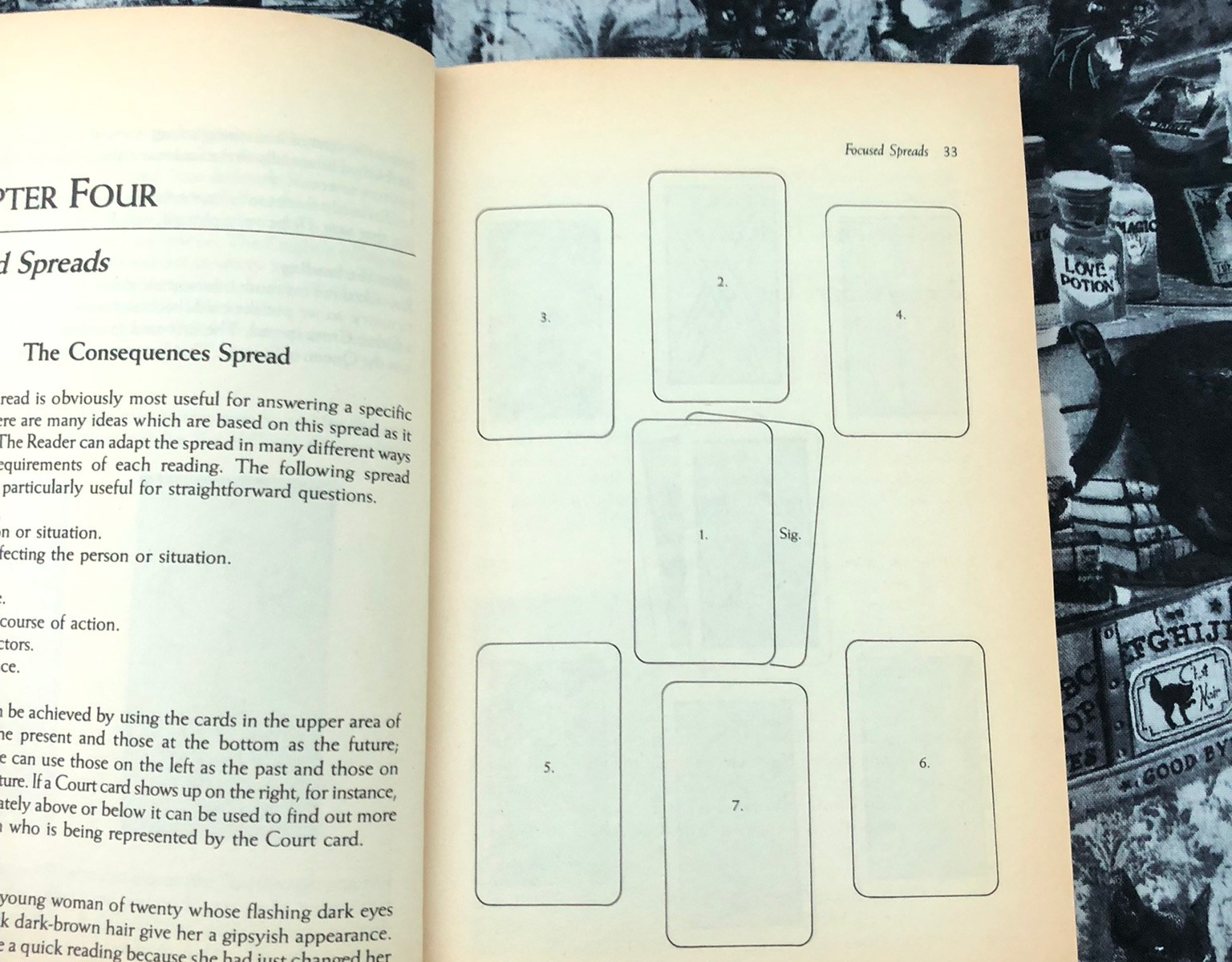
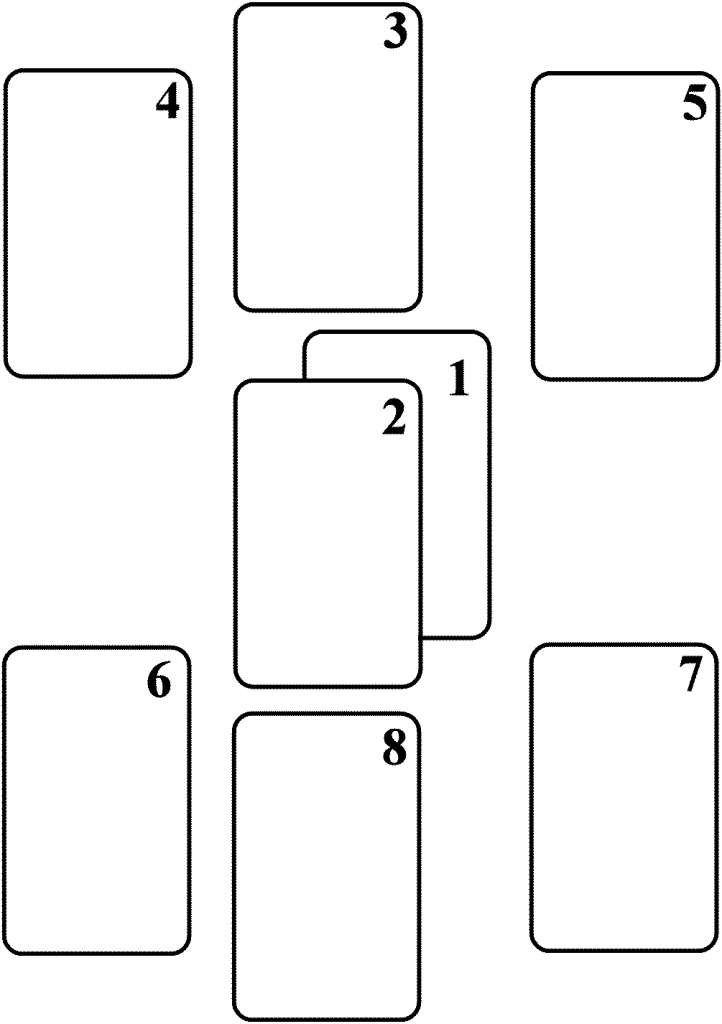
For such questions, I use a draw based on the classical tableaus that I refer to as the Mundane Cross. I gave it this name after using it for quite sometime, as when laid on a reading mat, it reminded me of the earth glyph.

The diagram below indicates how it is to be laid out:

03

04 – 01 – 05

02

The vertical line is read from the bottom upwards and describe the evolution of the situation. Thus cards two are three relate to the past and future, respectively. The horizontal axis is the present moment. However, the fourth card describes the challenge, obstruction or unhelpful influences and actions undertaken. In contrast, the fifth card is the opposite. As intimated above, it is essentially the mechanics found with the thirty-two card tableaus outlined by Minetta, &c.

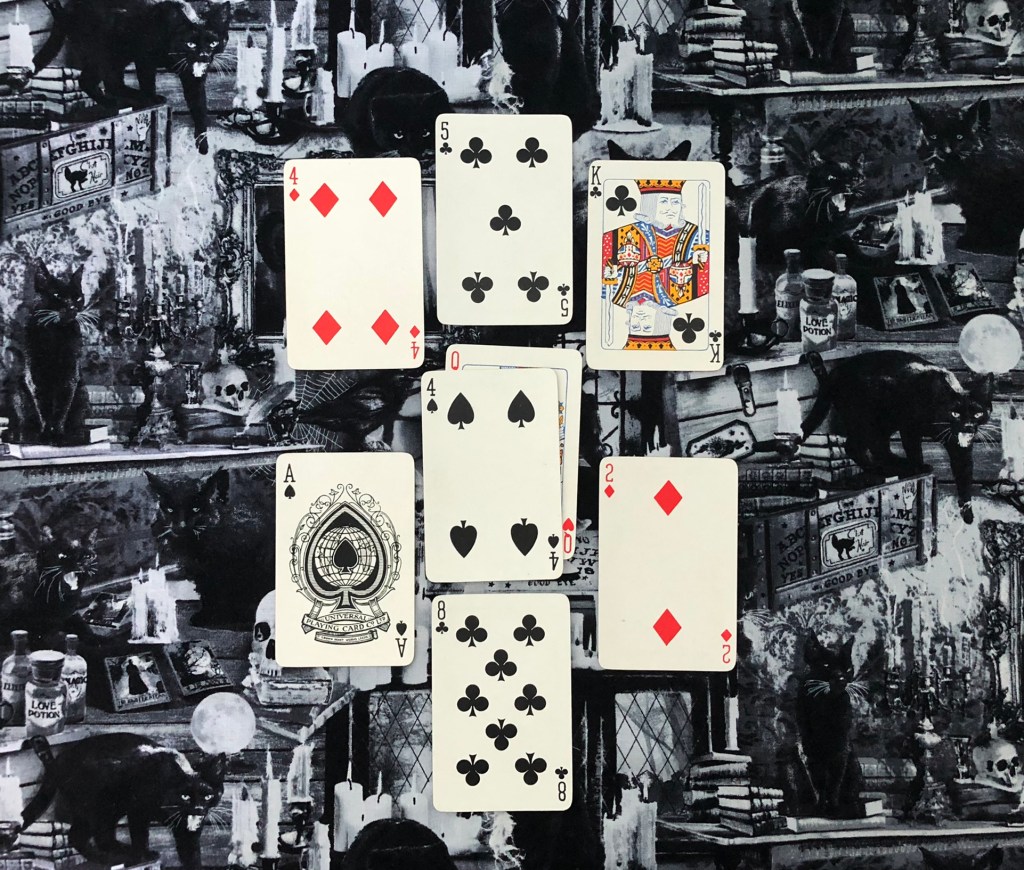
The cards as they fell:

At the centre of the Cross, we see XIV – Art. Above and below are the 5 of Cups and 5 of Wands, respectively. Two fives indicate worry, which fits and drives the Queen onwards. Being cards of water and fire, respectively, both are inimical to each other.

Yet, as Art, the Queen of Cups attempts to unite these opposing energies in the alchemical solvent, vitriol. The discord kindles the fire beneath Art’s cauldron, firing her actions (Five of Wands). But the solvent will prove inadequate, dissolving into a solution of dismay and regret (Five of Cups).

The trouble manifests in the form of the Prince of Cups (Air of Water). On the one hand, it is the son who has engineered the present situation. His impulsive drive (air) to preserve his own needs (water) have discounted anyone else and their feelings. However, the Prince advises the Queen avoids such action as emotional manipulation or conceding.

Her solution comes in the form of the Hierophant. Whereas the Queen cannot unite the opposing forces at play, she can appeal to the Hierophant. The Hierophant is the gatekeeper and mediates between the upper and lower worlds. He can offer the appropriate mediation neutrally, but in a firm and just manner which should prick the conscience of the Prince.

I did not hear from the Queen for sometime. In the eleventh hour the Prince had a change of heart after the wedding rehearsal.

§

References:

Bunning, J. (2007). Queen of Wands. [online] Learntarot.com. Available at: http://learntarot.com/wqn.htm [Accessed 20 Jan. 2020].
Crowley, A. (1976). The Book of Thoth: A Short Essay on the Tarot of the Egyptians. New York: Weiser.
Frawley, J. (2001). The Real Astrology. 1st ed. London: Apprentice, p.180.
Hildegarde de Bingen. (2007). Les causes et les remèdes. Grenoble: J. Millon.
Peach, E. (1988). Tarot for Tomorrow. 1st ed. Wellingborough: Aquarian Press.
Waite, A. (1977). The Pictorial Key to the Tarot. New York: Samuel Weiser.

Images:

Richard Madden. Gage Skidmore from Peoria, AZ, United States of America [CC BY-SA (https://creativecommons.org/licenses/by-sa/2.0)%5D.

Lena Zavaroni. [CC BY-SA (https://creativecommons.org/licenses/by-sa/2.0)%5D.

Astrological Charts: Delphic Oracle.

*Notes:

Throughout this article, we have utilised the Harris-Crowley cards. I chose this deck because the suit associations are familiar to most cartomantes. The elemental associations within each rank are also accepted.

Despite its ubiquitous presence, there is no agreement on the court cards’ elemental association by rank and we cannot ascertain Waite’s intentions from his text. Most feel that the Smith-Waite’s kings are the Harris-Crowley’s knights (fire).

However, when explaining the Celtic Cross, Waite states that a knight should be chosen to signify a man, aged 40 or above, and a king for one under that age. That conforms with the Golden Dawn approach. Whether this is one of several typing errors, we cannot know. Certainly, Colman-Smith’s illustrations of the four knights are more choleric than the kings. However, it cannot be ruled out that Waite was employing what Robert Cochrane described as “grey magic.” Such actions are in keeping with Waite’s known behaviours.

Personally, I believe that the Smith-Waite knights are the Harris-Crowley knights (choleric) and the Smith-Waite kings the Harris-Crowley princes (sanguine). When reading with the Smith-Waite or Marseille Tarots I use: knights = fire, queen = water, kings = air and pages = earth.