The Wheel

La cartomancy es tune profession au même titre que l’astrologie ou la radiesthésie. Il ne suffit pas d’avoir un don ! Ces techniques, comme pour tout, s’apprennent, se complètent, perfectionnent, avec patient et ténacité. (Cartomancy is a profession, just like astrology or dowsing. It’s not enough to have a gift! These techniques, as with everything, are learned, complemented, perfected, with patience and tenacity.)

Mary Marco & Jeanine Goffinet, Petit Lenormand: Méthode de Cartomancie

“But what other spreads are there other than GT or “box” spreads?”

It is a question that one often hears from curious cartomantes or existing students. After all, most examples of readings with the Petit Lenormand do centre on lines of varying sizes, the 3 x 3 or the GT. For some people, this rigidity can be off-putting.

Yet, there are indeed other spreads associated with the Petit Lenormand cards. It is quite a versatile deck.

So, I thought I would share some of my favourites. Some come from French literature, whereas others come from Basil Ivan Rakoczi (Coven of Thirteen) and Minetta (Star of Fortune).

We will start with a spread that I have not written about for some time. It is, however, a firm favourite of mine and one I discovered in the early 1990s: Mary Marco’s La Roue.
Mary di Marco is a Lenormand reader and psychic, based in Comines. In 1989, she published her Petit Lenormand Méthode de Cartomancie. It followed Erna Droesbeke’s 1987 Dutch text, which was translated into French, German and English. Sadly, Marco’s text has never been translated into English.
Marco, for me, has a significant impact. I did not adopt her meanings, but she offered me several methods of laying the cards. That is important. As students of divination, we must continue to challenge ourselves to further and deepen our relationship with the cards. Without this, we cannot hone, refine and better our skills. It is, for this reason, there are no experts. We are all students.

When I was first introduced to reading the Petit Lenormand, my Aunt knew only the “Grand Tableau.” That was never divided into the past, the present or the future. The full board referred only to the present and the future. From time to time, past events were described, but this was in the context of the evolution circumstances.

Erna Droesbeke described both the traditional “all future” convention and a method for examining the past, the present and the future (the cross and cross of destiny). However, I never added that method to my regular practice – especially after experimented with the Wheel Spread. I have genuinely found the Wheel Spread the best way for examining the evolution of a situation or client’s circumstances in detail.

However, it isn’t straightforward to explain the laying process! So, please, do bear with me.

Laying the Wheel:

1) Firstly, you remove the Significator and place it before you. If the Querent is under 21 or non-binary, you can use the Child card. For someone 21 years or over, use the Lady or the Gentleman according to their gender identity.  

Mary Marco recommends ascertaining the Querent’s name and Sun Sign to create a link between the Querent and the Cards.  

2) Shuffle the cards. Mary Marco recommends we shuffle seven times (in honour of the seven lights), but I recommend shuffling however you feel comfortable.  

 3) Once shuffled, cut the deck in two. The cut is the first indication of the reading, describing the atmosphere or tone in my experience.

4) Reconstitute the deck and deal from the top of the deck as follows:

  • the first card is dealt below the Significator;
  • the second is placed to the left of the Significator;
  • the third is goes above the Significator;
  • the fourth is set to the right of the Significator;
  • the fifth card is placed below the first card that was dealt.

The cards should be dealt face-down.  

5) Repeat this process twice. You will be left with five stacks of three cards around the Significator.

6) Now, deal five cards face down on top of each other. Put these aside along with the remaining deck.  

7) Turn your attention to the five stacks of three around the Significator. Flip each stack over so that the first card dealt in each position is on the right and the third card on the left.

8) Take the five cards you dealt on top of each other in step 6. Deal these cards (from the top) into the five positions (below the Significator, to the left of the Significator, and so on). These will become the fourth card in five packets of three.

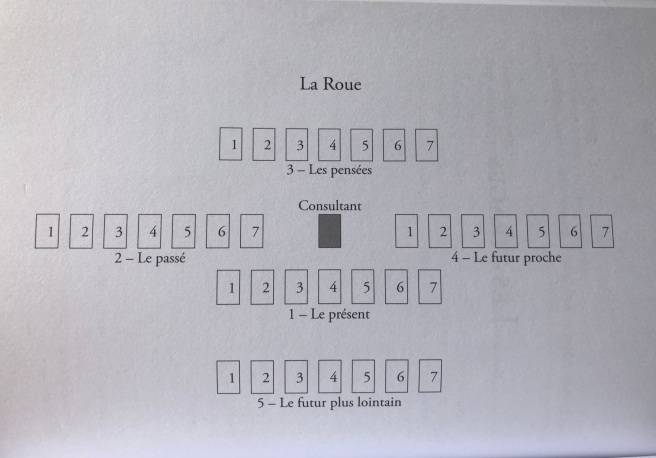
9) Now, pick up the remaining cards. These are dealt from the top of the deck as follows: below the Significator, to the left of the Significator, and so on. Eventually, you will end up five lines of seven cards as below:
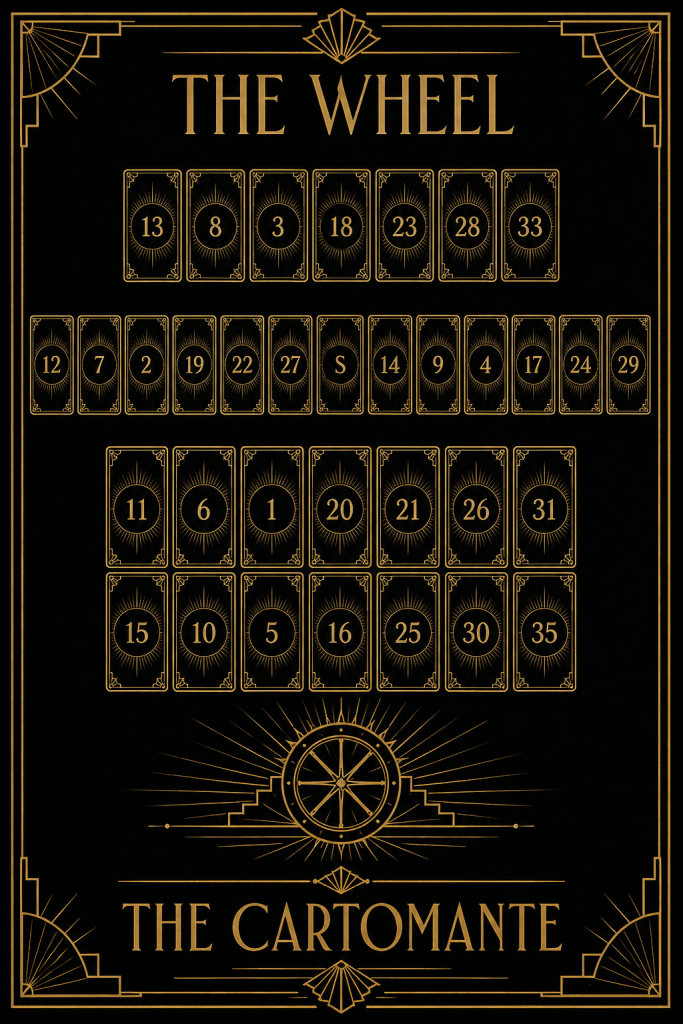
In the illustration above, I have numbered each card based on the order it is dealt. As you can see, the first three cards in each position end up being read in reverse order. Here, Marco follows several older cartomantic methods where one has to count out cards or rearrange them. So I would encourage you to follow the process.

Starting with the row of cards beneath the Significator, we move around clockwise.

The five rows of seven each have a specific context:

  • The cards immediately below the Significator refer to her present circumstances.
  • Those to the Significator’s left refer to the recent past.
  • Cards above the Significator refer to her thoughts.
  • The seven cards to the right of the Significator are the near future.
  • The final row of seven cards, dealt beneath the first row, is the more distant future.

Depending on preference, one can start with the past cards and then read the seven signifying the present. You can also note the cartes maîtresses and playing card values in each section.

Traveling the Wheel:  Dolores’ Reading

Dolores is a 33-year-old woman who came to me via a regular client. Due to Covid-19, the consultation was done via telephone.

After removing the Lady card, I shuffled, cut, and then laid out the Wheel Spread in the manner mentioned above.

The Cut:

.After riffling the cards, the deck was cut as below:

The Lilies – Ring refers not just to relationships characterised by mutual respect but also dealings with social security and other protective agencies.

The Wheel:

The cards as they fell:
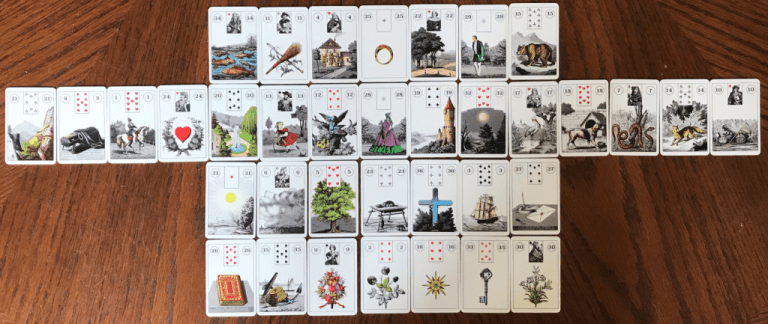
The Present:

The present is made up of the Sun, the Clouds, the Tree, the Mice, the Cross, the Ship and the Letter.
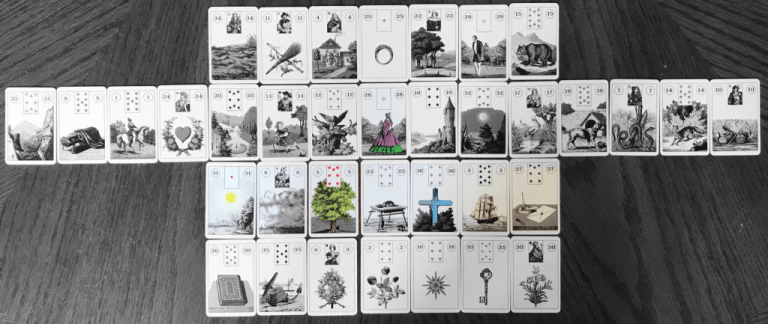
Health worries dominate Dolores’s present circumstances. Not only is the Sun and Tree clouded, but we have three sevens (the Tree, the Mice and the Letter), which forecast illness. Not great.

Right now, Dolores’ energy levels are fluctuating with sudden drops (Sun — Clouds), meaning she is physically and mentally fatigued (Clouds — Tree). It is quite likely she has dizzy spells and visual disturbances. She cannot find the necessary respite, which is further undermining her constitution (Tree — Mice) and causing her physical pain (Mice — Cross).

With the Mice in such a prominent position, this could also be financial and I felt this was so. Dolores has experienced a significant loss of comfort (Tree — Mice —Cross), creating both physical and material hardships.

However, the Cross is the abcissor. Dolores is at her lowest point. The worst is done.

As we advance, the Ship— Letter indicate a communication from someone living at a distance which will necessitate (Cross — Ship) Dolores travelling.

The Past:

In the past, we have: the Mountain, the Coffin, the Cavalier, the Heart, the Park, the Child and the Birds.
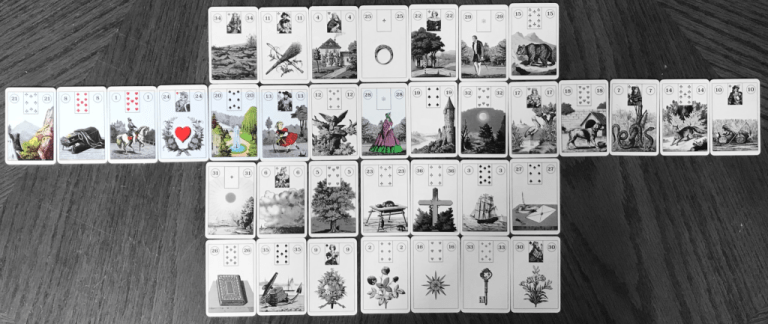
Let us turn to Dolores’s past and see just what bought about the current situation.

Straight away, we find the Mountain – Coffin. Dolores has faced a number of significant problems which proved nigh impossible to overcome. Her life stagnated. Eventually, she was forced to walk away (Coffin – Cavalier) – incurring a loss (Coffin).

The Cavalier – Heart reveal that at this time, Dolores’ love life came to the fore with a new man appeared. It was not too serious (Park), but there were a number of dates (Heart – Park) and callings on her (Cavalier – Heart).

Considering the presence of the Cavalier – Heart, the Child – Birds is a clear indication Dolores fell pregnant in the last few months. This has caused her considerable worry (Birds) and could be the cause of her current health issues.

Interestingly, there are two present and touching in the past. Dolores will have received some money, possibly as a loan (two eight). Unfortunately, the two knaves do issue a warning that could have a negative consequence later on in Dolores’s affairs.

Dolores confirmed that she was pregnant and had been diagnosed with gestational diabetes.

Thoughts:

We find the Fishes, the Birch Rod, the House, the Ring, the Path, the Gentleman, and the Bear cards for Dolores’s thoughts.
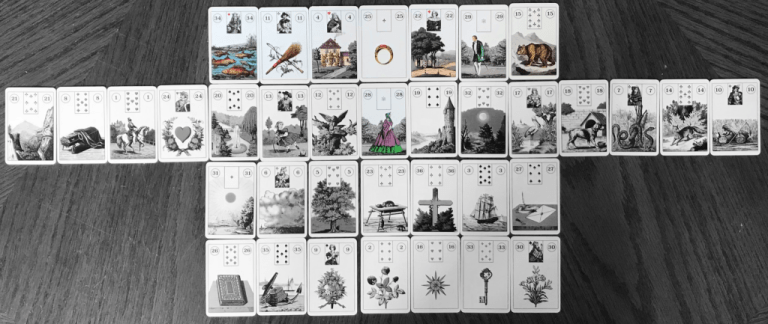
Unsurprisingly, Dolores’s thoughts are preoccupied with her financial difficulties (Fishes – Birch Rod). These are the cause of several arguments with her nearest and dearest (Birch Rod – House).

The presence of the Ring alongside two kings (an agreement) indicate Dolores has been attempting to find a resolution to correct some error (two aces). Often two aces can indicate lies. However, if we remember the past, there were two knaves, eights and nines. The Birch Rod is a corrective tool. We can see a more nuanced picture. Dolores’s financial problems stem from some error that has a significant effect as it is rectified.

Dolores is also questioning the future of her relationship (Ring – Path). She is uncertain (Path) whether she and her partner (Gentleman) are heading in the same direction. The Gentleman – Bear show he is somewhat strong-minded and overbearing in her opinion. Consequently, she is unsure if this will be sustainable (Ring – Path – Gentleman – Bear).

Near Future:

We find the High Tower, the Moon, the Stork, the Hound, the Serpent, the Fox, and the Scythe in the near future area.
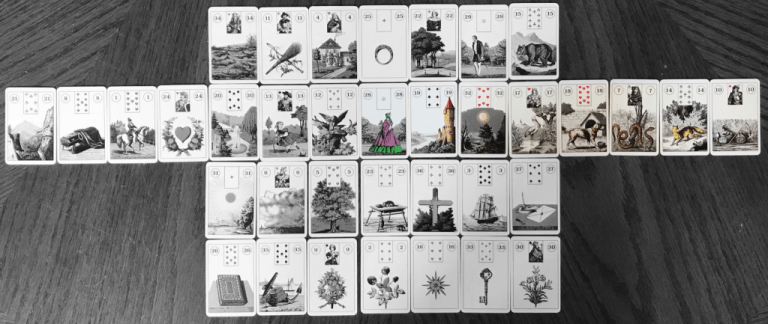
It seems Dolores will start her maternity leave soon (High Tower – Moon – Stork). Naturally, it will usher in long-term (High Tower) significant changes (Moon – Stork). She will miss her colleagues (Stork – Hound). She also seems to be worried that her job might not be safe (High Tower/Scythe & Moon/Fox).

Fortunately for Dolores, there appear to be new friends (Stork – Hound) on the horizon, too. The presence of the two queens confirms this. As the queen of clubs touches the Hound card, it would seem this friend is likely female.

Unfortunately, Dolores might soon be tempted (Serpent – Fox) to take advantage of a sudden (Fox – Scythe) offer of help (Hound – Serpent) that comes her way. Fox – Scythe can be a loan shark or an unregistered agency. She would be wise to resist as it will put her in severe difficulties and further losses (Fox – Scythe).

She just needs to hold in. Any help must come from the proper channels not the Fox — Scythe.

Distant Future:

For the more distant future, we see:  the Book, the Anchor, the Flowers, the Cloverleaf, the Stars, the Key and the Lilies. 
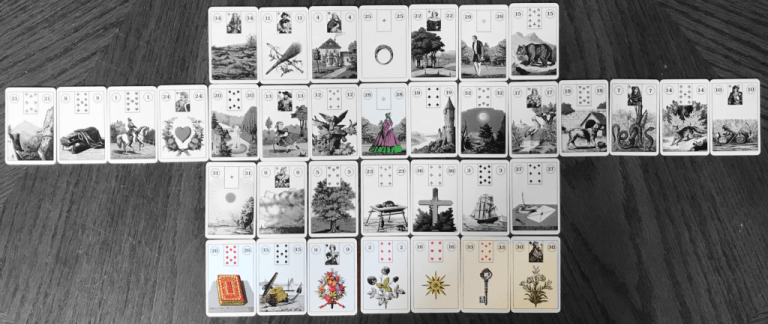
With time Dolores will find she has a better understanding of her circumstances (Book). She will access advice from either a charity or social care (Book/Lilies). This information will help her stabilise her situation and give her a firmer footing (Book – Anchor). That will allow her to arrangements which mean her life is easier and more comfortable (Flowers).

Dolores can expect a lot of merriment, gifts and a lot of short visits, which she will enjoy (Flowers – Cloverleaf). For the first time in a long time, her joy is unclouded (Cloverleaf – Stars).

In addition, Dolores will find she has a better sense of where she wants to go in (Stars – Key). This will likely lead to new projects or a focus on education (Key + Book/king of spades).

All of this will bring her a greater sense of peace and security (Key – Lilies).

Dolores inquired about how far in the future the reading covered.

The Lady card faces the High Tower. In the Petit Lenormand, spades or leaves are associated with autumn. The High Tower is the 6 of Spades, which means no further than the 3/4 October.

Dolores explained that she had started a new relationship and her partner had moved in. Unfortunately, she did not notify the appropriate authorities of this change in circumstances. She was overpaid in benefits and was now in financial difficulties. Her pregnancy was difficult, and she was not well.

Hopefully, as the cards show, she will find that once the baby is born and she can seek appropriate advice, her situation will improve.

§

References:

Droesbeke, E. 1987, 1989, & 1998. The Oracle of Mlle Lenormand. Königsfurt-Urania Verlag/David Westnedge Ltd.
Marco, M. and Goffinet, J., 1989. Petit Lenormand: Méthode de Cartomancie. Bruxelles: Servranx, pp. 35, 179 – 186

Illustrations:


Cards: The Wanderwust Lenormand © Wandering Oracle
Spread Illustration: Marco, M. and Goffinet, J., 1989. Petit Lenormand: Méthode de Cartomancie.
Featured Image: Wheel of Fortune: Ages of Man. William de Brailes, Public domain, via Wikimedia Commons
The Dailies: Daily Draws with the Petit Lenormand

“Dear, dear! How queer everything is to-day! And yesterday things went on just as usual. I wonder if I’ve been changed in the night? Let me think: was I the same when I got up this morning? I almost think I can remember feeling a little different. But if I’m not the same, the next question is, Who in the world am I? Ah, that’s the great puzzle!”

Lewis Carroll, Alice’s Adventures in Wonderland

Daily draws are a common practice recommended for and used by the apprentice Petit Lenormand cartomante. It does make sense: regular manipulation of the game keeps the cards hot and helps familiarity. Nevertheless, daily draws have their complexities which can be particularly challenging for a neophyte: phrasing, significator in or out, when to perform, retrofitting, &c.

It is for this reason one no longer recommends them for the absolute beginner.  Instead, I encourage students to incorporate them after the line of three and 3×3.  

One particular issue an apprentice is confronted with is the need to use “light” meanings.  It is a term used liberally.  But what does that mean?  All too often, it is interpreted as dilution.  However, that is incorrect.  Cards are never diluted.  You are not applying some magical thinner to the cards’ signification.  

The so-called light meanings are the cards’ signification in everyday parlance.  We call them light because of their familiar presence in day-to-day life.  So ‘light’ is nothing more than essence read in terms of function vis-à-vis context.  You are looking at where you experience them on a day-to-day basis.  No different to when you interpret the Heart (Kn♥), the Fishes (K♦) and the Anchor (9♠) as deep and lasting feelings in a love reading.   

So, in day-to-day terms, the Coffin (9♦) can be a bin.  Whereas the undertaker puts a cadaver in the casket, you put refuse.  The Coffin can also indicate a headache, cold or bug.  The Book (10♦) can be your iPad or Kindle.  The Cavalier (9♥) the post or your car or bike, and so on.  

The exact mechanics of daily draws differ from reader to reader.  Some prefer five cards; however, most favour two or three.  I hold with the latter.  Some readers remove the significator (the Child (Kn♠) , the Lady (A♠) or the Gentleman (A♥)) and deal two (or three) cards in front of it.  Others leave the significator within the pack.  

For myself, I never learned with daily draws.  So how I perform them is based on other experience:

Perform the reading at the start of the day, not the night before.  Doing the reading at the beginning of your day helps you focus your intention.  The cards will better respond.

Phrase the question precisely, including yourself in the question, e.g. what is the most significant event in my life today?  Just asking what will happen today can often result in a reading that has no bearing on you.  You might get a spoiler for the chapter in that novel you read on your commute.

Deal out the three cards in a line as shown below. 

A — B — C

Once laid out, I take the trigger card (that is the first card, card A) as identifying the topic. So, if the House (K♥) card falls here, the event concerns our home or someone we live with. Your wider family would be the Lilies (K♠). The Park (8♠) is out of the house. The Clouds (K♣) is often the weather, especially rain or fog. Warning cards, such as the Scythe (Kn♦) or the Fox (9♣), do not become benign, but you might get a papercut (Scythe) or be short-changed by the cashier (9♣).

Cards two and three (cards B and C) reveal the precise circumstance. So once you have pinpointed the main topic (trigger card), you then delineate the event (the pairing).

Quite often, people spread the cards but do not read them until the end of the day. That is both lazy and pointless. If you lay the cards, you read them. What is more, I encourage you to record the cards and write down your prediction. You can review your prognostication at the end of the day, and if you are wrong, try and see where you went wrong. That is how you learn.

So, for this article, I did a run of daily draws. Such readings are not part of my praxis. But I wanted some to share with you.

So for the first draw, the cards as they fell:

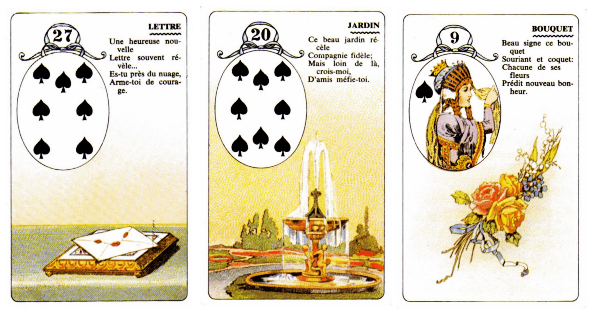
The cards are the Cavalier (9♥), the Scythe (Kn♦) and the Letter (7♠).

The Cavalier, as the trigger card, points to either the mail carrier or my car. Due to “shielding,” I was not going out, so the former made more sense. The pairing comprises the Scythe and the Letter cards, damaged or open (the Scythe cuts) mail.

On that day, Royal Mail delivered an item which was too big for the envelope. It had split, and Royal Mail had placed it in a cellophane “damaged post” bag.

The second draw had the cards as follows:

The House (K♥), the Bouquet (Q♠) and the Birch Rod (Kn♣).

As I live alone, the House represents my home. Will I have a burst pipe? No, that would be the Scythe (Kn♦) and the Serpent (Q♣). Here I have the Bouquet + Birch Rod: cleaning. As we know, the Flowers are ornamental and decorative, which on a day-to-day basis is keeping things clean. The Birch Rod is the corrective action (cleaning) taken to keep everything spick and span.

As you can see, at no point have I diluted the cards’ signification. All I have done is read them on a very mundane, everyday level. Doing so requires a good understanding of the cards’ essence and functional behaviour. For someone completely new, that can be a challenge. So if you are a total beginner, do not lose heart. Focus, instead, on short questions and build from there.

§

Featured Image: Michelangelo, Dusk, 1524-34; New Sacristy (Medici Chapel), San Lorenzo, Florence. Via Wiki Commons/ Richard Mortel from Riyadh, Saudi Arabia

The Three Rs: Reading the Combos in the Petit Lenormand

For those first lessons, reading, writing and arithmetic, I thought as great a burden and penalty as any Greek. And yet whence was this too, but from the sin and vanity of this life, because I was flesh, and a breath that passeth away and cometh not again? For those first lessons were better certainly, because more certain; by them I obtained, and still retain, the power of reading what I find written

St. Augustine, Confessions (Pusey, trans.)

Like most older readers, my Petit Lenormand apprenticeship was the “Grand Tableau.” These days, people prefer to “work up” to the full board via trios, squares and lines of varying length. Personally, I feel the GT is a good introduction; however, I can understand its intimidating appearance. It was, for this reason, I designed both my courses and mentoring around a structure designed to lead into the 36-card spread: line of three, 3 x 3 (teaches vertical and diagonal trios), line of five (can be read in mirror), line of nine (echoes the 9 x 4).

Combinations:

When I first started writing about the Petit Lenormand, there was a prevailing view that one had to memorise copious lists of different pairs, trios, &c. Most now know such ideas are nonsense: additional cards and directional nuances of specific decks all influence a combination.

However, the most significant modifiers are context and individual circumstances. If two people ask how their financial circumstances will progress, two identical pairings would have a different nuance for a wealthy entrepreneur and a single parent on benefits. Having a diverse clientele, I see this often. So they cannot be fixed.

It is, for this reason, I do not offer combination lists. Outside of a few essential pairs or trios (often for timing), it is far better from the start to focus on honing the necessary skill to combine cards in actual reading.

Forming Combinations:

There are several forms of combinations. But the three primaries are: by proximity, by touching and by correlation.

I refer to combinations of cards that touch – horizontally, vertically, or diagonally – as attendance. Other names include contact and encounter cards. The process is two-parted: narration and specification.

Narration:

Narration is when cards read like a storyboard: we start with the first card and move along, forming a narrative using the cards’ essence or core topic. Once the core significations are learned, most cartomantes find this method natural if not effortless.

For example, let us consider the following:

Letter: You receive a message (Letter, 7♠).

Letter + Park: You receive a message (Letter, 7♠) and go out (Park, 8♠).

Letter + Park + Bouquet: You receive a message (Letter, 7♠) and go out somewhere (Park, 8♠) and have a pleasant time (Bouquet, Q♠).

As you can see, building a flowing narrative is straightforward. It gives us the bare bones of an answer. However, it is vague and non-specific and needs to be fine-tuned, which is done through specification.

Specification:

Specification, or pairing, is the A – B method. Just as the word “feed” describes something different if preceded by the word “animal” or “social,” cards will be qualified by their attending partner. So, in A – B, B modifies or describes A.

When I first started writing about the cards I likened card A to a noun and card B to an adjective or verb. Nouns denote a person, object or place. Adjectives describe or seek to qualify a noun, and verbs express conditions or actions. Essentially, card B is the description or guise taken by card A.

To illustrate this, we will return to the above trio.

The first pairing is the Letter (7♠ ) and the Park (8♠). The topic of the Letter is often a ‘phone call, DM, e-mail or a letter. Our clue to its nature is the Park. It describes something as being in the open or en masse. The Letter + Park can thus be read as a flyer or advertisement.

The second pairing is the Park (8♠) and the Bouquet (Q♠). In this pairing, the Park is the subject. The Park’s essence is community, and thus is often either a place or group one mixes in. It is for this reason that the Park is the card of social networks such as Twitter, Instagram, Facebook, &c.

Considering the first pairing, we can take the Park as an event that the Bouquet describe. The Bouquet is the card of artistry and beauty. Describing the Park, the Park + Bouquet would refer to a craft fair, exhibition or horticulture event.

Now we know that the message received was an advertisement for an event or exhibition connected to crafts or horticulture. Which, from the narration, we see the client will attend and enjoy herself. She might take a girlfriend, as the Bouquet is also a person-card (queen of spades).

It should be clear then that narration gives the bare bones and specification the details. Using a line of three allows you the chance to practice combinations of attendance and get a feel of the cards.

Below are three clients readings done over the last few months.

Reading #1:

The first reading was for a female client who asked: will my presentation be well received?

The cards as they fell:

Cards: The Stars (6♥), the Lilies (K♠) and the Bear (10♣).

The narrative tells us that the Querent’s presentation will be clear (Stars) and go without any problems (Lilies), putting her in a strong position (Bear).

Let us refine it. The Stars is the cards of clarity and precision. The Lilies describes this as coming from focus and sensitivity. The Querent knows her stuff (clarity and focus) and knows how to put it across effectively (precision and sensitivity).

The final pairing is the Lilies and the Bear. When read as a topic, the Lilies is more often than not a man. Described by the Bear, we have a senior or older man in a position of power. We associate the Lilies with family, which would be someone within your team or department rather than higher management in professional terms.

Put together: we can say yes, it will go well and impress her immediate line manager. That she did. And has been given more responsibility as a result.

Reading #2:

The second reading was for a male consultant. He had just started his first job after University. He asked: should I come out to my colleagues?

The cards as they fell:

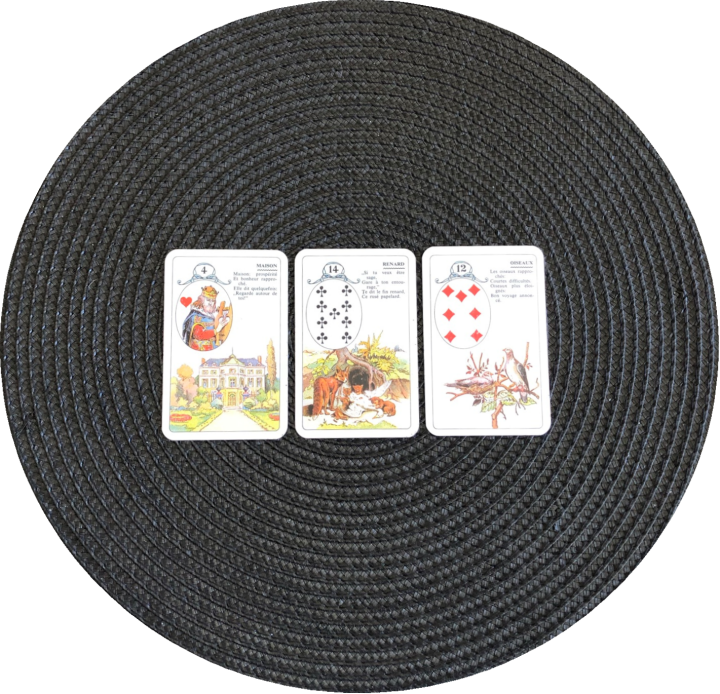
Cards: The House (K♥), the Fox (9♣) and the Birds (7♦).

The primary narration says that discussing his personal life (House) would be a mistake (Fox) and cause some upset at this time (Birds).

Why? The House signifies our home but also our personal life. Here, the Fox indicates the necessary steps taken to keep this private, e.g. the environment he is in is one where he needs to be discreet, not too open (House + Fox).

The reason is shown by the Fox + Birds: To avoid fuelling a two-faced colleague or gossips. Here, the Fox is the topic. Card no. 14 is the red flag card and indicates that something is wrong or lies. It is described by the Birds, which indicates noise and ruffled feathers. Often the Fox + Birds is an unfounded rumour — the Birds put 2 + 2 together and come up with 5.

So the answer is no, it is best to keep one’s private life private or risk causing up set by fuelling the office gossip.

Reading #3:

The third reading was for a female Querent. She was unemployed, and wanted to know: will I find a job soon?

On discussion with the Querent, we defined soon as a month.

The cards as they fell:

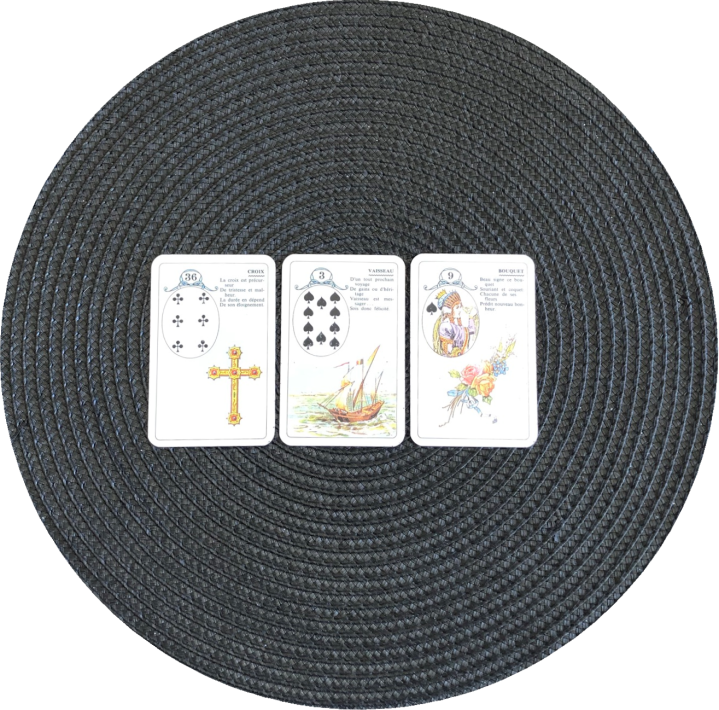
Cards: The Cross (6♣), the Boat (10♠) and the Bouquet (Q♠).

The narration tells us that there is still a difficult (Cross) wait (Boat) for a job offer (Bouquet).

The Cross is a time-card and always indicates the present. In terms of topic, it signifies hardship and pain. The Ship tells us that the hardship is being cast adrift. Nothing is moving, and she is lost (Cross + Boat).

The Ship + Bouquet tells us of a wait to hear of a job offer. The Boat is a long journey, or significant movement. The Bouquet , in this context, and be seen as an offer as it signifies arrangements (remember it shows cut flowers arranged in a bouquet).

So, the answer is no, not this month. But note that the Boat + Bouquet come after the Cross. The job is coming, but not this month.

This reading was done in February. In March, the Querent received a call-back for a second interview and was offered the job.

So, there you have a basic line of three and combinations.

§

Cards:  Jeu Lenormand © Carta Mundi

Featured Image: GBSmithArt, CC BY-SA 4.0 https://creativecommons.org/licenses/by-sa/4.0, via Wikimedia Commons