This article continues my series examining the trumps of the Tarot de Marseille, adapted from my unpublished manuscript, Tarot de Marseille: The Picturebook of Fate. As throughout this series, the emphasis is placed upon the traditional eikōn of the card, its historical context, and the practical significations I have found useful through divinatory practice. The interpretations presented here reflect my own experience of working with the Tarot de Marseille and should be understood as a working method rather than a definitive authority.
The Sevens: Justice and the Star
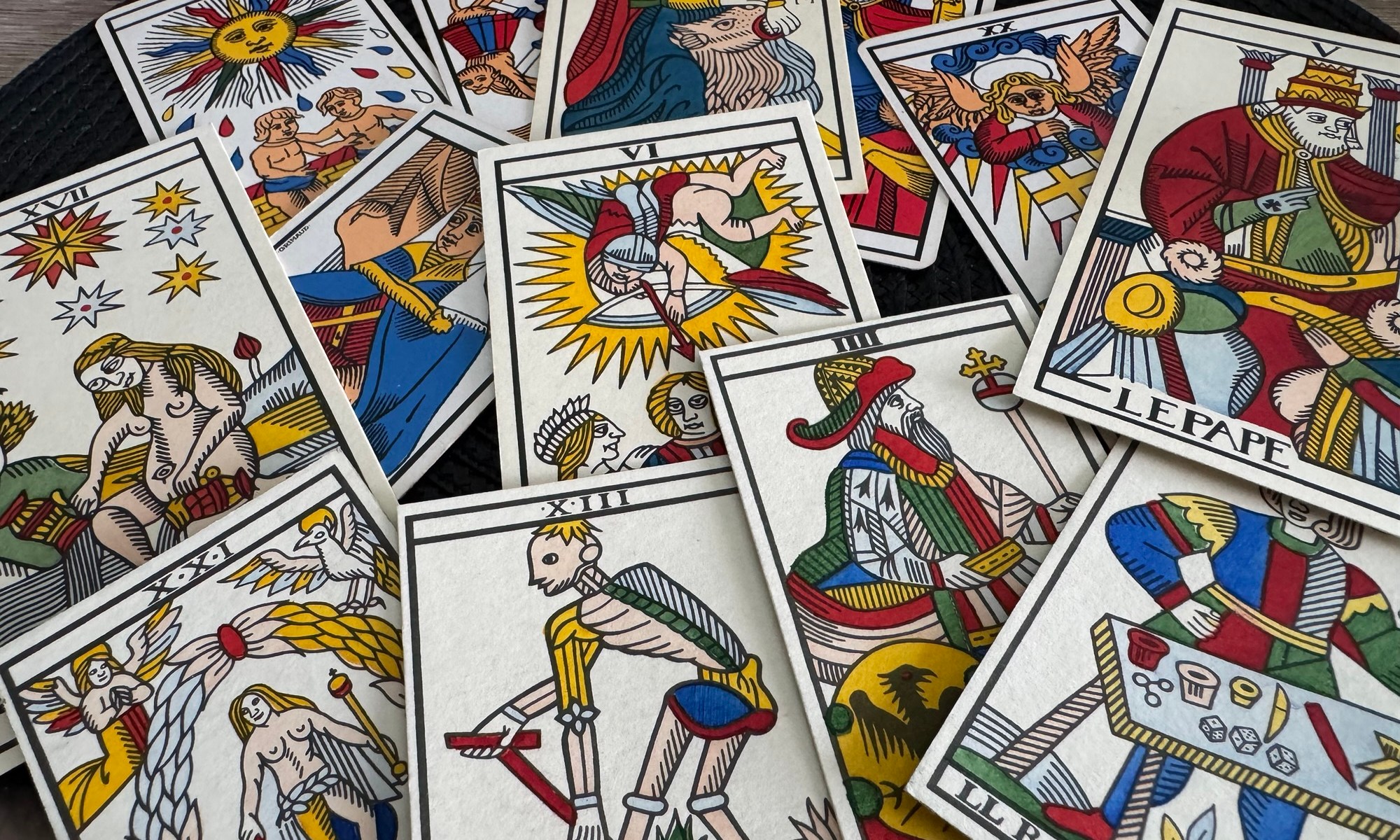
Trump XVII, L’Étoile, or the Star, is one of the most attractive and reassuring images in the Tarot. Yet what does it signify? Is it a card of metaphysics and awakening psychic gifts in some coming Aquarian age? Does it promise love, blessings, and second chances? Or does the Star serve a more ancient purpose, guiding us through darkness as Polaris guided travellers and sailors for centuries?
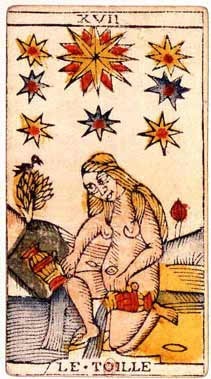
The traditional eikōn of the Star is both serene and enigmatic. A young maiden kneels beside a pool of water. Naked and unashamed, she pours water from two vessels, one upon the earth and the other back into the water from which it came. Behind her stand a tree and a bird, whilst overhead a large star is surrounded by seven smaller stars. The scene is peaceful, harmonious, and curiously timeless.
The essence of the Star is renewal; its function is to guide. Both principles are evident in the image. The maiden continually pours forth water, nourishing the land and replenishing the source from which the water is drawn. The gesture appears wasteful at first glance. Why pour water back into water? Yet the maiden seems unconcerned. Her actions are generous, life-giving, and restorative. She gives freely because renewal depends upon abundance rather than scarcity.
The figure herself is striking. Unlike many of the other trumps, she appears entirely without defence or pretence. Her nakedness signifies openness, sincerity, and vulnerability. Nothing is concealed. The Star therefore invites trust, encouraging us to remain receptive even when circumstances have given us reasons to withdraw.
At its heart, the Star is the card of Hope. In the Christian tradition, hope is not optimism, wishful thinking, or confidence that everything will work out according to our preferences. Rather, hope is the theological virtue by which we trust that the good remains attainable even when the path towards it is unclear. Hope sustains us when certainty is impossible and perseverance difficult. It gives direction amidst confusion and prevents us succumbing to despair. The maiden therefore does not merely renew the world around her; she embodies the confidence that renewal itself is possible.
The stars above her reinforce this message. The seven smaller stars may be understood as the seven wandering stars of classical astrology: the Sun, Moon, Mercury, Venus, Mars, Jupiter, and Saturn. Beyond these lay the primum mobile, and beyond that the Empyrean, the dwelling place of God and the ultimate object of hope. The heavens were not merely lights in the sky but visible reminders that the universe possesses order, purpose, and direction.
For countless generations, the stars also served as guides. Travellers navigated by them, farmers ordered their work by them, and societies measured time through their movements. They formed the great celestial clock by which the rhythms of life were understood. The Star therefore possesses a close relationship with guidance, timing, and orientation. It reminds us not only that there is a destination, but that there is also a path leading towards it.
This symbolism reaches its fullest expression in the journey of the Magi, who followed the Star of Bethlehem towards Christ. The star did not complete the journey for them, nor did it remove the difficulties they encountered. It simply revealed the direction in which they ought to travel. The Star card functions in much the same way. It does not guarantee an easy road, but it offers guidance, reassurance, and the confidence that one is moving towards the right destination.
The Star frequently manifests through the assistance of others. A friend, adviser, benefactor, healer, or even a stranger may appear at precisely the right moment, offering support, encouragement, or direction when it is most needed. Such help rarely solves every difficulty outright. Rather, it provides the guidance or reassurance necessary to take the next step forward.
The card is also a powerful indicator of regeneration. After a period of hardship, illness, disappointment, or loss, the Star marks the beginning of recovery and renewal. Affairs gradually improve, strength returns, and circumstances become more hopeful. The process is seldom immediate, but it is underway. Just as the maiden replenishes both land and water, the Star signifies that what has been depleted can once again become fruitful.
When the Star appears in a reading, it often does so after a period of difficulty, uncertainty, or loss. The worst has passed, and renewal has begun. The way forward may not yet be fully visible, but hope has returned. Guidance is available, help may arrive from unexpected quarters, and the process of regeneration is already underway. The card reminds us to keep our eyes fixed upon the greater goal, trusting that the darkness will eventually yield to light.
General: The beginning of renewal and regeneration within the querent’s affairs. Hope returns after a period of uncertainty, disappointment, or loss. The card frequently signifies guidance, encouragement, and assistance offered by others. Whilst difficulties may not disappear immediately, the Star reassures us that circumstances are improving and that a clearer path lies ahead. Progress may be gradual, but it is underway.
Love: For those seeking love, the Star is one of the most favourable trumps. New opportunities to meet people arise, often through existing friendships, shared interests, or social circles. It is not uncommon for a friendship to develop into something deeper under this card. In established relationships, the Star helps heal past hurts and restore trust where it has been damaged. Reconciliation is frequently indicated, together with the development of a more mature and supportive bond. Friendship, honesty, and mutual goodwill become the foundations upon which a stronger future is built.
Career: The Star is associated with astronomy, environmental science, botany, biochemistry, and other professions concerned with the natural world. It also governs occupations connected with beauty, wellness, skincare, spas, massage, and holistic wellbeing. In career matters, the card promises new opportunities, gradual advancement, and improving prospects. Businesses recover, projects regain momentum, and efforts begin to yield rewards.
Finance: Alongside the Sun, the Star is one of the most favourable trumps in financial matters. It may signify prizes, gifts, grants, inheritances, or other unexpected benefits. More commonly, it indicates that financial worries are beginning to recede and that circumstances are becoming easier to manage. The querent demonstrates adaptability, sound judgement, and an ability to make the most of available resources.
Health: Anatomically, the Star is associated with the skin, the body’s largest organ. When accompanied by the Sun or Moon, it may indicate conditions such as dry skin or hyperhidrosis respectively. More generally, however, the Star is a powerful card of healing, recovery, and regeneration. It encourages the care and preservation of health and is particularly favourable in matters relating to fertility, conception, convalescence, and recovery following illness.
Essence: Renewal. Function: Guide. Polarity: Positive. Astrological Association: Jupiter. Timing: Thursday. Within twelve years. It may also indicate Epiphany.
Tarot Cards: Jean Dodal Tarot via Wikipedia Commons. Public Domain.
The name of the Lord is a strong tower; the righteous man runs into it and is safe.
Proverbs 18:10 (RSV CE)
Thou wishest to be great, begin from the least. Thou art thinking to construct some mighty fabric in height; first think of the foundation of humility.
St Augustine, Sermon 69
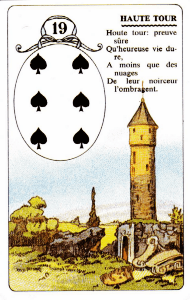
Tower, announces a long life and a happy old age; but if it surrounded by clouds, it announces sickness, and in certain circumstances, even death.
Original Instructions
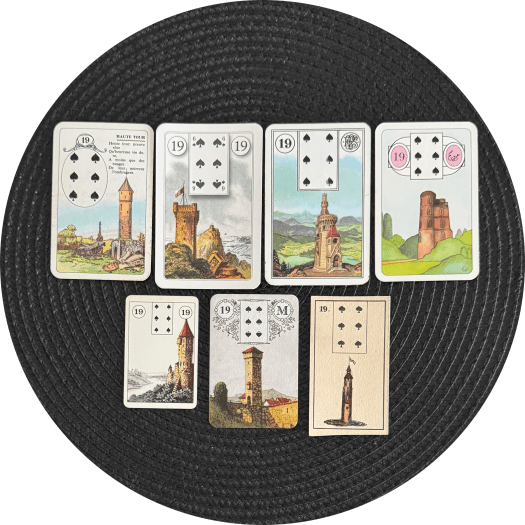
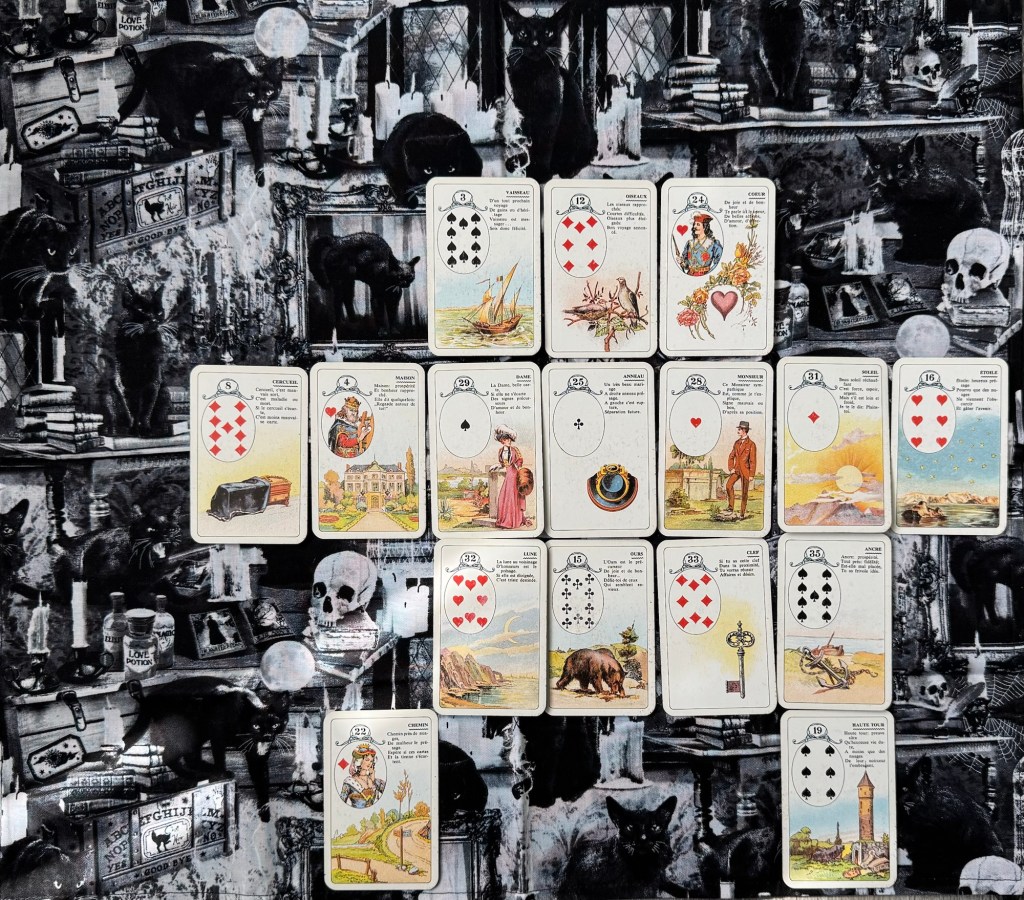
Card No. 19 in the Petit Lenormand, the High Tower, is represented by the Six of Spades. Few cards within the deck have undergone such a dramatic reinterpretation in modern times. For many contemporary readers, the High Tower is primarily a card of bureaucracy, government, institutions, and officialdom. Whilst such associations are not entirely without merit, I believe the older interpretation possesses considerably greater depth and offers a richer understanding of the card.
The Essence and Function of the High Tower
The traditional eikōn of the High Tower is especially important because it immediately reveals two significant characteristics. Firstly, it is clearly of an older architectural style than the other structures within the deck, such as the House or the Park. Secondly, it stands alone and rises to a considerable height above the surrounding landscape.
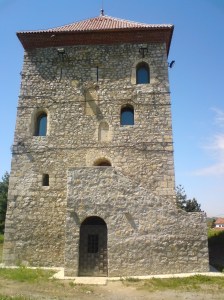
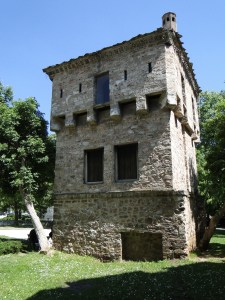
When discussing this card, some readers invoke images such as Alcatraz, the Bastille, or the Tower of London – or even the Tower of Babel. Yet the structure shown on the card is not a prison. It is far closer to a tower house (see below), a form of fortified dwelling once common throughout medieval and early modern Europe and one that would have been entirely familiar to the creators of the Petit Lenormand. Such towers were constructed as lookouts and places of refuge, particularly in isolated regions. Their purpose was not imprisonment, but observation. From their elevated position one could see across great distances and watch for opportunities or threats approaching from afar.
The High Tower is therefore not shown as a place of confinement, but as a place of perspective.
The essence of the High Tower is longevity and its function is to provide perspective.
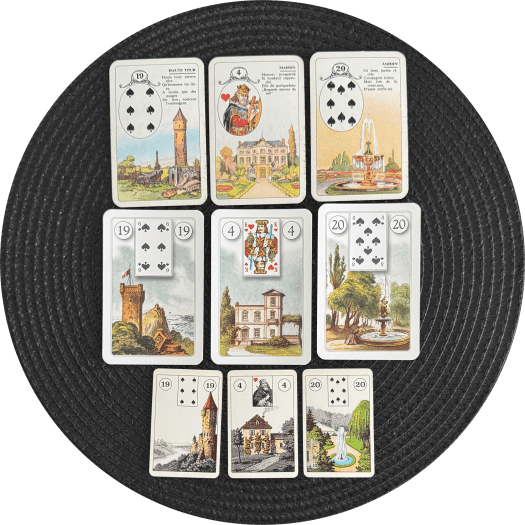
The significance of this perspective extends beyond the physical landscape. Standing atop the High Tower, one looks not merely across the countryside but across the course of life itself. Its great age speaks of endurance and survival. Unlike the fashionable château or ornamental park (see below), the tower has remained standing through the passage of generations. It has witnessed change, endured hardship, and survived the passage of time.
Longevity allows perspective. Perspective, in turn, allows us to understand the larger course of life.
This naturally links the card to old age, retirement, legacy, and life’s long-term trajectory.
It is for this reason that the original instructions speak of a long life and a happy retirement. Such promises carried far greater significance in earlier centuries than they do today. High mortality rates, illness, and economic hardship meant that few could take longevity for granted. To reach old age in comfort was a genuine blessing rather than an expectation.
Likewise, the traditional associations with widows and widowers arise quite naturally. The High Tower is not a malevolent card. Rather, one consequence of a long life is that we inevitably outlive some of those we love. Longevity carries its own sorrows alongside its rewards.
In practice, the High Tower frequently describes the seeker’s life path in general. Whereas many cards concern immediate events and circumstances, the High Tower takes a much broader view. It asks what the seeker is building and what their life is ultimately becoming. The surrounding cards often reveal the foundations, ambitions, accomplishments, and aspirations that will shape the years ahead.
For this reason, the High Tower is often concerned with legacy. It encourages us to look beyond present concerns and consider what will endure when today’s successes and difficulties have long passed. What are we building? What direction is life taking? What will remain when the immediate moment is gone? These are quintessentially Tower questions.
When the High Tower appears in a reading, it often encourages the seeker to adopt a long-term perspective. Immediate concerns are rarely its primary focus. Instead, it asks where one’s present choices are leading and what sort of future is being constructed through today’s actions.
The card can also reveal something about a person’s private definition of happiness and fulfilment. Beneficial cards surrounding the High Tower often indicate satisfaction with one’s circumstances and contentment with the direction life has taken. There is, however, a decidedly solitary quality to the card. From such a lofty vantage point one observes the world from a very personal perspective. Consequently, the High Tower can occasionally introduce a somewhat self-contained or even solipsistic outlook in which one’s own long-term concerns take precedence over the immediate concerns of others.
A useful distinction may be drawn between the High Tower and the Stars. Both cards involve looking into the distance, yet they do so in different ways. The Stars provides guidance and direction. It tells us where we ought to be heading. The High Tower, by contrast, provides perspective. It allows us to assess where the road may ultimately lead if we continue along our present course.
The High Tower also possesses important health associations. Like the Tree, Coffin, Birch Rod, and Mice, it frequently appears in questions concerning illness and physical wellbeing. The conditions it signifies are often long-lasting, chronic, or persistent rather than acute. In this regard, the card reflects duration more than severity. The illnesses associated with the High Tower frequently accompany the seeker over a considerable portion of life.
When adverse cards such as the Clouds surround the High Tower, the matter becomes more serious. Chronic conditions may worsen, independence may become compromised, and in rare circumstances the card can indeed contribute to indications of terminal illness. Such interpretations should never be reached lightly, but neither should the possibility be ignored when the wider spread supports it.
Some readers continue to associate the High Tower with governments, bureaucracy, and institutions. I can understand the rationale, and there are certainly occasions when such meanings prove appropriate. Nevertheless, I regard these interpretations as secondary rather than primary. Government is fundamentally a collective enterprise and therefore often appears more naturally under the Park, whilst authority frequently belongs to the Bear and regulation to the Birch Rod. The solitary High Tower speaks far more convincingly of perspective, longevity, isolation, and the long view of life than it does of bureaucracy as such.
Coda
At its heart, the High Tower is a card of longevity, perspective, and legacy. It encourages the seeker to look beyond immediate circumstances and consider the larger course of life. From its lofty vantage point, we are invited to reflect not merely upon where we stand today, but upon what we are building, what will endure, and where our present choices may ultimately lead.
Person and Description
Person
Like the Bear and the Hound, the High Tower can sometimes signify a person despite not being a court card. Unlike those cards, however, the High Tower’s significance derives less from authority or association and more from longevity, experience, and perspective.
When functioning in this capacity, the High Tower frequently represents an older relative, a family patriarch or matriarch, a respected elder, or someone whose life experience grants them a unique perspective upon events. What unites High Tower people is not merely age, but wisdom gained through the passage of time.
In my younger days, the card often represented a grandparent. For clients in later life, however, it can just as readily signify an elder sibling. This may seem unusual at first, yet it makes perfect sense. The older we become, the fewer people remain who remember the same events, places, and stages of life that we do. My youngest siblings, for example, were born when I was already a teenager and never knew our paternal grandparents. Only my brother, who is two years younger than I am, shares those memories of those “old days.” In this respect, the High Tower often signifies the person who remembers.
There is undoubtedly a masculine quality to the card, yet it may represent either a man or a woman. As always, the surrounding cards will clarify the person’s appearance, temperament, and influence within the reading.
Physical Description
Naturally, the High Tower often describes someone older than the seeker. Yet “older” is a relative concept. A person in their sixties may seem elderly to a client in their twenties, whilst appearing comparatively youthful to someone in their eighties.
For this reason, it is often more useful to think in terms of generations rather than specific ages. The High Tower frequently points towards our parents’ generation and, more commonly still, our grandparents’ generation.
Physically, the card tends to describe someone tall or at least above average height. Unless modified by cards such as the Child or the Mice, the individual is rarely short. There is often a sense of stature or presence about them, whether physical or social.
The High Tower also tends towards a vintage, traditional, or somewhat old-fashioned style of dress. Such people are seldom devoted followers of contemporary fashions. Instead, they often prefer clothes, jewellery, or possessions chosen for their quality, durability, and timeless appeal rather than their novelty.
There is frequently an air of dignity, reserve, or quiet self-possession about them. Like the structure itself, they often appear composed, self-contained, and somewhat removed from the bustle of everyday life.
Temperament
The High Tower describes someone shaped by experience and the passage of time. Such individuals often possess a broad perspective and a strong appreciation for stability, planning, and continuity. They are rarely impulsive and generally prefer to consider the long-term consequences of their actions before making important decisions.
There is frequently a conservative quality to the card, though not necessarily in a political sense. Rather, High Tower people value preservation. They respect traditions, family history, accumulated knowledge, and those institutions or practices that have proved their worth over time. They instinctively understand that not every problem requires reinvention and that some things endure for good reason.
The High Tower possesses a distinctly Saturnine temperament. At its best, this manifests as wisdom, prudence, discipline, patience, responsibility, and endurance. Such individuals are often relied upon for advice because they have already weathered many of life’s difficulties and acquired perspective through experience.
When poorly aspected, however, these same qualities can become rigidity, excessive caution, pessimism, or resistance to change. The individual may become isolated, aloof, or so focused upon preserving the past that they struggle to adapt to the future.
Above all, the High Tower describes someone whose greatest strength lies in perspective. They have seen enough of life to understand that today’s difficulties are merely part of a much longer story. From their elevated vantage point, they are often able to perceive patterns, consequences, and possibilities that others overlook.
Special Features
Grand Tableau
We have already discussed how the High Tower, free from the influence of the Clouds and other adverse cards, traditionally signifies a long life, comfortable retirement, and security in old age.
In practical terms, this usually indicates that the seeker is building a life capable of supporting future ambitions and long-term objectives. The card asks us to look beyond immediate circumstances and consider the wider course of life. For this reason, the surrounding cards frequently reveal what is being built, preserved, or invested in for the future.
Consider, for example, the combination Lady–High Tower–Stars, with the Stork above the High Tower and the Moon beneath it. Here we can see the Lady entering a significant new chapter of life. A change in status (Stork over Moon) enables her to make considerable progress towards her ambitions (Stars). The High Tower shows that this is not simply an isolated event but one that materially alters the direction and trajectory of her life.
These cards appeared for a female clinician who had recently been awarded a professorship.
A rather different example would be Coffin–High Tower–Stork, accompanied by the Scythe and the Tree. Here we see a warning that a sudden event (Scythe) involving illness or physical limitation (Coffin, Tree) will bring significant changes (Stork) to the seeker’s life circumstances (High Tower). The emphasis is not merely upon the illness itself, but upon the important long-term decisions and adjustments that follow.
In this particular case, the client suffered a serious fall that injured both her spine and hip. Surgery became necessary and, having lived for more than forty years in a third-floor flat, she was ultimately forced to relocate to a ground-floor property. The High Tower accurately described the profound alteration to the shape of her life rather than merely the accident itself.
One should never assume that adverse cards surrounding the High Tower indicate death or terminal illness. More often, they signify events that substantially alter the course of a person’s life. The challenge may be medical, financial, domestic, or professional; what matters is that it forces the seeker to reconsider long-term plans and adapt to a new reality.
If, for instance, we replaced the Tree and Scythe with the Fox and the Fishes, the reading would point towards a warning (Fox) concerning a significant financial loss or fraud (Coffin, Fishes, with the Fox). Such an event would necessitate considerable changes to the seeker’s lifestyle and long-term circumstances (High Tower–Stork). The principle remains the same: the High Tower is concerned with the broader consequences for the life path rather than the immediate event itself.
It can occasionally participate in indications of terminal illness, but far more often it signifies a major setback, challenge, or turning point that changes priorities and compels a reassessment of the future.
Age and Height
We have already seen how the High Tower can describe a person as older or taller. This descriptive quality, however, is not limited to people alone.
The High Tower’s characteristics of age, height, longevity, and endurance frequently transfer to whatever card it accompanies. Whenever the card combines with another significator, it often imparts a sense of historical importance, stature, permanence, or the passage of time.
Thus, Park–High Tower may describe a historic site or landmark such as the Great Pyramids of Giza or the Taj Mahal. These are public places (Park) that have endured across centuries and acquired historical significance (High Tower).
Similarly, Book–High Tower can indicate a long-kept secret, but more often it points towards a literary classic or historical work. Victor Hugo’s Les Misérables, Dante’s Divine Comedy, or a scholarly work on history would all fall comfortably within the symbolism. The important point is not merely that something is old, but that it has endured.
With the House, the High Tower may indicate a period property, an older residence, or a dwelling of considerable height. In practical terms, the combination frequently points towards a house of three or more storeys.
Whilst House–High Tower can certainly indicate an apartment building, one should avoid assuming this too quickly. The same combination may equally describe a townhouse, converted period residence, or flat contained within an older structure. As always, context remains paramount.
Protection
The tower-house existed because people wished to protect what they had built. Before it became a vantage point, it was a place of refuge. Its height afforded visibility, whilst its construction provided security.
For this reason, the High Tower often brings a sense of protection, continuity, and long-term stability. It suggests that the seeker possesses—or is in the process of constructing—the necessary foundations upon which future success may be built.
When favourable cards surround the High Tower, there is often an indication that sufficient safeguards are in place. The seeker is protected, stable, and well-positioned to pursue long-term ambitions. Their foundations are sound.
The presence of adverse cards paints a different picture. The Clouds, Scythe, or Mice may indicate weaknesses in the foundations upon which the future is being constructed. Long-term plans become vulnerable to uncertainty, disruption, or gradual erosion. In such circumstances, the card warns that the present position may not be as secure as it first appears.
The High Tower therefore differs from both the Tree and the Anchor. The Tree provides roots, vitality, and constitution. The Anchor supplies grounding, permanence, and stability. The High Tower, by contrast, offers protection and perspective. It safeguards what has already been built and allows us to see further into the future.
Relationships
The High Tower has acquired an unfortunate reputation in matters of the heart because many readers focus exclusively upon its solitary qualities. In practice, the card is considerably more nuanced.
Strong relationships often flourish beneath the High Tower’s influence because the card naturally concerns longevity, planning, commitment, and the future. Relationships supported by cards such as the House or the Anchor frequently possess the strength and stability necessary to go the distance. The emphasis here is not romantic passion but durability.
The difficulties arise when adverse cards are present or when the High Tower stands between the two significators.
For example, if we encounter Lord–High Tower–Lady in a reading for a woman, the partner’s attention is often directed towards his own long-term ambitions, plans, and future trajectory. The High Tower rises betweenthe two significators, creating emotional distance and leaving the Lady feeling excluded from that vision. In some cases this may contribute to separation, although the Ring and Anchor should always be examined carefully before reaching such a conclusion.
Likewise, Heart–High Tower can indicate loneliness. Yet this loneliness is rarely as straightforward as many assume. It need not arise through widowhood, divorce, or a lack of companionship. More commonly, it reflects a period in which the seeker’s focus is directed towards personal goals, career ambitions, retirement planning, education, or other long-term concerns.
The loneliness is therefore secondary rather than primary. The High Tower does not create isolation so much as it creates a perspective in which other priorities have taken precedence over romantic involvement.
One should never assume that solitude and loneliness are synonymous. The High Tower frequently describes periods of productive solitude in which the seeker focuses upon long-term objectives, personal development, study, or legacy. The card becomes problematic only when such distance begins to undermine important relationships or support networks.
Ultimately, the High Tower asks a simple but profound question of every relationship: will this endure? Its concern is not with the excitement of the moment, but with what will remain standing many years from now.
Wisdom
Like the Book, the High Tower can signify wisdom. The two cards, however, acquire their knowledge in very different ways.
The Book’s wisdom arises from study, scholarship, and specialised learning. The High Tower’s wisdom arises from lived experience. Its knowledge is gained through success and failure, hardship and triumph, endurance and survival. One learns from a book by reading; one learns from the High Tower by living.
The High Tower’s wisdom stems from perspective. Having witnessed the passage of time and weathered many of life’s changes, it is able to place present difficulties within a broader context. What appears overwhelming today often looks rather different when viewed from the vantage point of many years.
For this reason, High Tower people are often sought out for advice. They have already travelled roads that others are only beginning to walk. Their experience frequently helps us avoid mistakes, reassess our priorities, and regain our sense of direction.
If the Book teaches us what others have learned, the High Tower teaches us what life itself has taught.
Timing
In matters of timing, the High Tower is a decidedly slow-moving card. Its nature is long-term and it seldom describes developments that unfold quickly. The card encourages patience and reminds us that some objectives require years rather than weeks to achieve.
The High Tower is concerned with foundations, legacy, and the gradual construction of a life. Consequently, it often slows the cards around it and suggests that matters cannot be hurried. Like the tower-house itself, what is worth building takes time. The High Tower does not delay for the sake of delay; rather, it reminds us that substantial achievements require time to mature.
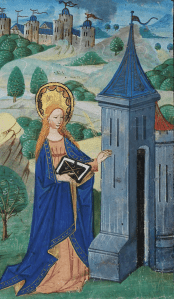
De Grey Hours, National Library of Wales, CC0, via Wikimedia Commons
In timing questions, the High Tower often asks the seeker to think in years rather than months.
As a practical guide, the High Tower frequently indicates a period of between twelve and eighteen months. Whilst the surrounding cards may modify this, the card generally points towards substantial developments whose full significance is only revealed through the passage of time.
I have also found that it can also signify the period between 4 and 17 December. This is derived from the feast day of St Barbara.
Health
Anatomically, the High Tower is associated with the spine and the back generally. This connection is quite natural when one considers the card’s symbolism of support, structure, and standing upright.
More commonly, however, the High Tower describes the duration and impact of an illness rather than its specific nature. The conditions associated with the card are often chronic, persistent, or require ongoing management. Such illnesses become part of the seeker’s life and must be accommodated within long-term plans and expectations.
For this reason, the High Tower often appears in readings concerning rehabilitation, lifestyle adjustments, chronic pain, degenerative conditions, or prolonged recovery periods. The emphasis is usually upon endurance, adaptation, and long-term management rather than immediate resolution.
Importantly, the High Tower should not be regarded as inherently negative. Indeed, some of the strongest indications of eventual recovery occur when it is supported by cards such as the Sun, Bear, Tree, Stars, or Key. In such instances, the card suggests that the illness may be lengthy or significant, but that the long-term outcome remains favourable. The High Tower simply indicates that recovery is likely to be measured in months or years rather than days or weeks.
Ultimately, the High Tower reminds us that health is best measured over a lifetime rather than a single day. The card asks not merely how we feel today, but what direction our health is taking and what foundations are being laid for the years ahead.
The High Tower in Action
This is a Grand Tableau; however, we shall focus only upon the section relevant to the question.
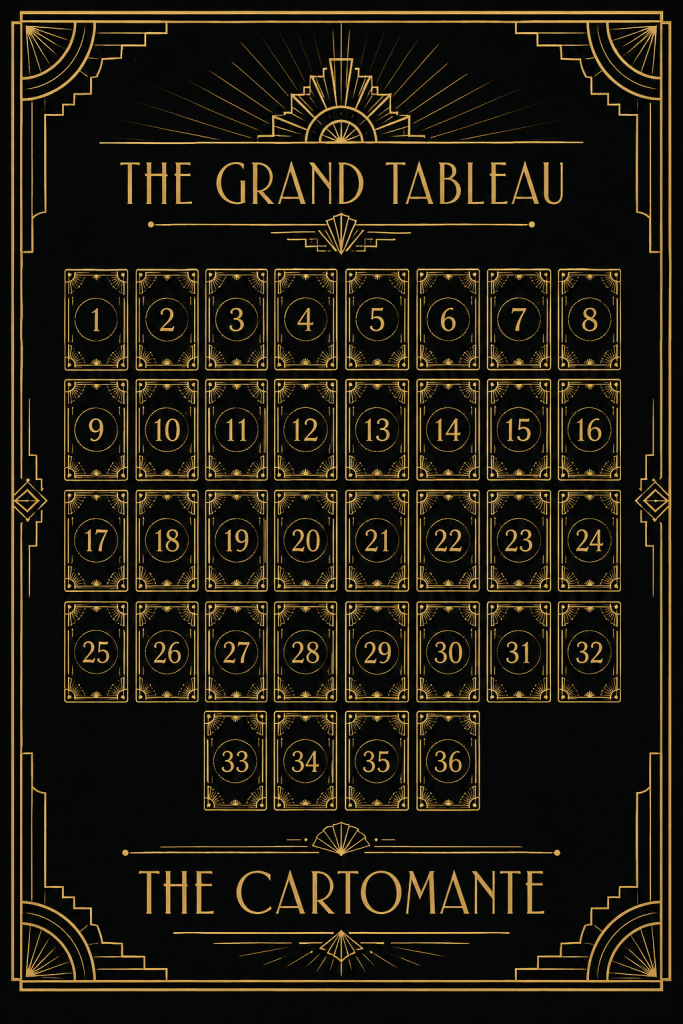
In a traditional Grand Tableau (be it Petit Lenormand, playing cards, Bohemian cards…), the significator did not divide the reading into a strict past, present, and future scheme. Instead, the tableau primarily described the present circumstances and the immediate future. During a consultation, the cards might be laid two or three times, with each subsequent tableau extending further into the future.
Victoria had recently qualified as a nurse. A few days after the reading, she was due to travel to Greece, where her best friend, who was Greek, was getting married. Upon her return, she was due to begin a new position. It was already apparent that a man was poised to enter Victoria’s life.
The Lady appeared in the twelfth position (8 x 4 + 4), followed by the Ring, the Lord, the Sun, and the Stars. Above the Ring stood the Birds, whilst the Heart appeared above the Lord. To the left of the Lady were the Coffin and the House.
Extract from a Grand Tableau
It therefore appeared that Victoria (Lady) was experiencing some upset (Birds) concerning her home life (Coffin–House). Victoria confirmed that she was shortly due to leave the house share and housemates with whom she had lived for the previous two years. This was understandably emotional, but the situation would soon pass. Because the House follows the Coffin the matter was still being mourned and had not yet been fully accepted/concluded.
Traditionally, the Ring falling to the right of the significator was said to forecast marriage. In practice, I have found it more often indicates that relationships, whether new or existing, are becoming a significant focus for the querent.
This interpretation is strengthened considerably by the presence of the Lord immediately following the Ring and facing the Lady. The Ring is crowned by the Birds card. Traditionally, the Birds indicates short-term agitation, nerves, and emotional excitement. As no particularly ominous cards surround the Birds, it seemed likely that Victoria would experience a mixture of anticipation, anxiety, and excitement regarding this developing relationship. It would quite literally make her heart race (Birds–Heart).
The relationship itself appeared promising. The Sun suggested warmth, happiness, and success, whilst the Stars indicated growth, continuity, and the spreading out of possibilities over time. The Bear beneath the Ring tells us of a strong bond.
Can we say anything further about the relationship’s trajectory?
Yes.
The first Lenormand book I ever read was The Oracle of Mlle Lenormand by the Dutch writer Erna Droesbeke, an English translation of her earlier Dutch work from the 1980s. It was the first book on the Petit Lenormand available in English. Another seventeen years would pass before Mario dos Ventos published a second English-language title.
In Droesbeke’s method, diagonal combinations are examined to identify causes on the left and effects on the right. Whilst she applied this technique primarily to the seeker’s significator, I have found it can be utilised successfully with other cartes maîtresses as well.
The Ring’s diagonal combinations were:
Left: Ship, Roads, Moon Right: Heart, Key, High Tower
The left-hand diagonal explains how Victoria arrived at this moment.
The Ship shows that her life is moving in a new direction, both literally and figuratively. She is about to travel abroad, but she is also preparing to embark upon a new chapter in life. The Moon reveals the successful completion of an important personal ambition through qualifying as a nurse. The Roads demonstrates that she has arrived at a genuine crossroads, where important decisions can no longer be postponed. She is starting her career, changing home, travelling abroad, and preparing for a future very different from the one she has known previously.
The right-hand diagonal reveals what follows.
The Heart indicates love, affection, and emotional connection. The Key shows that this relationship opens an important door in Victoria’s life. Heart – Key is often the combination that signifies someone falling in love with the “one.” The culmination of the sequence is the High Tower.
This is where the High Tower becomes particularly significant.
The card does not merely indicate durability or longevity. It suggests a relationship that becomes woven into the architecture of Victoria’s future. This is not simply a pleasant romance or a passing attachment. It possesses the potential to become one of the major structures around which her adult life will develop.
The relationship is not merely lasting. The High Tower tells us it is significant, life altering.
Whilst attending her friend’s wedding in Greece, Victoria met an English man who was holidaying with friends. The two quickly formed a connection and continued seeing one another after returning to Britain.
Eventually, Victoria made the considerable decision to relocate to Hove, where he was based, a choice that also affected the direction of her nursing career. More than fifteen years later, they remain together.
Here, the High Tower proved especially instructive. It did not refer to loneliness, separation, government or bureaucracy. It referred to Victoria’s life path. The relationship did not merely survive. It became one of the defining structures of Victoria’s adult life. This is precisely the type of permanence, longevity, and life-shaping significance that the High Tower so often describes in day-to-day readings.
§
Images:
Featured Image:
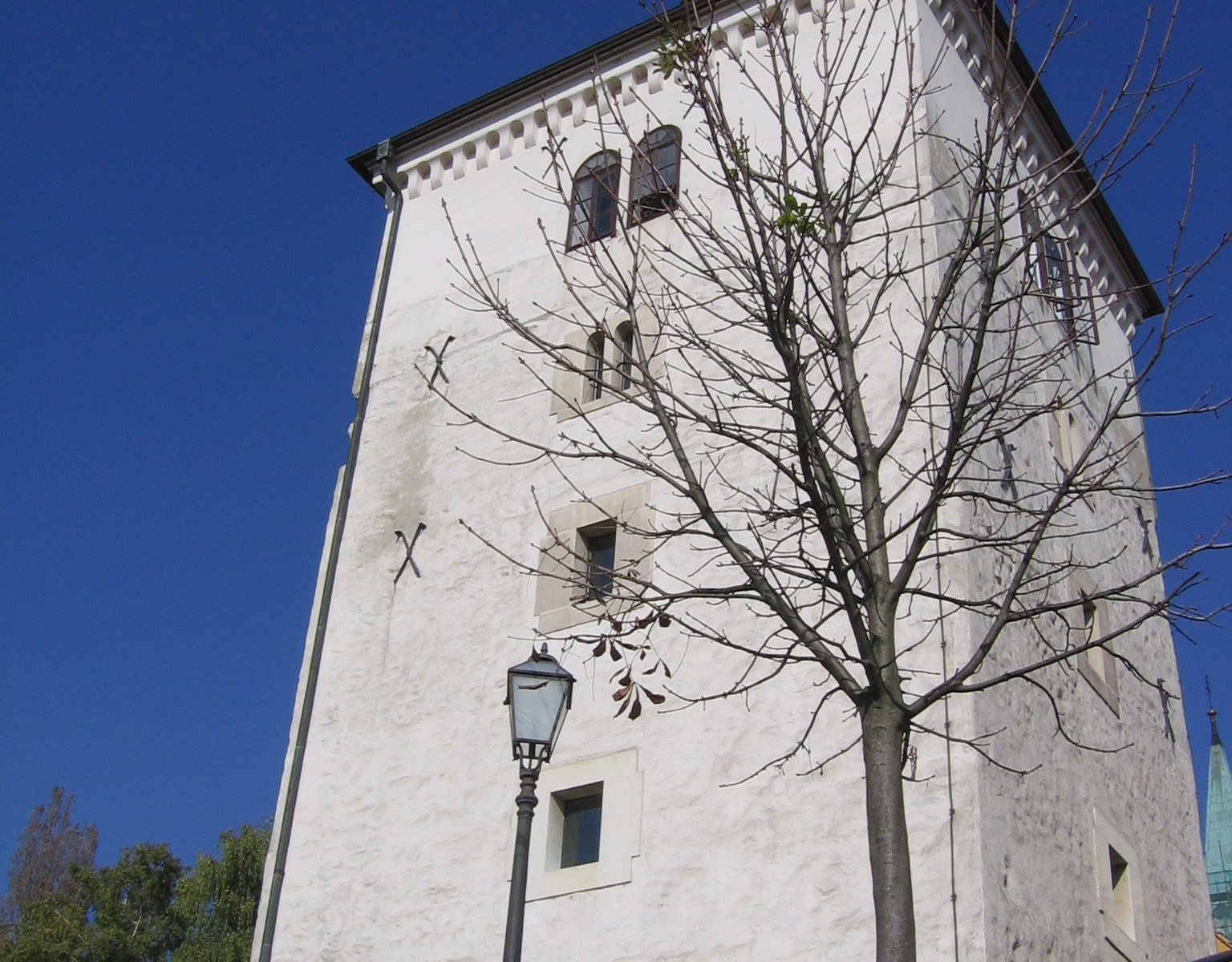
Lotrščak Tower, Zagreb. Avisadehh, CC0, via Wikimedia Commons
Boroveshengra, A., 2013. Cartomantes’ Cabinet: The Petit Lenormand Course. Boroveshengra, A., 2015. Lenormand Thirty Six cards. 2nd ed. Create Space. Ignatius Press (2005) Holy Bible RSVCE Compact Zipper. Ignatius Press. Matthews, C. 2014 The Complete Lenormand Oracle Handbook: Reading the Language and Symbols of the Cards. Rochester, VT: Destiny Books. Silvestre, C., 2003. Le Petit Lenormand. [Montpellier]: Gange éd.
This article continues my series examining the trumps of the Tarot de Marseille, adapted from my unpublished manuscript, Tarot de Marseille: The Picturebook of Fate. As throughout this series, the emphasis is placed upon the traditional eikōn of the card, its historical context, and the practical significations I have found useful through divinatory practice. The interpretations presented here reflect my own experience of working with the Tarot de Marseille and should be understood as a working method rather than a definitive authority.
The Eights: Justice and the Star
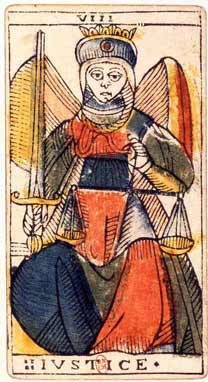
Trump VIII, La Justice, is one of the most familiar and enduring images of the Tarot. Yet does it concern only courts, contracts, and legal disputes? If it pertains to consequences and accountability, how does it differ from the purgatorial cleansing of the House of God? Does Justice simply demand that everyone receive equal treatment, or does it point towards a deeper principle of righteousness and right order?
The traditional eikōn of Justice is instantly recognisable. A richly dressed woman sits enthroned upon a great chair. Upon her head she wears a coronet adorned with a central jewel. In one hand she holds a double-edged sword; in the other, a balance. Together these symbols express the two essential aspects of justice: discernment and judgement. The scales weigh evidence and competing claims; the sword enforces the conclusion reached.
The essence of Justice is verity; its function is to balance. Justice begins with truth. Indeed, no just judgement is possible without first establishing the facts of the matter. The card therefore concerns objectivity, fairness, accountability, and the proper ordering of relationships, responsibilities, and obligations. Whilst the House of God purges what is disordered through correction and suffering, Justice seeks first to determine what is right and then restore equilibrium accordingly.
The imagery itself reinforces this principle. Unlike many later depictions of Justice, the Marseille figure wears no blindfold. She sees clearly. This is an important distinction. Justice is not ignorance, neutrality, or indifference. Before the scales can be balanced, the truth must be known. Her direct gaze reminds us that judgement requires observation, discernment, and understanding. The scales weigh the evidence; the sword enforces the verdict. So, watch how Justice balances the cards either side of her.
In the classical Christian tradition, Justice is one of the cardinal virtues and concerns rendering to each person their due. Importantly, this does not always mean giving everyone the same thing. Justice recognises distinctions of circumstance, responsibility, merit, and need. Traditionally, thinkers distinguished between commutative justice, governing obligations between individuals; distributive justice, concerning the allocation of benefits and burdens within society; and legal or social justice, through which individuals contribute to the common good. In every case, the objective remains the same: the establishment and maintenance of right order.
Justice is also a card of causality. Actions produce consequences. Decisions have effects. Causes generate results. The card reminds us that events do not simply arise from nowhere, but proceed from choices, obligations fulfilled or neglected, and the countless interactions that bind society together. Justice therefore asks not merely what happened? but also why did it happen? and what is now due as a result?
For this reason, Justice reminds us that human beings do not exist in isolation. We are members of families, communities, institutions, and societies. Our actions affect others and create obligations which cannot simply be ignored. The card therefore asks whether we have fulfilled our responsibilities, honoured our commitments, and acted with integrity towards those around us. It challenges us to look beyond personal preference and consider what fairness truly requires.
Justice frequently appears when important decisions must be made. Evidence must be gathered, facts established, competing claims weighed, and a conclusion reached. Hasty action is discouraged. The scales remind us that every matter should be examined carefully before judgement is rendered. Once that judgement is reached, however, the sword demands action. Justice does not deliberate indefinitely.
Naturally, the card governs legal matters of all kinds. Courts, contracts, mortgages, leases, wills, taxation, marriage, divorce, and other binding agreements fall within its domain. Yet its significance extends beyond formal legal processes. Whenever obligations, rights, responsibilities, or accountability are central to a situation, Justice is likely to be present. Ultimately, the card asks a simple but profound question: what is truly due in this situation, and how may balance be restored?
General: Righteousness, accountability, and the fair resolution of matters. Justice reminds us that actions have consequences and that causes inevitably produce effects. The card favours careful consideration, impartial judgement, and the weighing of evidence before decisions are reached. Whilst Justice renders what is due, it should not be confused with severity. True justice is tempered by mercy, for justice without mercy becomes cruelty, whilst mercy without justice ceases to be just.
Love: For those who are single, Justice seldom heralds the beginning of a significant new relationship. More often, it suggests that other responsibilities currently demand time, attention, and resources. Relationships that do begin under this card often prove secondary to other obligations and may struggle if practical realities have not been adequately considered. For established couples, Justice emphasises mutual responsibility, fairness, and commitment. Relationships require effort from both parties, and an imbalance of priorities will inevitably create difficulties. The card may also signify separation, divorce, or the equitable division of shared assets and responsibilities.
Career: Justice is naturally associated with the legal profession, including solicitors, barristers, judges, legal secretaries, and clerks. It also governs professions concerned with rules, regulation, and administration, such as human resources, local government, the civil service, compliance, and auditing. More generally, the card teaches that professional success depends upon diligence, reliability, and integrity. Poor timekeeping, failure to meet obligations, and neglect of responsibilities can result in sanctions or dismissal. Conversely, Justice rewards conscientious work and may indicate contracts, agreements, or offers being formally concluded.
Finance: Justice signifies finances that are properly accounted for and carefully balanced. Taxes, settlements, pensions, insurance claims, maintenance payments, and other financial obligations frequently fall under this card. Whilst it seldom promises sudden gains, it favours prudent management, steady savings, and investments approached with due care. Money is received or paid according to what is owed.
Health: Anatomically, Justice is associated with the lungs, kidneys, and urinary system. More broadly, it emphasises balance and personal responsibility in matters of health. Proper diet, exercise, and self-care are essential, whilst neglect and excess are likely to produce long-term consequences. Long-standing habits, whether beneficial or harmful, tend to yield their natural results under this card. Justice may also indicate colds, respiratory complaints, and chest infections, particularly when supported by cards such as the World.


.jpg)