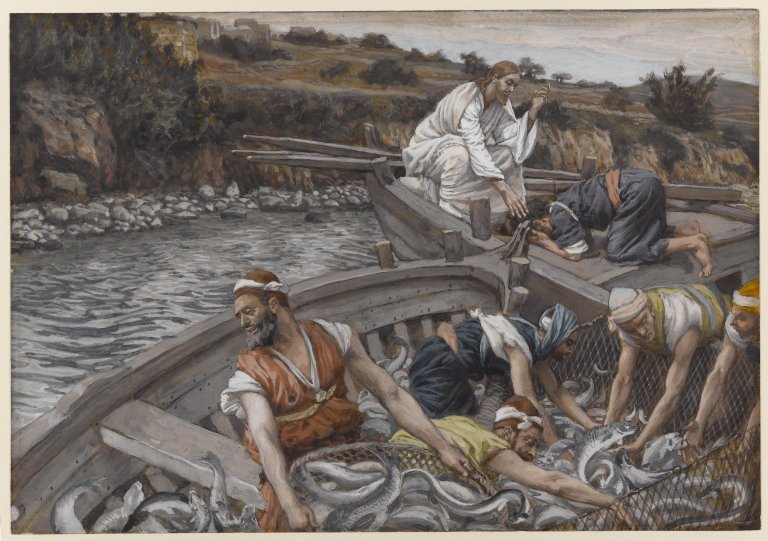
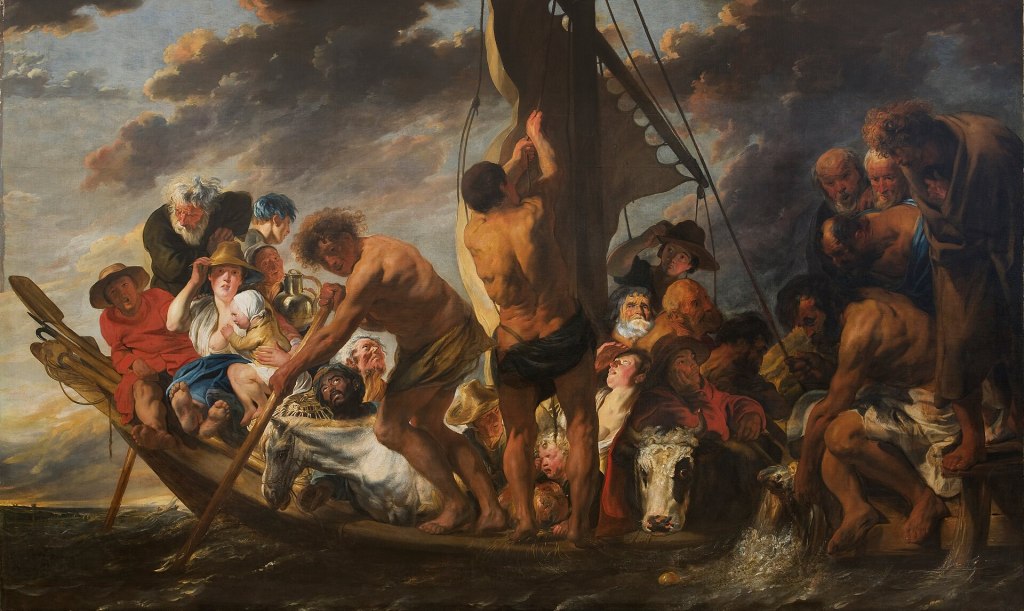
Jesus said to them, “Children, have you any fish?” They answered him, “No.” He said to them, “Cast the net on the right side of the boat, and you will find some.” So they cast it, and now they were not able to haul it in, for the quantity of fish… When they got out on land, they saw a charcoal fire there, with fish lying on it, and bread. Jesus said to them, “Bring some of the fish that you have just caught.” So Simon Peter went aboard and hauled the net ashore, full of large fish, a hundred and fifty-three of them; and although there were so many, the net was not torn.
John 21: 5-6, 9-11 (RSV CE)
Far out in the ocean, where the water is as blue as the prettiest cornflower, and as clear as crystal, it is very, very deep; so deep, indeed, that no cable could fathom it: many church steeples, piled one upon another, would not reach from the ground beneath to the surface of the water above. There dwell the Sea King and his subjects. We must not imagine that there is nothing at the bottom of the sea but bare yellow sand. No, indeed; the most singular flowers and plants grow there; the leaves and stems of which are so pliant, that the slightest agitation of the water causes them to stir as if they had life. Fishes, both large and small, glide between the branches, as birds fly among the trees here upon land.
The Little Mermaid, Hans Christian Andersen
Fish, prepares you to make a fortune by the sea, and series of happy enterprises; but if they are removed from the person, they are a sinister omen of the best of your projects being reversed.
Original Instructions
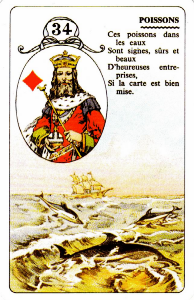
Card No. 34 in the Petit Lenormand, the Fishes, is represented by the King of Diamonds. Unlike many cards within the deck, its eikōn is remarkably consistent across the older patterns. Yet despite its apparent simplicity, the card has generated considerable debate amongst cartomantes. Is it merely a card of money and commerce? If so, how does it differ from the Bear? Why does it so often appear in questions concerning business and self-employment? And why have some readers associated it with addiction and excess? To answer these questions, we must first examine the image itself and the symbolism from which its meanings arise.
The Essence and Function of the Fishes
The traditional eikōn depicts a school of fish swimming through the sea. Depending upon the deck, the fish may be shown near the surface or within deeper waters. Some patterns substitute a pod of dolphins, most notably the Brepols, whilst the Schmid famously depicts a goldfish swimming within a bowl. Despite these variations, two elements remain constant: fish and water. The card therefore presents us with abundance moving within a fluid environment.
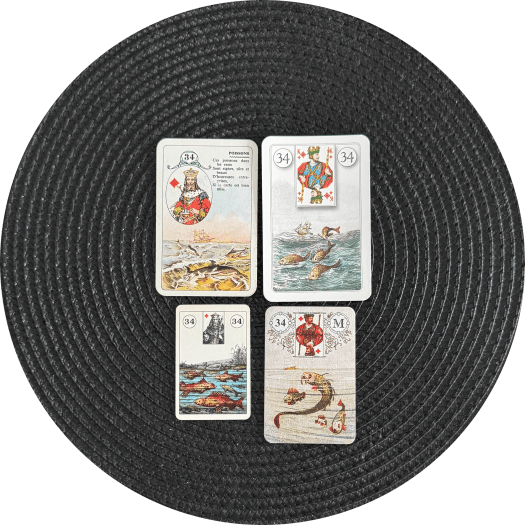
The essence of the Fishes is abundance and its function is to circulate.
I also prefer the title Fishes to the increasingly common Fish. The traditional image depicts numerous fish rather than a single specimen. More importantly, the sea itself contains immense variety. Within its waters exist countless species, sizes, and forms of life. This diversity is important. The Fishes does not merely signify abundance in the sense of quantity, but abundance in the sense of variety and opportunity. There is, quite literally, more than one fish in the sea. The card therefore speaks of plentiful resources, multiple possibilities, and a richness that arises from diversity as much as sheer volume.
Few resources were historically more important than fish. For centuries they represented a vital source of sustenance throughout Europe. Coastal communities depended upon fishing not merely as a means of survival but as a major source of trade, employment, and prosperity. Entire towns and regions flourished because of access to abundant fisheries.
Their importance was further reinforced by religious observance. During the medieval and early modern periods, Christians abstained from meat on numerous fast days, vigils, Fridays, and throughout Lent. Fish therefore occupied a privileged position upon the table, creating substantial demand and encouraging extensive commercial networks devoted to its supply. Although such restrictions were relaxed within many protestant traditions following the reformation, the customs often persisted in practice.
Advances in preservation, salting, and transport during the eighteenth and nineteenth centuries transformed the trade still further. Fish could be transported across great distances, turning what had once been a local commodity into an increasingly lucrative commercial enterprise. The card’s connection with commerce and profit therefore has deep historical roots.
Fish also acquired positive symbolic associations beyond the dinner table. In parts of Europe, goldfish were traditionally presented to couples upon their first wedding anniversary, linking the creatures with abundance, prosperity, and future happiness.
The symbolism of fish was equally important within Christianity. Several of Christ’s disciples were fishermen, and fishing imagery appears repeatedly throughout the Gospels. In Luke 5 and John 21, miraculous draughts of fishes reveal divine blessing and abundance. Likewise, the miracle of the loaves and fishes demonstrates provision in abundance, where apparently insufficient resources prove more than adequate to meet the needs of many.
These traditions help explain the card’s significance within divination.
The fish themselves signify abundant resources. The water in which they swim reveals how those resources move. This distinction is crucial. Fish stranded upon the shore soon perish. Equally, water without fish lacks the abundance suggested by the image. The Fishes therefore requires both plenty and movement. Resources must circulate if they are to remain useful and productive.

For this reason, the card is naturally associated with money. The French phrase l’argent liquide is particularly instructive. Wealth achieves its greatest utility when it flows. Money enters and leaves our lives, changes hands, funds purchases, creates opportunities, and sustains commerce. The Fishes therefore speaks less of what we possess than of how resources are moving.
A useful distinction may be drawn between the Bear and the Fishes. Both concern
resources, yet they do so in profoundly different ways.
The Bear stores resources and accumulates reserves. The Fishes circulates them.
A pension fund, savings account, insurance policy, or investment portfolio may be shown by the Bear. A salary, invoice, dividend payment, sale, commission, or business transaction belongs naturally to the Fishes.
The Bear asks what resources we possess. The Fishes asks how those resources move.
Consequently, the Fishes possesses a strongly transactional quality. Buying, selling, investing, trading, exchanging, negotiating, and conducting business all fall naturally within its sphere. Resources rarely remain still under the influence of this card. They flow from one place to another.
A common feature of older Lenormand literature was the assignment of cartes maîtresses for salaried and self-employed work. Like the High Tower, the Fishes was frequently cited as the principal card for entrepreneurs, merchants, and the self-employed.
Whilst this approach remains popular, it never worked particularly well in my own practice. Whether a person is salaried or self-employed, many of the same concerns still apply. Both rely upon status and reputation, shown by the Moon. Both benefit from security and stability, represented by the Anchor. Both encounter competitors, signified by the Fox, and both must deal with colleagues, employees, clients, or professional associates represented by the Hound.
Most importantly, both depend upon the circulation of resources. Salaries, invoices, commissions, sales, contracts, and payments all fall naturally within the domain of the Fishes. Without that flow, neither the employee nor the entrepreneur can sustain their position for very long.
For this reason, I have never found it necessary to assign the Fishes exclusively to self-employment. The card describes the movement of resources that supports a livelihood, regardless of whether those resources arise from a wage, a business, a professional practice, or an investment. The distinction between employment and self-employment is often far less important than the question of whether resources are flowing freely and abundantly.
Yet the significance of the Fishes extends far beyond money.
Wherever it appears, the card introduces abundance and movement. In matters of love, it may indicate a deep and generous flow of feeling. In domestic matters, material comfort and plentiful provision. In friendships, an abundance of support and goodwill. The card’s underlying principle remains consistent: there is plenty, and that plenty is circulating.
Some readers associate the Fishes with freedom and independence. This
observation is often correct, but I would regard these qualities as secondary rather than primary. Freedom and independence are not intrinsic meanings of the card. Rather, they arise as a consequence of its abundance. Those who possess plentiful resources generally enjoy greater freedom of choice than those who do not. Independence is therefore the result of abundance rather than the essence of the card itself.
Coda:
Ultimately, the Fishes reminds us that resources are of greatest value when they remain in motion. Wealth hidden away achieves little. Knowledge unshared stagnates. Feelings unexpressed diminish. Like the sea itself, the Fishes teaches that abundance thrives through circulation.
Person and Description
Person
Although the Fishes is not ordinarily used as a significator, its association with the King of Diamonds means that it can occasionally represent a man within a reading.
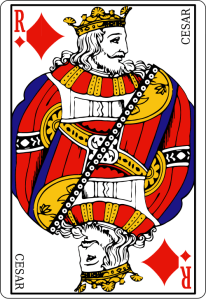
When functioning in this capacity, the King of Diamonds often signifies a man of a similar age to the seeker. He may be a brother, friend, business associate, or partner in some enterprise. On occasion, the card can represent a prospective romantic interest or potential partner, though I have found this considerably less common than its appearance as a friend, associate, or business contact.
The King of Diamonds also acquired military associations within traditional cartomancy. He is Caesar with his tenth and thirteenth legions. Consequently, the Fishes may sometimes signify a soldier, officer, veteran, or individual connected with the armed forces. As with all such court-card attributions, context remains essential.
When the Fishes is acting as a significator, the King largely sheds the descriptive qualities normally associated with the card. In such cases, one must look to the surrounding cards to determine the person’s appearance, temperament, and role within the matter under consideration.
Physical Description
When paired with a person card, the Fishes can contribute a number of descriptive features.
The eyes are often blue, grey, green, or otherwise reminiscent of water. There is frequently something bright, reflective, or fluid about the gaze. Hair is usually abundant and healthy, ranging from white and silver through lighter shades to dark brown or black. Baldness is relatively uncommon under this card.
The Fishes also tends to impart a well-groomed and carefully presented appearance. The individual often dresses well and may favour tailored clothing, quality fabrics, or attire that subtly signals prosperity and success.
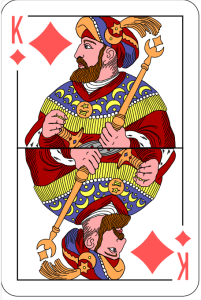
Interestingly, older cartomantic traditions sometimes associated the King of Diamonds with Caesar. Likewise, representations of the King of Diamonds and the Ober of Bells frequently depicted them wearing turbans or Eastern dress. Whilst one should not press such associations too far, they have often been reflected in practice. It is therefore not unusual for the Fishes to describe someone with an exotic style, cosmopolitan appearance, or a manner that appears slightly foreign to the seeker.
The Fishes rarely describes someone austere, deprived, or threadbare. Even when not especially wealthy, there is often an impression of comfort, plenty, or ease about their appearance. The card tends to convey the sense that the person has access to sufficient resources and knows how to present themselves accordingly.
Occasionally, the card may also point towards family connections, ancestry, or cultural ties originating in south-eastern Europe, the eastern Mediterranean, or West Asia. As always, such observations should be treated as descriptive tendencies rather than rigid rules.
Just as fish move comfortably through water, these individuals often appear entirely at ease within their environment and social circumstances. There is frequently something fluid, adaptable, and relaxed about both their bearing and manner.
More generally, the Fishes often describes someone who appears comfortable, prosperous, and at home in the world around them. Just as the fish moves naturally through water, so too does the individual seem well suited to their surroundings.
I think the core of the temperament should flow directly from your chosen essence (abundance) and function (to circulate). The Fishes person is not merely wealthy or interested in money. They are comfortable with movement, exchange, and opportunity. Unlike the Bear, which accumulates and preserves, the Fishes keeps resources moving.
Temperament
The Fishes describes an individual who is adaptable, resourceful, and comfortable navigating changing circumstances. Like the fish moving through water, they possess an ability to adjust to their environment and make the most of whatever opportunities present themselves. They are often a blend of sanguine and choler.
There is often a strong streak of independence associated with the card. Fishes people prefer the freedom to direct their own affairs and can become restless when they feel constrained by unnecessary rules or limitations. Many enjoy travelling and exploring new places, whilst others satisfy this same impulse through business ventures, investments, or the pursuit of new opportunities. Whether physically or metaphorically, they dislike remaining in one place for too long.
The card frequently appears in the lives of those drawn towards commerce, finance, trade, sales, investment, and other occupations involving the movement of goods, services, or money. Owing to its association with the King of Diamonds, it may also describe those serving in the armed forces or occupations connected with defence and security.
Fishes people are often motivated by the desire to achieve financial independence and material comfort. Unlike the Bear, however, they do not usually accumulate resources for their own sake. They understand that money derives its value from circulation and use. Consequently, they are often far more interested in generating opportunities and maintaining cash flow than building static reserves.
Most enjoy the finer things in life and appreciate quality, comfort, and occasionally a touch of luxury. Yet they are seldom miserly. Indeed, Fishes people are often surprisingly generous, particularly when they feel resources are flowing freely. They tend to view abundance as something to be enjoyed and shared rather than merely hoarded.
Above all, the Fishes describes a person who thrives through movement, opportunity, and exchange. Whether in business, relationships, or personal development, they are happiest when life continues to flow forward and new possibilities remain open before them.
Special Features
Grand Tableau
The original instructions placed considerable emphasis upon the proximity of the Fishes to the significator. When nearby, the card promised that one would “make a fortune by the sea and enjoy a series of happy enterprises.” When distant, it warned that “the best of your projects” would be “reversed.”
Like many traditional instructions, these statements become clearer when considered within their historical context. During the eighteenth and nineteenth centuries, trade, commerce, and enterprise remained among the principal avenues to prosperity. The sea was therefore not merely a geographical location but a symbol of commerce itself. Goods, money, and opportunity flowed through ports and waterways much as resources flow through the Fishes.
For this reason, the expression “make a fortune by the sea” should usually be understood figuratively rather than literally.
When the Fishes falls close to the significator, it suggests access to resources and a healthy circulation of abundance. Money, opportunities, customers, and support are all able to reach the seeker. This does not automatically indicate sudden wealth or dramatic financial gain. More often, it points towards stability, reliable income, and the confidence that resources will continue to flow when required.
Should one be seeking evidence of a substantial increase in wealth, additional cards such as the Sun, Stars, Key, or Cloverleaf are generally required.
When the Fishes falls at a distance from the significator, the opposite applies. The seeker becomes separated from the resources represented by the card. Opportunities may exist, but they are difficult to access. Income becomes uncertain, projects struggle for support, and abundance no longer flows as freely as it should.
It is in this sense that the traditional instruction warns that “the best of your projects” may be “reversed.” The underlying issue is not necessarily failure, but an interruption to the flow of resources upon which success depends. An idea may remain sound, a business profitable, or a plan achievable, yet without access to the necessary resources progress becomes difficult.
The surrounding cards will often explain the cause. The Clouds introduces a disturbance creating uncertainty regarding resources. The Coffin may indicate their cessation altogether. The Mice gradually erodes them through loss, waste, or theft. The Mountain blocks access, creating barriers and delays. The Fox warns of dishonesty, fraud, or resources being diverted away from their intended purpose.
Viewed in this way, the traditional instruction remains as relevant today as it was two centuries ago. The Fishes asks a simple question: How freely are resources flowing through your life? The answer often tells us far more than the amount of money currently sitting in a bank account.
Water
Before it became solely associated with money and commerce, the Fishes was a card of water. The abundance and circulation that underpin its financial meanings arise directly from the image itself: fish moving through an extensive body of water. To understand the card fully, one must therefore understand both the fishes and the water in which they swim.
The Fishes is the Petit Lenormand’s natural significator of water. The fish derive both life and movement from the water in which they swim. Consequently, the card frequently signifies the sea, oceans, rivers, lakes, reservoirs, harbours, and other substantial bodies of water.
This interpretation often proves surprisingly literal. Thus, Park–Fishes may indicate a location beside the sea, harbour, marina, riverfront, or lake. It may also describe maritime events, sailing competitions with the Ship, public gatherings by the water, and other activities connected with large bodies of water.
A useful distinction may be drawn between the Fishes and the Anchor. The Anchor belongs to the coast; the Fishes belongs to the water itself. Whilst there is frequently overlap between the two cards, the Anchor more naturally signifies beaches, shorelines, and coastal locations, whereas the Fishes points towards the body of water.
The water represented by the Fishes is not always calm or beneficial. Like any natural force, it can become excessive, polluted, restricted, or destructive when influenced by adverse cards.
Thus, Clouds–Fishes may indicate heavy rainfall, coastal flooding, flash floods, poor visibility at sea, or other situations in which water becomes a source of disruption and uncertainty. The Clouds obscures whilst the Fishes supplies the water itself.
Likewise, Serpent–Fishes may point towards contaminated water, pollution, toxic spills, sewage discharge, or other forms of corruption affecting waterways. Here, the Serpent introduces impurity into what would otherwise be a healthy flow.
Other combinations are equally revealing. Mice–Fishes may signify leaks, water damage, or the gradual loss of a resource through wastage. Coffin–Fishes can describe stagnant, polluted, or lifeless water. Mountain–Fishes may indicate dams, blocked waterways, restricted supply, or barriers preventing water from flowing freely.
Viewed in this way, the literal water meanings remain entirely consistent with the card’s broader symbolism. Whether it manifests as money, opportunities, emotions, or water itself, the Fishes remains fundamentally a card of resources in motion. The surrounding cards merely reveal the nature of the resource and the condition of its flow.
Depth
The Fishes not only signifies abundance and circulation but also depth.
This meaning arises naturally from the eikōn. The sea is not merely vast; it is deep. Much of it remains unexplored, hidden beneath the surface, and beyond ordinary human experience. It is from this image of the unfathomable sea that the Fishes acquires its association with depth, intensity, and richness.
A useful distinction may be drawn between several cards associated with increase. The Park multiplies, the Stars expands, but the Fishes deepens.
The card therefore describes the depth, intensity, richness, and extent of a thing rather than its quantity alone. Whatever the Fishes touches tends to acquire greater substance and penetration.
In matters of love, Heart–Fishes often indicates profound emotions and strong emotional investment. The feelings run deep and are seldom superficial. Should the Clouds also be present, those emotions become disturbed and unpredictable, producing emotional turbulence, uncertainty, and constant fluctuations of feeling. The depth remains, but its expression becomes clouded and unstable.
In a more literal sense, the card can also describe physical depth. Thus, Coffin–Fishes may indicate something situated deep below ground level, such as an extended cellar, basement, vault, or subterranean chamber. The Coffin provides the enclosure; the Fishes emphasises its depth.
Likewise, Cross–Fishes often signifies deep faith, religious conviction, or a spiritual life that profoundly shapes the individual’s outlook and conduct. Yet the same combination may equally indicate profound suffering, hardship, or burdens experienced with unusual intensity. The Fishes does not judge; it simply deepens whatever it touches.
This principle can be applied throughout the deck. Deep knowledge, deep pockets, deep loyalties, deep roots, deep grief, and deep convictions may all be indicated by the card when supported by the surrounding combinations.
Whether the subject concerns emotions, beliefs, finances, physical locations, or life experience, the Fishes frequently asks not how much there is, but how deep it runs. In this respect, the card reveals another aspect of abundance. True abundance is not always measured by quantity alone, but by richness, intensity, and depth.
Liquids
Because the Fishes is the deck’s natural significator of water, its symbolism readily extends to liquids more generally. Just as fish depend upon water for life and movement, the card frequently draws attention to substances that flow and circulate in liquid form.
In everyday matters, the Fishes may signify beverages of all kinds including water, tea, coffee, milk, fruit juice, wine, beer, spirits, and soft drinks. It often describes what is being consumed rather than what is being eaten.
The most familiar application of this meaning concerns alcohol. The Fishes alone may simply indicate drinking, hospitality, celebrations, or social occasions involving alcoholic beverages. It should not automatically be taken as a sign of addiction. Such conclusions require supporting cards. When afflicted by cards such as the Clouds, Mice, Coffin, or Cross, however, the card may point towards alcohol misuse, dependency, or the consequences of excessive consumption.
The symbolism extends beyond alcoholic drinks. Liquid medicines, fuels, chemicals, solvents, and other fluid substances all fall naturally within the sphere of the Fishes. Thus, Serpent–Fishes may indicate contaminated liquids, toxic substances, poisons, or illicit liquid drugs. Here the Serpent corrupts the otherwise healthy flow represented by the Fishes.
Whether the card signifies water, wine, medicine, or poison, the underlying principle remains the same. The Fishes represents a liquid resource in circulation. The surrounding cards reveal whether that flow is healthy, beneficial, excessive, harmful, or compromised.
Timing
In matters of timing, the Fishes is generally a slow-moving card. The abundance and depth associated with the card naturally encourage a longer time frame than one finds with cards such as the Cavalier, Birds, or Stars.
The card’s function is to circulate, and circulation rarely occurs all at once. Just as rivers, currents, and tides move according to their own rhythm, the Fishes often suggests that events must be allowed to develop naturally. Attempts to rush the process may prove ineffective or even counterproductive.
For this reason, the Fishes frequently slows the cards around it and emphasises the importance of patience. Resources, opportunities, and outcomes must be allowed to flow at their own pace.
In short-term questions, the Fishes can occasionally be read literally as thirty-four days. This is most useful when timing practical matters such as the arrival of a parcel, the settlement of a payment, or the completion of a transaction. In most timing questions, however, the card points towards periods measured in weeks or months rather than days.
Over the years, I have also observed an occasional association between the Fishes and Friday, as well as the Lenten season. This is not a traditional attribution, but one that arises naturally from the card’s fish symbolism. Historically, Fridays were days of abstinence and penance upon which meat was prohibited, whilst fish remained permissible. Similarly, fish played an important role throughout Lent. Although not a primary meaning, the connection has appeared frequently enough in practice to merit consideration.
Health
Within the body, the Fishes is associated with the urinary and renal systems and, more broadly, the regulation and circulation of bodily fluids. This connection arises quite naturally from the card’s symbolism of water, abundance, and flow.
The card also possesses a strong connection with fertility. As a traditional symbol of abundance and fruitfulness, the Fishes frequently draws attention to a person’s reproductive potential. The card differs from the Birds in an important respect. The Birds concerns conception, pregnancy, nesting, and unborn children. The Fishes concerns fertility itself: the capacity to conceive rather than conception as an event.
Consequently, where fertility issues are under consideration, particular attention should be paid to the Fishes. In larger layouts such as the Grand Tableau, it can be especially useful to examine the relationship between the Fishes and the Tree, together with any cards forming a chain between them.
More generally, the Fishes often indicates matters relating to hydration, nutrition, diet, and the balance of fluids within the body. Because the card governs liquids generally, it may also appear in connection with alcohol consumption, liquid medication, intravenous fluids, and other substances entering or leaving the body.
The surrounding cards will often refine the interpretation. Fishes–Bear may indicate fluid retention, oedema, or excessive accumulation of fluids. Fishes–Mountain can point towards restricted circulation of fluids, dryness, or conditions such as Sjögren’s syndrome, where the body’s normal moisture production becomes impaired.
As elsewhere in the deck, the Fishes is primarily concerned with flow. Healthy circulation of fluids supports health and vitality; disruption to that flow frequently corresponds with illness or discomfort. The card therefore often says as much about the body’s ability to regulate and distribute its resources as it does about any specific condition.
Ultimately, the Fishes reminds us that health depends upon movement as much as abundance. Just as resources must circulate through life, fluids must circulate properly through the body. Where that flow is healthy, the body functions effectively; where it becomes restricted, depleted, excessive, or obstructed, difficulties often arise.
The Fishes in Action
If one reads for others regularly, it is useful to have a spread capable of identifying both remedies and pitfalls. The Mundane Cross arose from precisely this necessity. I wanted a compact layout that could reveal not only what the seeker should do, but also what they should avoid doing.
The latter is often overlooked. Faced with a difficulty, most people feel compelled to do something. Far less attention is given to actions that may be unnecessary, unhelpful, or even counterproductive. The Mundane Cross was designed to illuminate both sides of the equation.
The spread is particularly well suited to questions focused upon a difficulty, obstacle, or challenge that the seeker is presently experiencing or anticipates encountering. I employ it with all the systems I work with, including the Petit Lenormand, Tarot, Oracle Belline, Oracle de la Triade, the Victorian Flower Oracle, and playing cards.
The cards are shuffled, cut, and dealt in the following manner. The first card is placed at the centre. The second is placed below it, the third above it, the fourth to its left, and the fifth to its right. The resulting layout appears as follows:
03
04 – 01 – 05
02
- Position 1 — The Present.
- Position 2 — The Past.
- Position 3 — The Future.
- Position 4 — Unhelpful Influences or What to Avoid.
- Position 5 — Helpful Influences or How to Act.
The positions derive from older cartomantic principles. The past lies beneath because it forms the foundation of the present, whilst the left-hand side, or sinister side, traditionally represents complications, challenges, and disruptive influences.
Example
I had known Siân for several years through work. Having married in 2022, she and her husband had been trying to conceive for approximately six months without success. Increasingly concerned that time was “running out”, Siân wanted to know whether she should consider IVF or pursue private fertility treatment. The reading was done in early 2024.
The cards drawn were:
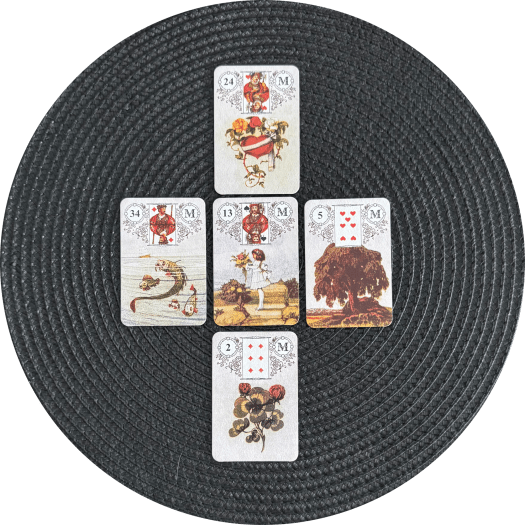
- Position 1 — Child
- Position 2 — Cloverleaf
- Position 3 — Heart
- Position 4 — Fishes
- Position 5 — Tree
The message of the spread was remarkably clear.
Reading the vertical column first, we see Cloverleaf – Child – Heart. The Cloverleaf often describes something recent, temporary, or of relatively short duration. This immediately suggested that Siân and her husband had not, in the grand scheme of things, been trying to conceive for very long.
The Child reinforced this observation. Here the Child does not primarily signify a child in the literal sense, nor should it automatically be interpreted as a card of something “new.” The traditional eikōn depicts a child of approximately six years of age. The card therefore describes something young, immature, developing, and still requiring time to grow.
The Child also possesses a spontaneous and playful quality. In many traditional decks, the child is shown playing, reminding us that not every problem must be approached with anxiety, planning, and constant scrutiny. Sometimes the card encourages a lighter touch, greater spontaneity, and the ability to enjoy the present moment.
In Siân’s case, the Child suggested that the process was still in its infancy. Not enough time had passed to justify treating the situation as a crisis. The card further implied that she and her husband would benefit from approaching the matter with less pressure and more spontaneity. What had begun as an expression of love was in danger of becoming a source of stress and worry.
The Heart in the future position was encouraging. It suggested that the matter would ultimately be guided by love rather than fear. At the centre of the question was not infertility itself, but a couple’s desire to create a family and share their love with a child. The Heart therefore indicated that hope, affection, and emotional fulfilment remained the likely destination of the story.
The real insight came from the horizontal axis.
The Fishes occupied the position of unhelpful influences. As we have seen throughout this article, the Fishes governs the flow of resources, including money, time, energy, attention, and emotional investment.
In this context, the card suggested that Siân risked pouring too many resources into solving a problem that had not yet demonstrated a need for intervention. The issue was not financial ruin, but disproportionate investment. Too much emotional, mental, and financial energy was beginning to flow towards a situation that was still in its earliest stages.
The combination of Fishes and the Child was especially revealing. Together, the cards suggested an attempt to solve a problem before it had fully emerged. The process was still developing, yet anxiety was already encouraging increasingly drastic solutions.
The Tree, by contrast, occupied the position of helpful influences.
As the card of health, growth, and natural development, the Tree pointed towards patience, wellbeing, and allowing processes to unfold in their own time. Combined with the Child, it strongly suggested that Siân needed to give the situation longer to develop before considering more significant interventions.
The contrast between the two cards was striking. The Tree showed where her attention should be directed; the Fishes revealed where that attention was becoming excessive.
The Tree also emphasised the importance of caring for herself. Rather than focusing upon fertility treatments, the cards encouraged her to prioritise her physical health, emotional wellbeing, and overall quality of life. Rest, relaxation, and reducing stress were likely to prove far more beneficial than pursuing increasingly expensive solutions.
Taken together, the Child and Tree counselled patience, natural growth, and a return to spontaneity. The Child and Fishes, by contrast, warned against investing excessive resources into something that was still at a very early stage of development. Rather than medical intervention, the cards suggested that time, relaxation, and a degree of playfulness would prove of greater benefit.
The spread therefore answered the question in a manner that was both practical and reassuring. Nothing suggested a need for immediate medical intervention. Instead, the cards indicated that Siân and her husband had simply not been trying long enough to justify drastic measures. The Child and Tree both counselled patience, whilst the Fishes warned against investing unnecessary resources into a process that was still very much in its infancy.
The outcome vindicated the reading. Five months later, Siân conceived naturally. In due course she gave birth to a healthy baby girl.
In this reading, the Fishes demonstrated that a card of abundance can become problematic when resources are directed towards the wrong objective. The issue was not a lack of resources, but the temptation to devote too many of them to a problem that still required time rather than intervention.
§
Images:
Featured Image:
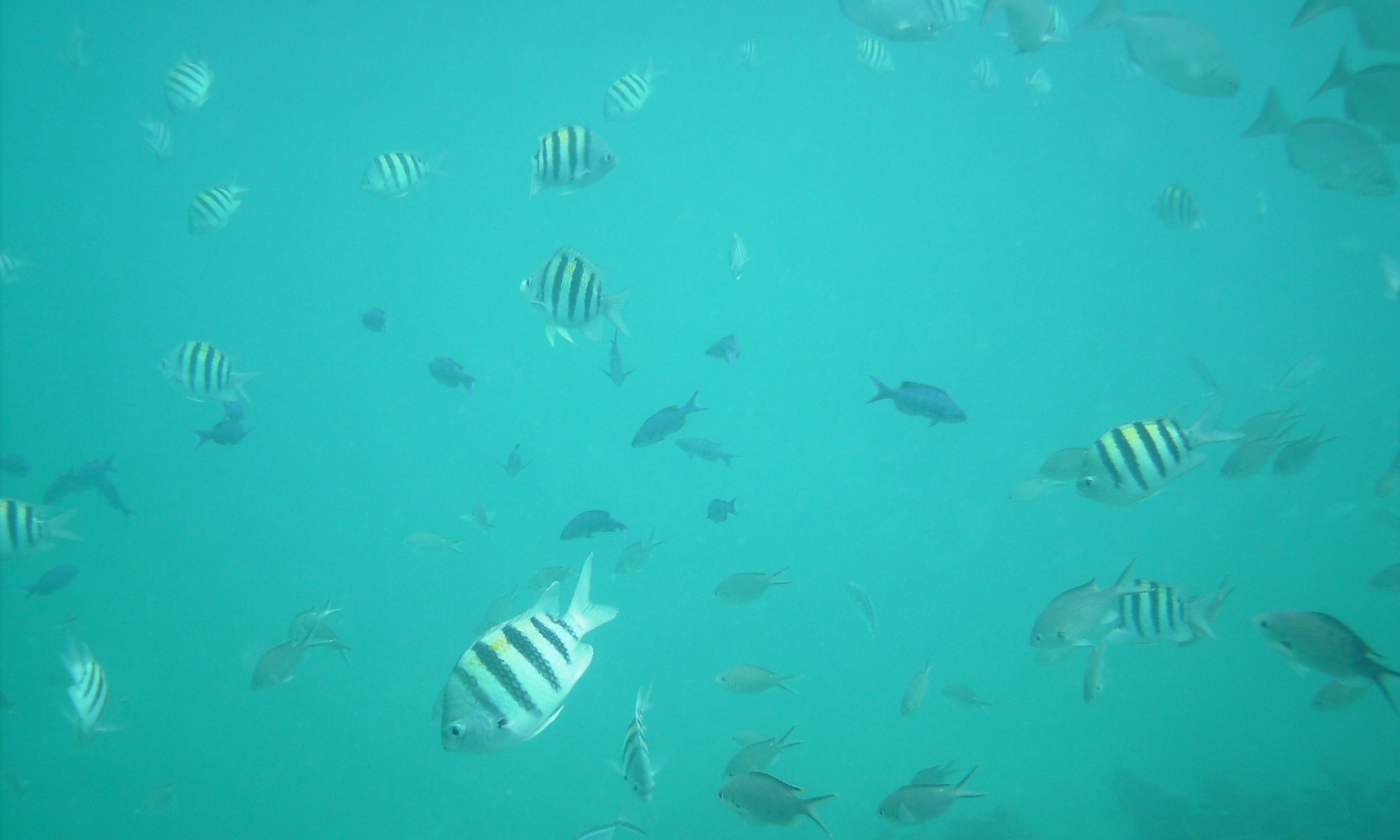
Fish at Molasses Reef, Jim Stuby, Public domain, via Wikimedia Commons
Cards:
Lenormand Cards: Jeu Lenormand © Cartamundi, WanderWüst © Jorge/Wandering Oracle, Lenormand Fortune-Telling Cards © Zao-Gelli, The Lenormand Oracle © Verlag für die Frau, Leipzig, Nieuwe Lenormand © Amber Studio/Erna Droesbeke, Lenormand 36 Orakelspielkarten © Königsfurt-Urania,
References:
Andersen, H.C. and Hersholt, J. (2005) The Complete Tales of Hans Christian Andersen. London: Folio Society in association with the British Library.
Boroveshengra, A., 2013. Cartomantes’ Cabinet: The Petit Lenormand Course.
Boroveshengra, A., 2015. Lenormand Thirty Six cards. 2nd ed. Create Space.
Ignatius Press (2005) Holy Bible RSVCE Compact Zipper. Ignatius Press.
Marco, M. and Goffinet, J., 1989. Petit Lenormand. Bruxelles: Servranx.
Matthews, C. 2014 The Complete Lenormand Oracle Handbook: Reading the Language and Symbols of the Cards. Rochester, VT: Destiny Books.
Meuris, B., 2018. Petit Lenormand Encyclopaedia: Volume 1. Create Space.
Silvestre, C., 2003. Le Petit Lenormand. [Montpellier]: Gange éd.

