She that fain would fly, she shall quickly follow,
Sappho, Ode to Aphrodite.
She that now rejects, yet with gifts shall woo thee,
She that heeds thee not, soon shall love to madness,
Love thee, the loth one!
Long-term readers will know that I have a preference for linear and classical carrés and stars over positional draws. However, from time to time, the cards will fall on my table in crosses, horoscopes, horseshoes and CCs.
Below I use two medium sized spreads that can be utilised for looking for love questions. Credit for the patterns go to Colette Silvestre[1] and Teresa Michelsen[2].
L’étoile de Vénus
This draw is designed purely for relationship development questions. The five cards are as follows:
1
2 3
4 5
- The first card represents the consultant.
- The second card represents the present influences.
- The third card represents influences that can either support or oppose the consultant.
- The fourth card is the consultant’s hopes.
- The fifth card is the outcome.
In her many books, ranging from TdM to L’oracle de Belline and both the petit Lenormand and grand jeu de Mademoiselle Lenormand, Mme Silvestre focuses on giving concise answers and emphasises cards’ behaviour. In this reading, great weight is thus given to passivity versus activeness and help versus hindrance.
Reading:
The first question comes from a young man, in his early twenties, referred hereafter to as the cavalier d’épée. He is currently single, having parted way with a young woman recently, and wanted to know if he would meet someone ‘new’ soon.
The cards as they fell:
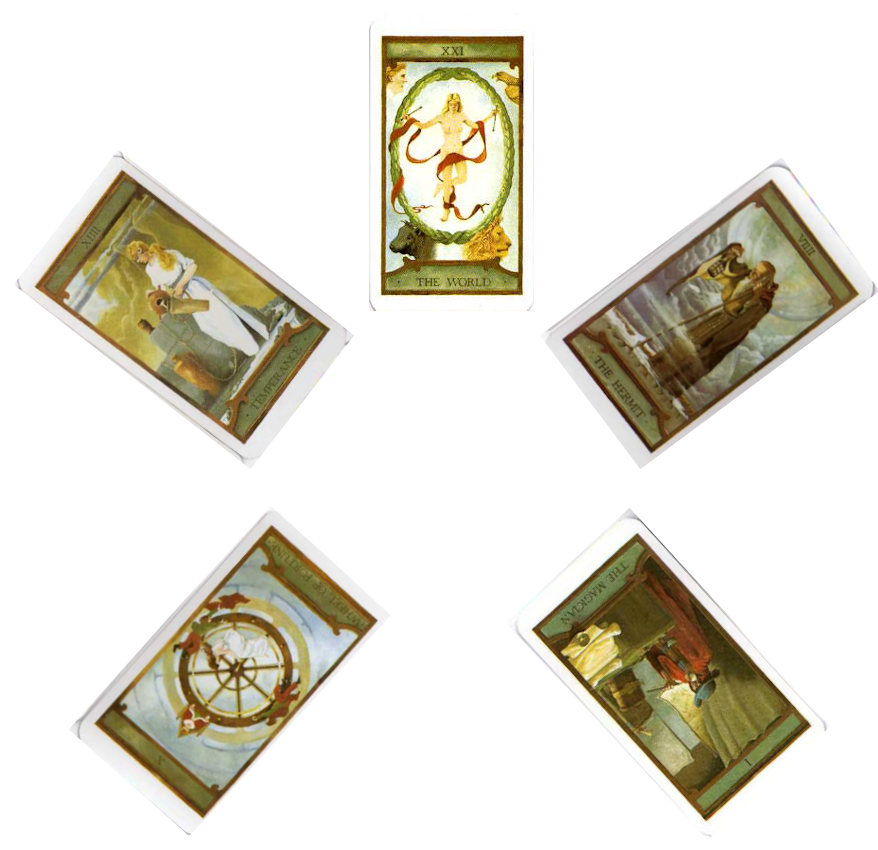
I replied: ‘Yes, if you’re prepared to be a gambler.’
The cavalier d’épée loftily stands to survey his domain (le monde), calm and collected (tempérance), but hesitant (l’ermite). He hopes for change and new encounters (the la roue de fortune). He can have this, but only if he takes a risk and seizes his opportunities (the le bateleur).
I often see the le bateleur card as ‘yes, but.’[3] Le bateleur knows success occurs when opportunity meets preparation. He is prepared to seize any opportunity, to take a risk. Is the cavalier limiting his opportunities in some way? The L’ermite says yes. Some cards, such as tempérance, are actively passive. To achieve perfect measure or understanding, and thus peace the the fruit of the virtue, she must actively engage in passivity. That helps, here. The l’érmite, however, challenges tempérance on whether she has found the right measure or moment.
We lay two pip cards over the l’érmite, to see what he’s contemplating: dix de denier and deux d’épée. failure, or the loss of success and he runs from this. But philosophers have always said abstinence is easier than temperance. I don’t think the Hermit knows there is no contingencies in affairs of the heart. You take a risk. Or you stop alone.
I think the cavalier d’épée will find himself surprised at the possibility that presents itself.
Looking for Love:
Teresa Michelsen outlined this spread in her book, Designing Your Own Tarot Spreads.
- The first card describes why you have not yet found your ideal partner.
- The second card tells you how to overcome issues expressed in the previous card.
- The third card advises you on the most positive action you can take to find your partner.
- The fourth card describes who will be the right person for you.
- The fifth card tells you where you will find this person.
- The sixth card tells you when you will find your partner.
Reading:
This question was posed by a divorcée hereafter referred to as the Queen of Coins. The Queen had a two-parted question, why she was unsuccessful in finding a partner and when this would change. You will see Teresa Michelsen’s layout beautifully addresses these factors.
The cards as they fell:
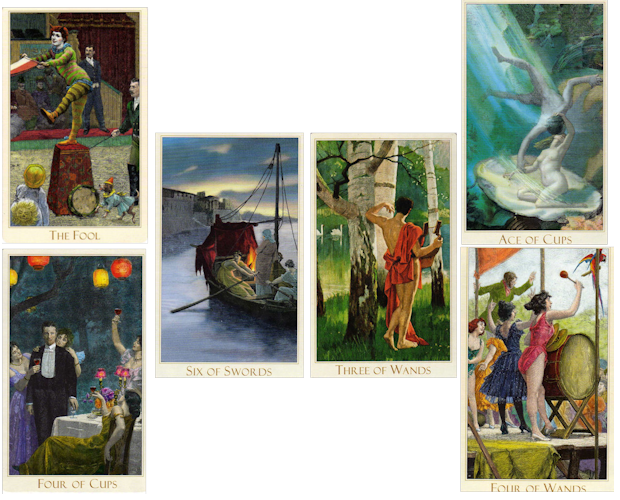
My answer is: her social circle is not conducive to a new relationship and this will change when she relocates and meets new people.
Despite her emotional stability, the Queen finds herself with indifferent and listless men (4 of Cups) and will need to destabilise and breakout from the status quo (the Fool). The most positive thing she can do is leave her coterie and cut ties with a crowd that does not serve her needs (6 of Swords).
She will find her ideal partner in a festive and lively crowd (4 of Wands) when she builds a new home for herself and feels revitalised (Ace of Cups).
Traditionally, when we see the 4 of Cups, we often talk about feeling secure, real emotional intelligence and fairness (being the sanguine, air suit). It’s also the home of friends. However, here, we see a man so secure that he is apathetic and inert and unresponsive to the Queen’s needs. In the face of this, the 6 of Swords tells the Queen to leave the party and sail away to the troubadours’ party in the 4 of Wands.
If we look at the 3 of Wands, as who will be right for the Queen, we say a man who has forsaken his white-tie for a red toga. He’s imaginative, probably musical, but keeps his bare feet on the ground. He balances reliability with inscrutability (both earth qualities), creativity and dint of effort. Whatta man, in the words of Salt-n-Pepa.
The Ace of Cups, in timing, can be read as the first week of autumn, that is the week commencing September 24. A change of residence is supported by both the 6 of Swords and 4 of Wands, and to a lesser extent the Fool. I thus favour a literal move rather than a figurative fresh-start. The Queen told me, after the reading, all her friends were attached. She is due to be rehoused by the local authorities in the summer. I wish her well.
§
Cards: The Prediction Tarot (Peter Richardson), Aquarian Press 1985; The Victorian Romantic Tarot (Alex Ukolov & Karen Mahony), Magic Realist Press 2006.
Featured Image: Fresco from Pompei, Casa dei Venus, 1st century AD. Unknown ancient Rome artist, photo of Stephen Haynes [Public domain], via Wikimedia Commons.
Title: Venus, by Shocking Blue.
Notes:
[1] Silvestre-Haéberlé, C. (2001). Les 12 meilleures méthodes pour tirer les tarots. 1st ed. Paris: Grancher.
[2]Michelsen, T. (2003). Designing your own tarot spreads. 1st ed. St. Paul, Minn.: Llewellyn Publications.
[3]Of note, he takes this precise meaning in the different versions of le tirage immediat sometimes called the rapid response.
 Journal of a Cartomante