This article continues my series examining the trumps of the Tarot de Marseille, adapted from my unpublished manuscript, Tarot de Marseille: The Picturebook of Fate. As throughout this series, the emphasis is placed upon the traditional eikōn of the card, its historical context, and the practical significations I have found useful through divinatory practice. The interpretations presented here reflect my own experience of working with the Tarot de Marseille and should be understood as a working method rather than a definitive authority.
The Sevens: The Charioteer and the House of God
Let us now review another reading and, in doing so, introduce a new spread.
The Mundane Cross
The Mundane Cross is a draw I utilise with all the card systems I work with, including the Tarot de Marseille, Petit Lenormand, Oracle Belline, Tarot Persan de Madame Indira, Oracle de la Triade, and the Victorian Flower Oracle. I developed the spread from certain conventions found in older cartomancy and eventually gave it its name because its layout resembles the traditional glyph of the Earth.
The spread is particularly well suited to questions focused upon a difficulty, obstacle, or challenge that the seeker either anticipates or is presently experiencing.
The 21 trumps and Madman card are shuffled, cut, and dealt in the following manner. The first card is placed at the centre. The second is placed below it, the third above it, the fourth to its left, and the fifth to its right. The resulting layout appears as follows:
03
04 – 01 – 05
02
- Position 1: The Present.
- Position 2: The Past.
- Position 3: The Future.
- Position 4: Unhelpful Influences or What to Avoid.
- Position 5: Helpful Influences or How to Act.
These days, we are often encouraged to view the past on the left and the future on the right. Yet many older cartomantic methods employed a vertical axis instead. If one considers archaeology, the symbolism becomes rather intuitive: the past lies beneath us because it forms the foundation upon which the present rests. Likewise, the future appears above because it represents what is yet to be built.
A similar logic informs the horizontal axis. The Latin words for left and right are sinister and dexter respectively. Traditionally, the left-hand side was associated with difficulties, complications, and disruptive influences, whilst the right conveyed assistance, remedy, and favourable action.
The Mundane Cross retains these older associations.
The vertical line (Positions 2-1-3) describes the development of the situation from past through present into future. The horizontal line reveals what hinders and what helps. Even where the future appears difficult, the spread frequently reveals practical steps by which matters may be improved.
Stephen’s Reading
Ana is one of my oldest friends. Her eldest son, Stephen, had found himself in some trouble during his teenage years and made a number of foolish mistakes. He eventually dropped out of university and, now in his early twenties, was struggling to secure permanent employment.
Ana was less concerned with predicting exactly what would happen than with understanding how she could best help him move forwards.
The cards dealt were:
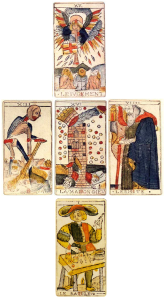
- Position 1: The House of God
- Position 2: The Juggler
- Position 3: The Angel
- Position 4: Death
- Position 5: The Hermit
The reading begins with the Juggler in the position of the past. The card suggested wasted potential, poor judgement, and a tendency to treat serious matters too lightly. Stephen possessed ability and opportunity, but lacked clear direction. As a consequence, he made choices that drew the wrong sort of attention and closed doors that might otherwise have remained open.
The Juggler can be energetic and talented, but he is not always prudent. In Stephen’s case, the card seemed to describe someone experimenting with life without fully appreciating the consequences of his actions.
The present was represented by the House of God.
Stephen was now experiencing the consequences of his earlier decisions. Although uncomfortable, the process served a corrective purpose.
In my own work, I frequently associate the House of God with Purgatory. Contrary to popular imagination, Purgatory is not primarily concerned with punishment but with purification. It is the process by which what is disordered, harmful, or incomplete is gradually transformed and made ready for something better.
Seen in this light, the House of God suggested that Stephen was passing through a necessary period of correction. His mistakes were not being ignored, nor were they being permitted to define him forever. Rather, they were being exposed, confronted, and purified through experience.
Importantly, the card did not simply indicate change. It indicated visible change. It would not be enough for Stephen to claim that he had learned from his mistakes. He would need to demonstrate it through his actions and conduct. The House of God tears down what is unsound so that something stronger may eventually be built in its place.
Far from indicating destruction for its own sake, the card suggested that Stephen was in the middle of a transformative process. Much like Purgatory itself, the discomfort served a purpose: preparing him for the renewal promised by the Angel that follows.
The future was represented by the Angel, one of the most hopeful cards in the traditional tarot.
The Angel is a card of resurrection, restoration, and second chances. It suggests that something believed lost may yet be recovered. Opportunities previously squandered may return, provided the lessons of the past have genuinely been learned.
For this reason, I felt there was a strong possibility that Stephen would eventually return to education or training. More broadly, the card suggested a vocation or calling waiting to be rediscovered. Once the errors of the past had been corrected and put behind him, he would be free to move forwards.
The card in the position of what to avoid was Death.
In this context, Death did not represent literal endings but rather the temptation to abandon hope. The card warned against writing himself off, defining himself by his mistakes, or concluding that his future had already been determined by his past.
The danger represented by Death was the belief that it was all over. Stephen needed to avoid becoming trapped by regret, resentment, or self-condemnation. The card warned him not to abandon the struggle.
The card showing how to act was the Hermit.
The Hermit advised prudence, reflection, and careful consideration. Rather than applying for jobs indiscriminately, Stephen needed to think seriously about what he actually wanted to achieve and how best to reach that goal.
The card also suggested discernment in the opportunities he pursued. Simply seeking any employment without purpose or direction would do little to demonstrate maturity. The Hermit encouraged him to develop a plan, reflect upon his past mistakes, and identify a meaningful path forwards.
Patience was essential. The Hermit does not rush. He illuminates the road one step at a time.
Taken together, the spread tells a remarkably coherent story.
The Juggler represents youthful mistakes and wasted opportunities. The House of God shows those mistakes being exposed, corrected, and purified through difficult experience. The Angel reveals the possibility of restoration and a second chance. Death warns against despair, whilst the Hermit advises a deliberate and thoughtful approach to the future.
The vertical axis tells a story not of downfall, but of redemption. The Juggler represents youthful errors and wasted opportunities. The House of God shows those errors being purified and corrected through experience. The Angel then reveals the possibility of restoration and a second chance. Stephen’s difficulties were therefore not the end of his story, but the means by which he was being prepared for a better one.
This example illustrates one of the great strengths of the Mundane Cross. The spread not only reveals the challenge itself but also identifies both the principal danger and the most effective remedy. Even when circumstances appear difficult, it often points towards a constructive path forward.
§
Tarot Cards: Jean Dodal Tarot via Wikipedia Commons. Public Domain.
Featured Image: Ancient Tarot Major Arcana © BP Grimaud/John Waddington Ltd, Leeds & London, Les Tarot de Marseille Jean Noblet, 1650 © Editions «letarot.com» (2001 [hand stencilled trumps]). Les Tarot de Marseille Jean Dodal, 1701 et 1715 © Editions «letarot.com» (2002 [hand stencilled trumps])

