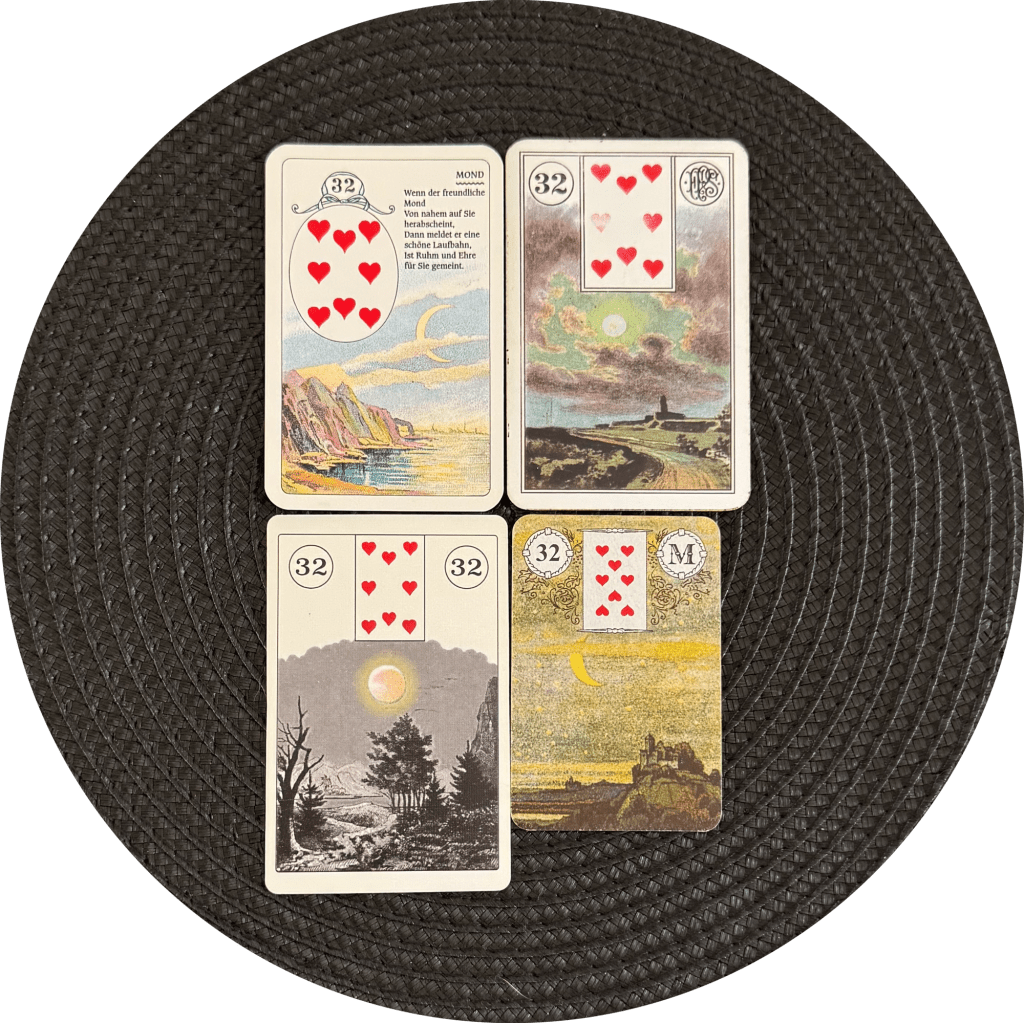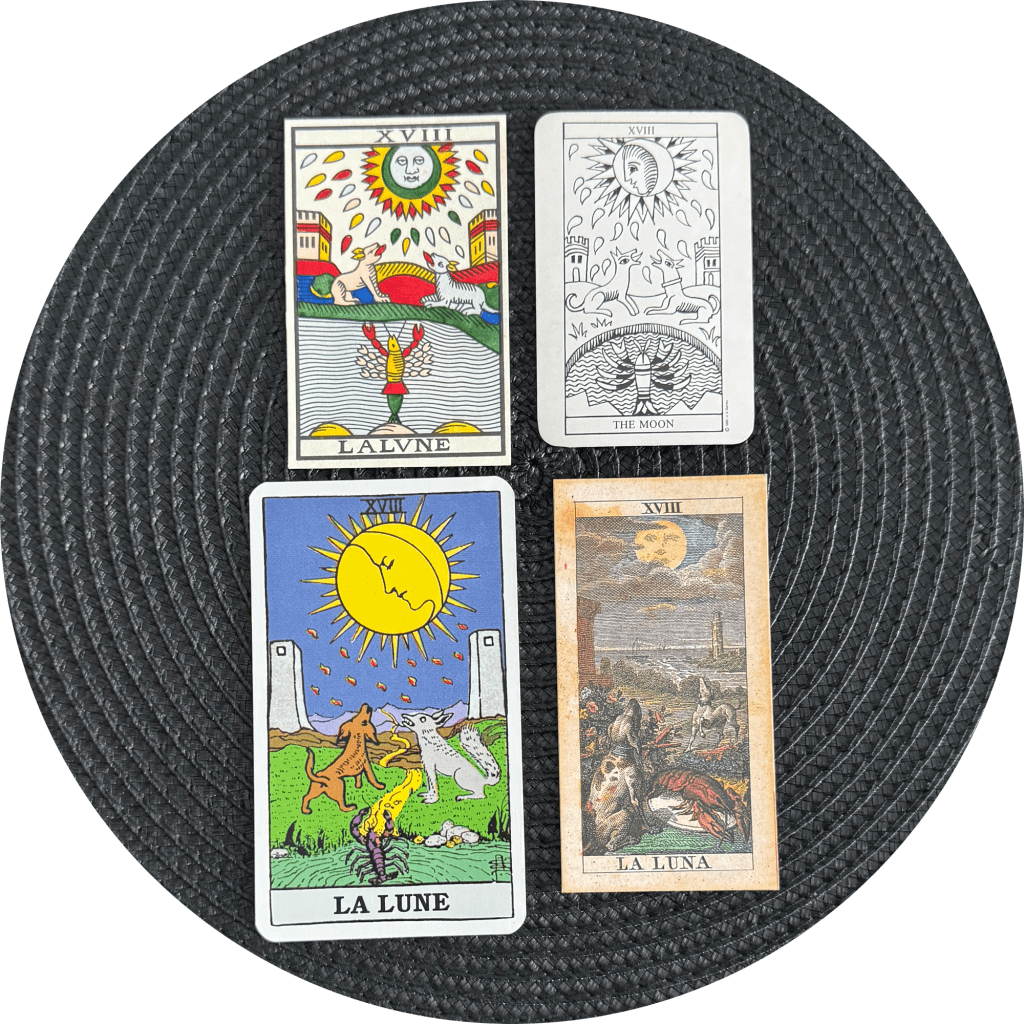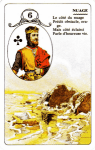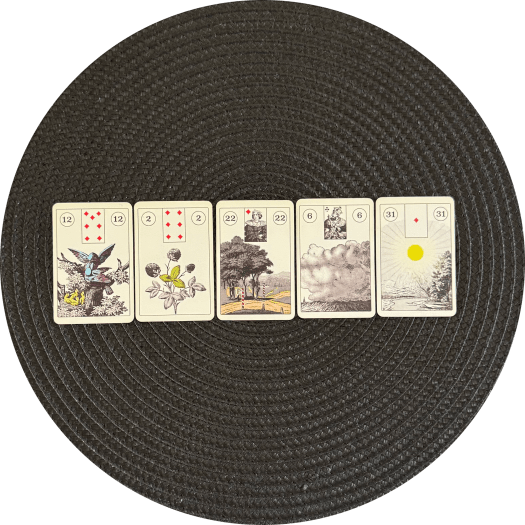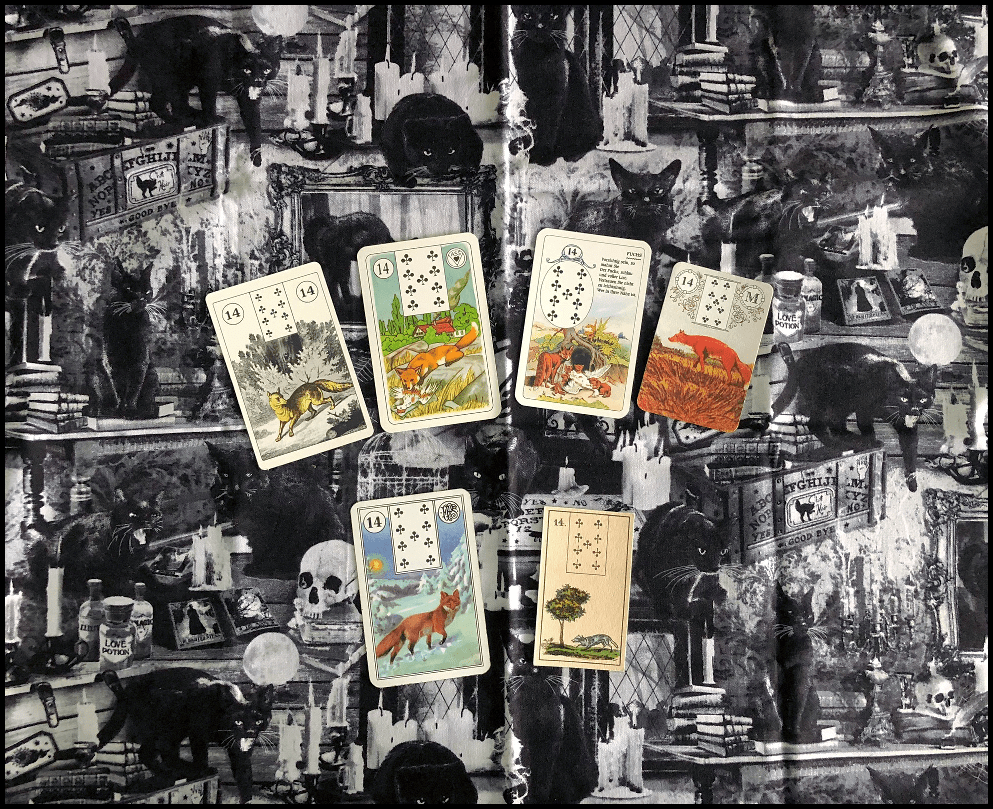
The Dwelling-Place: The House Card

God gives the lonely a home to live in; he leads the prisoners forth into freedom: but rebels must dwell in a parched land.

Psalm 67: 7, Grail Translation

In my Father’s house are many rooms; if it were not so, would I have told you that I go to prepare a place for you? And when I go and prepare a place for you, I will come again and will take you to myself, that where I am you may be also

John 14: 2 -3 (RSV CE)

Ah! there is nothing like staying at home for real comfort. Nobody can be more devoted to home than I am. I was quite a proverb for it at Maple Grove.

Emma, Jane Austen  

The House, signifies success and prosperity in all enterprises, even if the present situation of the person is unfortunate, he can expect a better future. If this card is located in the middle of the game, below the person, it is a warning to be on their guard regarding their surroundings.

Original Instructions

Card No. 4 in the Petit Lenormand, the House, is represented by the King of Hearts. At first glance its meaning appears straightforward. Does the card simply signify houses, property, and real estate? If so, what of those who live in apartments, caravans, motor homes, or houseboats? Does it represent the building itself, the family within it, or something deeper?

The Essence and Function of the House

The traditional eikōn of the House is remarkably consistent across the various patterns. It typically depicts a fashionable residence reflecting the period in which the deck was produced. The Brepols pattern shows an elegant Belle Époque château, whilst the Dondorf presents a comfortable Biedermeier home. The famous Altenburger pattern depicts a more modern Art Deco residence. Despite the differences in architecture, the core symbolism remains unchanged. Each image presents a place of shelter, permanence, and domestic life. 


The essence of the House is home and its function is to shelter

The House signifies the seeker’s home irrespective of its physical form. Whether one lives in a detached house, apartment, caravan, motor home, houseboat, or any other dwelling, it remains the place one returns to at the end of the day. If one lives there, it is one’s home and therefore falls naturally within the domain of the House. 

For this reason, the House is often quite literal. When combined with other cards, it can reveal conditions affecting the home itself. Thus, HouseCoffin may indicate rot, decay, mould, or structural deterioration. HouseMice frequently points towards vermin, infestations, or gradual damage to the property. HouseFishes may signify flooding, water ingress, subsidence, or drainage problems, whilst HouseClouds can indicate damage caused by storms, weather, or environmental conditions. 

Conversely, HouseBouquetHouseMoonHouseStars, and HouseSun frequently describe pleasant, attractive, or harmonious living environments. These combinations suggest a home that provides comfort, pride, security, and satisfaction. 

Yet the House is not merely the building in which we live. 

By extension, it governs domestic life itself. It reveals what is happening beneath the roof. Thus, HouseBirds may indicate worry, stress, and agitation within the home, whilst HouseBirch Rod often points towards arguments, tension, or conflict amongst those who live there. The card therefore tells us not only about the property, but also about the atmosphere within it. 

This naturally leads to the people who share our home. 

In many cases these individuals will be family members, but this is not always so. The House signifies those with whom we share a roof rather than those with whom we share blood. A student living in a dormitory, shared house, or sorority may therefore find their housemates represented by the House whilst their family appears elsewhere in the tableau. 

Here it is useful to distinguish between the House, the Lilies, and the Tree. The House describes the household itself and those who live within it. The Lilies represents the family unit more generally, regardless of whether its members live together. The Tree reaches further still, signifying ancestry, genealogy, inherited characteristics, and the familial roots from which we descend. 

At its deepest level, however, the House is not simply where we live but where we belong.

The card represents the conditions required for us to feel safe, secure, and at ease in the world. It is the place where we can lower our guard and be ourselves. This may be a physical location, but it can just as easily be a family, community, social circle, profession, or other environment that provides stability and acceptance. 

For this reason, the House often appears in questions that have nothing to do with property. When a seeker feels adrift, disconnected, or uncertain of their place in the world, the House frequently reveals what is missing. The card asks what conditions are necessary for the individual to feel safe, secure, valued, and at home within their own life. 

In this sense, the House is one of the deck’s most important indicators of personal stability. A well-supported House often shows that the seeker possesses strong foundations from which to build their life. Adverse cards may reveal instability, insecurity, or circumstances undermining their sense of safety and belonging. 

A useful distinction may be drawn between the House and the High Tower. The High Tower concerns the broader course of life, our ambitions, and ultimately our legacy. The House concerns the foundation from which that journey is undertaken. The High Tower asks what we are building; the House asks where we belong whilst building it. 

Indeed, I have often felt that every cartomantic system possesses a card that encapsulates its character and voice. For me, the House fulfils that role within the Petit Lenormand. 

Part of this arises from the card’s tone. The House possesses an elder masculine quality that reminds me of a grandfather, uncle, or trusted mentor. This, to me, feels profoundly Lenormand.

Coda

At its heart, the House is a card of home, shelter, and belonging. It reveals not only where we live, but where we feel safe, accepted, and rooted. Whether it appears as a literal dwelling, a family, a community, or a way of life, the House describes the foundations that allow us to flourish. 

Many cards in the Petit Lenormand encourage movement, change, ambition, or discovery. The House reminds us that such journeys are only meaningful when we know where we belong. It is the place from which we depart, the refuge to which we return, and the foundation upon which the rest of life is built.

Person and Description

Person

David Bellot, LGPL http://www.gnu.org/licenses/lgpl.html, via Wikimedia Commons

Although the House is not ordinarily a person card, it possesses an additional layer of symbolism through its association with the King of Hearts. In the folklore of the playing cards, this king is traditionally identified as Charlemagne. Consequently, the House can occasionally function as a male significator. 

When appearing as a person, the House usually represents a man who is at least of the seeker’s generation and more often somewhat older. The card frequently signifies a father, stepfather, uncle, godfather, older brother, housemate, or another established male figure within the seeker’s life. 

As Hearts is the suit associated with the Lord, the House often signifies a paternal relative or an important male member of the family. In readings for women, it can also occasionally point towards the husband’s family and, by extension, male in-laws. 

When functioning in this capacity, however, the House largely sheds its domestic meanings. The card’s purpose is simply to identify the individual. One should therefore look to the surrounding cards to determine the person’s appearance, temperament, circumstances, and influence within the reading. 

Interestingly, I have rarely found the House to signify a landlord. In matters relating to rented accommodation, that role is more commonly fulfilled by the Fishes in commercial arrangements or the Lilies when dealing with family property and inherited holdings. The House concerns those who dwell within the home rather than those who merely own it.

Physical Description

When contributing to a physical description, the House often imparts a distinctly square or solid appearance. The shoulders, chest, waist, and hips frequently appear proportionate, giving the person a relatively rectangular build. The face may likewise be broad or square in shape, particularly around the jaw and forehead. 

The card tends towards conventional, respectable, and often conservative styles of dress. These individuals are rarely driven by fashion for its own sake. Instead, they generally prefer practical, tidy, and reliable clothing that is appropriate to the occasion. 

Interestingly, the colours appearing on the House itself can occasionally provide useful descriptive details. For example, the House in the Blaue Eule (above, bottom right) has accurately described a man wearing a brown suit with a cream-coloured shirt. Likewise, the Brepols House (above, top left) has repeatedly appeared in connection with blue and pink garments or shoes worn by either men or women. In my experience, these colours are more likely to manifest in clothing than in hair or eye colour. 

For men, the House will often indicate some form of facial hair, whether a beard, moustache, or stubble. The card generally describes a healthy and established appearance, and unless strongly modified by surrounding cards, it is less likely to point towards thin or noticeably thinning hair.

Temperament

Phlegmatic, Rijksmuseum, CC0, via Wikimedia Commons

The House most closely corresponds to the traditional phlegmatic temperament. Such individuals are often calm, practical, dependable, and even-tempered. They value stability over excitement and generally prefer steady progress to sudden change. 

There is frequently a frugal and cautious quality about them. House people tend to think carefully before acting, avoid unnecessary risks, and place considerable value upon security, routine, and the preservation of what has already been built. 

The card also possesses a conciliatory nature. These individuals often dislike conflict within their home, family, workplace, or social circle and will frequently attempt to maintain harmony through compromise and common sense. 

Beneath this phlegmatic exterior, however, there is often a slight melancholic undertone. The person may be somewhat reserved in the expression of their emotions, cautious about revealing personal matters, or inclined towards nostalgia and reflection. This rarely manifests as overt sadness. Rather, it gives the individual a thoughtful and measured manner. 

The House often describes someone as musical. They very often play an instrument and have a good singing voice.

Above all, the House describes someone who values stability, belonging, and continuity. Like the card itself, they are most comfortable when life rests upon firm foundations and familiar routines.

Special Features

The House in the Grand Tableau

In the original instructions for the game, sometimes referred to as the Philippe Lenormand sheet, the House is given a rather enigmatic two-part augury:

“The House signifies success and prosperity in all enterprises, even if the present situation of the person is unfortunate, he can expect a better future.

If this card is located in the middle of the game, below the person, it is a warning to be on their guard regarding their surroundings.”

Let us consider these two statements in turn.

Success and Prosperity

Earlier in this article, we discussed how the House can provide insight into what a seeker requires in order to feel secure, stable, and at home in the world. At first glance, the traditional promise of “success and prosperity in all enterprises” may seem difficult to reconcile with such meanings. 

The answer lies in understanding that the House represents our foundations. 

The House itself cannot guarantee prosperity. Indeed, in a Grand Tableau the card will always be present, and it would be illogical to assume that every seeker is therefore assured wealth and success. Rather, the House reveals the part of life over which the seeker possesses the greatest degree of influence and control. Through the cards surrounding it, we often discover what must be strengthened, repaired, protected, or developed in order to improve our circumstances. 

For this reason, the House frequently reveals how a person can move beyond present difficulties and build a better future. It shows what may be done within the seeker’s own domain. 

The traditional instruction becomes easier to understand when viewed within its historical context. During the period in which the Petit Lenormand emerged, the home was not merely a place of residence. Multiple generations frequently lived beneath the same roof and the household often functioned as the centre of economic, social, and family life. To possess a secure and prosperous household was therefore a genuine sign of success. 

The House differs from the High Tower in this respect. The High Tower concerns the broader course of life, long-term ambitions, and ultimately legacy. The House concerns comfort, stability, security, and the foundations upon which that larger life is built.

The House in the Centre

The second instruction is often dismissed as obscure or nonsensical:

“If this card is located in the middle of the game, below the person, it is a warning to be on their guard regarding their surroundings.”

Yet I have found it remarkably insightful. 

If a card occupies the centre of the Grand Tableau, it frequently forms the greatest number of combinations. Eight cards surround it directly, and this number can increase further when techniques such as knighting and mirroring are employed. 

Why should this create difficulties for the House? 

The answer is that the House is the most private card in the deck. 

The House represents our personal domain. It is what occurs behind closed doors. It is our home life, our private affairs, and the aspects of life we prefer to keep sheltered from public scrutiny.

When numerous cards surround the House, there is often considerable activity within the seeker’s private sphere. Whilst this is not automatically negative, it frequently draws attention towards matters that would ordinarily remain personal. 

In practical terms, this can indicate a need for caution, discretion, and sound judgement in dealings with neighbours, family members, colleagues, and anyone else operating in close proximity to the seeker’s private life. 

The warning becomes more pronounced when the significator appears directly above the House. 

As we have already seen, cards exert an influence upon those beneath them. When the significator stands above the House, the seeker’s own actions, choices, or behaviour often contribute to the circumstances affecting the domestic sphere. In such cases, restoring calm, balance, and stability frequently falls to the seeker themselves. 

Importantly, I do not automatically regard this formation as negative. 

Indeed, over the last decade I have encountered it repeatedly amongst individuals with a strong presence on social media. The issue is rarely secrecy. Rather, the boundaries between public and private life begin to erode. Personal matters become visible to too many people, and aspects of life that should remain sheltered are exposed unnecessarily. 

For this reason, I increasingly associate this formation not with danger but with a need for discretion and common sense. The House reminds us that not everything must be shared and that some aspects of life flourish best when protected from excessive attention.

In this respect, the traditional warning remains entirely relevant. The issue is not secrecy. The issue is remembering that the House exists to shelter what belongs within it and not be outside it.

Due to this rule some assume that it is favourable to have the House at a distance. I disagree. While we do not wish to see the House in the middle and below the significator, it is best to see it nearby to provide the signifactor its shelter.

Privacy and the Private Life

The House and the Park form a natural pair of opposites within the Petit Lenormand. The Park describes life lived in public. Historically, parks were places where people gathered to socialise, attend concerts, take exercise, exchange news, and participate in community life. The card therefore governs social networks, public reputation, civic life, and those activities visible to the wider world. 

The House, by contrast, governs life lived in private. 

It is the domain that exists behind closed doors, beyond public scrutiny and observation. Whereas the Park asks what is shared with others, the House asks what remains within the home, family, or trusted circle. The distinction is not merely between a building and a public space, but between what is public and what is personal. 

For this reason, the House frequently describes the seeker’s private life. 

When cards such as the Birds or Birch Rod appear near the House, private matters may become the subject of discussion, speculation, criticism, or gossip. The Birds often indicates a stressful home life, chatter, and constant discussion, whilst the Birch Rod may point towards rumours, arguments, domestic disputes, or criticism emanating from those who are closest to us. In both cases, matters that would ordinarily remain within the House risk becoming more widely known.

This principle is particularly useful in relationship readings. 

The House often reveals what is happening behind closed doors rather than what is visible to the outside world. Public appearances can be misleading, but the House frequently exposes the true dynamics operating beneath the surface. 

Thus, HouseMoon may indicate a relationship in which feelings, expectations, and intentions are openly (the Moon symbolises not the emotions but the visibility) expressed and understood. HouseShip often suggests that circumstances within the home or relationship are changing direction or entering a new phase. HouseHeart points towards affection and emotional warmth within the domestic sphere, whilst HouseMountain may reveal emotional distance despite the individuals continuing to live under the same roof. 

The same principle applies to family relationships. The House frequently reveals tensions, alliances, routines, responsibilities, and patterns of behaviour that remain largely invisible to outsiders but profoundly shape daily life. 

On another level, the House can signify private membership of organisations, societies, and associations.

The defining characteristic here is not necessarily secrecy, but restricted access. Membership is often limited, controlled, or known only to those who belong. Thus, the card may occasionally indicate private clubs, lodges, covens, professional associations, invitation-only groups, fraternal organisations, or societies such as the Freemasons and the Magic Circle. 

Ultimately, the House governs those aspects of life that remain sheltered from public view. Whether it concerns family affairs, romantic relationships, private memberships, or personal matters, the card reminds us that not everything belongs in the Park. Some things flourish best within the protection of the House.

Real Estate

The House is the Petit Lenormand’s natural significator of real estate and property. Whilst the card most obviously describes a house, its symbolism extends far beyond a particular type of dwelling. Apartments, cottages, caravans, motor homes, houseboats, farms, and other residential properties all fall naturally within its sphere. The House may also signify plots of land, rental properties, commercial premises, and other forms of real estate that can be purchased, rented, inherited, occupied, or otherwise belong to an individual, family, or organisation. 

A useful distinction may be drawn between the House and the Park. 

The House describes property that belongs to, or can belong to, an individual, family, or private body. The Park, by contrast, describes public spaces intended for communal use. If the property forms part of someone’s personal domain, it will generally be shown by the House. If it is public and accessible to all, the Park is usually the more appropriate card.

 Because of this, the House is often invaluable when examining property matters. Whether a seeker is buying, selling, renting, relocating, renovating, or simply enquiring about their current residence, the House provides the anchor around which the interpretation may be built. 

One of the most useful applications of the House is profiling property. By examining the cards surrounding it, the cartomante can often build a remarkably detailed picture of a residence, neighbourhood, or parcel of land before ever setting foot there. 

For example, HouseShipSun frequently suggests a residence located some distance from the current home and generally to the south. The Ship implies movement beyond the immediate area, often to another city, county, state, canton, or region altogether, whilst the Sun provides the southern direction. 

The Roads operates somewhat differently. Rather than indicating substantial distance, it more commonly points towards a move within the same town or city. The seeker changes location, but remains within the broader area they already know. In practical terms, this often translates to a different neighbourhood, district, or suburb rather than an entirely new region. 

Other combinations allow us to construct an increasingly detailed profile. 

  • HouseMoon may describe a well-known location, one frequently photographed or admired, a residence associated with performance or the arts, or a building characterised by pale, silver, or grey colouring. 
  • HouseHigh Tower often indicates an old, tall, remote, or border property. Neighbours may be few and far between, and the residence frequently possesses a sense of history, longevity, or isolation. 
  • HouseAnchor commonly signifies a long-term residence situated near the coast or often by a beach. The property is often somewhere the seeker intends to remain for a considerable period of time. 
  • HouseTree may point towards a rural property surrounded by woodland, mature trees, or countryside. It can also indicate a location connected to the seeker’s ancestral roots, family history, or genealogy. 
  • House-Ship may show a houseboat or a property on or near a marina or shipping port (Fishes would show by the sea).

By combining the House with neighbouring cards in this manner, it is often possible to build a surprisingly detailed profile of both the property itself and the environment in which it is situated. 

In this respect, the House functions almost like a significator. The surrounding cards supply the details, revealing not only the appearance of the property but also its atmosphere, location, history, advantages, and challenges. 

Whether the matter concerns a family home, rental property, retirement residence, holiday cottage, or parcel of land, the House ultimately asks a simple question: Is this somewhere in which you can truly feel at home?

Departments and Subdivisions

The House is often said to signify home working, home businesses, side projects, or self-employment. This is not entirely incorrect. However, these meanings arise from the House’s descriptive qualities rather than from any intrinsic connection with work itself. It is important to remember that no card in the Petit Lenormand specifically means employment. The Moon continues to describe professional status and reputation. The Anchor remains the principal indicator of job security. The Fox reveals competitors, rivals, and workplace politics, whilst the Hound often signifies colleagues, employees, and professional associates. These are not meanings but rather essence being read as function in a work context.

The House therefore modifies these matters rather than replacing them. 

One particularly useful application of the card is its ability to describe departments, divisions, and subdivisions within a larger organisation. Just as the House represents a smaller domestic unit within a wider community, it can also signify a smaller unit within a broader institution. 

For example, if a seeker works in a hospital, the Park may represent the hospital as a whole, whilst the House identifies a particular department, ward, clinic, or specialty. Likewise, within a university, the Park may describe the institution itself, whilst the House points towards a specific faculty or department. 

The same principle applies to businesses, government agencies, military organisations, charities, and other large structures. The Park shows the wider organisation; the House identifies the part of it that the seeker inhabits directly. 

This distinction can prove especially valuable when questions of employment arise. If a seeker is considering a career move and the House repeatedly appears, the card often suggests remaining within the existing organisation whilst changing departments, teams, offices, or responsibilities. Rather than leaving altogether, the cards may be indicating that the solution lies closer to home. 

In this respect, the House once again performs its familiar function. It asks us to look first within our own domain before seeking answers elsewhere.

Timing

In matters of timing, the House is a steady card. Events unfold naturally and at an appropriate pace rather than being accelerated or delayed. The card favours routine, continuity, and gradual development. 

Unlike cards such as the Ship, which introduces movement, or the Mountain, which imposes delay, the House generally signifies progress occurring in an orderly and predictable fashion. Matters develop as they should, neither rushing ahead nor falling significantly behind. 

This reflects the card’s nature. Homes are not built overnight, yet neither do they remain entirely static. Life unfolds within them through the steady rhythms of daily existence. For this reason, the House is neither a particularly fast nor particularly slow card. 

In longer readings, I generally find the House points towards developments occurring within the current season or quarter. 

In shorter readings, the House frequently signifies a calendar month and is particularly associated with the month of March. This association arises through St Joseph, with March being his liturgical month, and who has long been regarded as the patron saint of homes, households, and property.

Health

Anatomically, the House is associated with the bones and skeletal system. The symbolism is straightforward. Just as a house provides structure, support, and protection, the skeleton performs the same function within the body. It gives shape to the individual and safeguards vital organs. 

The surrounding cards refine this picture. Thus, HouseScythe may indicate fractures, breaks, or injuries involving the skeletal system. HouseMice can point towards osteoporosis, bone thinning, or the gradual deterioration of structural integrity. 

A useful distinction may be drawn between the House and the Tree. The Tree governs vitality, constitution, and the body’s natural life force. The House concerns the body’s structure and framework.

More broadly, the House often comments upon how the individual maintains and cares for themselves. Because the card governs the place in which we live, it can also describe the body as the house in which we dwell throughout life. For example, HouseMountain may indicate stiffness, restricted movement, discomfort, or physical limitations. HouseBouquet, by contrast, often describes someone who takes pride in their appearance, pays attention to grooming and presentation, and makes a conscious effort to maintain their physical wellbeing. Here the emphasis is less upon health itself and more upon care, maintenance, and presentation.

Ultimately, the House asks a simple health question: How well are you maintaining the structure in which you live? Whether interpreted literally as the skeleton or more broadly as the body itself, the card emphasises maintenance, stability, and long-term care rather than quick remedies or dramatic interventions. In this respect, the House remains entirely true to its essence and function. Externally, it shelters the home; internally, it is reflected in the skeletal structure that shelters and supports the body itself.

The House in Action

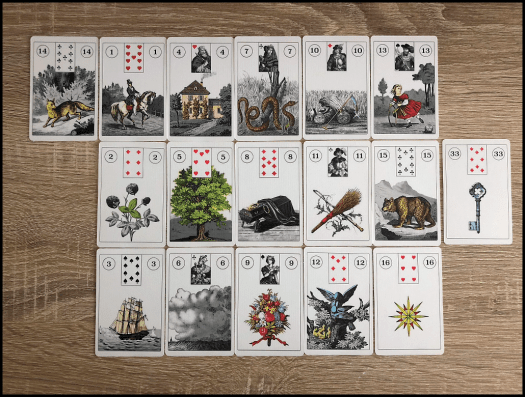
This reading was performed for a female friend, Lottie, in November 2005. At the time, she was working as a teacher and was interested in how her life might develop over the coming months. I cast a traditional Grand Tableau, though for the purposes of this example we shall restrict ourselves to the relevant section of the layout.

The first thing that immediately attracts attention is the position of the House. It falls in the centre of the Tableau, specifically in the House of the Park, with the Lady directly above it.

As discussed earlier in this article, the Lady immediately above the House was traditionally regarded as a warning that domestic matters would soon demand the seeker’s attention. Before assuming the worst, however, confirmation should always be sought from additional warning cards.

That confirmation is present here.

To the left of the House stands the Hound, which is connected to both the Fox and the Bear. Because the Bear follows the Fox, the Bear receives the Fox’s warning and becomes coloured by jealousy, resentment, and possessiveness which are the Bear’s negative attributes.

The Hound therefore becomes a red-flagged individual whose behaviour is motivated by envy.

Whilst the Hound commonly signifies friends and colleagues, the traditional eikōn depicts the dog beside its kennel within the grounds of its master’s home. The card therefore possesses a longstanding association with neighbours and those who live alongside us.

Combined with the nearby House, suspicion naturally falls upon somebody living close to the querent.

The question then becomes: why is this neighbour a concern? The answer is supplied by the Birch Rod, which crowns the Hound.

The issue is not merely the neighbour themselves but conflict with that neighbour.

The cards therefore warn of a dispute (Birch Rod) involving a dishonest or underhanded neighbour (FoxHound) whose actions are fuelled by jealousy or resentment (FoxBear).

Despite this warning, however, the Tableau also offered considerable reassurance.

Directly above the Lady stood the Stars, suggesting that Lottie would maintain clarity and avoid becoming overwhelmed by the situation.

Beneath the House stood the Anchor and Heart, indicating that domestic security and peace of mind would ultimately be preserved. To the right of the House appeared the Sun, strengthened further by the Cloverleaf above and the Bouquet beneath.

Together, these cards suggested a favourable outcome and the timely arrival of assistance.

At the time, I interpreted the Bouquet in conjunction with the nearby High Tower as describing an older woman whose advice, experience, or intervention would prove helpful. The Bouquet suggested good manners and goodwill, whilst the High Tower pointed towards seniority, maturity, or authority.

I remember telling Lottie that she would likely find herself involved in an unpleasant dispute affecting her home life, but that a fortunate opportunity (Cloverleaf) and assistance from an older woman (Bouquet, High Tower) would help bring the matter to a satisfactory and harmonious conclusion (Sun).

Events unfolded remarkably close to the cards.

A neighbour within the same house conversion became involved in a dispute regarding parking. The behaviour was very much in keeping with the Birch Rod, being argumentative, confrontational, and distinctly choleric in nature.

Fortunately, a long-term resident of the property was able to assist in finding a workable resolution (remember the Bouquet also signifies offers, pacts and compromises), reflecting the assistance shown by the Bouquet and High Tower.

Sadly, the matter did not end entirely without loss.

During the dispute, Lottie discovered that her car had been scratched. Whilst she was never able to prove who was responsible, the incident itself was highly suggestive of the combination we observed in the cards. The Birch Rod’s hostility combined with the Fox’s underhanded nature often manifests through spiteful acts (remember the Bear, too) designed to cause inconvenience whilst avoiding responsibility.

In the end, however, the more important promise of the cards proved correct.
Despite the tension, Lottie retained both her home and her peace of mind. The House remained secure, the Anchor held firm, and the conflict eventually

§

Images:

Featured Image:

Robertgrassi, Public domain, via Wikimedia Commons

Cards:

Lenormand Cards: Jeu Lenormand © Cartamundi, WanderWüst © Jorge/Wandering Oracle, Lenormand Fortune-Telling Cards © Zao-Gelli, The Lenormand Oracle © Verlag für die Frau, Leipzig, Nieuwe Lenormand © Amber Studio/Erna Droesbeke, Lenormand 36 Orakelspielkarten © Königsfurt-Urania,

References:

Boroveshengra, A., 2013. Cartomantes’ Cabinet: The Petit Lenormand Course.
Boroveshengra, A., 2015. Lenormand Thirty Six cards. 2nd ed. Create Space.
George, R. 2014 The Essential Lenormand: Your Guide to Precise & Practical Fortunetelling. Woodbury, MN: Llewellyn Publications.
Ignatius Press (2005) Holy Bible RSVCE Compact Zipper. Ignatius Press.
Matthews, C. 2014 The Complete Lenormand Oracle Handbook: Reading the Language and Symbols of the Cards. Rochester, VT: Destiny Books.
Silvestre, C., 2003. Le Petit Lenormand. [Montpellier]: Gange éd.

By the Starry Vault of Heaven: The Stars Card

And God said, “Let there be lights in the firmament of the heavens to separate the day from the night; and let them be for signs and for seasons and for days and years, and let them be lights in the firmament of the heavens to give light upon the earth.” And it was so

Genesis 1:14-15 (RSV CE)

We had found the stars, you and I. And this is given once only.

André Aciman, Call Me By Your Name

Star, confirms good luck in all your enterprises, but if it surrounded by clouds, it indicates a long period of misfortune

Original Instructions

Card No. 16 in the Petit Lenormand, the Stars, is represented by the Six of Hearts. It is often regarded as one of the deck’s most fortunate cards, associated with wishes, destiny, inspiration, and guidance. Whilst these meanings are not without merit, they are secondary to a far more fundamental principle: the Stars provides clarity.

The Essence and Function of the Stars

The traditional eikōn exists in two principal forms. Simpler decks depict a single star as a grapheme or glyph. More elaborate patterns show a night sky illuminated by numerous stars above a body of water or distant landscape. Despite these artistic variations, the symbolism remains essentially the same. The heavens stand above the world, providing orientation and direction to those below.

The essence of the Stars is clarity and its function is to guide.

For millennia, mankind has looked to the stars for guidance. Long before maps, satellites, and compasses became commonplace, travellers navigated by the heavens. Sailors crossed oceans using the stars to establish their position and direction. The North Star, Polaris, became especially important because its apparent fixity allowed travellers to orient themselves even in darkness.

Francesco del Cossa, Public domain, via Wikimedia Commons

The stars were not merely guides through space, but through time as well. The ancient Egyptians used groups of stars known as decans to divide the night and structure their calendar. Later, during the Hellenistic period, the observation of the heavens gave rise to horoscopic astrology, a sophisticated system that sought to understand time, fate, and human experience through the movements of celestial bodies. In both cases, the stars were valued because they revealed patterns and provided orientation. They allowed people to understand where they were and, equally importantly, where they were going.

I adjure you, my most precious brother, and you, initiates into this mystic art, by the starry vault of heaven and by the twelve-fold circle, by the Sun, the Moon, and the five wandering stars by whom all of life is guided, and by Providence itself and Holy Fate, to preserve these matters in secret and not to share them with the vulgar, but only with those worthy of them and able to preserve and requite them as they deserve

Vettius Valens, Anthology (Riley, trans)

This connection between divine guidance and celestial light also permeates the religious traditions familiar to the creators of the Petit Lenormand. On the fourth day of Creation, God placed the heavenly lights in the firmament to serve as signs, seasons, days, and years. The stars were intended to mark time and provide order to the world.

Likewise, God’s promise to Abraham invoked the stars of heaven as an image of destiny and fulfilment beyond immediate comprehension.

Star of Bethlehem, Elihu Vedder, Public domain, via Wikimedia Commons

Perhaps the most striking example is found in the Gospel account of the Magi. Guided by a star, they travelled from afar to adore the Christ Child. In Christian tradition, this event came to be understood as the first revelation of Christ to the nations. The star did not grant the Magi their wish. Rather, it showed them where they needed to go. It provided direction, certainty, and illumination.

Adoration of the Magi. Emmanuel Tzanes. Public domain, via Wikipedia Commons

This distinction is vital when reading the card.

Many modern authors describe the Stars as a wish card. In practice, I have never found this particularly accurate. The Stars does not grant wishes. It does not simply bestow success, happiness, or fulfilment. Rather, it provides the clarity necessary to realise those aspirations. It reveals where our attention should be focused and what path should be followed. The card joined to the Stars often describes precisely the area of life requiring deeper exploration and more serious consideration.

Vocation and Fulfilment

The Stars is especially important in questions concerning vocation and personal fulfilment.

Many readers confuse the Stars with the Sun or Moon. Whilst these cards may overlap, they describe very different phenomena. The Sun brings success, vitality, and visibility. The Moon brings recognition, reputation, and public esteem. The Stars, however, concerns direction and calling. It reveals what genuinely fulfils the individual and where their talents and interests can best be developed.

For this reason, the Stars often identifies a person’s niche. It points towards the area in which they should specialise, deepen their knowledge, or concentrate their efforts. The card does not merely show what one can do successfully, but what one feels called to pursue. In career readings, it frequently indicates the subject, profession, or field that gives meaning and purpose to one’s work.

A person may enjoy financial success under the Sun or public recognition under the Moon, yet still feel dissatisfied and adrift. The Stars seeks to remedy this by providing direction. It helps us discover not merely what we are capable of doing, but what we ought to be doing.

Love and Relationships

In matters of love, the Stars often describes a relationship that expands one’s horizons and encourages personal growth. The connection may be regarded as a true love, soulmate, kindred spirit, twin flame, or any of the other labels people use to describe relationships of unusual depth and significance.

What matters is not the terminology, but the experience itself. A Stars relationship broadens the perspective of those involved. It encourages learning, exploration, and development. The individuals help one another become more fully themselves.

The card’s guiding function is particularly evident here. The relationship often provides a sense of direction and purpose, helping both parties understand themselves more clearly and identify what they genuinely want from life.

When difficulties have arisen, the Stars can also be an encouraging sign. Because its nature is to guide, it frequently indicates that a relationship can be brought back onto the correct course. Misunderstandings may be clarified, goals re-aligned, and a shared sense of direction restored. The card does not promise that every relationship will survive, but it does suggest that clarity and honest reflection can illuminate the path forward.

For this reason, the Stars frequently indicates a period of study, reflection, planning, or specialisation. The card encourages a deep dive into the matter it touches. One moves beyond superficial understanding and begins to perceive the underlying patterns and connections that were previously overlooked.

In many respects, the Stars functions as a celestial astrolabe. It provides orientation and situates the seeker within a larger framework. Acting through the primum mobile, it reveals not merely where we are, but where we ought to be heading. The card therefore possesses a strongly chronocratic quality, helping us understand the proper timing, direction, and development of events.

Whipple Museum of the History of Science, CC BY-SA 2.0 https://creativecommons.org/licenses/by-sa/2.0, via Wikimedia Commons

This also explains the card’s longstanding interaction with the Clouds.

Traditionally, the combination of the Clouds and Stars has often been regarded as unfortunate. Whilst experience supports the difficulty implied by this pairing, the reason is frequently misunderstood. The misfortune does not arise because the stars themselves have become malevolent. Rather, the Clouds obscures them.

Without the stars, we lose our bearings. The path becomes uncertain. We struggle to understand what we truly want, where we should be directing our efforts, and what steps need to be taken next. Navigation becomes difficult because clarity has been removed. The resulting confusion, hesitation, and misdirection are the true hardship indicated by the combination.

The Clouds does not destroy the guidance offered by the Stars. It merely hides it from view.

Coda

At its heart, the Stars is a card of clarity, guidance, and orientation. It illuminates the path ahead, reveals underlying patterns, and helps the seeker understand where their efforts should be directed. Unlike the Key, which grants access, or the Ship, which provides movement, the Stars tells us where we ought to be going and how we might best arrive there.

Person and Description

Person

The Stars is not, in itself, a person card and is therefore not ordinarily used as a significator. When appearing alongside a person card, however, it can provide valuable information concerning both physical appearance and temperament.

Physical Description

The Stars often describes an individual who possesses a certain sparkle or luminosity that is difficult to define precisely. There is frequently something appealing, engaging, or memorable about them that cannot be adequately explained by conventional measures of attractiveness. Others simply seem to notice them.

The card also suggests a good sense of style. Such individuals are often well-presented and may have an appreciation for jewellery, decorative accessories, or clothing that catches the light. Depending upon the person, this can range from understated elegance to a fondness for more sparkly or eye-catching attire.

Free from adverse cards, the Stars frequently indicates clear skin and an attractive complexion. The appearance is often healthy, bright, and unblemished. Negative cards may modify this. The Mice can point towards acne, blemishes, or scarring, whilst the Coffin may suggest dryness, dullness, or skin conditions that diminish the card’s natural radiance.

In terms of stature, the Stars usually describes someone of average height and build. Rather than determining size, the card contributes an overall sense of refinement, brightness, and attractiveness.

Temperament

The Stars is one of the most intellectual cards in the Petit Lenormand. It frequently describes individuals with a keen mind, broad knowledge, and a genuine desire to understand the world around them.

These people are often drawn towards specialised interests and may devote considerable time and energy to mastering a particular subject. The topic itself matters far less than the depth of commitment. One person may become an authority on astronomy, another on railway history, vintage watches, philately, or Star Wars memorabilia. Stars people rarely dabble; they study.

The card’s connection with navigation, astronomy, and the heavens also creates a natural affinity for science, technology, and analytical thinking. Scientists, engineers, programmers, physicists, researchers, and academics frequently appear under the Stars. It may also indicate an interest in astrology, divination, and esoteric subjects, although this should not be overstated merely because one is conducting a card reading.

Perhaps the most distinctive quality of the Stars person is their sense of direction. Unlike many who drift through life uncertain of what they want, Stars people often possess clear goals and a strong understanding of how to achieve them. They are guided by ideals, ambitions, and long-term aspirations.

There is also an expansive quality about them. Their curiosity continually draws them towards new ideas, deeper understanding, and broader horizons. Consequently, they can sometimes be difficult to tie down. Like the stars themselves, they are oriented towards what lies beyond the horizon and are seldom content to remain confined for long.

Above all, the Stars describes a person seeking clarity, knowledge, and purpose. Whether through study, discovery, science, technology, or spiritual inquiry, they are driven by a desire to understand both where they are and where they are going.

Special Features

 Grand Tableau

Traditionally, the Stars augurs good fortune in one’s affairs because it provides clarity and direction. When we know where we are going and how to get there, success becomes considerably more likely.

When the Stars encounter the Clouds, however, their light is obscured. We no longer possess the information, understanding, or perspective required to navigate the situation effectively. The resulting disarray has traditionally been interpreted as misfortune, but the reality is rather more nuanced. The problem is not that the Stars has become malevolent; it is that its guidance can no longer be clearly seen.

When this occurs, it is often best to wait. It does not mean the goal must be abandoned. Rather, it suggests that the seeker is navigating without sufficient information and would be wise to postpone action until conditions become clearer.

Ideally, the Stars should fall both close to and above the significator. This suggests a particularly favourable position, as understanding, resources, and timing all align. The farther away the Stars lies, the less clear the direction becomes and the longer matters may take to achieve.

Direction

For millennia, travellers navigated by the stars. Chief among these was Polaris, the North Star, whose position in the constellation of Ursa Minor allowed sailors and travellers to establish true north even in darkness.

Consequently, it is only natural that the Stars can signify north, much as the Sun often signifies south.

This is not a signification the cartomante will make use of every day, but from time to time it can prove surprisingly helpful. Thus, ShipStars might indicate a journey to the north or travel in a northerly direction. Likewise, HouseStorkStars may show relocation north of one’s present residence. Both combinations have appeared in readings over the years.

More broadly, direction should not be understood solely in geographical terms. Just as sailors once used the stars to establish their position, the Stars often indicates the direction in which one’s attention, effort, or movement ought to be directed.

The Mental Plane

The Stars can also provide valuable insight into the seeker’s state of mind and approach to life. The card often reveals what currently occupies their attention and where their mental energy is being directed.

Thus, StarsBirds may describe someone who is excitable, mentally overstimulated, or easily distracted, whereas Stars–Sun often indicates optimism, confidence, and an ambitious outlook.

This principle can be applied practically. StarsHouse suggests that domestic concerns, family life, or property matters require attention. StarsShip may indicate a need to broaden one’s horizons, take a journey, or simply step away from the familiar in order to regain perspective. StarsBook often encourages study, research, or specialised learning.


In this respect, the Stars differs markedly from the Key. The Key provides access and answers. The Stars does not necessarily unlock anything. Rather, it points towards the area demanding our attention and encourages a deeper understanding of it.

The Deep Dive

One of the Stars’ most characteristic qualities is its tendency towards specialisation.

When the Stars falls with another card, it frequently invites the seeker to develop expertise in that area. The card encourages study, mastery, and a deeper understanding of the subject concerned.

Thus, StarsBook may indicate advanced study or scholarship. StarsShip can point towards expertise in travel, foreign cultures, or international affairs. StarsFishes may suggest specialised financial knowledge or investment expertise. StarsBouquet often appears in connection with artistic development or refined creative skills.

The Stars rarely encourages superficial engagement. It asks us to look deeper, understand more fully, and develop genuine mastery.

Expand

Like the Fishes and the Park, the Stars possesses a quantitative quality.

The distinction is important. The Park multiplies. The Fishes deepens. The Stars expands.

One need only imagine a clear night sky, stars spreading across the horizon in every direction. The card therefore signifies growth, extension, dissemination, and expansion.

This quality can prove beneficial or troublesome depending upon the circumstances. Several years ago, I read for a client whose first three cards in a Grand Tableau were HouseCoffinStars. Black mould (Coffin) had spread (Stars) throughout the client’s flat (House).

More positively, Fishes–Stars has appeared in connection with investments yielding substantial returns. One client more than doubled their original stake.

The important point is that the Stars itself is neutral. Clarity is neither inherently good nor bad. The card illuminates and expands whatever it touches, whether beneficial or harmful.

Timing

In matters of timing, the Stars is a relatively swift card and frequently accelerates events or reinforces the timing of neighbouring cards.

Under the auspices of the Stars, one should proceed with clarity but without unnecessary delay. Once the correct course of action has been identified, hesitation rarely proves beneficial.

Traditionally, the Stars signifies night, in contrast to the Moon’s association with evening. Thus, Cavalier–Stars may indicate a visitor arriving at night, a late-night journey, or news received after dark. These interpretations are most commonly employed in short-term readings, though they can occasionally prove relevant in larger spreads such as the Grand Tableau, particularly when appearing amongst the opening cards.

Over the years, I have also observed a recurring association between the Stars and the Feast of the Epiphany, traditionally celebrated on 6 January. This is not a traditional attribution, but one that has appeared with sufficient regularity in my own practice to merit mention. In most cases, the manifestation occurs around the date itself, extending from a few days before to roughly a week afterwards.

Health

Within the body, the Stars is associated with the skin. Free from adverse influences, it often signifies healthy, clear skin and good complexion. Other cards refine the picture. The Sun may point towards dryness or sensitivity, whilst the Mice can indicate parasites, repetitive tics, blemishes, or conditions that gradually diminish the skin’s appearance.

More commonly, however, the Stars appears in connection with sleep, cognition, concentration, and mental clarity. Just as the stars help travellers orient themselves physically, the Stars governs our ability to orient ourselves mentally.

When well-placed, the card supports clear thinking, good concentration, and healthy sleep patterns. When afflicted, difficulties may arise. Stars–Mountain, for example, can indicate insomnia, disrupted sleep, mental fatigue, or difficulty functioning effectively due to exhaustion.

On rarer occasions, the Stars can indicate an illness spreading or progressing. This is seldom an unexpected development, particularly where chronic or serious conditions are concerned, but it remains an important consideration. Here, the card reflects its expansive quality, showing a condition extending beyond its previous boundaries. As always, the surrounding cards will clarify whether such progression is significant, manageable, or merely part of an already recognised medical situation.

 The Stars in Action

As the name suggests, the Astrological Wheel, sometimes called the Horoscope Spread, has its origins in astrological practice, specifically the twelve mundane houses. It remains one of the most popular layouts amongst cartomantes. As someone with a long-standing interest in astrology, it is a spread for which I have a particular affinity and one that I frequently employed when reading with the Tarot and Oracle Belline. 

One of its principal strengths is that it covers the major areas of life: relationships, family, career, finances, education, health, and wellbeing. As one becomes more comfortable with the layout, it is also possible to obtain increasingly detailed information by examining the relationships between houses and, when appropriate, employing techniques such as derived houses. 

The Astrological Wheel

The spread contains twelve positions whose meanings derive from the core significations of the astrological houses. 

I emphasise core significations because each house possesses multiple layers of meaning, some of which are specific to specialised branches of astrology such as mundane astrology (the study of nations and political events) or decumbiture charts (cast when a person takes to their bed through illness). That the Fifth House can signify ambassadors is of little practical importance to the average client. 

The basic significations are as follows: 

  • First House: The querent’s mental state, health, and constitution. 
  • Second House: The querent’s income, finances, and possessions.
  • Third House: Communications, siblings, and neighbours. 
  • Fourth House: Home, domestic life, and parents. 
  • Fifth House: Children and hobbies. 
  • Sixth House: Pets, employees, illness, and difficulties. 
  • Seventh House: Partners and committed relationships. 
  • Eighth House: Outgoings, debts, losses, and endings. 
  • Ninth House: Education, travel, religion, and spiritual life. 
  • Tenth House: Career, public life, and major projects. 
  • Eleventh House: Friends, hopes, wishes, and good fortune. 
  • Twelfth House: Problems, challenges, and misfortune.

Some of these significations may surprise modern readers. My own approach follows earlier Hellenistic, Perso-Arabic, and Medieval and Renaissance astrologers. Consequently, I regard the First House as the principal house of health and vitality, whilst the Sixth pertains to illness, servants, employees, and difficulties. Likewise, I consider the Tenth House rather than the Sixth to be the primary house of career and public activity. 

For our purposes, however, we are concerned only with the basic significations of the houses. This is a card spread rather than a natal and solar return chart. 

Even so, it is easy to see how the houses relate to one another. The First and Sixth Houses, for example, describe health and ill-health respectively. Examining both positions allows us to compare a person’s strengths and vulnerabilities. 

Justine’s Reading

Justine was studying the Petit Lenormand and specifically requested that we use the Astrological Wheel. 

Whilst I frequently employ this spread with the Tarot and Oracle Belline, it is not one I utilise often with the Petit Lenormand. This is simply because I generally prefer the Grand Tableau or the Great Wheel. Nevertheless, the Astrological Wheel is perfectly suited to the Lenormand and was included by both Mary Marco and Jeanine Goffinet in their influential work on the cards. 

The spread may be performed using twelve, twenty-four, or all thirty-six cards. The deck is shuffled and cut before dealing one card into each house and, if desired, covering each position once or twice to create greater depth. 

In this example, we shall focus solely upon the Second and Eighth Houses, as these govern Justine’s finances. 

Second House: Bear – Key – Mice 

Eighth House: Child – Cloverleaf – Stars 

The Second House immediately revealed a mixed picture. 

The Bear confirmed that Justine possessed resources and ordinarily enjoyed a stable income. There was no indication of poverty or a complete lack of financial security. 

The Key, however, occupied a pivotal position between the Bear and the Mice. As discussed earlier in this series, the Key opens what precedes it and secures what follows. 

Thus, the Key is opening the Bear, granting access to its resources. At the same time, it is securing the Mice. This is an important distinction. The loss indicated by the Mice is no longer merely a possibility. It becomes something certain. 

Fortunately, the Mice remains the Mice. The loss is real, but relatively small. We are dealing with leakage, erosion, and gradual reduction rather than catastrophe. 

The sequence therefore suggested that Justine’s income would diminish for a period of time, forcing her to make use of savings or existing resources in order to compensate for the shortfall. 

The Eighth House explained why caution was required. 

At first glance, the presence of the Cloverleaf and Stars appears encouraging because both are traditionally regarded as fortunate cards. Yet context is everything. This is the Eighth House, which governs debts, losses, financial obligations, and endings. 

The Child here does not signify something new. Rather, it describes something small, immature, and underdeveloped. A minor debt, modest financial obligation, or relatively insignificant liability is being shown. 

The Cloverleaf initially appears reassuring. It suggests something temporary and manageable, perhaps an instalment plan, short-term payment arrangement, credit agreement, or other obligation expected to resolve itself quickly. 

The critical card, however, is the Stars

As discussed throughout this article, the Stars expands whatever it touches. It does not merely increase; it spreads outward and extends itself. Here the Stars follows both the Child and the Cloverleaf, showing that a small and initially manageable obligation is beginning to grow beyond its original limits. 

Taken together, the two houses described opposing movements. 

Resources were being reduced whilst obligations were expanding.

I therefore advised Justine that her income would likely be reduced for a period of time. If she had any existing credit-card balances, instalment plans, or buy-now-pay-later arrangements, she would be wise to address them sooner rather than later. There would be a temptation to rely upon such facilities to bridge the gap, but the expanding nature of the Stars suggested that interest charges and repayment obligations could become increasingly burdensome if left unchecked. 

The outcome reflected the cards closely. 

Shortly after the reading, Justine experienced a quiet period at the salon where she worked as a hairdresser. The resulting reduction in income made it difficult for her to maintain certain credit payments. Concerned about mounting interest, she negotiated a payment plan and adjusted her spending accordingly. 

The cards had not predicted financial ruin. Rather, they accurately identified a temporary reduction in income and highlighted how a modest financial obligation could expand into a more significant concern if left unmanaged. In this respect, the Stars performed exactly as expected: it showed a small problem spreading gradually beyond its original boundaries.

§

Images:

Featured Image: NASA, ESA, A. Aloisi (STScI/ESA), and The Hubble Heritage (STScI/AURA)-ESA/Hubble Collaboration, Public domain, via Wikimedia Commons

Cards:

Lenormand Cards: Jeu Lenormand © Cartamundi, WanderWüst © Jorge/Wandering Oracle, Lenormand Fortune-Telling Cards © Zao-Gelli, The Lenormand Oracle © Verlag für die Frau, Leipzig, Nieuwe Lenormand © Amber Studio/Erna Droesbeke, Lenormand 36 Orakelspielkarten © Königsfurt-Urania,

References:

Boroveshengra, A., 2013. Cartomantes’ Cabinet: The Petit Lenormand Course.
Boroveshengra, A., 2015. Lenormand Thirty Six cards. 2nd ed. Create Space.
Ignatius Press (2005) Holy Bible RSVCE Compact Zipper. Ignatius Press.
Marco, M. and Goffinet, J., 1989. Petit Lenormand. Bruxelles: Servranx.
Matthews, C. 2014 The Complete Lenormand Oracle Handbook: Reading the Language and Symbols of the Cards. Rochester, VT: Destiny Books.
Meuris, B., 2018. Petit Lenormand Encyclopaedia: Volume 1. Create Space.
Silvestre, C., 2003. Le Petit Lenormand. [Montpellier]: Gange éd.

Some Mighty Fabric in Height: The High Tower Card

The name of the Lord is a strong tower; the righteous man runs into it and is safe.

Proverbs 18:10 (RSV CE)

Thou wishest to be great, begin from the least. Thou art thinking to construct some mighty fabric in height; first think of the foundation of humility.

St Augustine, Sermon 69

Tower, announces a long life and a happy old age; but if it surrounded by clouds, it announces sickness, and in certain circumstances, even death.

Original Instructions

Card No. 19 in the Petit Lenormand, the High Tower, is represented by the Six of Spades. Few cards within the deck have undergone such a dramatic reinterpretation in modern times. For many contemporary readers, the High Tower is primarily a card of bureaucracy, government, institutions, and officialdom. Whilst such associations are not entirely without merit, I believe the older interpretation possesses considerably greater depth and offers a richer understanding of the card.

The Essence and Function of the High Tower

The traditional eikōn of the High Tower is especially important because it immediately reveals two significant characteristics. Firstly, it is clearly of an older architectural style than the other structures within the deck, such as the House or the Park. Secondly, it stands alone and rises to a considerable height above the surrounding landscape.

When discussing this card, some readers invoke images such as Alcatraz, the Bastille, or the Tower of London – or even the Tower of Babel. Yet the structure shown on the card is not a prison. It is far closer to a tower house (see below), a form of fortified dwelling once common throughout medieval and early modern Europe and one that would have been entirely familiar to the creators of the Petit Lenormand. Such towers were constructed as lookouts and places of refuge, particularly in isolated regions. Their purpose was not imprisonment, but observation. From their elevated position one could see across great distances and watch for opportunities or threats approaching from afar.

Nenadović Tower, Boksi, CC BY-SA 3.0 https://creativecommons.org/licenses/by-sa/3.0, via Wikimedia Commons

The High Tower is therefore not shown as a place of confinement, but as a place of perspective.

The essence of the High Tower is longevity and its function is to provide perspective.

The significance of this perspective extends beyond the physical landscape. Standing atop the High Tower, one looks not merely across the countryside but across the course of life itself. Its great age speaks of endurance and survival. Unlike the fashionable château or ornamental park (see below), the tower has remained standing through the passage of generations. It has witnessed change, endured hardship, and survived the passage of time.

Longevity allows perspective. Perspective, in turn, allows us to understand the larger course of life.

This naturally links the card to old age, retirement, legacy, and life’s long-term trajectory.

It is for this reason that the original instructions speak of a long life and a happy retirement. Such promises carried far greater significance in earlier centuries than they do today. High mortality rates, illness, and economic hardship meant that few could take longevity for granted. To reach old age in comfort was a genuine blessing rather than an expectation.

Likewise, the traditional associations with widows and widowers arise quite naturally. The High Tower is not a malevolent card. Rather, one consequence of a long life is that we inevitably outlive some of those we love. Longevity carries its own sorrows alongside its rewards.

In practice, the High Tower frequently describes the seeker’s life path in general. Whereas many cards concern immediate events and circumstances, the High Tower takes a much broader view. It asks what the seeker is building and what their life is ultimately becoming. The surrounding cards often reveal the foundations, ambitions, accomplishments, and aspirations that will shape the years ahead.

For this reason, the High Tower is often concerned with legacy. It encourages us to look beyond present concerns and consider what will endure when today’s successes and difficulties have long passed. What are we building? What direction is life taking? What will remain when the immediate moment is gone? These are quintessentially Tower questions.

When the High Tower appears in a reading, it often encourages the seeker to adopt a long-term perspective. Immediate concerns are rarely its primary focus. Instead, it asks where one’s present choices are leading and what sort of future is being constructed through today’s actions.

Tower of Kurt Pasha. Nikolai Karaneschev, CC BY 3.0 https://creativecommons.org/licenses/by/3.0, via Wikimedia Commons

The card can also reveal something about a person’s private definition of happiness and fulfilment. Beneficial cards surrounding the High Tower often indicate satisfaction with one’s circumstances and contentment with the direction life has taken. There is, however, a decidedly solitary quality to the card. From such a lofty vantage point one observes the world from a very personal perspective. Consequently, the High Tower can occasionally introduce a somewhat self-contained or even solipsistic outlook in which one’s own long-term concerns take precedence over the immediate concerns of others.

A useful distinction may be drawn between the High Tower and the Stars. Both cards involve looking into the distance, yet they do so in different ways. The Stars provides guidance and direction. It tells us where we ought to be heading. The High Tower, by contrast, provides perspective. It allows us to assess where the road may ultimately lead if we continue along our present course.

The High Tower also possesses important health associations. Like the Tree, Coffin, Birch Rod, and Mice, it frequently appears in questions concerning illness and physical wellbeing. The conditions it signifies are often long-lasting, chronic, or persistent rather than acute. In this regard, the card reflects duration more than severity. The illnesses associated with the High Tower frequently accompany the seeker over a considerable portion of life.

When adverse cards such as the Clouds surround the High Tower, the matter becomes more serious. Chronic conditions may worsen, independence may become compromised, and in rare circumstances the card can indeed contribute to indications of terminal illness. Such interpretations should never be reached lightly, but neither should the possibility be ignored when the wider spread supports it.

Some readers continue to associate the High Tower with governments, bureaucracy, and institutions. I can understand the rationale, and there are certainly occasions when such meanings prove appropriate. Nevertheless, I regard these interpretations as secondary rather than primary. Government is fundamentally a collective enterprise and therefore often appears more naturally under the Park, whilst authority frequently belongs to the Bear and regulation to the Birch Rod. The solitary High Tower speaks far more convincingly of perspective, longevity, isolation, and the long view of life than it does of bureaucracy as such.

Coda

At its heart, the High Tower is a card of longevity, perspective, and legacy. It encourages the seeker to look beyond immediate circumstances and consider the larger course of life. From its lofty vantage point, we are invited to reflect not merely upon where we stand today, but upon what we are building, what will endure, and where our present choices may ultimately lead.

Person and Description

Person

Like the Bear and the Hound, the High Tower can sometimes signify a person despite not being a court card. Unlike those cards, however, the High Tower’s significance derives less from authority or association and more from longevity, experience, and perspective.

When functioning in this capacity, the High Tower frequently represents an older relative, a family patriarch or matriarch, a respected elder, or someone whose life experience grants them a unique perspective upon events. What unites High Tower people is not merely age, but wisdom gained through the passage of time.

In my younger days, the card often represented a grandparent. For clients in later life, however, it can just as readily signify an elder sibling. This may seem unusual at first, yet it makes perfect sense. The older we become, the fewer people remain who remember the same events, places, and stages of life that we do. My youngest siblings, for example, were born when I was already a teenager and never knew our paternal grandparents. Only my brother, who is two years younger than I am, shares those memories of those “old days.” In this respect, the High Tower often signifies the person who remembers.

There is undoubtedly a masculine quality to the card, yet it may represent either a man or a woman. As always, the surrounding cards will clarify the person’s appearance, temperament, and influence within the reading.

Physical Description

Naturally, the High Tower often describes someone older than the seeker. Yet “older” is a relative concept. A person in their sixties may seem elderly to a client in their twenties, whilst appearing comparatively youthful to someone in their eighties.

For this reason, it is often more useful to think in terms of generations rather than specific ages. The High Tower frequently points towards our parents’ generation and, more commonly still, our grandparents’ generation.

Physically, the card tends to describe someone tall or at least above average height. Unless modified by cards such as the Child or the Mice, the individual is rarely short. There is often a sense of stature or presence about them, whether physical or social.

The High Tower also tends towards a vintage, traditional, or somewhat old-fashioned style of dress. Such people are seldom devoted followers of contemporary fashions. Instead, they often prefer clothes, jewellery, or possessions chosen for their quality, durability, and timeless appeal rather than their novelty.

There is frequently an air of dignity, reserve, or quiet self-possession about them. Like the structure itself, they often appear composed, self-contained, and somewhat removed from the bustle of everyday life.

Temperament

The High Tower describes someone shaped by experience and the passage of time. Such individuals often possess a broad perspective and a strong appreciation for stability, planning, and continuity. They are rarely impulsive and generally prefer to consider the long-term consequences of their actions before making important decisions.

There is frequently a conservative quality to the card, though not necessarily in a political sense. Rather, High Tower people value preservation. They respect traditions, family history, accumulated knowledge, and those institutions or practices that have proved their worth over time. They instinctively understand that not every problem requires reinvention and that some things endure for good reason.

The High Tower possesses a distinctly Saturnine temperament. At its best, this manifests as wisdom, prudence, discipline, patience, responsibility, and endurance. Such individuals are often relied upon for advice because they have already weathered many of life’s difficulties and acquired perspective through experience.

When poorly aspected, however, these same qualities can become rigidity, excessive caution, pessimism, or resistance to change. The individual may become isolated, aloof, or so focused upon preserving the past that they struggle to adapt to the future.

Above all, the High Tower describes someone whose greatest strength lies in perspective. They have seen enough of life to understand that today’s difficulties are merely part of a much longer story. From their elevated vantage point, they are often able to perceive patterns, consequences, and possibilities that others overlook.

Special Features

Grand Tableau

We have already discussed how the High Tower, free from the influence of the Clouds and other adverse cards, traditionally signifies a long life, comfortable retirement, and security in old age.

In practical terms, this usually indicates that the seeker is building a life capable of supporting future ambitions and long-term objectives. The card asks us to look beyond immediate circumstances and consider the wider course of life. For this reason, the surrounding cards frequently reveal what is being built, preserved, or invested in for the future.

Consider, for example, the combination LadyHigh TowerStars, with the Stork above the High Tower and the Moon beneath it. Here we can see the Lady entering a significant new chapter of life. A change in status (Stork over Moon) enables her to make considerable progress towards her ambitions (Stars). The High Tower shows that this is not simply an isolated event but one that materially alters the direction and trajectory of her life.

These cards appeared for a female clinician who had recently been awarded a professorship.

A rather different example would be CoffinHigh TowerStork, accompanied by the Scythe and the Tree. Here we see a warning that a sudden event (Scythe) involving illness or physical limitation (Coffin, Tree) will bring significant changes (Stork) to the seeker’s life circumstances (High Tower). The emphasis is not merely upon the illness itself, but upon the important long-term decisions and adjustments that follow.

In this particular case, the client suffered a serious fall that injured both her spine and hip. Surgery became necessary and, having lived for more than forty years in a third-floor flat, she was ultimately forced to relocate to a ground-floor property. The High Tower accurately described the profound alteration to the shape of her life rather than merely the accident itself.

One should never assume that adverse cards surrounding the High Tower indicate death or terminal illness. More often, they signify events that substantially alter the course of a person’s life. The challenge may be medical, financial, domestic, or professional; what matters is that it forces the seeker to reconsider long-term plans and adapt to a new reality.

If, for instance, we replaced the Tree and Scythe with the Fox and the Fishes, the reading would point towards a warning (Fox) concerning a significant financial loss or fraud (Coffin, Fishes, with the Fox). Such an event would necessitate considerable changes to the seeker’s lifestyle and long-term circumstances (High TowerStork). The principle remains the same: the High Tower is concerned with the broader consequences for the life path rather than the immediate event itself.

It can occasionally participate in indications of terminal illness, but far more often it signifies a major setback, challenge, or turning point that changes priorities and compels a reassessment of the future.

Age and Height

We have already seen how the High Tower can describe a person as older or taller. This descriptive quality, however, is not limited to people alone.

The High Tower’s characteristics of age, height, longevity, and endurance frequently transfer to whatever card it accompanies. Whenever the card combines with another significator, it often imparts a sense of historical importance, stature, permanence, or the passage of time.

Thus, ParkHigh Tower may describe a historic site or landmark such as the Great Pyramids of Giza or the Taj Mahal. These are public places (Park) that have endured across centuries and acquired historical significance (High Tower).

Similarly, BookHigh Tower can indicate a long-kept secret, but more often it points towards a literary classic or historical work. Victor Hugo’s Les Misérables, Dante’s Divine Comedy, or a scholarly work on history would all fall comfortably within the symbolism. The important point is not merely that something is old, but that it has endured.

With the House, the High Tower may indicate a period property, an older residence, or a dwelling of considerable height. In practical terms, the combination frequently points towards a house of three or more storeys.

Whilst HouseHigh Tower can certainly indicate an apartment building, one should avoid assuming this too quickly. The same combination may equally describe a townhouse, converted period residence, or flat contained within an older structure. As always, context remains paramount.

Protection

The tower-house existed because people wished to protect what they had built. Before it became a vantage point, it was a place of refuge. Its height afforded visibility, whilst its construction provided security.

For this reason, the High Tower often brings a sense of protection, continuity, and long-term stability. It suggests that the seeker possesses—or is in the process of constructing—the necessary foundations upon which future success may be built.

When favourable cards surround the High Tower, there is often an indication that sufficient safeguards are in place. The seeker is protected, stable, and well-positioned to pursue long-term ambitions. Their foundations are sound.

The presence of adverse cards paints a different picture. The Clouds, Scythe, or Mice may indicate weaknesses in the foundations upon which the future is being constructed. Long-term plans become vulnerable to uncertainty, disruption, or gradual erosion. In such circumstances, the card warns that the present position may not be as secure as it first appears.

The High Tower therefore differs from both the Tree and the Anchor. The Tree provides roots, vitality, and constitution. The Anchor supplies grounding, permanence, and stability. The High Tower, by contrast, offers protection and perspective. It safeguards what has already been built and allows us to see further into the future.

Relationships

The High Tower has acquired an unfortunate reputation in matters of the heart because many readers focus exclusively upon its solitary qualities. In practice, the card is considerably more nuanced.

Strong relationships often flourish beneath the High Tower’s influence because the card naturally concerns longevity, planning, commitment, and the future. Relationships supported by cards such as the House or the Anchor frequently possess the strength and stability necessary to go the distance. The emphasis here is not romantic passion but durability.

The difficulties arise when adverse cards are present or when the High Tower stands between the two significators.

For example, if we encounter LordHigh TowerLady in a reading for a woman, the partner’s attention is often directed towards his own long-term ambitions, plans, and future trajectory. The High Tower rises between the two significators, creating emotional distance and leaving the Lady feeling excluded from that vision. In some cases this may contribute to separation, although the Ring and Anchor should always be examined carefully before reaching such a conclusion.

Likewise, HeartHigh Tower can indicate loneliness. Yet this loneliness is rarely as straightforward as many assume. It need not arise through widowhood, divorce, or a lack of companionship. More commonly, it reflects a period in which the seeker’s focus is directed towards personal goals, career ambitions, retirement planning, education, or other long-term concerns.

The loneliness is therefore secondary rather than primary. The High Tower does not create isolation so much as it creates a perspective in which other priorities have taken precedence over romantic involvement.

One should never assume that solitude and loneliness are synonymous. The High Tower frequently describes periods of productive solitude in which the seeker focuses upon long-term objectives, personal development, study, or legacy. The card becomes problematic only when such distance begins to undermine important relationships or support networks.

Ultimately, the High Tower asks a simple but profound question of every relationship: will this endure? Its concern is not with the excitement of the moment, but with what will remain standing many years from now.

Wisdom

Like the Book, the High Tower can signify wisdom. The two cards, however, acquire their knowledge in very different ways.

The Book’s wisdom arises from study, scholarship, and specialised learning. The High Tower’s wisdom arises from lived experience. Its knowledge is gained through success and failure, hardship and triumph, endurance and survival. One learns from a book by reading; one learns from the High Tower by living.

The High Tower’s wisdom stems from perspective. Having witnessed the passage of time and weathered many of life’s changes, it is able to place present difficulties within a broader context. What appears overwhelming today often looks rather different when viewed from the vantage point of many years.

For this reason, High Tower people are often sought out for advice. They have already travelled roads that others are only beginning to walk. Their experience frequently helps us avoid mistakes, reassess our priorities, and regain our sense of direction.

If the Book teaches us what others have learned, the High Tower teaches us what life itself has taught.

Timing

In matters of timing, the High Tower is a decidedly slow-moving card. Its nature is long-term and it seldom describes developments that unfold quickly. The card encourages patience and reminds us that some objectives require years rather than weeks to achieve.

The High Tower is concerned with foundations, legacy, and the gradual construction of a life. Consequently, it often slows the cards around it and suggests that matters cannot be hurried. Like the tower-house itself, what is worth building takes time. The High Tower does not delay for the sake of delay; rather, it reminds us that substantial achievements require time to mature.

De Grey Hours, National Library of Wales, CC0, via Wikimedia Commons

In timing questions, the High Tower often asks the seeker to think in years rather than months.

As a practical guide, the High Tower frequently indicates a period of between twelve and eighteen months. Whilst the surrounding cards may modify this, the card generally points towards substantial developments whose full significance is only revealed through the passage of time.

I have also found that it can also signify the period between 4 and 17 December. This is derived from the feast day of St Barbara.

Health

Anatomically, the High Tower is associated with the spine and the back generally. This connection is quite natural when one considers the card’s symbolism of support, structure, and standing upright.

More commonly, however, the High Tower describes the duration and impact of an illness rather than its specific nature. The conditions associated with the card are often chronic, persistent, or require ongoing management. Such illnesses become part of the seeker’s life and must be accommodated within long-term plans and expectations.

For this reason, the High Tower often appears in readings concerning rehabilitation, lifestyle adjustments, chronic pain, degenerative conditions, or prolonged recovery periods. The emphasis is usually upon endurance, adaptation, and long-term management rather than immediate resolution.

Importantly, the High Tower should not be regarded as inherently negative. Indeed, some of the strongest indications of eventual recovery occur when it is supported by cards such as the Sun, Bear, Tree, Stars, or Key. In such instances, the card suggests that the illness may be lengthy or significant, but that the long-term outcome remains favourable. The High Tower simply indicates that recovery is likely to be measured in months or years rather than days or weeks.

Ultimately, the High Tower reminds us that health is best measured over a lifetime rather than a single day. The card asks not merely how we feel today, but what direction our health is taking and what foundations are being laid for the years ahead.

The High Tower in Action

This is a Grand Tableau; however, we shall focus only upon the section relevant to the question.

In a traditional Grand Tableau (be it Petit Lenormand, playing cards, Bohemian cards…), the significator did not divide the reading into a strict past, present, and future scheme. Instead, the tableau primarily described the present circumstances and the immediate future. During a consultation, the cards might be laid two or three times, with each subsequent tableau extending further into the future.

Victoria had recently qualified as a nurse. A few days after the reading, she was due to travel to Greece, where her best friend, who was Greek, was getting married. Upon her return, she was due to begin a new position. It was already apparent that a man was poised to enter Victoria’s life.

The Lady appeared in the twelfth position (8 x 4 + 4), followed by the Ring, the Lord, the Sun, and the Stars. Above the Ring stood the Birds, whilst the Heart appeared above the Lord. To the left of the Lady were the Coffin and the House.

Extract from a Grand Tableau

It therefore appeared that Victoria (Lady) was experiencing some upset (Birds) concerning her home life (CoffinHouse). Victoria confirmed that she was shortly due to leave the house share and housemates with whom she had lived for the previous two years. This was understandably emotional, but the situation would soon pass. Because the House follows the Coffin the matter was still being mourned and had not yet been fully accepted/concluded.

Traditionally, the Ring falling to the right of the significator was said to forecast marriage. In practice, I have found it more often indicates that relationships, whether new or existing, are becoming a significant focus for the querent.

This interpretation is strengthened considerably by the presence of the Lord immediately following the Ring and facing the Lady. The Ring is crowned by the Birds card. Traditionally, the Birds indicates short-term agitation, nerves, and emotional excitement. As no particularly ominous cards surround the Birds, it seemed likely that Victoria would experience a mixture of anticipation, anxiety, and excitement regarding this developing relationship. It would quite literally make her heart race (BirdsHeart).

The relationship itself appeared promising. The Sun suggested warmth, happiness, and success, whilst the Stars indicated growth, continuity, and the spreading out of possibilities over time. The Bear beneath the Ring tells us of a strong bond.

Can we say anything further about the relationship’s trajectory?

Yes.

The first Lenormand book I ever read was The Oracle of Mlle Lenormand by the Dutch writer Erna Droesbeke, an English translation of her earlier Dutch work from the 1980s. It was the first book on the Petit Lenormand available in English. Another seventeen years would pass before Mario dos Ventos published a second English-language title.

In Droesbeke’s method, diagonal combinations are examined to identify causes on the left and effects on the right. Whilst she applied this technique primarily to the seeker’s significator, I have found it can be utilised successfully with other cartes maîtresses as well.

The Ring’s diagonal combinations were:

Left: Ship, Roads, Moon
Right: Heart, Key, High Tower

The left-hand diagonal explains how Victoria arrived at this moment.

The Ship shows that her life is moving in a new direction, both literally and figuratively. She is about to travel abroad, but she is also preparing to embark upon a new chapter in life. The Moon reveals the successful completion of an important personal ambition through qualifying as a nurse. The Roads demonstrates that she has arrived at a genuine crossroads, where important decisions can no longer be postponed. She is starting her career, changing home, travelling abroad, and preparing for a future very different from the one she has known previously.

The right-hand diagonal reveals what follows.

The Heart indicates love, affection, and emotional connection. The Key shows that this relationship opens an important door in Victoria’s life. Heart Key is often the combination that signifies someone falling in love with the “one.” The culmination of the sequence is the High Tower.

This is where the High Tower becomes particularly significant.

The card does not merely indicate durability or longevity. It suggests a relationship that becomes woven into the architecture of Victoria’s future. This is not simply a pleasant romance or a passing attachment. It possesses the potential to become one of the major structures around which her adult life will develop.

The relationship is not merely lasting. The High Tower tells us it is significant, life altering.

Whilst attending her friend’s wedding in Greece, Victoria met an English man who was holidaying with friends. The two quickly formed a connection and continued seeing one another after returning to Britain.

Eventually, Victoria made the considerable decision to relocate to Hove, where he was based, a choice that also affected the direction of her nursing career. More than fifteen years later, they remain together.

Here, the High Tower proved especially instructive. It did not refer to loneliness, separation, government or bureaucracy. It referred to Victoria’s life path. The relationship did not merely survive. It became one of the defining structures of Victoria’s adult life. This is precisely the type of permanence, longevity, and life-shaping significance that the High Tower so often describes in day-to-day readings.

§

Images:

Featured Image:

Lotrščak Tower, Zagreb. Avisadehh, CC0, via Wikimedia Commons

Cards:

Lenormand Cards: Jeu Lenormand © Cartamundi, WanderWüst © Jorge/Wandering Oracle, Lenormand Fortune-Telling Cards © Zao-Gelli, The Lenormand Oracle © Verlag für die Frau, Leipzig, Nieuwe Lenormand © Amber Studio/Erna Droesbeke, Lenormand 36 Orakelspielkarten © Königsfurt-Urania,

References:

Boroveshengra, A., 2013. Cartomantes’ Cabinet: The Petit Lenormand Course.
Boroveshengra, A., 2015. Lenormand Thirty Six cards. 2nd ed. Create Space.
Ignatius Press (2005) Holy Bible RSVCE Compact Zipper. Ignatius Press.
Matthews, C. 2014 The Complete Lenormand Oracle Handbook: Reading the Language and Symbols of the Cards. Rochester, VT: Destiny Books.
Silvestre, C., 2003. Le Petit Lenormand. [Montpellier]: Gange éd.