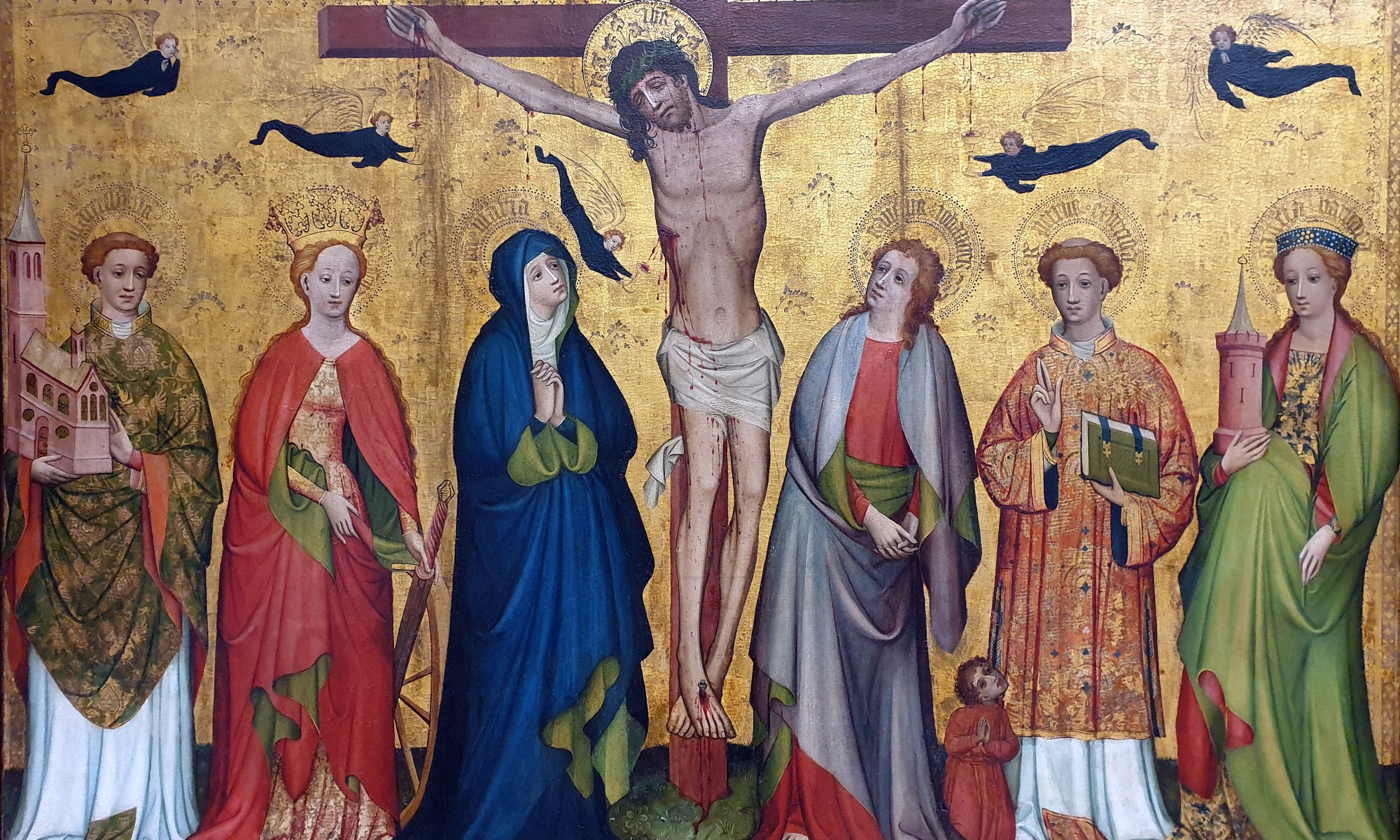
Christ above in torment hangs, She beneath beholds the pangs, of her dying, glorious Son.
Stabat Mater
What must that wood have looked like after the death of our Lord! The Cross was soaked in the Redeemer’s Blood; and so when you see a Cross, think of the Blood of Christ, poured out for you, and don’t deny him what he is asking you for.
St. Josemaría Escrivá
Cross, is always an ill omen, however, if it is very close to the person, it is such that the misfortune will not be long-lasting.
Original Instructions
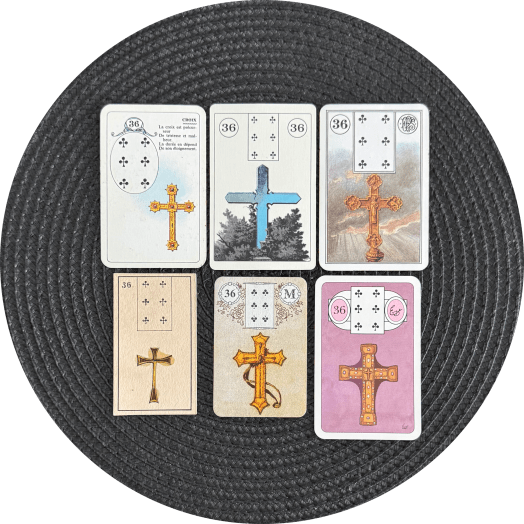
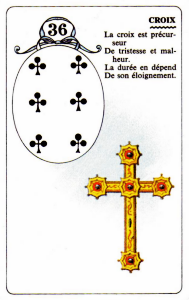
Card No. 36 in the Petit Lenormand, the Cross, is represented by the Six of Clubs. Whilst many contemporary authors associate the card with fate, destiny, karma, or even fated soulmates, such interpretations often overlook the image depicted upon the card itself and the historical context from which the Petit Lenormand emerged.
The Essence and Function of the Cross
The traditional eikōn of the Cross is remarkably consistent across the older patterns. We see a cross or crucifix, sometimes plain, sometimes ornate. The Brepols depicts a jewelled golden cross; the Piatnik shows an engraved example; the Blaue Eule introduces a crown of thorns; whilst the Wüst incorporates trees into the composition. Despite these artistic variations, the symbolism remains fundamentally unchanged.
The essence of the Cross is suffering and its function is to torture.
While the symbolism of a cross pre-dates Christianity, the Petit Lenormand is a child of Christian culture and society. The cards emerged in late eighteenth-century Europe, specifically in the former Holy Roman Empire. At that time, the cross would not merely have been recognised as a religious symbol, but understood through the Passion of Christ. For the ordinary person, the cross spoke of sacrifice, humiliation, agony, endurance, and death. The price of redemption.
Crucifixion was one of the cruellest methods of execution devised by the ancient world. The Romans employed it specifically because it was slow, public, and extraordinarily painful. Victims were subjected to prolonged physical torment, often dying through a combination of shock, exhaustion, blood loss, and gradual suffocation. The purpose was not simply to kill but to inflict suffering.
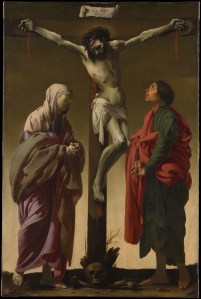
The spiritual literature of Christendom makes this point abundantly clear. In her visions of the Passion, St Brigid of Sweden wrote:
“Sometimes he endeavoured to stretch himself upon the cross, from the excessive bitterness of the intense and acute pain that he endured; for sometimes the pain from his members and pierced veins ascended to his heart, and tortured him cruelly with intense martyrdom, and thus his death was prolonged and dilated, with great torment and bitterness.”
Revelations of St Bridget, p. 55
Modern society often possesses a somewhat softened view of the cross owing to its ubiquity and Christ’s ultimate triumph over death. Yet earlier generations were acutely aware of what it represented. George Bernard Shaw, for example, specifically prohibited the use of a cross upon his memorial because he regarded it as a symbol of torture and blood sacrifice. Likewise, many traditional prayers dwell not merely upon victory, but upon the ignominy, suffering, and burden of Calvary.
This historical perspective provides the key to understanding the card.
When the Cross appears in a reading, it introduces suffering, hardship, burden, and pressure into the area of life it touches. The card does not simply indicate unhappiness. Rather, it signifies circumstances that place us under strain, require endurance, and test our capacity to persevere.
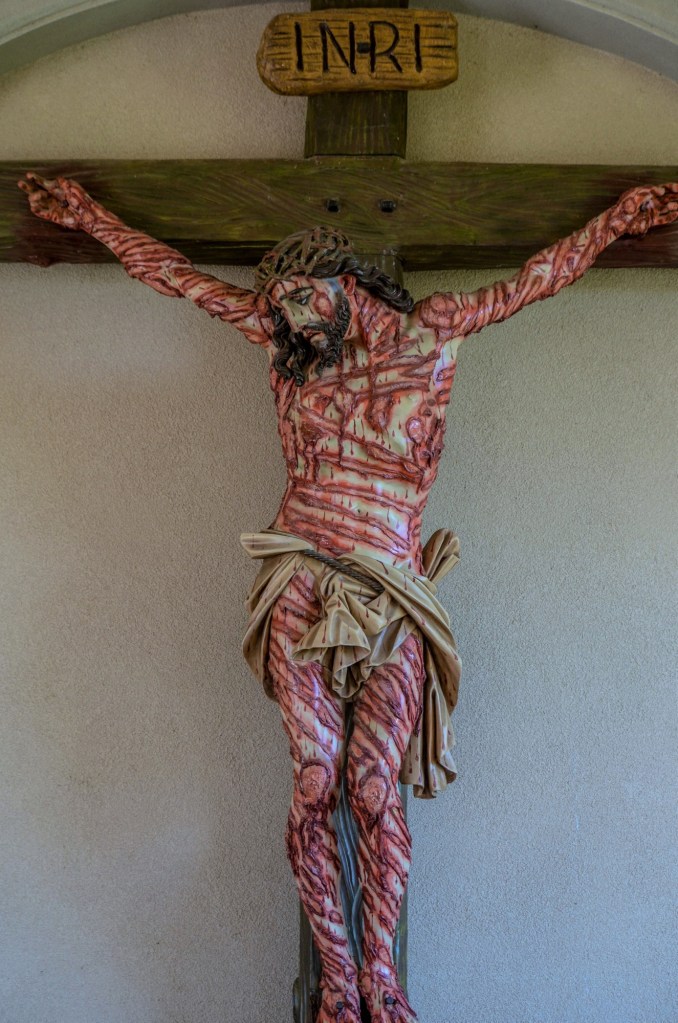
The Cross taxes us. It places weight upon our shoulders and demands that we carry it. These are the burdens we must bear, whether they arise through responsibility, illness, loss, hardship, sacrifice, or misfortune. The card often appears during periods in which progress is achieved only through persistence and resilience.
Like the instrument it depicts, the Cross rarely acts swiftly. Instead, it prolongs difficulties and increases the pressure exerted by surrounding cards. A problem becomes more burdensome; a delay becomes harder to endure; an obligation becomes heavier.
Yet there is another aspect of the Cross that is frequently overlooked. Within Christian thought, suffering is not always punitive. The doctrine of Purgatory, for example, presents suffering as a means of purification, whereby imperfections are burned away and the soul is prepared for a higher state. The process is undoubtedly painful, yet its purpose is ultimately corrective and transformative rather than destructive.
This principle may often be observed in the Cross card. The burdens it brings frequently compel the seeker to reassess priorities, relinquish unhealthy attachments, or develop qualities that would otherwise remain dormant. The Cross may therefore signify a hardship that ultimately changes us for the better. The experience itself is rarely pleasant, but it often leaves us stronger, wiser, more patient, or more resilient than before.
For this reason, the Cross should not be confused with simple misfortune. The Clouds obscures, the Mountain impedes, and the Coffin concludes. The Cross, by contrast, compels us to endure and, through that endurance, to be transformed. It is often the card of trials that shape character and burdens that teach difficult but necessary lessons.
There is also an important nuance preserved within the traditional instructions. When the Cross falls near the significator, the suffering is more immediate but often shorter in duration. The seeker experiences their Calvary now, bears the burden, and passes through it. When the card is more distant, the difficulties frequently lie further ahead, still waiting to be encountered.
Above all, the Cross reminds us that some burdens cannot be avoided. Certain hardships must simply be carried until their appointed end. The card therefore speaks not merely of suffering itself, but of the endurance, perseverance, and transformation that arise through it.
Coda
At its heart, the Cross is a card of suffering, burden, and endurance. It reveals those hardships that tax our strength, test our resolve, and place weight upon our shoulders. Unlike the Clouds, which obscures, or the Mountain, which blocks, the Cross demands that we carry a burden—and continue onwards despite it. Through that struggle, it often changes us, purging what is unnecessary and strengthening what remains.
Person and Description
The Cross is not ordinarily read as a person in its own right. Unlike the Child, Hound, Lord, or Lady, it does not function as a significator. Nevertheless, when appearing alongside a person card, it can provide important information concerning the individual’s physical appearance and temperament.
Physical Appearance
The Cross often describes someone with a lean, angular, or elongated build. Such individuals frequently possess long limbs, particularly the arms and legs, giving rise to an appearance that may be described as gangly or somewhat awkward. The very shape of the card is often reflected in the person it describes.
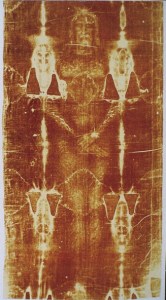
It is also not uncommon for the Cross to signify a person who bears a visible mark of suffering or hardship upon the body itself. Scars, burns, old injuries, amputations, limps, or other lasting physical reminders of past difficulties may all be represented by the card. In this respect, the body quite literally bears its own cross.
More generally, those described by the Cross are often thinner than average, with a somewhat drawn, austere, or careworn appearance. There is frequently something serious about them. Even when physically attractive, they seldom possess the softness, warmth, or symmetry associated with cards such as the Bouquet or the Heart. Rather, their appearance often conveys endurance, experience, and a life that has not always been easy.
Temperament
The Cross corresponds most closely to the traditional melancholic temperament and possesses a distinctly Saturnine quality. Such individuals are serious, reflective, dutiful, and often acutely aware of life’s hardships. They tend to approach life with a sense of responsibility and are rarely frivolous in either word or deed.
Having experienced suffering themselves, they frequently display considerable resilience, patience, and compassion towards others. At their best, Cross people are steadfast, conscientious, self-sacrificing, and capable of enduring difficulties that would overwhelm many. They understand that some burdens must simply be carried and often possess a quiet strength born from experience.
When poorly aspected, however, the Cross can become excessively heavy. The individual may be pessimistic, burdened by guilt, inclined towards martyrdom, or unable to relinquish old griefs and disappointments. Life is experienced more as a duty than a joy, and every hardship becomes another cross to bear.
The placement of the card provides additional nuance. When the Cross falls to the left of a person card, it often emphasises faith, religion, devotion, or a strong moral sense. The individual may be deeply religious, guided by conscience, or committed to a particular spiritual path. When the Cross falls to the right, the emphasis shifts towards sorrow, grief, burdens, and personal trials. Here we often encounter someone carrying a heavy emotional load or struggling through a particularly difficult chapter of life.
In either position, the Cross describes someone whose character has been profoundly shaped by suffering and endurance. Life has asked much of them, and that experience is usually written plainly upon both their character and their bearing.
Special Features
Abscissor: Wax and Wane
The Cross is the Petit Lenormand’s abscissor, from the Latin meaning “cutter-off.” In astrology, the term is often applied to the planet associated with death or termination. Within the Petit Lenormand, the Cross serves as an important marker of time and transition.
The symbolism is present within the image itself. The horizontal and vertical beams divide time into four directions, whilst their intersection forms the present moment. One may therefore view the Cross as a marker of the here and now—the point at which the past gives way to the future.
For this reason, close attention should be paid to the cards immediately adjacent to the Cross. The card preceding the Cross begins to wane and diminish in influence. The card following the Cross, by contrast, is waxing and increasing in significance. Just as the Moon waxes and wanes in light, so too do the cards adjacent to the Cross wax and wane in importance.
One may therefore understand the card to the left as the present becoming the past, whilst the card to the right represents the future becoming the present.
A practical example may illustrate the principle. Last year, my godson had the combination Park – Cross – Ring. A young man in his early twenties, he greatly enjoyed his freedom, social life, and ability to mingle, all of which were aptly shown by the Park. I was therefore rather surprised when I told him that a serious relationship was approaching. Shortly afterwards, he met a young lady at work. Over time, the Ring waxed in importance whilst the Park waned. His relationship became a priority, and he gradually lost touch with some of the people who had previously occupied so much of his social life.
Religion
℣. We adore Thee, O Christ, and we praise Thee.
℟. Because by Thy holy cross Thou hast redeemed the world.
The Cross is the deck’s natural significator of religion, faith, and spirituality. Whilst its imagery is explicitly Christian, its signification extends to religious belief more generally.
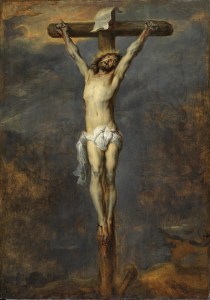
In practice, I have found that the card following the Cross can sometimes indicate the specific form a person’s spirituality takes. These observations arise from long-standing reading experience rather than any traditional instruction and should be regarded as descriptive tendencies rather than absolute rules.
- Cross + Stars: Judaism.
- Cross + Key: Catholicism, Eastern Catholic, Coptic and Orthodox Churches
- Cross + Fishes: Buddhism.
- Cross + Lilies: Hinduism.
- Cross + Moon: Islam.
- Cross + Tree: Neopaganism and Humanism.
- Cross + Park: Ecclesial Communities (Baptists, Anglicanism, Episcopal, Calvinist, Methodists, etc).
As always, context remains paramount.
Blast from the Past
An interesting feature of the Cross is its tendency to show someone re-entering our lives. This most commonly occurs when the Cross falls immediately to the left of a person card.
Thus, Cross + Hound may indicate a friend, colleague, neighbour, or companion whom one has not seen for some time returning to the seeker’s life. In effect, the individual crosses the threshold of the present moment and reappears within the seeker’s immediate circumstances.
When my second teacher first mentioned this technique, I was rather sceptical. Nevertheless, it has appeared with sufficient regularity in my own practice that I can no longer dismiss it. Few observations have proven so consistently reliable.
The Burden and the Support
In larger layouts, particularly the 3 × 3 and the Grand Tableau, special attention should be paid to the cards immediately above and below the Cross.
The card above the Cross frequently denotes the area in which the seeker feels most burdened, taxed, or tested. As we have already seen, cards exert an influence upon those beneath them. Consequently, the card crowning the Cross often reveals the source of the suffering or pressure indicated by the Cross itself.
Thus, if the Fishes appears above the Cross, financial matters may become a significant burden, or the seeker may struggle with excess, dependency, or addiction. If the House crowns the Cross, family obligations or domestic concerns may weigh heavily upon the shoulders. Should the Heart appear above the Cross, emotional suffering, disappointment, or the responsibilities of love may prove difficult to bear.
The card beneath the Cross operates rather differently. Here we often find a source of resilience, support, faith, or endurance. The card becomes strengthened by its position, providing the seeker with something upon which they may rely whilst carrying their burden.
In Christian tradition, Simon of Cyrene assisted Christ by carrying the Cross to Golgotha. The card beneath the Cross frequently performs a similar function. It may reveal the person, quality, resource, belief, or circumstance that helps the seeker endure their present trial.
Cross over Hound may show faithful friends and companions assisting the seeker through a difficult period.
When interpreted together, the cards above and below the Cross often reveal both the source of a person’s suffering and the means by which it may be borne. In this respect, the Cross not only identifies the burden itself but also teaches us where to look for the strength required to carry it.
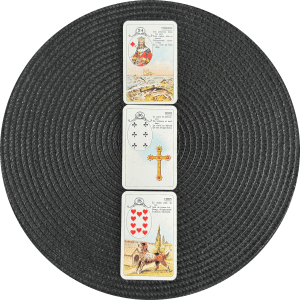
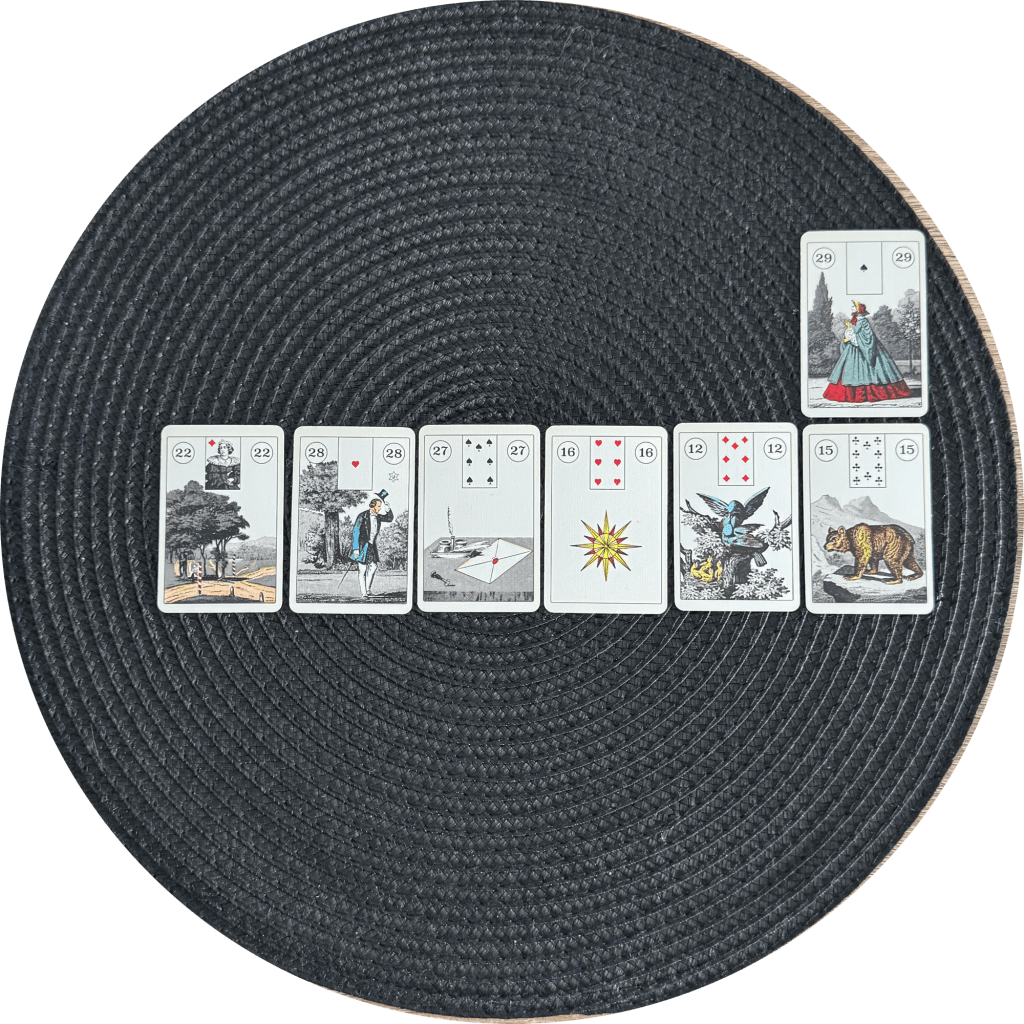
Above, we see an extract from a seeker’s Grand Tableau. The Fishes appeared above the Cross, whilst the Hound fell beneath it. At the time of the reading, the seeker was struggling with significant debt brought about by alcoholism. The Fishes crowning the Cross clearly identified both the financial burden and the addiction that lay at its root. Yet the Hound beneath the Cross revealed the means by which the burden could be borne. It strongly urged the seeker to reach out to her sponsor, as well as to the friends, helpers, and support network already present in her life. In true Hound fashion, assistance was available, but she needed to accept it. The burden remained real, but she did not have to carry it alone.
Time
Because the Cross marks the present moment, it carries a particular significance in timing questions.
When it appears in a timing draw, the card often serves as a reminder that present circumstances matter more than speculation about the future. Whatever is occurring now is likely to exert a direct influence upon the outcome being timed.
The Cross therefore encourages attention to immediate realities rather than distant possibilities. It tells us that the future is being shaped by what we are presently enduring, choosing, or carrying.
Health
In health matters, the Cross frequently indicates exhaustion. The individual is physically, mentally, emotionally, or spiritually depleted and finds even ordinary tasks burdensome.
It is one of the more debilitating cards in the deck, suggesting that suffering has already begun to consume the individual’s reserves of strength. There is often pain, fatigue, strain, or a prolonged sense of being worn down by circumstances.
Anatomically, the Cross is associated with the lower back and lumbar region. Yet in practice it will also frequently appear in connection with headaches, chronic pain, and discomfort affecting the hands or feet—the parts of the body most traditionally associated with crucifixion imagery.
An important distinction may be drawn between the Cross and the Bear. The Bear signifies reserves of strength; the Cross signifies the burden that consumes them. One card stores and strengthens, whilst the other taxes and depletes. Together, they often describe a person enduring considerable strain through sheer perseverance.
Nevertheless, the Cross should not always be regarded as ominous. As discussed earlier, suffering can be purgative as well as painful. Whilst the card may indicate hardship, it can also describe the process through which recovery, resilience, and transformation are achieved. In such cases, the burden remains real, but it serves a purpose beyond mere suffering.
The Cross in Action
Let us turn to a practical example.
In the spring of 2015, a friend invited me to read for guests at a party. One of those guests was Diana, a confident, outgoing, and gregarious primary-school teacher in her late twenties. At the time, she was single and wished to know what developments might be expected in her love life.
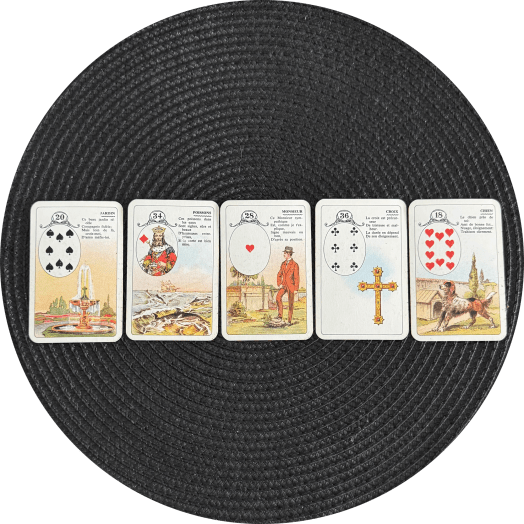
The cards drawn were the Park, the Fishes, the Lord, the Cross, and the Hound.
In this context, we can immediately discount meanings such as the stock market or public finances for the combination of Park and Fishes. Instead, the cards suggest that Diana would have no shortage of opportunities to meet new people. The Fishes indicates abundance, whilst the Park points towards social settings, gatherings, and public interactions. It is also possible that one such meeting would occur near a body of water, although that detail was naturally less certain at the time of the reading.
The appearance of the Lord clearly showed a new man entering her life. The surrounding cards suggested someone successful, well-established, and financially secure. Physically, he appeared to be rather tall, as indicated by the Cross. Given the influence of the Fishes, I also considered green-blue eyes, employment connected with finance, commerce, or the military to be possibilities.
At first glance, the prospects seemed favourable. Yet immediately following the Lord was the Cross.
As discussed earlier, the Cross often causes the card preceding it to wane in influence. The gentleman represented by the Lord was therefore unlikely to remain the central figure for long. This did not necessarily indicate a dramatic ending or bitter disappointment. More often, such combinations suggest that a relationship lacks sufficient substance to develop into something enduring.
The reason became apparent in the final card: the Hound.
Here the Hound pointed towards someone already known to Diana. Rather than introducing a completely new relationship, the cards suggested that an existing association would soon reassert itself. The new man represented by the Lord would enter the picture, but another man from Diana’s past (Cross – Hound) would ultimately prove more significant.
My conclusion was therefore straightforward: Diana would soon meet somebody new, but the more consequential relationship would involve a man she already knew.
Six months later, Diana returned for another reading. By then she had ended her brief relationship with the gentleman represented by the Lord (it would not work, was all Diana said) and had begun seeing a man she had known at university. The Hound had proven entirely accurate. The person who ultimately mattered was not the newcomer, but someone who had already been part of her life and had simply re-entered it at the appropriate time. The Cross told us that.
Images:
Featured Image:
Gemäldegalerie Berlin, Public domain, via Wikimedia Commons
Cards:
Lenormand Cards: Jeu Lenormand © Cartamundi, WanderWüst © Jorge/Wandering Oracle, Lenormand Fortune-Telling Cards © Zao-Gelli, The Lenormand Oracle © Verlag für die Frau, Leipzig, Nieuwe Lenormand © Amber Studio/Erna Droesbeke, Lenormand 36 Orakelspielkarten © Königsfurt-Urania,
References:
Barbet, P. (1963) A Doctor at Calvary: The Passion of Our Lord Jesus Christ as Described by a Surgeon. Garden City, N.Y: Doubleday.
Boroveshengra, A., 2013. Cartomantes’ Cabinet: The Petit Lenormand Course.
Boroveshengra, A., 2015. Lenormand Thirty Six cards. 2nd ed. Create Space.
George, R. 2014 The Essential Lenormand: Your Guide to Precise & Practical Fortunetelling. Woodbury, MN: Llewellyn Publications.
Ignatius Press (2005) Holy Bible RSVCE Compact Zipper. Ignatius Press.
Marco, M. and Goffinet, J., 1989. Petit Lenormand. Bruxelles: Servranx.
Matthews, C. 2014 The Complete Lenormand Oracle Handbook: Reading the Language and Symbols of the Cards. Rochester, VT: Destiny Books.
Meuris, B., 2018. Petit Lenormand Encyclopaedia: Volume 1. Create Space.
Revelations of St. Bridget: On the Life and Passion of Our lord and the Life of his Blessed Mother (2015). Charlotte, NC: TAN Books.
Silvestre, C., 2003. Le Petit Lenormand. [Montpellier]: Gange éd.
The Way of the Cross: According to the Method of St. Francis of Assisi. Charlotte: TAN Books.

 Journal of a Cartomante
_-_GT_2024.jpg)