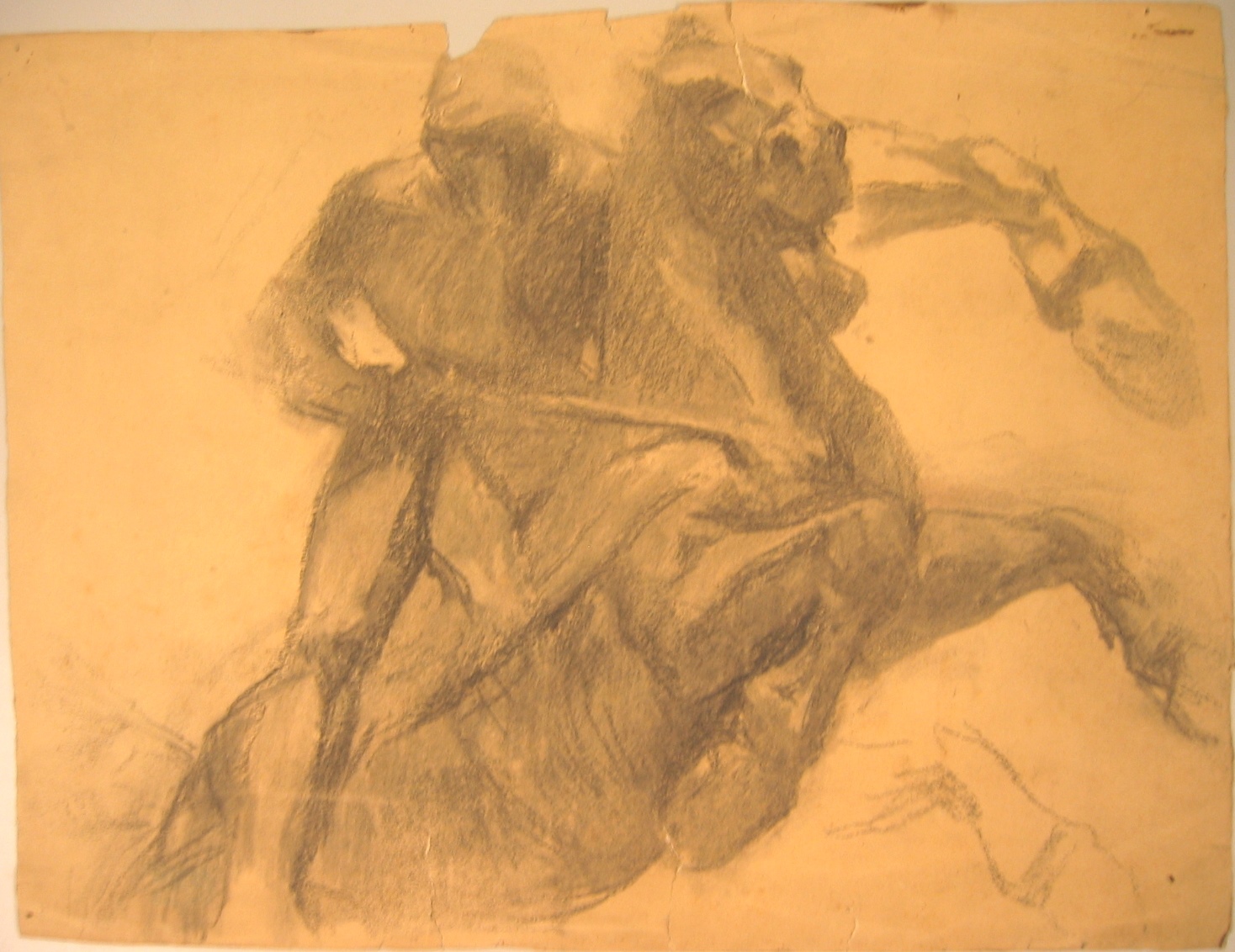
In the moment of our talking, envious time has ebb’d away. Seize the present; trust tomorrow e’en as little as you may.
Carmina, Horace
Cavalier, indicates good news, but a little far away, it can relate to the person’s home or come from foreign countries. This card is a messenger of good fortune when it is not surrounded by cards of a sinister nature.
Original Instructions
Despite being card no. 1, the 9 of Hearts — the Cavalier — is often passed over or regarded as one of the least interesting of the thirty‑six cards in the pack. Does it simply mean *news*? Does it signify your car, motorcycle or bicycle, or would that be the Ship? And if it falls far away, does it refer to someone or somewhere abroad?
The Essence and Function of the Cavalier
The essence of the Cavalier is that of a herald; its function is that of a messenger.
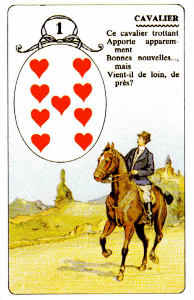
When discussing the Cavalier’s significations, “news” usually tops the list. That is fair: it is a communication card, and the Cavalier brings tidings. But how does it differ from the Letter (or even the Book in some circumstances), which also conveys news? The answer lies in the image — the eikṓn.
The Cavalier in Traditional Decks
In the Carta Mundi, Dondorf, Wust and Blaue Eule pattern, the traditional picture shows a male figure riding a horse. In more detailed illustrations, he is riding out from a substantial chateau. The Cavalier is therefore “a man abroad” — literally out from home — indicating that he is on the move.
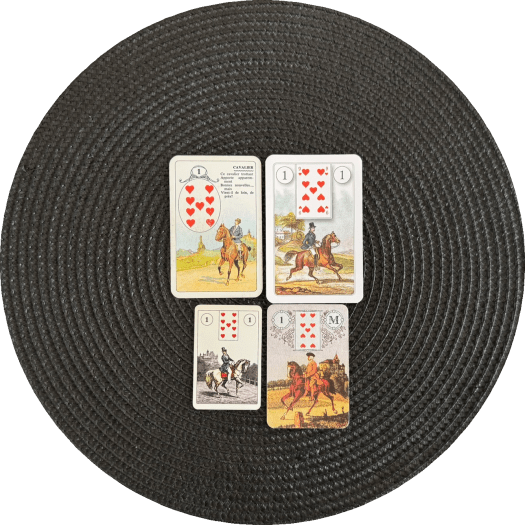
As such, it is often more accurate to say that he foretells the arrival of a visitor bearing news.
Even when combined with the Letter, one is far likelier to receive couriered parcels or documents requiring a signature, or items handed directly to you rather than pushed through the letterbox. The Cavalier adds a personal touch.
The card the Cavalier “rides away” from will often shed light on his tidings. For example, a carte maîtresse (or topic card) such as the Fishes or the Coffin would direct attention to finances or illness. If it is a person card, such as the Hound or the Bouquet (Queen of Spades), it is not uncommon for that person to be the visitor.
In spreads divided into past, present and future, the Cavalier’s gaze is significant. If he looks towards a past card, he may bring old news or an update on an ongoing matter. If he looks towards the future, the reverse is true.
The Cavalier is a fast card that adds celerity to the cards around him. Situations progress quickly. When he appears with cards forecasting opportunities or favourable circumstances, he stresses the need to act promptly. These chances will not linger.
Timing‑wise, the Cavalier is very short‑term. He usually arrives within a week at most — often the same day or the next.
The Cavalier also signifies horses and all members of the *Equidae* family. Paired with the Hound, it may indicate someone who keeps horses, donkeys and similar animals.
Coda
The Cavalier is the card of face‑to‑face communication, in contrast to the Letter. The reader must examine the surrounding cards to determine the nature of his tidings and whether they are welcome. He brings speed to the reading, both in terms of arrival and action — carpe diem.
Person and Description
Like the Birds and the Hound, the Cavalier is one of five cards read as people but not associated with a Court Card.
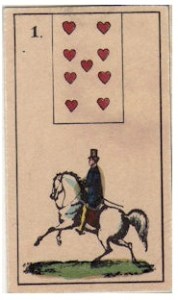
If read as a person, the Cavalier traditionally signifies a man — but only if the rider depicted is male. This is because the person‑function derives purely from the design; the Cavalier is not a court card but the 9♡. Consequently, in decks such as the Gilded Reverie Lenormand the Cavalier must be read as a woman if the rider shown is female. This is no different from the Birds card, which can signify a couple or “two of something” if two birds are shown. More birds, more people.
When read as a person, the attending cards reveal the individual’s character and appearance. The Cavalier sheds its own associations.
Physical Description and Temperament
The traditional eikṓn shows the Cavalier well‑dressed and not in livery or uniform. Artists may depict him in breeches, a justaucorps or a top hat, depending on the era — none of which were peasant attire. The Cavalier is therefore a dapper, well‑presented figure.
Physically, the card suggests someone fashionable, well‑kempt, up‑and‑coming and athletic. Equestrianism is a sport, and riding develops lean muscle. It is common for the Cavalier‑type person to enjoy sport and spend time exercising or in the gym.
If the card falls far away, it can sometimes indicate someone born in another country or of a different ethnicity to the querent. Caution is needed — it may refer to several generations back or simply an unusual name.
In terms of character, the Cavalier describes someone energetic, confident and always on the go — a person who knows what they want and is actively pursuing it. They are usually sociable, good communicators, and, in my experience, loyal and good friends.
Special Features
Traditionally, cartomancers paid attention to the Cavalier’s proximity to the significator.
If he falls far away, he may indeed signify news or a visitor from abroad. More often, however, the news he carries relates only indirectly to the querent — for example, someone calling at the querent’s home to see their spouse with gossip, or news concerning an extended family member or friend. Other times, the querent will hear some news when out-and-about or abroad (in nineteenth century parlance).
The closer the Cavalier falls, the more directly his news concerns the querent.
Over the years, the Cavalier has consistently signified a future love interest (in my readings and those of my clients). This often occurs when the Lord represents a current or former partner. Look for cards such as the Heart or the Ring near the Cavalier. Occasionally, he may appear as the Lady’s chevalier servente, especially with supporting cards such as the Serpent or the Lilies.
I have also found the Cavalier to be the primary significator for male same‑sex or same‑gender relationships. This emerged organically through working with the cards for myself and LGBTQ+ clients. Consequently, I have never found it necessary to replace the Lady with an extra Lord when reading for gay, bisexual or pansexual men. (For bisexual, omnisexual or pansexual clients, you will always need potential male, female and non‑binary cards.)
Transport and Movement
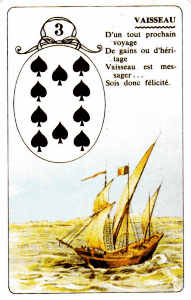
Another special feature of the Cavalier is his horse. When these cards were designed, horses were the primary means of personal transport. Today, the Cavalier’s horse corresponds to our cars, motorcycles and bicycles.
Some readers prefer the Ship for vehicles, but the traditional Ship eikṓn shows a large galleon, carrack or sea vessel — not a mode of everyday personal transport. I read the Ship as trains, buses, aeroplanes and ships. The Cavalier is the car.
Exercise and Sport
The Cavalier also signifies exercise and sport. Equestrianism requires skill and physical effort, whether eventing, endurance, carriage driving or dressage. The surrounding cards describe the specific exercise:
- Bear = weightlifting/bodybuilding
- Scythe = fencing or javelin
- Lilies = yoga
- Ship = rowing or sailing
- Birch Rod = boxing, combat sport, but also polo, cricket etc.
Some readers prefer the Birch Rod for exercise, but that has never made sense to me. Corporal punishment is not a sport.
Well‑Being
The Cavalier can be a welcome sign, indicating a return to form after illness. More commonly, he stresses the importance of diet, exercise and staying active. If accompanied by warning cards (such as the Scythe), he may indicate a sports injury or an accident involving a car or bicycle.
Anatomically, the Cavalier is associated with ligaments, as well as the legs, knees and ankles.
The Cavalier in Action
In 2022, a woman consulted me to ask whether she would be reconciled with an ex‑partner. Unfortunately, the cards indicated that this would not occur. However, the Grand Tableau revealed something far more promising: a new man on the horizon — someone entirely unknown to her.
I conducted a follow‑up reading, employing the Lost Man spread to gather further detail. The cards fell as follows:
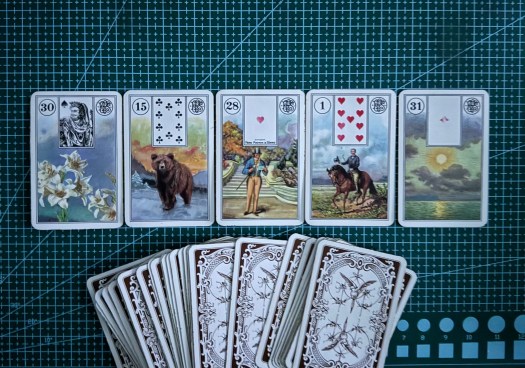
To begin with, we can see that he (Lord) is likely dark‑haired (Bear). Combined with the Cavalier card, we know he is physically fit; paired with the Bear, we are looking at someone deeply committed to resistance training and nutrition, intent on achieving maximum muscular development. The combination of the Cavalier and the Sun suggests a successful athlete — someone who almost certainly competes.
He will be well dressed and attentive to his appearance. The Bear, more often than not, points to facial hair. The pairing of the Bear with the Cavalier frequently indicates a slightly retro or vintage aesthetic — the sort of look one might associate with a modern hipster. This is reinforced by the Lilies, which lend a timeless elegance and a certain refinement.
In temperament, he is self‑reliant and assertive (Bear), with a strong drive for achievement (Cavalier and Sun). He is principled (Lilies) and emotionally stoic (Lilies and Bear).
The client subsequently met a personal trainer who looked as though he had stepped straight off the set of Peaky Blinders. He competed in several body building contests.
§
References:
Boroveshengra, A., 2013. Cartomantes’ Cabinet: The Petit Lenormand Course.
Boroveshengra, A., 2015. Lenormand Thirty Six cards. 2nd ed. Create Space.
Delclos, M., 2013. Le Livre du Petit Lenormand. 1st ed. Escalquens: Éd. Trajectoire.
George, R., 2014. Essential Lenormand. 1st ed. Llewellyn Publications, U.S.
Marco, M. and Goffinet, J., 1989. Petit Lenormand. Bruxelles: Servranx.
Silvestre, C., 2003. Le Petit Lenormand. [Montpellier]: Gange éd
 Journal of a Cartomante