A subject on which one is consulted with some regularity is timing. What is the most effective method? Is there a traditional consensus? Is the pace or suit method the more dependable?
Regrettably, one must be candid: whether we are speaking of the Lenormand Oracle, the Belline Oracle, the Tarot, or any other system of cartomancy, there is no single “best” method. None possesses an inherent or naturally embedded timing system in the way that palmistry does. If I am entirely honest, palmistry remains the most reliable divinatory art for timing.
So, how does a reader who works with the Lenormand Oracle time a reading?
My clientele seldom sought guidance concerning matters two or three years ahead. Their interest was, almost invariably, the next two to six months — a year at most. Over time, I found that the Petit Lenormand suited this time frame remarkably well, possessing an inherent swiftness. For longer‑term enquiries, I relied upon palmistry or, where an accurate birth time was available, astrology, particularly time lords.
Proportion
In my experience, the Grand Tableau — the full thirty‑six cards — covers approximately six to twelve weeks. The cards may touch upon matters beyond this period, but the bulk of the reading tends to unfold within four to eight weeks.
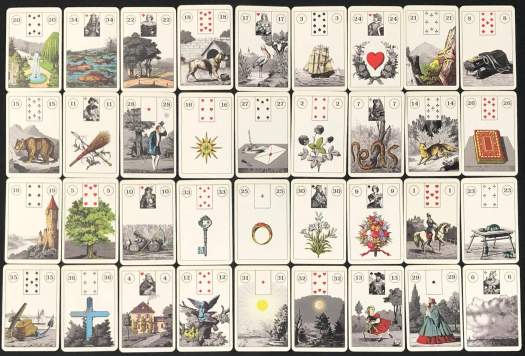
Consequently, if thirty‑six cards encompass six to twelve weeks, eighteen cards will cover roughly three to six weeks. A line or square of nine cards will therefore play out over a week or two.
The Question
If we keep this principle firmly in mind and in practice, the cards respond with far greater reliability. The simplest way to achieve this is through focus and clarity of question. When shuffling, direct your attention to the next month or two. With regular handling of the cards, this becomes second nature.
Timing the Reading
Once this foundation is established, one may begin to incorporate techniques such as pace. When using fewer than eighteen cards — ideally nine or fewer — note whether the spread is dominated by fast or slow cards. Pacing is most effective when cards fall in clusters. For example, if the first row of five contains three or four slow cards, the matters described may unfold over the following week or two. If the second row consists entirely of fast cards, one knows that events begin slowly but conclude swiftly.
Certain combinations have traditional timing associations. For instance, Roads–Cloverleaf indicates a period within six weeks, while Fox–Stars suggests the wrong time — that whatever is under discussion is ill‑timed. In a timing reading, Fox–Stars is very much a sign that the cards are saying you are not meant to know at present. These associations may be employed with confidence.
Seasonal and Daily Associations
Some further timing correspondences:
Bouquet — spring
Sun — summer
Scythe — autumn
Lilies — winter
Coffin–Sun — sunrise
Sun — morning
Park — luncheon
Garden–Moon — afternoon tea
Sun–Coffin — sunset
Moon–Stars — after dusk
Moon — evening
Stars — night
Over time, I have also found the following associations effective in my own readings, though they are not traditional:
Monday — Birch Rod
Tuesday — Cavalier
Wednesday — Lilies
Thursday — Stars
Friday — Cross
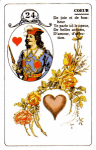
Saturday — Heart
Sunday — Sun
With the above in mind, I tend to focus my readings on short time frames and then employ pace to refine the sequence of events. For final confirmation, I usually draw a specific line of five, asking directly when something will occur, and use the cards’ progressed meanings (Mountain = a delay, Moon = 28 days, et cetera) to determine the time frame — exactly as I taught in my earlier courses. This final line almost invariably aligns with the main reading.
§
Cards: Jeu Lenormand © Cartamundi
 Journal of a Cartomante