Tarot de Marseille: The Picturebook of Fate: The Eights Part 1

This article continues my series examining the trumps of the Tarot de Marseille, adapted from my unpublished manuscript, Tarot de Marseille: The Picturebook of Fate. As throughout this series, the emphasis is placed upon the traditional eikōn of the card, its historical context, and the practical significations I have found useful through divinatory practice. The interpretations presented here reflect my own experience of working with the Tarot de Marseille and should be understood as a working method rather than a definitive authority.

The Eights: Justice and the Star

Trump VIII, La Justice, is one of the most familiar and enduring images of the Tarot. Yet does it concern only courts, contracts, and legal disputes? If it pertains to consequences and accountability, how does it differ from the purgatorial cleansing of the House of God? Does Justice simply demand that everyone receive equal treatment, or does it point towards a deeper principle of righteousness and right order?

The traditional eikōn of Justice is instantly recognisable. A richly dressed woman sits enthroned upon a great chair. Upon her head she wears a coronet adorned with a central jewel. In one hand she holds a double-edged sword; in the other, a balance. Together these symbols express the two essential aspects of justice: discernment and judgement. The scales weigh evidence and competing claims; the sword enforces the conclusion reached.

The essence of Justice is verity; its function is to balance. Justice begins with truth. Indeed, no just judgement is possible without first establishing the facts of the matter. The card therefore concerns objectivity, fairness, accountability, and the proper ordering of relationships, responsibilities, and obligations. Whilst the House of God purges what is disordered through correction and suffering, Justice seeks first to determine what is right and then restore equilibrium accordingly.

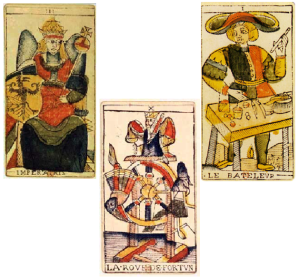
The imagery itself reinforces this principle. Unlike many later depictions of Justice, the Marseille figure wears no blindfold. She sees clearly. This is an important distinction. Justice is not ignorance, neutrality, or indifference. Before the scales can be balanced, the truth must be known. Her direct gaze reminds us that judgement requires observation, discernment, and understanding. The scales weigh the evidence; the sword enforces the verdict. So, watch how Justice balances the cards either side of her.

In the classical Christian tradition, Justice is one of the cardinal virtues and concerns rendering to each person their due. Importantly, this does not always mean giving everyone the same thing. Justice recognises distinctions of circumstance, responsibility, merit, and need. Traditionally, thinkers distinguished between commutative justice, governing obligations between individuals; distributive justice, concerning the allocation of benefits and burdens within society; and legal or social justice, through which individuals contribute to the common good. In every case, the objective remains the same: the establishment and maintenance of right order.

Justice is also a card of causality. Actions produce consequences. Decisions have effects. Causes generate results. The card reminds us that events do not simply arise from nowhere, but proceed from choices, obligations fulfilled or neglected, and the countless interactions that bind society together. Justice therefore asks not merely what happened? but also why did it happen? and what is now due as a result?

For this reason, Justice reminds us that human beings do not exist in isolation. We are members of families, communities, institutions, and societies. Our actions affect others and create obligations which cannot simply be ignored. The card therefore asks whether we have fulfilled our responsibilities, honoured our commitments, and acted with integrity towards those around us. It challenges us to look beyond personal preference and consider what fairness truly requires.

Justice frequently appears when important decisions must be made. Evidence must be gathered, facts established, competing claims weighed, and a conclusion reached. Hasty action is discouraged. The scales remind us that every matter should be examined carefully before judgement is rendered. Once that judgement is reached, however, the sword demands action. Justice does not deliberate indefinitely.

Naturally, the card governs legal matters of all kinds. Courts, contracts, mortgages, leases, wills, taxation, marriage, divorce, and other binding agreements fall within its domain. Yet its significance extends beyond formal legal processes. Whenever obligations, rights, responsibilities, or accountability are central to a situation, Justice is likely to be present. Ultimately, the card asks a simple but profound question: what is truly due in this situation, and how may balance be restored?

General: Righteousness, accountability, and the fair resolution of matters. Justice reminds us that actions have consequences and that causes inevitably produce effects. The card favours careful consideration, impartial judgement, and the weighing of evidence before decisions are reached. Whilst Justice renders what is due, it should not be confused with severity. True justice is tempered by mercy, for justice without mercy becomes cruelty, whilst mercy without justice ceases to be just.

Love: For those who are single, Justice seldom heralds the beginning of a significant new relationship. More often, it suggests that other responsibilities currently demand time, attention, and resources. Relationships that do begin under this card often prove secondary to other obligations and may struggle if practical realities have not been adequately considered. For established couples, Justice emphasises mutual responsibility, fairness, and commitment. Relationships require effort from both parties, and an imbalance of priorities will inevitably create difficulties. The card may also signify separation, divorce, or the equitable division of shared assets and responsibilities.

Career: Justice is naturally associated with the legal profession, including solicitors, barristers, judges, legal secretaries, and clerks. It also governs professions concerned with rules, regulation, and administration, such as human resources, local government, the civil service, compliance, and auditing. More generally, the card teaches that professional success depends upon diligence, reliability, and integrity. Poor timekeeping, failure to meet obligations, and neglect of responsibilities can result in sanctions or dismissal. Conversely, Justice rewards conscientious work and may indicate contracts, agreements, or offers being formally concluded.

Finance: Justice signifies finances that are properly accounted for and carefully balanced. Taxes, settlements, pensions, insurance claims, maintenance payments, and other financial obligations frequently fall under this card. Whilst it seldom promises sudden gains, it favours prudent management, steady savings, and investments approached with due care. Money is received or paid according to what is owed.

Health: Anatomically, Justice is associated with the lungs, kidneys, and urinary system. More broadly, it emphasises balance and personal responsibility in matters of health. Proper diet, exercise, and self-care are essential, whilst neglect and excess are likely to produce long-term consequences. Long-standing habits, whether beneficial or harmful, tend to yield their natural results under this card. Justice may also indicate colds, respiratory complaints, and chest infections, particularly when supported by cards such as the World.

Essence: Verity.
Function: Balance.
Polarity: Neutral.
Astrological Association: Libra.
Timing: October.

§

Tarot Cards: Jean Dodal Tarot via Wikipedia Commons. Public Domain.

Featured Image: Ancient Tarot Major Arcana © BP Grimaud/John Waddington Ltd, Leeds & London, Les Tarot de Marseille Jean Noblet, 1650 © Editions «letarot.com» (2001 [hand stencilled trumps]). Les Tarot de Marseille Jean Dodal, 1701 et 1715 © Editions «letarot.com» (2002 [hand stencilled trumps])
The Consequences Spread

This article previously appeared on my blog in 2022.

Unlike some, I have never had an extensive collection of cards, whether Tarot or otherwise. I did most of my professional Tarot readings with the a Marseille-style deck, Renaissance Tarot (Brian Williams) or the Prediction Tarot. It is this style of Tarot pack that has always drawn me.

But I do enjoy several modern or unusual decks: The Elemental Tarot, PoMo Tarot and the Rolla Nordic Tarot deck.

Popularised by Sasha Fenton, the “Consequences” spread was once quite popular in the 1980s and 1990s. I saw several Readers still using this in the late 1990s but by the mid-2000s it seemed to have vanished. I first came across it in Sasha Fenton’s Tarot In Action!, which I primarily purchased because it was illustrated with the deck I then worked with (the beautiful The Prediction Tarot). I found the Consequences spread a helpful layout and used it a lot, especially when I started doing readings for other people.

The spread is laid out as below.

The positions as follows:

  1. The Questioner’s card.
  2. The person or situation.
  3. Matters affecting the person or situation.
  4. The past.
  5. The future.
  6. Suggested course of action.
  7. Outside factors.
  8. Consequence.

Card one is the Questioner or Significator card and is drawn from the “Royal Arcana” or “Court Cards” before shuffling.

In my experience, cards two and three indicate the present and therefore are better considered together. Card two often describes how the Questioner’s experiences the matter under consideration. Card three is more objective and can describe external causes. I have also found it better to consider card seven before card six. Knowing the outside factors is often key to identifying the course of action the Questioner should take or consider.

In March, I was asked to read for a friend-of-friend who had had a tough time. Renee wanted to know whether her current situation would improve. No further details were volunteered. Renee has black-hair and dark brown eyes. I removed the Queen of Swords from the Rolla Nordic Tarot pack and laid out the Consequences spread. 

  1. Queen of Swords.
  2. 8 of Coins.
  3. 8 of Swords.
  4. King of Cups.
  5. 5 of Cups.
  6. Arcanum XIII. The Reaper.
  7. 4 of Swords.
  8. 4 of Cups.

Card #2 and #3 are both eights that signify “expenditure,” which often entails a loss. Sometimes the 8 of Coins (or Pentacles) can indicate (an expensive) lawsuit, divorce, or financial penalties; however, there are no other indicators of legal action in the spread. The answer lies in the 8 of Swords which often signifies a loss of status or business failure. Swords are the fire cards, and card #3 is flanked by two water cards (cups) and thus undignified. I felt that Renee was in dire financial straits (8 of Coins) due to a loss of business (8 of Swords). The 10 of Swords is more often the card of job loss, but I felt sure Renee had lost her job due to a downturn in business causing her significant money issues. I explained this to Renne and how I also felt this had been quite unfair, and she admitted she had had to apply for her old job of 20-years and been unsuccessful (8 of Swords = loss of status/prestige), resulting in redundancy.

The King of Cups as card #4 shows Renee had both enjoyed her job and the camaraderie with a male colleague. The King is touched by both the 8 of Swords and Arcanum XIII. The Reaper. He is no longer in Renee’s life, and some bitterness is felt on Renee’s part. 

We find the 5 of Cups as card #5. Five is the number of God and good fortune, and this card often indicates love and affection. However, we are not concerned with relationships, so I felt this card showed Renee being successfully selected for a new job soon. 

Card #7 is the 4 of Swords, a symbol of regret. With one eye on the 4 of Cups, I wondered if Renee’s old employer might soon rethink losing her knowledge and offer her a chance to return. 

In position #6, we find Arcanum XIII. The Reaper from the Greater Arcana. Often this card functions like a “period” ending what it falls beside. Otherwise, it is a card of significant alterations in circumstances and depression. Whether or not Renee has a chance to return or not she needs to put this matter behind her. There is no point (Arcanum XIII) in wondering whether she could have done things differently (4 of Swords). What is done is done and cannot be changed. It is time to move on. The Reaper tells her to draw a line under the matter.

Renee said: “I would never go back.” But I still had an intuition that her old job would play a role in getting her back to work.

The consequence is signified by the 4 of Cups. As fours indicate gains, we can sometimes read this card as an increase (gain) in the family (cups). For Renee, it confirms a new job and joining a team. However, it will likely be unexpected. Nevertheless, it will allow her to put the past to bed and start afresh.   

When? There are several methods for timing readings, but none are foolproof. The final card is from the suit of Cups, traditionally held to be ruled by Venus (and sometimes the Moon). Venus rules both Taurus and Libra. I, therefore, suggested May.

At the end of May, I learned that Renee had been offered a job at a school as an office manager. She had learned of the vacancy through her former colleague, who had a child attending the school. She was due to start on June 6.

 §

Tarot In Action! by Sasha Fenton, published by Aquarian Press in 1987.

Tarot de Marseille: The Picturebook of Fate: The Sevens Part 3

This article continues my series examining the trumps of the Tarot de Marseille, adapted from my unpublished manuscript, Tarot de Marseille: The Picturebook of Fate. As throughout this series, the emphasis is placed upon the traditional eikōn of the card, its historical context, and the practical significations I have found useful through divinatory practice. The interpretations presented here reflect my own experience of working with the Tarot de Marseille and should be understood as a working method rather than a definitive authority.

The Sevens: The Charioteer and the House of God

Let us now review another reading and, in doing so, introduce a new spread.

The Mundane Cross

The Mundane Cross is a draw I utilise with all the card systems I work with, including the Tarot de Marseille, Petit Lenormand, Oracle Belline, Tarot Persan de Madame Indira, Oracle de la Triade, and the Victorian Flower Oracle. I developed the spread from certain conventions found in older cartomancy and eventually gave it its name because its layout resembles the traditional glyph of the Earth.

The spread is particularly well suited to questions focused upon a difficulty, obstacle, or challenge that the seeker either anticipates or is presently experiencing.

The 21 trumps and Madman card are shuffled, cut, and dealt in the following manner. The first card is placed at the centre. The second is placed below it, the third above it, the fourth to its left, and the fifth to its right. The resulting layout appears as follows:

03
04 01 05
02

  • Position 1: The Present.
  • Position 2: The Past.
  • Position 3: The Future.
  • Position 4: Unhelpful Influences or What to Avoid.
  • Position 5: Helpful Influences or How to Act.

These days, we are often encouraged to view the past on the left and the future on the right. Yet many older cartomantic methods employed a vertical axis instead. If one considers archaeology, the symbolism becomes rather intuitive: the past lies beneath us because it forms the foundation upon which the present rests. Likewise, the future appears above because it represents what is yet to be built.

A similar logic informs the horizontal axis. The Latin words for left and right are sinister and dexter respectively. Traditionally, the left-hand side was associated with difficulties, complications, and disruptive influences, whilst the right conveyed assistance, remedy, and favourable action.

The Mundane Cross retains these older associations.

The vertical line (Positions 2-1-3) describes the development of the situation from past through present into future. The horizontal line reveals what hinders and what helps. Even where the future appears difficult, the spread frequently reveals practical steps by which matters may be improved.

Stephen’s Reading

Ana is one of my oldest friends. Her eldest son, Stephen, had found himself in some trouble during his teenage years and made a number of foolish mistakes. He eventually dropped out of university and, now in his early twenties, was struggling to secure permanent employment.

Ana was less concerned with predicting exactly what would happen than with understanding how she could best help him move forwards.

The cards dealt were:

  • Position 1: The House of God
  • Position 2: The Juggler
  • Position 3: The Angel
  • Position 4: Death
  • Position 5: The Hermit

The reading begins with the Juggler in the position of the past. The card suggested wasted potential, poor judgement, and a tendency to treat serious matters too lightly. Stephen possessed ability and opportunity, but lacked clear direction. As a consequence, he made choices that drew the wrong sort of attention and closed doors that might otherwise have remained open.

The Juggler can be energetic and talented, but he is not always prudent. In Stephen’s case, the card seemed to describe someone experimenting with life without fully appreciating the consequences of his actions.

The present was represented by the House of God.

Stephen was now experiencing the consequences of his earlier decisions. Although uncomfortable, the process served a corrective purpose.

In my own work, I frequently associate the House of God with Purgatory. Contrary to popular imagination, Purgatory is not primarily concerned with punishment but with purification. It is the process by which what is disordered, harmful, or incomplete is gradually transformed and made ready for something better.

Seen in this light, the House of God suggested that Stephen was passing through a necessary period of correction. His mistakes were not being ignored, nor were they being permitted to define him forever. Rather, they were being exposed, confronted, and purified through experience.

Importantly, the card did not simply indicate change. It indicated visible change. It would not be enough for Stephen to claim that he had learned from his mistakes. He would need to demonstrate it through his actions and conduct. The House of God tears down what is unsound so that something stronger may eventually be built in its place.

Far from indicating destruction for its own sake, the card suggested that Stephen was in the middle of a transformative process. Much like Purgatory itself, the discomfort served a purpose: preparing him for the renewal promised by the Angel that follows.

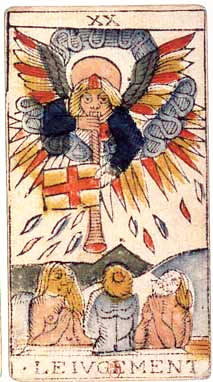
The future was represented by the Angel, one of the most hopeful cards in the traditional tarot.

The Angel is a card of resurrection, restoration, and second chances. It suggests that something believed lost may yet be recovered. Opportunities previously squandered may return, provided the lessons of the past have genuinely been learned.

For this reason, I felt there was a strong possibility that Stephen would eventually return to education or training. More broadly, the card suggested a vocation or calling waiting to be rediscovered. Once the errors of the past had been corrected and put behind him, he would be free to move forwards.

The card in the position of what to avoid was Death.

In this context, Death did not represent literal endings but rather the temptation to abandon hope. The card warned against writing himself off, defining himself by his mistakes, or concluding that his future had already been determined by his past.
The danger represented by Death was the belief that it was all over. Stephen needed to avoid becoming trapped by regret, resentment, or self-condemnation. The card warned him not to abandon the struggle.

The card showing how to act was the Hermit.

The Hermit advised prudence, reflection, and careful consideration. Rather than applying for jobs indiscriminately, Stephen needed to think seriously about what he actually wanted to achieve and how best to reach that goal.

The card also suggested discernment in the opportunities he pursued. Simply seeking any employment without purpose or direction would do little to demonstrate maturity. The Hermit encouraged him to develop a plan, reflect upon his past mistakes, and identify a meaningful path forwards.

Patience was essential. The Hermit does not rush. He illuminates the road one step at a time.

Taken together, the spread tells a remarkably coherent story.

The Juggler represents youthful mistakes and wasted opportunities. The House of God shows those mistakes being exposed, corrected, and purified through difficult experience. The Angel reveals the possibility of restoration and a second chance. Death warns against despair, whilst the Hermit advises a deliberate and thoughtful approach to the future.

The vertical axis tells a story not of downfall, but of redemption. The Juggler represents youthful errors and wasted opportunities. The House of God shows those errors being purified and corrected through experience. The Angel then reveals the possibility of restoration and a second chance. Stephen’s difficulties were therefore not the end of his story, but the means by which he was being prepared for a better one.

This example illustrates one of the great strengths of the Mundane Cross. The spread not only reveals the challenge itself but also identifies both the principal danger and the most effective remedy. Even when circumstances appear difficult, it often points towards a constructive path forward.

§

Tarot Cards: Jean Dodal Tarot via Wikipedia Commons. Public Domain.

Featured Image: Ancient Tarot Major Arcana © BP Grimaud/John Waddington Ltd, Leeds & London, Les Tarot de Marseille Jean Noblet, 1650 © Editions «letarot.com» (2001 [hand stencilled trumps]). Les Tarot de Marseille Jean Dodal, 1701 et 1715 © Editions «letarot.com» (2002 [hand stencilled trumps])