Tarot de Marseille: The Picturebook of Fate: The Sevens Part 2

This article continues my series examining the trumps of the Tarot de Marseille, adapted from my unpublished manuscript, Tarot de Marseille: The Picturebook of Fate. As throughout this series, the emphasis is placed upon the traditional eikōn of the card, its historical context, and the practical significations I have found useful through divinatory practice. The interpretations presented here reflect my own experience of working with the Tarot de Marseille and should be understood as a working method rather than a definitive authority.

The Sevens: The Charioteer and the House of God

Trump XVI, Le Maison Dieu, the House of God, or the Tower, is one of the most fascinating and unsettling cards of the Marseille Tarot. Why is it called the House of God? Is it the Tower of Babel brought low through pride? Sodom and Gomorrah destroyed by “brimstone and fire”? Does it depict divine punishment raining down from heaven? Why has the card become associated with hospitals, accidents, and sudden reversals? Or might its strange imagery point towards something altogether different: purification through suffering?

The traditional eikōn of the House of God is both dramatic and enigmatic. We see a stone tower with three windows. From above, flaming tongues descend from a burning sun and strike the structure. Its crown-shaped turret is dislodged and falls away. Two figures appear to tumble from the building, whilst flames or debris rain from the heavens. It is a powerful image of disruption, upheaval, and exposure.
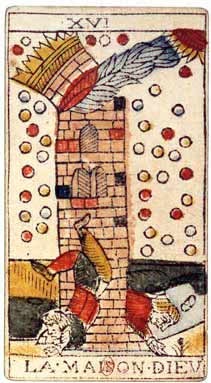
The essence of the House of God is expiation; its function is to purge. The card therefore concerns the removal of what is harmful, disordered, or in need of correction. Whilst this process may be painful, its purpose is ultimately restorative. Something must be cleansed before it can be made whole.

Because of its imagery, many readers associate the card with the Tower of Babel. Certainly, hubris, arrogance, and self-aggrandisement can lead to the sort of dramatic reversals represented here. From this perspective, the House of God serves as a warning that actions have consequences and that no structure built upon faulty foundations can endure indefinitely.

Yet the unusual title invites another interpretation. Several early and later Tarot images depict a fiery tower or gateway from which figures attempt to emerge. Medieval and early modern audiences would have recognised similar imagery from representations of Purgatory. A particularly beautiful example may be found in the Très Riches Heures du Duc de Berry, where souls are shown undergoing purification through cleansing fire.
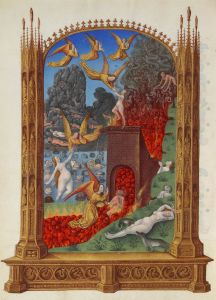
Folio 113v ©Photo. R.M.N. / R.-G. OjŽda. Wikipedia Commons

This is where the doctrine of Purgatory becomes helpful. Contrary to popular misconception, Purgatory is not a second Hell. Rather, it is a state of purification undergone by those destined for salvation but not yet fully prepared for the Beatific Vision. The image has deep roots within Christian thought. The Book of Wisdom speaks of souls being tested as gold in a furnace1. Saint Paul describes a person being saved “it will be as one who has gone through fire.”2 Saint Augustine, writing in The City of God, likewise discusses a purifying fire distinct from eternal punishment3. In each case, the purpose is correction rather than destruction.

At the time the forerunners of the Marseille Tarot emerged, such teachings were the subject of fierce controversy. Yet the notion that imperfections must be purged before perfection can be attained stretches back to the early Church Fathers. Seen in this light, the House of God is not principally a card of catastrophe, but of purification. It reveals those things which must be corrected before true progress can occur.

For this reason, the House of God possesses an interesting relationship with the Hanged Man. Both cards involve suffering, but for different reasons. The Hanged Man suffers from dishonour, damaged reputation, or circumstances that suspend progress. The House of God, by contrast, brings correction, redress, and reparation. When it appears in a reading, previous mistakes, indiscretions, or poor decisions often come to light. The querent may be required to face uncomfortable truths, make restitution, accept responsibility, or endure the consequences of earlier actions. The purpose, however, is ultimately restorative rather than punitive.

The card can therefore manifest through legal difficulties, disciplinary proceedings, formal warnings, examinations, audits, or any circumstance in which faults are exposed and corrected. The process is seldom pleasant, but it serves a necessary purpose. The fire burns away what should not remain.

On a more literal level, the House of God often signifies accidents, disasters, and damage to property. Fire is a particularly strong association, whether through electrical faults, chimney fires, arson, or other causes. The card can also manifest through storms, hurricanes, flooding, lightning strikes, structural failures, and similar events that suddenly disrupt what had previously appeared secure. In such cases, the card does not necessarily imply wrongdoing or punishment. Rather, it reflects the destructive and purgative force already present within the image itself: something is broken down, swept away, or rendered unusable so that a period of repair and rebuilding must follow. For this reason, the House of God frequently appears when accidents are likely to play an important role in the matter under consideration. These may be minor mishaps or more serious incidents involving vehicles, workplaces, homes, or public spaces. The common thread is disruption. Life is interrupted, plans are derailed, and attention is forcibly directed towards addressing the consequences.

The imagery also lends itself naturally to weather and natural disasters. Lightning strikes, fires, storms, structural damage, and other disruptive events frequently fall within the card’s domain. Here again, we see a force that strips away what had previously appeared secure.

Finally, the House of God is a longstanding significator of hospitals and medical treatment. At first glance, the association may seem unusual. Yet treatment itself is often a form of expiation. Surgery, rehabilitation, physiotherapy, chemotherapy, and other interventions can be painful and disruptive, but their purpose is to remove illness and restore health. In much the same way, the House of God depicts the difficult but necessary process by which something harmful is exposed, confronted, and ultimately purged.

General: A period of atonement, correction, or reckoning as past actions and decisions return to demand attention. The card frequently signifies conflict, disputes, and relationships entering a turbulent phase. It may indicate hospitals, prisons, disciplinary proceedings, or significant disruption to one’s circumstances. Property damage, fires, flooding, storms, and other severe weather events also fall within its sphere.

Love: When the House of God is prominent, disagreements, accusations, and confrontations can place considerable strain upon a relationship. Secrets, lies, and matters long concealed often come to light, forcing both parties to address uncomfortable truths. When supported by cards such as Death or the Hanged Man, separations and periods of estrangement may occur. For those who are single, the card is generally unfavourable for new relationships and often signifies loneliness, isolation, or the need to work through unresolved issues before moving forward.

Career: The House of God is associated with the fire and rescue service, paramedics, emergency medicine, and, to a lesser extent, the police. Other occupations include construction, demolition, disaster recovery, and humanitarian or aid work. More generally, the card often heralds instability in professional life. Disciplinary action, redundancy, restructuring, or project failure may disrupt established plans. Progress is delayed whilst necessary corrections are made.

Finance: Financial hardship is a common manifestation of the House of God. Penalties, fines, sanctions, or unexpected expenses may place considerable strain upon resources. Property and vehicle repairs can prove particularly burdensome. In more severe cases, loss of income, mounting debt, eviction, repossession, or foreclosure may become pressing concerns. The card reflects a period in which finances require urgent attention and difficult sacrifices.

Health: The House of God is one of the principal significators of hospitals and medical treatment. With the Popess, it may indicate investigations, tests, and diagnostic procedures; with the Hanged Man, admission or an extended stay. The card is also associated with accidents, injuries, physical trauma, and pain more generally. Whilst often difficult, the treatment or intervention shown by the card usually serves a corrective purpose.

Essence: Expiation.
Function: Purge.
Polarity: Negative.
Astrological Association: Mars.
Timing: Tuesday. Within two years. It may also indicate All Souls’ Day.

§

Tarot Cards: Jean Dodal Tarot via Wikipedia Commons. Public Domain.

Featured Image: Ancient Tarot Major Arcana © BP Grimaud/John Waddington Ltd, Leeds & London, Les Tarot de Marseille Jean Noblet, 1650 © Editions «letarot.com» (2001 [hand stencilled trumps]). Les Tarot de Marseille Jean Dodal, 1701 et 1715 © Editions «letarot.com» (2002 [hand stencilled trumps])

  1. But the souls of the virtuous are in the hands of God, no torment shall ever touch them. In the eyes of the unwise, they did appear to die, their going looked like a disaster, their leaving us, like annihilation; but they are in peace. If they experienced punishment as men see it, their hope was rich with immortality; slight was their affliction, great will their blessings be. God has put them to the test and proved them worthy to be with him; he has tested them like gold in a furnace and accept them as a holocaust. Wisdom 3: 1 – 6 ↩︎
  2. That day will begin with fire, and the fire will test the quality of each man’s work. If his structure stands up to it, he will get his wages; if it is burnt down, he will be the loser, and though he is saved himself, it will be as one who has gone through fire. 1 Corinthians 3: 14 – 15 ↩︎
  3. But temporary punishments are suffered by some in this life only, by others after death, by others both now and then; but all of them before that last and strictest judgment. But of those who suffer temporary punishments after death, all are not doomed to those everlasting pains which are to follow that judgment; for to some, as we have already said, what is not remitted in this world is remitted in the next, that is, they are not punished with the eternal punishment of the world to come. City of God. Vol II. Book XXI. Chapter 13. St Augustine. ↩︎
Tarot de Marseille: The Picturebook of Fate: The Sevens Part 1

This article continues my series examining the trumps of the Tarot de Marseille, adapted from my unpublished manuscript, Tarot de Marseille: The Picturebook of Fate. As throughout this series, the emphasis is placed upon the traditional eikōn of the card, its historical context, and the practical significations I have found useful through divinatory practice. The interpretations presented here reflect my own experience of working with the Tarot de Marseille and should be understood as a working method rather than a definitive authority.

The Sevens: The Charioteer and the House of God

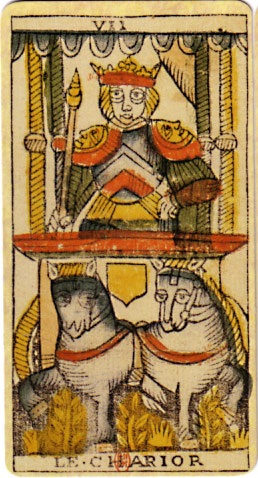
Trump VII, Le Chariot, or the Charioteer, is an intriguing and often misunderstood figure. Does he signify the successful mastery of opposing forces? Why do some associate him with fame and public recognition? Perhaps he is instead a symbol of triumph achieved through persistence, determination, and effort. Whatever interpretation one favours, the Charioteer is fundamentally a card of advancement and success earned through action.

The traditional eikōn depicts a male figure standing within a canopied ceremonial chariot. He carries a large sceptre and wears armour together with an open coronet. Particularly striking are the crescent-faced pauldrons upon his shoulders and the pair of horses that draw the vehicle. Curiously, the horses appear to possess no hind legs, lending the image a dreamlike quality whilst emphasising movement and progress over practical considerations.

The essence of the Charioteer is advancement; his function is to propel. The card concerns forward progress, momentum, and the successful movement of a project, ambition, or undertaking towards its desired conclusion. Unlike the Wheel of Fortune, whose movement is cyclical and uncertain, the Charioteer’s movement is directed and purposeful. He knows where he is going and intends to arrive there.

Even in his fine armour, however, the Charioteer does not appear to be going to war. His equipment is ceremonial rather than practical, and the vehicle itself seems designed for display rather than battle. The image is better understood through the Roman triumphus, a civil and religious ceremony celebrating victory. Victorious generals processed through the city in a ceremonial chariot, receiving public acclaim whilst offering thanks to the gods. In the modern world, graduations, promotions, awards ceremonies, and similar honours fulfil much the same function. The Charioteer therefore represents not the struggle itself, but its successful conclusion.

When the Charioteer appears in a reading, it is usually a sign that matters are moving towards a favourable outcome. A long effort begins to bear fruit. Discipline, perseverance, and determination receive their reward. Frequently, the card follows a setback or disappointment. One passes an examination after a previous failure, secures employment after a lengthy search, or succeeds on a second attempt where the first proved unsuccessful. The victory may not be spectacular, but it is deserved, and therefore all the sweeter.

For this reason, the Charioteer is an encouraging card. It reassures us that persistence, self-reliance, and disciplined effort are capable of producing tangible results. Progress is made, barriers are overcome, and achievements are recognised. The card often carries an element of public acknowledgement, explaining its association with reputation, honours, and occasionally fame. Others take notice of what has been accomplished.

Naturally, the Charioteer is associated with vehicles of all kinds, including cars, bicycles, motorcycles, and horses. It frequently signifies travel and journeys, although these tend to be local or domestic in character. Unlike the World, which broadens horizons and crosses frontiers, the Charioteer usually operates within familiar territory.

An intriguing aspect of the card is its relationship with destiny and Providence. Success seldom arises through effort alone. Ability, determination, and discipline are important, but so too are circumstance and opportunity. The doctrine of Divine Providence teaches that the world is not governed by blind chance, but ordered towards its proper ends according to a wisdom that often exceeds our understanding. The Charioteer reminds us that whilst we must provide the effort, favourable circumstances may also play their part. We steer the chariot and hold the reins, but the road itself is not entirely of our own making.

General: Successful progress through effort, perseverance, and self-reliance. The card signifies advancement, achievement, and tangible results following sustained endeavour. It often indicates the influence of Providence, whereby favourable circumstances assist one’s efforts. Awards, honours, promotions, and public recognition are common manifestations. The Charioteer is also associated with sport, competition, and vehicles.

Love: After a period of difficulties, uncertainty, or important decisions, a relationship is able to move forward once more. The Charioteer frequently appears when one partner has previously prioritised personal ambitions or concerns over the relationship itself. If so, the card suggests that lessons have been learned and that both parties are now prepared to work together towards common goals. Milestones such as engagements, moving in together, or other significant developments often occur under this card. For those who are single, the Charioteer may signify meeting someone whilst travelling or in transit, or a partner whose profession involves driving, transport, emergency services, or the armed forces.

Career: The Charioteer possesses strong connections with the armed forces, military service, and professions requiring discipline and determination. It also governs sport, fitness, and competition, making it relevant to athletes, coaches, and personal trainers. Other associations include mechanics, blacksmiths, metalworkers, engineers, and occupations involving vehicles or transport. In career matters, the card generally promises advancement, promotion, and recognition for hard work.

Finance: Financial circumstances are improving as previous mistakes are left behind and valuable lessons learned. The card indicates a stable income, though one requiring careful management and long-term planning. It commonly appears when the querent is considering a significant purchase, particularly a vehicle. Whilst the purchase may be achievable, the Charioteer advises caution regarding borrowing. Delaying gratification in favour of financial prudence is often the wiser course.

Health: Anatomically, the Charioteer is associated with the head, face, and ears. It may point towards headaches, migraines, vertigo, tinnitus, rosacea, acne, hair loss, and, in women, conditions such as hirsutism. When accompanied by cards such as the Devil or the Tower, it can indicate injuries arising from sport, physical activity, or accidents involving vehicles. More generally, however, the card signifies recovery through perseverance and the determination to overcome adversity.

Essence: Advancement.
Function: Propel.
Polarity: Positive.
Astrological Association: Aries.
Timing: April.

§

Tarot Cards: Jean Dodal Tarot via Wikipedia Commons. Public Domain.

Featured Image: Ancient Tarot Major Arcana © BP Grimaud/John Waddington Ltd, Leeds & London, Les Tarot de Marseille Jean Noblet, 1650 © Editions «letarot.com» (2001 [hand stencilled trumps]). Les Tarot de Marseille Jean Dodal, 1701 et 1715 © Editions «letarot.com» (2002 [hand stencilled trumps].

Tarot de Marseille: The Picturebook of Fate: The Sixes Part 3

This article continues my series examining the trumps of the Tarot de Marseille, adapted from my unpublished manuscript, Tarot de Marseille: The Picturebook of Fate. As throughout this series, the emphasis is placed upon the traditional eikōn of the card, its historical context, and the practical significations I have found useful through divinatory practice. The interpretations presented here reflect my own experience of working with the Tarot de Marseille and should be understood as a working method rather than a definitive authority.

The Sixes: The Lover and the Devil

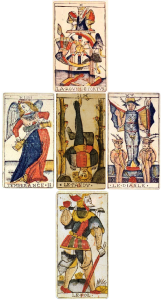
Let us now turn to another example and, in doing so, introduce a different variation of the classic Cross Spread.

One of the principal reasons for this spread’s enduring popularity is its ability to provide a clear and decisive response to a question. Indeed, where appropriate, it may even yield a simple affirmative or negative answer.

In this instance, however, we shall employ an older variation, one often likened to a court hearing. It is perhaps fitting that the querent in this example was herself a barrister, for the structure of the spread closely resembles a legal proceeding.

The twenty-one trumps and the Madman are shuffled and cut, after which four cards are dealt in the form of a cross.

03
01 05 02
04

  • Card 1 (Left): The card arguing in favour of the matter, including helpful influences and supporting evidence.
  • Card 2 (Right): The card arguing against the matter, including obstacles and hostile influences.
  • Card 3 (Above): The judge, who weighs the evidence and clarifies the question.
  • Card 4 (Below): The outcome or verdict.
  • Card 5 (Centre): The synthesis.

Unlike the first four cards, the fifth is not drawn but calculated. One adds together the numerical values of the four cards already laid, using the numbering of the Major Arcana, and reduces the result to a number not exceeding twenty-two.

For example, should one draw the Star (17), the Madman (0), Temperance (14), and the Charioteer (7), the calculation is as follows:

17 + 0 + 14 + 7 = 38

As this exceeds twenty-two, one reduces it further:

3 + 8 = 11

The resulting number corresponds to Fortitude, which serves as the synthesis.

It should be evident that this synthesis card is not to be read as an additional outcome; that function is already fulfilled by the fourth card. Rather, the synthesis reveals the underlying dynamics of the matter, the deeper currents and governing principles operating behind the question.

Oswald Wirth, who was the first author to document this spread in print, advocated reading the synthesis before interpreting the other cards, regarding it as the key to understanding the reading as a whole.

A brief note should be made regarding the Madman. When it appears amongst the first four cards, it is assigned the numerical value of zero for the purposes of calculation. However, the matter is treated somewhat differently in the case of the synthesis. Should the final total reduce to twenty-two, the Madman itself becomes the synthesis card.

Example

This reading was conducted in 2008.

Janine was in her late forties and enjoyed a successful career as a barrister. Three years earlier she had divorced her husband, Ben, following an infidelity. Since they shared two children, Ben remained a regular presence in her life. Recently he had approached her with a proposal that they attempt a reconciliation.
Her question was:

“Should I give him another chance?”

The cards drawn were:

  • Position 1: Temperance (14)
  • Position 2: The Devil (15)
  • Position 3: The Wheel of Fortune (10)
  • Position 4: The Madman (0)


Let us calculate the synthesis:

14 + 15 + 10 + 0 = 39

As this exceeds twenty-two, we reduce it further:

3 + 9 = 12

The synthesis is Trump XII, the Hanged Man. The essence of the Hanged Man is dishonour and advises that past problems—and the loss of trust—still have an influence on the relationship.

The card arguing in favour of reconciliation was Temperance.

Temperance suggested that a genuine degree of harmony had already been achieved between Janine and Ben. Through considerable effort, clear boundaries, and mutual concern for their children, the former couple had established a workable relationship. Communication had improved, conflict had subsided, and they had learned to co-operate effectively as parents.

In short, the card acknowledged that something valuable had been gained since the divorce. A degree of peace and balance had emerged from what had once been a difficult situation.

Arguing against the proposal was the Devil.

The Devil suggested that the unhealthy dynamic which had contributed to the breakdown of the marriage had not truly disappeared. Old patterns of control, dependency, and imbalance remained present beneath the surface.

The card did not necessarily imply malice on Ben’s part. Rather, it questioned whether the underlying nature of the relationship had genuinely changed. Ben appeared eager for reconciliation, but the Devil raised doubts about his motives and, more importantly, about his ability to escape familiar patterns of behaviour.

The judge was the Wheel of Fortune.

This is where the reading became particularly revealing.

The Wheel asked a simple question: what has actually changed?

Relationships often end because the same patterns repeat themselves. The Wheel is not concerned with promises, intentions, or hopes. It is concerned with cycles.

Every previous attempt at improving the relationship had followed a recognisable pattern. Things improved for a time, old difficulties resurfaced, conflict returned, and both parties eventually found themselves back where they had started.

The Wheel therefore reminded Janine that cycles tend to repeat unless something fundamental alters their course.

The outcome was represented by the Madman.

The Madman did not suggest liberation or adventure. Rather, he represented a return to uncertainty, instability, and lack of direction. The card suggested acting without sufficient evidence that the circumstances had materially changed would be a mistake.

One is reminded of the familiar observation that people often repeat the same behaviour whilst hoping for a different result.

From the perspective of the spread’s judicial structure, the verdict was clear. Revisiting the relationship would place Janine back upon an uncertain road whose destination was already largely known.

The synthesis was the Hanged Man, and it confirmed this interpretation.

The Hanged Man revealed the deeper dynamic underlying the question. Janine remained suspended between the past and the future. Part of her still felt the pull of what the marriage had once been, whilst another part recognised the life she had built since the divorce. She still couldn’t forget Ben’s betrayal and loss of trust.

The synthesis therefore suggested that reconciliation would not resolve this state of suspension. On the contrary, it was likely to prolong it. Rather than moving forwards, Janine risked becoming trapped once again within circumstances she had already spent years trying to escape.

My conclusion was that Janine should not give Ben another chance.

The cards did not suggest that reconciliation was impossible, but they strongly indicated that the conditions necessary for a successful reconciliation were absent. Temperance showed that a healthy co-parenting relationship had already been established. The Devil suggested that unhealthy dynamics remained unresolved. The Wheel of Fortune questioned whether anything fundamental had changed, whilst the Madman warned against returning to uncertainty and repeating familiar mistakes.

The Hanged Man ultimately revealed that revisiting the relationship would leave Janine suspended between the life she had left behind and the future she was attempting to create.

This example illustrates an important principle of the Cross Spread. The verdict alone is not the whole answer. The judge explains why the verdict is reached, whilst the synthesis reveals the deeper principle operating beneath the entire matter. Here, both the verdict and the synthesis pointed away from genuine progress. The Madman offered movement without direction, whilst the Hanged Man offered suspension without resolution. Together, they suggested that the cycle was far more likely to repeat than to change.

§

Tarot Cards: Jean Dodal Tarot via Wikipedia Commons. Public Domain.

Featured Image: Ancient Tarot Major Arcana © BP Grimaud/John Waddington Ltd, Leeds & London, Les Tarot de Marseille Jean Noblet, 1650 © Editions «letarot.com» (2001 [hand stencilled trumps]). Les Tarot de Marseille Jean Dodal, 1701 et 1715 © Editions «letarot.com» (2002 [hand stencilled trumps])