This article continues my series examining the trumps of the Tarot de Marseille, adapted from my unpublished manuscript, Tarot de Marseille: The Picturebook of Fate. As throughout this series, the emphasis is placed upon the traditional eikōn of the card, its historical context, and the practical significations I have found useful through divinatory practice. The interpretations presented here reflect my own experience of working with the Tarot de Marseille and should be understood as a working method rather than a definitive authority.
The Sevens: The Charioteer and the House of God
Trump XVI, Le Maison Dieu, the House of God, or the Tower, is one of the most fascinating and unsettling cards of the Marseille Tarot. Why is it called the House of God? Is it the Tower of Babel brought low through pride? Sodom and Gomorrah destroyed by “brimstone and fire”? Does it depict divine punishment raining down from heaven? Why has the card become associated with hospitals, accidents, and sudden reversals? Or might its strange imagery point towards something altogether different: purification through suffering?
The traditional eikōn of the House of God is both dramatic and enigmatic. We see a stone tower with three windows. From above, flaming tongues descend from a burning sun and strike the structure. Its crown-shaped turret is dislodged and falls away. Two figures appear to tumble from the building, whilst flames or debris rain from the heavens. It is a powerful image of disruption, upheaval, and exposure.
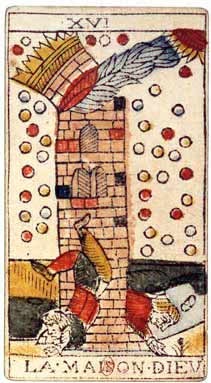
The essence of the House of God is expiation; its function is to purge. The card therefore concerns the removal of what is harmful, disordered, or in need of correction. Whilst this process may be painful, its purpose is ultimately restorative. Something must be cleansed before it can be made whole.
Because of its imagery, many readers associate the card with the Tower of Babel. Certainly, hubris, arrogance, and self-aggrandisement can lead to the sort of dramatic reversals represented here. From this perspective, the House of God serves as a warning that actions have consequences and that no structure built upon faulty foundations can endure indefinitely.
Yet the unusual title invites another interpretation. Several early and later Tarot images depict a fiery tower or gateway from which figures attempt to emerge. Medieval and early modern audiences would have recognised similar imagery from representations of Purgatory. A particularly beautiful example may be found in the Très Riches Heures du Duc de Berry, where souls are shown undergoing purification through cleansing fire.
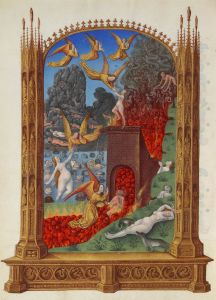
This is where the doctrine of Purgatory becomes helpful. Contrary to popular misconception, Purgatory is not a second Hell. Rather, it is a state of purification undergone by those destined for salvation but not yet fully prepared for the Beatific Vision. The image has deep roots within Christian thought. The Book of Wisdom speaks of souls being tested as gold in a furnace1. Saint Paul describes a person being saved “it will be as one who has gone through fire.”2 Saint Augustine, writing in The City of God, likewise discusses a purifying fire distinct from eternal punishment3. In each case, the purpose is correction rather than destruction.
At the time the forerunners of the Marseille Tarot emerged, such teachings were the subject of fierce controversy. Yet the notion that imperfections must be purged before perfection can be attained stretches back to the early Church Fathers. Seen in this light, the House of God is not principally a card of catastrophe, but of purification. It reveals those things which must be corrected before true progress can occur.
For this reason, the House of God possesses an interesting relationship with the Hanged Man. Both cards involve suffering, but for different reasons. The Hanged Man suffers from dishonour, damaged reputation, or circumstances that suspend progress. The House of God, by contrast, brings correction, redress, and reparation. When it appears in a reading, previous mistakes, indiscretions, or poor decisions often come to light. The querent may be required to face uncomfortable truths, make restitution, accept responsibility, or endure the consequences of earlier actions. The purpose, however, is ultimately restorative rather than punitive.
The card can therefore manifest through legal difficulties, disciplinary proceedings, formal warnings, examinations, audits, or any circumstance in which faults are exposed and corrected. The process is seldom pleasant, but it serves a necessary purpose. The fire burns away what should not remain.
On a more literal level, the House of God often signifies accidents, disasters, and damage to property. Fire is a particularly strong association, whether through electrical faults, chimney fires, arson, or other causes. The card can also manifest through storms, hurricanes, flooding, lightning strikes, structural failures, and similar events that suddenly disrupt what had previously appeared secure. In such cases, the card does not necessarily imply wrongdoing or punishment. Rather, it reflects the destructive and purgative force already present within the image itself: something is broken down, swept away, or rendered unusable so that a period of repair and rebuilding must follow. For this reason, the House of God frequently appears when accidents are likely to play an important role in the matter under consideration. These may be minor mishaps or more serious incidents involving vehicles, workplaces, homes, or public spaces. The common thread is disruption. Life is interrupted, plans are derailed, and attention is forcibly directed towards addressing the consequences.
The imagery also lends itself naturally to weather and natural disasters. Lightning strikes, fires, storms, structural damage, and other disruptive events frequently fall within the card’s domain. Here again, we see a force that strips away what had previously appeared secure.
Finally, the House of God is a longstanding significator of hospitals and medical treatment. At first glance, the association may seem unusual. Yet treatment itself is often a form of expiation. Surgery, rehabilitation, physiotherapy, chemotherapy, and other interventions can be painful and disruptive, but their purpose is to remove illness and restore health. In much the same way, the House of God depicts the difficult but necessary process by which something harmful is exposed, confronted, and ultimately purged.
General: A period of atonement, correction, or reckoning as past actions and decisions return to demand attention. The card frequently signifies conflict, disputes, and relationships entering a turbulent phase. It may indicate hospitals, prisons, disciplinary proceedings, or significant disruption to one’s circumstances. Property damage, fires, flooding, storms, and other severe weather events also fall within its sphere.
Love: When the House of God is prominent, disagreements, accusations, and confrontations can place considerable strain upon a relationship. Secrets, lies, and matters long concealed often come to light, forcing both parties to address uncomfortable truths. When supported by cards such as Death or the Hanged Man, separations and periods of estrangement may occur. For those who are single, the card is generally unfavourable for new relationships and often signifies loneliness, isolation, or the need to work through unresolved issues before moving forward.
Career: The House of God is associated with the fire and rescue service, paramedics, emergency medicine, and, to a lesser extent, the police. Other occupations include construction, demolition, disaster recovery, and humanitarian or aid work. More generally, the card often heralds instability in professional life. Disciplinary action, redundancy, restructuring, or project failure may disrupt established plans. Progress is delayed whilst necessary corrections are made.
Finance: Financial hardship is a common manifestation of the House of God. Penalties, fines, sanctions, or unexpected expenses may place considerable strain upon resources. Property and vehicle repairs can prove particularly burdensome. In more severe cases, loss of income, mounting debt, eviction, repossession, or foreclosure may become pressing concerns. The card reflects a period in which finances require urgent attention and difficult sacrifices.
Health: The House of God is one of the principal significators of hospitals and medical treatment. With the Popess, it may indicate investigations, tests, and diagnostic procedures; with the Hanged Man, admission or an extended stay. The card is also associated with accidents, injuries, physical trauma, and pain more generally. Whilst often difficult, the treatment or intervention shown by the card usually serves a corrective purpose.
Essence: Expiation.
Function: Purge.
Polarity: Negative.
Astrological Association: Mars.
Timing: Tuesday. Within two years. It may also indicate All Souls’ Day.
§
Tarot Cards: Jean Dodal Tarot via Wikipedia Commons. Public Domain.
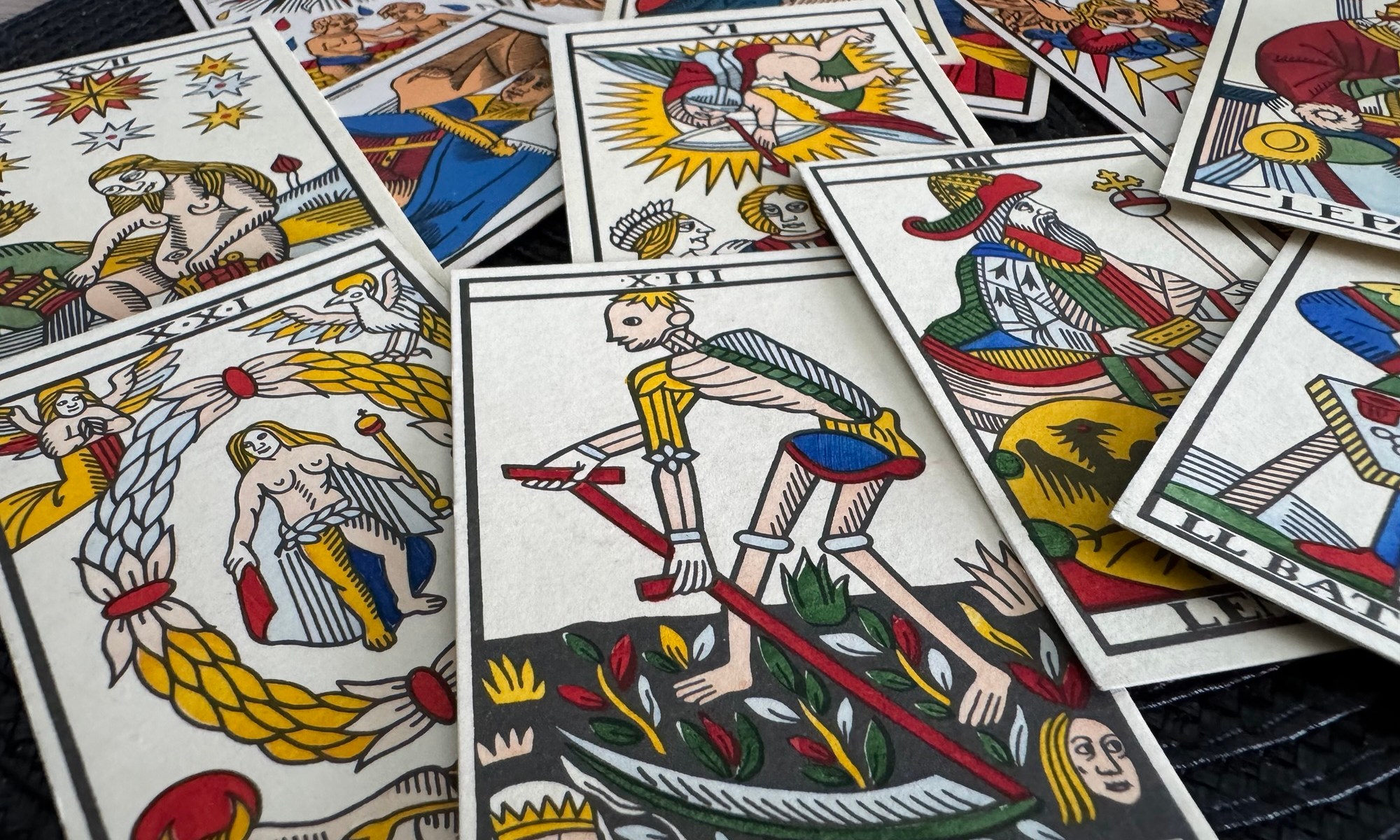
Featured Image: Ancient Tarot Major Arcana © BP Grimaud/John Waddington Ltd, Leeds & London, Les Tarot de Marseille Jean Noblet, 1650 © Editions «letarot.com» (2001 [hand stencilled trumps]). Les Tarot de Marseille Jean Dodal, 1701 et 1715 © Editions «letarot.com» (2002 [hand stencilled trumps])
- But the souls of the virtuous are in the hands of God, no torment shall ever touch them. In the eyes of the unwise, they did appear to die, their going looked like a disaster, their leaving us, like annihilation; but they are in peace. If they experienced punishment as men see it, their hope was rich with immortality; slight was their affliction, great will their blessings be. God has put them to the test and proved them worthy to be with him; he has tested them like gold in a furnace and accept them as a holocaust. Wisdom 3: 1 – 6 ↩︎
- That day will begin with fire, and the fire will test the quality of each man’s work. If his structure stands up to it, he will get his wages; if it is burnt down, he will be the loser, and though he is saved himself, it will be as one who has gone through fire. 1 Corinthians 3: 14 – 15 ↩︎
- But temporary punishments are suffered by some in this life only, by others after death, by others both now and then; but all of them before that last and strictest judgment. But of those who suffer temporary punishments after death, all are not doomed to those everlasting pains which are to follow that judgment; for to some, as we have already said, what is not remitted in this world is remitted in the next, that is, they are not punished with the eternal punishment of the world to come. City of God. Vol II. Book XXI. Chapter 13. St Augustine. ↩︎

