

This article continues my series examining the trumps of the Tarot de Marseille, adapted from my unpublished manuscript, Tarot de Marseille: The Picturebook of Fate. As throughout this series, the emphasis is placed upon the traditional eikōn of the card, its historical context, and the practical significations I have found useful through divinatory practice. The interpretations presented here reflect my own experience of working with the Tarot de Marseille and should be understood as a working method rather than a definitive authority.
The Sevens: The Charioteer and the House of God
Trump VII, Le Chariot, or the Charioteer, is an intriguing and often misunderstood figure. Does he signify the successful mastery of opposing forces? Why do some associate him with fame and public recognition? Perhaps he is instead a symbol of triumph achieved through persistence, determination, and effort. Whatever interpretation one favours, the Charioteer is fundamentally a card of advancement and success earned through action.
The traditional eikōn depicts a male figure standing within a canopied ceremonial chariot. He carries a large sceptre and wears armour together with an open coronet. Particularly striking are the crescent-faced pauldrons upon his shoulders and the pair of horses that draw the vehicle. Curiously, the horses appear to possess no hind legs, lending the image a dreamlike quality whilst emphasising movement and progress over practical considerations.
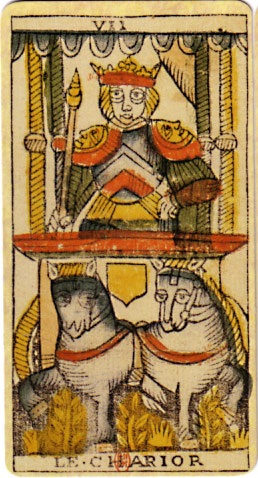
The essence of the Charioteer is advancement; his function is to propel. The card concerns forward progress, momentum, and the successful movement of a project, ambition, or undertaking towards its desired conclusion. Unlike the Wheel of Fortune, whose movement is cyclical and uncertain, the Charioteer’s movement is directed and purposeful. He knows where he is going and intends to arrive there.
Even in his fine armour, however, the Charioteer does not appear to be going to war. His equipment is ceremonial rather than practical, and the vehicle itself seems designed for display rather than battle. The image is better understood through the Roman triumphus, a civil and religious ceremony celebrating victory. Victorious generals processed through the city in a ceremonial chariot, receiving public acclaim whilst offering thanks to the gods. In the modern world, graduations, promotions, awards ceremonies, and similar honours fulfil much the same function. The Charioteer therefore represents not the struggle itself, but its successful conclusion.
When the Charioteer appears in a reading, it is usually a sign that matters are moving towards a favourable outcome. A long effort begins to bear fruit. Discipline, perseverance, and determination receive their reward. Frequently, the card follows a setback or disappointment. One passes an examination after a previous failure, secures employment after a lengthy search, or succeeds on a second attempt where the first proved unsuccessful. The victory may not be spectacular, but it is deserved, and therefore all the sweeter.
For this reason, the Charioteer is an encouraging card. It reassures us that persistence, self-reliance, and disciplined effort are capable of producing tangible results. Progress is made, barriers are overcome, and achievements are recognised. The card often carries an element of public acknowledgement, explaining its association with reputation, honours, and occasionally fame. Others take notice of what has been accomplished.
Naturally, the Charioteer is associated with vehicles of all kinds, including cars, bicycles, motorcycles, and horses. It frequently signifies travel and journeys, although these tend to be local or domestic in character. Unlike the World, which broadens horizons and crosses frontiers, the Charioteer usually operates within familiar territory.
An intriguing aspect of the card is its relationship with destiny and Providence. Success seldom arises through effort alone. Ability, determination, and discipline are important, but so too are circumstance and opportunity. The doctrine of Divine Providence teaches that the world is not governed by blind chance, but ordered towards its proper ends according to a wisdom that often exceeds our understanding. The Charioteer reminds us that whilst we must provide the effort, favourable circumstances may also play their part. We steer the chariot and hold the reins, but the road itself is not entirely of our own making.
General: Successful progress through effort, perseverance, and self-reliance. The card signifies advancement, achievement, and tangible results following sustained endeavour. It often indicates the influence of Providence, whereby favourable circumstances assist one’s efforts. Awards, honours, promotions, and public recognition are common manifestations. The Charioteer is also associated with sport, competition, and vehicles.
Love: After a period of difficulties, uncertainty, or important decisions, a relationship is able to move forward once more. The Charioteer frequently appears when one partner has previously prioritised personal ambitions or concerns over the relationship itself. If so, the card suggests that lessons have been learned and that both parties are now prepared to work together towards common goals. Milestones such as engagements, moving in together, or other significant developments often occur under this card. For those who are single, the Charioteer may signify meeting someone whilst travelling or in transit, or a partner whose profession involves driving, transport, emergency services, or the armed forces.
Career: The Charioteer possesses strong connections with the armed forces, military service, and professions requiring discipline and determination. It also governs sport, fitness, and competition, making it relevant to athletes, coaches, and personal trainers. Other associations include mechanics, blacksmiths, metalworkers, engineers, and occupations involving vehicles or transport. In career matters, the card generally promises advancement, promotion, and recognition for hard work.
Finance: Financial circumstances are improving as previous mistakes are left behind and valuable lessons learned. The card indicates a stable income, though one requiring careful management and long-term planning. It commonly appears when the querent is considering a significant purchase, particularly a vehicle. Whilst the purchase may be achievable, the Charioteer advises caution regarding borrowing. Delaying gratification in favour of financial prudence is often the wiser course.
Health: Anatomically, the Charioteer is associated with the head, face, and ears. It may point towards headaches, migraines, vertigo, tinnitus, rosacea, acne, hair loss, and, in women, conditions such as hirsutism. When accompanied by cards such as the Devil or the Tower, it can indicate injuries arising from sport, physical activity, or accidents involving vehicles. More generally, however, the card signifies recovery through perseverance and the determination to overcome adversity.
Essence: Advancement.
Function: Propel.
Polarity: Positive.
Astrological Association: Aries.
Timing: April.
§
Tarot Cards: Jean Dodal Tarot via Wikipedia Commons. Public Domain.
Featured Image: Ancient Tarot Major Arcana © BP Grimaud/John Waddington Ltd, Leeds & London, Les Tarot de Marseille Jean Noblet, 1650 © Editions «letarot.com» (2001 [hand stencilled trumps]). Les Tarot de Marseille Jean Dodal, 1701 et 1715 © Editions «letarot.com» (2002 [hand stencilled trumps].

