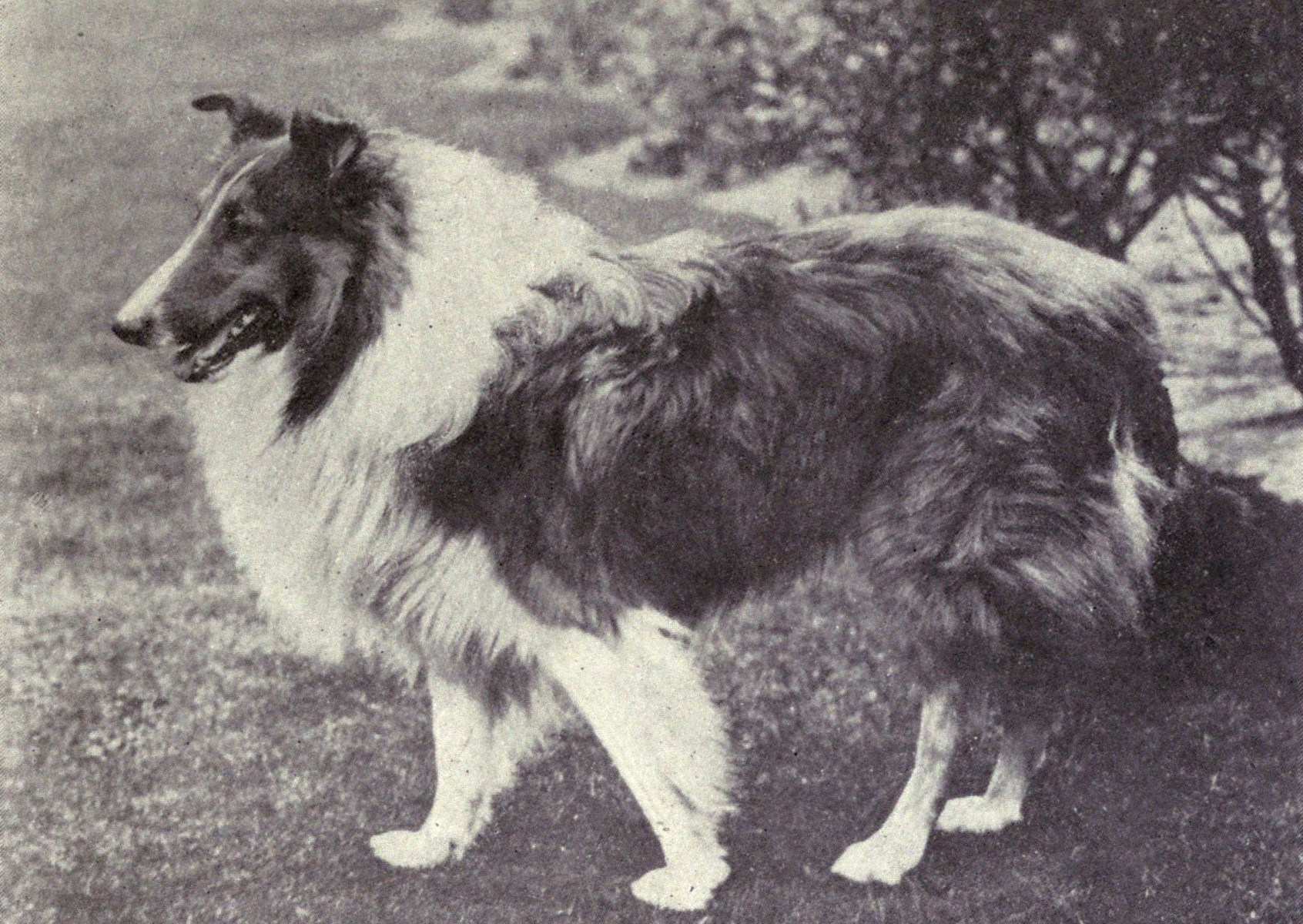
Lassie was so well known in the village. It was because, as the women said, “You can set your clock by her.”
Eric Knight, Lassie Come-Home
Moreover, when our hearts are authentically open to universal communion, this sense of fraternity excludes nothing and no one. It follows that our indifference or cruelty towards fellow creatures of this world sooner or later affects the treatment we mete out to other human beings.
Pope Francis, Laudato Si’
Dog, very close, it is an assurance of fidelity and friendship; very far it indicates betrayal, and if surrounded by clouds it warns not to rely on those who call themselves friends.
Original Instructions
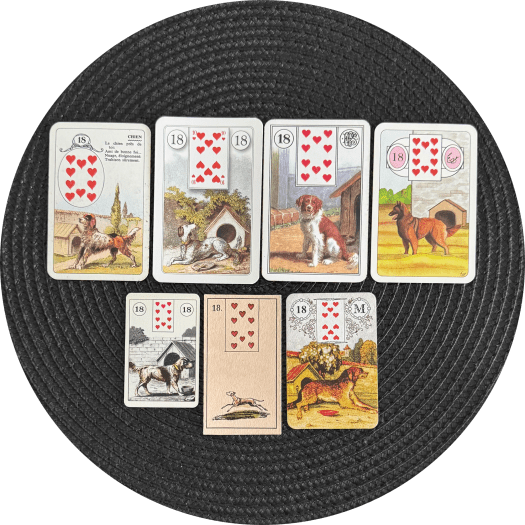
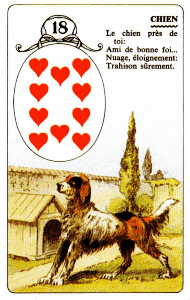
Card No. 18 in the Petit Lenormand, the Hound, is represented by the Ten of Hearts. Few cards in the deck are as readily associated with friendship and loyalty. Yet reducing the card to friendship alone overlooks much of its symbolism and practical application.
The Essence and Function of the Hound
The traditional eikōn depicts a medium- to large-sized working dog, often resembling a setter, spaniel, or similar breed. The animal is frequently shown within its master’s garden, beside its kennel, and many decks depict the hound with ears raised attentively as though it has heard or seen something of interest. This attentive posture is itself revealing, for the hound is neither idle nor decorative. It has a role to fulfil.
The essence of the Hound is association and its function is to support and assist.
Dogs possess one of the oldest relationships between mankind and the animal kingdom. Long before they became household pets, dogs served as hunting companions, guardians of hearth and home, herders of livestock, protectors of property, and assistants in countless daily tasks. Even today, many working breeds continue to perform duties that require intelligence, attentiveness, and co-operation with human beings.
For this reason, I prefer the designation Hound rather than the more common Dog. The modern word dog readily evokes the image of a pet and encourages a somewhat sentimental interpretation centred upon affection and loyalty. Whilst loyalty certainly forms part of the card’s symbolism, it is only one aspect of a broader picture. The hound is not merely loved; it is useful. It accompanies, assists, guards, and works alongside its master.
When the Hound appears near the significator, traditional interpretations emphasise faithful friendships, loyalty, and support. This is not incorrect. However, it should not be accepted uncritically. The surrounding cards must always be consulted. The Hound accompanied by the Fox, Serpent, or Birch Rod may indicate false friends, betrayal, manipulation, or unhealthy social dynamics. A person may call themselves a friend whilst behaving in a manner that is anything but friendly.
For this reason, the Hound should be regarded as a neutral card. It identifies members of the seeker’s social circle and support network, but does not automatically guarantee their goodwill. The neighbouring cards reveal whether the relationships are beneficial or harmful.
In practice, the Hound is first and foremost the card of the seeker’s entourage. When it falls nearby, one can be reasonably certain that the seeker is not acting alone. There are people around them whose lives and interests intersect with their own. Free from warning cards or malefics, one may conclude that the pack is close-knit and supportive. The card thus speaks less of the solitary devotion embodied by Lassie or Greyfriars Bobby than it does of mutual co-operation within a pack.
Unlike the Bear, which stands above us through authority and influence, the Hound stands beside us. The card describes peers, companions, associates, and those with whom we share common interests, responsibilities, or objectives. It is fundamentally a card of horizontal rather than hierarchical relationships.
An often-overlooked aspect of the card arises from the traditional image itself. The hound is typically shown outdoors beside its kennel, guarding the grounds of its master’s property. Consequently, the card frequently signifies individuals who work alongside us or provide services on our behalf. Employees, assistants, gardeners, maintenance workers, and others who contribute to the smooth running of daily life may all be represented by the Hound. In this sense, the card encompasses anyone whose role involves practical support.
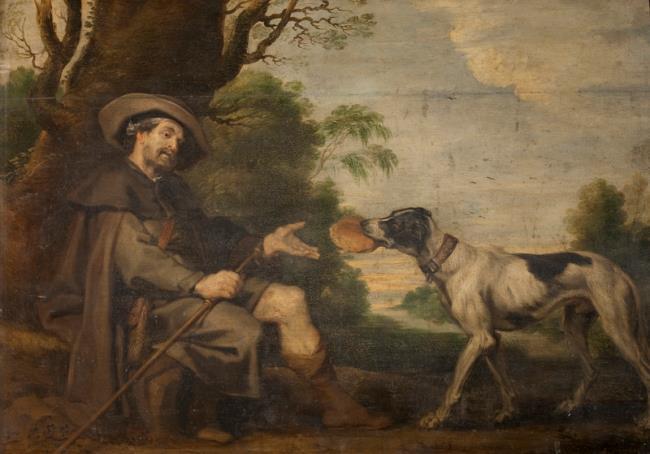
The kennel itself offers another useful clue. Situated within the grounds of the home whilst remaining a separate dwelling, it naturally suggests those who live nearby. For this reason, the Hound may also signify neighbours, particularly those with whom we interact regularly.
The card possesses a strong connection to professional life. For those who supervise staff, the Hound frequently represents employees. Otherwise, it often signifies colleagues and co-workers. Certain combinations may add further specificity. With the Birch Rod, the card may indicate a trade-union representative or workplace advocate. With the House, it can point towards human resources or another department concerned with the welfare and administration of employees.
As the card of association, the Hound can also function as a useful third-party significator. Relationships create bonds that often persist long after the romance itself has ended. For this reason, it is not uncommon to find the Hound representing an ex-partner or former companion whose life remains connected to that of the seeker. Likewise, some readers employ the Hound as an alternative significator in questions concerning same-sex relationships, particularly where the Lord and Lady are unsuitable.
Of course, the Hound may also signify actual pets. This aspect of the card remains entirely valid and will be discussed in greater detail later.
Coda
At its heart, the Hound is the card of those who accompany us through life. It signifies our entourage: friends, colleagues, neighbours, assistants, employees, allies, and sometimes even our rivals. Whether these associations prove supportive or harmful depends upon the surrounding cards, but the Hound invariably reminds us that no one truly acts in isolation.
Person and Description
Person
The Hound is one of a small number of Petit Lenormand cards that regularly signifies a person despite not being a court card. Indeed, much like the Bear, the Hound is more commonly encountered as a person—or group of people—than as an abstract topic. This should not surprise us. As the card of association and support, the Hound naturally manifests through the individuals who accompany, assist, or work alongside the seeker.
When signifying a person, the Hound may represent a friend, associate, colleague, employee, business partner, neighbour, or other member of the seeker’s entourage. The card itself is gender-neutral and may represent either a man or a woman according to the circumstances of the reading.
In matters of romance, I have found that the Hound will often represent a man when reading for a woman. Nevertheless, this is not a fixed rule. In readings for lesbian or bisexual women, I have frequently observed the card signifying a female partner or romantic interest. As with the Bear, function and context are more important than rigid gender assignments.
The Hound also acquires specialised meanings in particular contexts. Thus, in legal matters, the card frequently signifies a solicitor, barrister, or other legal representative. Such individuals are employed to advise, assist, and act in support of the client’s interests, making them a natural expression of the card’s symbolism.
Physical Description
When paired with a person card, the Hound often contributes a distinctly canine quality to the individual’s appearance. There is frequently something familiar, approachable, or immediately recognisable about their expression.
The smile is often broad and engaging, whilst the eyes may appear somewhat doleful, gentle, or attentive. Prominent teeth are not uncommon and, in some cases, a noticeable gap between the front teeth (diastema) may be present.
Hair colour depends largely upon the breed depicted in the deck itself. Unlike the Cross or the Scythe, however, the Hound seldom describes baldness. Hair is usually thick, abundant, and occasionally shaggy in appearance.
One curious observation repeatedly borne out in practice is that Hound people often possess a familiar name. It is not uncommon for their name to be shared with a friend, sibling, colleague, relative, or even the querent themselves. Whether this arises from association or coincidence I cannot say, but the pattern appears often enough to merit mention.
Temperament
The Hound corresponds most closely to a blend of the sanguine and phlegmatic temperaments. Such individuals are sociable, approachable, and easy to get along with, whilst also being dependable, patient, and supportive.
At heart, Hound people wish to belong. They thrive in groups, partnerships, teams, and social networks. Unlike the Bear, which stands apart through authority, or the Fox, which often acts independently, the Hound is most comfortable as part of a pack. Consequently, these individuals are frequently natural team players who enjoy working alongside others towards a common goal.
They are often accommodating and eager to please. Many dislike prolonged isolation and derive considerable satisfaction from companionship and co-operation. At their best, they are loyal, reliable, supportive, and willing to assist those they regard as part of their circle.
When poorly aspected, however, the desire for acceptance can become a weakness. The Hound may become overly dependent upon the approval of others, excessively eager to please, or reluctant to challenge unhealthy group dynamics. In such cases, association gives way to conformity and genuine friendship is replaced by the desire simply to belong.
Above all, the Hound describes a person who lives through their connections with others. Whether friend, colleague, neighbour, employee, adviser, or companion, they are rarely solitary figures. Their greatest strengths—and occasionally their greatest weaknesses—arise from the relationships they form and maintain with those around them.
Special Features
Pets
Naturally, the Hound signifies pets and companion animals. In most readings, the Hound alone will adequately represent whatever animal companions the seeker may possess. Nevertheless, the surrounding cards can often provide greater specificity.
The following correspondences arise from a combination of traditional associations and long-standing observation in practice:
- Cavalier — horses, ponies, donkeys, and other riding animals.
- Serpent — snakes, lizards, and reptiles generally.
- Bouquet — bees, butterflies, spiders, insects, and other small invertebrates.
- Birds — birds of all kinds, from domestic poultry through to owls.
- Fox — cats, foxes, badgers, other small mammals.
- Bear — large animals, working animals, livestock, and wild beasts.
- Stork — birds of prey, waterfowl, amphibians, and migratory species.
- Mice — mice, rats, guinea pigs, rabbits, hedgehogs, and other small mammals.
- Fishes — fish, aquatic creatures, and marine mammals.
As always, context should guide interpretation. These combinations are descriptive rather than absolute and are intended to refine the Hound rather than replace it.
The Familiar
Most readers will be familiar with the observation from Arthur Conan Doyle’s Silver Blaze concerning the dog that did not bark. The significance lay in the fact that the dog recognised the intruder and therefore raised no alarm. In other words, the person was familiar.
A similar principle may be observed in the Petit Lenormand. The Hound frequently indicates that a person is already known to the seeker in some capacity. However, this requires a degree of nuance.
The Hound does not necessarily indicate a close relationship, nor does it imply friendship. Rather, it points towards someone who already occupies the seeker’s sphere of association. One may know who they are without knowing them particularly well.
I remember a reading several years ago in which the combination Ship – Park – Hound appeared. That very day I travelled to London to visit a friend and attend a concert. During the train journey, I encountered an individual who worked for the same organisation as myself. We had never spoken, yet we had seen one another repeatedly in corridors, training sessions, and the staff canteen. The person was not a stranger, but neither were they a friend. They were simply familiar.
This is often how the Hound operates. The individual may be someone from work, a neighbour, a regular customer, a fellow commuter, a former classmate, or even someone with whom the seeker has merely exchanged e-mails. The connection already exists, however slight it may be. What the Hound frequently suggests is that this existing association will become more established, bringing the person more fully into the seeker’s life and awareness.
Familiarity and Routine
An often-overlooked quality of the Hound is its preference for the familiar. Dogs are creatures of habit. They thrive upon routine, recognise established territory, and generally take comfort in what is known rather than what is novel. This characteristic can often be observed in the card’s divinatory meanings.
When the Hound describes a situation, it frequently indicates something familiar, established, or recurring. The people, places, or circumstances involved are rarely entirely new. Instead, they are things with which the seeker already has some degree of experience or prior acquaintance.
For this reason, the Hound can occasionally suggest an aversion to change. The card often favours continuity over novelty and may indicate a preference for established routines, trusted methods, and familiar surroundings. Whilst this can provide stability and reassurance, it can also lead to complacency or resistance to new opportunities.
A simple example would be Ship–Hound. Rather than showing an adventurous journey into unknown territory, the combination often indicates travelling somewhere one has visited before. The seeker may habitually holiday in the same destination, stay in the same hotel, or return repeatedly to a favourite location. The Ship provides the movement; the Hound makes that movement familiar and well-trodden.
The same principle applies elsewhere. Park–Hound may indicate a familiar venue or favourite restaurant, House–Hound long-established domestic routines, and Ring–Hound repetitive behaviour or a longstanding contact or agreement. In each instance, the Hound adds a quality of familiarity, consistency, and reliability.
Like a faithful working dog returning to the same path day after day, the Hound often reminds us that there is value in what is known, trusted, and proven. The challenge lies in recognising when familiarity provides stability and when it merely prevents us from exploring new possibilities.
Timing
In matters of timing, the Hound is generally a slow-moving card. Unlike the Cavalier, which brings speed and immediacy, the Hound proceeds cautiously and deliberately. Like a working dog following a scent, it pauses, investigates, and checks its surroundings before moving forward.
For this reason, the Hound often advises patience. Matters represented by the card tend to develop gradually as trust, familiarity, and co-operation are established. Progress is achieved through consistency rather than haste.
As a practical guide, the Hound frequently indicates a period of between four and eighteen months, particularly in matters concerning relationships, friendships, careers, and collaborative ventures.
Over the years, I have also observed an occasional association between the Hound and the period from 25 July to 16 August, encompassing the feast days of St Christopher and St Roch, both saints traditionally associated with dogs. This is not a traditional attribution, but one that has appeared with sufficient regularity in my own practice to merit mention.
Health
Traditionally, the Hound is often taken to signify the doctor. This can certainly occur in practice. Over recent years, however, I have found that the Bear more frequently represents the physician, particularly a senior doctor, consultant, or other clinician charged with responsibility for the seeker’s treatment and care.
In healthcare matters, the Bear often directs treatment; the Hound helps us through it.
The Hound more naturally describes those healthcare professionals whose role centres upon practical support, assistance, and day-to-day care. Thus, it frequently signifies nurses, physiotherapists, occupational therapists, counsellors, carers, and others who work directly alongside the patient throughout their recovery or rehabilitation. As with the card generally, the emphasis falls upon support rather than authority.
The Hound can also indicate illnesses that must be managed rather than cured outright. Such conditions become part of the seeker’s daily life and require ongoing treatment, monitoring, or adjustment. Eczema, hepatitis B, and similar chronic conditions may occasionally be represented by the card when supported by the surrounding combinations. Here, the symbolism is particularly apt. Like a faithful hound, the condition remains with the individual. Whilst undesirable, it can often be managed successfully through treatment, adaptation, and ongoing care.
Anatomically, the Hound is associated with the nose and mouth, including the teeth and tongue. Consequently, the card governs smell, taste, speech, oral health, and conditions affecting the upper respiratory passages.
Above all, the Hound reminds us that recovery is rarely a solitary endeavour. Whether through nurses, therapists, carers, family members, friends, or support groups, healing often depends upon the assistance and companionship of others. As elsewhere in the deck, the Hound reveals those who stand beside us when help is most needed.
The Hound in Action
Two of the most practical applications of fortune-telling and divination are helping us make better decisions and preparing us for challenges whilst maximising opportunities. We shall examine the former here.
Questions involving a choice between two alternatives are amongst the most common consultations a cartomante will encounter. Consequently, most readers eventually develop a preferred method for approaching them.
Over the years, I have experimented with several techniques. Ultimately, however, I found that simplicity produces the clearest results. For each option, I deal between three and five cards whilst asking what the outcome of choosing that particular course of action would be. It is a straightforward approach, but a highly effective one. I generally favour either the Petit Lenormand or L’Oracle Belline for such questions, although the Tarot, playing cards, and Oracle de la Triade all perform admirably.
Where my method differs from that of some cartomantes is that I read each option separately. Whatever deck I am using, I want both choices to have access to the entire deck. Otherwise, the second option is no longer being judged on equal terms.
In April 2025, it became apparent that my home required a complete rewire. After checking credentials, references, and quotations, I had narrowed the choice down to two firms. The question remained: which one should I employ?
I therefore consulted the cards, performing a separate reading for each company.
First Company
The cards drawn were:
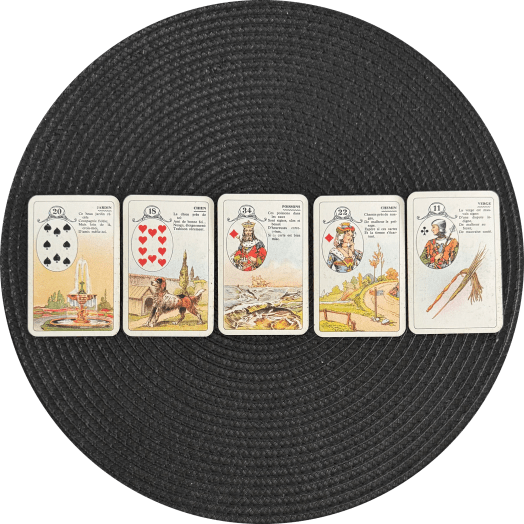
Park – Hound – Fishes – Roads – Birch Rod
At first glance, the combination appeared promising, but certain practical concerns quickly became apparent.
The Park preceding the Hound suggests a company operating on a broader scale. The business enjoys a significant public presence and serves a large customer base. The Hound here does not primarily describe friendship or loyalty, but personnel and service.
Taken together, Park–Hound often describes a dog with many masters. The company is attempting to satisfy numerous clients simultaneously and must constantly divide its attention between competing demands. The addition of the Fishes reinforces this interpretation, indicating a substantial flow of work, customers, and income.
The consequence is revealed by the Roads and Birch Rod. Because the company accepts work regardless of current staffing pressures, resources must frequently be reallocated. Electricians are moved between jobs, schedules altered, and plans adjusted in order to meet demand. The Roads shows the continual decisions required to allocate personnel, whilst the Birch Rod acts as a card of correction and rescheduling rather than conflict.
The company was not necessarily unreliable; it was simply stretched across too many commitments at once.
Taken together, the cards described a busy and successful firm, but one where dates and arrangements were unlikely to remain fixed. If I went with them, I’d have to be prepared to change schedules.
Second Company
Having returned the cards to the deck, I shuffled and cut before performing the second reading.
The cards drawn were:
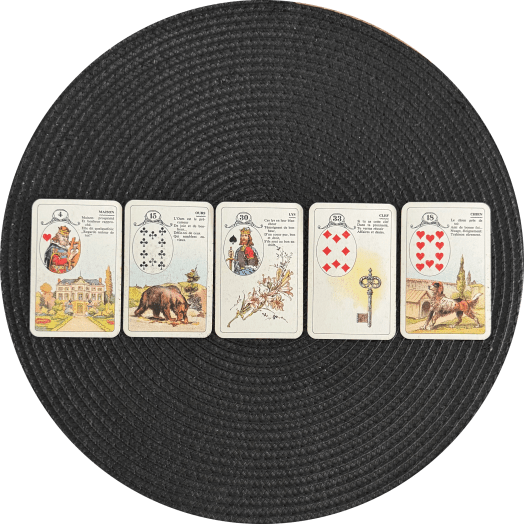
House – Bear – Lilies – Key – Hound
The contrast was striking.
The House immediately suggested a smaller, more localised operation. Unlike the first company, there was less emphasis upon scale and market reach. Instead, the focus fell upon stability, reliability, and established working practices.
The combination of Bear–Lilies was particularly encouraging. The Bear provides strength, resources, and experience, whilst the Lilies adds professionalism, honouring commitments and high standards. Together, the cards described a company that knew its trade thoroughly and approached its work with care.
The Key reinforced this favourable impression. Not only did it indicate competence, but it also suggested that the company possessed the necessary expertise to handle the work correctly. The Key facilitates access to solutions and, in this instance, pointed towards a business capable of delivering a high standard of workmanship (Lilies).
Finally, the Hound appeared again, though in a very different context. Here it described dependable tradesmen who took pride in their work and honoured their commitments. The emphasis was not upon numbers, but upon reliability and service.
Outcome
Comparing the two readings, the distinction became clear.
What ultimately separated the two companies was not competence, but reliability. Both appeared capable of completing the work. The first company’s scale created scheduling pressures and a need for constant adjustment. The second company’s smaller size allowed it to offer a more personal, consistent, and dependable service.
I therefore chose the second company.
The outcome justified the decision. The work was completed on schedule, professionally executed, and to an excellent standard. More importantly for our purposes, the reading neatly illustrates one of the Hound’s less-discussed functions. Whilst often associated with friendship, the Hound is equally a card of dependable service, practical assistance, employees, and professional support.
The appearance of the Hound in both readings is particularly instructive. In the first, it described a larger workforce whose members were continually being reassigned to meet demand. In the second, it described reliable individuals who could be trusted to fulfil their obligations. The card did not merely show people; it revealed the quality of the support they would provide.
This distinction proved decisive in selecting the better option – and also why I like to use a whole deck for each possibility. The same cards can appear telling important but different information.
§
Images:
Featured Image:
Rough Collie from 1915, Public domain, via Wikimedia Commons
Cards:
Lenormand Cards: Jeu Lenormand © Cartamundi, WanderWüst © Jorge/Wandering Oracle, Lenormand Fortune-Telling Cards © Zao-Gelli, The Lenormand Oracle © Verlag für die Frau, Leipzig, Nieuwe Lenormand © Amber Studio/Erna Droesbeke, Lenormand 36 Orakelspielkarten © Königsfurt-Urania,
References:
Boroveshengra, A., 2013. Cartomantes’ Cabinet: The Petit Lenormand Course.
Boroveshengra, A., 2015. Lenormand Thirty Six cards. 2nd ed. Create Space.
George, R. 2014 The Essential Lenormand: Your Guide to Precise & Practical Fortunetelling. Woodbury, MN: Llewellyn Publications.
Marco, M. and Goffinet, J., 1989. Petit Lenormand. Bruxelles: Servranx.
Silvestre, C., 2003. Le Petit Lenormand. [Montpellier]: Gange éd.


