Carpe Diem: The Cavalier Card

In the moment of our talking, envious time has ebb’d away. Seize the present; trust tomorrow e’en as little as you may.

Carmina, Horace

Cavalier, indicates good news, but a little far away, it can relate to the person’s home or come from foreign countries. This card is a messenger of good fortune when it is not surrounded by cards of a sinister nature.

Original Instructions

Despite being card no. 1, the 9 of Hearts — the Cavalier — is often passed over or regarded as one of the least interesting of the thirty‑six cards in the pack. Does it simply mean *news*? Does it signify your car, motorcycle or bicycle, or would that be the Ship? And if it falls far away, does it refer to someone or somewhere abroad?

The Essence and Function of the Cavalier

The essence of the Cavalier is that of a herald; its function is that of a messenger.
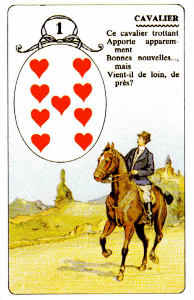
When discussing the Cavalier’s significations, “news” usually tops the list. That is fair: it is a communication card, and the Cavalier brings tidings. But how does it differ from the Letter (or even the Book in some circumstances), which also conveys news? The answer lies in the image — the eikṓn.

The Cavalier in Traditional Decks

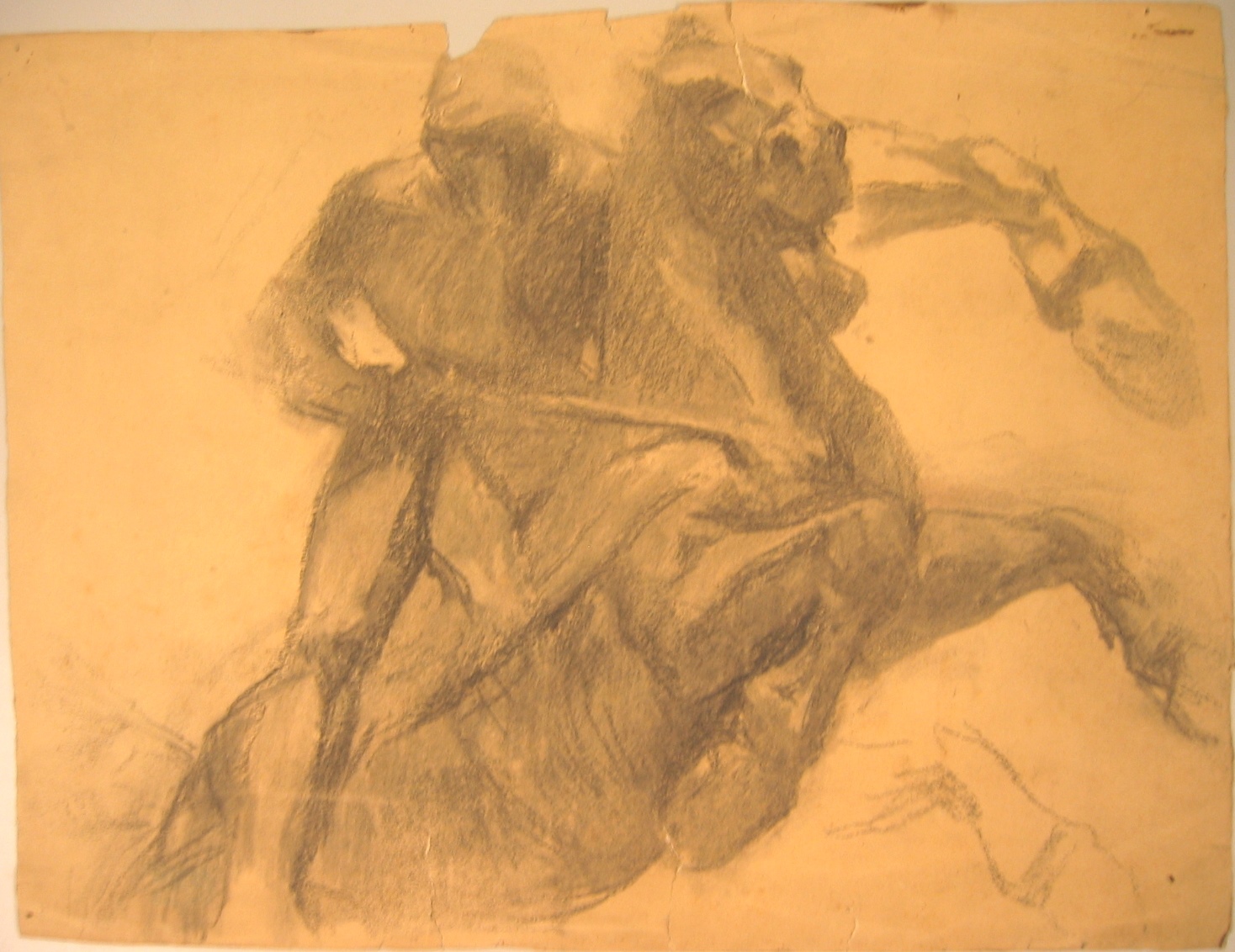
In the Carta Mundi, Dondorf, Wust and Blaue Eule pattern, the traditional picture shows a male figure riding a horse. In more detailed illustrations, he is riding out from a substantial chateau. The Cavalier is therefore “a man abroad” — literally out from home — indicating that he is on the move.
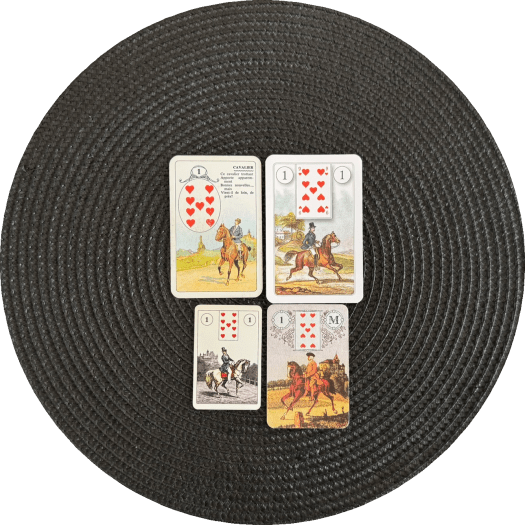
As such, it is often more accurate to say that he foretells the arrival of a visitor bearing news.

Even when combined with the Letter, one is far likelier to receive couriered parcels or documents requiring a signature, or items handed directly to you rather than pushed through the letterbox. The Cavalier adds a personal touch.

The card the Cavalier “rides away” from will often shed light on his tidings. For example, a carte maîtresse (or topic card) such as the Fishes or the Coffin would direct attention to finances or illness. If it is a person card, such as the Hound or the Bouquet (Queen of Spades), it is not uncommon for that person to be the visitor.

In spreads divided into past, present and future, the Cavalier’s gaze is significant. If he looks towards a past card, he may bring old news or an update on an ongoing matter. If he looks towards the future, the reverse is true.

The Cavalier is a fast card that adds celerity to the cards around him. Situations progress quickly. When he appears with cards forecasting opportunities or favourable circumstances, he stresses the need to act promptly. These chances will not linger.

Timing‑wise, the Cavalier is very short‑term. He usually arrives within a week at most — often the same day or the next.

The Cavalier also signifies horses and all members of the *Equidae* family. Paired with the Hound, it may indicate someone who keeps horses, donkeys and similar animals.

Coda

The Cavalier is the card of face‑to‑face communication, in contrast to the Letter. The reader must examine the surrounding cards to determine the nature of his tidings and whether they are welcome. He brings speed to the reading, both in terms of arrival and action — carpe diem.

Person and Description

Like the Birds and the Hound, the Cavalier is one of five cards read as people but not associated with a Court Card.
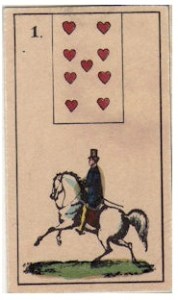
If read as a person, the Cavalier traditionally signifies a man — but only if the rider depicted is male. This is because the person‑function derives purely from the design; the Cavalier is not a court card but the 9♡. Consequently, in decks such as the Gilded Reverie Lenormand the Cavalier must be read as a woman if the rider shown is female. This is no different from the Birds card, which can signify a couple or “two of something” if two birds are shown. More birds, more people.

When read as a person, the attending cards reveal the individual’s character and appearance. The Cavalier sheds its own associations.

Physical Description and Temperament

The traditional eikṓn shows the Cavalier well‑dressed and not in livery or uniform. Artists may depict him in breeches, a justaucorps or a top hat, depending on the era — none of which were peasant attire. The Cavalier is therefore a dapper, well‑presented figure.

Physically, the card suggests someone fashionable, well‑kempt, up‑and‑coming and athletic. Equestrianism is a sport, and riding develops lean muscle. It is common for the Cavalier‑type person to enjoy sport and spend time exercising or in the gym.

If the card falls far away, it can sometimes indicate someone born in another country or of a different ethnicity to the querent. Caution is needed — it may refer to several generations back or simply an unusual name.

In terms of character, the Cavalier describes someone energetic, confident and always on the go — a person who knows what they want and is actively pursuing it. They are usually sociable, good communicators, and, in my experience, loyal and good friends.

Special Features

Traditionally, cartomancers paid attention to the Cavalier’s proximity to the significator.

If he falls far away, he may indeed signify news or a visitor from abroad. More often, however, the news he carries relates only indirectly to the querent — for example, someone calling at the querent’s home to see their spouse with gossip, or news concerning an extended family member or friend. Other times, the querent will hear some news when out-and-about or abroad (in nineteenth century parlance).

The closer the Cavalier falls, the more directly his news concerns the querent.

Over the years, the Cavalier has consistently signified a future love interest (in my readings and those of my clients). This often occurs when the Lord represents a current or former partner. Look for cards such as the Heart or the Ring near the Cavalier. Occasionally, he may appear as the Lady’s chevalier servente, especially with supporting cards such as the Serpent or the Lilies.

I have also found the Cavalier to be the primary significator for male same‑sex or same‑gender relationships. This emerged organically through working with the cards for myself and LGBTQ+ clients. Consequently, I have never found it necessary to replace the Lady with an extra Lord when reading for gay, bisexual or pansexual men. (For bisexual, omnisexual or pansexual clients, you will always need potential male, female and non‑binary cards.)

Transport and Movement
Another special feature of the Cavalier is his horse. When these cards were designed, horses were the primary means of personal transport. Today, the Cavalier’s horse corresponds to our cars, motorcycles and bicycles.

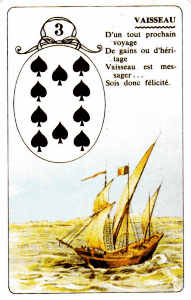
Some readers prefer the Ship for vehicles, but the traditional Ship eikṓn shows a large galleon, carrack or sea vessel — not a mode of everyday personal transport. I read the Ship as trains, buses, aeroplanes and ships. The Cavalier is the car.

Exercise and Sport

The Cavalier also signifies exercise and sport. Equestrianism requires skill and physical effort, whether eventing, endurance, carriage driving or dressage. The surrounding cards describe the specific exercise: 

  • Bear = weightlifting/bodybuilding 
  • Scythe = fencing or javelin 
  • Lilies = yoga 
  • Ship = rowing or sailing 
  • Birch Rod = boxing, combat sport, but also polo, cricket etc.

Some readers prefer the Birch Rod for exercise, but that has never made sense to me. Corporal punishment is not a sport.

Well‑Being

The Cavalier can be a welcome sign, indicating a return to form after illness. More commonly, he stresses the importance of diet, exercise and staying active. If accompanied by warning cards (such as the Scythe), he may indicate a sports injury or an accident involving a car or bicycle.

Anatomically, the Cavalier is associated with ligaments, as well as the legs, knees and ankles.

The Cavalier in Action

In 2022, a woman consulted me to ask whether she would be reconciled with an ex‑partner. Unfortunately, the cards indicated that this would not occur. However, the Grand Tableau revealed something far more promising: a new man on the horizon — someone entirely unknown to her.

I conducted a follow‑up reading, employing the Lost Man spread to gather further detail. The cards fell as follows:
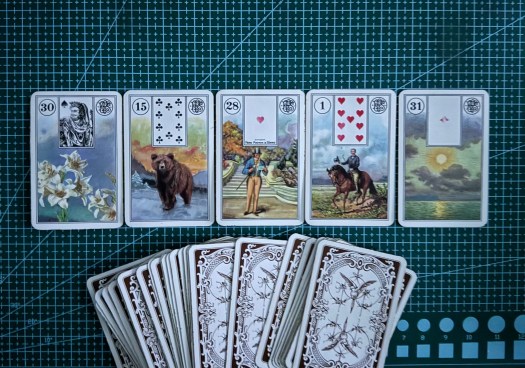
To begin with, we can see that he (Lord) is likely dark‑haired (Bear). Combined with the Cavalier card, we know he is physically fit; paired with the Bear, we are looking at someone deeply committed to resistance training and nutrition, intent on achieving maximum muscular development. The combination of the Cavalier and the Sun suggests a successful athlete — someone who almost certainly competes.

He will be well dressed and attentive to his appearance. The Bear, more often than not, points to facial hair. The pairing of the Bear with the Cavalier frequently indicates a slightly retro or vintage aesthetic — the sort of look one might associate with a modern hipster. This is reinforced by the Lilies, which lend a timeless elegance and a certain refinement.

In temperament, he is self‑reliant and assertive (Bear), with a strong drive for achievement (Cavalier and Sun). He is principled (Lilies) and emotionally stoic (Lilies and Bear).

The client subsequently met a personal trainer who looked as though he had stepped straight off the set of Peaky Blinders. He competed in several body building contests.

§

References:

Boroveshengra, A., 2013. Cartomantes’ Cabinet: The Petit Lenormand Course.
Boroveshengra, A., 2015. Lenormand Thirty Six cards. 2nd ed. Create Space.
Delclos, M., 2013. Le Livre du Petit Lenormand. 1st ed. Escalquens: Éd. Trajectoire.
George, R., 2014. Essential Lenormand. 1st ed. Llewellyn Publications, U.S.
Marco, M. and Goffinet, J., 1989. Petit Lenormand. Bruxelles: Servranx.
Silvestre, C., 2003. Le Petit Lenormand. [Montpellier]: Gange éd
Your Lips Are Venomous Poison: The Serpent Card

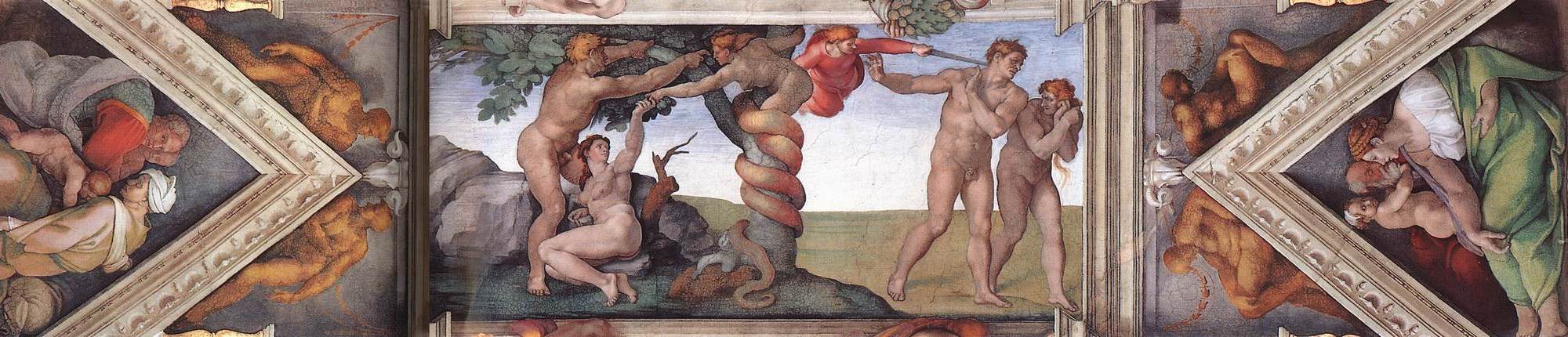
Now the serpent was more subtle than any other wild creature that the Lord God had made.

Genesis 3: 1, Revised Standard Version Catholic Edition

Snake, is a sign of misfortunes, which is gauged by the distance of the card to that of person, but always brings hypocrisy, betrayal and loss.

Philippe Lenormand Sheet

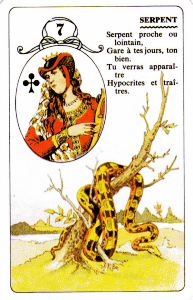
Card no. 7, the Queen of Clubs or the SERPENT card, has a notorious reputation. Is this picture the “big bad” of the deck? Perhaps she is a feminine woman, mother or a rival? Or could this card represent tutelary forces and mother wit?

The Essence and Function of the Serpent Card:

The essence and function of the Serpent card is venom and inducement, respectively. The Serpent is a warning card which indicates an area that must be approached with extreme care. Mishandled she will strike and envenomation occurs, giving a devastating blow. Carefully side-stepping this venomous viper will ensure your safety, but can result in delays and detours and also teach a valuable lesson.

A good understanding of the essence and function of the Serpent card is commensurate to a sound comprehension of the creature itself and folklore.

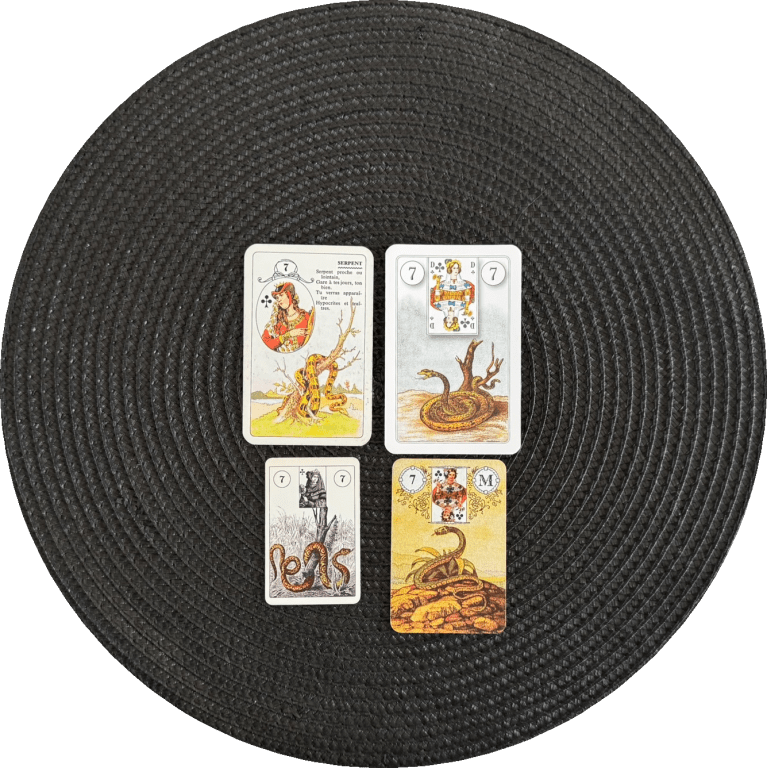
The traditional eikṓn for card no. 7 is that of a snake hiding either in a tree or grass. The former appears in the Das Spiel der Hoffnung, the Dondorf pattern, the Brepols & Dierckx, the C.L. Wüst and the so-called Leipzig Lenormand. The Blaue/Rote Eule favour the latter motif. You can see four examples below.

It is not uncommon to see words such as “constriction,” “strangle,” and “tie-up” used to describe the Queen of Clubs card. In the modern vernacular, the Serpent is perceived as a member of the Boidae family or other non-venomous snake that utilises constriction to kill its prey. But is this consistent with the deck’s origin? No.

Several snake species were to be found in eighteenth and nineteenth-century Europe, but no large boas. Of the snakes common to the region from where the cards emerged, there are non-venomous and venomous candidates. Considering the Serpent card’s nefarious associations, the latter is the likeliest inspiration.

The Vipera aspis or European viper (and its subspecies), is prevalent in various regions of Europe including the Petit Lenormand’s birthplace. It is venomous and its bite is noted to be painful. The venom is used for hunting and defence. Small in size it will bite prey, and wait for the venom to kill before pursuing.

Overtime, misidentification resulted in a myth of their aggressiveness.

Snake folklore is complex and rich — with reverence and fear often appearing side-by-side. As such, one finds much disagreement and contradictions from culture to culture. Consequently, it is best to focus on the folklore of the geographical origin of the cards.

Due to farming, agricultural communities were far likelier to encounter snakes. These communities noted some were venomous, and therefore, dangerous. Seeing the snakes shedding their skin and going underground only to re-emerge brought an association with the underworld. From this, the dark chthonic, tutelary, and primordial serpent emerged.

Unblinking, the snake was thought to be all-seeing and possessing powerful wisdom and discernment, which could be transferred as clairvoyance and clairaudience. That is preserved in the Grimm Brothers’ Die weiße Schlange (The White Snake). However, it must be remembered that the snake keeps her belly to the ground. As such, we can see that will use dirty tricks to get what she wants and never hesitate to stoop low.

Of course, the most significant folkloric influence for the Petit Lenormand would be the snake of the Garden of Eden. Christians specifically linked the snake with demonic powers. This interpretation associates this snake with temptation, incitement and sexuality. All three are to be found in the card (see Marco, &c).

However, I feel there is a better illustration of the Serpent card to be found in old folktales. One many of us will remember from childhood. Let us consider the Farmer and Viper.

In wintertime, a farmer spied a small snake unmoving in his frosty fields. He recognised the snake as one with potent venom. Nevertheless, he was kind-hearted and generous. He carefully picked up the snake and placed it in the breast pocket of his coat. As he went about his business, the snake began to revive and gain its strength. Once sufficiently recovered, the snake bit the farmer, delivering its potent venom. Sensing his demise, the farmer warned those around him to learn from his fate and not pity a scoundrel.

The tale is believed to be the origin of the phrase “nursing a snake at one’s bosom.” However good the farmer’s intentions, his actions were foolish; he nursed his own killer. He failed to keep a safe distance.

If one considers the common negative associations applied to the Serpent card – betrayal, spitefulness and treachery – they all infer a closeness.

To bite, the Serpent has to be close enough. Where she falls, is where you must exercise caution or run the risk of being close enough to be bitten. Her venom will result in some form of adversity, personal loss or complications. But only if she can strike. Remember that.

Coda

The Serpent is a warning card. Where she falls, marks an area that can become toxic. If engaged, she will strike . Her venom brings difficulties, toxic situations and betrayal. These will prove challenging and complicated to resolve.

Person and Description:

Card no. 7 is the Queen of Clubs and can therefore be read as a woman when paired with a social card (the House, the Park, and so on). Ordinarily, the Queen is a woman aged 35 + and is noted to be intelligent, serious-minded, and influencing the querent or their affairs.

If she falls next to the King of Clubs (the Clouds) or the Knave of Clubs (the Birch Rod), it tells the reader that a couple or mother and child have a bearing on the question, respectively. Rarely, all three will fall together. If you see this, it indicates a family unit.

Some cartomantes and authors (such as the French author, Marie Delclos) use the Queen of Clubs as the Significator for married brunettes.  Personally, I prefer the Child, the Gentleman the Lady cards for Significators.

It is not uncommon for cartomantes (see Moony, Stella Waldvogel, &c) to use the Queen of Clubs as the Significator for mothers. Depending on the reader, several explanations can be given, such as the umbilical cord being snake-like. However, most cite the Queen herself. Technically, the kreuz-dame was seen as an older woman but not kin without the presence of herzkarten (Kraheck-Liecke, 2008). Even then, it was not necessarily the mother. However, it is a valid association but not one to which I subscribe.

I use the Queen of Clubs as the Significator for the same-sex partner-card for lesbian and bisexual women. 

Mary Marco associated card no. 7 with sexuality and lovers, both male and female (Marco and Goffinet, 1989). I concur with Madame Marco. The Serpent card itself can indicate unfaithfulness and lovers of either gender.

If the Serpent pairs with a person card, it can be read as a description. It will describe both the appearance and psychological state or temperament of the person. This can be the Querent’s card or another figure in the game.

Physically, the Serpent describes someone with dark brown or black hair and green or hazel eyes. Often the person (male or female) wears it long. Traditionally, the person is attractive, and can be very feminine.

It is not uncommon for a person described by the Serpent to wear spectacles or corrective lenses. Over time I have also observed that the Serpent can indicate a lisp or breathy voice.

Serpent people are often erudite, well-spoken and multilingual. Often such people can possess knowledge or influence that is needed for the Querent’s cause. However, the Serpent-people are not altruistic and will not help someone if it brings them no benefit. More negatively, the Serpent indicates someone who is a toxic presence and a backstabber, or seditious and passive-aggressive.

It is worth noting where the Serpent falls in relation to the person-card. If it precedes the person-card, such as the Serpent + the Gentleman, then the individual receives the more destructive attributes of the Serpent card. Such a man will be charming, attractive and o-so-kind but should be avoided and treated with extreme caution. If engaged, you will be bitten. As snakes are good at camouflage, you will often be quite surprised that such people are such backstabbers.

If, however, the person-card comes first, such people take the more benign meanings of the Serpent.  The individual is intelligent, attractive but probably not the most friendly of people, but they pose no danger providing you do not rile them.

Special Features:

When the Serpent card falls near the Significator card, it is a warning. The Serpent’s poison can be delivered in several forms: betrayal, exploitation and, of course, two-facedness. Camouflaged, snakes are good at hiding. For this reason, when the Serpent strikes, we are often just as devastated by the perpetrator’s identity as much as their actions.

Far away, the Serpent cannot strike at the Querent directly. Like the Fox card, this does not so much neutralise the Serpent’s negative traits as much as creating a safe distance for one to overcome any challenges. It is thus a good indicator of overcoming difficulties.

As with the Fox and the Birch Rod, the Serpent cannot affect every card in the game. Her direct influence is on those cards she is near and encounters.

Of these, her venom is directed to those cards she dominates/overcomes: i.e. when she is card A in an A + B (+ C) formation.

I prefer Petit Lenormands that show a right-facing Serpent (Brepols & Dierckx, Wanderwust, &c). In such patterns, one can use the head of the snake as an aide-memoire.

A card overcome by the Serpent poses some problem or danger to the Querent. Unfortunately, the card often signifies something the Querent desires and will be tempted to pursue. However, if the Serpent is unheeded, the area will prove either damaging or cause a lot of problems that will be challenging to put right later on.

If this is one of the carte maîtresses, that area becomes a key concern and one which the Querent must proceed with caution.

One example I have seen over and over is the Serpent + the Moon near the Significator. All too often, a new job or promotion appears. It looks too good to be true; and it is. Either you are handed a poison chalice or working with toxic people. If you leave too soon, it does not look on your curriculum vitae.

Sadly, the Serpent can be hard to resist. But the topic affected by the Serpent is always best left for a time. Yes, it might delay you. But in the end it is for the best.

When the Serpent falls in a descriptive position (e.g. card B or C), she adds a complexity or roundabout/delayed quality.

For example, the Letter + the Serpent often indicates a telephone call that keeps your waiting, or a letter that is late in the post or delivered to your next-door neighbour by mistake.

Several of the Petit Lenormand cards can be seen as trump cards. That is having the ability to neutralise or overcome another card. The Serpent card is the Mice’s trump card.

The Stork trumps the Serpent card. If the Stork faces the Serpent, she can eat the Serpent. Many older patterns often illustrated the Stork eating either an amphibian or reptile. Storks are known to eat snakes. Remember nature is the oldest oracle!

The Serpent is the card of reptiles and amphibians. If paired with the Hound card, the Querent’s pets are likely to be snakes, tortoises, newts, frogs and so on.

On a mundane level, the Serpent can indicate cables and wires, ropes, piping, or something that can become tangled (laces, &c). Both with the Fishes and on its own, the Serpent can indicate brooks, rivers and streams. With the Road card, it can show winding pathways, country lanes and so on.

Some careers associated with the Serpent card indicate plumbers, cable laying technicians, gas maintenance, sewage workers, environmental science (toxic or dangerous substances), toxicologists, jobs involving the care of exotic animals (especially reptiles), and translators.

Well-Being:

Anatomically, the Serpent refers to organs used in the intestinal stage of digestion: starting with the duodenum and ending with the anus. In addition to the organs, the Serpent can refer to conditions such as Crohn’s disease or ulcerative colitis (with Birch Rod), irritable bowel syndrome (with the Mice), polyps (Flowers) as well as haemorrhoids and constipation (Mountain), and so on.

In addition to the above, the Serpent can also indicate all poisons, toxins and harmful substances. Consequently, we never like to see her near the Tree or the Coffin cards.

The Serpent + the Heart will appear when someone has septicaemia and sepsis occurs. Due to the association with poisons, the Key + the Serpent often appears when someone is undergoing chemotherapy.

Someone with a significant allergic reaction to makeup or beauty products might see the Serpent + the Flowers.

The Serpent in Action:

In August 2020, a female Querent asked about the money she was owed. The finances had been loaned to help someone who was struggling due to furlough. It was a significant amount of money.

The three cards that fell on the table were:

Fishes + Ring + Serpent

The Fishes card is the master card of money. Paired with the Ring card, we have a financial agreement or contract. Consequently, we know that both parties intended this to be a loan. There is every intention of the money being returned to the Querent, and the Ring itself confirms this.

However, the Ring is paired with the Serpent. So, the money will be returned late due to complications.

Consequently, we can say yes but not on time.

The Querent asked for a timescale. Looking through the deck, the Lady faced the Clouds card, which indicates March. That was seven months from the time of the reading, which the Serpent card echoes.

And so it was.

§

Images:

Cards: Jeu Lenormand © Cartamundi, WanderWüst © Jorge/Wandering Oracle, Cartes Lenormand © Dondorf (Author’s Collection) , Nr. 1941 Mlle Lenormand Wahrsagekarten © Piatnik, Petit Lenormand © Daveluy (Author’s Collection).

References:

Delclos, M., 2013. Le Livre du Petit Lenormand. 1st ed. Escalquens: Éd. Trajectoire.
George, R., 2014. Essential Lenormand. 1st ed. Llewellyn Publications, U.S.
Grimm, J., Grimm, W., Zipes, J. and Dezsö, A., n.d (2016). The Original Folk and Fairy Tales of the Brothers Grimm. 1st ed. Princeton University Press.
Johnson, B., 1994. Lady of the Beasts. 1st ed. Rochester, Vt.: Inner Traditions International.
Kraheck-Liecke, B. (2008). Birgitt Kraheck-Liecke [online].
MacNamee, G., 2000. The Serpent’s Tale. 1st ed. Athens: University of Georgia Press.
Marco, M. and Goffinet, J., 1989. Petit Lenormand. Bruxelles: Servranx.
Meuris, B., 2018. Petit Lenormand Encyclopaedia: Volume 1 & 2. Create Space.
Phillips, L., 2021. Lozzy’s Complete Guide To Lenormand: Workbook Edition. 1st ed. Independent.
Silvestre, C., 2003. Le Petit Lenormand. [Montpellier]: Gange éd.

Maître Fripon: The Fox Card

Avec tout son mépris, il s’est bien joué du roi qui va perdre son temps à l’attendre et en être pour ses frais (With all his contempt, he played the King well who will waste his time waiting for him and being at his expense.)

Le Roman de Renart

Fox, if this card is near, you must beware of those with whom you are connected, because some seek to deceive you, otherwise there is no danger.

Philippe Lenormand Sheet

Card no. 14, the Nine of Clubs or the FOX, can be one of the most divisive cards in the pack. Is Renard the master card of work? Maybe he’s the family card par excellence? Or is he the red devil himself?

The Essence and Function of the Fox Card:

The essence and function of the Fox card is falsehood and manipulation, respectively. The Fox’s presence in the game is a warning to be on your guard. Failure to be vigilant will see you fall foul to his wily ways. It is for this reason I often describe the card as a red-flag.

To understand the Nine of Clubs, we have to consider both its eikṓn and folklore.

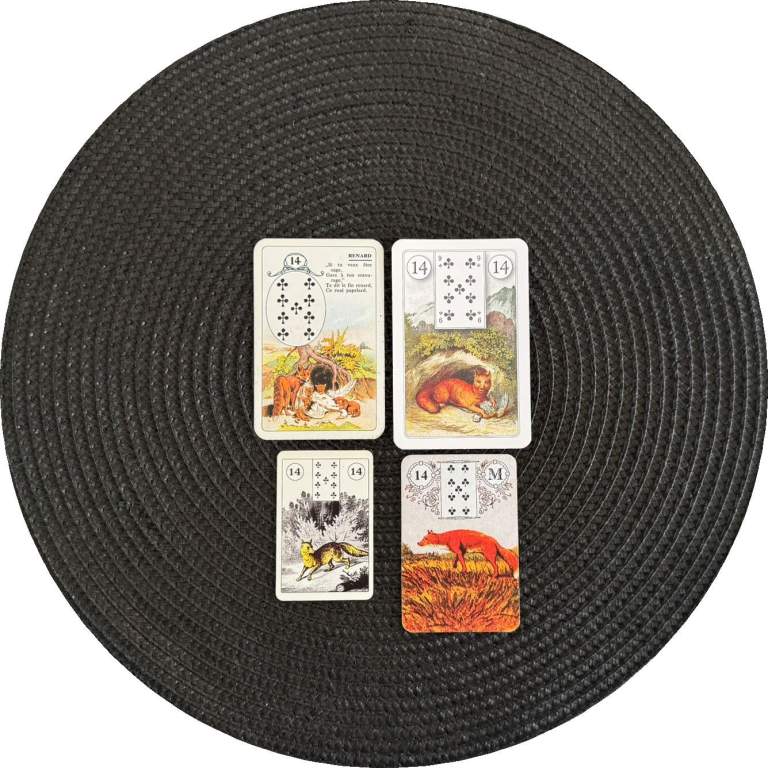
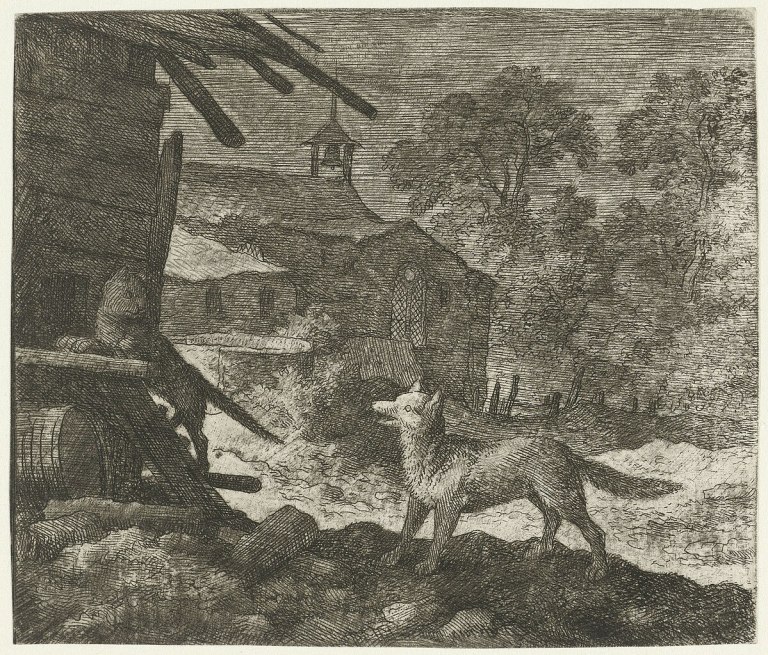
Starting with the Das Spiel der Hoffnung, the traditional motif of card no. 14 is of a stealthy fox, ready to pounce, or that of a tod or vixen with a dead fowl.

The chicken never saw him coming…

Over time the design has only ever been subtly reinterpreted. The classic Brepols & Dierckx pattern – much loved by serious readers – has either a tod or vixen presenting a goose to four kits at their den. It is presented along with three other classic motifs below.

The animal killed or stalked by the Fox varies from deck-to-deck. However, it tends towards domestic fowl or poultry (chickens, geese, game birds and partridges). Consequently, the implication is that these are not wild birds but someone’s livestock. To feed himself, the fox has trespassed upon someone’s land, found, caught, and killed another’s resources (the bird either raised for flesh or eggs).

Of course, such behaviour cannot be classified as either evil or wicked. The fox must eat. Nevertheless, if we remember that this bird was part of a farmer’s resources needed to feed his family, we can better understand the negative side affect the Fox’s action can have.

We also see the emergence of competing interests.

Foxes are ever-present figures in Old European folklore. Animal lore is often grounded in agriculture and husbandry. The fox-farmer experience saw the fox became a trickster, shapeshifter and wily rascal associated with cunning and manipulation.

Let us consider the classic tale of the Fox and the Crow.

Watching, a fox spies a crow landing in a tree with a piece of cheese which he himself rather fancies. He cannot run the risk of the crow flying away. So, the fox approaches and begins to flatter and praise the crow. Eventually, the fox states he believes the crow must have a lovely voice. Will she please sing to him? the fox asks. Flattered, the crow begins to sing and drops the cheese into the waiting mouth of the fox.

The craftiness and ingenuity employed by the fox in the tale, as well as his desire of something not his, are all to be found in card no. 14. The Fox card in the Judith Bartschi Lenormand utilises this well known tale.

The Fox is in direct opposition with the Querent (he wants the same thing as you), and the Fox will, as a survivalist, prioritise and serve his interests first. If successful his actions will result in a tangible loss. Keen to avoid confrontation, subtle manipulation and treachery fit him best. Hence the red flag.

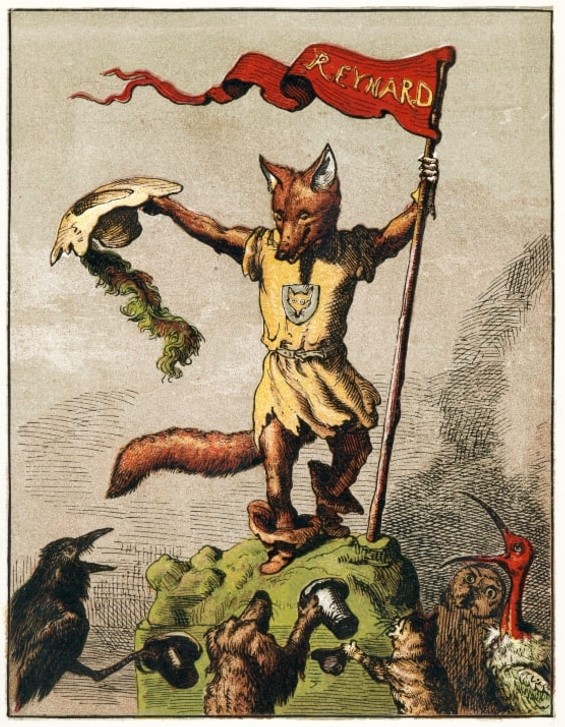
Classic tales such as the Reynard the Fox, first appearing in the 12th century, as well as the Teumessian Fox, Schir Lowrence, Godmother Lisa, the Fox and the Mask as well as the Wolf and the Fox (Grimm Brothers) can all be studied to better understand this card.

Coda

The Fox card is a red-flag that the Querent must be on her card. Where he stalks, the Querent must act with caution. She will need to guard against manipulation, sabotage and dishonesty. Failure to do so will incur a loss.

Always remember: the Fox is after your cheese!

Person and Descriptions:

As an animal card, the Nine of Clubs can be seen as a person: the competition or rival. Read thus, card no. 14 can be male or female. Look and see if a court-card is present. If not, if the Fox faces a heart or clubs card the person will likely be male. Spades and diamonds indicate females.

However, most of the time, the Fox will be read as a description of a person card. In such cases, careful consideration of his position in the draw must be given. We will consider each option:

Let us take the Fox + the Lady . As the Fox precedes her, she receives a red-flagged status. Such a person needs to be treated with extreme caution. Her interests come first, and she will not hesitate to lie and cheat if it serves her end. She will be charming and have a silver tongue.

Reversing the two cards, the Lady + the Fox, we see something different. Here the Lady card is described as a very independent and solitary person who is nevertheless no threat. She will be extremely clever, resourceful and ambitious but not a team player. She can be nosey. You will not warm to her.

If the Fox falls above the Lady card, it controls or influences her. Such a woman will have a clear agenda and particular motivation which drives her behaviour. In her mind, she has formulated a strategy, which has lead her to enter your entourage. Unfortunately, she has decided that dishonest means or cheating will be the best method of securing it. Beware this is the arch saboteur.

Cards below are controlled or influenced. Should the Fox fall beneath the Lady card, the woman in question uses a calculated and shrewd approach to achieve a goal. She uses research, cunning and her own skills to get what she desires. However, these are not dishonest. You will find that such a person is goal-oriented and target approached in her manner. A self-made woman.

One positive attribute the Fox brings to a person-card is that they are family oriented. However outsiders are frowned-upon.

If the Fox falls before the Querent’s card, it warns the Reader that the client will keep stuff back or not be 100% honest.

Physically, the Fox describes someone as having red hair. This can be shaded from strawberry blonde, ginger to red-brown. Due to the Fox’s penchant for masks, he can indicate someone has hair extensions or wears a wig/hairpiece. In my experience, the Fox does not reveal dyed hair.

The Fox’s build is more “skinny” than slim. The person also often has a prominent nose.

Special Features:

In 2011 and 2012, I discussed the Fox card’s effect in terms of proximity and order. Examining both the Serpent and the Fox cards as descriptions for people cards, I touched upon the importance of order once more. The importance of order and proximity underpins the material below.

When the Fox card falls near the Significator, its influence is at its most potent. This is because proximity concerns engagement. Its influence is felt directly/strongly. You are, therefore, urged to be on your guard or fall foul to the Fox’s machinations as he is active in your vicinity.

Should the Fox be at a distance, it has less opportunity to act. It is not close enough to your environment/resources. You do not engage directly. It does not cease to be a concern; care should still be given to the cards the Fox affects.

Like the other cards, the Fox cannot affect every card in the game. His influence is confined to the cards he is near and encounters. Cards are controlled or dominated by the card that comes before them. That is the A card in an A + B (+ C) grouping.

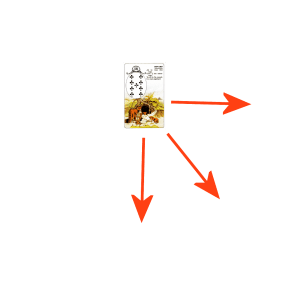
For the Fox, these will be the cards shown in red below:

These are the cards the Fox influences (below), overcomes (precedes) and effects in terms of consequence (diagonal). In these combinations he is card A.

You can see these cards as being red-flagged. They will be areas where caution must be exercised to avoid traps or pitfalls. Of course, any carte maîtresse falling here becomes a key life area of concern.

The beauty of the Fox card is that it offers us a warning. A shrewd Querent can use this information. With enough cunning and finesse you can build a strategy or take steps to turn the tables.

The other cards will receive the Fox’s descriptive values or traits. Of course, these will be of the mercurial nature of the card. But they do not receive the red-flag status of being on the Fox’s radar.

The Petit Lenormand’s Nine of Clubs shares several associations in common with the Italian Falsità (4♦) card, which shows a cat. We see this across several cartomantic methods.

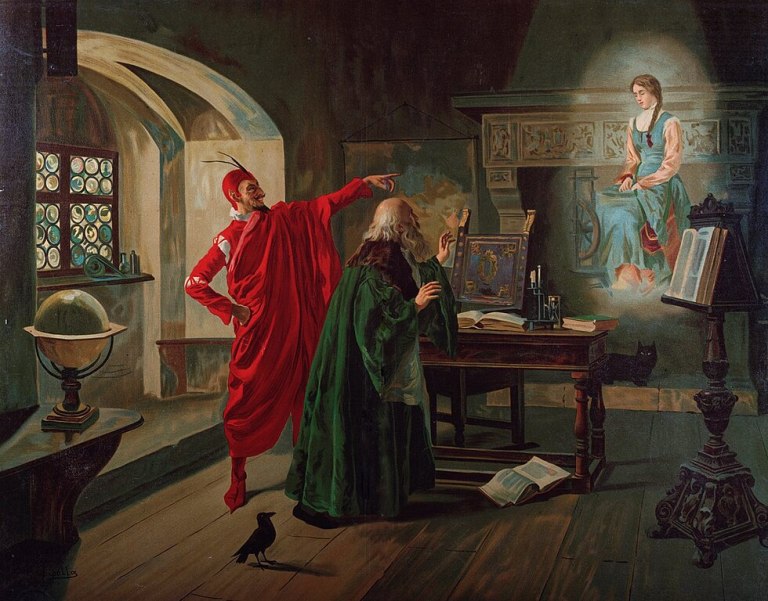
Like the cat, the fox was demonised. Not as common as black dogs and toads, foxes appear in lore and records as familiar spirits or disguised fae/demons. Méphistophélès, from Germanic folklore, is often shown dressed in red with vulpine features.

The shapeshifter nature of the fox in folklore can manifest in readings. Seeing the Park + the Fox can indicate a masquerade, costume event or CosPlay. The Book + the Fox can indicate a pseudonym or nom de plume.

The Fox and Cats:

In Continental and Eastern Europe, the Fox card is linked to felines. I know French, Romanian, Russian and Belgian cartomantes who all acknowledge this association.

But why? Some believe it is a flawed association and that the Hound should be the card of cats, citing foxes being part of the same family as dogs.

It is not disputed that foxes are members of the Canidae family. If such biological classification precludes the association of felines with the Fox, it must also exclude it from the Hound card, too.

Regardless of the biological family, the evolution of the fox sees it differ in a number of ways to the dog. But also share traits with cats:

Unlike dogs, some foxes can climb and ascend trees. The fox has both longer and cat-like sensitive whiskers. Foxes’ pupils are vertically split unlike other members of the Canidae family.

At the time of the cards conception, the European Wildcat was also far more common. This feline is an adept hunter: eating rats, mice, moles, birds and capable of killing rabbits and chickens — something that still occurs.

However, it is folklore that has linked the cat with the fox. Both were unfairly demonised and associated with deceit and manipulation. Both were seen as shape-shifters capable of deceiving the common man.

The Reynard fables — a direct influence on the card — includes a character called Tybalt, the Prince of Cats. Despite their rivalry, Tybalt is variously described as a friend, ally and cousin of Reynard.

It is for this reason several decks employ the fox and cat interchangeably for cards associated with falsity.

It is essential to recognise the role and influence of folklore in cartomancy. You can choose not to associate the card with cats. But it is a grave mistake to dismiss it as flawed logic. If you do, you’re dismissing the very core essence that gave birth to the oracle.

Renard the Worker:

In their 1989 Petit Lenormand: Méthod de Cartomancie, Mary [di] Marco and Jeanine Goffinet associated card no. 14 with salaried employees and the Fishes with the self-employed, military and entrepreneurs. Neither Silvestre nor Delclos followed this particular model, but Moony, Rana George and Lozzy Phillips do. My second mentor (herself French) used the Fox card for self-employed or temporary workers.

The distinction between salaried and self-employment was common in the Petit Lenormand literature until recent times. Several German readers used the High Tower as Marco did the Fishes.

As a younger reader, I did attempt to integrate this distinction. I could see the logic of the Fox as a temp, freelancer or the wheeler dealer. Foxes work for themselves. Over time, however, I found that the cards simply did not adhere to this distinction. Instead, the same card(s) matter regardless of whether the person is salaried or freelance, but the nuance was different due to different circumstances.

This realisation led me to see the Fox as a critical card for career readings. But not in a manner where he (or any other card) can be read purely as work.

Foxes are opportunistic and in constant competition with their environment. They are remarkable survivors and have had to adapt to ever-changing habitats.

Consequently, card no. 14 talks more about competition, rivals and the strategies needed to succeed in business or at work. When someone is going for a job interview, the Fox will be the other candidates. If you are running a business, the Fox is your biggest competition.

If the Fox talks about roles, it is cash-in-hand, casual labour, game-keeper, night workers, pawn-brokers, smallholdings, as well as the less legal poachers, hunters, and so on.

Well-Being:

The Fox is associated with the nose and olfactory system. Got a nasal polyp? The Fox + Flowers says you do! Blocked nose? The Fox + Mountain . The Fox + Flowers can also indicate allergic rhinitis.

Time after time, the Fox will appear near the Tree or Coffin when the client is either ill but asymptomatic or requires more specialist investigation (if the Key is nearby).

If the Fox card overcomes either the Tree or the Coffin, he warns of illnesses that are either masked by generalised symptoms or have no apparent symptoms. With the Fox + the Coffin, there is a strong possibility of misdiagnosis or inaccurate tests that need repeating. Due to personal experience, whenever I see such configurations, I urge the Querent to get an annual check-up and, if necessary, a second opinion.

The Fox in Action:

In the summer of 2020, a female Querent consulted the cards. Her question concerned as to whether an upcoming first date would gell well. Although the Lady and the Gentleman had spoken over FaceTime and exchanged e-mails and DMS, neither had met face-to-face. Consequently, the Lady was full of nerves.

The cards as they fell:

The Birds, the Fox and the Park.

We can immediately tell that the response is negative. The Birds, paired with the Fox, shows that nerves will be a big issue. Neither the Lady nor the Gentleman will feel comfortable in each others company (Birds + Fox). The conversation will be pretty tense, with both holding back.

As a result, both parties will decide that they do not have a good enough rapport or chemistry to form an association. That is signified by Fox’s overcoming the Park. Wrong company.

As such, the answer is no, and both will decide not to see each other again.

So it was. The Lady and the Gentleman both felt that they had nothing common. The Lady told me the evening ending early as they had nothing to talk about.

§

Illustrations:

Cards: Ur Lenormand: The Primal Lenormand © U.S. Games, Jeu Lenormand © Cartamundi, WanderWüst © Jorge/Wandering Oracle, Cartes Lenormand ©Dondorf, Lenormand Fortune-Telling Cards © Zao-Gelli, Petit Lenormand © Daveluy (Author’s Collection).

References or Further Reading

Boroveshengra, A., 2011, 2012 & 2013. Journal of Cartomante: The Fox and Serpent.
Boroveshengra, A., 2013. Cartomantes’ Cabinet: The Petit Lenormand Course.
Boroveshengra, A., 2015. Lenormand Thirty Six cards. 2nd ed. Create Space.
Delclos, M., 2013. Le Livre du Petit Lenormand. 1st ed. Escalquens: Éd. Trajectoire.
George, R., 2014. Essential Lenormand. 1st ed. Llewellyn Publications, U.S.
Marco, M. and Goffinet, J., 1989. Petit Lenormand. Bruxelles: Servranx.
Meuris, B., 2018. Petit Lenormand Encyclopaedia: Volume 1 & 2. Create Space.
Muradova, A., 2021. The Red Devil and the Symbolic Meaning of the Colour ‘Red’ in Modern Breton. [online] Journal.fi. Available at: https://journal.fi/scf/article/view/7542 [Accessed 6 May 2021].
Phillips, L., 2021. Lozzy’s Complete Guide To Lenormand: Workbook Edition. 1st ed. Independent.
Silvestre, C., 2003. Le Petit Lenormand. [Montpellier]: Gange éd.