I will fall upon them like a bear robbed of her cubs, I will tear open their breast, and there I will devour them like a lion as a wild beast would rend them.
Hosea 13:8 (RSV CE)
The bear took no heed of his words, but gave the wicked creature a single blow with his paw, and he did not move again.
Snow-White and Red-Rose, Grimms’ Fairytales
Bear, signifies happiness, but warns of the need to avoid conversations with those who envy.
Original Instructions
Card No. 15 in the Petit Lenormand, the Bear, is represented by the 10 of Clubs. Modern interpretations often reduce the card to a mother, manager, financial backer, or authority figure. Whilst such meanings are not without merit, they fail to explain why the card assumes these roles. To understand the Bear properly, one must first consider the animal itself and the qualities it has embodied throughout history, folklore, and human observation.
The Essence and Function of the Bear
The traditional eikōn of the Bear is remarkably consistent. We typically see a large adult Eurasian brown bear standing amidst a forest or upon rocky ground. Some decks, particularly older examples such as the Schmid pattern, substitute a polar bear. Whilst this may affect certain descriptive details discussed later, the underlying symbolism remains substantially unchanged.
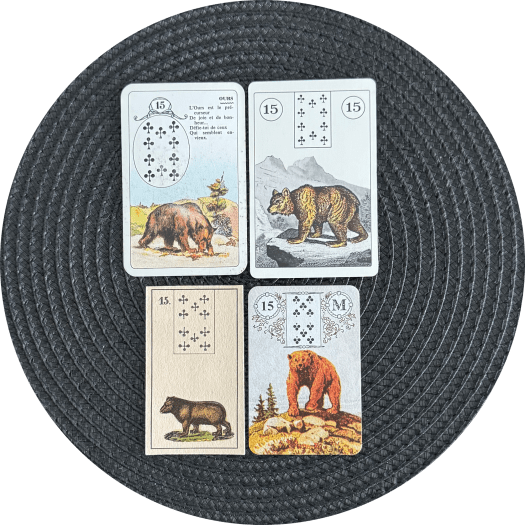
The essence of the Bear is power and its function is to store and strengthen.
Few animals evoke strength as readily as the bear. It is among the largest and most formidable predators found in Europe. Even where bears have long since disappeared from the landscape, they continue to occupy a prominent place within folklore, heraldry, and the popular imagination. When the Bear appears in a reading, it rarely signifies something small, insignificant, or easily overlooked. Rather, it introduces a substantial presence that exerts weight and influence upon the matter under consideration.
The Bear’s power is not merely physical. Bears accumulate reserves and draw upon them when circumstances require. This instinctive behaviour provides an important clue to the card’s function. The Bear stores resources and strengthens whatever it touches. Consequently, it often appears in matters involving authority, finance, protection, support, influence, and the accumulation of assets.
Just as the Clouds darkens and the Birds disturbs, the Bear strengthens. Whatever card falls with the Bear acquires greater weight, substance, and resilience. Positive cards become more robust and enduring; difficult cards can become more formidable and harder to overcome. The Bear rarely acts subtly. Its influence tends to be obvious and significant.
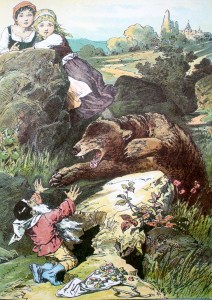
The Bear occupies a notable place within folklore. In Aesop’s The Lion, the Bear and the Fox, the lion and bear exhaust themselves fighting over a prize, only for the fox to seize the opportunity created by their struggle. The tale demonstrates that strength alone does not always prevail, whilst simultaneously reminding us of the immense power possessed by the bear. Likewise, in the Grimms’ Snow-White and Rose-Red, the bear appears not merely as a beast but as a powerful figure whose true nature lies hidden beneath an intimidating exterior. In neither tale is the Bear weak, insignificant, or easily ignored. Its presence alters the course of events simply because of the power it possesses.
As a practical divinatory symbol, the Bear frequently signifies magnitude. Whatever area of life it touches tends to become larger, stronger, or more significant. With the Fishes, resources and wealth may increase. With the House, emphasis falls upon a substantial property or a family of considerable influence. With the Tree, vitality and resilience may be reinforced. With the Mountain, one may encounter an obstacle of considerable size and difficulty. In each instance, the Bear adds weight and substance to the matter at hand.
There is also a deeply habitual quality to the card. Bears are creatures of habit. They establish feeding grounds, return to familiar locations, follow seasonal routines, and conserve their energy through established patterns of behaviour. Consequently, the Bear often introduces a degree of predictability and consistency into a situation. What it governs may not always be especially exciting, but it is often dependable and enduring. The card suggests resources that can be relied upon and strengths that have been built over time.
At the same time, the Bear is not passive. Beneath its calm exterior lies tremendous force. When circumstances require action, the Bear possesses both the strength and the reserves necessary to pursue its objectives. Thus, the card can indicate not only stability, but also the power to effect meaningful change when change becomes necessary.

Like the Hound, the Bear frequently signifies a person. However, whereas the Hound generally represents a peer, colleague, friend, or subordinate, the Bear typically occupies a position of seniority within the querent’s life. It may therefore represent a parent, grandparent, elder relative, supervisor, manager, mentor, official, or bureaucrat. In each instance, the common denominator is authority, influence, and access to resources.
It is also worth remembering that resources and influence can attract envy. The original instructions contain a specific warning concerning jealousy, a feature of the card that has largely disappeared from contemporary interpretations. Yet the warning remains highly relevant. The Bear often signifies strength, assets, advantages, or influence that others may covet. Where adverse cards surround the Bear, one should be mindful of resentment, rivalry, and those who seek to benefit from resources that do not belong to them.
Contrary to popular fiction, bears are not especially territorial animals, and their ranges frequently overlap. They do, however, respect boundaries and personal space. In this respect, the Bear offers a valuable lesson. Shared environments do not necessarily imply friendship or goodwill. The card reminds us to respect boundaries, protect our resources, and avoid assuming that proximity guarantees loyalty.
An interesting distinction may also be drawn between the Bear and the Key. The Bear provides resources; the Key provides access to them. Possessing wealth, influence, knowledge, or strength is one matter. Being able to make practical use of those assets is another. One card stores and strengthens; the other opens and facilitates.
Coda
At its heart, the Bear is a card of strength, resources, and influence. It signifies those people, assets, and reserves upon which we rely when life demands endurance, protection, or sustained effort. Above all, the Bear reminds us that true power lies not merely in force, but in possessing sufficient resources to withstand adversity and achieve our aims
Person and Description
Person
The Bear is one of only a small number of Petit Lenormand cards that regularly signifies a person despite not being a court card. Depending upon one’s method, there are four—and occasionally five—such cards within the deck. Indeed, like the Hound, the Bear is more commonly encountered as a person than as an abstract topic.
This should not surprise us. Whilst concepts such as authority, influence, and power can manifest in many forms, most people experience them through individuals who exercise a strong presence within their lives. Consequently, the Bear often enters a reading as a tangible person rather than a general circumstance.
Who that person proves to be depends largely upon the context of the consultation. What unites Bear figures is not age alone, but their ability to exercise authority, influence, or control over the matter in question. The card may therefore signify a parent, grandparent, elder relative, teacher, supervisor, manager, police officer, senior clinician, government official, or some other individual whose position naturally commands deference and respect.
Whatever role they occupy, the Bear person tends to be someone whose presence carries weight and whose opinions, decisions, or actions materially affect the outcome of events.
Physical Description

Bears are large and powerful animals, and this influence is readily reflected in physical descriptions. The Bear frequently indicates someone of above-average height, strong or muscular (but not fat), or notable physical strength. Think of Charles Atlas.
Yet the most important feature is not necessarily size itself, but presence. Even when not especially large in stature, Bear people often dominate a room through confidence, status, reputation, or force of personality. They are individuals whom others notice and remember.
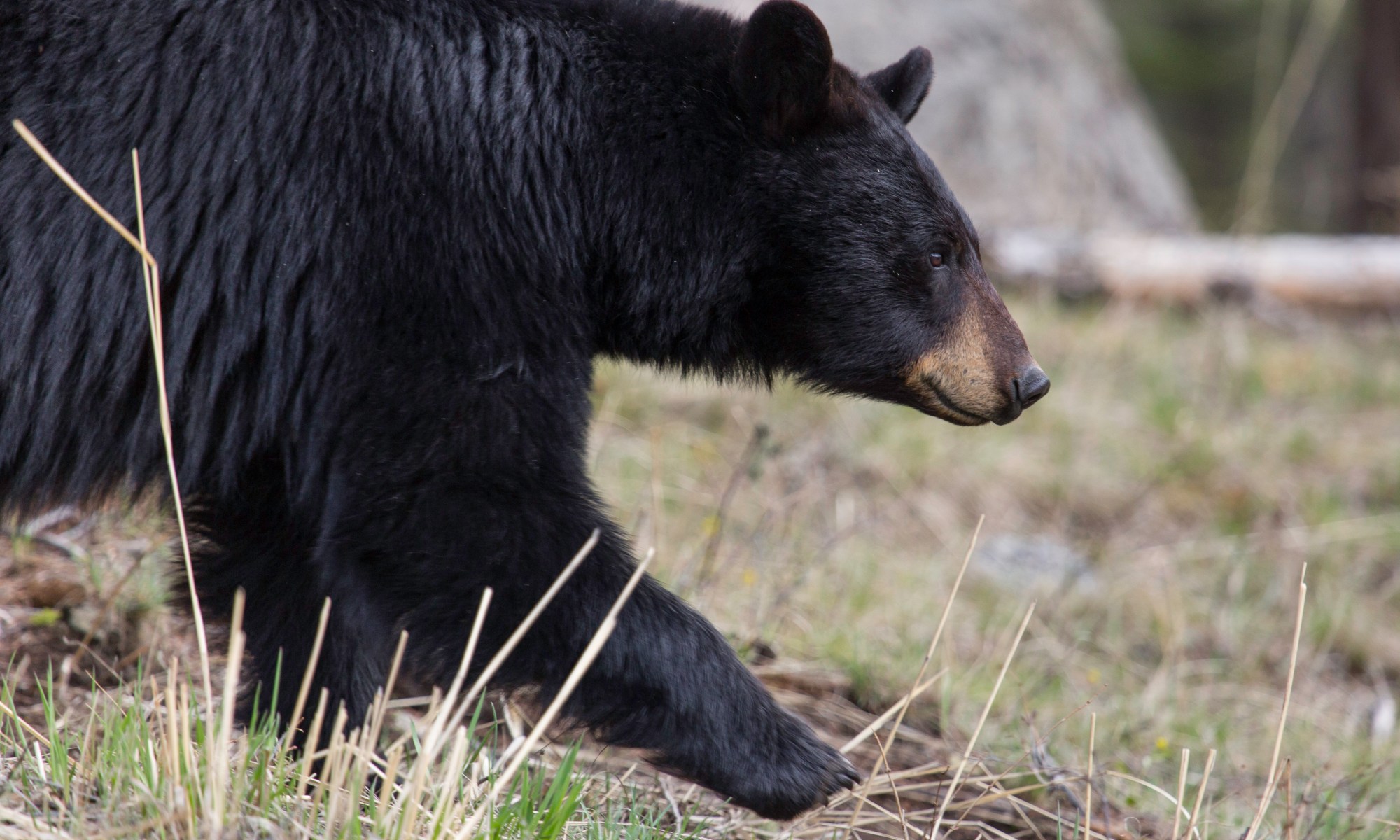
The specific species depicted on the card may also provide useful descriptive nuance. Most Petit Lenormand decks portray a brown bear, suggesting light brown or dark brown. Some decks, however, most notably the Schmid and Gilded Reverie, depict a polar bear. In such instances, blonde, grey, or white hair may become more likely. Black bears, where depicted, naturally suggest darker colouring.

The hair is typically thick and abundant. Men represented by the Bear frequently wear a beard, moustache, or other facial hair. The overall impression is one of solidity, maturity, and physical substance.
Temperament
When describing character, the Bear corresponds most closely to the traditional choleric temperament. Of the four classical temperaments, the choleric is associated with strength, decisiveness, leadership, and the ability to impose one’s will upon circumstances.
Bear people possess a powerful personality. They are assertive, self-reliant, and rarely inclined to suffer fools gladly. Such individuals prefer action to hesitation and frequently assume responsibility when others are uncertain how to proceed. They often possess strong opinions and little difficulty expressing them.
At their best, they are protective, dependable, courageous, and resolute. They willingly defend those under their care and often provide practical support when difficulties arise. The Bear’s function of storing and strengthening is frequently visible in such individuals. They accumulate resources, knowledge, influence, contacts, or wealth over time and prefer to maintain adequate reserves rather than live from hand to mouth.
There is also a solitary quality to the Bear. Like the animal itself, the Bear person may occasionally prefer their own company and can be perfectly content spending time alone. They do not necessarily require constant social interaction and are often comfortable operating independently.
When poorly aspected, however, the Bear’s strength can become oppressive. The desire to protect becomes possessiveness; authority becomes control; confidence becomes intimidation. Such individuals may be domineering, covetous, or even bullying, expecting others to defer to their wishes simply because they possess the greater strength. In extreme cases, the Bear’s considerable resources and influence may be used to manipulate rather than support those around them.
Whether beneficent or overbearing, the Bear is seldom weak, timid, or inconsequential. Above all, it describes a person whose power is felt by others and whose presence has a substantial impact upon the world around them.
Special Features
Male or Female
When I first began reading the Petit Lenormand, the Bear frequently represented the client’s mother or grandmother. This was not because the card was inherently female, but because mothers were generally the primary caregivers and grandmothers commonly provided practical support and childcare. The Bear signified the person exercising strength, protection, authority, and control over resources within the family.
Naturally, this role can be occupied just as readily by a man. Indeed, changing social patterns have made this increasingly common. The Bear follows function rather than gender. Whoever provides the resources, protection, support, guidance, or authority is most likely to be represented by the card.
The same principle applies in professional matters. When I first started reading professionally, the Bear often manifested as a male employer, manager, police officer, or civil servant. Today such positions are occupied by women just as frequently. The card has not changed; society has.
If one wishes to appeal to zoology, one can certainly observe that the sow raises her cubs unaided by the boar. Yet this merely explains why the Bear may sometimes appear as a mother; it does not establish the card as inherently female. The Petit Lenormand concerns essence and function above all else, and the Bear functions as a figure of authority, protection, resources, and power regardless of sex.
Finance
Some cartomantes employ the Bear as their principal financial master card. Given that money itself is a form of power, this approach is not without merit. Nevertheless, I have always found the Fishes more appropriate for matters of income, outgoings and financial flow. The Bear concerns wealth in a rather different manner.
If the Fishes shows money moving, the Bear shows money stored. If the Fishes concerns liquidity, the Bear concerns accumulated wealth. Bears accumulate fat during periods of abundance and draw upon those reserves when circumstances require. During winter, those reserves sustain the animal and preserve its strength until conditions improve. This behaviour provides an excellent analogy for the card’s financial significance.
The Bear therefore governs savings accounts, investment portfolios, pensions, insurance policies, property assets, and other accumulated resources. It describes the reserves upon which one may draw when required. Put another way, the Bear concerns how one’s money works on one’s behalf rather than how it is earned. It is less concerned with what enters and leaves the account than with what remains there.
For this reason, the Bear often provides an excellent indication of a seeker’s overall financial strength and security. It reveals not what is flowing into the account this month, but what resources have already been accumulated and preserved for the future.
The greater the reserves signified by the Bear, the more relevant its traditional warning concerning envy becomes. Those who possess resources often attract the attention of those who lack them, and the original caution concerning jealousy should never be dismissed lightly.
The Bear’s Paw
One of the more useful applications of the Bear appears in vertical combinations, particularly in the 3 × 3 and the Grand Tableau. I often refer to this relationship as the Bear’s Paw.
The principle is straightforward. The Bear strengthens and stores resources. Consequently, the card below the Bear often indicates something that can be utilised, cultivated, or harnessed in order to strengthen the seeker’s position.
Thus, if the Bear stands above the Moon, the querent’s reputation, public standing, or recognised expertise may provide a valuable advantage. Their talents could perhaps be marketed more effectively, their résumé circulated more widely, or their achievements promoted more confidently.
Likewise, when the Bear appears above the Bouquet, artistic talents, creativity, craftsmanship, or aesthetic skills may represent an under-utilised resource capable of generating additional opportunities or income.
The precise manifestation will depend upon the card involved, but the underlying principle remains remarkably consistent. The Bear identifies a source of strength; the card beneath it reveals where that strength may be found.
Above all, the Bear’s Paw reminds us that power rarely appears from nowhere. More often, it arises from resources, talents, and advantages we already possess but have yet to use to their fullest extent.
The Bear in Action
The Mundane Cross
The following spread is one that I use regularly across all the decks with which I work: the Petit Lenormand, Tarot, Oracle Belline, Playing Cards, Oracle de la Triade, and the Victorian Flower Oracle. It evolved from certain conventions found within older methods of reading tableaus using thirty-two and thirty-six card decks. Over time, I came to refer to it as the Mundane Cross because its layout resembles the traditional glyph for the Earth. It has formed part of my practice for well over a decade.
The spread is particularly well suited to questions focused upon a difficulty, obstacle, or challenge that the seeker either anticipates or is presently experiencing.
The cards are shuffled, cut, and dealt in the following manner. The first card is placed at the centre. The second is placed below it, the third above it, the fourth to its left, and the fifth to its right. The resulting layout appears as follows:
03
04 – 01 – 05
02
- Position 1 — The Present.
- Position 2 — The Past.
- Position 3 — The Future.
- Position 4 — Unhelpful Influences or What to Avoid.
- Position 5 — Helpful Influences or How to Act.
Modern readers tend to place the past to the left and the future to the right. Yet many older cartomantic methods1 employed a vertical axis instead. If one considers archaeology, the symbolism becomes rather intuitive: the past lies beneath us because it forms the foundation upon which the present rests. Likewise, the future appears above because it represents what is yet to be built.
A similar logic informs the horizontal axis. The Latin words for left and right are sinister and dexter respectively. Traditionally, the left-hand side was associated with difficulties, complications, and disruptive influences, whilst the right conveyed assistance, remedy, and favourable action.
The Mundane Cross retains these older associations.
The vertical line (Positions 2–1–3) describes the development of the situation from past through present into future. The horizontal line reveals what hinders and what helps. Even where the future appears difficult, the spread frequently reveals practical steps by which matters may be improved.
Example Reading
Elvira was concerned about her son, Marino. Following an acrimonious divorce, Marino had become the primary carer for his three children, one of whom was severely disabled. Elvira felt that he was overwhelmed by his circumstances and increasingly depressed.
Her question was straightforward:
Will the situation improve and what can I do to help?
The cards drawn were2:
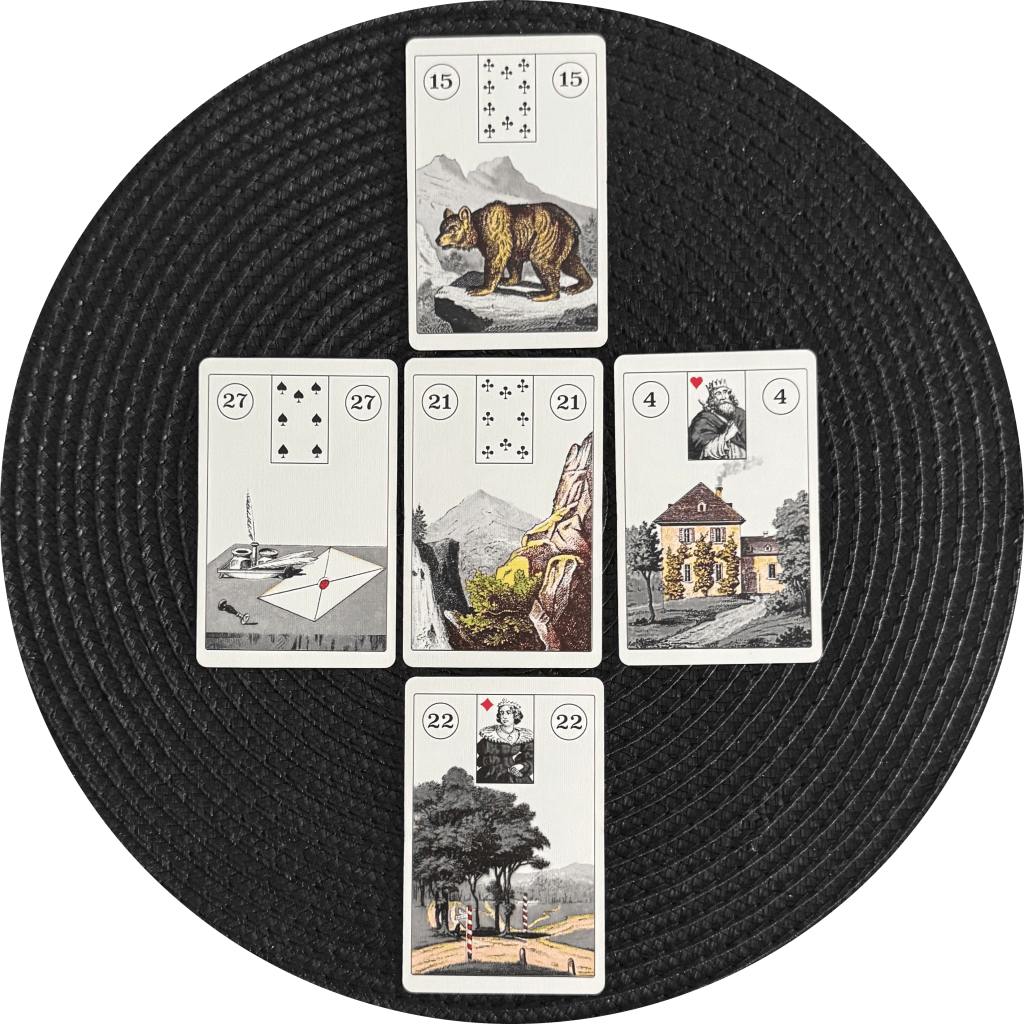
- Position 1: The Mountain
- Position 2: The Roads
- Position 3: The Bear
- Position 4: The Letter
- Position 5: The House
The message of the spread was remarkably clear.
Reading the vertical column first, we see that following a series of difficult choices and life-changing decisions (Roads), Marino now finds himself engaged in an uphill struggle (Mountain). The card speaks of obstacles, burdens, and challenges that require perseverance rather than quick solutions.
The future, however, is encouraging. Once these difficulties have been worked through, the Bear indicates a considerably stronger position. Marino emerges more resilient, more secure, and better able to manage the demands placed upon him. Indeed, the relationship between the Mountain and the Bear is particularly telling. The hardship itself is what forges the strength represented by the Bear. The present burden is not merely something to be endured, but something through which Marino develops the resilience and resources he will ultimately need.
The horizontal axis provides the practical advice.
The Letter occupies the position of unhelpful influences. However well-intentioned Elvira’s concern may have been, constant telephone calls, messages, and attempts to check on Marino were likely adding to his sense of pressure. The card suggests that continual communication had become another demand upon an already overburdened (Mountain) man.
The House, by contrast, reveals the helpful influence. Elvira needed to provide support without intrusion. Respecting Marino’s boundaries, preserving his privacy, and allowing him the space to manage his affairs were likely to prove far more beneficial than frequent intervention. The House provided stability, security, and a place of refuge rather than additional demands upon his attention.
The spread therefore delivered a reassuring message. Marino’s circumstances were undeniably difficult, but the struggle was temporary rather than permanent. The Bear showed that strength lay ahead. Elvira’s role was not to solve the problem for him, but to provide the stable foundation represented by the House whilst trusting him to navigate the Mountain in his own way.
§
Images:
Featured Image:
Yellowstone National Park from Yellowstone NP, USA, Public domain, via Wikimedia Commons. https://commons.wikimedia.org/wiki/File:Bear_in_motion,_Lamar_Valley_(18394494681).jpg
Cards:
Lenormand Cards: Jeu Lenormand © Cartamundi, WanderWüst © Jorge/Wandering Oracle, Lenormand Fortune-Telling Cards © Zao-Gelli, The Lenormand Oracle © Verlag für die Frau, Leipzig, Nieuwe Lenormand © Amber Studio/Erna Droesbeke, Lenormand 36 Orakelspielkarten © Königsfurt-Urania,
References:
Aesop (2013) Aesop’s illustrated fables (Barnes & Noble Collectible Editions). S.l.: Barnes & Noble.
Boroveshengra, A., 2013. Cartomantes’ Cabinet: The Petit Lenormand Course.
Boroveshengra, A., 2015. Lenormand Thirty Six cards. 2nd ed. Create Space.
George, R. 2014 The Essential Lenormand: Your Guide to Precise & Practical Fortunetelling. Woodbury, MN: Llewellyn Publications.
Grimm, J. & L. 2020 The Complete Grimms’ Fairy Tales. New Delhi, India: Fingerprint! Classics.
Marco, M. and Goffinet, J., 1989. Petit Lenormand. Bruxelles: Servranx.
Matthews, C. 2014 The Complete Lenormand Oracle Handbook: Reading the Language and Symbols of the Cards. Rochester, VT: Destiny Books.
Meuris, B., 2018. Petit Lenormand Encyclopaedia: Volume 1. Create Space.
Silvestre, C., 2003. Le Petit Lenormand. [Montpellier]: Gange éd.
 Journal of a Cartomante
.jpg)