I am the rose of Sharon, the lily of the valleys. As a lily among the thistles, so is my love among the maidens.
My Beloved is mine and I am his. He pastures his flock among the lilies.
The Song of Solomon 2:1-2, 16, The Jerusalem Bible (1966)
Lilies, announces a happy life unless surrounded by clouds where it indicates sorrows in the family. If this card is found above the person it indicates virtue, below, it cast doubts on their principles
Original Instructions
Like the Fox and Birch Rod, card No. 30 – the King of Spades – the Lilies is a card that divides opinion. Is it the notorious “sex card”? A symbol of purity? Or the Petit Lenormand’s eikōn of all things venerable and elderly?
The Essence and Function of the Lilies
The essence of the Lilies is serenity; its function is righteousness. One once proposed “ecstasy” as its essence, intending a profound emotional and spiritual union that brings tranquillity to the soul. Yet the term was too often misunderstood, and “serenity”—the harmony of mind, body, and spirit—is the more accurate expression of the card’s nature.
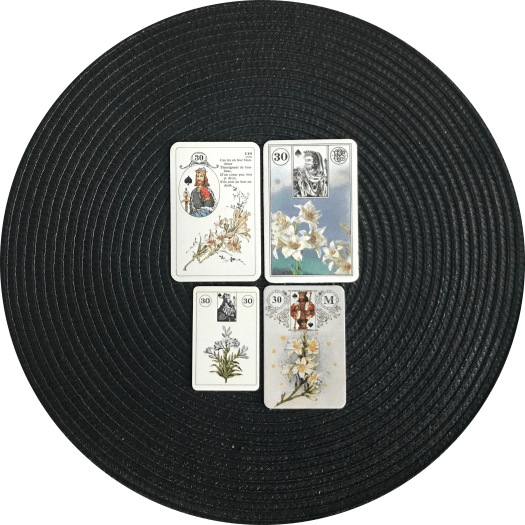
Traditionally, the Lilies depict a branch of white Easter or Madonna lilies, though some historical decks employ other varieties or colours, subtly altering the descriptive interpretation.
As with the Fox, folklore provides the key to the Lilies’ seemingly contradictory associations. These are ancient, varied, and deeply rooted in European tradition.
Hellenistic myth holds that the lily sprang from Hera’s breast milk, linking it with marriage, fertility and fidelity. The fleur‑de‑lis, meanwhile, has long symbolised kingship, chivalry, and protection. In the langage des fleurs, lilies convey meanings ranging from love and majesty to rebirth and passion. Though chrysanthemums are more commonly associated with death, lilies too may evoke grief and funerary rites for Anglos, adding a further note of solemnity to their symbolism.
Within the Judeo‑Christian European tradition—the one most relevant to Lenormand—the lily is intimately connected with both Our Lord and his Blessed Mother. The Madonna lily appears frequently in depictions of the Annunciation, where St Gabriel bears a spray of lilies. Though often said to signify virginity, its symbolism is richer: the three petals evoke the Holy Trinity and reflect Our Lady’s unique relationship to it—Daughter of the Father, Mother of the Son, and Spouse of the Holy Spirit.
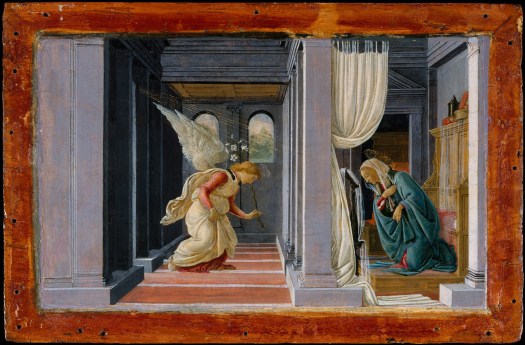
A persistent misunderstanding must be addressed. The lily’s association with purity is frequently taken as a synonym for virginity and, by extension, celibacy. This conflation is misleading. In the Annunciation, the lily points not primarily to virginity in a narrow or physiological sense, but to the mystery of the Immaculate Conception: Our Lady’s own conception free from original sin—“Hail, full of grace, the Lord is with you” (Luke 1:28, RSVCE). To reduce the symbol to celibacy alone is to flatten its theological and symbolic depth. The Immaculate Conception is not the Incarnation; St. Anna and St. Joachim conceived Our Lady in the normal manner. Her perpetual virginity forms part of this mystery, but it does not exhaust it.
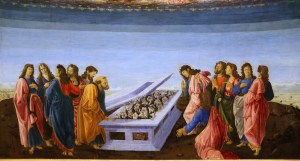
The lily also appears in depictions of the Dormition and Assumption, reinforcing themes of incorruptibility and exalted grace. The assumption lily blooms around 15 August, aligning with the Feast of the Dormition of the Theotokos. The Easter lily, by contrast, signifies the Resurrection and the joy that follows Calvary. In the Song of Solomon, the bride is likened to a lily among brambles (or thistles)—an image of love, beauty, and delight.
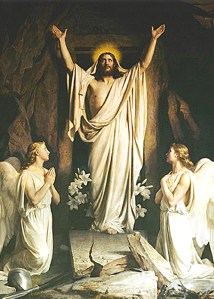
These associations—grace, renewal, tenderness, and moral purity—form the interpretative field of the Lilies card.
Interpretative Principles
The Lilies is sometimes dismissed as a “catch‑all” card, and not without reason. More than almost any other eikōn, it demands context. It is rarely read as an event and only occasionally as a topic outside a Grand Tableau. Its primary role is atmospheric: in the absence of malefic influences, it brings fulfilment, harmony, and a sense of belonging. In relationships, it denotes tenderness, mutual respect, and genuine affection.
When read independently, the Lilies most often signifies a person or, in certain contexts, an institution charged with a duty of care. It is also associated with the family—though not the household, which belongs to the House card.
Functionally, the Lilies represents righteousness or moral excellence. It encourages the virtues that sustain harmony—integrity, charity, honesty, humility—and thus the attainment of one’s highest potential.
Coda
At heart, the Lilies is an atmospheric card, bringing contentment and tendresse to situations and relationships. Otherwise, it is most commonly read as a man or, thematically, as the family.
Person and Description
Person
Card no. 30 corresponds to the King of Spades. In playing‑card folklore, the King of Spades is associated with King David the Prophet; accordingly, when read as a person, the Lilies signifies a man. Following Etteilla, the suit of spades is associated with the female significator—the Lady (Ace of Spades). Accordingly, the King may also represent a maternal relative or, for a married man in a relationship reading, a relation by marriage.
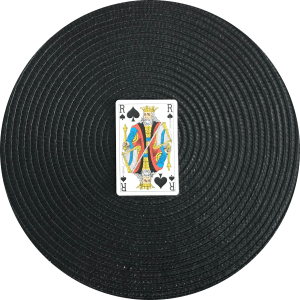
Most court cards—such as the Fishes (King of Diamonds) or the Roads (Queen of Diamonds)—are read as persons only when paired with a social card. This is because their personal interpretation is a secondary function, activated only when the spread explicitly calls for it. The Lilies, however, like the Serpent, the Hound, and the Bear, is read as a person in the majority of draws.
Marco and Goffinet observe that this typically occurs when the Lilies is read in isolation. Experience confirms this, though what is “isolation”? The Lilies is best read as a person when it occupies a non‑descriptive position—when functioning as a trigger card, for example, or often as a focus card. In other instances, cultivated intuition guides the decision.
Consider Lilies + Ring. While it may indicate a close familial bond, outside a Grand Tableau it more commonly signifies an agreement involving a man. In the Game of Destiny example on this site, the Lilies is descriptive in the first stage but a person in the third. Positioned between the Birch Rod and the Book, it was more coherent to read it as a person: signs of illness (Tree + Birch Rod) required investigation (Book) by an individual (Lilies).
With practice, one becomes attuned to the language of the cards, and immediate cognition—true intuition—reveals when the Lilies denotes a person.
Though many sources describe the King of Spades as an older man, this should not be assumed. Court cards shed fixed attributes, and their physical and psychological qualities emerge through surrounding cards. Unless additional indicators—such as the Tower or Clouds—explicitly suggest “age”, the King will simply denote an adult male, often near the seeker’s own age. One should never presume advanced years without clear support.
Physical Description & Temperament
Like all cards, the Lilies may describe a person’s physical appearance when paired with a person card. Its aesthetic is one of refinement and striking presence. Whereas the Bouquet denotes classical beauty—soft, harmonious, and conventionally pleasing—the Lilies suggests a sharper, more sculpted elegance. It evokes the sort of individual whose features are arresting rather than merely pretty: poised, immaculate, and possessed of an almost austere allure. Think of the cool, chiselled glamour of Marlene Dietrich or the sleek, commanding presence of Buster Crabbe. Temperamentally, such a person is composed, dignified, and self‑possessed, with an air of quiet authority and a natural inclination towards restraint and decorum. They are loyal, tender, and notably discerning—a good judge of character. Experience shows that those signified by the Lilies will give everyone a fair chance; yet once their good opinion is lost, it is lost irrevocably.
A slight caution is necessary when describing colouring. The Lilies often indicates clear skin and fair hair, but this does not necessarily imply white hair; it may be ash, flaxen, or platinum. Grey hair belongs more properly to the Clouds card. Moreover, this colouring applies only when the deck depicts a white‑yellow lily. If the card shows lilies of another hue, that colour should be used instead. The ASS Lenormand, for example, has a distinct pink tint—an easy detail to overlook, as one client discovered when they met someone who matched every other aspect of the description but had, quite literally, pink hair. I had missed this.
Special Features
Above or Below
Traditionally, cartomancers paid close attention to whether the Lilies fell above or below the person card. The original instructions state: “If this card is found above the person it indicates virtue; below, it casts doubts on their principles.” This reflects a broader rule within Lenormand: a card influences the card beneath it. When such a card falls above a person card—“crowns” it, in divinatory parlance—it guides, elevates, or directs the individual. Consequently, several cards are markedly more auspicious when placed above the significator, such as the Stars, the Sun, the Moon, and the Key.
The Lilies follows this principle closely. When it falls above the significator, its qualities—serenity, righteousness, moral clarity—guide and shape the person’s conduct. When it falls below, those qualities are not held aloft; the individual’s own motivations, desires, and needs become the primary driving force. The Lilies still colours the interpretation, but it does not “crown” the querent.
It is worth reiterating that virtue, in this context, must not be confused with sexuality. Virtue is not chastity; it is an inner excellence, a disposition towards harmony, integrity, and a flourishing life. The Lilies speaks to moral character, not sexual behaviour.
Practically, this feature is especially useful when examining partnerships—romantic, familial, or professional. Noting whether the Lilies lies above or below a partner card offers nuance in judging the surrounding descriptive cards. Above, it suggests that the person is guided by the Lilies’ qualities; below, that those qualities are present but not determinative. This simple positional observation can provide a surprising degree of insight into the dynamics at play.
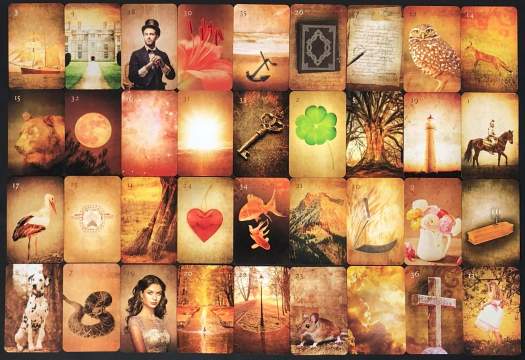
The Grand Tableau below illustrates this principle in practice. The Lilies appears in the first row, immediately to the right of the Lord card and above the Lady, who sits in the bottom row.
Epic Light Lenormand
© Kathleen Bergmann
The querent—the Lady—is a principled, well‑adjusted woman who dislikes conflict (Birch Rod crowning). The Lilies falling to the right of the Lord describes him as essentially decent: good‑natured, loyal, and fundamentally sound in character. Yet it does not fall above him. He is not self‑serving, but neither is he above exploiting grey areas when it suits him; the Lilies does not “crown” him, and thus its virtues do not guide his conduct in a decisive way.
The gentleman in question worked in finance and had been offered a secondment requiring twelve months in Hong Kong. He was keen to pursue the opportunity, even though it meant postponing a planned wedding (Stork, Ring, Birch Rod). The Lilies’ position—beside him but not above—captured this nuance perfectly: a fundamentally decent man, but one whose personal ambitions and practical considerations outweighed the guiding influence of serenity, loyalty, and moral restraint.
The Lord lies in the domicile of the Ship card, indicating a man keen to move forward and pursue opportunities for advancement. He also knights to both the Ring and the Heart, showing that he is in love with his fiancée and genuinely wishes to marry her; however, he sees this occurring after he has addressed his professional aspirations. Knighting, after all, reveals what lies “around the corner.” His focus is on building a better life rather than on the wedding day itself.
The querent was under pressure to end the relationship, yet the individual urging this course of action was neither neutral nor trustworthy, as shown by Hound–Serpent and Fox–Hound. Fortunately, the situation is not irreparable. Clarity can be restored by gaining a proper understanding of each other’s needs (Stars–Birch Rod) and by removing the poisonous words and influences that have clouded judgement (Stork–Serpent).
Sex and the Lilies
For some readers, the Lilies is the so‑called “sex card.” Others prefer the Birch Rod or the Serpent for such matters. In truth, no single Lenormand card pertains specifically to sex or sexuality. If the querent asks about sex, then all thirty‑six cards become “sex cards,” for the context of the question governs the interpretation. The cards speak to the subject placed before them.
In questions concerning romantic relationships, the Lilies contributes a quality of tendresse—a deep bond marked by affection, devotion, and emotional maturity. It signifies a relationship characterised by gentleness, mutual respect, and a serene, enduring love. When the question explicitly concerns sex, the Lilies describes the act not in crude or mechanical terms, but as unitive: an expression of love that joins two people physically (and spiritually). It speaks to intimacy as an extension of tenderness, not as an isolated or purely physical pursuit. Hence the often cited Lilies—Sun being “great sex” would be true, but only in a specific context.
Family and Relationships
When approached as a topic (usually in a Grand Tableau), the Lilies generally pertains to the family, though its emphasis lies more upon one’s relationship with them than upon specific events.
For example, the Tree and the Coffin falling with the Lilies may indeed indicate a significant illness or bereavement within the family. Yet in practice it is far more common for such combinations to speak of emotional distance, estrangement, or a sense of rejection within the family dynamic. Conversely, benefic cards around the Lilies describe closeness, support, and a deep sense of belonging.
Timing
Traditionally, the Lilies is associated with winter. When paired with the Clouds, it may denote snowfall or blizzards. In my own practice, it has also shown a consistent affinity with Wednesday, though this is a personal correspondence rather than a traditional one.
Health
In matters of health, the Lilies pertains to the hormonal system—the internal regulators of development, mood, metabolism, growth, and reproduction. With supportive cards, it may also indicate issues relating to sexual health. Its influence is subtle but significant, pointing to the underlying rhythms and balances that sustain the body’s well‑being.
The Lilies in Action
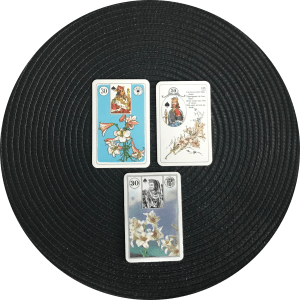
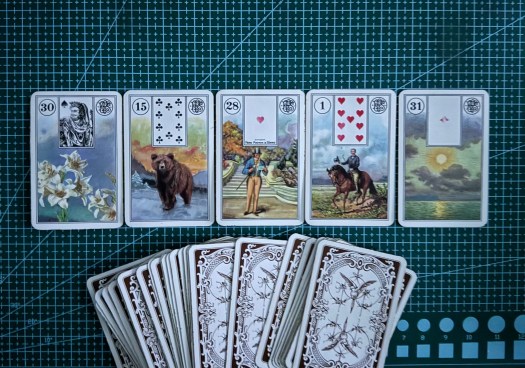
A woman consulted the cards, desperate to resolve an acrimonious dispute with her daughter‑in‑law. What, if anything, could she do to remedy the situation? The cards fell as shown below.
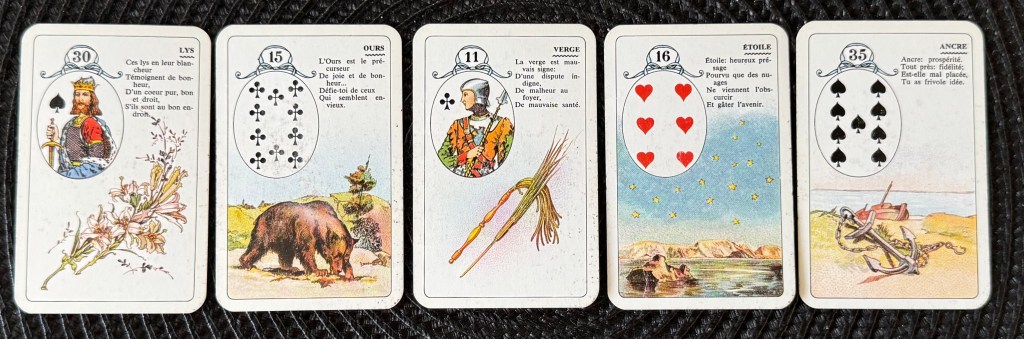
Of note, neither the querent’s nor her daughter‑in‑law’s significators—the Lady and the Serpent —appear. This indicates that the matter is not something the querent can resolve by her own efforts alone.
As the trigger card, the Lilies is best read here as a person. The querent should seek assistance from a man (Lilies) who possesses natural authority (Bear–Birch Rod) and who can, where necessary, take the parties involved to task (Birch Rod) and restore a sense of stability and clarity (Stars–Anchor).
As the reading is for a woman, the Lilies in this context would most likely represent a member of the querent’s own family (Spades). The Bear often denotes someone “senior”—a parent, grandparent, or aunt/uncle. In this instance, it transpired that the figure in question was the querent’s elder brother, who did indeed intervene.
The reading below was performed in August 2025 for a man struggling to decide between two options. No information was given regarding the specifics. What, then, could he do?
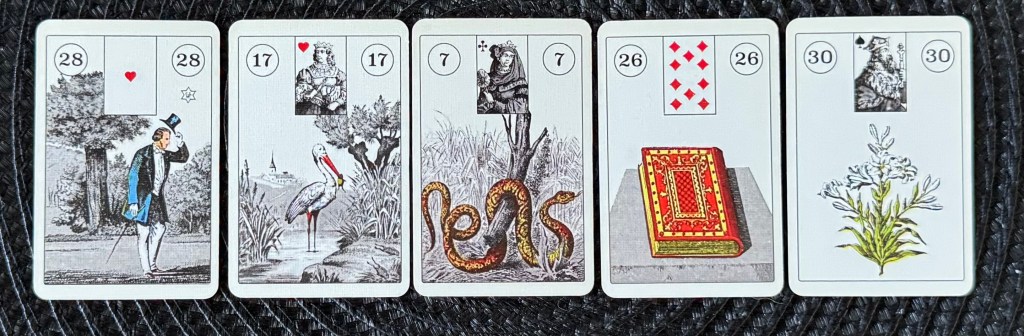
The Lord appears as the first card, indicating that no one can make the decision on his behalf. However, a female friend (Stork, supported by two Queens) can help him unravel the situation (Stork–Serpent) and arrive at an informed decision with clarity (Book) and peace of mind (Lilies). You’ll note, here, the Stork overcomes the Serpent taking the venom (danger) from the Book.
§
Images:
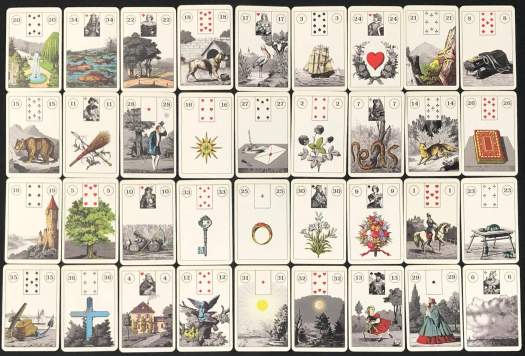
Cards: Jeu Lenormand © Cartamundi, WanderWüst © Jorge/Wandering Oracle, Nr. 1941 Mlle Lenormand Wahrsagekarten © Piatnik, Lenormand Fortune-Telling Cards © Zao-Gelli, Lenormand (Symbole): Die echten Altenburg-Spielkarten © Königsfurt-Urania, Jeu de 32 cartes à jouer belote © Fournier, Epic Light Lenormand © Kathleen Bergmann.
Featured Image: Cantique des Cantiques by Gustave Moreau via Wiki Common.
References:
Burke, L. (1867) Illustrated Language of Flowers. London ; New York : G. Routledge and Sons.
Delclos, M., 2013. Le Livre du Petit Lenormand. 1st ed. Escalquens: Éd. Trajectoire.
George, R., 2014. Essential Lenormand. 1st ed. Llewellyn Publications, U.S.
Marco, M. and Goffinet, J., 1989. Petit Lenormand. Bruxelles: Servranx.
Matthews, C. (2014) The Complete Lenormand Oracle Handbook: Reading the Language and Symbols of the Cards. Rochester, VT: Destiny Books.
Rublack, U. (2010) Gender in Early Modern German history. Cambridge: Cambridge University Press.
The RHS Lindley Library Vol. 10: The Victorian Language of Flowers, 2013.
Silvestre, C., 2003. Le Petit Lenormand. [Montpellier]: Gange éd.
Watson, C.B. (1961) Shakespeare and the Renaissance Concept of Honour.
 Journal of a Cartomante