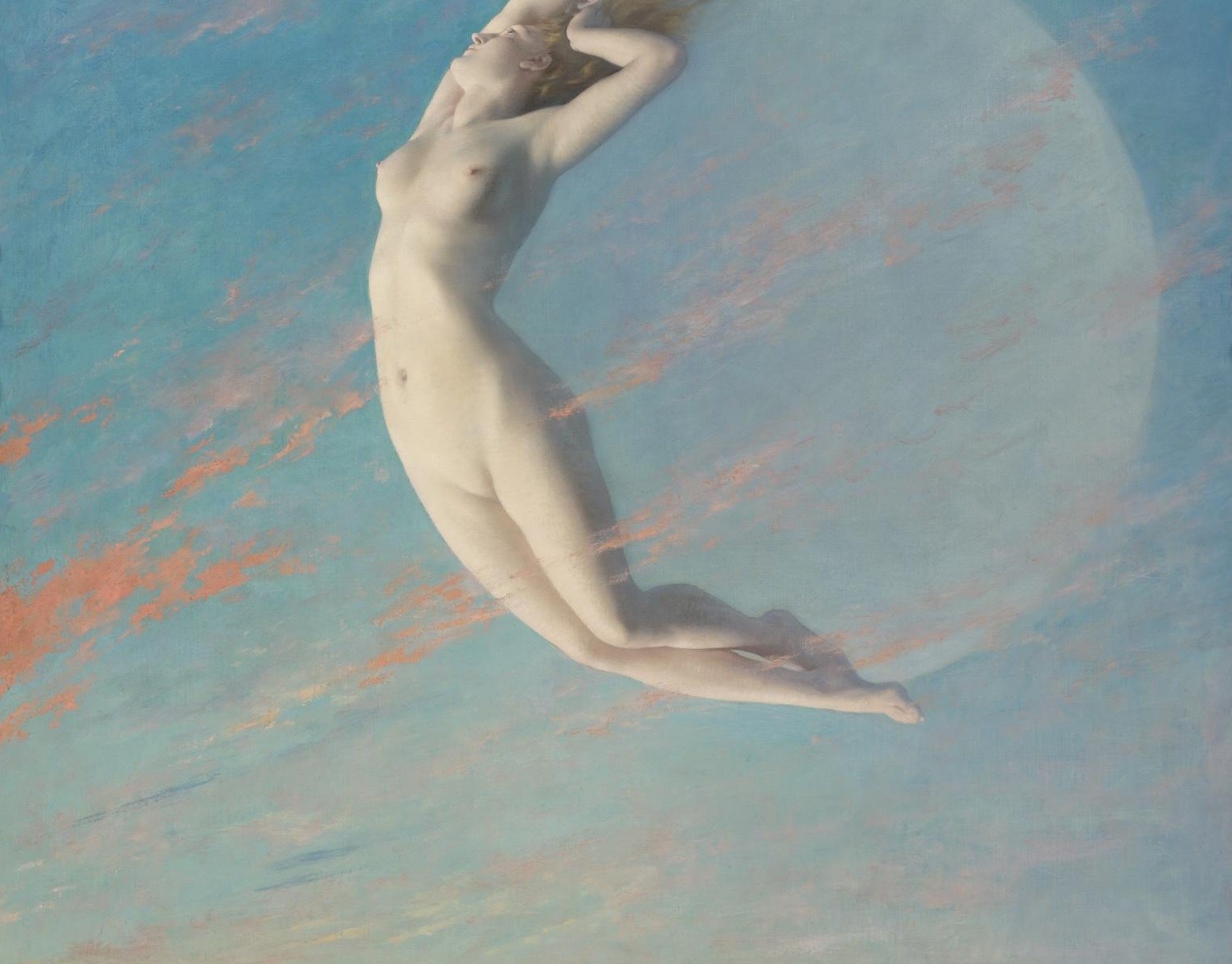
As She Grows, Bright Rays Are Shed: The Moon Card

As she grows, bright rays are shed I from the firmament

Homeric Hymn to Selene

Sweet Moon, I thank thee for thy sunny beams; I thank thee, Moon, for shining now so bright.

A Midsummer Night’s Dream, William Shakespeare

Moon, is a sign of great honour, if this card is located next to the person, on the contrary, if it is at a distance it announces misfortunes

Original Instructions


The Lenormand’s 32nd card, the Eight of Hearts — or the Moon — is at once intriguing and, for some, perplexing. Why should it be associated with employment? Is it not rather a card of emotions and sensibility? Surely it may be read in much the same way as the Moon in the Tarot?

The Essence and Function of the Moon Card

Reflection is the principal function of the Moon card. In the past, I have advanced “recognition”, “fascination” and “visibility” as its essence; however, reflection proves, in many respects, the more apt term, for it encompasses both the card’s essence and its function.
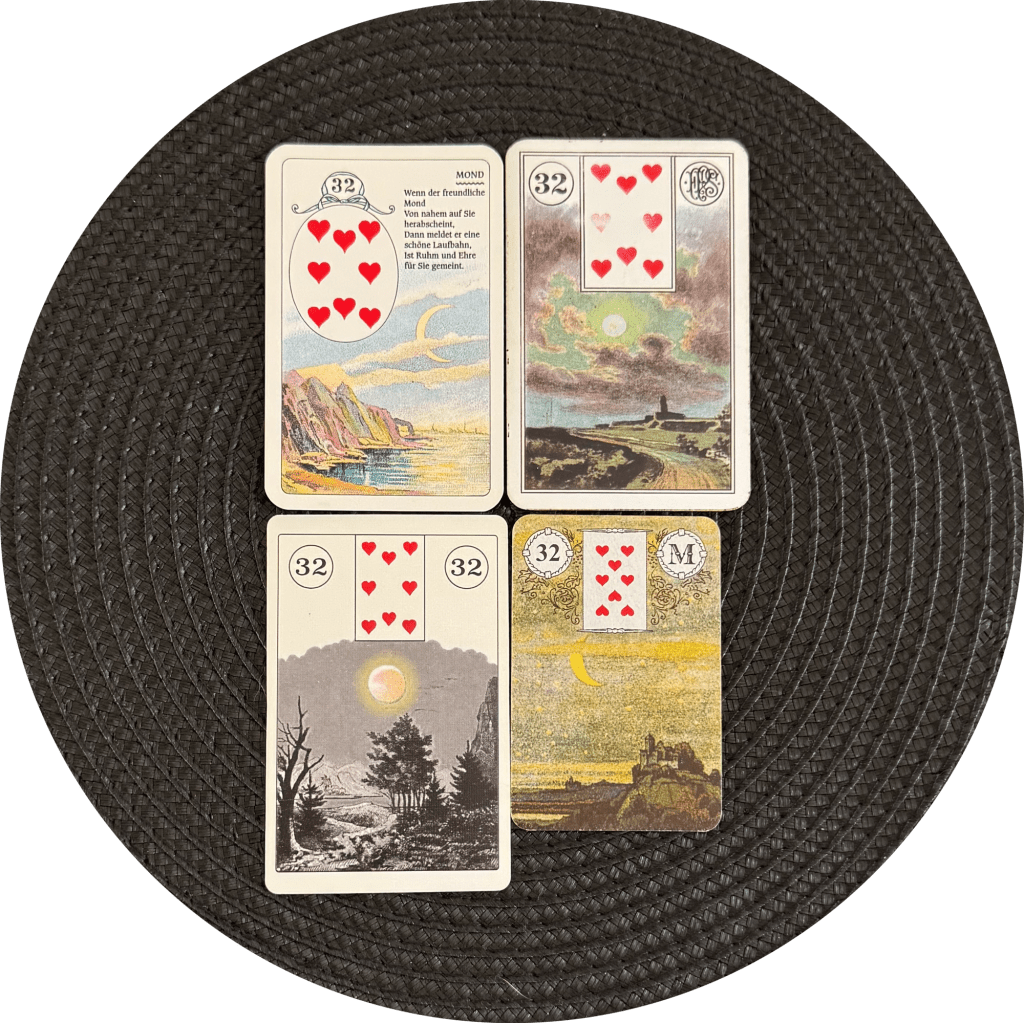
The traditional eikōn of the Moon remains remarkably consistent across well-known patterns — Brepols, Dondorf, Wüst, Piatnik, and the Blaue and Rote Eule, among others. In more elaborate packs, a crescent or full moon casts its light upon a landscape typically populated by trees and scattered clouds. Simpler decks favour a stylised crescent form.

The moon is the Earth’s sole natural satellite. Its gravitational influence helps to regulate climate, govern the tides, and sustain essential ecological processes. Although early cultures lacked the scientific vocabulary to articulate this, the moon’s vital importance was nevertheless recognised and revered from the earliest civilisations.

Via Wiki Commons

Accordingly, like the sun, the moon occupies a position of great significance within myth and folklore. Familiar are the tales of lunar deities — Coyolxāuhqui, Selene, Chang’e — as well as stories concerning the moon’s effects upon human nature. Medieval lore likewise abounds with images of a man confined within the moon.

Within the Western tradition from which the Lenormand cards emerged, the moon has long been understood in intimate relation to the sun. These two luminaries were regarded not only as mythological consorts, but as complementary principles within a broader cosmology.

Particular emphasis was placed upon the moon as the reflector of the sun’s light, and consequently upon its phases. Where the sun signifies the vital, animating force, the moon represents the corporeal life and the body itself. For just as the soul cannot be seen directly, neither can light; both are apprehended through their manifestation — light through reflection, the soul through the living body.
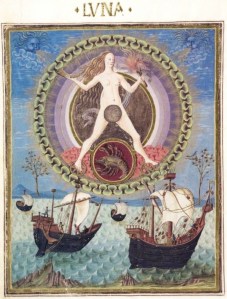

Sphaerae coelestis et planetarum descriptio aka De Sphaerae

Like the moon, the body waxes and wanes: it is born, it grows, and it declines. Owing to the shifting degrees of lunar illumination throughout its cycles, the moon has long been associated with fluctuation and inconstancy.

It is this dynamic interplay, centred upon the moon as the conduit of the sun’s light, that proves essential to a proper understanding of the card and its significations. The moon does not generate light of its own; rather, it receives, modulates, and reflects the sun’s radiance. Thus, its meaning lies not in independent force, but in transmission, mediation, and the varying degrees of visibility it affords. It is through this reflective function — the transformation of light into perceptible form — that the deeper significance of the card is revealed.

A Case of Two Moon: Lenormand and Tarot

For some, the Lenormand’s Moon may appear readily interchangeable with its counterpart in the Tarot. Yet this is not the case. While both cards ultimately derive their meanings from the same underlying principle — the reflection of light — their emphases diverge markedly.
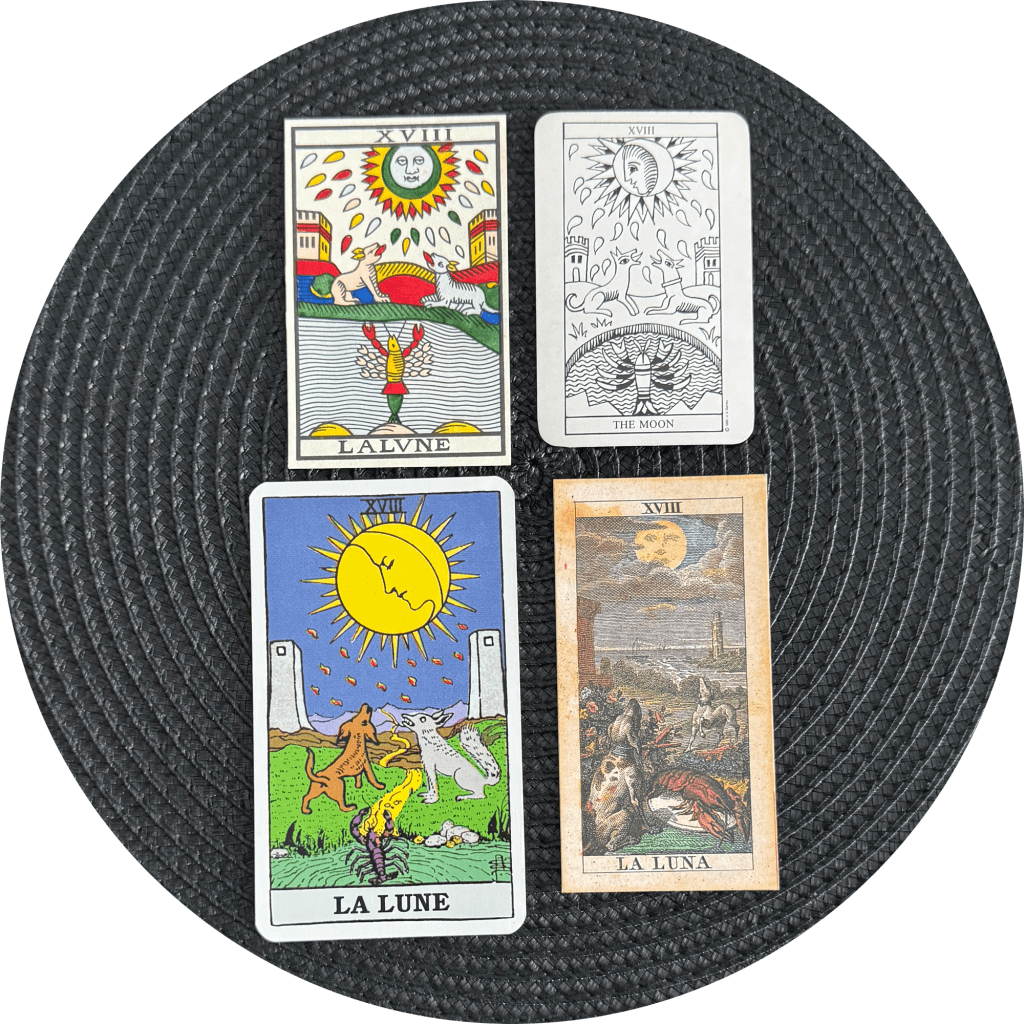
In the Lenormand system, the Moon presents the benevolence of reflected light. Its illumination is steady, guiding, and socially perceptible. It speaks to the visibility conferred through reflection — how one is seen when light is cast upon them.

By contrast, the Tarot’s Moon is concerned not with the gift of reflection, but with its instability. Here, the reflected light is partial, shifting, and uncertain — a mirror that distorts as much as it reveals. It aligns itself with half-truths, obscurity, confusion, voluntary change and forces that operate beyond conscious control. Rather than conferring recognition, it introduces ambiguity and disorientation.
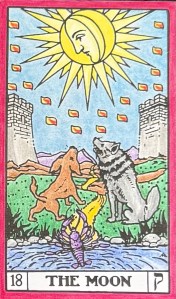
The Moon from the BOTA Tarot

Thus, although both cards arise from the same cosmological idea — the moon as reflector of light — they articulate opposing aspects of that condition. The Lenormand emphasises reflection as guidance and affirmation; the Tarot emphasises it as distortion and concealment. In this sense, the essential quality of the Tarot’s Moon is not illumination, but a kind of darkness — a state defined in implicit contrast to the clarity and vitality of the Sun.

Interpreting the Moon

In interpretation, the Moon card offers a reflection of the querent or of the situation as it appears in the eyes of others. It does not generate light in its own right, but instead reveals how illumination — as signified by the Sun — is received, modulated, and perceived. In this sense, it presents a portrait: a mediated image shaped by reflection rather than direct exposure.

The card therefore provides the reader with an essential perspective — how the matter at hand will be seen, recognised, and judged. It speaks to reputation, standing, and the outward impression formed when light is cast indirectly. If the Sun shows what is, the Moon shows how that reality is reflected back into the social and perceptual realm.

It follows that the Moon concerns itself not with internal states, but with outward appearance. It does not, of itself, describe emotional experience or personal sentiment. Such matters properly belong to the domain of the Heart card, which alone addresses affection, emotion, and feelings. The Moon, by contrast, pertains to visibility and perception — to how things are seen, rather than how they are felt.

Coda

The Moon reflects. It reveals how light—truth, status, or circumstance—is mediated and recognised in the wider world. Thus, it is not a card of feeling, but of appearance, reputation, and the image that endures in the minds of others.

Person and Description

The Moon is not, in itself, a significator of a person. When it appears in combination with a person-card, however, it may serve to describe that individual’s appearance and character.

Physical Description

In itself, the Moon card suggests a person of a distinctly phlegmatic cast: a round or softly contoured face, clear complexion, and a fuller figure, typically of short to average stature. Hair colouring often tends towards the lighter spectrum — from pale blonde to silver or ashen tones.

Owing to its essential quality of reflection, the Moon frequently indicates an appearance that recalls or evokes another individual. The person may seem familiar, as though they echo or resemble someone known to or admired by the querent. This resemblance may extend to public figures, though it need not be confined to celebrities.

When accompanied by the Bouquet, the indication is elevated towards a more classical ideal of beauty — polished, harmonious, and somewhat timeless in its appeal. One might think in terms of refined glamour or cultivated attractiveness, akin to figures such as Dorothy Dandridge, Hedy Lamarr, Oscar Micheaux, or Cary Grant.

Temperament

The Man in the Moon
Baring-Gould, Sabine (1872). Curious Myths of the Middle Ages

In matters of temperament, the Moon commonly describes an individual of calm and composed disposition, though at times inclined towards timidity or reserve. Such a person is often acutely aware of appearances and the impressions they create, not necessarily from vanity, but from a desire to be well-regarded and properly received.

Moreover, the Moon frequently denotes a mind capable of sustained fascination. This may manifest as a deep and abiding interest in particular subjects or pursuits, occasionally tending towards the obsessive. Their inner life, though not explicitly emotional in the sense of the Heart, is nevertheless shaped by habitual reflection and attentiveness to how things are perceived.

Special Features

Fame

The traditional instructions associate the Moon with fame and honours — an attribution that is neither arbitrary nor without foundation. As noted earlier, the Moon governs the public, reflecting its tastes, inclinations, and mood. It is from this collective body that recognition arises, and it is recognition that forms the very currency of fame.

For what is fame, if not the sustained regard of others? It is, in essence, the successful reflection of one’s image in the minds of the many.

Accordingly, when the Moon appears at a distance, or is afflicted by cards such as the Clouds or the Coffin, it often indicates difficulty in attaining recognition or rejection . The querent may find their efforts overlooked, their qualities insufficiently acknowledged, leading in time to frustration or disillusionment.

Work

For most individuals, fame and recognition are realised — in however modest a form — through their professional life. It follows, therefore, that the Moon assumes a position of particular importance in matters of career and vocation.

The rationale is straightforward: in seeking employment or advancement, one must be perceived favourably. One must impress, distinguish oneself, and be seen — in short, to achieve a form of personal distinction (fame) in order to be selected or honoured (employed).

Thus, the cards surrounding the Moon will indicate how the querent presents within a professional context: the strength of their credentials, the impression they make upon others, and the balance of their perceived strengths and weaknesses.

More broadly, the Moon serves as a barometer of professional standing and trajectory. Beneficial cards suggest an individual who is established, respected, and progressing; adverse influences, by contrast, indicate obscurity, stagnation, or a lack of due appreciation.

In this respect, the Moon may rightly be regarded as the master card of work. It not only reveals how one is perceived, but also reflects what one does and the status one holds within that sphere. Through the eyes of others, it presents a living portrait of the querent’s professional identity — their role, their standing, and the degree of recognition accorded to them.

It governs not the labour itself, but the acknowledgement of that labour, upon which all opportunity, advancement, and ultimately the attainment of a better life depend.

It may be usefully contrasted with other occupational indicators within the system. The Anchor, for instance, speaks to stability, permanence, and thus job security — the extent to which one’s position is fixed and enduring. The Fox, by contrast, introduces the element of rivalry and competition, indicating colleagues, competitors, or adversaries within the professional sphere. Where the Moon reflects how one is seen and valued, the Anchor shows how secure one is, and the Fox reveals the conditions under which one must contend.

Proximity

As a mere reflection of the Sun’s rays, the light of the Moon does not carry with the same force or reach; it must be near at hand to be properly perceived. Consequently, when the Moon appears at a distance within the tableau, it indicates a lack of visible success or recognition. The querent’s efforts may go unnoticed or insufficiently appreciated, often giving rise to frustration or disillusionment, as the reflection fails to reach those whose regard is sought.

When joined by the Clouds, this condition is further degraded. The reflected light is obscured, producing not only diminished visibility, but a distorted or unfavourable appearance. In such instances, the card may signify a damaged reputation or poor public impression, which in turn restricts opportunity and diminishes tangible prospects.

Timing

The Moon is generally regarded as a swift-moving card. Traditionally, it is associated with the evening, standing in contrast to the Stars, which pertain to the deeper hours of night.

In broader temporal terms, the Moon may also signify a lunar cycle, approximately twenty‑eight days.

From experience, the pairing of Moon and Child may be read as after new moon. The Moon in conjunction with the Sun may denote the full moon. Conversely, the sequence of Sun followed by Moon may be taken to signify the summer solstice.

Health

In matters of health, the Moon often points towards conditions rooted in perception, identity, and the relationship between the self and its reflected image. It is particularly associated with disturbances such as body dysmorphia, gender dysmorphia, eating disorders, and avoidant personality patterns — all of which involve a disjunction between reality and its perception or expression.

The card may also describe intrusive recollection, such as flashbacks, particularly those associated with trauma. In this respect, it reflects not the present reality, but the persistent re‑emergence of past impressions, as seen in conditions such as post-traumatic stress.

In combination with the Scythe, the indications may become more severe, extending to self-harming tendencies or behaviours directed against the body.

The Moon in Action

In 2024, a client consulted me with a fairly common difficulty: why could she not meet someone with whom she might form a lasting relationship. Siobhan, in her late twenties, had explored a variety of avenues — dating applications, singles’ events, blind dates, and so forth — yet nothing progressed beyond an initial encounter.

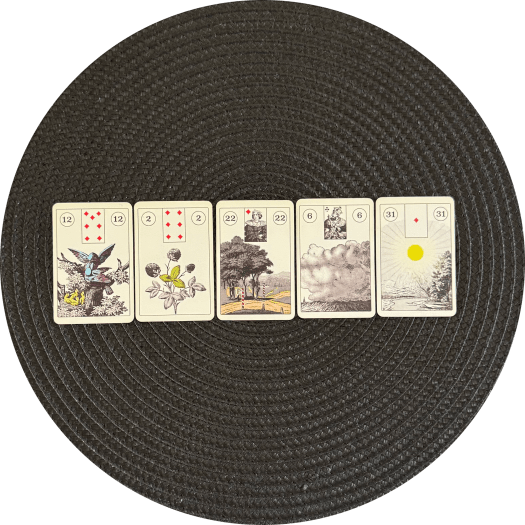
The cards as they fell:
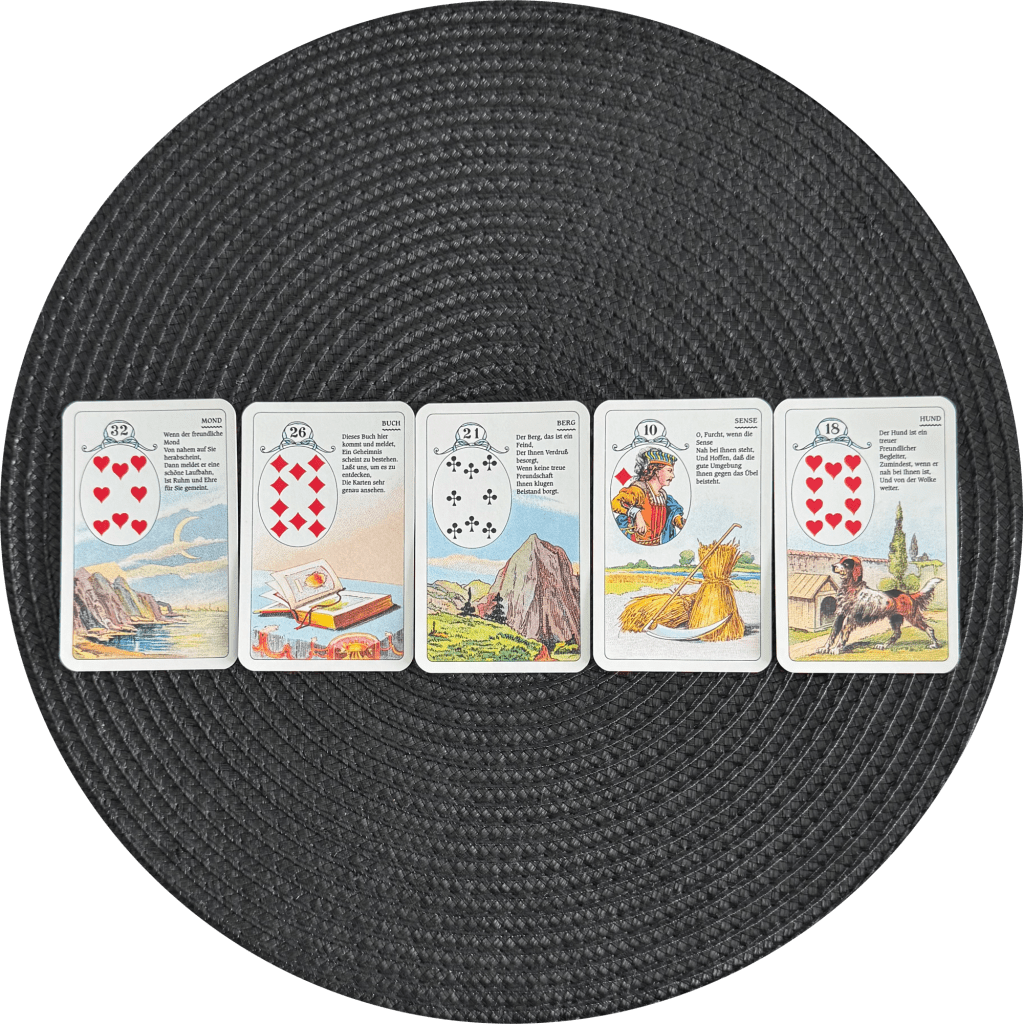
The Moon, the Book, the Mountain, the Scythe, and the Hound.

The message conveyed by the cards was both clear and direct: she was perceived as too guarded.

Within a relational context, the Moon affords a glimpse into how one is seen by partners or prospective suitors. Followed by the Book, it suggests an air of inscrutability — reinforced by the way in which the Moon reflects upon the spine of the Book — indicating something withheld or not readily accessible. This inscrutability functions as a barrier, as shown by the Mountain, preventing others from approaching with ease.

The resulting first impression is one of distance or reserve. Consequently, others struggle to engage with Siobhan, to establish common ground, or to form a meaningful connection — a difficulty expressed through the Scythe and the Hound. The Hound, as the card of one’s circle or “pack”, represents those with whom one feels at ease and shares familiarity; its separation here underscores the absence of that natural ease and rapport.

The cards’ response, though somewhat cutting, aligned closely with feedback Siobhan had previously received — namely, that connections tended to falter due to a perceived lack of chemistry or shared ground.

§

Images:

Lenormand Cards: Jeu Lenormand © Cartamundi, WanderWüst © Jorge/Wandering Oracle, Nr. 1941 Mlle Lenormand Wahrsagekarten © Piatnik, Lenormand Fortune-Telling Cards © Zao-Gelli

Tarot Cards: Les Tarots Marseille de Jean Noblet, Paris, vers 1650 © Éditions Letarot.com (2001), Rolla Nordic Tarot © US Games, Systems, Inc (1981), Je de Tarot Albano-Waite © Carta Mundi/US Games Systems, Inc (1987), Tarocco Soprafino © Il Meneghello Edizioni, Milano-Italy (2023), BOTA Tarot  © Builders of the Adytum 

Featured Image: Selene, Albert Aublet, via Wiki Commons

References:

Avelar, H. and Ribeiro, L. (2010) On the Heavenly Spheres: A Treatise on Traditional Astrology. Tempe, AZ: American Federation of Astrologers.
Boroveshengra, A., 2013. Cartomantes’ Cabinet: The Petit Lenormand Course.
Boroveshengra, A., 2015. Lenormand Thirty Six cards. 2nd ed. Create Space.
Delclos, M., 2013. Le Livre du Petit Lenormand. 1st ed. Escalquens: Éd. Trajectoire.
Marco, M. and Goffinet, J., 1989. Petit Lenormand. Bruxelles: Servranx. 
Ptolemaeus, C. and Robbins, F.E. (2001) Tetrabiblos. Cambridge, MA: Harvard Univ. Press.
Valens, V. and Riley, M.T. (2022) The Anthology. Denver, CO: Amor Fati Publications.
With All Triumphant Splendour: The Sun Card

There he has placed a tent for the sun; it comes forth like a bridegroom coming from his tent, rejoices like a champion to run its course.

Psalm 18:6, The Grail Translation

Sun, near, you are enlightened by its rays and happiness grows, but if it is far away, all cools with discouragement in all enterprises and prepares for calamities

Original Instructions

When one turns to card no. 31 — the Ace of Diamonds, or the Sun — it can, at first sight, appear somewhat one‑dimensional, even a little uninspiring. Is it not merely a symbol of success? How does it differ from the Cloverleaf? And can this eikōn truly disperse the Clouds?

The Essence and Function of the Sun

The essence of the Sun card is illumination, and its function is to energise. Illumination, in this context, must be understood in its fullest breadth: physical, intellectual, spiritual, and indeed metaphysical.

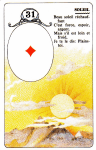
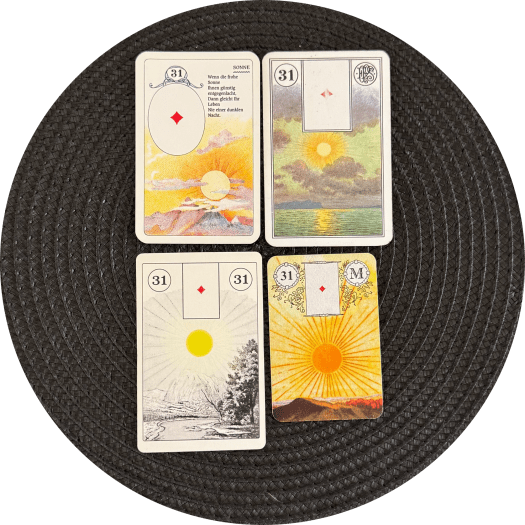
Across the principal patterns, the traditional eikōn of the Sun remains strikingly consistent. The examples referenced here are drawn from decks published by Carta Mundi, Piatnik, the Wandering Oracle, and Zao‑Gelli.

We behold the rising sun in splendour, its rays falling beneficently upon the landscape. Depending upon the artist’s preference, one may find bodies of water, rolling hills, or mountains. A particularly early and enduring detail is the presence of dispersing clouds — a feature to which we shall return in due course.

Interpretative Principles

The Sun is the brightest star and the gravitational centre of our solar system. It is indispensable for warmth, light, food energy, and the precipitation upon which all life depends. In the same way, the Sun card invigorates situations and provides the necessary conditions for success across every sphere of life, not merely the financial or professional.

The Sun photographed at 304 angstroms by the Atmospheric Imaging Assembly (AIA 304) of NASA’s Solar Dynamics Observatory (SDO). This is a false-color image of the Sun observed in the extreme ultraviolet region of the spectrum.

From the earliest civilisations, the sun has held a central place in myth and ritual. Agrarian cultures, acutely aware of their dependence upon its light and warmth, marked the solstices with solemn observances, recognising in them the turning points of the agricultural year. These ancient intuitions are not lost to us: the winter solstice is crowned by the Great Feast of Christmas, when the Light enters the world, and the summer solstice by the Nativity of St John the Baptist, whose mission was to herald that Light and then diminish before it. The cosmic symbolism of the sun, therefore, still finds relevance in modern European culture.

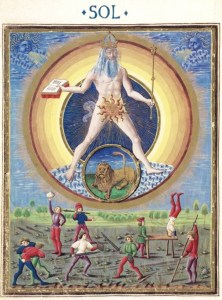
Although the ancients lacked terms such as “dwarf star” or “photosynthesis”, they understood perfectly our dependence upon the sun for survival — and the dangers inherent in its power. For this reason, as attested by the great astrologers, the sun was regarded as the supreme luminary. It is the giver of light, heat, and life, and symbolises our vital energy, spirit, and soul. Through its beneficence of light, it grants the enlightenment and perception required to apprehend revealed truth.

Page from Sphaerae coelestis et planetarum descriptio aka De Sphaerae (ca. 1470), an illuminated astrological manuscript from the Biblioteca Estense Universitaria (Inv. alpha.x.2.14).

All these qualities are encoded within the eikōn: the rising sun as giver of light; the rays as vital force; the dispersing clouds as the dawning of perception; and the landscape as the world quickened by its warmth. The Sun card, therefore, is not merely a cipher for success but the animating principle that renders success possible — the life‑giving radiance without which nothing can flourish.

Coda

Ultimately, the Sun brings not only illumination but its life‑giving heat. Just as the natural sun quickens the earth and drives away the shadows, so too does this card energise circumstances, dissolve impediments, and break through situations that have grown dark or stagnant. It imparts a vital force to the reading as a whole: a renewed impetus, a confident drive towards success, and a sense of bonheur that restores optimism and forward movement.

In relationships, the Sun denotes bonds marked by genuine warmth, openness, and a wholesome delight in the other. It speaks of affection that is steady, generous, and life‑affirming — a warmth that strengthens, encourages, and sustains. In this way, the Sun stands as the card that brings vitality, clarity, and the invigorating heat in which people, plans, and possibilities can truly flourish.

Person and Description

The Sun card, taken on its own, is not read as a person. It does not function as a significator in the way that the Lord, the Lady, Dog or Serpent cards do. However, when it appears in conjunction with a person card, it can offer a vivid and reliable description of both physical appearance and temperament. In this sense, the Sun acts as an enhancing influence, illuminating the qualities of the individual it accompanies.

Physical Description

Physically, the Sun card describes someone with a strong, well‑formed body and a healthy, ruddy complexion. The colouring indicated by the Sun ranges from olive to bronzed and, in some cases, distinctly dark. It is not uncommon for this card to point to striking or memorable eyes — whether notably large, or marked by a golden or amber hue. As ever, one should look for supporting testimony in neighbouring cards before drawing firm conclusions. The hair is often thick, sometimes luxuriant, and may have a warm or sun‑touched tone.

Temperament

In matters of temperament, the Sun card portrays an individual endowed with drive, determination, and a clear sense of purpose. This is someone who strives to see their vision realised and their aspirations fulfilled. They are frequently successful in their chosen field — and the surrounding cards will usually indicate the nature of that field with some precision. Such a person naturally gravitates towards leadership roles and tends to excel when placed at the forefront; they like to be at the top of their game and are seldom content with mediocrity.

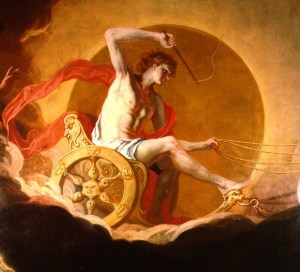
Hans Adam Weissenkircher: Helios on His Chariot

Yet this ambition is not cold or self‑serving. The Sun confers warmth, generosity, and a buoyant sense of bonheur. In love readings, it adds a splash of passion and a wholehearted delight in the relationship. This is a temperament that uplifts others, radiates confidence, and brings a steady, invigorating positivity to all it touches.

Special Features

Proximity

In the Lenormand tradition, proximity is a principle of considerable importance, and the Sun card offers a particularly clear demonstration of its effects. When the Sun falls close to the significator, it acts as a direct source of strength and vitality for the querent. Its nearness energises them, providing the determination, stamina, and inner fortitude required to pursue their aspirations with confidence. The cards immediately surrounding the Sun will often reveal the nature of the endeavours being activated or supported, and may indicate where the querent’s efforts are most likely to bear fruit.

When the Sun lies far from the significator, its influence cools. Opportunities become fewer, and those that do arise tend to be more complex or demanding. The querent may find that progress requires sustained effort, and that obstacles must be met with considerable resolve. In many cases, the distance of the Sun can signify a loss of mettle — not necessarily failure, but a period in which the querent feels depleted, overburdened, or unable to maintain the momentum needed to overcome the trials before them.

The Sun and the Clouds

Light and Its Absence

In most strands of folklore, the absence of light has long been regarded as ominous. Light reveals, clarifies, and brings truth into view; darkness obscures, conceals, and unsettles. Eclipses, in particular, were traditionally interpreted as malefic portents — moments when the natural order appeared to falter and the heavens themselves seemed troubled. This symbolic contrast between light and darkness lies at the heart of the Clouds card, and we shall explore it more fully in the dedicated article on that subject.

The Clouds’ Ability to Eclipse the Sun

Because of this ancient association, the Clouds card does indeed possess the capacity to eclipse the Sun. When this occurs, it traditionally signifies a reversal of fortune. Opportunities diminish, dividends fail to materialise, and relationships may cool or become strained. Matters that once seemed straightforward turn into uphill struggles, and the querent may find themselves labouring against unfavourable conditions. The Sun’s usual clarity and vigour are overshadowed, and progress becomes markedly more difficult.

When the Sun Lessens the Clouds’ Influence

There are, however, circumstances in which the Sun appears to ameliorate or soften the malevolence of the Clouds. This typically occurs when the Sun crowns the Clouds card, or when both the Sun and the significator fall together on the light side of the Clouds (or the Sun above the Clouds). In such configurations, the Sun’s influence can mitigate the severity of the storm, offering moments of respite, insight, or renewed strength. The challenges remain, but they are less overwhelming, and the querent may find that clarity returns more swiftly than expected.

Not a True Neutralisation

It is important to stress that this is not analogous to the Serpent neutralising the Mice. The Clouds are not dispelled; they still bring turbulence, confusion, and delay. What the Sun can do, in favourable positions, is lessen the impact and shorten the duration of the storm. The querent may still face trials, but the Sun ensures that these trials are not wholly debilitating, and that a path forward remains visible, however faintly.

The Sun and the Cloverleaf

Among readers drawing upon the Germanic literature, it is common to encounter the Sun described as großes Glück — “great good fortune” — and to see it contrasted with the Cloverleaf, often styled as “small luck.” While this distinction is not entirely misguided, it is rather more nuanced than a simple matter of scale.

The beneficence of the Sun operates on a broader and more enduring plane. Its radiance creates the conditions for long‑term improvement, illuminating opportunities that can lead to substantial and lasting betterment in the quality of one’s life. The Sun’s influence is expansive: its rays can touch every sphere — professional, financial, relational, and personal — and provide the clarity, vigour, and momentum required for genuine advancement.

The Cloverleaf, by contrast, represents a fortunate turn — a brief boon from Fortuna. It is the card of the lucky break, the unexpected windfall, the small but cheering stroke of chance. When combined with the Fishes, for example, the Cloverleaf might suggest a modest win on a scratch card or a fleeting financial perk. The Sun with the Fishes, however, speaks of something altogether more substantial: the creation of a nest egg, the establishment of security, or the emergence of a meaningful opportunity for long‑term prosperity.

For this reason, it is unhelpful to view the two cards merely in terms of “big” and “small.” The more accurate distinction lies between chance and opportunity. The Cloverleaf offers chance — a momentary stroke of luck. The Sun offers opportunity — the conditions in which meaningful success can be pursued, achieved, and sustained.

Timing

Within the folklore of the cards, the Sun carries several well‑attested timing associations. In terms of season, it naturally signifies summer — the period of greatest light, warmth, and activity. When the question concerns short time frames, the Sun points to the morning, the time of day when energy rises and undertakings begin. Over longer spans, it can denote a solar year, marking the full cycle of the sun’s passage.

Some readers also make use of the card number. From the “31”, one may, in certain contexts, derive a period of thirty‑one days, particularly when the surrounding cards support a numerical interpretation.

Through experience, I have found that the Sun can signify Sunday in very short‑term readings, such as a week‑ahead draw or the tirage du chien de pique. This is not a traditional association, but it has proved reliable in practice and is worth noting when the question is tightly bound to the days of the week.

Health

In matters of health, the Sun’s principal meaning is energy and vitality. When this force is impaired, the querent may feel lethargic, depleted, or spent. The Sun can also indicate drying out — dehydration, for instance — and, when paired with the Stars, it may point to dry skin or issues arising from lack of moisture.

Within the body, the Sun corresponds to the central nervous system, the core network through which impulses, responses, and vital signals are transmitted. Very occasionally, when combined with the Birds or the Serpent, the Sun may draw attention to the eyes, particularly issues relating to brightness, strain, or sensitivity.

The Sun Card in Action

In early 2025, Charlene was referred to me by a long‑standing client. She is a successful solicitor in her mid‑thirties who had, for almost a year, been seeing a man eleven years her junior. The relationship was, by her account, affectionate and companionable; however, he was markedly reticent when the subject of long‑term plans arose. Charlene, by contrast, was keen to settle and wished to know whether he was genuinely invested in a future together.

The significators were the Lord (her partner) and the Lady (Charlene). The cards drawn were: the Birds, the Cloverleaf, the Roads, the Clouds, and the Sun.

Some cartomantes, seeing a line conclude with the Sun, would be inclined to answer in the affirmative. After all, the Sun is a positive card and, in many contexts, brings matters to a favourable close. In this instance, however, the answer was sadly no. His initial enthusiasm had waned.

Let us examine the line. The Birds, in themselves, often indicate minor irritations, agitation, or a flutter of nervous energy. Yet, when paired with the Cloverleaf, the emphasis shifts towards excitement — a lively spark, but one that is short‑lived. Both the Birds and the Cloverleaf are transient eikōns; their influence is brief, their effects fleeting.

The Roads mark a turning point: the moment when the flurry of excitement subsides and the ardour cools. There is nothing in the line to suggest that the Lord is a poor character or ill‑intentioned. Rather, it shows a divergence of aims. Charlene possessed the desire and drive to pursue a long‑term future; he did not.

The Clouds confirm the cooling of sentiment and the onset of uncertainty. The Sun at the end does not revive the relationship; instead, it clarifies the situation. It reveals the truth plainly: he was not prepared to commit his time and energy, he just didn’t feel it.

In due course, the relationship ended, not through acrimony but because he was simply not ready to settle at that time.

The next article in this series will turn to the Moon card, a natural companion to the Sun. The two are intimately connected, and once their relationship is properly understood, the workings of the Moon in practical readings become far easier to grasp. By considering them together, one gains a clearer sense of how these paired forces operate within the Lenormand system.

§

Images:

Cards: Jeu Lenormand © Cartamundi, WanderWüst © Jorge/Wandering Oracle, Nr. 1941 Mlle Lenormand Wahrsagekarten © Piatnik, Lenormand Fortune-Telling Cards © Zao-Gelli

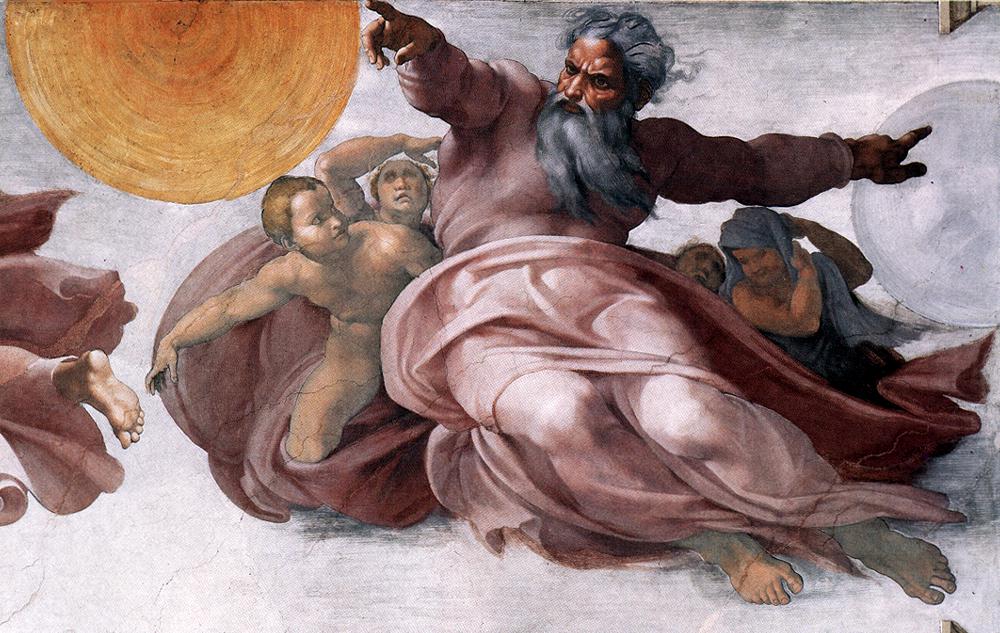
Featured Image: God Creates the Sun and Planets, Michelangelo, Sistine Chapel via Wiki Common.

References:

Boroveshengra, A., 2013. Cartomantes’ Cabinet: The Petit Lenormand Course.
Boroveshengra, A., 2015. Lenormand Thirty Six cards. 2nd ed. Create Space.
Delclos, M., 2013. Le Livre du Petit Lenormand. 1st ed. Escalquens: Éd. Trajectoire.
Marco, M. and Goffinet, J., 1989. Petit Lenormand. Bruxelles: Servranx. 
Matthews, C. (2014) The Complete Lenormand Oracle Handbook: Reading the Language and Symbols of the Cards. Rochester, VT: Destiny Books. 
Ptolemaeus, C. and Robbins, F.E. (2001) Tetrabiblos. Cambridge, MA: Harvard Univ. Press.
Silvestre, C., 2003. Le Petit Lenormand. [Montpellier]: Gange éd.
Valens, V. and Riley, M.T. (2022) The Anthology. Denver, CO: Amor Fati Publications.

Fox Associations

In the sixteen years since I first began to write about the Petit Lenormand, requests for “combination lists” have been both frequent and persistent. They are, however, something I have consistently declined to produce. My view has always been that it is far better to learn how to combine cards properly before committing any fixed pairing to memory. Of course, certain traditional associations do exist, and many of them hold true. Even so, you will not require them every time those cards appear together in a reading.

Times also change. In the early 2000s, I was working in the healthcare sector and read for a great many doctors, nurses, physiotherapists and the like. At that time, the Letter–Birds combination appeared endlessly. Do you remember pagers? I cannot recall when that combination was last appropriate. What was once ubiquitous has now become an historical curiosity.

The other difficulty with combination lists is that they are entirely devoid of context. They must be written—and read—as though everything were equal, which is almost never the case in practice. Some might even describe them as a form of creative fiction: neat, tidy, and occasionally useful, but never a substitute for genuine interpretative skill.

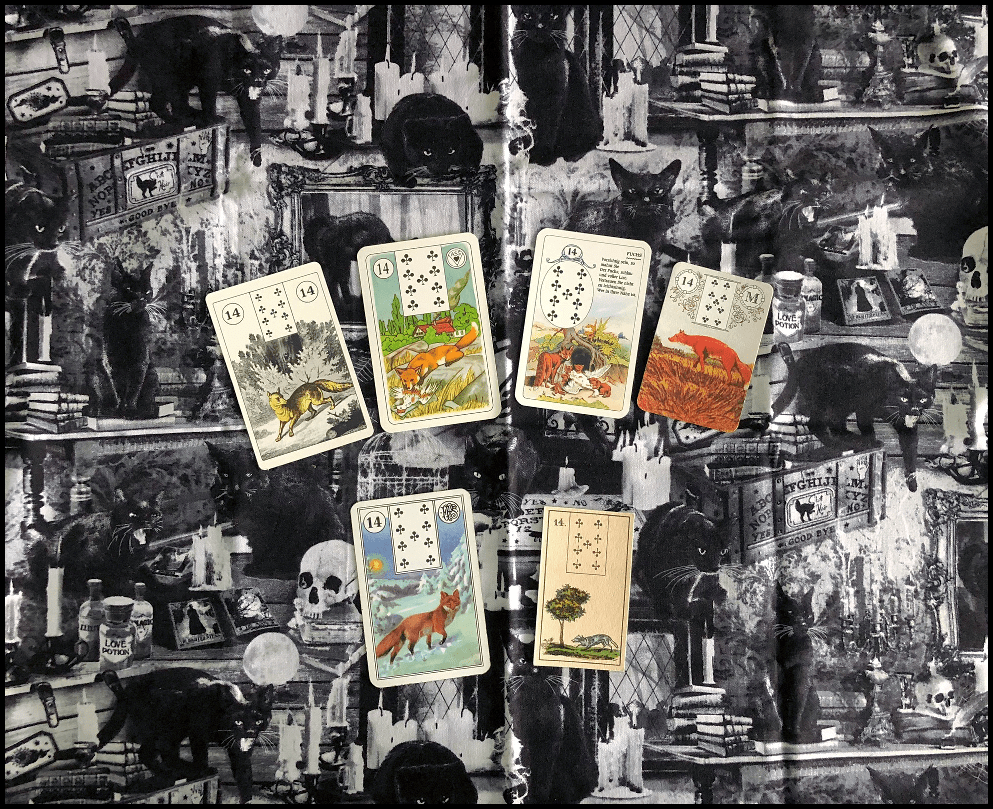
Of all the cards I was asked for combinations list, six appear with striking regularity: the Clouds, the Scythe, the Fox, the Mice, the Key and the Cross. Five of the nine traditional negative cards, and one can understand why they provoke anxiety. I can also understand the Key, too. Yet the Fox is the card that tops the list, time and again. I eventually realised that this was often because the person asking used the Fox as a work card; when it appeared outside professional matters, they struggled to relate it to the rest of life.

It is profoundly unhelpful to think in such terms. No Lenormand card means work, finance or sex in and of itself. Some cards have an affinity with certain spheres of life, certainly, and when examining a particular topic in a reading—especially in the Grand Tableau—you may draw upon these affinities to build a fuller and more nuanced picture. But they are contributory functions, not categorical definitions. To treat any card as the exclusive representative of a core concept is to limit the system and, ultimately, to limit one’s own interpretative ability.

So, for what it may be worth, here are some Fox associations—again, all things being equal, and I genuinely would not attempt to memorise them.

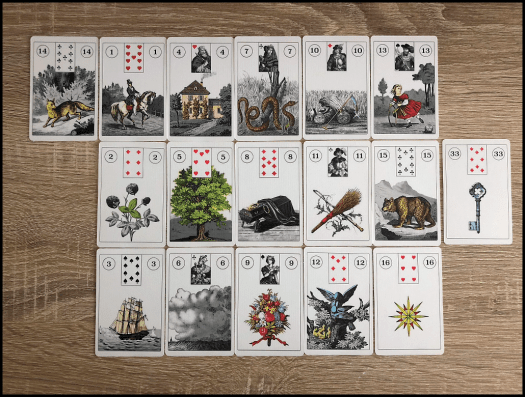
14 – 01: An untrustworthy visitor or confidence trickster. Something is amiss with the car, motorcycle, bicycle or horse, and there may be cheating in sport.

14 – 02: A day of misfortune. A lie told off the cuff, and someone feigning happiness or “putting on a front.”

14 – 03: An unprofitable enterprise. A warning against travel, as any journey undertaken is likely to encounter difficulties.

14 – 04: Domestic discomfort and tension behind closed doors. Something is wrong with the property. As a person: an unreliable man.

14 – 05: Poor lifestyle choices causing long‑term issues. A possible misdiagnosis or need for a second opinion (contrast with 14 – 05). Entrapment in long‑standing lies.

14 – 06: Deceit comes to light, though matters remain less transparent than they appear. As a person: an untrustworthy and unpleasant (usually older) man.

14 – 07: Temptation, inducement and spite; lies, intrigue and hidden agendas. A caution against detours. As a person: an untrustworthy and unpleasant (often older) woman.

14 – 08: Wrong treatment or a poor reaction to it (compare with 14 – 05). Feigning illness or grief for advantage. Ignorance, or a secret taken to the grave.

14 – 09: A charm offensive or douceur with strings attached. Occasionally, difficulties involving a woman.

14 – 10: A sudden display of aggression or intimidation. Sabotage of your efforts, often in work. Sometimes, criminal fraud.

14 – 11: Wrong punishment. Arguments arising from deception, or pointless quarrelling. Writing something known to be untrue, even libel.

14 – 12: Baseless rumour or speculation, though often dismissed as unfounded worry. Rarely, slander or a false‑positive pregnancy test. As a person: an untrustworthy couple.

14 – 13: A deceitful or manipulative child, though often a “little white lie.” Vivid imagination. Very occasionally, questions of biological parentage.

14 – 15: An older person acting out of character, or a sign something is wrong with them. Rarely, controlling behaviour or extreme jealousy. Very rare: a wig or hairpiece.

14 – 16: Poor timing: the stars are not aligned. A warning against proceeding now. Sometimes, overconfidence in skill or ability.

14 – 17: Not the right moment for change. Frustration, false starts and matters failing to take off. As a person: unreliable, hyperactive.

14 – 18: Dishonesty from someone close, or a false friend. A dishonest employee or rivalry at work. Something amiss with a pet. Rarely, peer pressure.

14 – 19: A need for assistance, as your perspective lacks objectivity. General struggle with life. Rarely, passing off something as antique or lying about one’s age.

14 – 20: Propaganda, fake news and grooming. Social discomfort or being amongst people not to your taste/caution when going out. Rarely, internet or social‑media scammers.

14 – 21: Walking into a misjudged situation that will require effort to resolve. Occasionally, giving up prematurely or overstating a problem.

14 – 22: A wrong choice or misguided direction. Problems with a commute or planned route. Expect delays.

14 – 23: Safeguard against theft or vandalism. More often, an unwelcome truth about a person or situation comes to light.

14 – 24: Loving the wrong person and heading for heartache. A third party or love rival. Emotional manipulation used to exploit or control.

14 – 25: A contract with hidden obligations or unfair terms—check the small print. A relationship moving in the wrong direction. Repeating the same mistake.

14 – 26: Discovering the truth, or a warning of paperwork problems. Rarely, falsified documents or qualifications.

14 – 27: Post going astray, intercepted mail or deliberate tampering. Sometimes, a wrong number or telemarketing scam. Text to the wrong person!

14 – 28: An untrustworthy man. Occasionally, self‑delusion.

14 – 29: A dishonest woman. She may also be deluding herself.

14 – 30: Absence of a moral compass; infidelity. Abuse of position or power. Unhealthy family dynamics.

14 – 31: Success fails at the final hurdle. Matters will not go well—contingency planning is essential. Occasionally, heating problems.

14 – 32: Defamation or the deliberate falsification of credentials—lying on a CV or providing false references. Your performance is being watched closely, and any mistake will be used to someone’s advantage. Occasionally, an undeserved reputation.

14 – 33: You’re being lied to. Security is compromised—change passwords and locks. Occasionally, a lie uncovered but the realisation comes too late.

14 – 34: A fraudulent transaction or financial scam. Otherwise, a warning to budget as money will soon be tight. Moonshine.

14 – 35: No stability in relationships, work, finances or home life. Too much baggage; difficulty moving on. As a person: a fair‑weather friend.

14 – 36: The mask slips and truth emerges; trial by fire. Treachery is left behind and you are ready to move on. Occasionally, suffering caused by deceit.

§

Cards: WanderWüst © Jorge/Wandering Oracle

Featured Image: WanderWüst © Jorge/Wandering Oracle, Lenormand (Symbole): Die echten Altenburg-Spielkarten © Königsfurt-Urania,Jeu Lenormand © Cartamundi, Lenormand Fortune-Telling Cards © Zao-Gelli, Nr. 1941 Mlle Lenormand Wahrsagekarten © Piatnik, The Lenormand Oracle © Verlag für die Frau, Leipzig (1982).