Fate has decreed for each person the immutable working out of events, reinforcing this decree with many opportunities for good or bad consequences…
– Vettius Valens, The Anthology (Riley Trans.)
Le grand jeu du Destin — the great game of destiny — piqued my interest from the right from the start. As a young cartomante, I used it extensively and still do. It has featured in my courses and blogs. The spread, however, never caught on among my English-readers. However, I find it the best alternative to the Grand Tableau to review someone’s life in general over the coming three or four months.
The Great Game of Destiny
In addition to asking for the name and sun sign of the Querent, Mary Marco recommends shuffling the cards seven times in honour of the seven lights (planets). I feel that this is a personal preference.
Once shuffled, the cards should be cut in two. The cartomantes reads the cut, which will offer some insight into the tone of the reading, reconstituting the cards.
The First Reading: The 21 Cards
1) In this draw, we use the playing cards to select our 21 cards. From the top of the deck, deal three cards.
a) Firstly, look and see if any of the three cards are from the same suit. For example, you deal the following three cards: the Boat (10 of Spades), the Cloverleaf (6 of Diamonds) and the Tree (7 of Hearts). All three are from different suits. For this reason, you put them aside.
b) Deal three more cards. This time you have the Letter (7 of Spades), the Moon (8 of Hearts) and the Anchor (9 of Spades). We have two spades. Of the two that originate from the same suit, we retain the card with the highest value. For us, the is the Anchor.
c) If you see three cards from the same suit (such as the Stars, the Stork, and the Cavalier which are all hearts), you retain all three cards.
d) Similarly, if you see three cards of the same value (the Serpent, the Flowers, the Path which are all queens), you retain all three.
2) You continue to deal cards by three, always looking for cards that carry the same suit and retaining the card with the highest value. Knaves, queens, kings and aces are considered to be 11, 12, 13 and 14, respectively.
Once you have exhausted your cards, you take the eliminated cards and shuffle them and begin to deal them in threes.
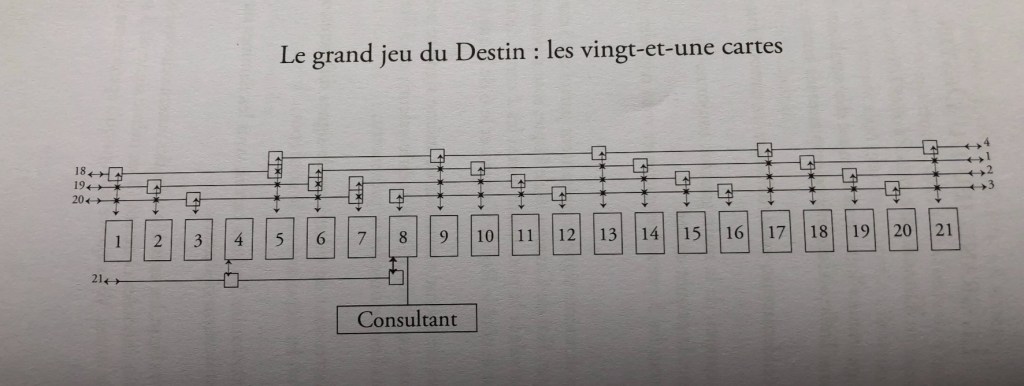
3) You continue this until you have 21 cards arranged in front of you. We are supposed to lay them in a line, as above. However I prefer a 3 x 7 (+ 2). Here is the reading:
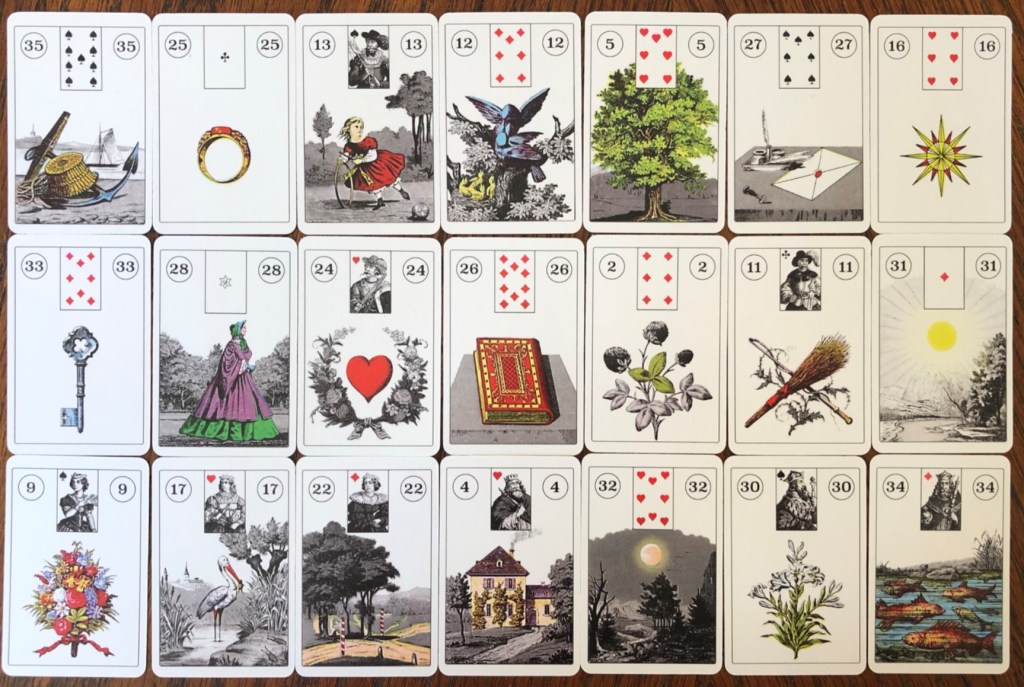
4) Look at the 21 cards in front of you. Is the significator (the Child, the Lady or the Gentleman) present? If the Querent’s card is present, you may proceed to step 5.
If the significator not been selected during preliminary steps, you must shuffle the remaining fifteen cards, cut them and then deal them in twos.
Keep the pair that contains the significator and add them to the 21 cards.
5) The first reading is done using a count of five commencing from the significator.
For example, our Querent is signified by the Lady card. We count as follows:
The Lady (1), the Heart (2), the Book (3), the Cloverleaf (4) and the Birch Rod (5).
The Birch Road becomes card 1, and we count along to the next fifth card: the Paths.
You continue the count, threading together a story. The presence of the master cards can often guide the reading, and the shift from one to another, such as the House (homelife) to the Ring (relationships), might indicate a change in focus.
This is your first reading.
Below is the reading arranged according to the count. However, do not rearrange your cards! The cards need to be in the order that they were dealt for the Second Reading.
The First Reading: Elisabeth’s Reading
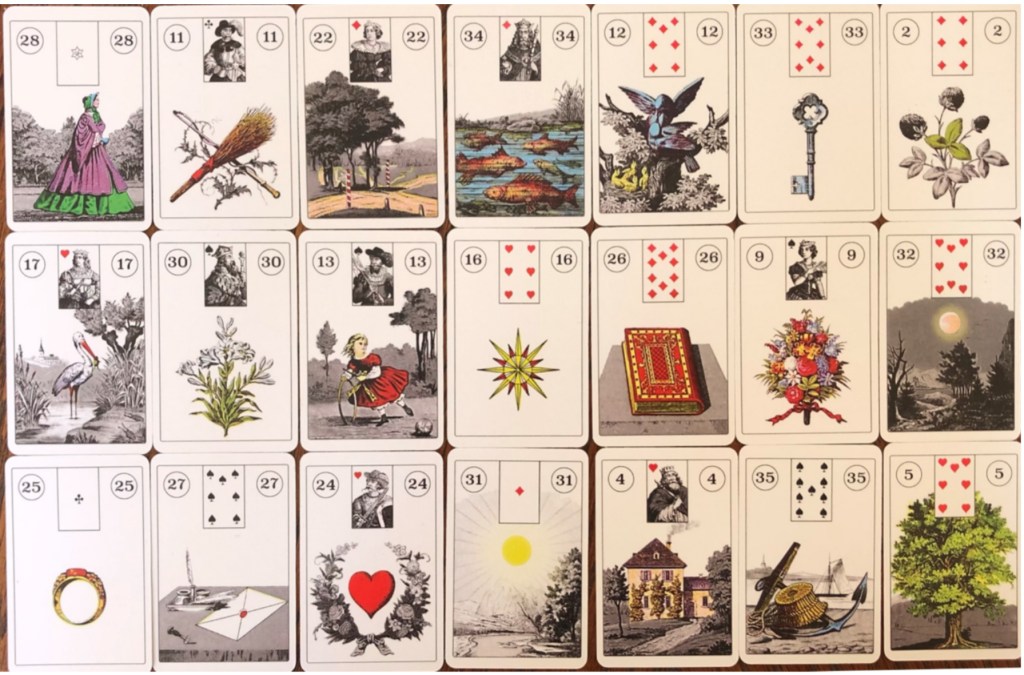
Currently, Elisabeth feels tired and quite battered and bruised by life, which could undermine her health (Birch Rod). Circumstances are set to force her into an important financial decision (Birch Rod — Path — Fishes). However, her options will seem unfair and limited (Birch Rod — Path), leaving her deeply nervous (Fishes — Birds). Nevertheless, resolving these financial worries (Fishes — Birds) will be crucial to improving her life (Key). Discussing her choices with an advisor (King of Diamonds/Fishes — Birds) will clarify her options and alleviate her worries (Birds — Key). Thus armed, she will have not just a better understanding but will find an opportune moment (Key — Cloverleaf) to turn her situation around (Stork), bringing in the sense of peace (Stork — Lilies) and renewed optimism for the future (Lilies — Child).
Elisabeth will find that her daughter* (Lilies — Child) thrives in the coming weeks (Child — Stars). In particular, she will find considerable success in her education (Child — Stars — Book), highlighting a natural gift or ability hitherto unrecognised (Stars — Book). It will be found that this increased recognition brings more educational options or avenues (Book — Flowers — Moon).
There are professional opportunities for Elisabeth, too. Her talents are set to be recognised in an interview (Flowers — Moon), leading to a job offer or promotion (Flowers —Moon — Ring). She will sign a contract (Ring — Letter), bringing her much satisfaction and joy (Heart — Sun).
Elisabeth is currently single, but a new relationship is both on the horizon and in her mind (Ring, crowning the Lady). There will be an exchange of messages and telephone calls of a romantic nature (Letter — Heart). Although not too serious at first (Letter), strong chemistry and sincerity give the relationship strong potential in the future (Heart – Sun). The man is older than Elisabeth, successful, and has a good temperament and nature (King of Hearts) with whom Elisabeth will have a strong rapport (Sun – House).
At home, Elisabeth is assured of support and affection (Sun – House). Her support network is solid and stable (Sun – House – Anchor), and she can rely on this continuing undisturbed (House – Anchor – Tree).
Elisabeth’s health will also improve going forward. The malaise triggered by the Birch Rod will pass, and her constitution will hold out (House – Anchor) will remain strong (Anchor –Tree).
Thus concludes the first reading of the 21 cards.
Second Reading: Pairing
Mary Marco refers to the second step as confirmation and proof by two. However, it is essentially pairing or mirroring, which was a common technique in classical cartomancy. When Mlle Le Normand refers to examining the “extremities” she is discussing pairing.
1) Read the first, and the last card dealt together, e.g. card 1 + card 21 (or card 1 + 23). In the reading below, that is the Anchor and the Fishes.
2) Now, you read the second card, the twentieth. In the reading below, that is the Ring and the Lilies cards.
3) You continue to pair the cards. You will find, with 21 cards, card 11 cannot be paired. It offers a conclusion and can help determine the condition of the fortune.
The Second Reading: Elisabeth’s Reading
We will now pair the 21 cards.
The cards as they fell:
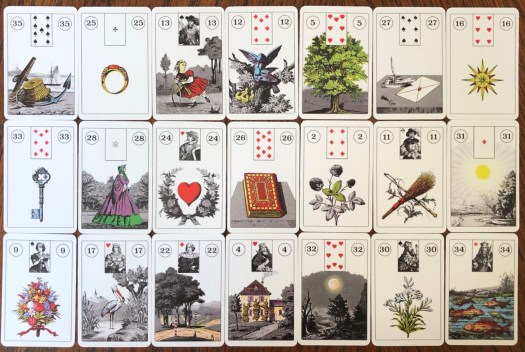
Anchor – Fishes: Elisabeth will find her financial situation stabilises with a secure income to balance her outgoings.
Ring – Lilies: The situation is helped by a contract or agreement through an advocate or charity.
Child – Moon: Elisabeth will continue to be held in high esteem. Her daughter will also find it is her time to be in the spotlight.
Birds – House: There will be much excitement in the home about this latest development…
Tree – Path: …as it signals crucial decisions that need to be made about her daughter’s future.
Letter – Stork: All of which will be followed up in several telephone discussions and messages going back-and-forth with previous plans changed…
Stars – Flowers: …due to the arrival of a new offer. Elisabeth will also find that her skills are recognised with the benefit accorded to her as a result.
Key – Sun: Bringing her particular success and renewed energy.
Lady – Birch Rod: That will undoubtedly help alleviate a brief dip in her energy or health issue.
Heart – Cloverleaf: She might find that her lethargy is caused by anaemia. However, this will be rectified. Elisabeth will also welcome an opportune development in her love life.
Book: This will come as an unexpected and surprising development for Elisabeth. However, with her shrewd and measured approach, she will meet her challenges.
This concludes the second step of the reading.
Third Reading: The Four Stacks
The third and final stage of the reading is described as being confirmation and proof by four.
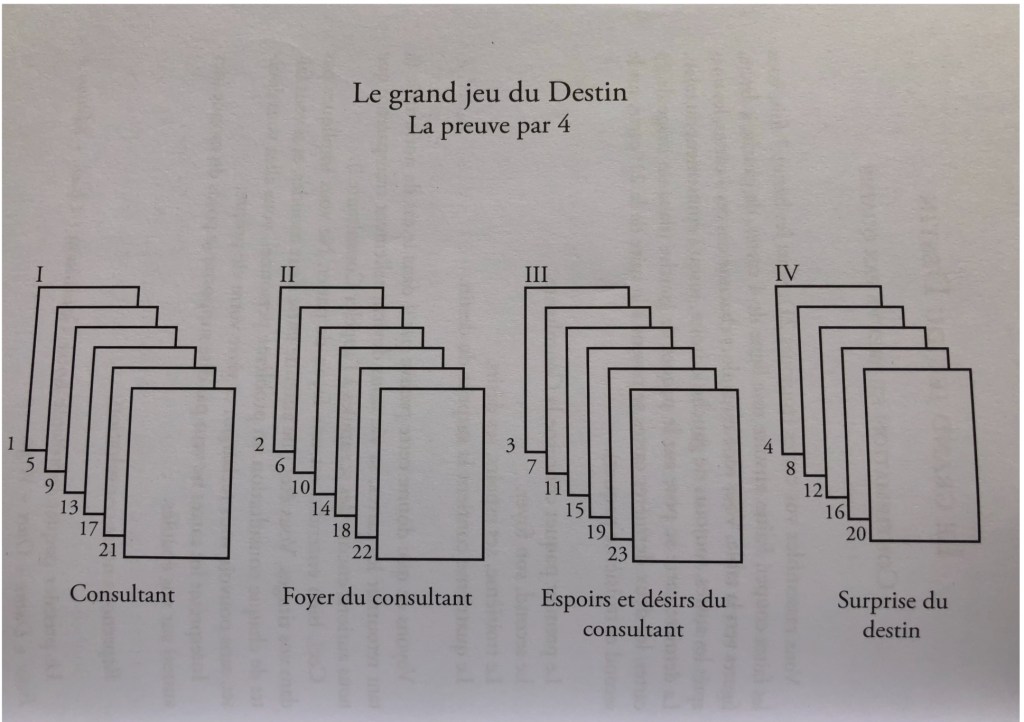
1) Gather the 21 (or 23) cards and shuffle and cut them. Then deal four cards face down in a row.
2) Deal four more cards on top of the first four. You continue to do this until all the cards are dealt.
If you were using 21 cards, you would find that you end up with six cards in the first column and five in the second, third and fourth packet.
3) The four packets provide the final confirmation and explanation of your reading.
- The first packet relates to the client herself.
- The second concerns the Querent’s home and family.
- The third describes her hopes and desires.
- The fourth set of cards is the surprise of destiny.
The Third Reading: Elisabeth’s Reading
Elisabeth’s cards were gathered, shuffled and cut before dealing them out into four stacks.
The cards as they fell:
Group 1:
The first packet refers to Elisabeth herself. Here we find: the Tree, the Birch Rod, the Lilies, the Book, the Key, and the House.
Elisabeth will find that her constitution (Tree) is tested (Birch Rod) for a time, leaving her lethargic and in some discomfort (Tree – Birch Rod). Easing this will involve consulting a professional (King of Spades) who will perform some investigations (Lilies – Book – Key). Once completed, a solution will be found (Key) that restores Elisabeth to her usual good health after rest (House).
Group 2:
The second packet refers to Elisabeth’s home. Here we find: the Birds, the Letter, the Child, the Path and the Cloverleaf.
There will be a brief period of stress and worry in the home, but it will pass (Birds). This stems from messages received (Birds – Letter). The packet confirms that there will be some news regarding Elisabeth’s daughters (Letter – Child). Her daughter will find this an uncertain time (Child – Path) as she considers what options confront her. However, with careful consideration, she will find the right one (Cloverleaf).
Group 3:
The third packet refers to Elisabeth’s hopes and wishes. Here we find the Lady, the Stork, the Ring, the Flowers and the Stars.
Elisabeth is hoping to see a change in her relationship status (Lady – Stork – Ring). She desires someone to date (Ring – Flowers) but who truly appreciates and respects her (Flowers – Stars).
Group 4:
The final packet is the surprise of fate. Here we dealt: the Sun, the Moon, the Heart, the Fishes and the Anchor.
To Elisabeth’s surprise, she will find herself successful in her career with opportunities (either a new job or promotion) that recognise her talents appearing (Sun – Moon). This will boost her confidence and sense of self-worth (Moon – Heart – Fishes). As a result, her financial situation improves (Fishes – Anchor). She will also find this helps realise her wish for a new relationship (Heart – Fishes – Anchor).
This concludes the reading. Often, if there is one or two follow-up questions, these can be answered with the French Cross or lines of three or five.
So, there you have, the Great Game of Destiny. Unlike the Grand Tableau or the Astrological Wheel, the Great Game does not offer us an overview of all areas of life. It focuses on two or three areas at the most. These are current strands of Fate intersecting in the Querent’s life at this time. However, the addition of the second and third steps mean these are explored in detail and the predictions refined or elaborated on.
Please give it a go. Once you’ve done it once or twice, you will find it is quite flowing and intuitive.
§
The Circlestead © abCartomancy 2010 – 2021
References:
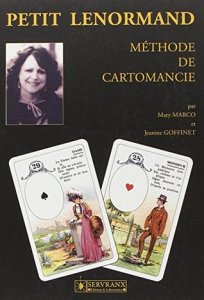
Marco, M. and Goffinet, J., 1989. Petit Lenormand: Méthode de Cartomancie. Bruxelles: Servranx, pp. 35, 179 – 186
Illustrations:
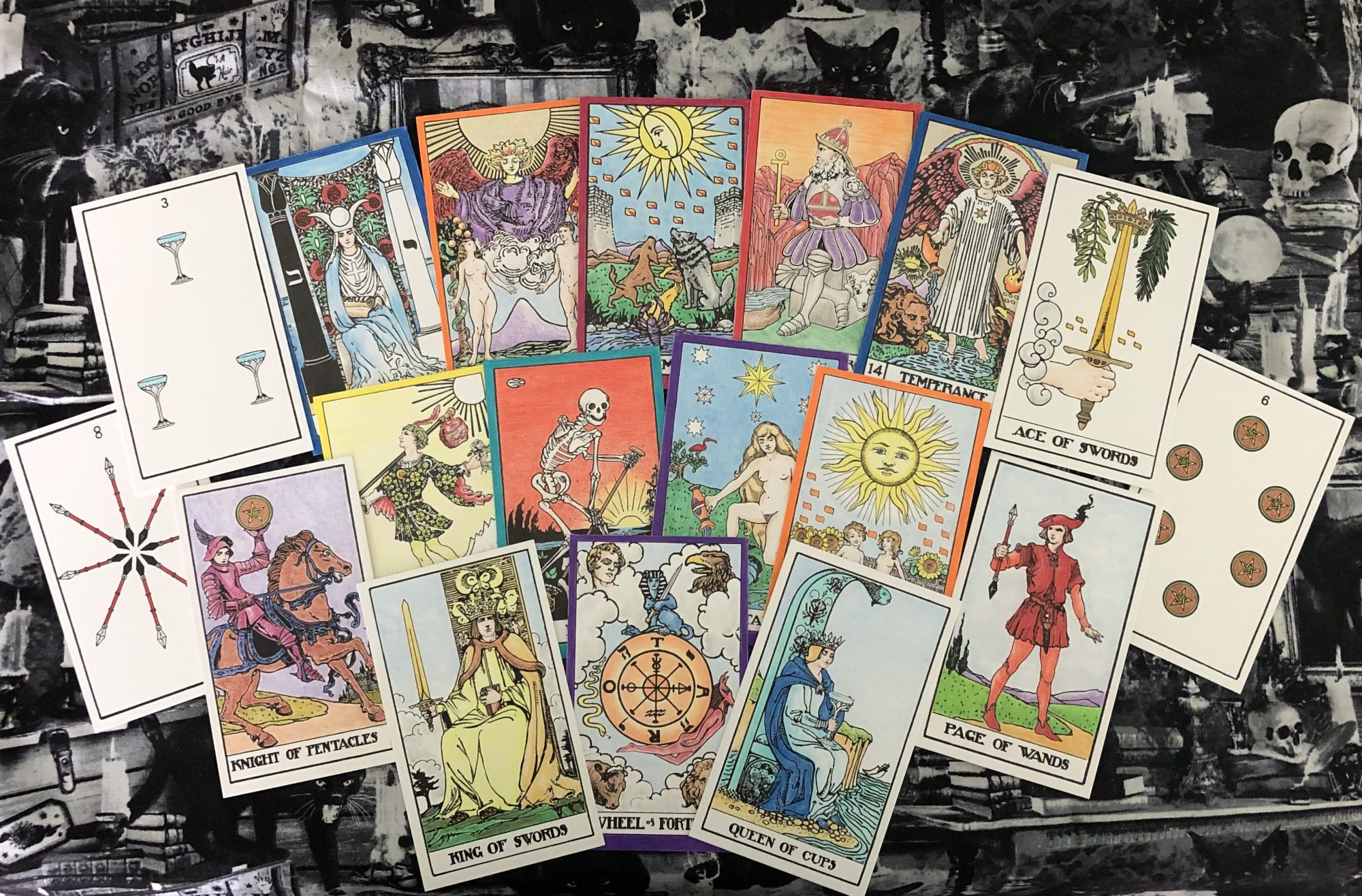
Cards: The Wanderwust Lenormand © Wandering Oracle
Spread Illustration: Marco, M. and Goffinet, J., 1989. Petit Lenormand: Méthode de Cartomancie.
Featured Image: The Three Fates. Alexander Rothaug (Austria, 1870-1946), Public domain, via Wikimedia Commons
Notes:
*Lilies — Child can be a younger family member, but Elisabeth has a daughter, and the Child is the natural Significator of one’s offspring.
 Journal of a Cartomante
Dear Andy,
Hi! It’s nice to read your blog again. Your writings are both informative and inspiring. I’m sure I’ll be trying this spread soon.
However, I do have some questions after reading this article, and I would appreciate it if you could shed some light on my confusion.
1) Regarding the first step, do you always end up with a perfect 21-card spread? It seems to me by drawing trios one either pick one or retain all three. Would it be possible if the last trio I draw have the same value/suit but when there remains only 1 position left in the 21-card spread? If possible, how do I proceed the reading?
2) You mentioned that you prefer a box shape rather than a 21-card line suggested by other authors. When counting, do you take note of the cards touching the counted ones? Cards like the Clouds affects nearby cards, and in a box it seems to me that it would get to touch more cards, thus “clouding” the meaning of more cards.
3) Following my second question, you mentioned that it is possible that one need to draw an extra pair to complement a 21-card spread that lacks the significator. Where do you suggest one place this extra pair? I’m asking this, because, if my concern regarding cards affecting attended cards is valid, then the pair’s placement would also influence their interpretation.
I hope my questions aren’t too bothersome, and that everything is safe and well in your life.
Sadewa
LikeLike
Hello Sadewa
I had to close it temporarily, due to a violation of my copyright.
1) Personally, I have always ended up with 21 cards. If, however, you had 20 cards and the final trio was, for example, three queens I would keep all three. But it has never happened.
2) Yes. Over time, I have found a 3 x 7 works best — 21 or 23 cards in a line takes up a lot of space. It just about space.
Marco’s example does not indicate that the cartomante should have consider the cards either side of the counted card; however, I always have. It is just how I count. I do not, however, consider vertical combinations unless drawn to do so.
Clouding, yes. But only cards either side.
3) I put them underneath the three rows of seven under cards 15 and 16.
I never find questions bothersome. I look forward to hearing how you get on.
LikeLike
Dear Andy,
Thank you for your patient explanation. That really helps.
I tried this method the other day. I thought you might want to know that I also ended up with a perfect 21-card spread. (I had to draw an extra pair for my significator)
The reading made sense to me. I’ll wait and see how the cards play out.
Sadewa
LikeLike